


 |
市場調查報告書
商品編碼
2076888
全球農業機械市場:按動力、設備類型、功能、推進方式、驅動類型、產品類型和地區分類-預測至2033年Farm Equipment Market by Power, Type (Tractors, Balers, Sprayers, Harvesters), Function, & Propulsion, and Region - Global Forecast to 2033 |
||||||


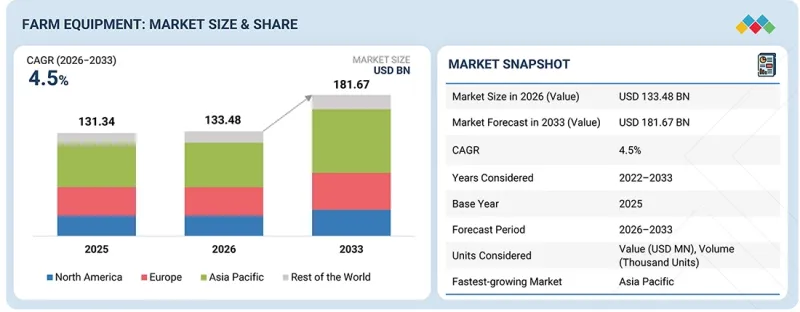
預計農業機械市場將從 2026 年的 1,334.8 億美元成長到 2033 年的 1,816.7 億美元,複合年成長率為 4.5%。
| 調查範圍 | |
|---|---|
| 調查期 | 2026-2033 |
| 基準年 | 2025 |
| 預測期 | 2026-2033 |
| 目標單元 | 10億美元 |
| 部分 | 按產量、設備類型、功能、推進方式、驅動類型、產品類型和地區分類。 |
| 目標區域 | 亞洲-大洋洲、歐洲、北美洲及其他地區 |
2025年,全球全部區域的農業曳引機市場需求出現溫和下滑,主因是農業收入停滯不前、利率高企以及設備更換周期延長。美國農機製造商協會(AEM)、歐洲農機製造商協會(CEMA)和區域農業組織的產業預測顯示,北美地區的曳引機銷售量將下降約7-9%,歐洲下降22-24%,亞太地區下降4-6%。在亞太地區,政府補貼和強勁的國內需求(尤其是在印度)有助於緩解市場放緩。這種影響在大馬力曳引機和聯合收割機領域更為顯著,因為農民往往會推遲購買新設備,並延長現有設備的使用壽命。此外,以色列和伊朗之間的衝突加劇了短期壓力,引發了人們對中東供應鏈中斷以及燃料和物流成本不確定性增加的擔憂。這導致農場盈利下降,農機購買計畫推遲,尤其是在價格敏感型市場。然而,這種影響仍然是間接的、短期的,由於全球糧食需求和持續的機械化趨勢,長期需求保持穩定。
“在預測期內,租賃市場中的收割和脫粒設備領域是成長最快的領域。”
收割和脫粒設備是農業機械市場中最大的細分市場之一。這是因為這類設備直接針對作物生產中最勞力密集且時間最緊迫的環節:收割作物並將可銷售的穀物與秸稈分離,同時最大限度地減少損失。亞太地區(中國、印度、東南亞)、北美、歐洲和拉丁美洲等主要糧食產區的需求尤其強勁。在這些地區,由於農業工資上漲、勞動力短缺、農場規模擴大以及收割季節縮短等因素,農業機械化進程正在加速。這些機械廣泛用於收割小麥、稻米、玉米、大麥、大豆和其他穀物作物,使農民能夠減少糧食損失、提高糧食品質、降低對勞動力的依賴,並在惡劣天氣影響產量之前完成收割。
近期的技術創新進一步加速了這些技術的應用。例如,2025年2月,約翰迪爾推出了一款新一代聯合收割機,配備了先進的作物餵入系統,旨在提高作物捕獲和收割效率。同年6月,他們又推出了F8和F9自走式飼料收割機,這兩款收割機具備更高的自動化程度、精密農業技術以及更優的作業效率。此外,他們也針對印度稻米種植區推出了PRO588i-G聯合收割機。該機型採用了一種在日本設計的特殊脫粒機構,可減少巴斯馬蒂米的碎粒,同時也有助於殘茬管理並減少秸稈焚燒。同樣,為了最大限度地提高生產效率並減少操作員干預,原始設備製造商(OEM)正擴大將GPS導航、自動收割調整、遠端資訊處理和人工智慧驅動的機器最佳化等技術整合到聯合收割機中。隨著全球糧食產量持續成長,農場規模不斷擴大,商業化程度不斷提高,對收割和脫粒設備的需求預計將保持強勁,使該行業成為全球農業機械化最重要的驅動力之一。
“電池驅動的電動曳引機將引領農業曳引機行業的未來發展。”
電動曳引機主要用於低功率、高精度作業以及對排放氣體、噪音和運營成本要求極低的受控環境。其主要應用領域包括果園、葡萄園、園藝、溫室栽培、畜牧場、市政農業以及日常運作時間內輕度至中度的田間作業。在歐洲和美國,小型電動曳引機在葡萄園中尤其受歡迎,因為它們能夠在狹窄的行間高效作業,減少對土壤的衝擊,並實現零排放。此外,其低噪音和低維護需求也促使市政部門擴大將其用於城市維護工作。代表性車型包括Monarch Tractor MK-V(電池容量約70千瓦時)、Solectrac e25和e70(電池容量約22-70千瓦時)、Fendt e100 V Vario(電池容量約100千瓦時)以及久保田面向亞太市場的緊湊型電動曳引機。先進的充電策略,例如農場夜間充電、太陽能充電系統以及工作間隙的短暫補電,正在提高電動農業機械的實用性和普及率。此外,政府支持的農業貸款減免、低利率農業貸款計劃以及機械購置貸款項目,鼓勵農民投資購買現代化機械,進一步加速農業機械化進程和先進農業技術的應用。
政府支持是加速電動曳引機普及的重要因素。在加州,CORE計劃提供銷售點獎勵,可大幅降低電動曳引機的初始成本。補貼金額通常從小型緊湊型曳引機的約16,000美元到中型農機的43,000美元至130,000美元不等,某些大型曳引機的補貼金額甚至更高,具體取決於合格。在歐洲,歐盟綠色交易、通用農業政策(CAP)生態計畫以及德國和法國等國的補貼計畫都支持電動曳引機的普及。加拿大和亞太地區部分地區也提供類似的清潔設備融資方案。雖然電動曳引機的初始成本高於傳統的柴油曳引機,但由於燃料和維護成本降低、能源效率提高以及排放氣體,長期來看預計可以節省大量成本。在政府獎勵、優惠融資計劃、不斷擴大的充電基礎設施以及日益嚴格的排放法規的支持下,預計主要農業市場對電動曳引機的需求將穩步成長,尤其是在那些積極推行永續性舉措和農業機械化程度較高的地區。
“據估計,貨運代理行業是林業機械市場中成長最快的細分領域。”
集材機正成為林業機械化設備領域成長最快的細分市場之一,歐洲在需求和技術應用方面明顯主導。在瑞典、芬蘭和中歐等國家,集材機廣泛應用於短材伐木(CTL)系統。由於嚴格的環境法規、FSC/PEFC認證要求以及對減少土壤損害和每立方米木材碳排放的重視,該系統已成為現代永續林業的主流。原始設備製造商(負載容量)的需求集中在12-20噸及以上噸位,其中專為高生產率、陡坡作業和連續疏伐循環而設計的機型,例如日本小松公司的845/855/875/895系列和龐塞的Buffalo和Elephant系列,廣受歡迎。歐洲集材機市場正受到「車隊現代化」的推動,老舊的集材機系統正被更精準、更環保、數位連接的機器所取代。在北美,儘管集材機的應用正在逐步擴展,尤其是在加拿大和美國某些林區的短材伐木作業中,但集材機仍主導著大規模伐木作業。約翰迪爾和小松林業等領先的原始設備製造商(OEM)正透過利用遠端資訊處理技術、節能液壓系統和操作員輔助技術來提升集材機的性能,而未來的發展預計將集中在半自動駕駛、人工智慧驅動的負載容量最佳化和混合動力系統等方面。
“預計歐洲將成為第二大區域市場。”
根據歐洲機械製造商協會 (CEMA) 和德國機械設備製造業聯合會 (VDMA) 的預測,2025 年歐洲曳引機市場預計將比 2024 年萎縮約 22%,這是近年來最嚴重的萎縮之一。法國的曳引機市場下降了 17.2%(27,844 台),主要原因是農業收入成長乏力、利率高企以及更換週期延後。土耳其的曳引機市場也大幅下降了 36.3%(40,505 台),主要原因是貨幣貶值、通貨膨脹和購買力下降。俄羅斯的曳引機市場則下降了 31%(24,150 台),主要原因是供應受限和貿易限制。相較之下,義大利的曳引機市場則成長了 14.1%(17,573 台),這主要得益於補貼主導推動了葡萄園和果園的更換需求。同時,波蘭的汽車銷量成長了 22.1%(10433 輛),這得益於歐盟通用農業政策 (CAP) 的大力財政支持、農場整合以及車輛現代化進程的加速。
從曳引機馬力來看,131-250馬力區間仍然是多元化農業和合約作業的核心需求,而250馬力以上的曳引機在法國、德國和東歐地區成長更為迅速,這主要得益於對農田整合和提高生產力的需求不斷成長。歐盟第五階段排放法規、2027年機械法律規範以及綠色新政等政策與成本壓力,進一步推動了這項轉變。歐洲100-200馬力電動曳引機仍處於發展初期,但正在迅速崛起,主要用於葡萄園、果園、溫室和市政作業。在這些應用情境中,低雜訊、零排放和精準作業比高高功率更為重要。
農業機械市場由迪爾公司(美國)、愛科公司(美國)、凱斯紐荷蘭工業集團(荷蘭)、久保田公司(日本)、克拉斯集團(德國)、馬恆達有限公司(印度)、伊勢崎公司(日本)、埃斯科特久保田有限公司(印度)、SDF集團(德國)和洋馬控股公司(日本)等全球性公司主導。這些公司主導了產品開發和合作等策略來擴大市場佔有率。
調查範圍:
本研究將農業機械市場細分,並依產量、驅動類型、設備類型、功能、推進方式及地區進行分析。此外,本研究也涵蓋了農業機械市場生態系統中的競爭格局以及主要參與者的公司概況。
本報告的主要益處
本報告為市場領導者和新參與企業提供農業機械市場及其細分市場最準確的銷售預測。它幫助相關人員了解競爭格局,更好地定位自身業務,並制定合適的打入市場策略。此外,它還幫助相關人員了解市場趨勢,並提供有關關鍵市場促進因素、限制因素、挑戰和機會的資訊。
本報告深入分析了以下幾點:
- 本報告分析了影響農業阻礙因素市場成長的因素,包括主要促進因素(政府對農業貸款豁免和信貸貸款的支持、OEM/銷售獎勵以支持經銷商服務和租賃業務、合約農業以及農業機械化的進步)、制約因素(租賃市場的擴張、新興國家高成本)、機遇(精密農業的普及、研發法規的加強以及電動曳引機的普及)以及電動燃料的排放氣體)。
- 產品開發與創新:深入了解農業機械市場的未來技術、研發活動和新產品發布。
- 市場發展:盈利市場的全面資訊-本報告分析了各個地區的農業機械市場。
- 市場多元化:農業機械市場新產品、未開發地區、近期趨勢和投資的全面訊息
- 競爭分析:本分析詳細評估了農業機械市場主要參與者的市場佔有率、成長策略和服務產品,包括迪爾公司(美國)、愛科公司(美國)、凱斯紐荷蘭工業公司(荷蘭)、久保田株式會社(日本)、克拉斯集團(德國)、馬恆田達公司(印度)、伊勢田公司(日本)、印度斯科特(日本)。
目錄
第1章:引言
第2章執行摘要
第3章重要考察
第4章 市場概覽
- 市場動態
- 促進因素
- 抑制因子
- 機會
- 任務
- 未滿足的需求和未開發的領域
- 相互關聯的市場與跨產業機遇
- 一級/二級/三級公司的策略性舉措
第5章 產業趨勢
- 總體經濟指標
- 供應鏈分析
- 生態系分析
- 價格分析
- 2026-2027 年主要會議和活動
- 貿易分析
- 影響客戶業務的趨勢/顛覆性因素
- 投資和資金籌措場景
- 案例研究分析
- 總擁有成本
- OEM分析
- 主要OEM廠商的曳引機價格範圍
- 伊朗-以色列戰爭對農業機械市場的影響
- 主要國家各品牌曳引機銷售
- 曳引機生產能力(按原始設備製造商分類)
- 未來投資將用於提高曳引機產能
第6章 技術進步、專利、創新與未來應用
- 主要技術
- 互補技術
- 鄰近技術
- 專利分析
- 未來應用
- 成功案例和實際應用
第7章 監理情勢
- 當地法規和合規性
- 監管機構、政府機構和其他組織
- 業界標準
- 非道路移動機械排放氣體法規(NRMM)展望
- 北美洲
- 歐洲
- 亞洲及大洋洲
第8章:顧客趨勢與購買行為
- 決策流程
- 主要相關人員和採購標準
- 實施障礙和內部挑戰
- 終端用戶產業未滿足的需求
- 市場盈利
第9章:農業曳引機市場(以功率輸出分類)
- 不到30馬力
- 30-70馬力
- 71-130馬力
- 131-250馬力
- 250馬力或以上
- 產業洞察
第10章:農業機械市場(依設備類型分類)
- 穀物聯合收割機
- 非穀物聯合收割機
- 打包機
- 自走式噴霧器
- 曳引機式噴霧器
- 產業洞察
第11章:農業機械市場(依功能分類)
- 耕作與翻土
- 播種和種植
- 植物保護和施肥
- 收割和脫粒
- 其他功能
- 產業洞察
第12章:電動農用曳引機市場(依推進系統分類)
- 電池式電動車
- 油電混合車
- 氫
- 產業洞察
第13章:農業曳引機租賃市場概覽
- 租賃經濟學和資產利用率分析
- 農業機械租賃業務模式的演變
- 原始設備製造商的租賃計劃和策略
- 未來收入分析
第14章:農業曳引機租賃市場(按驅動類型分類)
- 兩輪驅動(2WD)
- 四輪驅動(4WD)
- 產業洞察
第15章:農業機械租賃市場(依設備類型分類)
- 聯結機
- 結合
- 噴霧器
- 打包機
- 其他
- 產業洞察
第16章:林業機械市場(依產品類型分類)
- 費勒‧邦徹
- 收割機
- 貨運代理
- 裝載機
- 集材機
- 旋轉機
- 其他
- 產業洞察
第17章:農業曳引機市場(按地區分類)
- 亞洲及大洋洲
- 澳洲
- 中國
- 印度
- 日本
- 韓國
- 其他
- 歐洲
- 法國
- 德國
- 義大利
- 波蘭
- 俄羅斯
- 西班牙
- 土耳其
- 英國
- 其他
- 北美洲
- 美國
- 加拿大
- 墨西哥
- 世界其他地區
- 阿根廷
- 巴西
- 其他
- 產業洞察
第18章 競爭格局
- 概述
- 主要參與企業的策略/優勢,2022-2026 年
- 2021-2025年收入分析
- 2025年市佔率分析
- 企業估值和財務指標
- 品牌/產品對比
- 企業估值矩陣:主要公司,2025 年
- 公司估值矩陣:新創企業/中小企業,2025 年
- 競爭格局
第19章:公司簡介
- 主要參與企業
- DEERE & COMPANY
- CNH INDUSTRIAL
- MAHINDRA & MAHINDRA
- AGCO CORPORATION
- KUBOTA CORPORATION
- CLAAS KGAA
- ISEKI & CO., LTD.
- ESCORTS KUBOTA LIMITED
- SDF GROUP
- YANMAR HOLDINGS CO., LTD.
- 其他公司
- JCB
- TRACTORS AND FARM EQUIPMENT
- SONALIKA
- TYM CORPORATION
- DAEDONG CORPORATION
- EXEL INDUSTRIES LTD.
- BUCHER INDUSTRIES AG
- ZETOR TRACTORS AS
- ARGO TRACTORS SPA
- CONCERN TRACTOR PLANTS
- AMAZONE H. DREYER GMBH & CO. KG
- BUHLER INDUSTRIES INC.
- AUTONOMOUS TRACTOR CORPORATION
- CHANGZHOU DONGFENG AGRICULTURAL MACHINERY GROUP CO., LTD.
- CHINA NATIONAL MACHINERY INDUSTRY CORPORATION
- WEICHAI LOVOL HEAVY INDUSTRY CO., LTD.
- BERNARD KRONE HOLDING SE & CO.
- VERMEER CORPORATION
- POTTINGER LANDTECHNIK GMBH
- MINSK TRACTOR WORKS
- HENAN QIANLI MACHINERY CO., LTD.
- MASCHIO GASPARDO SPA
- ALAMO GROUP INC.
- KOMATSU LTD.
- CATERPILLAR INC.
- PONSSE PLC
- TIGERCAT INTERNATIONAL INC.
第20章:調查方法
第21章 市場建議
第22章附錄
The farm equipment market is projected to grow from USD 133.48 billion in 2026 to USD 181.67 billion by 2033, registering a CAGR of 4.5%.
| Scope of the Report | |
|---|---|
| Years Considered for the Study | 2026-2033 |
| Base Year | 2025 |
| Forecast Period | 2026-2033 |
| Units Considered | USD Billion |
| Segments | by Power, Type, Function, Propulsion & Region |
| Regions covered | Asia Oceania, Europe, North America, and the Rest of the World |
In 2025, the global farm tractor market saw a moderate decline in demand across key regions, mainly due to weak farm incomes, high interest rates, and delayed replacement cycles. Based on industry outlooks from AEM, CEMA, and regional agricultural agencies, tractor sales are estimated to have declined by around ~7-9% in North America, ~22-24% in Europe, and ~4-6% in Asia Oceania, where government subsidies and stronger domestic demand (especially in India) helped limit the slowdown. The impact is more visible in high-horsepower tractors and combine segments, as farmers extend equipment life instead of purchasing new machines. Moreover, the Israel-Iran conflict adds further short-term pressure by increasing uncertainty in fuel and logistics costs due to potential Middle East supply route disruptions, which reduces farm profitability and delays equipment purchases, especially in price-sensitive markets. However, the impact remains indirect and short-term, while long-term demand stays stable due to global food needs and ongoing mechanization trends.
"The harvester & threshing segment in the rental market is the fastest-growing segment during the forecast period."
Harvesting and threshing equipment represent one of the largest segments of the agricultural implements market because they directly address the most labor-intensive and time-critical stage of crop production - harvesting crops and separating marketable grain from straw with minimal losses. Demand is particularly strong across major grain-producing regions, including Asia Pacific (China, India, and Southeast Asia), North America, Europe, and Latin America, where rising farm wages, labor shortages, larger farm sizes, and increasingly narrow harvesting windows are accelerating mechanization. These machines are widely used for wheat, rice, maize, barley, soybean, and other cereal crops, enabling farmers to reduce grain losses, improve grain quality, lower labor dependency, and complete harvesting operations before adverse weather affects yields.
Recent innovations are further strengthening adoption; for example, in February 2025, John Deere introduced next-generation combine harvesting equipment with advanced crop-feeding systems designed to improve crop capture and harvesting efficiency, while in June 2025, the company launched its F8 and F9 self-propelled forage harvesters featuring enhanced automation, precision farming technologies, and improved operational productivity. It launched the PRO588i-G combine harvester for India's rice-growing regions, incorporating a specialized Japanese-designed threshing mechanism that reduces grain breakage in Basmati rice while supporting residue management and reducing stubble burning. Similarly, OEMs are increasingly integrating GPS guidance, automated harvesting adjustments, telematics, and AI-driven machine optimization into combines and harvesters to maximize productivity and reduce operator intervention. As global cereal production continues to rise and farms become larger and more commercialized, demand for harvesting and threshing equipment is expected to remain strong, making this segment one of the most critical drivers of agricultural mechanization worldwide.
"Battery electric tractors would lead the future of the farm tractor industry."
Electric tractors are mainly used in low-power, precision, and controlled-environment applications where emissions, noise, and operating costs need to be minimized. Key applications include orchards, vineyards, horticulture, greenhouse operations, livestock farms, municipal agriculture, and light-to-medium-duty field work for daily operating hours. In Europe and the US, small EV tractors are particularly popular in vineyards because they can operate efficiently in narrow rows while reducing soil disturbance and eliminating exhaust emissions. Municipal bodies also increasingly use them for city maintenance work due to their low noise levels and lower maintenance requirements. Leading models include Monarch Tractor MK-V (~70 kWh battery), Solectrac e25 and e70 (~22-70 kWh), Fendt e100 V Vario (~100 kWh), and compact electric offerings from Kubota in Asia Oceania markets. Advanced charging strategies such as on-farm overnight charging, solar-powered charging systems, and opportunity charging through short top-ups during operational breaks are improving the practicality and adoption of electric farm equipment. Additionally, government-supported farm loan waivers, low-interest agricultural credit schemes, and equipment financing programs are helping farmers invest in modern machinery, further accelerating farm mechanization and the adoption of advanced agricultural technologies.
Government support is a major factor accelerating adoption. In California, the CORE programme provides point-of-sale incentives that significantly reduce upfront costs for electric tractors, with support typically ranging from USD ~16,000 for small compact tractors to USD 43,000-130,000 for mid-sized agricultural equipment, and in some heavy-duty categories even higher depending on eligibility. In Europe, adoption is supported through the EU Green Deal, CAP eco-schemes, and national subsidy programs in countries like Germany and France, while similar clean equipment funding exists in parts of Canada and APAC. Although electric tractors have higher upfront costs than conventional diesel models, they offer significant long-term savings through lower fuel and maintenance expenses, improved energy efficiency, and reduced emissions. Supported by government incentives, favorable financing programs, expanding charging infrastructure, and increasingly stringent emission regulations, demand for electric tractors is expected to grow steadily across key agricultural markets, particularly in regions with strong sustainability initiatives and mechanized farming practices.
"The forwarders segment is estimated to be the fastest growing in the forest machinery market."
Forwarders are emerging as one of the most important growth segments in mechanized forestry equipment, with Europe clearly leading demand and technology adoption. In countries like Sweden, Finland, and Central Europe, forwarders are widely used in cut-to-length (CTL) harvesting systems, which dominate modern sustainable forestry due to strict environmental regulations, FSC/PEFC certification requirements, and a strong focus on reducing soil damage and carbon emissions per cubic meter of timber. OEM demand is concentrated in the 12-20+ ton payload range, with popular models such as Komatsu 845/855/875/895 and Ponsse Buffalo and Elephant series designed for high productivity, steep terrain operation, and continuous thinning cycles. Europe's forwarder market is driven by fleet replacement, as older skidder-based systems are being replaced with more precise, environmentally friendly, and digitally connected machines. In North America, adoption is growing gradually in Canada and selected U.S. forestry regions, particularly for cut-to-length (CTL) operations, while skidders continue to dominate large-scale harvesting. Leading OEMs such as John Deere and Komatsu Forest are enhancing forwarders with telematics, fuel-efficient hydraulics, and operator-assist technologies, while future developments are expected to focus on semi-autonomous operation, AI-based load optimization, and hybrid power systems.
"Europe is projected to be the second-largest regional market."
According to CEMA and VDMA, the European tractor market declined by around ~22% during 2025 as compared to 2024, marking one of the sharpest contractions in recent years. France declined by -17.2% (27,844 units) due to weaker farm income, high interest rates, and delayed replacement cycles. Turkey recorded a sharp -36.3% drop (40,505 units) driven by currency depreciation, inflation, and reduced purchasing power, and Russia declined by -31% (24,150 units) due to supply constraints and trade restrictions. In contrast, Italy grew by +14.1% (17,573 units), supported by subsidy-led replacement demand in vineyards and orchards, while Poland rose by +22.1% (10,433 units), driven by strong EU CAP funding, farm consolidation, and faster modernization of fleets.
Based on the horsepower of tractors, the 131-250 HP segment remains the core demand base for mixed farming and contracting, while the >250 HP segment is growing faster in France, Germany, and Eastern Europe due to land consolidation and higher productivity requirements. This transition is driven more by policy and cost pressure such as EU Stage V norms, the Machinery Regulation 2027 framework, and the Green Deal. EV tractors with 100-200 HP in Europe are still in an early-stage but fast-emerging segment, mainly used in vineyards, orchards, greenhouses, and municipal applications where low noise, zero emissions, and precision work are more important than high power.
In-depth interviews were conducted with CEOs, marketing directors, other innovation and technology directors, and executives from various key organizations operating in this market.
- By Company Type: OEMs - 80%, Farm Equipment Manufacturing Companies - 20%
- By Designation: C Levels - 50%, Directors - 30%, Others - 20%
- By Region: North America - 30%, Europe - 20%, Asia Oceania - 40%, Rest of the World - 10%
The farm equipment market is dominated by global players such as Deere & Company (US), AGCO Corporation (US), CNH Industrial N.V. (Netherlands), Kubota Corporation (Japan), CLAAS KGaA mbH (Germany), Mahindra&Mahindra Ltd. (India), ISEKI & Co., Ltd. (Japan), Escorts Kubota Limited (India), SDF Group (Germany), and Yanmar Holdings Co., Ltd (Japan). These companies adopted strategies such as product development, deals, and others to gain traction in the market.
Research Coverage:
The study segments the farm equipment market and forecasts the market size based on power output (<30 HP, 31-70 HP, 71-130 HP, 131-250 HP, and >250 HP), drive type (two-wheel drive and four-wheel drive), farm equipment market, rental market, by equipment type (tractors, combines, sprayers, balers, others), forestry machinery market, by implement type (skidders, forwarders, bunchers, swing machines, harvesters, loaders, and other forestry machinery), by function (plowing & cultivation, sowing & planting, harvesting & threshing, and others), by equipment type (cereal combines, non-cereal, combines, balers, self-propelled sprayers, tractor-mounted sprayers, and tillers), rental market, by power output (<30 HP, 31-70 HP, 71-130 HP, 131-250 HP, >250 HP), electric tractor market, by propulsion (battery electric, hybrid electric, and hydrogen), and region (Asia Oceania, North America, Europe, and the Rest of the World [RoW]). It also covers the competitive landscape and company profiles of the major players in the farm equipment market ecosystem.
Key Benefits of the Report
The report will provide market leaders and new entrants with the closest approximations of revenue figures for the farm equipment market and its subsegments. This report will help stakeholders understand the competitive landscape and gain insights to position their businesses better and plan suitable go-to-market strategies. The report also helps stakeholders understand the market pulse and provides information on key market drivers, restraints, challenges, and opportunities.
The report provides insights on the following pointers:
- Analysis of key drivers (Government support with farmer loan waivers/credit finance, OEM/sales incentives to support dealer services and rental operations, Contract farming, and Increase in farm mechanization), restraints (Growth of rental market, High equipment cost in emerging economies), opportunities (Growing adoption of precision agriculture, Increasing R&D and adoption of electric tractors), and challenges (Rapidly changing emission norms and mandates) influencing the growth of the farm equipment market.
- Product Development/Innovation: Detailed insights on upcoming technologies, research & development activities, and new product launches in the farm equipment market
- Market Development: Comprehensive information about lucrative markets - the report analyses the farm equipment market across varied regions.
- Market Diversification: Exhaustive information about new products, untapped geographies, recent developments, and investments in the farm equipment market
- Competitive Assessment: In-depth assessment of market shares, growth strategies, and service offerings of leading players like Deere & Company (US), AGCO Corporation (US), CNH Industrial N.V. (Netherlands), Kubota Corporation (Japan), and CLAAS KGaA mbH (Germany), Mahindra & Mahindra (India), ISEKI & Co., Ltd. (Japan), Escorts Kubota Limited (India), SDF Group (Germany), and Yanmar Holdings Co., Ltd (Japan), among others, in the farm equipment market.
TABLE OF CONTENTS
1 INTRODUCTION
- 1.1 STUDY OBJECTIVES
- 1.2 MARKET DEFINITION
- 1.3 STUDY SCOPE
- 1.3.1 MARKET SEGMENTATION AND REGIONAL SCOPE
- 1.3.2 INCLUSIONS AND EXCLUSIONS
- 1.3.3 YEARS CONSIDERED
- 1.4 CURRENCY CONSIDERED
- 1.5 SUMMARY OF CHANGES
- 1.6 STAKEHOLDERS
2 EXECUTIVE SUMMARY
- 2.1 MARKET INSIGHTS AND KEY HIGHLIGHTS
- 2.2 KEY MARKET PARTICIPANTS: MAPPING OF STRATEGIC DEVELOPMENTS
- 2.3 DISRUPTIVE TRENDS SHAPING MARKET
- 2.4 HIGH-GROWTH SEGMENTS
- 2.5 REGIONAL SNAPSHOT: MARKET SIZE, GROWTH RATE, AND FORECAST
3 PREMIUM INSIGHTS
- 3.1 ATTRACTIVE OPPORTUNITIES FOR PLAYERS IN FARM EQUIPMENT MARKET
- 3.2 FARM EQUIPMENT MARKET, BY EQUIPMENT TYPE
- 3.3 FARM TRACTOR MARKET, BY POWER OUTPUT
- 3.4 FARM TRACTOR MARKET, BY DRIVE TYPE
- 3.5 FARM IMPLEMENT MARKET, BY FUNCTION
- 3.6 ELECTRIC TRACTOR MARKET, BY PROPULSION
- 3.7 FARM EQUIPMENT RENTAL MARKET, BY EQUIPMENT TYPE
- 3.8 FOREST MACHINERY MARKET, BY PRODUCT TYPE
4 MARKET OVERVIEW
- 4.1 INTRODUCTION
- 4.2 MARKET DYNAMICS
- 4.2.1 DRIVERS
- 4.2.1.1 Government-backed mechanization financing and farm equipment modernization programs
- 4.2.1.2 Government and OEM incentives to support dealer services and rental operations
- 4.2.1.3 Rise of contract farming
- 4.2.1.4 Surge in farm mechanization
- 4.2.2 RESTRAINTS
- 4.2.2.1 Booming rental market
- 4.2.2.2 High cost of farm equipment in emerging economies
- 4.2.3 OPPORTUNITIES
- 4.2.3.1 Rapid adoption of precision farming
- 4.2.3.2 Increasing R&D activities and growing use of electric tractors
- 4.2.4 CHALLENGES
- 4.2.4.1 Changing emission norms and mandates
- 4.2.4.2 Shortage of skilled technicians for electric tractors
- 4.2.1 DRIVERS
- 4.3 UNMET NEEDS AND WHITE SPACES
- 4.4 INTERCONNECTED MARKETS AND CROSS-SECTOR OPPORTUNITIES
- 4.5 STRATEGIC MOVES BY TIER-1/2/3 PLAYERS
5 INDUSTRY TRENDS
- 5.1 MACROECONOMIC INDICATORS
- 5.1.1 GDP TRENDS AND FORECAST
- 5.1.2 TRENDS IN GLOBAL FARM EQUIPMENT MARKET
- 5.1.2.1 Regional GDP dynamics
- 5.1.2.1.1 Developed markets
- 5.1.2.1.2 Emerging markets
- 5.1.2.2 Investment environment
- 5.1.2.1 Regional GDP dynamics
- 5.2 SUPPLY CHAIN ANALYSIS
- 5.3 ECOSYSTEM ANALYSIS
- 5.4 PRICING ANALYSIS
- 5.4.1 AVERAGE SELLING PRICE TREND, BY POWER OUTPUT AND REGION
- 5.5 KEY CONFERENCES AND EVENTS, 2026-2027
- 5.6 TRADE ANALYSIS
- 5.6.1 IMPORT SCENARIO (HS CODE 843210)
- 5.6.2 EXPORT SCENARIO (HS CODE 843210)
- 5.7 TRENDS/DISRUPTIONS IMPACTING CUSTOMER BUSINESS
- 5.8 INVESTMENT AND FUNDING SCENARIO
- 5.9 CASE STUDY ANALYSIS
- 5.9.1 SOLECTRAC'S ELECTRIC TRACTORS FOR MUSHROOM FARM
- 5.9.2 AGRIMACS' ELECTRIC TRACTORS FOR SUSTAINABLE AGRICULTURAL PRACTICES
- 5.9.3 WENTE VINEYARDS' MONARCH TRACTORS FOR IMPROVED OPERATIONAL EFFICIENCY AND COST-EFFECTIVENESS
- 5.10 TOTAL COST OF OWNERSHIP
- 5.10.1 TOTAL COST OF OWNERSHIP FOR ELECTRIC AND DIESEL TRACTORS
- 5.10.1.1 Diesel tractors
- 5.10.1.2 Electric tractors
- 5.10.1.3 Cumulative result of TCO for electric vs. diesel tractors
- 5.10.1 TOTAL COST OF OWNERSHIP FOR ELECTRIC AND DIESEL TRACTORS
- 5.11 OEM ANALYSIS
- 5.11.1 ELECTRIC/HYBRID TRACTOR BATTERY CAPACITY VS. MOTOR OUTPUT
- 5.11.2 REGIONAL TREND OF DIESEL TRACTORS, BY DRIVE TYPE
- 5.11.3 HORSEPOWER ANALYSIS OF KEY PLAYERS
- 5.11.4 SEMI-AUTONOMOUS VS. AUTONOMOUS FARM TRACTOR OFFERINGS
- 5.11.5 FUTURE INVESTMENTS IN FARM EQUIPMENT TECHNOLOGIES
- 5.12 PRICE RANGES OF TRACTORS BY TOP OEMS
- 5.12.1 YANMAR AMERICA CORPORATION
- 5.12.2 DEERE & COMPANY
- 5.12.3 MASSEY FERGUSON (AGCO CORPORATION)
- 5.12.4 EICHER TRACTOR (TAFE)
- 5.12.5 SONALIKA
- 5.12.6 NEW HOLLAND
- 5.13 IMPACT OF ISRAEL-IRAN WAR ON FARM EQUIPMENT MARKET
- 5.13.1 SURGE IN OIL PRICES
- 5.13.2 RISE IN DIESEL PRICES
- 5.13.3 HYPOTHESIS OF WAR IMPACT
- 5.14 BRAND-WISE TRACTOR SALES IN KEY COUNTRIES
- 5.14.1 GERMANY: BRAND-WISE TRACTOR SALES
- 5.14.2 FRANCE: BRAND-WISE SALES
- 5.14.3 SPAIN: BRAND-WISE SALES
- 5.14.4 ITALY: BRAND-WISE SALES
- 5.14.5 TURKEY: BRAND-WISE SALES
- 5.14.6 UK: BRAND-WISE SALES
- 5.14.7 INDIA: BRAND-WISE SALES
- 5.14.8 SOUTH KOREA: BRAND-WISE SALES
- 5.15 OEM-WISE PRODUCTION CAPACITY OF TRACTORS
- 5.16 FUTURE INVESTMENTS FOR INCREASING TRACTOR PRODUCTION CAPACITY
6 TECHNOLOGICAL ADVANCEMENTS, PATENTS, INNOVATIONS, AND FUTURE APPLICATIONS
- 6.1 KEY TECHNOLOGIES
- 6.1.1 FARM EQUIPMENT AUTOMATION
- 6.1.2 AGRICULTURE 5.0
- 6.1.3 ELECTRIFICATION
- 6.1.4 TRACTOR-IMPLEMENT COMMUNICATION
- 6.2 COMPLEMENTARY TECHNOLOGIES
- 6.2.1 FARM MANAGEMENT SOFTWARE
- 6.2.2 CNG TRACTORS
- 6.3 ADJACENT TECHNOLOGIES
- 6.3.1 PRECISION FARMING
- 6.3.2 HIGH-PRECISION RTK AND PPP CORRECTIONS
- 6.4 PATENT ANALYSIS
- 6.5 FUTURE APPLICATIONS
- 6.6 SUCCESS STORIES AND REAL-WORLD APPLICATIONS
7 REGULATORY LANDSCAPE
- 7.1 REGIONAL REGULATIONS AND COMPLIANCE
- 7.1.1 REGULATORY BODIES, GOVERNMENT AGENCIES, AND OTHER ORGANIZATIONS
- 7.1.2 INDUSTRY STANDARDS
- 7.2 NON-ROAD MOBILE MACHINERY EMISSION (NRMM) REGULATION OUTLOOK
- 7.2.1 NORTH AMERICA
- 7.2.1.1 US
- 7.2.2 EUROPE
- 7.2.3 ASIA OCEANIA
- 7.2.3.1 China
- 7.2.3.2 India
- 7.2.1 NORTH AMERICA
8 CUSTOMER LANDSCAPE AND BUYER BEHAVIOR
- 8.1 DECISION-MAKING PROCESS
- 8.2 KEY STAKEHOLDERS AND BUYING CRITERIA
- 8.2.1 KEY STAKEHOLDERS IN BUYING EVALUATION PROCESS
- 8.2.2 BUYING CRITERIA
- 8.3 ADOPTION BARRIERS AND INTERNAL CHALLENGES
- 8.4 UNMET NEEDS OF END-USE INDUSTRIES
- 8.5 MARKET PROFITABILITY
9 FARM TRACTOR MARKET, BY POWER OUTPUT
- 9.1 INTRODUCTION
- 9.2 <30 HP
- 9.2.1 RISE OF MECHANIZATION THROUGH GOVERNMENT SUBSIDIES, MACHINERY GRANTS, AND COOPERATIVE OWNERSHIP MODELS
- 9.2.2 OPERATIONAL DATA FOR <30 HP TRACTORS
- 9.3 30-70 HP
- 9.3.1 UPGRADE OF TRADITIONAL PLATFORMS WITH HIGHER LIFTING CAPACITIES AND CONNECTED TECHNOLOGIES
- 9.3.2 OPERATIONAL DATA FOR 30-70 HP TRACTORS
- 9.4 71-130 HP
- 9.4.1 NEED FOR TRACTORS WITH HIGHER POWER AND EFFICIENCY IN EXTENSIVE FARMLANDS
- 9.5 131-250 HP
- 9.5.1 SIGNIFICANT PRESENCE OF LARGE FARMLANDS IN EUROPE
- 9.6 >250 HP
- 9.6.1 GROWING ORGANIZED FARMING ACTIVITIES
- 9.7 INDUSTRY INSIGHTS
10 FARM EQUIPMENT MARKET, BY EQUIPMENT TYPE
- 10.1 INTRODUCTION
- 10.2 CEREAL COMBINES
- 10.2.1 SURGE IN CEREAL DEMAND FROM FOOD, FEED, AND BIOFUEL INDUSTRIES
- 10.3 NON-CEREAL COMBINES
- 10.3.1 RISING LABOR SHORTAGES AND INCREASING CULTIVATION OF COMMERCIAL CROPS
- 10.4 BALERS
- 10.4.1 EXPANSION OF GLOBAL LIVESTOCK SECTOR AND ELEVATED DEMAND FOR HIGH-QUALITY FORAGE
- 10.5 SELF-PROPELLED SPRAYERS
- 10.5.1 NEED FOR TIMELY APPLICATION OF HERBICIDES, FUNGICIDES, AND FERTILIZERS ACROSS LARGE-SCALE FARMING OPERATIONS
- 10.6 TRACTOR-MOUNTED SPRAYERS
- 10.6.1 GROWING DEMAND FOR PESTICIDES, HERBICIDES, FUNGICIDES, AND LIQUID FERTILIZERS
- 10.7 INDUSTRY INSIGHTS
11 FARM IMPLEMENT MARKET, BY FUNCTION
- 11.1 INTRODUCTION
- 11.2 PLOWING & CULTIVATING
- 11.2.1 HIGHER YIELDS CATERING TO NEEDS OF GROWING POPULATION
- 11.3 SOWING & PLANTING
- 11.3.1 HIGH CONCENTRATION IN LARGE AGRICULTURAL PRODUCTION SYSTEMS
- 11.4 PLANT PROTECTION & FERTILIZING
- 11.4.1 ESCALATING CROP PRODUCTION AND ENHANCING FOOD QUALITY
- 11.5 HARVESTING & THRESHING
- 11.5.1 EXPANDING PRODUCTION OF HIGH-CAPACITY HARVESTING IMPLEMENTS FOR SMALL AND LARGE FARMS
- 11.6 OTHER FUNCTIONS
- 11.7 INDUSTRY INSIGHTS
12 ELECTRIC FARM TRACTOR MARKET, BY PROPULSION
- 12.1 INTRODUCTION
- 12.2 BATTERY ELECTRIC
- 12.2.1 REDUCTION IN BATTERY MANUFACTURING COSTS
- 12.3 HYBRID ELECTRIC
- 12.3.1 HIGHER POWER OUTPUT THAN BATTERY ELECTRIC TRACTORS
- 12.4 HYDROGEN
- 12.4.1 ADVANCEMENTS IN FUEL CELL TECHNOLOGY AND INFRASTRUCTURE
- 12.5 INDUSTRY INSIGHTS
13 FARM TRACTOR RENTAL MARKET OVERVIEW
- 13.1 INTRODUCTION
- 13.2 RENTAL ECONOMICS AND ASSET UTILIZATION ANALYSIS
- 13.2.1 REGIONAL PENETRATION OF RENTAL TRACTORS
- 13.2.2 PRICE STRUCTURE FOR RENTAL TRACTORS (PER DAY/WEEK)
- 13.2.3 AVERAGE ANNUAL UTILIZATION RATE
- 13.2.4 RENTAL DAYS PER YEAR BY TRACTOR HP CATEGORY
- 13.3 FARM EQUIPMENT RENTAL BUSINESS MODEL EVOLUTION
- 13.3.1 TRADITIONAL FARM EQUIPMENT RENTAL BUSINESS MODEL VS. SUBSCRIPTION MODEL
- 13.3.2 EQUIPMENT-AS-A-SERVICE (EAAS)
- 13.4 OEM RENTAL PROGRAMS AND STRATEGIES
- 13.4.1 PARTNERSHIPS WITH DIGITAL RENTAL PROGRAMS
- 13.5 FUTURE REVENUE ANALYSIS
14 FARM TRACTOR RENTAL MARKET, BY DRIVE TYPE
- 14.1 INTRODUCTION
- 14.2 TWO-WHEEL DRIVE (2WD)
- 14.2.1 LOWER ACQUISITION AND RENTAL COSTS, REDUCED FUEL CONSUMPTION, AND SUITABILITY FOR ROUTINE ACTIVITIES
- 14.3 FOUR-WHEEL DRIVE (4WD)
- 14.3.1 NEED FOR GREATER PRODUCTIVITY AND LABOR EFFICIENCY
- 14.4 INDUSTRY INSIGHTS
15 FARM EQUIPMENT RENTAL MARKET, BY EQUIPMENT TYPE
- 15.1 INTRODUCTION
- 15.2 TRACTORS
- 15.2.1 ONGOING COLLABORATIONS BETWEEN OEMS AND APPLICATION COMPANIES
- 15.3 COMBINES
- 15.3.1 IMPROVED MACHINE UTILIZATION RATES AND REDUCED IDLE CAPITAL
- 15.4 SPRAYERS
- 15.4.1 GROWING ADOPTION OF PRECISION AGRICULTURE AND STRICTER REGULATIONS ON CHEMICAL APPLICATION
- 15.5 BALERS
- 15.5.1 INCREASING PREFERENCE FOR ROUND BALERS WITH PRE-CUTTING SYSTEMS
- 15.6 OTHER RENTAL EQUIPMENT
- 15.7 INDUSTRY INSIGHTS
16 FOREST MACHINERY MARKET, BY PRODUCT TYPE
- 16.1 INTRODUCTION
- 16.2 FELLER BUNCHERS
- 16.2.1 HIGH DEMAND FOR FTL PROCESS IN AMERICAS
- 16.3 HARVESTERS
- 16.3.1 LABOR SHORTAGES AND SUSTAINABILITY REQUIREMENTS ACCELERATING MECHANIZATION
- 16.4 FORWARDERS
- 16.4.1 EMPHASIS ON REDUCING WOOD LOSSES DURING EXTRACTION
- 16.5 LOADERS
- 16.5.1 INCREASE IN COMMERCIAL CONSTRUCTION ACTIVITIES
- 16.6 SKIDDERS
- 16.6.1 CONTINUOUS EXPANSION OF INDUSTRIAL TIMBER PRODUCTION AND PLANTATION FORESTRY
- 16.7 SWING MACHINES
- 16.7.1 ADAPTABILITY AND EFFICIENCY IN DIVERSE TERRAINS PROPELLING DEMAND
- 16.8 OTHER FOREST MACHINERY
- 16.9 INDUSTRY INSIGHTS
17 FARM TRACTOR MARKET, BY REGION
- 17.1 INTRODUCTION
- 17.2 ASIA OCEANIA
- 17.2.1 AUSTRALIA
- 17.2.1.1 Large-scale mechanized agriculture and technology adoption to drive market
- 17.2.2 CHINA
- 17.2.2.1 Declined demand due to post-subsidy demand correction and weaker replacement cycles
- 17.2.3 INDIA
- 17.2.3.1 Government subsidies, rural income stability, and mechanization access through rental and service models to drive market
- 17.2.4 JAPAN
- 17.2.4.1 Seasonal sales and concentration on pre-planting and harvest periods to drive market
- 17.2.5 SOUTH KOREA
- 17.2.5.1 Weakening trend due to shift in equipment preferences toward smaller utility machines, smart farming tools, and drones
- 17.2.6 REST OF ASIA OCEANIA
- 17.2.1 AUSTRALIA
- 17.3 EUROPE
- 17.3.1 FRANCE
- 17.3.1.1 Farmers prioritizing cost control over machinery upgrades to impede market
- 17.3.2 GERMANY
- 17.3.2.1 Shortage of farm labor to drive market
- 17.3.3 ITALY
- 17.3.3.1 Increasing demand for precision agriculture to drive market
- 17.3.4 POLAND
- 17.3.4.1 EU-linked modernization incentives and investment support programs to drive demand
- 17.3.5 RUSSIA
- 17.3.5.1 Strong shift toward 4WD and high-efficiency mechanization to drive market
- 17.3.6 SPAIN
- 17.3.6.1 EU CAP-backed subsidies, improved farm income, and modernization demand in permanent crops to drive market
- 17.3.7 TURKEY
- 17.3.7.1 Declining growth due to rising input costs
- 17.3.8 UK
- 17.3.8.1 Non-arable and diversified farm use cases to drive market
- 17.3.9 REST OF EUROPE
- 17.3.1 FRANCE
- 17.4 NORTH AMERICA
- 17.4.1 US
- 17.4.1.1 Reduced demand due to high interest rates, lower commodity prices, and elevated dealer inventories
- 17.4.2 CANADA
- 17.4.2.1 Smaller tractor demand and steady replacement cycles to drive market
- 17.4.3 MEXICO
- 17.4.3.1 Increasing presence of OEMs to drive market
- 17.4.1 US
- 17.5 REST OF THE WORLD
- 17.5.1 ARGENTINA
- 17.5.1.1 Prevalence of mid- and high-horsepower tractor segments to drive market
- 17.5.2 BRAZIL
- 17.5.2.1 Improved financing through agricultural credit programs to drive market
- 17.5.3 OTHERS
- 17.5.1 ARGENTINA
- 17.6 INDUSTRY INSIGHTS
18 COMPETITIVE LANDSCAPE
- 18.1 OVERVIEW
- 18.2 KEY PLAYER STRATEGIES/RIGHT TO WIN, 2022-2026
- 18.3 REVENUE ANALYSIS, 2021-2025
- 18.4 MARKET SHARE ANALYSIS, 2025
- 18.5 COMPANY VALUATION AND FINANCIAL METRICS
- 18.6 BRAND/PRODUCT COMPARISON
- 18.7 COMPANY EVALUATION MATRIX: KEY PLAYERS, 2025
- 18.7.1 STARS
- 18.7.2 EMERGING LEADERS
- 18.7.3 PERVASIVE PLAYERS
- 18.7.4 PARTICIPANTS
- 18.7.5 COMPANY FOOTPRINT
- 18.7.5.1 Company footprint
- 18.7.5.2 Region footprint
- 18.7.5.3 Propulsion footprint
- 18.7.5.4 Drive type footprint
- 18.7.5.5 Equipment type footprint
- 18.8 COMPANY EVALUATION MATRIX: STARTUPS/SMES, 2025
- 18.8.1 PROGRESSIVE COMPANIES
- 18.8.2 RESPONSIVE COMPANIES
- 18.8.3 DYNAMIC COMPANIES
- 18.8.4 STARTING BLOCKS
- 18.8.5 COMPETITIVE BENCHMARKING
- 18.8.5.1 List of startups/SMEs
- 18.8.5.2 Competitive benchmarking of startups/SMEs
- 18.9 COMPETITIVE SCENARIO
- 18.9.1 PRODUCT LAUNCHES/DEVELOPMENTS
- 18.9.2 DEALS
- 18.9.3 EXPANSIONS
- 18.9.4 OTHER DEVELOPMENTS
19 COMPANY PROFILES
- 19.1 KEY PLAYERS
- 19.1.1 DEERE & COMPANY
- 19.1.1.1 Business overview
- 19.1.1.2 Products offered
- 19.1.1.3 Recent developments
- 19.1.1.3.1 Product launches/developments
- 19.1.1.3.2 Deals
- 19.1.1.3.3 Expansions
- 19.1.1.3.4 Other developments
- 19.1.1.4 MnM view
- 19.1.1.4.1 Key strengths
- 19.1.1.4.2 Strategic choices
- 19.1.1.4.3 Weaknesses and competitive threats
- 19.1.2 CNH INDUSTRIAL
- 19.1.2.1 Business overview
- 19.1.2.2 Products offered
- 19.1.2.3 Recent developments
- 19.1.2.3.1 Product launches/developments
- 19.1.2.3.2 Deals
- 19.1.2.3.3 Expansions
- 19.1.2.3.4 Other developments
- 19.1.2.4 MnM view
- 19.1.2.4.1 Key strengths
- 19.1.2.4.2 Strategic choices
- 19.1.2.4.3 Weaknesses and competitive threats
- 19.1.3 MAHINDRA & MAHINDRA
- 19.1.3.1 Business overview
- 19.1.3.2 Products offered
- 19.1.3.3 Recent developments
- 19.1.3.3.1 Product launches/developments
- 19.1.3.3.2 Deals
- 19.1.3.3.3 Expansions
- 19.1.3.4 MnM view
- 19.1.3.4.1 Key strengths
- 19.1.3.4.2 Strategic choices
- 19.1.3.4.3 Weaknesses and competitive threats
- 19.1.4 AGCO CORPORATION
- 19.1.4.1 Business overview
- 19.1.4.2 Products offered
- 19.1.4.3 Recent developments
- 19.1.4.3.1 Product launches/developments
- 19.1.4.3.2 Deals
- 19.1.4.3.3 Expansions
- 19.1.4.3.4 Other developments
- 19.1.4.4 MnM view
- 19.1.4.4.1 Key strengths
- 19.1.4.4.2 Strategic choices
- 19.1.4.4.3 Weaknesses and competitive threats
- 19.1.5 KUBOTA CORPORATION
- 19.1.5.1 Business overview
- 19.1.5.2 Products offered
- 19.1.5.3 Recent developments
- 19.1.5.3.1 Product launches/developments
- 19.1.5.3.2 Deals
- 19.1.5.3.3 Expansions
- 19.1.5.3.4 Other developments
- 19.1.5.4 MnM view
- 19.1.5.4.1 Key strengths
- 19.1.5.4.2 Strategic choices
- 19.1.5.4.3 Weaknesses and competitive threats
- 19.1.6 CLAAS KGAA
- 19.1.6.1 Business overview
- 19.1.6.2 Products offered
- 19.1.6.3 Recent developments
- 19.1.6.3.1 Product launches/developments
- 19.1.6.3.2 Deals
- 19.1.6.3.3 Expansions
- 19.1.6.3.4 Other developments
- 19.1.7 ISEKI & CO., LTD.
- 19.1.7.1 Business overview
- 19.1.7.2 Products offered
- 19.1.7.3 Recent developments
- 19.1.7.3.1 Product launches/developments
- 19.1.7.3.2 Expansions
- 19.1.8 ESCORTS KUBOTA LIMITED
- 19.1.8.1 Business overview
- 19.1.8.2 Products offered
- 19.1.8.3 Recent developments
- 19.1.8.3.1 Product launches/developments
- 19.1.8.3.2 Deals
- 19.1.8.3.3 Expansions
- 19.1.9 SDF GROUP
- 19.1.9.1 Business overview
- 19.1.9.2 Products offered
- 19.1.9.3 Recent developments
- 19.1.9.3.1 Product launches/developments
- 19.1.9.3.2 Deals
- 19.1.9.3.3 Expansions
- 19.1.9.3.4 Other developments
- 19.1.10 YANMAR HOLDINGS CO., LTD.
- 19.1.10.1 Business overview
- 19.1.10.2 Products offered
- 19.1.10.3 Recent developments
- 19.1.10.3.1 Product launches/developments
- 19.1.10.3.2 Deals
- 19.1.10.3.3 Expansions
- 19.1.10.3.4 Other developments
- 19.1.1 DEERE & COMPANY
- 19.2 OTHER PLAYERS
- 19.2.1 JCB
- 19.2.2 TRACTORS AND FARM EQUIPMENT
- 19.2.3 SONALIKA
- 19.2.4 TYM CORPORATION
- 19.2.5 DAEDONG CORPORATION
- 19.2.6 EXEL INDUSTRIES LTD.
- 19.2.7 BUCHER INDUSTRIES AG
- 19.2.8 ZETOR TRACTORS A.S.
- 19.2.9 ARGO TRACTORS S.P.A.
- 19.2.10 CONCERN TRACTOR PLANTS
- 19.2.11 AMAZONE H. DREYER GMBH & CO. KG
- 19.2.12 BUHLER INDUSTRIES INC.
- 19.2.13 AUTONOMOUS TRACTOR CORPORATION
- 19.2.14 CHANGZHOU DONGFENG AGRICULTURAL MACHINERY GROUP CO., LTD.
- 19.2.15 CHINA NATIONAL MACHINERY INDUSTRY CORPORATION
- 19.2.16 WEICHAI LOVOL HEAVY INDUSTRY CO., LTD.
- 19.2.17 BERNARD KRONE HOLDING SE & CO.
- 19.2.18 VERMEER CORPORATION
- 19.2.19 POTTINGER LANDTECHNIK GMBH
- 19.2.20 MINSK TRACTOR WORKS
- 19.2.21 HENAN QIANLI MACHINERY CO., LTD.
- 19.2.22 MASCHIO GASPARDO S.P.A.
- 19.2.23 ALAMO GROUP INC.
- 19.2.24 KOMATSU LTD.
- 19.2.25 CATERPILLAR INC.
- 19.2.26 PONSSE PLC
- 19.2.27 TIGERCAT INTERNATIONAL INC.
20 RESEARCH METHODOLOGY
- 20.1 RESEARCH DATA
- 20.1.1 SECONDARY DATA
- 20.1.1.1 List of secondary sources
- 20.1.1.2 Key data from secondary sources
- 20.1.2 PRIMARY DATA
- 20.1.2.1 List of primary participants
- 20.1.2.2 Breakdown of primary interviews
- 20.1.2.3 Major objectives of primary research
- 20.1.1 SECONDARY DATA
- 20.2 MARKET ESTIMATION METHODOLOGY
- 20.2.1 BOTTOM-UP APPROACH
- 20.2.2 TOP-DOWN APPROACH
- 20.3 DATA TRIANGULATION
- 20.4 FACTOR ANALYSIS
- 20.5 RESEARCH LIMITATIONS
- 20.6 RESEARCH ASSUMPTIONS AND RISK ASSESSMENT
21 RECOMMENDATIONS BY MARKETSANDMARKETS
- 21.1 ASIA OCEANIA TO DOMINATE FARM EQUIPMENT MARKET
- 21.2 KEY FOCUS AREAS OF ELECTRIC FARM TRACTORS
- 21.3 4WD TRACTORS FOR FUTURE APPLICATIONS
- 21.4 GROWTH IN DEMAND FOR AUTONOMOUS TRACTORS IN COMING YEARS
- 21.5 CONCLUSION
22 APPENDIX
- 22.1 INSIGHTS FROM INDUSTRY EXPERTS
- 22.2 DISCUSSION GUIDE
- 22.3 KNOWLEDGESTORE: MARKETSANDMARKETS' SUBSCRIPTION PORTAL
- 22.4 CUSTOMIZATION OPTIONS
- 22.4.1 FARM EQUIPMENT MARKET, BY DRIVE TYPE & COUNTRY
- 22.4.1.1 Asia Oceania
- 22.4.1.1.1 China
- 22.4.1.1.2 India
- 22.4.1.1.3 Japan
- 22.4.1.1.4 South Korea
- 22.4.1.1.5 Australia
- 22.4.1.1.6 Rest of Asia Oceania
- 22.4.1.2 Europe
- 22.4.1.2.1 Germany
- 22.4.1.2.2 France
- 22.4.1.2.3 UK
- 22.4.1.2.4 Spain
- 22.4.1.2.5 Russia
- 22.4.1.2.6 Italy
- 22.4.1.2.7 Poland
- 22.4.1.2.8 Turkiye
- 22.4.1.2.9 Rest of Europe
- 22.4.1.3 North America
- 22.4.1.3.1 US
- 22.4.1.3.2 Canada
- 22.4.1.3.3 Mexico
- 22.4.1.4 Rest of the World
- 22.4.1.4.1 Brazil
- 22.4.1.4.2 Argentina
- 22.4.1.4.3 Others
- 22.4.1.1 Asia Oceania
- 22.4.2 ELECTRIC TRACTOR MARKET, BY POWER OUTPUT & COUNTRY
- 22.4.2.1 Asia Oceania
- 22.4.2.1.1 China
- 22.4.2.1.2 India
- 22.4.2.1.3 Japan
- 22.4.2.1.4 South Korea
- 22.4.2.1.5 Australia
- 22.4.2.1.6 Rest of Asia Oceania
- 22.4.2.2 Europe
- 22.4.2.2.1 Germany
- 22.4.2.2.2 France
- 22.4.2.2.3 UK
- 22.4.2.2.4 Spain
- 22.4.2.2.5 Russia
- 22.4.2.2.6 Italy
- 22.4.2.2.7 Poland
- 22.4.2.2.8 Turkey
- 22.4.2.2.9 Rest of Europe
- 22.4.2.3 North America
- 22.4.2.3.1 US
- 22.4.2.3.2 Canada
- 22.4.2.3.3 Mexico
- 22.4.2.4 Rest of the World
- 22.4.2.4.1 Brazil
- 22.4.2.4.2 Argentina
- 22.4.2.4.3 Others
- 22.4.2.1 Asia Oceania
- 22.4.3 AGRICULTURE SPRAYER MARKET, BY TYPE
- 22.4.3.1 Self-propelled sprayers
- 22.4.3.2 Tractor-mounted sprayers
- 22.4.3.3 Trailed sprayers
- 22.4.3.4 Handheld sprayers
- 22.4.4 DETAILED ANALYSIS AND PROFILING OF ADDITIONAL MARKET PLAYERS (UP TO THREE)
- 22.4.1 FARM EQUIPMENT MARKET, BY DRIVE TYPE & COUNTRY
- 22.5 RELATED REPORTS
- 22.6 AUTHOR DETAILS
List of Tables
- TABLE 1 CURRENCY EXCHANGE RATES
- TABLE 2 CREDIT SUBSIDY AND SUPPORT BY KEY PLAYERS FOR FINANCING
- TABLE 3 SUPPORT FROM REGIONAL GOVERNMENTS
- TABLE 4 HARVESTER AND TRACTOR RENTAL RATES IN US, 2026 (USD)
- TABLE 5 STRATEGIC MOVES BY TIER-1/2/3 PLAYERS
- TABLE 6 REAL GDP PERCENTAGE CHANGE, BY COUNTRY, 2022-2031
- TABLE 7 ROLE OF COMPANIES IN ECOSYSTEM
- TABLE 8 AVERAGE SELLING PRICE TREND OF <30 HP FARM TRACTORS, BY REGION, 2022 VS. 2024 VS. 2026 (USD)
- TABLE 9 AVERAGE SELLING PRICE TREND OF 30-70 HP FARM TRACTORS, BY REGION, 2022 VS. 2024 VS. 2026 (USD)
- TABLE 10 AVERAGE SELLING PRICE TREND OF 71-130 HP FARM TRACTORS, BY REGION, 2022 VS. 2024 VS. 2026 (USD)
- TABLE 11 AVERAGE SELLING PRICE TREND OF 131-250 HP FARM TRACTORS, BY REGION, 2022 VS. 2024 VS. 2026 (USD)
- TABLE 12 AVERAGE SELLING PRICE TREND OF >250 HP FARM TRACTORS, BY REGION, 2022 VS. 2024 VS. 2026 (USD)
- TABLE 13 KEY CONFERENCES AND EVENTS, 2026-2027
- TABLE 14 IMPORT DATA FOR HS CODE 843210-COMPLIANT PRODUCTS, BY COUNTRY, 2021-2025 (USD THOUSAND)
- TABLE 15 EXPORT DATA FOR HS CODE 843210-COMPLIANT PRODUCTS, BY COUNTRY, 2021-2025 (USD THOUSAND)
- TABLE 16 TOTAL COST OF OWNERSHIP
- TABLE 17 MODELS SELECTED FOR ANALYSIS
- TABLE 18 COST COMPARISON OF DIESEL AND ELECTRIC TRACTORS OVER FIVE YEARS IN INDIA
- TABLE 19 KEY MODELS FROM YANMAR AMERICA CORPORATION AND THEIR PRICE RANGES
- TABLE 20 KEY MODELS FROM DEERE & COMPANY AND THEIR PRICE RANGES
- TABLE 21 KEY MODELS FROM MASSEY FERGUSON (AGCO CORPORATION) AND THEIR PRICE RANGES
- TABLE 22 KEY MODELS FROM EICHER TRACTOR (TAFE) AND THEIR PRICE RANGES
- TABLE 23 KEY MODELS FROM SONALIKA AND THEIR PRICE RANGES
- TABLE 24 KEY MODELS FROM NEW HOLLAND AND THEIR PRICE RANGES
- TABLE 25 IMPACT SUMMARY: ICE FARM TRACTOR MARKET (BEFORE VS. AFTER CONFLICT-DRIVEN OIL VOLATILITY)
- TABLE 26 IMPACT SUMMARY: EV FARM TRACTOR MARKET (BEFORE VS. AFTER CONFLICT-DRIVEN OIL VOLATILITY)
- TABLE 27 OEM-WISE PRODUCTION CAPACITY OF TRACTORS
- TABLE 28 FUTURE INVESTMENTS FOR INCREASING TRACTOR PRODUCTION CAPACITY
- TABLE 29 PRODUCTS LAUNCHED FOR AUTONOMOUS AND SEMI-AUTONOMOUS ELECTRIC TRACTORS
- TABLE 30 FUNDING PROVIDED BY USDA AND NSF FOR PRECISION AGRICULTURE RESEARCH AND DEVELOPMENT, 2022-2025
- TABLE 31 PATENT ANALYSIS
- TABLE 32 SUCCESS STORIES AND REAL-WORLD APPLICATIONS
- TABLE 33 NORTH AMERICA: REGULATORY BODIES, GOVERNMENT AGENCIES, AND OTHER ORGANIZATIONS
- TABLE 34 EUROPE: REGULATORY BODIES, GOVERNMENT AGENCIES, AND OTHER ORGANIZATIONS
- TABLE 35 ASIA OCEANIA: REGULATORY BODIES, GOVERNMENT AGENCIES, AND OTHER ORGANIZATIONS
- TABLE 36 REST OF THE WORLD: REGULATORY BODIES, GOVERNMENT AGENCIES, AND OTHER ORGANIZATIONS
- TABLE 37 INDUSTRY STANDARDS
- TABLE 38 US: TIER 4 EMISSION STANDARDS
- TABLE 39 EUROPEAN UNION: STAGE V VS. VI EMISSION STANDARDS
- TABLE 40 CHINA: CHINA IV EMISSION STANDARDS
- TABLE 41 INDIA: TREM V EMISSION STANDARDS
- TABLE 42 INFLUENCE OF STAKEHOLDERS ON BUYING PROCESS OF DIESEL AND ELECTRIC TRACTORS (%)
- TABLE 43 KEY BUYING CRITERIA FOR DIESEL AND ELECTRIC TRACTORS
- TABLE 44 MARKET PROFITABILITY FOR ICE TRACTORS
- TABLE 45 MARKET PROFITABILITY FOR ELECTRIC TRACTORS
- TABLE 46 FARM TRACTOR MARKET, BY POWER OUTPUT, 2022-2025 (THOUSAND UNITS)
- TABLE 47 FARM TRACTOR MARKET, BY POWER OUTPUT, 2026-2033 (THOUSAND UNITS)
- TABLE 48 FARM TRACTOR MARKET, BY POWER OUTPUT, 2022-2025 (USD MILLION)
- TABLE 49 FARM TRACTOR MARKET, BY POWER OUTPUT, 2026-2033 (USD MILLION)
- TABLE 50 <30 HP FARM TRACTOR MARKET, BY REGION, 2022-2025 (THOUSAND UNITS)
- TABLE 51 <30 HP FARM TRACTOR MARKET, BY REGION, 2026-2033 (THOUSAND UNITS)
- TABLE 52 <30 HP FARM TRACTOR MARKET, BY REGION, 2022-2025 (USD MILLION)
- TABLE 53 <30 HP FARM TRACTOR MARKET, BY REGION, 2026-2033 (USD MILLION)
- TABLE 54 30-70 HP FARM TRACTOR MARKET, BY REGION, 2022-2025 (THOUSAND UNITS)
- TABLE 55 30-70 HP FARM TRACTOR MARKET, BY REGION, 2026-2033 (THOUSAND UNITS)
- TABLE 56 30-70 HP FARM TRACTOR MARKET, BY REGION, 2022-2025 (USD MILLION)
- TABLE 57 30-70 HP FARM TRACTOR MARKET, BY REGION, 2026-2033 (USD MILLION)
- TABLE 58 OPERATIONAL DATA FOR 71-130 HP TRACTORS
- TABLE 59 71-130 HP FARM TRACTOR MARKET, BY REGION, 2022-2025 (THOUSAND UNITS)
- TABLE 60 71-130 HP FARM TRACTOR MARKET, BY REGION, 2026-2033 (THOUSAND UNITS)
- TABLE 61 71-130 HP FARM TRACTOR MARKET, BY REGION, 2022-2025 (USD MILLION)
- TABLE 62 71-130 HP FARM TRACTOR MARKET, BY REGION, 2026-2033 (USD MILLION)
- TABLE 63 OPERATIONAL DATA FOR 131-250 HP TRACTORS
- TABLE 64 131-250 HP FARM TRACTOR MARKET, BY REGION, 2022-2025 (THOUSAND UNITS)
- TABLE 65 131-250 HP FARM TRACTOR MARKET, BY REGION, 2026-2033 (THOUSAND UNITS)
- TABLE 66 131-250 HP FARM TRACTOR MARKET, BY REGION, 2022-2025 (USD MILLION)
- TABLE 67 131-250 HP FARM TRACTOR MARKET, BY REGION, 2026-2033 (USD MILLION)
- TABLE 68 >250 HP FARM TRACTOR MARKET, BY REGION, 2022-2025 (THOUSAND UNITS)
- TABLE 69 >250 HP FARM TRACTOR MARKET, BY REGION, 2026-2033 (THOUSAND UNITS)
- TABLE 70 >250 HP FARM TRACTOR MARKET, BY REGION, 2022-2025 (USD MILLION)
- TABLE 71 >250 HP FARM TRACTOR MARKET, BY REGION, 2026-2033 (USD MILLION)
- TABLE 72 FARM EQUIPMENT MARKET, BY EQUIPMENT TYPE, 2022-2025 (THOUSAND UNITS)
- TABLE 73 FARM EQUIPMENT MARKET, BY EQUIPMENT TYPE, 2026-2033 (THOUSAND UNITS)
- TABLE 74 FARM EQUIPMENT MARKET, BY EQUIPMENT TYPE, 2022-2025 (USD MILLION)
- TABLE 75 FARM EQUIPMENT MARKET, BY EQUIPMENT TYPE, 2026-2033 (USD MILLION)
- TABLE 76 CEREAL COMBINE MARKET, BY REGION, 2022-2025 (THOUSAND UNITS)
- TABLE 77 CEREAL COMBINE MARKET, BY REGION, 2026-2033 (THOUSAND UNITS)
- TABLE 78 CEREAL COMBINE MARKET, BY REGION, 2022-2025 (USD MILLION)
- TABLE 79 CEREAL COMBINE MARKET, BY REGION, 2026-2033 (USD MILLION)
- TABLE 80 NON-CEREAL COMBINE MARKET, BY REGION, 2022-2025 (THOUSAND UNITS)
- TABLE 81 NON-CEREAL COMBINE MARKET, BY REGION, 2026-2033 (THOUSAND UNITS)
- TABLE 82 NON-CEREAL COMBINE MARKET, BY REGION, 2022-2025 (USD MILLION)
- TABLE 83 NON-CEREAL COMBINE MARKET, BY REGION, 2026-2033 (USD MILLION)
- TABLE 84 BALER MARKET, BY REGION, 2022-2025 (THOUSAND UNITS)
- TABLE 85 BALER MARKET, BY REGION, 2026-2033 (THOUSAND UNITS)
- TABLE 86 BALER MARKET, BY REGION, 2022-2025 (USD MILLION)
- TABLE 87 BALER MARKET, BY REGION, 2026-2033 (USD MILLION)
- TABLE 88 SELF-PROPELLED SPRAYER MARKET, BY REGION, 2022-2025 (THOUSAND UNITS)
- TABLE 89 SELF-PROPELLED SPRAYER MARKET, BY REGION, 2026-2033 (THOUSAND UNITS)
- TABLE 90 SELF-PROPELLED SPRAYER MARKET, BY REGION, 2022-2025 (USD MILLION)
- TABLE 91 SELF-PROPELLED SPRAYER MARKET, BY REGION, 2026-2033 (USD MILLION)
- TABLE 92 TRACTOR-MOUNTED SPRAYER MARKET, BY REGION, 2022-2025 (THOUSAND UNITS)
- TABLE 93 TRACTOR-MOUNTED SPRAYER MARKET, BY REGION, 2026-2033 (THOUSAND UNITS)
- TABLE 94 TRACTOR-MOUNTED SPRAYER MARKET, BY REGION, 2022-2025 (USD MILLION)
- TABLE 95 TRACTOR-MOUNTED SPRAYER MARKET, BY REGION, 2026-2033 (USD MILLION)
- TABLE 96 FARM IMPLEMENT MARKET, BY FUNCTION, 2022-2025 (USD MILLION)
- TABLE 97 FARM IMPLEMENT MARKET, BY FUNCTION, 2026-2033 (USD MILLION)
- TABLE 98 PLOWING & CULTIVATING IMPLEMENT MARKET, BY REGION, 2022-2025 (USD MILLION)
- TABLE 99 PLOWING & CULTIVATING IMPLEMENT MARKET, BY REGION, 2026-2033 (USD MILLION)
- TABLE 100 SOWING & PLANTING IMPLEMENT MARKET, BY REGION, 2022-2025 (USD MILLION)
- TABLE 101 SOWING & PLANTING IMPLEMENT MARKET, BY REGION, 2026-2033 (USD MILLION)
- TABLE 102 PLANT PROTECTION & FERTILIZING IMPLEMENT MARKET, BY REGION, 2022-2025 (USD MILLION)
- TABLE 103 PLANT PROTECTION & FERTILIZING IMPLEMENT MARKET, BY REGION, 2026-2033 (USD MILLION)
- TABLE 104 HARVESTING & THRESHING IMPLEMENT MARKET, BY REGION, 2022-2025 (USD MILLION)
- TABLE 105 HARVESTING & THRESHING IMPLEMENT MARKET, BY REGION, 2026-2033 (USD MILLION)
- TABLE 106 OTHER IMPLEMENT MARKET, BY REGION, 2022-2025 (USD MILLION)
- TABLE 107 OTHER IMPLEMENT MARKET, BY REGION, 2026-2033 (USD MILLION)
- TABLE 108 ELECTRIC FARM TRACTOR MARKET, BY PROPULSION, 2022-2025 (UNITS)
- TABLE 109 ELECTRIC FARM TRACTOR MARKET, BY PROPULSION, 2026-2033 (UNITS)
- TABLE 110 ELECTRIC FARM TRACTOR MARKET, BY PROPULSION, 2022-2025 (USD MILLION)
- TABLE 111 ELECTRIC FARM TRACTOR MARKET, BY PROPULSION, 2026-2033 (USD MILLION)
- TABLE 112 BATTERY ELECTRIC TRACTOR SPECIFICATIONS WITH MOTOR AND BATTERY CAPACITIES
- TABLE 113 BATTERY ELECTRIC FARM TRACTOR MARKET, BY REGION, 2022-2025 (UNITS)
- TABLE 114 BATTERY ELECTRIC FARM TRACTOR MARKET, BY REGION, 2026-2033 (UNITS)
- TABLE 115 BATTERY ELECTRIC FARM TRACTOR MARKET, BY REGION, 2022-2025 (USD MILLION)
- TABLE 116 BATTERY ELECTRIC FARM TRACTOR MARKET, BY REGION, 2026-2033 (USD MILLION)
- TABLE 117 HYBRID ELECTRIC TRACTOR SPECIFICATIONS WITH MOTOR AND ENGINE CAPACITIES
- TABLE 118 HYBRID ELECTRIC FARM TRACTOR MARKET, BY REGION, 2022-2025 (UNITS)
- TABLE 119 HYBRID ELECTRIC FARM TRACTOR MARKET, BY REGION, 2026-2033 (UNITS)
- TABLE 120 HYBRID ELECTRIC FARM TRACTOR MARKET, BY REGION, 2022-2025 (USD MILLION)
- TABLE 121 HYBRID ELECTRIC FARM TRACTOR MARKET, BY REGION, 2026-2033 (USD MILLION)
- TABLE 122 HYDROGEN FARM TRACTOR MARKET, BY REGION, 2022-2025 (UNITS)
- TABLE 123 HYDROGEN FARM TRACTOR MARKET, BY REGION, 2026-2033 (UNITS)
- TABLE 124 HYDROGEN FARM TRACTOR MARKET, BY REGION, 2022-2025 (USD MILLION)
- TABLE 125 HYDROGEN FARM TRACTOR MARKET, BY REGION, 2026-2033 (USD MILLION)
- TABLE 126 DEERE & COMPANY FARM TRACTOR RENTAL STRUCTURE (PER DAY/WEEK)
- TABLE 127 SUBSCRIPTION-BASED FARM EQUIPMENT MODELS
- TABLE 128 EAAS-BASED FARM EQUIPMENT MODELS
- TABLE 129 PARTNERSHIPS WITH DIGITAL RENTAL PROGRAMS
- TABLE 130 FARM TRACTOR RENTAL MARKET, BY DRIVE TYPE, 2022-2025 (USD MILLION)
- TABLE 131 FARM TRACTOR RENTAL MARKET, BY DRIVE TYPE, 2026-2033 (USD MILLION)
- TABLE 132 2WD TRACTOR RENTAL MARKET, BY REGION, 2022-2025 (USD MILLION)
- TABLE 133 2WD TRACTOR RENTAL MARKET, BY REGION, 2026-2033 (USD MILLION)
- TABLE 134 4WD TRACTOR RENTAL MARKET, BY REGION, 2022-2025 (USD MILLION)
- TABLE 135 4WD TRACTOR RENTAL MARKET, BY REGION, 2026-2033 (USD MILLION)
- TABLE 136 FARM EQUIPMENT RENTAL MARKET, BY EQUIPMENT TYPE, 2022-2025 (USD MILLION)
- TABLE 137 FARM EQUIPMENT RENTAL MARKET, BY EQUIPMENT TYPE, 2026-2033 (USD MILLION)
- TABLE 138 TRACTOR RENTAL MARKET, BY REGION, 2022-2025 (USD MILLION)
- TABLE 139 TRACTOR RENTAL MARKET, BY REGION, 2026-2033 (USD MILLION)
- TABLE 140 COMBINE RENTAL MARKET, BY REGION, 2022-2025 (USD MILLION)
- TABLE 141 COMBINE RENTAL MARKET, BY REGION, 2026-2033 (USD MILLION)
- TABLE 142 SPRAYER RENTAL MARKET, BY REGION, 2022-2025 (USD MILLION)
- TABLE 143 SPRAYER RENTAL MARKET, BY REGION, 2026-2033 (USD MILLION)
- TABLE 144 BALER RENTAL MARKET, BY REGION, 2022-2025 (USD MILLION)
- TABLE 145 BALER RENTAL MARKET, BY REGION, 2026-2033 (USD MILLION)
- TABLE 146 OTHER RENTAL EQUIPMENT MARKET, BY REGION, 2022-2025 (USD MILLION)
- TABLE 147 OTHER RENTAL EQUIPMENT MARKET, BY REGION, 2026-2033 (USD MILLION)
- TABLE 148 FOREST MACHINERY MARKET, BY PRODUCT TYPE, 2022-2025 (USD MILLION)
- TABLE 149 FOREST MACHINERY MARKET, BY PRODUCT TYPE, 2026-2033 (USD MILLION)
- TABLE 150 FELLER BUNCHER MARKET, BY REGION, 2022-2025 (USD MILLION)
- TABLE 151 FELLER BUNCHER MARKET, BY REGION, 2026-2033 (USD MILLION)
- TABLE 152 HARVESTER MARKET, BY REGION, 2022-2025 (USD MILLION)
- TABLE 153 HARVESTER MARKET, BY REGION, 2026-2033 (USD MILLION)
- TABLE 154 FORWARDER MARKET, BY REGION, 2022-2025 (USD MILLION)
- TABLE 155 FORWARDER MARKET, BY REGION, 2026-2033 (USD MILLION)
- TABLE 156 LOADER MARKET, BY REGION, 2022-2025 (USD MILLION)
- TABLE 157 LOADER MARKET, BY REGION, 2026-2033 (USD MILLION)
- TABLE 158 SKIDDER MARKET, BY REGION, 2022-2025 (USD MILLION)
- TABLE 159 SKIDDER MARKET, BY REGION, 2026-2033 (USD MILLION)
- TABLE 160 SWING MACHINE MARKET, BY REGION, 2022-2025 (USD MILLION)
- TABLE 161 SWING MACHINE MARKET, BY REGION, 2026-2033 (USD MILLION)
- TABLE 162 OTHER FOREST MACHINERY MARKET, BY REGION, 2022-2025 (USD MILLION)
- TABLE 163 OTHER FOREST MACHINERY MARKET, BY REGION, 2026-2033 (USD MILLION)
- TABLE 164 FARM TRACTOR MARKET, BY REGION, 2022-2025 (THOUSAND UNITS)
- TABLE 165 FARM TRACTOR MARKET, BY REGION, 2026-2033 (THOUSAND UNITS)
- TABLE 166 FARM TRACTOR MARKET, BY REGION, 2022-2025 (USD MILLION)
- TABLE 167 FARM TRACTOR MARKET, BY REGION, 2026-2033 (USD MILLION)
- TABLE 168 ASIA OCEANIA: FARM TRACTOR MARKET, BY COUNTRY, 2022-2025 (THOUSAND UNITS)
- TABLE 169 ASIA OCEANIA: FARM TRACTOR MARKET, BY COUNTRY, 2026-2033 (THOUSAND UNITS)
- TABLE 170 ASIA OCEANIA: FARM TRACTOR MARKET, BY COUNTRY, 2022-2025 (USD MILLION)
- TABLE 171 ASIA OCEANIA: FARM TRACTOR MARKET, BY COUNTRY, 2026-2033 (USD MILLION)
- TABLE 172 AUSTRALIA: FARM TRACTOR MARKET, BY POWER OUTPUT, 2022-2025 (THOUSAND UNITS)
- TABLE 173 AUSTRALIA: FARM TRACTOR MARKET, BY POWER OUTPUT, 2026-2033 (THOUSAND UNITS)
- TABLE 174 AUSTRALIA: FARM TRACTOR MARKET, BY POWER OUTPUT, 2022-2025 (USD MILLION)
- TABLE 175 AUSTRALIA: FARM TRACTOR MARKET, BY POWER OUTPUT, 2026-2033 (USD MILLION)
- TABLE 176 CHINA: FARM TRACTOR MARKET, BY POWER OUTPUT, 2022-2025 (THOUSAND UNITS)
- TABLE 177 CHINA: FARM TRACTOR MARKET, BY POWER OUTPUT, 2026-2033 (THOUSAND UNITS)
- TABLE 178 CHINA: FARM TRACTOR MARKET, BY POWER OUTPUT, 2022-2025 (USD MILLION)
- TABLE 179 CHINA: FARM TRACTOR MARKET, BY POWER OUTPUT, 2026-2033 (USD MILLION)
- TABLE 180 INDIA: FARM TRACTOR MARKET, BY POWER OUTPUT, 2022-2025 (THOUSAND UNITS)
- TABLE 181 INDIA: FARM TRACTOR MARKET, BY POWER OUTPUT, 2026-2033 (THOUSAND UNITS)
- TABLE 182 INDIA: FARM TRACTOR MARKET, BY POWER OUTPUT, 2022-2025 (USD MILLION)
- TABLE 183 INDIA: FARM TRACTOR MARKET, BY POWER OUTPUT, 2026-2033 (USD MILLION)
- TABLE 184 JAPAN: FARM TRACTOR MARKET, BY POWER OUTPUT, 2022-2025 (THOUSAND UNITS)
- TABLE 185 JAPAN: FARM TRACTOR MARKET, BY POWER OUTPUT, 2026-2033 (THOUSAND UNITS)
- TABLE 186 JAPAN: FARM TRACTOR MARKET, BY POWER OUTPUT, 2022-2025 (USD MILLION)
- TABLE 187 JAPAN: FARM TRACTOR MARKET, BY POWER OUTPUT, 2026-2033 (USD MILLION)
- TABLE 188 SOUTH KOREA: FARM TRACTOR MARKET, BY POWER OUTPUT, 2022-2025 (THOUSAND UNITS)
- TABLE 189 SOUTH KOREA: FARM TRACTOR MARKET, BY POWER OUTPUT, 2026-2033 (THOUSAND UNITS)
- TABLE 190 SOUTH KOREA: FARM TRACTOR MARKET, BY POWER OUTPUT, 2022-2025 (USD MILLION)
- TABLE 191 SOUTH KOREA: FARM TRACTOR MARKET, BY POWER OUTPUT, 2026-2033 (USD MILLION)
- TABLE 192 REST OF ASIA OCEANIA: FARM TRACTOR MARKET, BY POWER OUTPUT, 2022-2025 (THOUSAND UNITS)
- TABLE 193 REST OF ASIA OCEANIA: FARM TRACTOR MARKET, BY POWER OUTPUT, 2026-2033 (THOUSAND UNITS)
- TABLE 194 REST OF ASIA OCEANIA: FARM TRACTOR MARKET, BY POWER OUTPUT, 2022-2025 (USD MILLION)
- TABLE 195 REST OF ASIA OCEANIA: FARM TRACTOR MARKET, BY POWER OUTPUT, 2026-2033 (USD MILLION)
- TABLE 196 EUROPE: FARM TRACTOR MARKET, BY COUNTRY, 2022-2025 (THOUSAND UNITS)
- TABLE 197 EUROPE: FARM TRACTOR MARKET, BY COUNTRY, 2026-2033 (THOUSAND UNITS)
- TABLE 198 EUROPE: FARM TRACTOR MARKET, BY COUNTRY, 2022-2025 (USD MILLION)
- TABLE 199 EUROPE: FARM TRACTOR MARKET, BY COUNTRY, 2026-2033 (USD MILLION)
- TABLE 200 FRANCE: FARM TRACTOR MARKET, BY POWER OUTPUT, 2022-2025 (THOUSAND UNITS)
- TABLE 201 FRANCE: FARM TRACTOR MARKET, BY POWER OUTPUT, 2026-2033 (THOUSAND UNITS)
- TABLE 202 FRANCE: FARM TRACTOR MARKET, BY POWER OUTPUT, 2022-2025 (USD MILLION)
- TABLE 203 FRANCE: FARM TRACTOR MARKET, BY POWER OUTPUT, 2026-2033 (USD MILLION)
- TABLE 204 GERMANY: FARM TRACTOR MARKET, BY POWER OUTPUT, 2022-2025 (THOUSAND UNITS)
- TABLE 205 GERMANY: FARM TRACTOR MARKET, BY POWER OUTPUT, 2026-2033 (THOUSAND UNITS)
- TABLE 206 GERMANY: FARM TRACTOR MARKET, BY POWER OUTPUT, 2022-2025 (USD MILLION)
- TABLE 207 GERMANY: FARM TRACTOR MARKET, BY POWER OUTPUT, 2026-2033 (USD MILLION)
- TABLE 208 ITALY: FARM TRACTOR MARKET, BY POWER OUTPUT, 2022-2025 (THOUSAND UNITS)
- TABLE 209 ITALY: FARM TRACTOR MARKET, BY POWER OUTPUT, 2026-2033 (THOUSAND UNITS)
- TABLE 210 ITALY: FARM TRACTOR MARKET, BY POWER OUTPUT, 2022-2025 (USD MILLION)
- TABLE 211 ITALY: FARM TRACTOR MARKET, BY POWER OUTPUT, 2026-2033 (USD MILLION)
- TABLE 212 POLAND: FARM TRACTOR MARKET, BY POWER OUTPUT, 2022-2025 (THOUSAND UNITS)
- TABLE 213 POLAND: FARM TRACTOR MARKET, BY POWER OUTPUT, 2026-2033 (THOUSAND UNITS)
- TABLE 214 POLAND: FARM TRACTOR MARKET, BY POWER OUTPUT, 2022-2025 (USD MILLION)
- TABLE 215 POLAND: FARM TRACTOR MARKET, BY POWER OUTPUT, 2026-2033 (USD MILLION)
- TABLE 216 RUSSIA: FARM TRACTOR MARKET, BY POWER OUTPUT, 2022-2025 (THOUSAND UNITS)
- TABLE 217 RUSSIA: FARM TRACTOR MARKET, BY POWER OUTPUT, 2026-2033 (THOUSAND UNITS)
- TABLE 218 RUSSIA: FARM TRACTOR MARKET, BY POWER OUTPUT, 2022-2025 (USD MILLION)
- TABLE 219 RUSSIA: FARM TRACTOR MARKET, BY POWER OUTPUT, 2026-2033 (USD MILLION)
- TABLE 220 SPAIN: FARM TRACTOR MARKET, BY POWER OUTPUT, 2022-2025 (THOUSAND UNITS)
- TABLE 221 SPAIN: FARM TRACTOR MARKET, BY POWER OUTPUT, 2026-2033 (THOUSAND UNITS)
- TABLE 222 SPAIN: FARM TRACTOR MARKET, BY POWER OUTPUT, 2022-2025 (USD MILLION)
- TABLE 223 SPAIN: FARM TRACTOR MARKET, BY POWER OUTPUT, 2026-2033 (USD MILLION)
- TABLE 224 TURKEY: FARM TRACTOR MARKET, BY POWER OUTPUT, 2022-2025 (THOUSAND UNITS)
- TABLE 225 TURKEY: FARM TRACTOR MARKET, BY POWER OUTPUT, 2026-2033 (THOUSAND UNITS)
- TABLE 226 TURKEY: FARM TRACTOR MARKET, BY POWER OUTPUT, 2022-2025 (USD MILLION)
- TABLE 227 TURKEY: FARM TRACTOR MARKET, BY POWER OUTPUT, 2026-2033 (USD MILLION)
- TABLE 228 UK: FARM TRACTOR MARKET, BY POWER OUTPUT, 2022-2025 (THOUSAND UNITS)
- TABLE 229 UK: FARM TRACTOR MARKET, BY POWER OUTPUT, 2026-2033 (THOUSAND UNITS)
- TABLE 230 UK: FARM TRACTOR MARKET, BY POWER OUTPUT, 2022-2025 (USD MILLION)
- TABLE 231 UK: FARM TRACTOR MARKET, BY POWER OUTPUT, 2026-2033 (USD MILLION)
- TABLE 232 REST OF EUROPE: FARM TRACTOR MARKET, BY POWER OUTPUT, 2022-2025 (THOUSAND UNITS)
- TABLE 233 REST OF EUROPE: FARM TRACTOR MARKET, BY POWER OUTPUT, 2026-2033 (THOUSAND UNITS)
- TABLE 234 REST OF EUROPE: FARM TRACTOR MARKET, BY POWER OUTPUT, 2022-2025 (USD MILLION)
- TABLE 235 REST OF EUROPE: FARM TRACTOR MARKET, BY POWER OUTPUT, 2026-2033 (USD MILLION)
- TABLE 236 NORTH AMERICA: FARM TRACTOR MARKET, BY COUNTRY, 2022-2025 (THOUSAND UNITS)
- TABLE 237 NORTH AMERICA: FARM TRACTOR MARKET, BY COUNTRY, 2026-2033 (THOUSAND UNITS)
- TABLE 238 NORTH AMERICA: FARM TRACTOR MARKET, BY COUNTRY, 2022-2025 (USD MILLION)
- TABLE 239 NORTH AMERICA: FARM TRACTOR MARKET, BY COUNTRY, 2026-2033 (USD MILLION)
- TABLE 240 US: FARM TRACTOR MARKET, BY POWER OUTPUT, 2022-2025 (THOUSAND UNITS)
- TABLE 241 US: FARM TRACTOR MARKET, BY POWER OUTPUT, 2026-2033 (THOUSAND UNITS)
- TABLE 242 US: FARM TRACTOR MARKET, BY POWER OUTPUT, 2022-2025 (USD MILLION)
- TABLE 243 US: FARM TRACTOR MARKET, BY POWER OUTPUT, 2026-2033 (USD MILLION)
- TABLE 244 CANADA: FARM TRACTOR MARKET, BY POWER OUTPUT, 2022-2025 (THOUSAND UNITS)
- TABLE 245 CANADA: FARM TRACTOR MARKET, BY POWER OUTPUT, 2026-2033 (THOUSAND UNITS)
- TABLE 246 CANADA: FARM TRACTOR MARKET, BY POWER OUTPUT, 2022-2025 (USD MILLION)
- TABLE 247 CANADA: FARM TRACTOR MARKET, BY POWER OUTPUT, 2026-2033 (USD MILLION)
- TABLE 248 MEXICO: FARM TRACTOR MARKET, BY POWER OUTPUT, 2022-2025 (THOUSAND UNITS)
- TABLE 249 MEXICO: FARM TRACTOR MARKET, BY POWER OUTPUT, 2026-2033 (THOUSAND UNITS)
- TABLE 250 MEXICO: FARM TRACTOR MARKET, BY POWER OUTPUT, 2022-2025 (USD MILLION)
- TABLE 251 MEXICO: FARM TRACTOR MARKET, BY POWER OUTPUT, 2026-2033 (USD MILLION)
- TABLE 252 REST OF THE WORLD: FARM TRACTOR MARKET, BY COUNTRY, 2022-2025 (THOUSAND UNITS)
- TABLE 253 REST OF THE WORLD: FARM TRACTOR MARKET, BY COUNTRY, 2026-2033 (THOUSAND UNITS)
- TABLE 254 REST OF THE WORLD: FARM TRACTOR MARKET, BY COUNTRY, 2022-2025 (USD MILLION)
- TABLE 255 REST OF THE WORLD: FARM TRACTOR MARKET, BY COUNTRY, 2026-2033 (USD MILLION)
- TABLE 256 ARGENTINA: FARM TRACTOR MARKET, BY POWER OUTPUT, 2022-2025 (THOUSAND UNITS)
- TABLE 257 ARGENTINA: FARM TRACTOR MARKET, BY POWER OUTPUT, 2026-2033 (THOUSAND UNITS)
- TABLE 258 ARGENTINA: FARM TRACTOR MARKET, BY POWER OUTPUT, 2022-2025 (USD MILLION)
- TABLE 259 ARGENTINA: FARM TRACTOR MARKET, BY POWER OUTPUT, 2026-2033 (USD MILLION)
- TABLE 260 BRAZIL: FARM TRACTOR MARKET, BY POWER OUTPUT, 2022-2025 (THOUSAND UNITS)
- TABLE 261 BRAZIL: FARM TRACTOR MARKET, BY POWER OUTPUT, 2026-2033 (THOUSAND UNITS)
- TABLE 262 BRAZIL: FARM TRACTOR MARKET, BY POWER OUTPUT, 2022-2025 (USD MILLION)
- TABLE 263 BRAZIL: FARM TRACTOR MARKET, BY POWER OUTPUT, 2026-2033 (USD MILLION)
- TABLE 264 OTHERS: FARM TRACTOR MARKET, BY POWER OUTPUT, 2022-2025 (THOUSAND UNITS)
- TABLE 265 OTHERS: FARM TRACTOR MARKET, BY POWER OUTPUT, 2026-2033 (THOUSAND UNITS)
- TABLE 266 OTHERS: FARM TRACTOR MARKET, BY POWER OUTPUT, 2022-2025 (USD MILLION)
- TABLE 267 OTHERS: FARM TRACTOR MARKET, BY POWER OUTPUT, 2026-2033 (USD MILLION)
- TABLE 268 KEY PLAYER STRATEGIES/RIGHT TO WIN, 2022-2026
- TABLE 269 FARM EQUIPMENT MARKET: DEGREE OF COMPETITION
- TABLE 270 REGION FOOTPRINT
- TABLE 271 PROPULSION FOOTPRINT
- TABLE 272 DRIVE TYPE FOOTPRINT
- TABLE 273 EQUIPMENT TYPE FOOTPRINT
- TABLE 274 LIST OF STARTUPS/SMES
- TABLE 275 COMPETITIVE BENCHMARKING OF STARTUPS/SMES
- TABLE 276 FARM EQUIPMENT MARKET: PRODUCT LAUNCHES/DEVELOPMENTS, 2022-2026
- TABLE 277 FARM EQUIPMENT MARKET: DEALS, 2022-2026
- TABLE 278 FARM EQUIPMENT MARKET: EXPANSIONS, 2022-2026
- TABLE 279 FARM EQUIPMENT MARKET: OTHER DEVELOPMENTS, 2022-2026
- TABLE 280 DEERE & COMPANY: COMPANY OVERVIEW
- TABLE 281 DEERE & COMPANY: PRODUCTS OFFERED
- TABLE 282 DEERE & COMPANY: PRODUCT LAUNCHES/DEVELOPMENTS
- TABLE 283 DEERE & COMPANY: DEALS
- TABLE 284 DEERE & COMPANY: EXPANSIONS
- TABLE 285 DEERE & COMPANY: OTHER DEVELOPMENTS
- TABLE 286 CNH INDUSTRIAL: COMPANY OVERVIEW
- TABLE 287 CNH INDUSTRIAL: PRODUCTS OFFERED
- TABLE 288 CNH INDUSTRIAL: PRODUCT LAUNCHES/DEVELOPMENTS
- TABLE 289 CNH INDUSTRIAL: DEALS
- TABLE 290 CNH INDUSTRIAL: EXPANSIONS
- TABLE 291 CNH INDUSTRIAL: OTHER DEVELOPMENTS
- TABLE 292 MAHINDRA & MAHINDRA: COMPANY OVERVIEW
- TABLE 293 MAHINDRA & MAHINDRA: PRODUCTS OFFERED
- TABLE 294 MAHINDRA & MAHINDRA: PRODUCT LAUNCHES/DEVELOPMENTS
- TABLE 295 MAHINDRA & MAHINDRA: DEALS
- TABLE 296 MAHINDRA & MAHINDRA: EXPANSIONS
- TABLE 297 AGCO CORPORATION: COMPANY OVERVIEW
- TABLE 298 AGCO CORPORATION: PRODUCTS OFFERED
- TABLE 299 AGCO CORPORATION: PRODUCT LAUNCHES/DEVELOPMENTS
- TABLE 300 AGCO CORPORATION: DEALS
- TABLE 301 AGCO CORPORATION: EXPANSIONS
- TABLE 302 AGCO CORPORATION: OTHER DEVELOPMENTS
- TABLE 303 KUBOTA CORPORATION: COMPANY OVERVIEW
- TABLE 304 KUBOTA CORPORATION: PRODUCTS OFFERED
- TABLE 305 KUBOTA CORPORATION: PRODUCT LAUNCHES/DEVELOPMENTS
- TABLE 306 KUBOTA CORPORATION: DEALS
- TABLE 307 KUBOTA CORPORATION: EXPANSIONS
- TABLE 308 KUBOTA CORPORATION: OTHER DEVELOPMENTS
- TABLE 309 CLAAS KGAA: COMPANY OVERVIEW
- TABLE 310 CLAAS KGAA: PRODUCTS OFFERED
- TABLE 311 CLAAS KGAA: PRODUCT LAUNCHES/DEVELOPMENTS
- TABLE 312 CLAAS KGAA: DEALS
- TABLE 313 CLASS KGAA: EXPANSIONS
- TABLE 314 CLAAS KGAA: OTHER DEVELOPMENTS
- TABLE 315 ISEKI & CO., LTD.: COMPANY OVERVIEW
- TABLE 316 ISEKI & CO., LTD.: PRODUCTS OFFERED
- TABLE 317 ISEKI & CO., LTD.: PRODUCT LAUNCHES/DEVELOPMENTS
- TABLE 318 ISEKI & CO., LTD.: EXPANSIONS
- TABLE 319 ESCORTS KUBOTA LIMITED: COMPANY OVERVIEW
- TABLE 320 ESCORTS KUBOTA LIMITED: PRODUCTS OFFERED
- TABLE 321 ESCORTS KUBOTA LIMITED: PRODUCT LAUNCHES/DEVELOPMENTS
- TABLE 322 ESCORTS KUBOTA LIMITED: DEALS
- TABLE 323 ESCORTS KUBOTA LIMITED: EXPANSIONS
- TABLE 324 SDF GROUP: COMPANY OVERVIEW
- TABLE 325 SDF GROUP: PRODUCTS OFFERED
- TABLE 326 SDF GROUP: PRODUCT LAUNCHES/DEVELOPMENTS
- TABLE 327 SDF GROUP: DEALS
- TABLE 328 SDF GROUP: EXPANSIONS
- TABLE 329 SDF GROUP: OTHER DEVELOPMENTS
- TABLE 330 YANMAR HOLDINGS CO., LTD.: COMPANY OVERVIEW
- TABLE 331 YANMAR HOLDINGS CO., LTD.: PRODUCTS OFFERED
- TABLE 332 YANMAR HOLDINGS CO., LTD.: PRODUCT LAUNCHES/DEVELOPMENTS
- TABLE 333 YANMAR HOLDINGS CO., LTD.: DEALS
- TABLE 334 YANMAR HOLDINGS CO., LTD.: EXPANSIONS
- TABLE 335 YANMAR HOLDINGS CO., LTD.: OTHER DEVELOPMENTS
- TABLE 336 JCB: COMPANY OVERVIEW
- TABLE 337 TRACTORS AND FARM EQUIPMENT: COMPANY OVERVIEW
- TABLE 338 SONALIKA: COMPANY OVERVIEW
- TABLE 339 TYM CORPORATION: COMPANY OVERVIEW
- TABLE 340 DAEDONG CORPORATION: COMPANY OVERVIEW
- TABLE 341 EXEL INDUSTRIES LTD.: COMPANY OVERVIEW
- TABLE 342 BUCHER INDUSTRIES AG: COMPANY OVERVIEW
- TABLE 343 ZETOR TRACTORS A.S.: COMPANY OVERVIEW
- TABLE 344 ARGO TRACTORS S.P.A.: COMPANY OVERVIEW
- TABLE 345 CONCERN TRACTOR PLANTS: COMPANY OVERVIEW
- TABLE 346 AMAZONE H. DREYER GMBH & CO. KG: COMPANY OVERVIEW
- TABLE 347 BUHLER INDUSTRIES INC.: COMPANY OVERVIEW
- TABLE 348 AUTONOMOUS TRACTOR CORPORATION: COMPANY OVERVIEW
- TABLE 349 CHANGZHOU DONGFENG AGRICULTURAL MACHINERY GROUP CO., LTD.: COMPANY OVERVIEW
- TABLE 350 CHINA NATIONAL MACHINERY INDUSTRY CORPORATION: COMPANY OVERVIEW
- TABLE 351 WEICHAI LOVOL HEAVY INDUSTRY CO., LTD.: COMPANY OVERVIEW
- TABLE 352 BERNARD KRONE HOLDING SE & CO.: COMPANY OVERVIEW
- TABLE 353 VERMEER CORPORATION: COMPANY OVERVIEW
- TABLE 354 POTTINGER LANDTECHNIK GMBH: COMPANY OVERVIEW
- TABLE 355 MINSK TRACTOR WORKS: COMPANY OVERVIEW
- TABLE 356 HENAN QIANLI MACHINERY CO., LTD.: COMPANY OVERVIEW
- TABLE 357 MASCHIO GASPARDO S.P.A.: COMPANY OVERVIEW
- TABLE 358 ALAMO GROUP INC.: COMPANY OVERVIEW
- TABLE 359 KOMATSU LTD.: COMPANY OVERVIEW
- TABLE 360 CATERPILLAR INC.: COMPANY OVERVIEW
- TABLE 361 PONSSE PLC: COMPANY OVERVIEW
- TABLE 362 TIGERCAT INTERNATIONAL INC.: COMPANY OVERVIEW
List of Figures
- FIGURE 1 MARKET SCENARIO
- FIGURE 2 GLOBAL FARM TRACTOR EQUIPMENT MARKET SCENARIO, 2022-2033
- FIGURE 3 MAJOR STRATEGIES ADOPTED BY KEY PLAYERS IN FARM EQUIPMENT MARKET
- FIGURE 4 DISRUPTIONS INFLUENCING GROWTH OF FARM EQUIPMENT MARKET
- FIGURE 5 HIGH-GROWTH SEGMENTS IN FARM EQUIPMENT MARKET
- FIGURE 6 ASIA OCEANIA TO BE LEADING MARKET DURING FORECAST PERIOD
- FIGURE 7 GROWING MECHANIZATION IN FARMING TO DRIVE MARKET
- FIGURE 8 NON-CEREAL COMBINES TO BE FASTEST-GROWING SEGMENT DURING FORECAST PERIOD
- FIGURE 9 30-70 HP SEGMENT TO LEAD MARKET DURING FORECAST PERIOD
- FIGURE 10 2WD SEGMENT TO BE LARGER THAN 4WD SEGMENT DURING FORECAST PERIOD
- FIGURE 11 PLOWING & CULTIVATING TO BE LARGEST SEGMENT DURING FORECAST PERIOD
- FIGURE 12 BATTERY ELECTRIC SEGMENT TO BE DOMINANT DURING FORECAST PERIOD
- FIGURE 13 TRACTORS TO SURPASS OTHER SEGMENTS DURING FORECAST PERIOD
- FIGURE 14 FORWARDERS TO BE PREVALENT DURING FORECAST PERIOD
- FIGURE 15 FARM EQUIPMENT MARKET DYNAMICS
- FIGURE 16 MECHANIZATION RATE AND POPULATION ENGAGED IN AGRICULTURE, 2025
- FIGURE 17 SUPPLY CHAIN ANALYSIS
- FIGURE 18 ECOSYSTEM MAPPING
- FIGURE 19 ECOSYSTEM ANALYSIS
- FIGURE 20 AVERAGE SELLING PRICE TREND OF <30 HP FARM TRACTORS, BY REGION, 2022 VS. 2024 VS. 2026 (USD)
- FIGURE 21 AVERAGE SELLING PRICE TREND OF 30-70 HP FARM TRACTORS, BY REGION, 2022 VS. 2024 VS. 2026 (USD)
- FIGURE 22 AVERAGE SELLING PRICE TREND OF 71- 130 HP FARM TRACTORS, BY REGION, 2022 VS. 2024 VS. 2026 (USD)
- FIGURE 23 AVERAGE SELLING PRICE TREND OF 131-250 HP FARM TRACTORS, BY REGION, 2022 VS. 2024 VS. 2026 (USD)
- FIGURE 24 AVERAGE SELLING PRICE TREND OF >250 HP FARM TRACTORS, BY REGION, 2022 VS. 2024 VS. 2026 (USD)
- FIGURE 25 IMPORT DATA FOR HS CODE 843210-COMPLIANT PRODUCTS, BY COUNTRY, 2021-2025 (USD THOUSAND)
- FIGURE 26 EXPORT DATA FOR HS CODE 843210-COMPLIANT PRODUCTS, BY COUNTRY, 2021-2025 (USD THOUSAND)
- FIGURE 27 TRENDS/DISRUPTIONS IMPACTING CUSTOMER BUSINESS
- FIGURE 28 INVESTMENT AND FUNDING SCENARIO, 2022-2026 (USD MILLION)
- FIGURE 29 FACTORS INFLUENCING TOTAL COST OF OWNERSHIP
- FIGURE 30 TOTAL COST OF OWNERSHIP FOR DIESEL TRACTORS
- FIGURE 31 TOTAL COST OF OWNERSHIP FOR ELECTRIC TRACTORS
- FIGURE 32 CUMULATIVE RESULT OF TOTAL COST OF OWNERSHIP CONSIDERING ELECTRIC AND DIESEL TRACTORS
- FIGURE 33 ELECTRIC/HYBRID TRACTOR BATTERY CAPACITY VS. MOTOR OUTPUT
- FIGURE 34 REGIONAL TREND OF DIESEL TRACTORS, BY DRIVE TYPE
- FIGURE 35 HORSEPOWER ANALYSIS OF KEY PLAYERS
- FIGURE 36 SEMI-AUTONOMOUS VS. AUTONOMOUS FARM TRACTOR OFFERINGS
- FIGURE 37 FUTURE INVESTMENTS IN FARM EQUIPMENT TECHNOLOGIES
- FIGURE 38 DIRECT IMPACT OF ISRAEL-IRAN WAR ON FARM EQUIPMENT MARKET
- FIGURE 39 INDIRECT IMPACT OF ISRAEL-IRAN WAR ON FARM EQUIPMENT INDUSTRY
- FIGURE 40 CRUDE OIL PRICES, JANUARY 2, 2026, TO MARCH 18, 2026 (USD)
- FIGURE 41 RISE IN DIESEL PRICES IN KEY COUNTRIES
- FIGURE 42 PATENT ANALYSIS
- FIGURE 43 FUTURE APPLICATIONS
- FIGURE 44 NRMM EMISSION REGULATION OUTLOOK, 2019-2030
- FIGURE 45 GLOBAL EMISSION REDUCTION ACROSS KEY COUNTRIES
- FIGURE 46 INFLUENCE OF STAKEHOLDERS ON BUYING PROCESS OF DIESEL AND ELECTRIC TRACTORS
- FIGURE 47 KEY BUYING CRITERIA FOR DIESEL AND ELECTRIC TRACTORS
- FIGURE 48 FARM TRACTOR MARKET, BY POWER OUTPUT, 2026 VS. 2033 (USD MILLION)
- FIGURE 49 FARM EQUIPMENT MARKET, BY EQUIPMENT TYPE, 2026 VS. 2033 (USD MILLION)
- FIGURE 50 FARM IMPLEMENT MARKET, BY FUNCTION, 2026 VS. 2033 (USD MILLION)
- FIGURE 51 ELECTRIC FARM TRACTOR MARKET, BY PROPULSION, 2026 VS. 2033 (USD MILLION)
- FIGURE 52 AVERAGE GLOBAL PACK AND CELL PRICE PER KILOWATT-HOUR, 2013-2024
- FIGURE 53 FARM TRACTOR RENTAL MARKET, BY DRIVE TYPE, 2026 VS. 2033 (USD MILLION)
- FIGURE 54 FARM EQUIPMENT RENTAL MARKET, BY EQUIPMENT TYPE, 2026 VS. 2033 (USD MILLION)
- FIGURE 55 FOREST MACHINERY MARKET, BY PRODUCT TYPE, 2026 VS. 2033 (USD MILLION)
- FIGURE 56 FARM TRACTOR MARKET, BY REGION, 2026 VS. 2033 (USD MILLION)
- FIGURE 57 ASIA OCEANIA: FARM TRACTOR MARKET SNAPSHOT
- FIGURE 58 EUROPE: FARM TRACTOR MARKET SNAPSHOT
- FIGURE 59 NORTH AMERICA: FARM TRACTOR MARKET SNAPSHOT
- FIGURE 60 REST OF THE WORLD: FARM TRACTOR MARKET, BY COUNTRY, 2026 VS. 2033 (USD MILLION)
- FIGURE 61 REVENUE ANALYSIS OF TOP LISTED/PUBLIC PLAYERS, 2021-2025
- FIGURE 62 MARKET SHARE ANALYSIS OF KEY PLAYERS, 2025
- FIGURE 63 MARKET SHARE ANALYSIS OF TRACTOR MANUFACTURERS IN INDIA, 2025
- FIGURE 64 COMPANY VALUATION (USD BILLION)
- FIGURE 65 FINANCIAL METRICS (EV/EBITDA)
- FIGURE 66 BRAND/PRODUCT COMPARISON
- FIGURE 67 COMPANY EVALUATION MATRIX (KEY PLAYERS), 2025
- FIGURE 68 COMPANY FOOTPRINT
- FIGURE 69 COMPANY EVALUATION MATRIX (STARTUPS/SMES), 2025
- FIGURE 70 DEERE & COMPANY: COMPANY SNAPSHOT
- FIGURE 71 CNH INDUSTRIAL: COMPANY SNAPSHOT
- FIGURE 72 MAHINDRA & MAHINDRA: COMPANY SNAPSHOT
- FIGURE 73 AGCO CORPORATION: COMPANY SNAPSHOT
- FIGURE 74 KUBOTA CORPORATION: COMPANY SNAPSHOT
- FIGURE 75 CLAAS KGAA: COMPANY SNAPSHOT
- FIGURE 76 ISEKI & CO., LTD.: COMPANY SNAPSHOT
- FIGURE 77 ESCORTS KUBOTA LIMITED: COMPANY SNAPSHOT
- FIGURE 78 SDF GROUP: COMPANY SNAPSHOT
- FIGURE 79 YANMAR HOLDINGS CO., LTD.: COMPANY SNAPSHOT
- FIGURE 80 RESEARCH DESIGN
- FIGURE 81 RESEARCH DESIGN MODEL
- FIGURE 82 RESEARCH METHODOLOGY: HYPOTHESIS BUILDING
- FIGURE 83 BOTTOM-UP APPROACH (POWER OUTPUT AND REGION)
- FIGURE 84 TOP-DOWN APPROACH (FARM TRACTOR MARKET BY DRIVE TYPE)
- FIGURE 85 FACTOR ANALYSIS FOR MARKET SIZING: DEMAND AND SUPPLY SIDES
- FIGURE 86 DATA TRIANGULATION

 2026-2030年全球機器人除草機市場
 羽毛去毛邊機市場規模、佔有率和成長分析:按類型、加工能力、應用、最終用途、分銷管道和地區分類-2026-2033年產業預測
 全球農業機械市場規模、佔有率、趨勢和成長分析報告(2026-2034年)
 農業機械設備市場:2026-2032年全球市場預測(按類型、功率輸出、引擎類型、變速箱類型、自動化程度、移動性、所有權類型、應用、最終用戶和銷售管道)
 農業機械市場機會、成長促進因素、產業趨勢分析及2026-2035年預測。
 農業切碎機市場-全球產業規模、佔有率、趨勢、機會和預測:按產品類型、自動化等級、商業模式、地區和競爭格局分類,2021-2031年
 2026年全球農業加長型堆高機市場報告
 農業及農業機械市場規模、佔有率及成長分析:依設備類型、產量、自動化程度、應用、驅動系統、最終用戶、銷售管道及地區分類-2026-2033年產業預測
 農業機械:市場佔有率分析、產業趨勢與統計、成長預測(2026-2031)
 2034年農業打包機市場預測-全球產品、動力來源、配置、技術、應用、最終用戶和區域分析