

 |
市場調查報告書
商品編碼
2060322
全球電子帳單市場:按帳單架構、技術、產品、應用和地區分類-預測至2032年Electronic Toll Collection Market by Technology (GNSS/GPS), Offering (Hardware, Software, Services), Type (Open Road Tolling, Barrier-based ETC, Hybrid Systems), Application (Bridges & Tunnels), and Region - Global Forecast to 2032 |
||||||


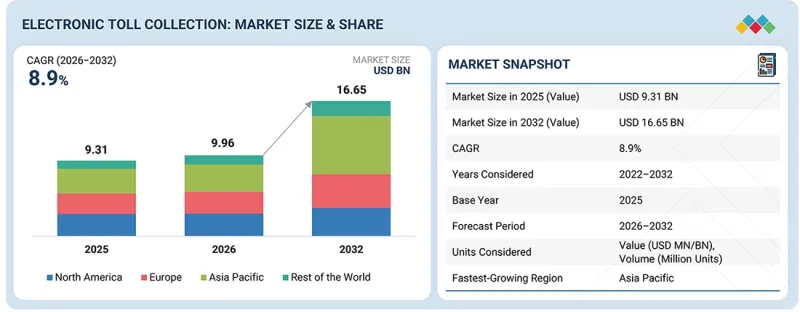
全球電子收費市場預計在預測期內將以 8.9% 的複合年成長率成長,從 2025 年的 93.1 億美元成長到 2032 年的 166.5 億美元。
市場成長的促進因素包括:對智慧型運輸系統(ITS) 基礎設施的投資增加、對更順暢的車輛通行的需求不斷成長,以及在高速公路、都市區道路、橋樑和隧道上不斷擴大的數位收費支付生態系統。
| 調查範圍 | |
|---|---|
| 調查期 | 2021-2032 |
| 基準年 | 2024 |
| 預測期 | 2025-2032 |
| 目標單元 | 金額(10億美元) |
| 部分 | 按收費架構、技術、產品、應用和區域分類 |
| 目標區域 | 北美、歐洲、亞太地區及其他地區 |
向自動化和無障礙收費系統的轉變正在加速RFID、GNSS、自動車牌識別(ANPR)和基於雲端的收費管理平台等技術的採用。
此外,緩解交通堵塞、提高收費效率和提升通勤便利性的需求日益成長,正在推動電子收費系統的大規模部署。互聯出行、即時分析、人工智慧驅動的交通管理以及互通支付系統的不斷進步,進一步提升了電子收費系統的擴充性和營運效率。同時,對智慧城市基礎設施和綜合交通網路的投資增加,拓寬了電子收費系統的部署機會,使其成為下一代智慧出行和道路基礎設施現代化建設的關鍵驅動力。
“在預測期內,車牌識別攝影機細分市場預計將以最高的複合年成長率成長。”
在預測期內,用於電子收費的車牌自動識別(ANPR)攝影機細分市場預計將實現最高的複合年成長率(CAGR)。這一成長主要得益於自由流和無障礙收費系統的日益普及,這些系統需要精準的即時車輛辨識能力。 ANPR攝影機技術能夠自動採集和識別車牌,無需實體標籤或車輛停車即可實現無縫收費交易。這些系統正日益整合到高速公路、都市區收費網路、橋樑和智慧交通走廊中,以提高收費效率、交通處理能力和執法準確性。此外,對可互通的收費基礎設施、違規管理和自動車輛分類的需求不斷成長,正在加速攝影機系統、邊緣處理和基於人工智慧的影像分析領域的創新。對智慧交通系統、雲端連接的收費平台和數位旅行基礎設施的投資增加,進一步推動了ANPR攝影機的普及。影像效能、分析軟體和系統整合能力的持續進步,實現了可擴展的部署和營運最佳化,使ANPR攝影機細分市場成為電子收費市場的主要驅動力。
“預計到 2025 年,交易處理軟體將在電子交易中心 (ETC) 市場佔據相當大的佔有率。”
預計到2032年,交易處理軟體將在電子收費市場佔據最大的市場佔有率。這項成長主要得益於數位收費基礎設施的日益普及,以及整個收費網路對即時、安全、大規模交易管理日益成長的需求。交易處理軟體是電子收費系統(ETC)的營運基礎,能夠實現通行費計算、支付授權、帳戶管理、互通性、對帳和集中式資料處理。隨著交通管理部門致力於提升營運效率和使用者體驗,收費系統在高速公路、都市區收費項目、橋樑和一般道路環境中的部署正在迅速推進。與傳統收費方式相比,這些平台能夠提供更快的交易執行速度、與RFID、GNSS和ANPR技術的無縫整合,以及更高的通行費收入準確性。此外,雲端架構、人工智慧驅動的分析、網路安全安全功能和整合支付生態系統的進步正在擴展軟體的功能,即使在複雜且交通繁忙的環境中也能實現可擴展的部署。
“預計到2032年,美國將佔據ETC市場最大的佔有率。”
預計到2032年,美國將佔據電子收費市場最大的佔有率,這得益於其在高速公路、橋樑和都市區交通走廊廣泛部署的電子和無現金收費基礎設施。美國受惠於早期採用開放車道收費、大力投資智慧型運輸系統(ITS)以及不斷擴展的RFID、車牌自動識別(ANPR)和基於雲端的收費管理平台。人們日益關注如何緩解交通堵塞、提高收費效率和提升通勤便利性,這正在加速整個交通網路電子收費系統的部署。此外,成熟的收費業者、持續的基礎設施現代化改造以及人工智慧驅動的交通分析和數位支付生態系統的整合,進一步鞏固了美國在全球電子收費市場的領先地位。
為了確定並檢驗透過二手研究收集到的各個細分市場和子細分市場的市場規模,我們對電子帳單市場的關鍵產業專家進行了廣泛的一手訪談。本報告中一手訪談對象的詳細情況如下:
調查範圍:
本報告將電子收費市場細分,並按應用(高速公路、都市區)、類型(基於應答器/標籤的收費系統及其他)、交付方式(硬體、後勤部門及其他服務)和技術(RFID、DSRC及其他技術)預測市場規模。該報告還探討了市場促進因素、挑戰和限制因素,並詳細分析了區域市場趨勢(北美、歐洲、亞太及其他地區)。此外,報告中還包含主要參與者的供應鏈分析以及電子收費生態系統的競爭分析。
購買本報告的主要好處:
關鍵促進因素(迫切需要緩解交通堵塞和減少交通事故,政府大力支持引入先進的收費解決方案,自動收費方式的便利性,交通基礎設施的技術進步),阻礙因素(過度依賴技術和易受技術故障影響,開發中國家實施電子收費系統的限制,需要對基於 GPS 和 GNSS的電子收費系統進行大量初始投資),機會(集中精力最大限度地減少燃料消耗和排放,以獲得經濟和環境效益,將區塊鏈技術整合到收費系統中,增加交通運輸領域的官民合作關係(PPP) 協議,以及擴大全電子收費系統),以及挑戰(數據隱私問題,與收費系統相關的互通性問題)。
服務開發/創新 - 深入洞察電子帳單市場的未來技術、研發活動和新產品發布。
市場發展:盈利市場的全面資訊-本報告分析了各個地區的電子帳單市場。
市場多元化:提供有關電子帳單市場的新產品、未開發市場、最新趨勢和投資的全面資訊。
競爭分析:對電子收費市場主要參與者的市場佔有率、成長策略和服務產品進行詳細評估,包括 Kapsch TrafficCom AG(奧地利)、Conduent Incorporated(美國)、ST Engineering(TransCore)(美國)、Thales(法國)、Cubic Corporation(美國)、西門子(德國)、EFKON Gmber Inc.(參與企業)、美國)。
目錄
第1章:引言
第2章執行摘要
第3章重要考察
第4章 市場概覽
- 市場動態
- 促進因素
- 抑制因子
- 機會
- 任務
- 相互關聯的市場與跨產業機遇
- 一級/二級/三級公司的策略性舉措
第5章 產業趨勢
- 波特五力分析
- 宏觀經濟展望
- 價值鏈分析
- 生態系分析
- 價格分析
- 貿易分析
- 2026年重大會議和活動
- 影響客戶業務的趨勢/顛覆性因素
- 投資和資金籌措場景
- 案例研究分析
- 美國關稅的影響—概述
第6章:技術進步、人工智慧的影響、專利與創新
- 主要技術
- 互補技術
- 技術藍圖
- 專利分析
- 人工智慧/生成式人工智慧對電子帳單市場的影響
第7章 地方法規和合規性
- 當地法規和合規性
- 監管機構、政府機構和其他組織
- 業界標準
第8章:顧客趨勢與購買行為
- 決策流程
- 買方相關人員和採購評估標準
- 實施障礙和內部挑戰
- 各種應用中尚未滿足的需求
- 市場盈利
第9章:通行費支付方式
- 預付款
- 付款後
第10章:電子收費所使用的收費架構
- 硬體供應商
- 軟體和平台提供者
- 系統整合商
- 收費公路業者/收費員
- 託管服務供應商
第11章:電子收費市場(依收費架構分類)
- 開放車道收費系統(ORT)
- 屏障底座等。
- 混合系統
第12章:電子收費市場(依技術分類)
- RFID
- DSRC
- GNSS/GPS
- 其他
第13章:電子收費市場(依產品/服務分類)
- 硬體
- 軟體
- 服務
第14章:電子收費市場(按應用)
- 高速公路/主幹道
- 都市區堵塞收費
- 橋樑和隧道
- 跨境收費
第15章:電子收費市場(按地區分類)
- 北美洲
- 美國
- 加拿大
- 墨西哥
- 歐洲
- 英國
- 德國
- 法國
- 義大利
- 西班牙
- 北歐國家
- 挪威
- 其他
- 亞太地區
- 中國
- 日本
- 韓國
- 澳洲
- 新加坡
- 印度
- 其他
- 線
- 南美洲
- 中東和非洲
第16章 競爭格局
- 概述
- 2021-2026年主要參與企業的競爭策略/優勢
- 2025年市佔率分析
- 2021-2025年收入分析
- 企業估值和財務指標
- 品牌對比
- 企業估值矩陣:主要公司,2025 年
- 公司估值矩陣:新創企業/中小企業,2025 年
- 競爭格局
第17章:公司簡介
- 主要參與企業
- KAPSCH TRAFFICCOM AG
- CONDUENT INCORPORATED
- EFKON GMBH
- ST ENGINEERING(TRANSCORE)
- THALES
- SIEMENS
- Q-FREE
- CUBIC CORPORATION
- NEOLOGY
- FEIG ELECTRONIC
- TOSHIBA CORPORATION,
- MITSUBISHI HEAVY INDUSTRIES, LTD.
- QUARTERHILL INC.
- PERCEPTICS, LLC
- SKYTOLL
- 其他公司
- EMOVIS
- STAR SYSTEMS INTERNATIONAL
- GEA
- ADAPTIVE RECOGNITION INC.
- SICE
- JENOPTIK
- FAR EASTERN GROUP
- TOLL COLLECT GMBH
- GEOTOLL
- INDRA
- KISTLER GROUP
- VERRA MOBILITY
- 營業執照持有人
- VINCI HIGHWAYS
- TRANSURBAN GROUP
- ABERTIS
- EGIS
- ROADIS
- IRB INFRASTRUCTURE DEVELOPERS LTD.
第18章:調查方法
第19章附錄
The global electronic toll collection market is projected to grow from USD 9.31 billion in 2025 to USD 16.65 billion by 2032 at a CAGR of 8.9% during the forecast period. Market growth is being driven by increasing investments in intelligent transportation infrastructure, growing demand for frictionless vehicle movement, and rising adoption of digital toll payment ecosystems across highways, urban corridors, bridges, and tunnels.
| Scope of the Report | |
|---|---|
| Years Considered for the Study | 2021-2032 |
| Base Year | 2024 |
| Forecast Period | 2025-2032 |
| Units Considered | Value (USD Billion) |
| Segments | By Technology, Application and Region |
| Regions covered | North America, Europe, APAC, RoW |
The transition toward automated and barrier-free toll collection systems is accelerating the deployment of technologies such as RFID, GNSS, automatic number plate recognition (ANPR), and cloud-based toll management platforms.
Additionally, the increasing focus on reducing traffic congestion, improving toll revenue efficiency, and enhancing commuter convenience is supporting large-scale ETC implementation. Continuous advancements in connected mobility, real-time analytics, AI-enabled traffic management, and interoperable payment systems are further strengthening scalability and operational performance, while growing investments in smart city infrastructure and integrated transportation networks are expanding deployment opportunities, positioning electronic toll collection as a critical enabler of next-generation intelligent mobility and road infrastructure modernization.
"The ANPR cameras segment is projected to grow at the highest CAGR during the forecast period."
The ANPR cameras segment for electronic toll collection is projected to achieve the highest CAGR during the forecast period. This growth is supported by the increasing adoption of free-flow and barrier-free tolling systems that require accurate, real-time vehicle identification capabilities. ANPR camera technologies enable automatic capture and recognition of vehicle license plates, supporting seamless toll transactions without requiring physical tags or vehicle stoppage. These systems are increasingly being integrated into highways, urban road pricing networks, bridges, and smart transportation corridors to improve toll collection efficiency, traffic throughput, and enforcement accuracy. Additionally, rising demand for interoperable tolling infrastructure, violation management, and automated vehicle classification is accelerating innovation in camera systems, edge processing, and AI-based image analytics. Growing investments in intelligent transportation systems, cloud-connected toll platforms, and digital mobility infrastructure are further driving deployment. Continuous advancements in imaging performance, analytics software, and system integration capabilities are enabling scalable implementation and operational optimization, positioning the ANPR cameras segment as a key growth driver in the electronic toll collection market.
"Transaction Processing Software is projected to account for a significant share of the ETC market in 2025."
Transaction Processing Software is projected to account for the highest market share of the electronic toll collection market in 2032. This growth is driven by increasing deployment of digital tolling infrastructure and the rising need for real-time, secure, and high-volume transaction management across toll networks. Transaction processing software serves as the operational backbone of ETC systems by enabling toll calculation, payment authorization, account management, interoperability, reconciliation, and centralized data processing. There is strong adoption of tolling systems across highways, urban tolling programs, bridges, and open-road environments, accelerating their deployment as transportation authorities aim to improve both operational efficiency and the user experience. These platforms enable faster transaction execution, seamless integration with RFID, GNSS, and ANPR technologies, and greater toll revenue accuracy than conventional toll collection approaches. Additionally, advancements in cloud architecture, AI-enabled analytics, cybersecurity capabilities, and integrated payment ecosystems are expanding software functionality and enabling scalable deployment in complex, high-traffic transportation environments.
"The US is projected to capture the largest share in the ETC market in 2032."
The US is projected to capture the largest share in the electronic toll collection market in 2032, supported by the extensive deployment of electronic and cashless tolling infrastructure across highways, bridges, and urban mobility corridors. The country benefits from early adoption of open road tolling, strong investments in intelligent transportation systems, and growing implementation of RFID, ANPR, and cloud-based toll management platforms. Increasing focus on reducing traffic congestion, improving toll collection efficiency, and enhancing commuter convenience is accelerating ETC adoption across transportation networks. Additionally, the presence of established toll operators, continuous infrastructure modernization initiatives, and integration of AI-driven traffic analytics and digital payment ecosystems continue to strengthen the US position as a leading market for electronic toll collection globally.
Extensive primary interviews were conducted with key industry experts in the electronic toll collection market space to determine and verify the market size for various segments and subsegments gathered through secondary research. The breakdown of primary participants for the report is shown below.
The study contains insights from various industry experts, from component suppliers to Tier 1 companies and OEMs. The break-up of the primaries is as follows:
By Company Type - Tier 1-35%, Tier 2-45%, Tier 3 -20%
By Designation- C-level Executives - 40%, Directors - 30%, Others - 30%
By Region North America - 40%, Europe - 30%, Asia Pacific - 20%, RoW - 10%
The electronic toll collection market is dominated by a few globally established players, such as Kapsch TrafficCom AG (Austria), Conduent Incorporated (US), ST Engineering (TransCore) (Singapore), Thales (France), and Siemens (Germany).
Research Coverage:
The report segments the electronic toll collection market and forecasts its size by application (highways, urban areas), type (transponder/tag-based tolling systems, other types), offering (hardware, back-office & other services), and technology (RFID, DSRC, other technologies). It also discusses the market's drivers, restraints, opportunities, and challenges. It gives a detailed view of the market across regions (North America, Europe, Asia Pacific, RoW). The report includes a supply chain analysis of key players and a competitive analysis of the electronic toll collection ecosystem.
Key Benefits of Buying the Report:
Analysis of key drivers (Urgent need to mitigate traffic congestion and reduce road accidents, strong government support to deploy advanced tolling solutions, high convenience of automated toll payment options, technological advancements in transportation infrastructure), restraints (overreliance on technologies and susceptibility to technical failure, ETC implementation constraints in developing countries, requirement for high initial investments in GPS- and GNSS-based ETC systems), opportunities (significant focus on minimizing fuel consumption and emissions for economic and environmental gains, integration of blockchain technology into toll collection systems, rising number of public-private partnership agreements in transportation sector, increasing adoption of all-electronic tolling systems), and challenges (data privacy concerns, interoperability issues associated with tolling systems)
Service Development/Innovation: Detailed insights into upcoming technologies, research and development activities, and new product launches in the electronic toll collection market
Market Development: Comprehensive information about lucrative markets - the report analyses the electronic toll collection market across varied regions
Market Diversification: Exhaustive information about new products, untapped geographies, recent developments, and investments in the electronic toll collection market.
Competitive Assessment: In-depth assessment of market shares, growth strategies, and service offerings of leading players, such as Kapsch TrafficCom AG (Austria), Conduent Incorporated (US), ST Engineering (TransCore) (US), Thales (France), Cubic Corporation (US), Siemens (Germany), EFKON GmbH (Austria), Neology, Inc. (US), FEIG ELECTRONIC (Germany), and Q-Free (Norway), among others in the electronic toll collection market.
TABLE OF CONTENTS
1 INTRODUCTION
- 1.1 STUDY OBJECTIVES
- 1.2 MARKET DEFINITION
- 1.2.1 INCLUSIONS AND EXCLUSIONS
- 1.3 MARKET SCOPE
- 1.3.1 MARKET SEGMENTATION AND REGIONAL SCOPE
- 1.3.2 YEARS CONSIDERED
- 1.3.3 CURRENCY CONSIDERED
- 1.4 UNIT CONSIDERED
- 1.5 LIMITATIONS
- 1.6 STAKEHOLDERS
- 1.7 SUMMARY OF CHANGES
2 EXECUTIVE SUMMARY
- 2.1 MARKET HIGHLIGHTS AND KEY INSIGHTS
- 2.2 KEY MARKET PARTICIPANTS: MAPPING OF STRATEGIC DEVELOPMENTS
- 2.3 DISRUPTIVE TRENDS IN ELECTRONIC TOLL COLLECTION MARKET
- 2.4 HIGH-GROWTH SEGMENTS
- 2.5 REGIONAL SNAPSHOT: MARKET SIZE, GROWTH RATE, AND FORECAST
3 PREMIUM INSIGHTS
- 3.1 ATTRACTIVE OPPORTUNITIES FOR PLAYERS IN ELECTRONIC TOLL COLLECTION MARKET
- 3.2 ELECTRONIC TOLL COLLECTION MARKET, BY TECHNOLOGY
- 3.3 ELECTRONIC TOLL COLLECTION MARKET, BY OFFERING
- 3.4 ELECTRONIC TOLL COLLECTION MARKET, BY TOLLING ARCHITECTURE
- 3.5 ELECTRONIC TOLL COLLECTION MARKET, BY APPLICATION
- 3.6 ELECTRONIC TOLL COLLECTION MARKET, BY REGION
4 MARKET OVERVIEW
- 4.1 INTRODUCTION
- 4.2 MARKET DYNAMICS
- 4.2.1 DRIVERS
- 4.2.1.1 Urgent need to mitigate traffic congestion and reduce road accidents
- 4.2.1.2 Strong government support to deploy advanced tolling solutions across highways and urban areas
- 4.2.1.3 High convenience of automated toll payment options
- 4.2.1.4 Technological advancements in transportation infrastructure
- 4.2.2 RESTRAINTS
- 4.2.2.1 Susceptibility of ETC solutions to technical failures and vulnerability to cybertattacks
- 4.2.2.2 Implementation constraints in developing countries
- 4.2.2.3 Requirement for high initial investments in GPS- and GNSS-based ETC systems
- 4.2.3 OPPORTUNITIES
- 4.2.3.1 Significant focus on minimizing fuel consumption and emissions for economic and environmental gains
- 4.2.3.2 Integration of blockchain technology into toll collection systems
- 4.2.3.3 Rising number of public-private partnership agreements in transportation sector
- 4.2.3.4 Increasing adoption of all-electronic tolling systems
- 4.2.4 CHALLENGES
- 4.2.4.1 Data privacy concerns
- 4.2.4.2 Interoperability issues associated with tolling systems
- 4.2.1 DRIVERS
- 4.3 INTERCONNECTED MARKETS AND CROSS-SECTOR OPPORTUNITIES
- 4.4 STRATEGIC MOVES BY TIER 1/2/3 PLAYERS
5 INDUSTRY TRENDS
- 5.1 PORTER'S FIVE FORCES ANALYSIS
- 5.1.1 THREAT OF NEW ENTRANTS
- 5.1.2 THREAT OF SUBSTITUTES
- 5.1.3 BARGAINING POWER OF SUPPLIERS
- 5.1.4 BARGAINING POWER OF BUYERS
- 5.1.5 INTENSITY OF COMPETITIVE RIVALRY
- 5.2 MACROECONOMIC OUTLOOK
- 5.2.1 INTRODUCTION
- 5.2.2 GDP TRENDS AND FORECAST
- 5.2.3 TRENDS IN GLOBAL ELECTRONIC TOLL COLLECTION INDUSTRY
- 5.2.4 TRENDS IN ROADWAY TRANSPORTATION INDUSTRY
- 5.3 VALUE CHAIN ANALYSIS
- 5.4 ECOSYSTEM ANALYSIS
- 5.5 PRICING ANALYSIS
- 5.5.1 AVERAGE SELLING PRICE TREND OF RFID TAGS AND READERS, BY KEY PLAYER, 2022-2025
- 5.5.2 AVERAGE SELLING PRICE TREND OF ELECTRONIC TOLL COLLECTION SYSTEMS, BY REGION, 2022-2025
- 5.6 TRADE ANALYSIS
- 5.6.1 IMPORT SCENARIO (HS CODE 8530)
- 5.6.2 EXPORT SCENARIO (HS CODE 8530)
- 5.7 KEY CONFERENCES AND EVENTS, 2026
- 5.8 TRENDS/DISRUPTIONS IMPACTING CUSTOMER BUSINESS
- 5.9 INVESTMENT AND FUNDING SCENARIO
- 5.10 CASE STUDY ANALYSIS
- 5.10.1 WESTERN DIGITAL AND THEOBROMA SYSTEMS PROVIDES CUSTOMIZED TOLL COLLECTION SYSTEM FOR EUROPEAN PROJECT
- 5.10.2 SICE UPGRADES HUMBER BRIDGE TOLLING SYSTEM FOR OPTIMIZED TRAFFIC MANAGEMENT AND REVENUE GENERATION
- 5.10.3 MASSACHUSETTS DEPARTMENT OF TRANSPORTATION SELECTED TRANSCORE FOR E-ZPASS CUSTOMER SERVICE ENHANCEMENT
- 5.10.4 ERC SELECTS CLOUD-BASED TOLLING SOLUTION FROM COGNIZANT TO MAXIMIZE REVENUE
- 5.10.5 PLUS MALAYSIA USES TAPWAY'S AI AND NVIDIA'S GPUS IN RFID TOLL TRACKING SYSTEM BASED ON ANPR TECHNOLOGY
- 5.11 IMPACT OF US TARIFF - OVERVIEW
- 5.11.1 INTRODUCTION
- 5.11.2 KEY TARIFF RATES
- 5.11.3 PRICE IMPACT ANALYSIS
- 5.11.4 IMPACT ON COUNTRIES/REGIONS
- 5.11.4.1 US
- 5.11.4.2 Europe
- 5.11.4.3 Asia Pacific
- 5.11.5 IMPACT ON APPLICATION
6 TECHNOLOGICAL ADVANCEMENTS, AI-DRIVEN IMPACT, PATENTS, AND INNOVATIONS
- 6.1 KEY TECHNOLOGIES
- 6.1.1 GNSS/GPS-BASED TOLLING SYSTEMS
- 6.1.2 AI-POWERED TRAFFIC ANALYTICS AND AUTOMATED ENFORCEMENT
- 6.2 COMPLEMENTARY TECHNOLOGIES
- 6.2.1 IOT SENSORS AND ROADSIDE UNITS
- 6.2.2 CYBERSECURITY SOLUTIONS
- 6.2.3 BIG DATA ANALYTICS PLATFORMS
- 6.2.4 DIGITAL PAYMENT AND FINTECH INTEGRATION
- 6.3 TECHNOLOGY ROADMAP
- 6.4 PATENT ANALYSIS
- 6.5 IMPACT OF AI/GEN AI ON ELECTRONIC TOLL COLLECTION MARKET
- 6.5.1 TOP USE CASES AND MARKET POTENTIAL
- 6.5.2 BEST PRACTICES FOLLOWED BY OEMS IN ELECTRONIC TOLL COLLECTION MARKET
- 6.5.3 CASE STUDIES RELATED TO AI IMPLEMENTATION IN ELECTRONIC TOLL COLLECTION MARKET
- 6.5.4 INTERCONNECTED ECOSYSTEM AND IMPACT ON MARKET PLAYERS
- 6.5.5 CLIENTS' READINESS TO ADOPT GENERATIVE AI IN ELECTRONIC TOLL COLLECTION MARKET
7 REGIONAL REGULATIONS AND COMPLIANCE
- 7.1 REGIONAL REGULATIONS AND COMPLIANCE
- 7.2 REGULATORY BODIES, GOVERNMENT AGENCIES, AND OTHER ORGANIZATIONS
- 7.3 INDUSTRY STANDARDS
8 CUSTOMER LANDSCAPE AND BUYER BEHAVIOR
- 8.1 DECISION-MAKING PROCESS
- 8.2 BUYER STAKEHOLDERS AND BUYING EVALUATION CRITERIA
- 8.2.1 KEY STAKEHOLDERS IN BUYING PROCESS
- 8.2.2 BUYING CRITERIA
- 8.3 ADOPTION BARRIERS AND INTERNAL CHALLENGES
- 8.4 UNMET NEEDS OF VARIOUS APPLICATIONS
- 8.5 MARKET PROFITABILITY
9 PAYMENT METHODS ADOPTED TO PAY TOLLS
- 9.1 INTRODUCTION
- 9.2 PREPAID
- 9.3 POST-PAID
10 TOLLING ARCHITECTURES DEPLOYED IN ELECTRONIC TOLL COLLECTION
- 10.1 INTRODUCTION
- 10.2 HARDWARE PROVIDERS
- 10.3 SOFTWARE & PLATFORM PROVIDERS
- 10.4 SYSTEM INTEGRATORS
- 10.5 TOLL OPERATORS/CONCESSIONAIRES
- 10.6 MANAGED SERVICE PROVIDERS
11 ELECTRONIC TOLL COLLECTION MARKET, BY TOLLING ARCHITECTURE
- 11.1 INTRODUCTION
- 11.2 OPEN ROAD TOLLING (ORT)
- 11.2.1 INCLINATION TOWARD REDUCING CONGESTION AND IMPROVING FUEL EFFICIENCY TO BOOST ADOPTION
- 11.3 BARRIER-BASED ETC
- 11.3.1 LOW DEPLOYMENT COMPLEXITY AND HIGH TRANSACTION ACCURACY TO ACCELERATE IMPLEMENTATION
- 11.4 HYBRID SYSTEMS
- 11.4.1 GROWING EMPHASIS ON DIGITAL PAYMENTS AND SMART MOBILITY INITIATIVES TO DRIVE INSTALLATION
12 ELECTRONIC TOLL COLLECTION MARKET, BY TECHNOLOGY
- 12.1 INTRODUCTION
- 12.2 RFID
- 12.2.1 EASY INTEGRATION INTO ANY INFRASTRUCTURE AND LOW OPERATING COST TO FUEL SEGMENTAL GROWTH
- 12.3 DSRC
- 12.3.1 GROWING DEMAND FOR SECURE AND PRIVACY-CENTRIC ETC SOLUTIONS TO FOSTER SEGMENTAL GROWTH
- 12.4 GNSS/GPS
- 12.4.1 SUPPORT FOR DISTANCE-BASED CHARGING WITHOUT EXTENSIVE ROADSIDE INFRASTRUCTURE TO BOOST MARKET
- 12.5 OTHER TECHNOLOGIES
13 ELECTRONIC TOLL COLLECTION MARKET, BY OFFERING
- 13.1 INTRODUCTION
- 13.2 HARDWARE
- 13.2.1 ROADSIDE INFRASTRUCTURE
- 13.2.1.1 Growing preference for automated mobility environments to create roadside infrastructure requirements
- 13.2.2 ANPR CAMERAS
- 13.2.2.1 Increasing adoption of open road tolling and congestion management programs to facilitate segmental growth
- 13.2.3 RFID/DSRC READERS
- 13.2.3.1 Increasing demand for low-latency tolling and traffic management systems to augment segmental growth
- 13.2.4 TRANSPONDERS/OBUS
- 13.2.4.1 Expansion of national and regional interoperability initiatives to stimulate segmental growth
- 13.2.5 SENSORS & CONTROLLERS
- 13.2.5.1 Potential to improve detection accuracy and system visibility to promote segmental growth
- 13.2.1 ROADSIDE INFRASTRUCTURE
- 13.3 SOFTWARE
- 13.3.1 TRANSACTION PROCESSING
- 13.3.1.1 Rising investments in high-speed, low-latency processing infrastructure to contribute to segmental growth
- 13.3.2 VIOLATION ENFORCEMENT
- 13.3.2.1 Need to identify and manage unpaid toll transactions to promote segmental growth
- 13.3.3 TOLL MANAGEMENT
- 13.3.3.1 Surging deployment of multi-corridor toll networks and interoperable transportation infrastructure to accelerate segmental growth
- 13.3.4 REVENUE MANAGEMENT
- 13.3.4.1 Requirement to identify leakage points and optimize collection efficiency to encourage market expansion
- 13.3.5 INTEROPERABILITY PLATFORMS
- 13.3.5.1 Ability to facilitate transaction exchange, account synchronization, payment coordination, across toll operators to boost deployment
- 13.3.1 TRANSACTION PROCESSING
- 13.4 SERVICES
- 13.4.1 MANAGED SERVICES
- 13.4.1.1 Elevating use of performance-based delivery models to promote segmental growth
- 13.4.2 INTEGRATION & DEPLOYMENT
- 13.4.2.1 Increasing adoption of multi-technology toll environments to contribute to segmental growth
- 13.4.3 MAINTENANCE & SUPPORT
- 13.4.3.1 Necessity to maintain compliance with operational requirements and service-level agreements to encourage segmental growth
- 13.4.4 CONSULTING
- 13.4.4.1 Growing complexity of tolling environments to create need for consulting services
- 13.4.1 MANAGED SERVICES
14 ELECTRONIC TOLL COLLECTION MARKET, BY APPLICATION
- 14.1 INTRODUCTION
- 14.2 HIGHWAYS/EXPRESSWAYS
- 14.2.1 URGENT NEED TO IMPROVE TRAFFIC FLOW AND REDUCE CONGESTION AND HARMFUL EMISSIONS ACROSS HIGHWAYS TO UPTAKE GROWTH
- 14.3 URBAN CONGESTION CHARGING
- 14.3.1 SMART CITY DEVELOPMENT INITIATIVES TO SPUR DEMAND
- 14.4 BRIDGES & TUNNELS
- 14.4.1 GROWING ADOPTION OF AUTOMATED TOLLING ACROSS BRIDGES AND TUNNELS TO FACILITATE SEGMENTAL GROWTH
- 14.5 CROSS-BORDER TOLLING
- 14.5.1 INCREASING INTERNATIONAL TRANSPORTATION CONNECTIVITY AND REGIONAL MOBILITY PROGRAMS TO DRIVE SEGMENTAL GROWTH
15 ELECTRONIC TOLL COLLECTION MARKET, BY REGION
- 15.1 INTRODUCTION
- 15.2 NORTH AMERICA
- 15.2.1 US
- 15.2.1.1 Growing emphasis on modernizing road infrastructure to accelerate market growth
- 15.2.2 CANADA
- 15.2.2.1 Rising installation of ETC systems on major highways and bridges to drive market
- 15.2.3 MEXICO
- 15.2.3.1 Increasing number of projects for connecting with neighboring countries to contribute to market growth
- 15.2.1 US
- 15.3 EUROPE
- 15.3.1 UK
- 15.3.1.1 Adoption of advanced tolling technologies to enhance traffic efficiency to fuel market growth
- 15.3.2 GERMANY
- 15.3.2.1 Strong technological expertise and advanced tolling infrastructure to support market growth
- 15.3.3 FRANCE
- 15.3.3.1 Rising deployment of electronic tolling in environmental charging zones to reinforce market growth
- 15.3.4 ITALY
- 15.3.4.1 Expanding toll road network and digitally enabled heavy-vehicle tolling to contribute to market growth
- 15.3.5 SPAIN
- 15.3.5.1 Surging installation of automated and MLFF-ready ETC solutions across highways to foster market growth
- 15.3.6 NORDICS
- 15.3.6.1 Advancing digital road-charging through GNSS, ANPR, and eco-focused pricing models to drive market
- 15.3.7 NORWAY
- 15.3.7.1 HIGH adoption of free-flow tolling and digital mobility infrastructure to strengthen market expansion
- 15.3.8 REST OF EUROPE
- 15.3.1 UK
- 15.4 ASIA PACIFIC
- 15.4.1 CHINA
- 15.4.1.1 Rising government support for automating toll payments to augment market growth
- 15.4.2 JAPAN
- 15.4.2.1 Increasing need to reduce traffic at toll gates to fuel market growth
- 15.4.3 SOUTH KOREA
- 15.4.3.1 Expansion of smart mobility initiatives and digital transportation programs to spur demand
- 15.4.4 AUSTRALIA
- 15.4.4.1 Leveraging free-flow tolling to improve urban mobility and transport efficiency to support market growth
- 15.4.5 SINGAPORE
- 15.4.5.1 Pioneering urban-centric digital tolling through GNSS-based ERP framework to foster market growth
- 15.4.6 INDIA
- 15.4.6.1 Accelerating nationwide toll digitization through RFID expansion and expressway development projects to expedite market growth
- 15.4.7 REST OF ASIA PACIFIC
- 15.4.1 CHINA
- 15.5 ROW
- 15.5.1 SOUTH AMERICA
- 15.5.1.1 Brazil
- 15.5.1.1.1 Transition toward automated and free-flow toll collection environments to improve traffic throughput to drive market
- 15.5.1.2 Argentina
- 15.5.1.2.1 Greater adoption of digital toll collection models supported by infrastructure upgrades to propel market
- 15.5.1.3 Rest of South America
- 15.5.1.1 Brazil
- 15.5.2 MIDDLE EAST & AFRICA
- 15.5.2.1 GCC countries
- 15.5.2.1.1 Government initiatives to regulate traffic and curb over-speeding to support market growth
- 15.5.2.2 Rest of Middle East & Africa
- 15.5.2.1 GCC countries
- 15.5.1 SOUTH AMERICA
16 COMPETITIVE LANDSCAPE
- 16.1 OVERVIEW
- 16.2 KEY PLAYER COMPETITIVE STRATEGIES/RIGHT TO WIN, 2021-2026
- 16.2.1 PRODUCT PORTFOLIO
- 16.2.2 REGIONAL FOCUS
- 16.2.3 MANUFACTURING FOOTPRINT
- 16.2.4 ORGANIC/INORGANIC GROWTH STRATEGIES
- 16.3 MARKET SHARE ANALYSIS, 2025
- 16.4 REVENUE ANALYSIS, 2021-2025
- 16.5 COMPANY VALUATION AND FINANCIAL METRICS
- 16.6 BRAND COMPARISON
- 16.6.1 KAPSCH TRAFFICCOM AG (AUSTRIA)
- 16.6.2 CONDUENT, INC. (US)
- 16.6.3 ST ENGINEERING (TRANSCORE) (US)
- 16.6.4 THALES GROUP (FRANCE)
- 16.6.5 SIEMENS AG (GERMANY)
- 16.7 COMPANY EVALUATION MATRIX: KEY PLAYERS, 2025
- 16.7.1 STARS
- 16.7.2 EMERGING LEADERS
- 16.7.3 PERVASIVE PLAYERS
- 16.7.4 PARTICIPANTS
- 16.7.5 COMPANY FOOTPRINT: KEY PLAYERS, 2025
- 16.7.5.1 Company footprint
- 16.7.5.2 Region footprint
- 16.7.5.3 Offering footprint
- 16.7.5.4 Tolling architecture footprint
- 16.7.5.5 Technology footprint
- 16.7.5.6 Application footprint
- 16.8 COMPANY EVALUATION MATRIX: STARTUPS/SMES, 2025
- 16.8.1 PROGRESSIVE COMPANIES
- 16.8.2 RESPONSIVE COMPANIES
- 16.8.3 DYNAMIC COMPANIES
- 16.8.4 STARTING BLOCKS
- 16.8.5 COMPETITIVE BENCHMARKING: KEY STARTUPS/SMES, 2025
- 16.8.5.1 Detailed list of key startups/SMEs
- 16.8.5.2 Competitive benchmarking of key startups/SMEs
- 16.9 COMPETITIVE SCENARIO
- 16.9.1 PRODUCT LAUNCHES/DEVELOPMENTS
- 16.9.2 DEALS
- 16.9.3 OTHER DEVELOPMENTS
17 COMPANY PROFILES
- 17.1 KEY PLAYERS
- 17.1.1 KAPSCH TRAFFICCOM AG
- 17.1.1.1 Business overview
- 17.1.1.2 Products/Solutions/Services offered
- 17.1.1.3 Recent developments
- 17.1.1.3.1 Product launches
- 17.1.1.3.2 Deals
- 17.1.1.3.3 Expansions
- 17.1.1.3.4 Other developments
- 17.1.1.4 MnM view
- 17.1.1.4.1 Key strengths/Right to win
- 17.1.1.4.2 Strategic choices
- 17.1.1.4.3 Weaknesses/Competitive threats
- 17.1.2 CONDUENT INCORPORATED
- 17.1.2.1 Business overview
- 17.1.2.2 Products/Solutions/Services offered
- 17.1.2.3 Recent developments
- 17.1.2.3.1 Product launches
- 17.1.2.3.2 Other developments
- 17.1.2.4 MnM view
- 17.1.2.4.1 Key strengths/Right to win
- 17.1.2.4.2 Strategic choices
- 17.1.2.4.3 Weaknesses/Competitive threats
- 17.1.3 EFKON GMBH
- 17.1.3.1 Business overview
- 17.1.3.2 Products/Solutions/Services offered
- 17.1.3.3 Recent developments
- 17.1.3.3.1 Product launches
- 17.1.3.3.2 Other developments
- 17.1.3.4 MnM view
- 17.1.3.4.1 Key strengths/Right to win
- 17.1.3.4.2 Strategic choices
- 17.1.3.4.3 Weaknesses/Competitive threats
- 17.1.4 ST ENGINEERING (TRANSCORE)
- 17.1.4.1 Business overview
- 17.1.4.2 Products/Solutions/Services offered
- 17.1.4.3 Recent developments
- 17.1.4.3.1 Product launches
- 17.1.4.3.2 Deals
- 17.1.4.3.3 Expansions
- 17.1.4.3.4 Other developments
- 17.1.4.4 MnM view
- 17.1.4.4.1 Key strengths/Right to win
- 17.1.4.4.2 Strategic choices
- 17.1.4.4.3 Weaknesses/Competitive threats
- 17.1.5 THALES
- 17.1.5.1 Business overview
- 17.1.5.2 Products/Solutions/Services offered
- 17.1.5.3 Recent developments
- 17.1.5.3.1 Other developments
- 17.1.5.4 MnM view
- 17.1.5.4.1 Key strengths/Right to win
- 17.1.5.4.2 Strategic choices
- 17.1.5.4.3 Weaknesses/Competitive threats
- 17.1.6 SIEMENS
- 17.1.6.1 Business overview
- 17.1.6.2 Products/Solutions/Services offered
- 17.1.7 Q-FREE
- 17.1.7.1 Business overview
- 17.1.7.2 Products/Services/Solutions offered
- 17.1.7.3 Recent developments
- 17.1.7.3.1 Developments
- 17.1.8 CUBIC CORPORATION
- 17.1.8.1 Business overview
- 17.1.8.2 Products/Solutions/Services offered
- 17.1.8.3 Recent developments
- 17.1.8.3.1 Product launches
- 17.1.9 NEOLOGY
- 17.1.9.1 Business overview
- 17.1.9.2 Products/Solutions/Services offered
- 17.1.9.3 Recent developments
- 17.1.9.3.1 Product launches
- 17.1.9.3.2 Deals
- 17.1.9.3.3 Other developments
- 17.1.10 FEIG ELECTRONIC
- 17.1.10.1 Business overview
- 17.1.10.2 Products/Solutions/Services offered
- 17.1.10.3 Recent developments
- 17.1.10.3.1 Product launches
- 17.1.10.3.2 Deals
- 17.1.11 TOSHIBA CORPORATION,
- 17.1.11.1 Business overview
- 17.1.11.2 Products/Solutions/Services offered
- 17.1.12 MITSUBISHI HEAVY INDUSTRIES, LTD.
- 17.1.12.1 Business overview
- 17.1.12.2 Products/Solutions/Services offered
- 17.1.12.3 Recent developments
- 17.1.12.3.1 Developments
- 17.1.13 QUARTERHILL INC.
- 17.1.13.1 Business overview
- 17.1.13.2 Products/Solutions/Services offered
- 17.1.13.3 Recent developments
- 17.1.13.3.1 Product launches
- 17.1.13.3.2 Deals
- 17.1.13.3.3 Other developments
- 17.1.14 PERCEPTICS, LLC
- 17.1.14.1 Business overview
- 17.1.14.2 Products/Solutions/Services offered
- 17.1.14.3 Recent developments
- 17.1.14.3.1 Product launches
- 17.1.15 SKYTOLL
- 17.1.15.1 Business overview
- 17.1.15.2 Products/Solutions/Services offered
- 17.1.15.3 Recent developments
- 17.1.15.3.1 Expansions
- 17.1.15.3.2 Other developments
- 17.1.1 KAPSCH TRAFFICCOM AG
- 17.2 OTHER PLAYERS
- 17.2.1 EMOVIS
- 17.2.2 STAR SYSTEMS INTERNATIONAL
- 17.2.3 GEA
- 17.2.4 ADAPTIVE RECOGNITION INC.
- 17.2.5 SICE
- 17.2.6 JENOPTIK
- 17.2.7 FAR EASTERN GROUP
- 17.2.8 TOLL COLLECT GMBH
- 17.2.9 GEOTOLL
- 17.2.10 INDRA
- 17.2.11 KISTLER GROUP
- 17.2.12 VERRA MOBILITY
- 17.3 CONCESSIONAIRES
- 17.3.1 VINCI HIGHWAYS
- 17.3.2 TRANSURBAN GROUP
- 17.3.3 ABERTIS
- 17.3.4 EGIS
- 17.3.5 ROADIS
- 17.3.6 IRB INFRASTRUCTURE DEVELOPERS LTD.
18 RESEARCH METHODOLOGY
- 18.1 INTRODUCTION
- 18.2 RESEARCH DATA
- 18.2.1 SECONDARY DATA
- 18.2.1.1 Key data from secondary sources
- 18.2.2 PRIMARY DATA
- 18.2.2.1 Primary interview participants
- 18.2.2.2 Breakdown of primaries
- 18.2.2.3 Key data from primary sources
- 18.2.2.4 Key industry insights
- 18.2.1 SECONDARY DATA
- 18.3 FACTOR ANALYSIS
- 18.3.1 SUPPLY-SIDE ANALYSIS
- 18.3.2 DEMAND-SIDE ANALYSIS
- 18.4 MARKET SIZE ESTIMATION METHODOLOGY
- 18.4.1 BOTTOM-UP APPROACH
- 18.4.1.1 Approach to arrive at market size using bottom-up analysis (demand side)
- 18.4.2 TOP-DOWN APPROACH
- 18.4.2.1 Approach to arrive at market size using top-down approach (supply side)
- 18.4.3 GROWTH PROJECTION AND FORECAST-RELATED ASSUMPTIONS
- 18.4.1 BOTTOM-UP APPROACH
- 18.5 MARKET BREAKDOWN AND DATA TRIANGULATION
- 18.6 RESEARCH ASSUMPTIONS
- 18.7 RESEARCH LIMITATIONS
- 18.8 RISK ASSESSMENT
19 APPENDIX
- 19.1 INSIGHTS FROM INDUSTRY EXPERTS
- 19.2 DISCUSSION GUIDE
- 19.3 KNOWLEDGE STORE: MARKETSANDMARKETS' SUBSCRIPTION PORTAL
- 19.4 CUSTOMIZATION OPTIONS
- 19.5 RELATED REPORTS
- 19.6 AUTHOR DETAILS
List of Tables
- TABLE 1 REPORT INCLUSIONS AND EXCLUSIONS
- TABLE 2 INTERCONNECTED MARKETS AND CROSS-SECTOR OPPORTUNITIES
- TABLE 3 STRATEGIC FOCUS OF KEY COMPANIES AND ACTION TAKEN BY THEM
- TABLE 4 PORTER'S FIVE FORCES ANALYSIS
- TABLE 5 GDP PERCENTAGE CHANGE, BY COUNTRY, 2021-2030
- TABLE 6 ROLE OF COMPANIES IN ELECTRONIC TOLL COLLECTION ECOSYSTEM
- TABLE 7 AVERAGE SELLING PRICE TREND OF RFID TAGS AND READERS PROVIDED BY KEY PLAYERS, 2022-2025 (USD)
- TABLE 8 AVERAGE SELLING PRICE TREND OF ELECTRONIC TOLL COLLECTION SYSTEMS, BY REGION, 2022-2025 (USD)
- TABLE 9 IMPORT DATA FOR HS CODE 8530-COMPLIANT PRODUCTS, BY COUNTRY, 2021-2025 (USD MILLION)
- TABLE 10 EXPORT DATA FOR HS CODE 8530-COMPLIANT PRODUCTS, BY COUNTRY, 2021-2025 (USD MILLION)
- TABLE 11 LIST OF KEY CONFERENCES AND EVENTS, 2026
- TABLE 12 US-ADJUSTED RECIPROCAL TARIFF RATES
- TABLE 13 ELECTRONIC TOLL COLLECTION MARKET: TECHNOLOGY ROADMAP
- TABLE 14 LIST OF MAJOR PATENTS, 2022-2024
- TABLE 15 KEY USE CASES AND MARKET POTENTIAL
- TABLE 16 BEST PRACTICES: COMPANIES IMPLEMENTING AI AND OTHER ADVANCED TECHNOLOGIES
- TABLE 17 ELECTRONIC TOLL COLLECTION MARKET: CASE STUDIES RELATED TO AI IMPLEMENTATION
- TABLE 18 INTERCONNECTED ECOSYSTEM AND IMPACT ON MARKET PLAYERS
- TABLE 19 NORTH AMERICA: LIST OF REGULATORY BODIES, GOVERNMENT AGENCIES, AND OTHER ORGANIZATIONS
- TABLE 20 EUROPE: LIST OF REGULATORY BODIES, GOVERNMENT AGENCIES, AND OTHER ORGANIZATIONS
- TABLE 21 ASIA PACIFIC: LIST OF REGULATORY BODIES, GOVERNMENT AGENCIES, AND OTHER ORGANIZATIONS
- TABLE 22 ROW: LIST OF REGULATORY BODIES, GOVERNMENT AGENCIES, AND OTHER ORGANIZATIONS
- TABLE 23 STANDARDS: ELECTRONIC TOLL COLLECTION
- TABLE 24 INFLUENCE OF STAKEHOLDERS ON BUYING PROCESS FOR APPLICATIONS
- TABLE 25 KEY BUYING CRITERIA FOR APPLICATIONS
- TABLE 26 UNMET NEEDS IN ELECTRONIC TOLL COLLECTION MARKET, BY APPLICATION
- TABLE 27 ELECTRONIC TOLL COLLECTION MARKET, BY TOLLING ARCHITECTURE, 2022-2025 (USD MILLION)
- TABLE 28 ELECTRONIC TOLL COLLECTION MARKET, BY TOLLING ARCHITECTURE, 2026-2032 (USD MILLION)
- TABLE 29 OPEN ROAD TOLLING (ORT): ELECTRONIC TOLL COLLECTION MARKET, BY REGION, 2022-2025 (USD MILLION)
- TABLE 30 OPEN ROAD TOLLING (ORT): ELECTRONIC TOLL COLLECTION MARKET, BY REGION, 2026-2032 (USD MILLION)
- TABLE 31 BARRIER-BASED ETC: ELECTRONIC TOLL COLLECTION MARKET, BY REGION, 2022-2025 (USD MILLION)
- TABLE 32 BARRIER-BASED ETC: ELECTRONIC TOLL COLLECTION MARKET, BY REGION, 2026-2032 (USD MILLION)
- TABLE 33 HYBRID SYSTEMS: ELECTRONIC TOLL COLLECTION MARKET, BY REGION, 2022-2025 (USD MILLION)
- TABLE 34 HYBRID SYSTEMS: ELECTRONIC TOLL COLLECTION MARKET, BY REGION, 2026-2032 (USD MILLION)
- TABLE 35 ELECTRONIC TOLL COLLECTION MARKET, BY TECHNOLOGY, 2022-2025 (USD MILLION)
- TABLE 36 ELECTRONIC TOLL COLLECTION MARKET, BY TECHNOLOGY, 2026-2032 (USD MILLION)
- TABLE 37 RFID TAGS: ELECTRONIC TOLL COLLECTION MARKET, 2022-2025 (MILLION UNITS)
- TABLE 38 RFID TAGS: ELECTRONIC TOLL COLLECTION MARKET, 2026-2032 (MILLION UNITS)
- TABLE 39 ELECTRONIC TOLL COLLECTION MARKET, BY OFFERING, 2022-2025 (USD MILLION)
- TABLE 40 ELECTRONIC TOLL COLLECTION MARKET, BY OFFERING, 2026-2032 (USD MILLION)
- TABLE 41 HARDWARE: ELECTRONIC TOLL COLLECTION MARKET, BY REGION, 2022-2025 (USD MILLION)
- TABLE 42 HARDWARE: ELECTRONIC TOLL COLLECTION MARKET, BY REGION, 2026-2032 (USD MILLION)
- TABLE 43 HARDWARE: ELECTRONIC TOLL COLLECTION MARKET, BY TYPE, 2022-2025 (USD MILLION)
- TABLE 44 HARDWARE: ELECTRONIC TOLL COLLECTION MARKET, BY TYPE, 2026-2032 (USD MILLION)
- TABLE 45 SOFTWARE: ELECTRONIC TOLL COLLECTION MARKET, BY REGION, 2022-2025 (USD MILLION)
- TABLE 46 SOFTWARE: ELECTRONIC TOLL COLLECTION MARKET, BY REGION, 2026-2032 (USD MILLION)
- TABLE 47 SOFTWARE: ELECTRONIC TOLL COLLECTION MARKET, BY TYPE, 2022-2025 (USD MILLION)
- TABLE 48 SOFTWARE: ELECTRONIC TOLL COLLECTION MARKET, BY TYPE, 2026-2032 (USD MILLION)
- TABLE 49 SERVICES: ELECTRONIC TOLL COLLECTION MARKET, BY REGION, 2022-2025 (USD MILLION)
- TABLE 50 SERVICES: ELECTRONIC TOLL COLLECTION MARKET, BY REGION, 2026-2032 (USD MILLION)
- TABLE 51 SERVICES: ELECTRONIC TOLL COLLECTION MARKET, BY TYPE, 2022-2025 (USD MILLION)
- TABLE 52 SERVICES: ELECTRONIC TOLL COLLECTION MARKET, BY TYPE, 2026-2032 (USD MILLION)
- TABLE 53 ELECTRONIC TOLL COLLECTION MARKET, BY APPLICATION, 2022-2025 (USD MILLION)
- TABLE 54 ELECTRONIC TOLL COLLECTION MARKET, BY APPLICATION, 2026-2032 (USD MILLION)
- TABLE 55 HIGHWAYS/EXPRESSWAYS: ELECTRONIC TOLL COLLECTION MARKET, BY REGION, 2022-2025 (USD MILLION)
- TABLE 56 HIGHWAYS/EXPRESSWAYS: ELECTRONIC TOLL COLLECTION MARKET, BY REGION, 2026-2032 (USD MILLION)
- TABLE 57 HIGHWAYS/EXPRESSWAYS: ELECTRONIC TOLL COLLECTION MARKET IN NORTH AMERICA, BY COUNTRY, 2022-2025 (USD MILLION)
- TABLE 58 HIGHWAYS/EXPRESSWAYS: ELECTRONIC TOLL COLLECTION MARKET IN NORTH AMERICA, BY COUNTRY, 2026-2032 (USD MILLION)
- TABLE 59 HIGHWAYS/EXPRESSWAYS: ELECTRONIC TOLL COLLECTION MARKET IN EUROPE, BY COUNTRY, 2022-2025 (USD MILLION)
- TABLE 60 HIGHWAYS/EXPRESSWAYS: ELECTRONIC TOLL COLLECTION MARKET IN EUROPE, BY COUNTRY, 2026-2032 (USD MILLION)
- TABLE 61 HIGHWAYS/EXPRESSWAYS: ELECTRONIC TOLL COLLECTION MARKET IN ASIA PACIFIC, BY COUNTRY, 2022-2025 (USD MILLION)
- TABLE 62 HIGHWAYS/EXPRESSWAYS: ELECTRONIC TOLL COLLECTION MARKET IN ASIA PACIFIC, BY COUNTRY, 2026-2032 (USD MILLION)
- TABLE 63 HIGHWAYS/EXPRESSWAYS: ELECTRONIC TOLL COLLECTION MARKET IN ROW, BY REGION, 2022-2025 (USD MILLION)
- TABLE 64 HIGHWAYS/EXPRESSWAYS: ELECTRONIC TOLL COLLECTION MARKET IN ROW, BY REGION, 2026-2032 (USD MILLION)
- TABLE 65 URBAN CONGESTION CHARGING: ELECTRONIC TOLL COLLECTION MARKET, BY REGION, 2022-2025 (USD MILLION)
- TABLE 66 URBAN CONGESTION CHARGING: ELECTRONIC TOLL COLLECTION MARKET, BY REGION, 2026-2032 (USD MILLION)
- TABLE 67 URBAN CONGESTION CHARGING: ELECTRONIC TOLL COLLECTION MARKET IN NORTH AMERICA, BY COUNTRY, 2022-2025 (USD MILLION)
- TABLE 68 URBAN CONGESTION CHARGING: ELECTRONIC TOLL COLLECTION MARKET IN NORTH AMERICA, BY COUNTRY, 2026-2032 (USD MILLION)
- TABLE 69 URBAN CONGESTION CHARGING: ELECTRONIC TOLL COLLECTION MARKET IN EUROPE, BY COUNTRY, 2022-2025 (USD MILLION)
- TABLE 70 URBAN CONGESTION CHARGING: ELECTRONIC TOLL COLLECTION MARKET IN EUROPE, BY COUNTRY, 2026-2032 (USD MILLION)
- TABLE 71 URBAN CONGESTION CHARGING: ELECTRONIC TOLL COLLECTION MARKET IN ASIA PACIFIC, BY COUNTRY, 2022-2025 (USD MILLION)
- TABLE 72 URBAN CONGESTION CHARGING: ELECTRONIC TOLL COLLECTION MARKET IN ASIA PACIFIC, BY COUNTRY, 2026-2032 (USD MILLION)
- TABLE 73 URBAN CONGESTION CHARGING: ELECTRONIC TOLL COLLECTION MARKET IN ROW, BY REGION, 2022-2025 (USD MILLION)
- TABLE 74 URBAN CONGESTION CHARGING: ELECTRONIC TOLL COLLECTION MARKET IN ROW, BY REGION, 2026-2032 (USD MILLION)
- TABLE 75 BRIDGES & TUNNELS: ELECTRONIC TOLL COLLECTION MARKET, BY REGION, 2022-2025 (USD MILLION)
- TABLE 76 BRIDGES & TUNNELS: ELECTRONIC TOLL COLLECTION MARKET, BY REGION, 2026-2032 (USD MILLION)
- TABLE 77 BRIDGES & TUNNELS: ELECTRONIC TOLL COLLECTION MARKET IN NORTH AMERICA, BY COUNTRY, 2022-2025 (USD MILLION)
- TABLE 78 BRIDGES & TUNNELS: ELECTRONIC TOLL COLLECTION MARKET IN NORTH AMERICA, BY COUNTRY, 2026-2032 (USD MILLION)
- TABLE 79 BRIDGES & TUNNELS: ELECTRONIC TOLL COLLECTION MARKET IN EUROPE, BY COUNTRY, 2022-2025 (USD MILLION)
- TABLE 80 BRIDGES & TUNNELS: ELECTRONIC TOLL COLLECTION MARKET IN EUROPE, BY COUNTRY, 2026-2032 (USD MILLION)
- TABLE 81 BRIDGES & TUNNELS: ELECTRONIC TOLL COLLECTION MARKET IN ASIA PACIFIC, BY COUNTRY, 2022-2025 (USD MILLION)
- TABLE 82 BRIDGES & TUNNELS: ELECTRONIC TOLL COLLECTION MARKET IN ASIA PACIFIC, BY COUNTRY, 2026-2032 (USD MILLION)
- TABLE 83 BRIDGES & TUNNELS: ELECTRONIC TOLL COLLECTION MARKET IN ROW, BY REGION, 2022-2025 (USD MILLION)
- TABLE 84 BRIDGES & TUNNELS: ELECTRONIC TOLL COLLECTION MARKET IN ROW, BY REGION, 2026-2032 (USD MILLION)
- TABLE 85 CROSS-BORDER TOLLING: ELECTRONIC TOLL COLLECTION MARKET, BY REGION, 2022-2025 (USD MILLION)
- TABLE 86 CROSS-BORDER TOLLING: ELECTRONIC TOLL COLLECTION MARKET, BY REGION, 2026-2032 (USD MILLION)
- TABLE 87 CROSS-BORDER TOLLING: ELECTRONIC TOLL COLLECTION MARKET IN NORTH AMERICA, BY COUNTRY, 2022-2025 (USD MILLION)
- TABLE 88 CROSS-BORDER TOLLING: ELECTRONIC TOLL COLLECTION MARKET IN NORTH AMERICA, BY COUNTRY, 2026-2032 (USD MILLION)
- TABLE 89 CROSS-BORDER TOLLING: ELECTRONIC TOLL COLLECTION MARKET IN EUROPE, BY COUNTRY, 2022-2025 (USD MILLION)
- TABLE 90 CROSS-BORDER TOLLING: ELECTRONIC TOLL COLLECTION MARKET IN EUROPE, BY COUNTRY, 2026-2032 (USD MILLION)
- TABLE 91 CROSS-BORDER TOLLING: ELECTRONIC TOLL COLLECTION MARKET IN ASIA PACIFIC, BY COUNTRY, 2022-2025 (USD MILLION)
- TABLE 92 CROSS-BORDER TOLLING: ELECTRONIC TOLL COLLECTION MARKET IN ASIA PACIFIC, BY COUNTRY, 2026-2032 (USD MILLION)
- TABLE 93 CROSS-BORDER TOLLING: ELECTRONIC TOLL COLLECTION MARKET IN ROW, BY REGION, 2022-2025 (USD MILLION)
- TABLE 94 CROSS-BORDER TOLLING: ELECTRONIC TOLL COLLECTION MARKET IN ROW, BY REGION, 2026-2032 (USD MILLION)
- TABLE 95 ELECTRONIC TOLL COLLECTION MARKET, BY REGION, 2022-2025 (USD MILLION)
- TABLE 96 ELECTRONIC TOLL COLLECTION MARKET, BY REGION, 2026-2032 (USD MILLION)
- TABLE 97 NORTH AMERICA: ELECTRONIC TOLL COLLECTION MARKET, BY COUNTRY, 2022-2025 (USD MILLION)
- TABLE 98 NORTH AMERICA: ELECTRONIC TOLL COLLECTION MARKET, BY COUNTRY, 2026-2032 (USD MILLION)
- TABLE 99 NORTH AMERICA: ELECTRONIC TOLL COLLECTION MARKET, BY TOLLING ARCHITECTURE, 2022-2025 (USD MILLION)
- TABLE 100 NORTH AMERICA: ELECTRONIC TOLL COLLECTION MARKET, BY TOLLING ARCHITECTURE, 2026-2032 (USD MILLION)
- TABLE 101 NORTH AMERICA: ELECTRONIC TOLL COLLECTION MARKET, BY OFFERING, 2022-2025 (USD MILLION)
- TABLE 102 NORTH AMERICA: ELECTRONIC TOLL COLLECTION MARKET, BY OFFERING, 2026-2032 (USD MILLION)
- TABLE 103 NORTH AMERICA: ELECTRONIC TOLL COLLECTION MARKET, BY TECHNOLOGY, 2022-2025 (USD MILLION)
- TABLE 104 NORTH AMERICA: ELECTRONIC TOLL COLLECTION MARKET, BY TECHNOLOGY, 2026-2032 (USD MILLION)
- TABLE 105 NORTH AMERICA: ELECTRONIC TOLL COLLECTION MARKET, BY APPLICATION, 2022-2025 (USD MILLION)
- TABLE 106 NORTH AMERICA: ELECTRONIC TOLL COLLECTION MARKET, BY APPLICATION, 2026-2032 (USD MILLION)
- TABLE 107 US: ELECTRONIC TOLL COLLECTION MARKET, BY APPLICATION, 2022-2025 (USD MILLION)
- TABLE 108 US: ELECTRONIC TOLL COLLECTION MARKET, BY APPLICATION, 2026-2032 (USD MILLION)
- TABLE 109 CANADA: ELECTRONIC TOLL COLLECTION MARKET, BY APPLICATION, 2022-2025 (USD MILLION)
- TABLE 110 CANADA: ELECTRONIC TOLL COLLECTION MARKET, BY APPLICATION, 2026-2032 (USD MILLION)
- TABLE 111 MEXICO: ELECTRONIC TOLL COLLECTION MARKET, BY APPLICATION, 2022-2025 (USD MILLION)
- TABLE 112 MEXICO: ELECTRONIC TOLL COLLECTION MARKET, BY APPLICATION, 2026-2032 (USD MILLION)
- TABLE 113 EUROPE: ELECTRONIC TOLL COLLECTION MARKET, BY COUNTRY, 2022-2025 (USD MILLION)
- TABLE 114 EUROPE: ELECTRONIC TOLL COLLECTION MARKET, BY COUNTRY, 2026-2032 (USD MILLION)
- TABLE 115 EUROPE: ELECTRONIC TOLL COLLECTION MARKET, BY TOLLING ARCHITECTURE, 2022-2025 (USD MILLION)
- TABLE 116 EUROPE: ELECTRONIC TOLL COLLECTION MARKET, BY TOLLING ARCHITECTURE, 2026-2032 (USD MILLION)
- TABLE 117 EUROPE: ELECTRONIC TOLL COLLECTION MARKET, BY OFFERING, 2022-2025 (USD MILLION)
- TABLE 118 EUROPE: ELECTRONIC TOLL COLLECTION MARKET, BY OFFERING, 2026-2032 (USD MILLION)
- TABLE 119 EUROPE: ELECTRONIC TOLL COLLECTION MARKET, BY TECHNOLOGY, 2022-2025 (USD MILLION)
- TABLE 120 EUROPE: ELECTRONIC TOLL COLLECTION MARKET, BY TECHNOLOGY, 2026-2032 (USD MILLION)
- TABLE 121 EUROPE: ELECTRONIC TOLL COLLECTION MARKET, BY APPLICATION, 2022-2025 (USD MILLION)
- TABLE 122 EUROPE: ELECTRONIC TOLL COLLECTION MARKET, BY APPLICATION, 2026-2032 (USD MILLION)
- TABLE 123 UK: ELECTRONIC TOLL COLLECTION MARKET, BY APPLICATION, 2022-2025 (USD MILLION)
- TABLE 124 UK: ELECTRONIC TOLL COLLECTION MARKET, BY APPLICATION, 2026-2032 (USD MILLION)
- TABLE 125 GERMANY: ELECTRONIC TOLL COLLECTION MARKET, BY APPLICATION, 2022-2025 (USD MILLION)
- TABLE 126 GERMANY: ELECTRONIC TOLL COLLECTION MARKET, BY APPLICATION, 2026-2032 (USD MILLION)
- TABLE 127 FRANCE: ELECTRONIC TOLL COLLECTION MARKET, BY APPLICATION, 2022-2025 (USD MILLION)
- TABLE 128 FRANCE: ELECTRONIC TOLL COLLECTION MARKET, BY APPLICATION, 2026-2032 (USD MILLION)
- TABLE 129 ITALY: ELECTRONIC TOLL COLLECTION MARKET, BY APPLICATION, 2022-2025 (USD MILLION)
- TABLE 130 ITALY: ELECTRONIC TOLL COLLECTION MARKET, BY APPLICATION, 2026-2032 (USD MILLION)
- TABLE 131 SPAIN: ELECTRONIC TOLL COLLECTION MARKET, BY APPLICATION, 2022-2025 (USD MILLION)
- TABLE 132 SPAIN: ELECTRONIC TOLL COLLECTION MARKET, BY APPLICATION, 2026-2032 (USD MILLION)
- TABLE 133 NORDICS: ELECTRONIC TOLL COLLECTION MARKET, BY APPLICATION, 2022-2025 (USD MILLION)
- TABLE 134 NORDICS: ELECTRONIC TOLL COLLECTION MARKET, BY APPLICATION, 2026-2032 (USD MILLION)
- TABLE 135 NORWAY: ELECTRONIC TOLL COLLECTION MARKET, BY APPLICATION, 2022-2025 (USD MILLION)
- TABLE 136 NORWAY: ELECTRONIC TOLL COLLECTION MARKET, BY APPLICATION, 2026-2032 (USD MILLION)
- TABLE 137 REST OF EUROPE: ELECTRONIC TOLL COLLECTION MARKET, BY APPLICATION, 2022-2025 (USD MILLION)
- TABLE 138 REST OF EUROPE: ELECTRONIC TOLL COLLECTION MARKET, BY APPLICATION, 2026-2032 (USD MILLION)
- TABLE 139 ASIA PACIFIC: ELECTRONIC TOLL COLLECTION MARKET, BY COUNTRY, 2022-2025 (USD MILLION)
- TABLE 140 ASIA PACIFIC: ELECTRONIC TOLL COLLECTION MARKET, BY COUNTRY, 2026-2032 (USD MILLION)
- TABLE 141 ASIA PACIFIC: ELECTRONIC TOLL COLLECTION MARKET, BY TOLLING ARCHITECTURE, 2022-2025 (USD MILLION)
- TABLE 142 ASIA PACIFIC: ELECTRONIC TOLL COLLECTION MARKET, BY TOLLING ARCHITECTURE, 2026-2032 (USD MILLION)
- TABLE 143 ASIA PACIFIC: ELECTRONIC TOLL COLLECTION MARKET, BY OFFERING, 2022-2025 (USD MILLION)
- TABLE 144 ASIA PACIFIC: ELECTRONIC TOLL COLLECTION MARKET, BY OFFERING, 2026-2032 (USD MILLION)
- TABLE 145 ASIA PACIFIC: ELECTRONIC TOLL COLLECTION MARKET, BY TECHNOLOGY, 2022-2025 (USD MILLION)
- TABLE 146 ASIA PACIFIC: ELECTRONIC TOLL COLLECTION MARKET, BY TECHNOLOGY, 2026-2032 (USD MILLION)
- TABLE 147 ASIA PACIFIC: ELECTRONIC TOLL COLLECTION MARKET, BY APPLICATION, 2022-2025 (USD MILLION)
- TABLE 148 ASIA PACIFIC: ELECTRONIC TOLL COLLECTION MARKET, BY APPLICATION, 2026-2032 (USD MILLION)
- TABLE 149 CHINA: ELECTRONIC TOLL COLLECTION MARKET, BY APPLICATION, 2022-2025 (USD MILLION)
- TABLE 150 CHINA: ELECTRONIC TOLL COLLECTION MARKET, BY APPLICATION, 2026-2032 (USD MILLION)
- TABLE 151 JAPAN: ELECTRONIC TOLL COLLECTION MARKET, BY APPLICATION, 2022-2025 (USD MILLION)
- TABLE 152 JAPAN: ELECTRONIC TOLL COLLECTION MARKET, BY APPLICATION, 2026-2032 (USD MILLION)
- TABLE 153 SOUTH KOREA: ELECTRONIC TOLL COLLECTION MARKET, BY APPLICATION, 2022-2025 (USD MILLION)
- TABLE 154 SOUTH KOREA: ELECTRONIC TOLL COLLECTION MARKET, BY APPLICATION, 2026-2032 (USD MILLION)
- TABLE 155 AUSTRALIA: ELECTRONIC TOLL COLLECTION MARKET, BY APPLICATION, 2022-2025 (USD MILLION)
- TABLE 156 AUSTRALIA: ELECTRONIC TOLL COLLECTION MARKET, BY APPLICATION, 2026-2032 (USD MILLION)
- TABLE 157 SINGAPORE: ELECTRONIC TOLL COLLECTION MARKET, BY APPLICATION, 2022-2025 (USD MILLION)
- TABLE 158 SINGAPORE: ELECTRONIC TOLL COLLECTION MARKET, BY APPLICATION, 2026-2032 (USD MILLION)
- TABLE 159 INDIA: ELECTRONIC TOLL COLLECTION MARKET, BY APPLICATION, 2022-2025 (USD MILLION)
- TABLE 160 INDIA: ELECTRONIC TOLL COLLECTION MARKET, BY APPLICATION, 2026-2032 (USD MILLION)
- TABLE 161 REST OF ASIA PACIFIC: ELECTRONIC TOLL COLLECTION MARKET, BY APPLICATION, 2022-2025 (USD MILLION)
- TABLE 162 REST OF ASIA PACIFIC: ELECTRONIC TOLL COLLECTION MARKET, BY APPLICATION, 2026-2032 (USD MILLION)
- TABLE 163 ROW: ELECTRONIC TOLL COLLECTION MARKET, BY REGION, 2022-2025 (USD MILLION)
- TABLE 164 ROW: ELECTRONIC TOLL COLLECTION MARKET, BY REGION, 2026-2032 (USD MILLION)
- TABLE 165 ROW: ELECTRONIC TOLL COLLECTION MARKET, BY TOLLING ARCHITECTURE, 2022-2025 (USD MILLION)
- TABLE 166 ROW: ELECTRONIC TOLL COLLECTION MARKET, BY TOLLING ARCHITECTURE, 2026-2032 (USD MILLION)
- TABLE 167 ROW: ELECTRONIC TOLL COLLECTION MARKET, BY OFFERING, 2022-2025 (USD MILLION)
- TABLE 168 ROW: ELECTRONIC TOLL COLLECTION MARKET, BY OFFERING, 2026-2032 (USD MILLION)
- TABLE 169 ROW: ELECTRONIC TOLL COLLECTION MARKET, BY TECHNOLOGY, 2022-2025 (USD MILLION)
- TABLE 170 ROW: ELECTRONIC TOLL COLLECTION MARKET, BY TECHNOLOGY, 2026-2032 (USD MILLION)
- TABLE 171 ROW: ELECTRONIC TOLL COLLECTION MARKET, BY APPLICATION, 2022-2025 (USD MILLION)
- TABLE 172 ROW: ELECTRONIC TOLL COLLECTION MARKET, BY APPLICATION, 2026-2032 (USD MILLION)
- TABLE 173 SOUTH AMERICA: ELECTRONIC TOLL COLLECTION MARKET, BY APPLICATION, 2022-2025 (USD MILLION)
- TABLE 174 SOUTH AMERICA: ELECTRONIC TOLL COLLECTION MARKET, BY APPLICATION, 2026-2032 (USD MILLION)
- TABLE 175 SOUTH AMERICA: ELECTRONIC TOLL COLLECTION MARKET, BY COUNTRY, 2022-2025 (USD MILLION)
- TABLE 176 SOUTH AMERICA: ELECTRONIC TOLL COLLECTION MARKET, BY COUNTRY, 2026-2032 (USD MILLION)
- TABLE 177 MIDDLE EAST & AFRICA: ELECTRONIC TOLL COLLECTION MARKET, BY APPLICATION, 2022-2025 (USD MILLION)
- TABLE 178 MIDDLE EAST & AFRICA: ELECTRONIC TOLL COLLECTION MARKET, BY APPLICATION, 2026-2032 (USD MILLION)
- TABLE 179 MIDDLE EAST & AFRICA: ELECTRONIC TOLL COLLECTION MARKET, BY COUNTRY, 2022-2025 (USD MILLION)
- TABLE 180 MIDDLE EAST & AFRICA: ELECTRONIC TOLL COLLECTION MARKET, BY COUNTRY, 2026-2032 (USD MILLION)
- TABLE 181 ELECTRONIC TOLL COLLECTION MARKET: OVERVIEW OF STRATEGIES ADOPTED BY KEY PLAYERS, 2021-2026
- TABLE 182 ELECTRONIC TOLL COLLECTION MARKET: DEGREE OF COMPETITION, 2025
- TABLE 183 ELECTRONIC TOLL COLLECTION MARKET: REGION FOOTPRINT
- TABLE 184 ELECTRONIC TOLL COLLECTION MARKET: OFFERING FOOTPRINT
- TABLE 185 ELECTRONIC TOLL COLLECTION MARKET: TOLLING ARCHITECTURE FOOTPRINT
- TABLE 186 ELECTRONIC TOLL COLLECTION MARKET: TECHNOLOGY FOOTPRINT
- TABLE 187 ELECTRONIC TOLL COLLECTION: APPLICATION FOOTPRINT
- TABLE 188 ELECTRONIC TOLL COLLECTION MARKET: LIST OF KEY STARTUPS/SMES
- TABLE 189 ELECTRONIC TOLL COLLECTION MARKET: COMPETITIVE BENCHMARKING OF KEY STARTUPS/SMES
- TABLE 190 ELECTRONIC TOLL COLLECTION MARKET: PRODUCT LAUNCHES/DEVELOPMENTS, JANUARY 2021-APRIL 2026
- TABLE 191 ELECTRONIC TOLL COLLECTION MARKET: DEALS, JANUARY 2021-APRIL 2026
- TABLE 192 ELECTRONIC TOLL COLLECTION MARKET: OTHER DEVELOPMENTS, JANUARY 2021-APRIL 2026
- TABLE 193 KAPSCH TRAFFICCOM AG: COMPANY OVERVIEW
- TABLE 194 KAPSCH TRAFFICCOM AG: PRODUCTS/SOLUTIONS/SERVICES OFFERED
- TABLE 195 KAPSCH TRAFFICCOM AG: PRODUCT LAUNCHES
- TABLE 196 KAPSCH TRAFFICCOM AG: DEALS
- TABLE 197 KAPSCH TRAFFICCOM AG: EXPANSIONS
- TABLE 198 KAPSCH TRAFFICCOM AG: OTHER DEVELOPMENTS
- TABLE 199 CONDUENT INCORPORATED: COMPANY OVERVIEW
- TABLE 200 CONDUENT INCORPORATED: PRODUCTS/SOLUTIONS/SERVICES OFFERED
- TABLE 201 CONDUENT INCORPORATED: PRODUCT LAUNCHES
- TABLE 202 CONDUENT INCORPORATED: OTHER DEVELOPMENTS
- TABLE 203 EFKON GMBH: COMPANY OVERVIEW
- TABLE 204 EFKON GMBH: PRODUCTS/SOLUTIONS/SERVICES OFFERED
- TABLE 205 EFKON GMBH: PRODUCT LAUNCHES
- TABLE 206 EFKON GMBH: OTHER DEVELOPMENTS
- TABLE 207 ST ENGINEERING (TRANSCORE): COMPANY OVERVIEW
- TABLE 208 ST ENGINEERING (TRANSCORE): PRODUCTS/SOLUTIONS/SERVICES OFFERED
- TABLE 209 ST ENGINEERING (TRANSCORE): PRODUCT LAUNCHES
- TABLE 210 ST ENGINEERING (TRANSCORE): DEALS
- TABLE 211 ST ENGINEERING (TRANSCORE): EXPANSIONS
- TABLE 212 ST ENGINEERING (TRANSCORE): OTHER DEVELOPMENTS
- TABLE 213 THALES: COMPANY OVERVIEW
- TABLE 214 THALES: PRODUCTS/SOLUTIONS/SERVICES OFFERED
- TABLE 215 THALES: OTHER DEVELOPMENTS
- TABLE 216 SIEMENS: COMPANY OVERVIEW
- TABLE 217 SIEMENS: PRODUCTS/SOLUTIONS/SERVICES OFFERED
- TABLE 218 Q-FREE: COMPANY OVERVIEW
- TABLE 219 Q-FREE: PRODUCT/SERVICE/SOLUTION OFFERED
- TABLE 220 Q-FREE: DEVELOPMENTS
- TABLE 221 CUBIC CORPORATION: COMPANY OVERVIEW
- TABLE 222 CUBIC CORPORATION: PRODUCTS/SOLUTIONS/SERVICES OFFERED
- TABLE 223 CUBIC CORPORATION: PRODUCT LAUNCHES
- TABLE 224 NEOLOGY: COMPANY OVERVIEW
- TABLE 225 NEOLOGY: PRODUCTS/SOLUTIONS/SERVICES OFFERED
- TABLE 226 NEOLOGY: PRODUCT LAUNCHES
- TABLE 227 NEOLOGY: DEALS
- TABLE 228 NEOLOGY: OTHER DEVELOPMENTS
- TABLE 229 FEIG ELECTRONIC: COMPANY OVERVIEW
- TABLE 230 FEIG ELECTRONIC: PRODUCTS/SOLUTIONS/SERVICES OFFERED
- TABLE 231 FEIG ELECTRONIC: PRODUCT LAUNCHES
- TABLE 232 FEIG ELECTRONIC: DEALS
- TABLE 233 TOSHIBA CORPORATION: COMPANY OVERVIEW
- TABLE 234 TOSHIBA CORPORATION: PRODUCTS/SOLUTIONS/SERVICES OFFERED
- TABLE 235 MITSUBISHI HEAVY INDUSTRIES, LTD.: COMPANY OVERVIEW
- TABLE 236 MITSUBISHI HEAVY INDUSTRIES, LTD.: PRODUCTS/SOLUTIONS/ SERVICES OFFERED
- TABLE 237 MITSUBISHI HEAVY INDUSTRIES, LTD.: DEVELOPMENTS
- TABLE 238 QUARTERHILL INC: COMPANY OVERVIEW
- TABLE 239 QUARTERHILL INC: PRODUCTS/SOLUTIONS/SERVICES OFFERED
- TABLE 240 QUARTERHILL INC: PRODUCT LAUNCHES
- TABLE 241 QUARTERHILL INC.: DEALS
- TABLE 242 QUARTERHILL INC.: OTHER DEVELOPMENTS
- TABLE 243 PERCEPTICS, LLC: COMPANY OVERVIEW
- TABLE 244 PERCEPTICS, LLC: PRODUCTS/SOLUTIONS/SERVICES OFFERED
- TABLE 245 PERCEPTICS, LLC: PRODUCT LAUNCHES
- TABLE 246 SKYTOLL: COMPANY OVERVIEW
- TABLE 247 SKYTOLL: PRODUCTS/SOLUTIONS/SERVICES OFFERED
- TABLE 248 SKYTOLL: EXPANSIONS
- TABLE 249 SKYTOLL: OTHER DEVELOPMENTS
- TABLE 250 LIST OF MAJOR SECONDARY SOURCES
- TABLE 251 LIST OF KEY PARTICIPANTS IN PRIMARY INTERVIEW
- TABLE 252 ELECTRONIC TOLL COLLECTION MARKET GROWTH ASSUMPTIONS
- TABLE 253 ELECTRONIC TOLL COLLECTION MARKET: RESEARCH ASSUMPTIONS
- TABLE 254 ELECTRONIC TOLL COLLECTION MARKET: RISK ASSESSMENT
List of Figures
- FIGURE 1 MARKETS COVERED AND REGIONAL SCOPE
- FIGURE 2 DURATION COVERED
- FIGURE 3 MARKET SCENARIO
- FIGURE 4 GLOBAL ELECTRONIC TOLL COLLECTION MARKET, 2022-2032
- FIGURE 5 MAJOR STRATEGIES ADOPTED BY KEY PLAYERS IN ELECTRONIC TOLL COLLECTION MARKET, 2021-2026
- FIGURE 6 DISRUPTIONS INFLUENCING GROWTH OF ELECTRONIC TOLL COLLECTION MARKET
- FIGURE 7 HIGH-GROWTH SEGMENTS IN ELECTRONIC TOLL COLLECTION MARKET, 2026-2032
- FIGURE 8 ASIA PACIFIC TO REGISTER HIGHEST CAGR IN ELECTRONIC TOLL COLLECTION MARKET, IN TERMS OF VALUE, DURING FORECAST PERIOD
- FIGURE 9 RISING ADOPTION OF CASHLESS TOLLING AND INTELLIGENT TRANSPORTATION SYSTEMS TO DRIVE ELECTRONIC TOLL COLLECTION MARKET
- FIGURE 10 RFID TECHNOLOGY TO ACCOUNT FOR LARGEST SHARE OF ELECTRONIC TOLL COLLECTION MARKET IN 2032
- FIGURE 11 SERVICES SEGMENT TO HOLD LARGEST SHARE OF ELECTRONIC TOLL COLLECTION MARKET IN 2026
- FIGURE 12 ORT TOLLING ARCHITECTURE TO ACCOUNT FOR LARGEST SHARE OF ELECTRONIC TOLL COLLECTION MARKET IN 2026
- FIGURE 13 HIGHWAYS/EXPRESSWAYS TO DOMINATE ELECTRONIC TOLL COLLECTION MARKET IN 2026
- FIGURE 14 NORTH AMERICA CAPTURED SECOND-LARGEST SHARE OF ELECTRONIC TOLL COLLECTION MARKET IN 2025
- FIGURE 15 ELECTRONIC TOLL COLLECTION MARKET: DRIVERS, RESTRAINTS, OPPORTUNITIES, AND CHALLENGES
- FIGURE 16 IMPACT ANALYSIS OF DRIVERS
- FIGURE 17 IMPACT ANALYSIS OF RESTRAINTS
- FIGURE 18 IMPACT ANALYSIS OF OPPORTUNITIES
- FIGURE 19 IMPACT ANALYSIS OF CHALLENGES
- FIGURE 20 PORTER'S FIVE FORCES ANALYSIS
- FIGURE 21 VALUE CHAIN ANALYSIS
- FIGURE 22 ELECTRONIC TOLL COLLECTION REALITY ECOSYSTEM
- FIGURE 23 AVERAGE SELLING PRICE OF RFID TAGS AND READERS OFFERED BY KEY PLAYER, 2025
- FIGURE 24 REGION-WISE DATA FOR AVERAGE SELLING PRICE TREND OF ELECTRONIC TOLL COLLECTION SYSTEMS, 2022-2025
- FIGURE 25 IMPORT SCENARIO FOR HS CODE 8530-COMPLIANT PRODUCTS IN TOP 5 COUNTRIES, 2021-2025
- FIGURE 26 EXPORT SCENARIO FOR HS CODE 8530-COMPLIANT PRODUCTS IN TOP 5 COUNTRIES, 2021-2025
- FIGURE 27 TRENDS & DISRUPTIONS IMPACTING CUSTOMERS' CUSTOMERS
- FIGURE 28 INVESTMENT AND FUNDING SCENARIO, 2019-2025
- FIGURE 29 PATENTS APPLIED AND GRANTED, 2016-2025
- FIGURE 30 ELECTRONIC TOLL COLLECTION MARKET DECISION-MAKING FACTORS
- FIGURE 31 INFLUENCE OF STAKEHOLDERS ON BUYING PROCESS FOR APPLICATIONS
- FIGURE 32 KEY BUYING CRITERIA FOR APPLICATIONS
- FIGURE 33 ADOPTION BARRIERS AND INTERNAL CHALLENGES
- FIGURE 34 BARRIER-BASED ETC SEGMENT TO ACCOUNT FOR LARGEST MARKET SHARE IN 2032
- FIGURE 35 RFID SEGMENT TO HOLD PROMINENT SHARE OF ELECTRONIC TOLL COLLECTION MARKET IN 2032
- FIGURE 36 SERVICES SEGMENT TO ACCOUNT FOR MAJORITY OF MARKET SHARE IN 2032
- FIGURE 37 ROADSIDE INFRASTRUCTURE SEGMENT TO ACCOUNT FOR LARGEST MARKET SHARE IN 2032
- FIGURE 38 TRANSACTION PROCESSING SEGMENT TO ACCOUNT FOR LARGEST MARKET SHARE IN 2032
- FIGURE 39 MANAGED SERVICES SEGMENT TO DOMINATE MARKET THROUGOUT FORECAST PERIOD
- FIGURE 40 HIGHWAYS/EXPRESSWAYS SEGMENT TO ACCOUNT FOR LARGEST MARKET SHARE IN 2032
- FIGURE 41 US TO LEAD ELECTRONIC TOLL COLLECTION MARKET FOR HIGHWAYS/EXPRESSWAYS IN 2032
- FIGURE 42 NORDICS TO ACCOUNT FOR LARGEST SHARE OF EUROPEAN MARKET FOR URBAN CONGESTION CHARGING IN 2032
- FIGURE 43 CHINA TO ACCOUNT FOR LARGEST MARKET SHARE FOR BRIDGES & TUNNELS SEGMENT BY 2032
- FIGURE 44 US TO ACCOUNT FOR LARGEST SHARE OF NORTH AMERICAL ELECTRONIC TOLL COLLECTION MARKET FOR CROSS-BORDER TOLLING IN 2032
- FIGURE 45 ASIA PACIFIC TO DOMINATE ELECTRONIC TOLL COLLECTION MARKET IN 2032
- FIGURE 46 NORTH AMERICA: ELECTRONIC TOLL COLLECTION MARKET SNAPSHOT
- FIGURE 47 EUROPE: ELECTRONIC TOLL COLLECTION MARKET SNAPSHOT
- FIGURE 48 ASIA PACIFIC: ELECTRONIC TOLL COLLECTION MARKET SNAPSHOT
- FIGURE 49 ROW: ELECTRONIC TOLL COLLECTION MARKET SNAPSHOT
- FIGURE 50 MARKET SHARE ANALYSIS OF ELECTRONIC TOLL COLLECTION MARKET, 2025
- FIGURE 51 ELECTRONIC TOLL COLLECTION MARKET: REVENUE ANALYSIS OF FIVE KEY PLAYERS, 2021-2025
- FIGURE 52 COMPANY VALUATION
- FIGURE 53 FINANCIAL METRICS (EV/EBITDA)
- FIGURE 54 BRAND COMPARISON
- FIGURE 55 ELECTRONIC TOLL COLLECTION MARKET: COMPANY EVALUATION MATRIX (KEY PLAYERS), 2025
- FIGURE 56 ELECTRONIC TOLL COLLECTION MARKET: COMPANY FOOTPRINT
- FIGURE 57 ELECTRONIC TOLL COLLECTION MARKET: STARTUPS/SMES EVALUATION MATRIX, 2025
- FIGURE 58 KAPSCH TRAFFICCOM AG: COMPANY SNAPSHOT
- FIGURE 59 CONDUENT INCORPORATED: COMPANY SNAPSHOT
- FIGURE 60 ST ENGINEERING (TRANSCORE): COMPANY SNAPSHOT
- FIGURE 61 THALES: COMPANY SNAPSHOT
- FIGURE 62 SIEMENS: COMPANY SNAPSHOT
- FIGURE 63 TOSHIBA CORPORATION: COMPANY SNAPSHOT
- FIGURE 64 MITSUBISHI HEAVY INDUSTRIES, LTD.: COMPANY SNAPSHOT
- FIGURE 65 QUARTERHILL INC: COMPANY SNAPSHOT
- FIGURE 66 ELECTRONIC TOLL COLLECTION MARKET: RESEARCH DESIGN
- FIGURE 67 ELECTRONIC TOLL COLLECTION MARKET: RESEARCH APPROACH
- FIGURE 68 PRIMARY INTERVIEW BREAKUP: BY COMPANY TYPE, DESIGNATION, REGION
- FIGURE 69 DATA OBTAINED FROM PRIMARY SOURCES
- FIGURE 70 CORE INSIGHTS FROM EXPERTS
- FIGURE 71 REVENUE GENERATED FROM SALES OF ELECTRONIC TOLL COLLECTIONS
- FIGURE 72 ELECTRONIC TOLL COLLECTION MARKET: DEMAND-SIDE ANALYSIS
- FIGURE 73 ELECTRONIC TOLL COLLECTION MARKET: SUPPLY-SIDE ANALYSIS
- FIGURE 74 ELECTRONIC TOLL COLLECTION MARKET: BOTTOM-UP APPROACH
- FIGURE 75 ELECTRONIC TOLL COLLECTION MARKET: TOP-DOWN APPROACH
- FIGURE 76 ELECTRONIC TOLL COLLECTION MARKET: DATA TRIANGULATION
- FIGURE 77 EXPERT INSIGHTS

 電子帳單市場:按組件、技術、交易類型、收款方式、應用程式和最終用戶分類-2026-2032年全球市場預測
 電子帳單市場規模、佔有率、趨勢和預測:按技術、系統、子系統、交付方式、計費方式、應用和地區分類,2026-2034 年
 電子帳單市場:按類型、交付方式、技術和地區分類。
 2026年全球電子帳單市場報告
 電子收費市場分析及預測(至2035年):按類型、產品、服務、技術、組件、應用、部署、最終用戶及解決方案分類
 電子收費(ETC)全球市場規模、佔有率、趨勢和成長分析報告(2026-2034)
 電子帳單市場-全球產業規模、佔有率、趨勢、機會和預測:按技術、收款方式、應用、地區和競爭格局分類,2021-2031年
 全球電子收費市場,2026-2030年日本電子收費系統(ETC)市場規模、佔有率、趨勢及預測(按技術、系統、子系統、交付類型、收費方式、應用和地區分類),2026-2034年
 電子道路收費(ETC) 市場機會、成長動力、產業趨勢分析及 2025 - 2034 年預測