


 |
市場調查報告書
商品編碼
2048955
全球碳纖維市場:依原料、要素、產品類型、纖維類型、應用、終端用戶產業及地區分類-預測至2031年Carbon Fiber Market by Raw Material Type, By Fiber Type, By Modulus, By Product Type, By Application, By End-use Industry, By Region - Forecast to 2031 |
||||||


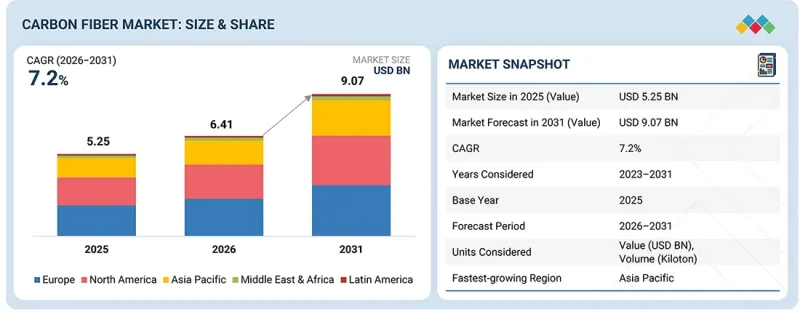
預計到 2026 年,碳纖維市場價值將達到 64.1 億美元,並預計從 2026 年到 2031 年將以 7.2% 的複合年成長率成長,到 2031 年達到 90.7 億美元。
瀝青基碳纖維由石油基瀝青製成,具有優異的機械性能和高熱穩定性。這些纖維的抗張強度超過5 GPa,與鋼的抗張強度相當。
| 調查範圍 | |
|---|---|
| 調查期 | 2023-2031 |
| 基準年 | 2025 |
| 預測期 | 2026-2031 |
| 計算單位 | 金額(百萬美元)和數量(千噸) |
| 部分 | 依原料、係數、產品類型、纖維類型、應用、最終用途產業、地區 |
| 目標區域 | 歐洲、北美、亞太地區、中東和非洲、拉丁美洲 |
此外,其剛性重量比是鋁的兩倍,使其成為輕量化應用的理想選擇。瀝青基碳纖維具有出色的耐腐蝕性、耐化學性和耐極端溫度性能,使其能夠在惡劣環境下使用。其高導熱性確保了高效率的散熱,使其適用於對熱敏感的應用。與聚丙烯腈(PAN)基纖維相比,瀝青基碳纖維具有更高的抗疲勞性,並且可以針對特定應用進行更高精度的製造。
“以金額為準,原生碳纖維在整個碳纖維市場中佔據最大佔有率。”
由於其卓越的機械性能,包括高強度、輕質、高剛性和優異的耐化學性,原生碳纖維在全球碳纖維市場中佔據最大佔有率。這些特性使得原生碳纖維成為航太與國防、汽車、風力發電、體育用品和壓力容器等產業高要求應用的理想選擇。在終端用戶產業,飛機、汽車和可再生能源系統越來越依賴輕量材料,以提高燃油效率、增強結構性能並減少整體排放。原生碳纖維因其穩定的品質、可靠的性能和成熟的製造程序而備受青睞。這些要素對於關鍵和高效能結構應用至關重要。雖然再生碳纖維作為一種經濟高效且永續的替代方案正在興起,但原生碳纖維憑藉其卓越的結構完整性、增強的耐久性和在先進複合材料應用中的廣泛適用性,仍然佔據市場主導地位。
“從以金額為準來看,高模量碳纖維在整個碳纖維市場中佔據第三大佔有率。”
高模量碳纖維憑藉其在高性能應用中卓越的剛性和尺寸穩定性,在全球碳纖維市場中佔據第三大市場佔有率。高模量碳纖維是為那些剛度和抗變形能力比抗張強度更重要的應用而設計。這些纖維的碳含量通常超過98%,這賦予了它們優異的剛度、熱穩定性和結構性能。高模量碳纖維的主要特性之一是其高模量,通常超過370 GPa,使其剛度遠高於標準模量碳纖維。這些特性使得高模量碳纖維廣泛應用於航太零件、衛星、國防系統、體育用品和精密工業設備等領域,這些領域對輕質結構、最小撓度和高精度都有極高的要求。
“以金額為準,長纖維在整個碳纖維市場中佔據了第三大佔有率。”
長纖維碳纖維在全球碳纖維市場中佔據第三大佔有率,這主要得益於其卓越的機械性能以及在高性能複合材料領域日益廣泛的應用。長纖維碳纖維的長度通常超過1毫米,被廣泛用作先進複合材料結構的增強材料,以滿足其對強度和耐久性的高要求。與短纖維碳纖維相比,長纖維碳纖維具有更高的拉伸強度、更強的剛性、更優異的抗衝擊性和更佳的疲勞性能,使其適用於承受持續機械應力和嚴苛工況的應用。這些優異的性能促使其在風電、航太與國防、汽車和賽車等產業中得到更廣泛的應用。長纖維碳纖維複合材料廣泛應用於風力發電機葉片、飛機結構零件、高性能汽車零件以及一級方程式賽車等領域,在這些領域,輕量材料、卓越的結構完整性和長期可靠性至關重要。
“就以金額為準,非複合材料領域在碳纖維市場中佔據第二大佔有率。”
在傳統複合材料材料結構之外,碳纖維在獨立應用和特殊應用領域的應用日益廣泛,推動了非複合材料領域在全球碳纖維市場中佔據第二大佔有率。碳纖維以其卓越的強度重量比、剛性、耐腐蝕性和抗疲勞性而廣受認可,這些特性正推動其在各種非複合材料應用中更廣泛的應用。除了結構應用外,碳纖維還具有優異的導熱性和導電性,使其成為散熱器、電磁干擾 (EMI) 屏蔽、半導體、先進電池和燃料電池組件等電子電氣應用的理想材料。此外,其生物相容性、輕質和滲透性也引起了醫療保健領域的極大關注,使其成為手術器械、義肢、整形外科器械和醫學影像設備的理想材料。技術進步以及電子、醫療保健和工業應用領域對高性能材料日益成長的需求,將繼續推動非複合材料碳纖維領域的成長。
“在預測期內,壓力容器行業預計將成為成長最快的終端用戶行業。”
預計在預測期內,壓力容器產業將成為全球碳纖維市場中成長最快的領域,這主要得益於氫氣、壓縮天然氣 (CNG)、航太和工業應用領域對輕質高壓儲能解決方案的需求不斷成長。碳纖維廣泛應用於壓力容器的製造,其製造過程主要採用纏繞成型法,即將高強度纖維束纏繞在內襯或芯軸上,形成堅固且氣密的結構。碳纖維增強壓力容器在保持優異強度、耐腐蝕性和耐壓性的同時,顯著減輕了重量。它們通常比傳統的鋼製或鋁製容器輕75%。這些優勢使其成為氫氣儲存槽、CNG氣瓶、航太系統和交通運輸應用的理想選擇,在這些應用中,減輕重量和提高運作效率至關重要。此外,碳纖維壓力容器還具有卓越的抗疲勞性、耐久性和長使用壽命,這支持了它們在下一代清潔能源和移動出行解決方案中日益廣泛的應用。預計對氫能基礎設施、燃料電池汽車和替代燃料儲存技術的投資增加將進一步加速全球對碳纖維壓力容器的需求。
“在預測期內,亞太地區碳纖維市場預計將錄得最高的成長率。”
在預測期內,亞太地區預計將成為碳纖維市場成長最快的地區,這主要得益於快速的工業化進程、汽車、航太和製造業對輕量材料日益成長的需求,以及對技術創新的高度重視。特別是日本、中國和韓國等國家正在碳纖維市場進行大量投資,包括先進製造技術以及用於航太、汽車和基礎設施應用的碳纖維複合材料的開發。這些國家以其尖端技術和創新而聞名,東麗株式會社和三菱化學集團等領導企業正推動高性能應用碳纖維生產技術的進步。
本報告對以下公司進行了全面分析:
市場的主要參與者包括東麗株式會社(日本)、陶氏化學株式會社(土耳其)、三菱化學集團株式會社(日本)、Syensqo(比利時)、帝人株式會社(日本)、SGL Carbon(德國)、Hexcel Corporation(美國)、HS Hyosung Advanced Materials(韓國)、中復神鷹(中國)、碳株纖維株) Corporation(日本)、大阪瓦斯化學株式會社(日本)、UMATEX(俄羅斯)、吉林化纖集團(中國)、江蘇恆申(中國)和中國藍星集團(中國)。
調查範圍
本研究報告按原料類型(瀝青和原膠)、纖維類型(原生纖維和再生纖維)、彈性模量(標準、中等、高)、產品類型(連續纖維、長纖維、短纖維)、應用領域(複合材料和非複合材料)、終端用戶產業(航太與國防、汽車、風能、管道、壓力容器、體育用品、建築與基礎設施、建築與農業本報告涵蓋影響碳纖維市場成長的關鍵因素的詳細信息,包括促進因素、阻礙因素、挑戰和機會。該報告對主要行業參與者進行了深入調查,提供了有關其業務概況、解決方案和服務、關鍵策略以及碳纖維市場最新趨勢的見解。此外,本報告也對碳纖維市場生態系統中新興的新創公司進行了競爭分析。
購買本報告的理由:
本報告透過提供碳纖維市場及其細分市場最準確的銷售數據估算,幫助市場領導和新參與企業更了解市場格局。它有助於相關人員了解競爭格局,更好地定位自身業務,並制定合適的打入市場策略。此外,本報告還幫助相關人員了解市場趨勢,並提供關鍵市場促進因素、限制因素、挑戰和機會的資訊。
本報告深入分析了以下幾點:
- 本報告分析了影響碳纖維市場成長的因素,包括主要促進因素(衛星零件製造的擴張、航太和國防工業的高需求、由於嚴格的環境法規而在汽車應用中的採用率增加、風力發電行業的使用增加以及對壓力容器用常規絲束碳纖維的需求增加)、阻礙因素(生產成本高、製造技術缺乏、對壓力容器用常規絲束碳纖維的需求增加)、制約電算電力(FCEV) 的需求增加、在 3D 列印領域的使用增加以及碳纖維回收技術的進步)和挑戰(低成本碳纖維的生產、資本密集型生產和複雜的製造流程以及可回收性問題)。
- 產品開發與創新:深入了解碳纖維市場的未來技術、研發活動和服務推出。
- 市場發展:提供盈利市場的全面資訊。本報告分析了不同地區的碳纖維市場。
- 市場多元化:全面介紹碳纖維市場的服務、未開發地區、最新趨勢及投資狀況。
- 競爭評估:我們對東麗株式會社(日本)、陶氏化學株式會社(土耳其)、三菱化學集團株式會社(日本)、Syensqo(比利時)、帝人株式會社(日本)、SGL Carbon(德國)、Hexcel Corporation(美國)、HS Hyosung Advanced Materials(韓國)、中復神鷹(中國碳纖維集團) Corporation(日本)、大阪瓦斯化學株式會社(日本)、UMATEX(俄羅斯)、吉林化纖集團(中國)、江蘇恆申(中國)和中國藍星集團(中國)等主要公司的市場佔有率、成長策略和服務產品進行了詳細評估。
目錄
第1章:引言
第2章執行摘要
第3章重要考察
第4章 市場概覽
- 市場動態
- 促進因素
- 抑制因子
- 機會
- 任務
- 未滿足的需求和未開發的領域
- 相互關聯的市場與跨產業機遇
- 新的經營模式和生態系統的變化
- 一級/二級/三級公司的策略性舉措
第5章 產業趨勢
- 波特五力分析
- 總體經濟指標
- 供應鏈分析
- 生態系分析
- 價格分析
- 貿易分析,2021-2025年
- 2026年至2028年主要會議及活動
- 影響客戶業務的趨勢/顛覆性因素
- 投資和資金籌措場景
- 案例研究分析
- 2025年美國關稅對碳纖維市場的影響
第6章:技術進步、人工智慧的影響、專利、創新與未來應用
- 主要新興技術
- 互補技術
- 技術/產品藍圖
- 專利分析
- 未來應用
- 人工智慧/生成式人工智慧對碳纖維市場的影響
- 成功案例和實際應用
第7章永續性和監管情勢
- 當地法規和合規性
- 對永續性的承諾
- 對永續性和監管政策舉措的影響
- 認證、標籤檢視、環境標準
第8章:顧客趨勢與購買行為
- 決策流程
- 買方相關人員和採購評估標準
- 實施障礙和內部挑戰
- 各個終端用戶產業中尚未滿足的需求
- 市場盈利
第9章:碳纖維市場(按原始材料分類)
- PAN基碳纖維
- 瀝青基碳纖維
第10章:碳纖維市場(依係數)
- 標準彈性模量
- 中間彈性模量
- 高模量
第11章:碳纖維市場(依產品類型分類)
- 連續碳纖維
- 長碳纖維
- 短碳纖維
第12章:碳纖維市場(依纖維類型分類)
- 原生碳纖維
- 再生碳纖維
第13章:碳纖維市場(依應用領域分類)
- 複合材料
- 非複合材料
第14章:碳纖維市場(依終端用戶產業分類)
- 航太/國防
- 風力發電
- 車
- 管道
- 體育用品
- 醫療保健
- 建築和基礎設施
- 壓力容器
- 船
- 其他
第15章:碳纖維市場(依地區分類)
- 歐洲
- 北美洲
- 亞太地區
- 中東和非洲
- 拉丁美洲
第16章 競爭格局
- 概述
- 主要參與企業的策略/優勢
- 收入分析
- 市佔率分析
- 品牌對比
- 企業估值矩陣:主要公司,2025 年
- 公司估值矩陣:新創企業/中小企業,2025 年
- 企業估值和財務指標
- 競爭格局
第17章:公司簡介
- 主要參與企業
- TORAY INDUSTRIES, INC.
- DOWAKSA
- MITSUBISHI CHEMICAL GROUP CORPORATION
- SYENSQO
- TEIJIN LIMITED
- SGL CARBON
- HEXCEL CORPORATION
- HS HYOSUNG ADVANCED MATERIALS
- ZHONGFU SHENYING CARBON FIBER CO., LTD.
- UMATEX
- KUREHA CORPORATION
- OSAKA GAS CHEMICALS CO., LTD.
- JILIN CHEMICAL FIBER GROUP CO., LTD.
- JIANGSU HENGSHEN CO., LTD.
- CHINA NATIONAL BLUESTAR(GROUP)CO., LTD.
- 其他公司
- CHINA WEIHAI GUANGWEI COMPOSITES CO., LTD.
- CHANGSHENG(LANGFANG)TECHNOLOGY CO., LTD.
- JILIN JIYAN HIGH-TECH FIBER CO., LTD.
- JILIN SHENZHOU CARBON FIBER CO., LTD.
- ALFA CHEMISTRY
- BCIRCULAR
- VARTEGA INC.
- FLINK INTERNATIONAL CO., LTD.
- CHINA COMPOSITES GROUP CORPORATION LTD.
- FORMOSA PLASTICS CORPORATION
- NIPPON GRAPHITE FIBER CO., LTD.
- NEWTECH GROUP CO., LTD.
- ACE C&TECH CO., LTD.
- PROCOTEX
- CARBON CONVERSIONS
- OAK RIDGE NATIONAL LABORATORY
第18章:調查方法
第19章附錄
The carbon fiber market is estimated at USD 6.41 billion in 2026 and is projected to reach USD 9.07 billion by 2031, at a CAGR of 7.2% from 2026 to 2031. Pitch-based carbon fibers, derived from petroleum-based pitch, offer superior mechanical properties and high thermal stability. They possess excellent tensile strength, exceeding 5 GPa, which is comparable to steel.
| Scope of the Report | |
|---|---|
| Years Considered for the Study | 2023-2031 |
| Base Year | 2025 |
| Forecast Period | 2026-2031 |
| Units Considered | Value (USD million) and volume (kiloton) |
| Segments | Raw material type, fiber type, modulus, product type, application, end-use industry, and region |
| Regions covered | Europe, North America, Asia Pacific, Middle East & Africa, and Latin America |
Moreover, their specific stiffness is twice that of aluminum, making them ideal for lightweight applications. Pitch carbon fibers exhibit exceptional resistance to corrosion, chemicals, and extreme temperatures, enabling their utilization in demanding environments. Their high thermal conductivity ensures efficient heat dissipation, making them suitable for heat-sensitive applications. Pitch-based carbon fiber offers enhanced fatigue resistance and can be manufactured with greater precision in certain applications compared to PAN-based fibers.
''In terms of value, virgin carbon fiber accounted for the largest share of the overall carbon fiber market.''
The virgin carbon fiber segment accounted for the largest share of the global carbon fiber market owing to its superior mechanical properties, including high strength, lightweight characteristics, stiffness, and excellent chemical resistance. These properties make virgin carbon fiber highly suitable for demanding applications across industries such as aerospace & defense, automotive, wind energy, sporting goods, and pressure vessels. End-use industries increasingly rely on lightweight materials to improve fuel efficiency, enhance structural performance, and reduce overall emissions in aircraft, vehicles, and renewable energy systems. Virgin carbon fiber remains widely preferred for its consistent quality, reliable performance, and well-established manufacturing processes, which are essential for critical and high-performance structural applications. Although recycled carbon fiber is gaining momentum as a cost-effective and sustainable alternative, virgin carbon fiber continues to dominate the market because of its superior structural integrity, enhanced durability, and broader applicability across advanced composite applications.
''In terms of value, high modulus accounted for the third-largest share of the overall carbon fiber market.''
The high-modulus carbon fiber segment accounted for the third-largest share of the global carbon fiber market, owing to its superior stiffness and dimensional stability in high-performance applications. High modulus carbon fiber is specifically engineered for applications where rigidity and resistance to deformation are more critical than tensile strength. These fibers typically possess a carbon content exceeding 98%, which contributes to their exceptional stiffness, thermal stability, and structural performance. One of the key characteristics of high-modulus carbon fiber is its high modulus of elasticity, generally above 370 GPa, making it considerably stiffer than standard-modulus carbon fiber. Owing to these properties, high-modulus carbon fibers are extensively used in aerospace components, satellites, defense systems, sporting goods, and precision industrial equipment, where lightweight structures with minimal flex and high accuracy are required.
''In terms of value, long fiber accounted for the third-largest share of the overall carbon fiber market.''
The long carbon fiber segment held the third-largest share of the global carbon fiber market, driven by its enhanced mechanical performance and growing use in high-performance composite applications. Long carbon fibers, typically measuring more than 1 mm in length, are widely used as reinforcement in advanced composite structures that require superior strength and durability. Compared to short carbon fibers, long carbon fibers provide higher tensile strength, improved stiffness, better impact resistance, and enhanced fatigue performance, making them suitable for applications exposed to continuous mechanical stress and demanding operating conditions. These characteristics have increased their adoption across industries such as wind energy, aerospace & defense, automotive, and motorsports. Long carbon fiber composites are extensively utilized in wind turbine blades, aircraft structural components, high-performance automotive parts, and Formula 1 vehicles, where lightweight materials with superior structural integrity and long-term reliability are critical.
''In terms of value, the non-composites segment accounted for the second-largest share of the carbon fiber market.''
The non-composites segment accounted for the second-largest share of the global carbon fiber market, driven by the expanding use of carbon fiber in standalone and specialty applications beyond traditional composite structures. Carbon fiber is widely recognized for its exceptional strength-to-weight ratio, stiffness, corrosion resistance, and fatigue resistance, and these properties are increasingly driving its adoption in various non-composite applications. In addition to structural uses, carbon fiber demonstrates excellent thermal and electrical conductivity, making it highly suitable for electronic and electrical applications such as heat sinks, electromagnetic interference (EMI) shielding, semiconductors, advanced batteries, and fuel cell components. The material is also gaining significant traction in the medical and healthcare sectors owing to its biocompatibility, lightweight nature, and radiolucency, which make it ideal for surgical instruments, prosthetics, orthopedic devices, and medical imaging equipment. Growing technological advancements and the increasing need for high-performance materials across electronics, healthcare, and industrial applications continue to support the growth of the non-composites carbon fiber segment.
"The pressure vessels industry is projected to be the fastest-growing end-use industry during the forecast period."
The pressure vessels industry is projected to register the fastest growth in the global carbon fiber market during the forecast period, driven by rising demand for lightweight, high-pressure storage solutions across hydrogen, compressed natural gas (CNG), aerospace, and industrial applications. Carbon fiber is widely used in pressure vessel manufacturing via filament winding, where high-strength tows are wound over a liner or mandrel to create durable, gas-tight structures. Carbon fiber-reinforced pressure vessels offer significant weight reduction, typically being up to 75% lighter than conventional steel or aluminum vessels, while maintaining superior strength, corrosion resistance, and pressure-handling capability. These advantages make them highly suitable for hydrogen storage tanks, CNG cylinders, aerospace systems, and transportation applications where weight reduction and operational efficiency are critical. In addition, carbon fiber pressure vessels provide excellent fatigue resistance, durability, and long service life, supporting their increasing adoption in next-generation clean energy and mobility solutions. Growing investments in hydrogen infrastructure, fuel cell vehicles, and alternative fuel storage technologies are expected to further accelerate demand for carbon fiber-based pressure vessels globally.
"The Asia Pacific region is projected to register the highest growth rate in the carbon fiber market during the forecast period."
The Asia Pacific is projected to be the fastest-growing region in the carbon fiber market during the forecast period, driven by rapid industrialization, rising demand for lightweight materials across the automotive, aerospace, and manufacturing industries, and a strong focus on technological advancements. In particular, countries like Japan, China, and South Korea are investing substantially in the carbon fiber market, including advanced manufacturing technologies and the development of carbon fiber composites for aerospace, automotive, and infrastructure applications. These countries are known for their cutting-edge technology and innovation, with major companies such as Toray Industries, Inc. and Mitsubishi Chemical Group Corporation driving advancements in carbon fiber production for high-performance applications.
This study has been validated through primary interviews with industry experts globally. The primary sources have been divided into the following three categories:
- By Company Type: Tier 1 - 40%, Tier 2 - 33%, and Tier 3 - 27%
- By Designation: C-level - 50%, Director-level - 30%, and Managers - 20%
- By Region: North America - 15%, Europe - 50%, Asia Pacific - 20%, the Middle East & Africa - 10%, and Latin America - 5%
The report provides a comprehensive analysis of the following companies:
Prominent companies in this market include Toray Industries, Inc. (Japan), DowAksa (Turkey), Mitsubishi Chemical Group Corporation (Japan), Syensqo (Belgium), Teijin Limited (Japan), SGL Carbon (Germany), Hexcel Corporation (US), HS Hyosung Advanced Materials (South Korea), Zhongfu Shenying Carbon Fiber Co., Ltd. (China), Kureha Corporation (Japan), Osaka Gas Chemicals Co., Ltd., (Japan), UMATEX (Russia), Jilin Chemical Fiber Group Co., Ltd. (China), Jiangsu Hengshen Co., Ltd. (China), and China National Bluestar (Group) Co., Ltd. (China).
Research coverage
This research report categorizes the carbon fiber market by raw material type (pan and pitch), fiber type (virgin and recycled), modulus (standard, intermediate, and high), product type (continuous, long, and short), application (composites and non-composites), end-use industry (aerospace & defense, automotive, wind energy, pipe, pressure vessels, sporting goods, construction & infrastructure, medical & healthcare, and marine), and region (North America, Europe, Asia Pacific, the Middle East & Africa, and Latin America). The scope of the report includes detailed information on the major factors influencing the growth of the carbon fiber market, including drivers, restraints, challenges, and opportunities. A thorough examination of the key industry players has been conducted in order to provide insights into their business overview, solutions and services, key strategies, and recent developments in the carbon fiber market. This report includes a competitive analysis of upcoming startups in the carbon fiber market ecosystem.
Reasons to buy this report:
The report will help market leaders/new entrants in this market with information on the closest approximations of revenue for the overall carbon fiber market and its subsegments. This report will help stakeholders understand the competitive landscape and gain insights to better position their businesses and plan suitable go-to-market strategies. The report also helps stakeholders understand the pulse of the market and provides them with information on key market drivers, restraints, challenges, and opportunities.
The report provides insights into the following pointers:
- Analysis of key drivers (growth in manufacturing of satellite parts, high demand from aerospace & defense industry, rising adoption in automobile applications due to stringent eco-friendly regulations, increased use in wind energy industry, and rising demand for regular tow carbon in pressure vessels), restraints (high production cost, lack of standardization in manufacturing technologies, and damage repair and compatibility issues), opportunities (increased investments in the development of low-cost coal-based carbon fibers, potential opportunities in new applications, increasing demand for fuel cell electric vehicles (FCEVs), increasing use in 3D printing, advancements in carbon fiber recycling technologies), and challenges (production of low-cost carbon fiber, capital-intensive production and complex manufacturing processes, and recyclability issues) influencing the growth of the carbon fiber market.
- Product Development/Innovation: Detailed insights on upcoming technologies, research & development activities, and service launches in the carbon fiber market.
- Market Development: Comprehensive information about lucrative markets - the report analyses the carbon fiber market across varied regions.
- Market Diversification: Exhaustive information about services, untapped geographies, recent developments, and investments in the carbon fiber market.
- Competitive Assessment: In-depth assessment of market shares, growth strategies, and service offerings of leading players like Toray Industries, Inc. (Japan), DowAksa (Turkey), Mitsubishi Chemical Group Corporation (Japan), Syensqo (Belgium), Teijin Limited (Japan), SGL Carbon (Germany), Hexcel Corporation (US), HS Hyosung Advanced Materials (South Korea), Zhongfu Shenying Carbon Fiber Co., Ltd. (China), Kureha Corporation (Japan), Osaka Gas Chemicals Co., Ltd., (Japan), UMATEX (Russia), Jilin Chemical Fiber Group Co., Ltd. (China), Jiangsu Hengshen Co., Ltd. (China), and China National Bluestar (Group) Co., Ltd. (China) in the carbon fiber market.
TABLE OF CONTENTS
1 INTRODUCTION
- 1.1 STUDY OBJECTIVES
- 1.2 MARKET DEFINITION
- 1.3 STUDY SCOPE
- 1.3.1 MARKETS COVERED AND REGIONAL SCOPE
- 1.3.2 INCLUSIONS AND EXCLUSIONS
- 1.3.3 YEARS CONSIDERED
- 1.3.4 CURRENCY CONSIDERED
- 1.3.5 UNITS CONSIDERED
- 1.4 LIMITATIONS
- 1.5 STAKEHOLDERS
2 EXECUTIVE SUMMARY
- 2.1 KEY INSIGHTS AND MARKET HIGHLIGHTS
- 2.2 KEY MARKET PARTICIPANTS: SHARE INSIGHTS AND STRATEGIC DEVELOPMENTS
- 2.3 DISRUPTIVE TRENDS SHAPING MARKET
- 2.4 HIGH-GROWTH SEGMENTS & EMERGING FRONTIERS
- 2.5 SNAPSHOT: GLOBAL MARKET SIZE, GROWTH RATE, AND FORECAST
3 PREMIUM INSIGHTS
- 3.1 ATTRACTIVE OPPORTUNITIES FOR PLAYERS IN CARBON FIBER MARKET
- 3.2 CARBON FIBER MARKET, BY END-USE INDUSTRY AND REGION
- 3.3 CARBON FIBER MARKET, BY RAW MATERIAL
- 3.4 CARBON FIBER MARKET, BY APPLICATION
- 3.5 CARBON FIBER MARKET, BY MODULUS
- 3.6 CARBON FIBER MARKET, BY FIBER TYPE
- 3.7 CARBON FIBER MARKET, BY PRODUCT TYPE
- 3.8 CARBON FIBER MARKET, BY COUNTRY
4 MARKET OVERVIEW
- 4.1 INTRODUCTION
- 4.2 MARKET DYNAMICS
- 4.2.1 DRIVERS
- 4.2.1.1 Growing demand for lightweight and fuel-efficient vehicles
- 4.2.1.2 Growth in manufacturing of satellite parts
- 4.2.1.3 High usage in aerospace & defense industry
- 4.2.1.4 Increased use in wind energy industry
- 4.2.2 RESTRAINTS
- 4.2.2.1 High material and production cost
- 4.2.2.2 Lack of standardization in manufacturing technologies
- 4.2.2.3 Damage repair and compatibility issues
- 4.2.3 OPPORTUNITIES
- 4.2.3.1 Increased investments in development of low-cost coal-based carbon fibers
- 4.2.3.2 Increasing use in 3D printing
- 4.2.3.3 Growing demand for recyclable and sustainable composite materials
- 4.2.3.4 Increasing demand for fuel-cell electric vehicles (FCEVs)
- 4.2.4 CHALLENGES
- 4.2.4.1 Supply chain concentration and precursor dependency
- 4.2.4.2 Certification and qualification barriers in high-performance applications
- 4.2.4.3 Demand volatility driven by policy-dependent end-use industries
- 4.2.1 DRIVERS
- 4.3 UNMET NEEDS AND WHITE SPACES
- 4.3.1 UNMET NEEDS IN CARBON FIBER MARKET
- 4.3.2 WHITE SPACE OPPORTUNITIES
- 4.4 INTERCONNECTED MARKETS AND CROSS-SECTOR OPPORTUNITIES
- 4.4.1 INTERCONNECTED MARKETS
- 4.4.2 CROSS-SECTOR OPPORTUNITIES
- 4.5 EMERGING BUSINESS MODELS AND ECOSYSTEM SHIFTS
- 4.5.1 EMERGING BUSINESS MODELS
- 4.5.2 ECOSYSTEM SHIFTS
- 4.6 STRATEGIC MOVES BY TIER-1/2/3 PLAYERS
- 4.6.1 KEY MOVES AND STRATEGIC FOCUS
5 INDUSTRY TRENDS
- 5.1 PORTER'S FIVE FORCES ANALYSIS
- 5.1.1 THREAT OF NEW ENTRANTS
- 5.1.2 THREAT OF SUBSTITUTES
- 5.1.3 BARGAINING POWER OF SUPPLIERS
- 5.1.4 BARGAINING POWER OF BUYERS
- 5.1.5 INTENSITY OF COMPETITIVE RIVALRY
- 5.2 MACROECONOMICS INDICATORS
- 5.2.1 INTRODUCTION
- 5.2.2 GDP TRENDS AND FORECAST
- 5.2.3 TRENDS IN AUTOMOTIVE INDUSTRY
- 5.2.4 TRENDS IN AEROSPACE & DEFENSE
- 5.2.5 TRENDS IN WIND ENERGY
- 5.3 SUPPLY CHAIN ANALYSIS
- 5.4 ECOSYSTEM ANALYSIS
- 5.5 PRICING ANALYSIS
- 5.5.1 AVERAGE SELLING PRICE OFFERED BY KEY PLAYERS, BY END-USE INDUSTRY
- 5.5.2 AVERAGE SELLING PRICE TREND OF CARBON FIBER, BY REGION
- 5.6 TRADE ANALYSIS, 2021-2025
- 5.6.1 IMPORT SCENARIO (HS CODE 681511)
- 5.6.2 EXPORT SCENARIO (HS CODE 681511)
- 5.7 KEY CONFERENCES AND EVENTS, 2026-2028
- 5.8 TRENDS/DISRUPTIONS IMPACTING CUSTOMER BUSINESS
- 5.9 INVESTMENT AND FUNDING SCENARIO
- 5.10 CASE STUDY ANALYSIS
- 5.10.1 MITSUBISHI'S DEVELOPMENT OF CARBON FIBER-REINFORCED PLASTICS FOR STRUCTURAL AIRCRAFT PARTS
- 5.10.2 SGL CARBON'S CLIMATE-FRIENDLY CARBON FIBER TO REVOLUTIONIZE SUSTAINABLE MANUFACTURING
- 5.10.3 TRUE TEMPER SPORTS PARTNERS WITH HEXCEL CORPORATION FOR ITS FIRST GOLF SHAFT LINE
- 5.11 IMPACT OF 2025 US TARIFF ON CARBON FIBER MARKET
- 5.11.1 INTRODUCTION
- 5.11.2 KEY TARIFF RATES
- 5.11.3 PRICE IMPACT ANALYSIS
- 5.11.4 IMPACT ON COUNTRIES/REGIONS
- 5.11.4.1 North America
- 5.11.4.2 Europe
- 5.11.4.3 Asia Pacific
- 5.11.4.4 Middle East & Africa
- 5.11.5 IMPACT ON TOP END-USE INDUSTRIES
6 TECHNOLOGICAL ADVANCEMENTS, AI-DRIVEN IMPACT, PATENTS, INNOVATIONS, AND FUTURE APPLICATIONS
- 6.1 KEY EMERGING TECHNOLOGIES
- 6.1.1 LOW-COST CARBON FIBER (LCCF) VIA ALTERNATIVE PRECURSORS (LIGNIN/BIO-BASED/PAN-BLENDS)
- 6.1.2 PLASMA OXIDATION & MICROWAVE-ASSISTED CARBONIZATION (RAPID PROCESSING CF TECHNOLOGY)
- 6.2 COMPLEMENTARY TECHNOLOGIES
- 6.2.1 CARBON FIBER RECYCLING (RCF) & CLOSED-LOOP MANUFACTURING
- 6.3 TECHNOLOGY/PRODUCT ROADMAP
- 6.3.1 SHORT-TERM (2026-2028) | FOUNDATION & INCREMENTAL COMMERCIALIZATION
- 6.3.2 MID-TERM (2028-2031) | EXPANSION & STANDARDIZATION
- 6.3.3 LONG-TERM (2032-2036+) | DISRUPTION & MASS ADOPTION
- 6.4 PATENT ANALYSIS
- 6.4.1 INTRODUCTION
- 6.4.2 METHODOLOGY
- 6.4.3 DOCUMENT TYPES
- 6.4.4 INSIGHTS
- 6.4.5 LEGAL STATUS
- 6.4.6 JURISDICTION ANALYSIS
- 6.4.7 TOP APPLICANTS
- 6.4.8 TOP 10 PATENT OWNERS (US) IN LAST 5 YEARS
- 6.5 FUTURE APPLICATIONS
- 6.5.1 STRUCTURAL EV BATTERY INTEGRATION (CELL-TO-PACK/ STRUCTURAL COMPOSITES)
- 6.5.2 HYBRID MULTI-MATERIAL VEHICLE ARCHITECTURES
- 6.5.3 ADVANCED STRUCTURAL & INFRASTRUCTURE SYSTEMS
- 6.5.4 HIGH-PERFORMANCE DATA CENTERS & ELECTRONICS
- 6.5.5 NEXT-GENERATION MOBILITY (UAVS, EVTOLS, SPACE SYSTEMS)
- 6.6 IMPACT OF AI/GEN AI ON CARBON FIBER MARKET
- 6.6.1 TOP USE CASES AND MARKET POTENTIAL
- 6.6.2 BEST PRACTICES IN CARBON FIBER MARKET
- 6.6.3 CASE STUDIES OF AI IMPLEMENTATION IN CARBON FIBER MARKET
- 6.6.4 INTERCONNECTED ADJACENT ECOSYSTEM AND IMPACT ON MARKET PLAYERS
- 6.6.5 CLIENTS' READINESS TO ADOPT GENERATIVE AI IN CARBON FIBER MARKET
- 6.7 SUCCESS STORIES AND REAL-WORLD APPLICATIONS
- 6.7.1 TORAY INDUSTRIES: HIGH-PERFORMANCE AEROSPACE AND SPORTS APPLICATIONS
- 6.7.2 HEXCEL CORPORATION: ADVANCED COMPOSITE STRUCTURES FOR AEROSPACE
7 SUSTAINABILITY AND REGULATORY LANDSCAPE
- 7.1 REGIONAL REGULATIONS AND COMPLIANCE
- 7.1.1 REGULATORY BODIES, GOVERNMENT AGENCIES, AND OTHER ORGANIZATIONS
- 7.1.2 INDUSTRY STANDARDS
- 7.2 SUSTAINABILITY INITIATIVES
- 7.2.1 CARBON IMPACT AND ECO-APPLICATIONS OF CARBON FIBER
- 7.2.1.1 Carbon impact reduction
- 7.2.1.2 Eco-Applications
- 7.2.1 CARBON IMPACT AND ECO-APPLICATIONS OF CARBON FIBER
- 7.3 SUSTAINABILITY IMPACT AND REGULATORY POLICY INITIATIVES
- 7.4 CERTIFICATIONS, LABELING, ECO-STANDARDS
8 CUSTOMER LANDSCAPE & BUYER BEHAVIOR
- 8.1 DECISION-MAKING PROCESS
- 8.2 BUYER STAKEHOLDERS AND BUYING EVALUATION CRITERIA
- 8.2.1 KEY STAKEHOLDERS IN BUYING PROCESS
- 8.2.2 BUYING CRITERIA
- 8.3 ADOPTION BARRIERS & INTERNAL CHALLENGES
- 8.4 UNMET NEEDS FROM VARIOUS END-USE INDUSTRIES
- 8.5 MARKET PROFITABILITY
- 8.5.1 REVENUE POTENTIAL
- 8.5.2 COST DYNAMICS
- 8.5.3 MARGIN OPPORTUNITIES BY APPLICATION
9 CARBON FIBER MARKET, BY RAW MATERIAL
- 9.1 INTRODUCTION
- 9.2 PAN-BASED CARBON FIBER
- 9.2.1 EXTENSIVE DEMAND FOR LIGHTWEIGHT STRUCTURAL COMPOSITES TO DRIVE MARKET
- 9.3 PITCH-BASED CARBON FIBER
- 9.3.1 WIDE USAGE IN SATELLITES, INDUSTRIAL, CONSTRUCTION, AND SPORTING GOODS SEGMENTS TO DRIVE MARKET
- 9.3.2 PETROLEUM-BASED PITCH CARBON FIBER
- 9.3.3 COAL-BASED PITCH CARBON FIBER
10 CARBON FIBER MARKET, BY MODULUS
- 10.1 INTRODUCTION
- 10.2 STANDARD MODULUS
- 10.2.1 USAGE ACROSS INDUSTRIES TO DRIVE MARKET
- 10.3 INTERMEDIATE MODULUS
- 10.3.1 DEMAND IN PRESSURE VESSELS, WIND TURBINE BLADES, AND AEROSPACE TO DRIVE MARKET
- 10.4 HIGH MODULUS
- 10.4.1 DEMAND FOR AEROSPACE APPLICATIONS TO DRIVE MARKET
11 CARBON FIBER MARKET, BY PRODUCT TYPE
- 11.1 INTRODUCTION
- 11.2 CONTINUOUS CARBON FIBER
- 11.2.1 RISING DEMAND FOR LIGHTWEIGHT HIGH-STRENGTH COMPOSITES TO DRIVE MARKET
- 11.3 LONG CARBON FIBER
- 11.3.1 INCREASING DEMAND FOR DURABLE LIGHTWEIGHT COMPOSITES TO DRIVE MARKET
- 11.4 SHORT CARBON FIBER
- 11.4.1 COST-EFFECTIVE LIGHTWEIGHT MATERIALS TO DRIVE MARKET
12 CARBON FIBER MARKET, BY FIBER TYPE
- 12.1 INTRODUCTION
- 12.2 VIRGIN CARBON FIBER
- 12.2.1 LONG-TERM HIGH PERFORMANCE IN TERMS OF FATIGUE AND ENVIRONMENTAL EFFECTS TO DRIVE MARKET
- 12.3 RECYCLED CARBON FIBER
- 12.3.1 GROWING ENVIRONMENTAL CONCERNS TO DRIVE MARKET
13 CARBON FIBER MARKET, BY APPLICATION
- 13.1 INTRODUCTION
- 13.2 COMPOSITES
- 13.2.1 RIGIDITY AND HIGH TENSILE STRENGTH TO FUEL DEMAND
- 13.2.2 PREPREGS
- 13.2.3 MOLDING COMPOUNDS
- 13.2.4 WOVEN FABRICS
- 13.3 NON-COMPOSITES
- 13.3.1 RISING DEMAND FOR EVS AND 3D PRINTING TO DRIVE MARKET
14 CARBON FIBER MARKET, BY END-USE INDUSTRY
- 14.1 INTRODUCTION
- 14.2 AEROSPACE & DEFENSE
- 14.2.1 MAJOR CONSUMER OF CARBON FIBER COMPOSITE MATERIALS
- 14.2.2 ROCKETS, SPACE VEHICLES, HABITATION EQUIPMENT
- 14.2.3 UMA (URBAN AIR MOBILITY) AND SMALL AIRCRAFT EQUIPMENT
- 14.3 WIND ENERGY
- 14.3.1 STEADY INCREASE IN GLOBAL WIND ENERGY INSTALLATION
- 14.4 AUTOMOTIVE
- 14.4.1 INCREASING ADOPTION OF CARBON FIBERS BY AUTOMOTIVE GIANTS TO DRIVE MARKET
- 14.4.2 INTERIOR COMPONENTS
- 14.4.3 EXTERIOR COMPONENTS
- 14.4.4 SMALL MOBILITY APPLICATION
- 14.5 PIPES
- 14.5.1 UNIQUE BLEND OF PROPERTIES TO DRIVE MARKET
- 14.6 SPORTING GOODS
- 14.6.1 INTEREST IN HIGHER PERFORMANCE AND SUSTAINABILITY TO DRIVE NEW CFRP MATERIALS IN SPORTING GOODS
- 14.7 MEDICAL & HEALTHCARE
- 14.7.1 SUSTENANCE UNDER EXTREME ENVIRONMENTAL CONDITIONS TO DRIVE MARKET
- 14.7.2 DIAGNOSTICS IMAGING
- 14.7.3 BODY IMPLANT, SURGICAL INSTRUMENTS, AND OTHERS
- 14.8 CONSTRUCTION & INFRASTRUCTURE
- 14.8.1 GROWTH IN CONSTRUCTION & INFRASTRUCTURE SEGMENT TO BOOST DEMAND
- 14.8.2 BUILDING INFRASTRUCTURE
- 14.8.3 CIVIL INFRASTRUCTURE
- 14.9 PRESSURE VESSELS
- 14.9.1 INCREASE IN DEMAND FOR TYPE IV CYLINDERS TO DRIVE MARKET
- 14.10 MARINE
- 14.10.1 GROWING MARINE APPLICATIONS TO DRIVE MARKET
- 14.11 OTHER END-USE INDUSTRIES
- 14.11.1 ELECTRICAL & ELECTRONICS
- 14.11.2 CABLES
- 14.11.3 MOLDING COMPOUNDS
15 CARBON FIBER MARKET, BY REGION
- 15.1 INTRODUCTION
- 15.2 EUROPE
- 15.2.1 EUROPE: CARBON FIBER MARKET, BY END-USE INDUSTRY
- 15.2.2 EUROPE: CARBON FIBER MARKET, BY COUNTRY
- 15.2.2.1 Germany
- 15.2.2.1.1 Strong automotive, aerospace, and renewable energy demand to drive market
- 15.2.2.2 France
- 15.2.2.2.1 Strong aerospace, EV, and renewable energy industries to drive market
- 15.2.2.3 UK
- 15.2.2.3.1 Growing demand for lightweight materials and offshore wind energy to drive market
- 15.2.2.4 Italy
- 15.2.2.4.1 Growing demand from automotive, wind energy, and advanced composites to drive market
- 15.2.2.5 Spain
- 15.2.2.5.1 Strong wind energy and aerospace demand to drive market
- 15.2.2.6 Rest of Europe
- 15.2.2.1 Germany
- 15.3 NORTH AMERICA
- 15.3.1 NORTH AMERICA: CARBON FIBER MARKET, BY END-USE INDUSTRY
- 15.3.2 NORTH AMERICA: CARBON FIBER MARKET, BY COUNTRY
- 15.3.2.1 US
- 15.3.2.1.1 Presence of well-established industries to drive market
- 15.3.2.2 Canada
- 15.3.2.2.1 Presence of well-established aerospace industry to fuel demand
- 15.3.2.1 US
- 15.4 ASIA PACIFIC
- 15.4.1 ASIA PACIFIC: CARBON FIBER MARKET, BY END-USE INDUSTRY
- 15.4.2 ASIA PACIFIC: CARBON FIBER MARKET, BY COUNTRY
- 15.4.2.1 Japan
- 15.4.2.1.1 Strong carbon fiber exports and advanced manufacturing to drive market
- 15.4.2.2 China
- 15.4.2.2.1 Strong EV, wind energy, and aerospace demand to drive market
- 15.4.2.3 Taiwan
- 15.4.2.3.1 Strong bicycle and advanced composites industries to drive market
- 15.4.2.4 South Korea
- 15.4.2.4.1 Strong automotive, hydrogen, and shipbuilding industries to drive market
- 15.4.2.5 Rest of Asia Pacific
- 15.4.2.1 Japan
- 15.5 MIDDLE EAST & AFRICA
- 15.5.1 MIDDLE EAST & AFRICA: CARBON FIBER MARKET, BY END-USE INDUSTRY
- 15.5.2 MIDDLE EAST & AFRICA: CARBON FIBER MARKET, BY COUNTRY
- 15.5.2.1 GCC Countries
- 15.5.2.1.1 UAE
- 15.5.2.1.1.1 Regional hub for advanced composites and lightweight mobility
- 15.5.2.1.2 Saudi Arabia
- 15.5.2.1.2.1 High demand in pipes & pressure vessels industry
- 15.5.2.1.3 Rest of GCC Countries
- 15.5.2.1.1 UAE
- 15.5.2.2 South Africa
- 15.5.2.2.1 Strengthens position in wind energy and advanced composites
- 15.5.2.3 Rest of Middle East & Africa
- 15.5.2.1 GCC Countries
- 15.6 LATIN AMERICA
- 15.6.1 LATIN AMERICA: CARBON FIBER MARKET, BY END-USE INDUSTRY
- 15.6.2 LATIN AMERICA: CARBON FIBER MARKET, BY COUNTRY
- 15.6.2.1 Brazil
- 15.6.2.1.1 Key hub for aerospace, wind energy, and automotive composites
- 15.6.2.2 Mexico
- 15.6.2.2.1 Automotive and wind energy industries to be prominent consumers of carbon fiber
- 15.6.2.3 Rest of Latin America
- 15.6.2.1 Brazil
16 COMPETITIVE LANDSCAPE
- 16.1 OVERVIEW
- 16.2 KEY PLAYER STRATEGIES/RIGHT TO WIN
- 16.3 REVENUE ANALYSIS
- 16.4 MARKET SHARE ANALYSIS
- 16.5 BRAND COMPARISON
- 16.6 COMPANY EVALUATION MATRIX: KEY PLAYERS, 2025
- 16.6.1 STARS
- 16.6.2 EMERGING LEADERS
- 16.6.3 PERVASIVE PLAYERS
- 16.6.4 PARTICIPANTS
- 16.6.5 COMPANY FOOTPRINT: KEY PLAYERS, 2025
- 16.6.5.1 Company footprint
- 16.6.5.2 Region footprint
- 16.6.5.3 Raw material type footprint
- 16.6.5.4 Fiber type footprint
- 16.6.5.5 Modulus type footprint
- 16.6.5.6 Product type footprint
- 16.6.5.7 Application footprint
- 16.6.5.8 End-use industry footprint
- 16.7 COMPANY EVALUATION MATRIX: STARTUPS/SMES, 2025
- 16.7.1 PROGRESSIVE COMPANIES
- 16.7.2 RESPONSIVE COMPANIES
- 16.7.3 DYNAMIC COMPANIES
- 16.7.4 STARTING BLOCKS
- 16.7.5 COMPETITIVE BENCHMARKING: STARTUPS/SMES, 2025
- 16.7.5.1 Detailed list of key startups/SMEs
- 16.7.5.2 Competitive benchmarking of key startups/SMEs
- 16.8 COMPANY VALUATION AND FINANCIAL METRICS
- 16.9 COMPETITIVE SCENARIO
- 16.9.1 PRODUCT LAUNCHES
- 16.9.2 DEALS
- 16.9.3 EXPANSIONS
- 16.9.4 OTHER DEVELOPMENTS
17 COMPANY PROFILES
- 17.1 KEY COMPANIES
- 17.1.1 TORAY INDUSTRIES, INC.
- 17.1.1.1 Business overview
- 17.1.1.2 Products offered
- 17.1.1.3 Recent developments
- 17.1.1.3.1 Product launches
- 17.1.1.3.2 Deals
- 17.1.1.3.3 Expansions
- 17.1.1.3.4 Other developments
- 17.1.1.4 MnM view
- 17.1.1.4.1 Right to win
- 17.1.1.4.2 Strategic choices
- 17.1.1.4.3 Weaknesses and competitive threats
- 17.1.2 DOWAKSA
- 17.1.2.1 Business overview
- 17.1.2.2 Products offered
- 17.1.2.3 Recent developments
- 17.1.2.3.1 Deals
- 17.1.2.3.2 Expansions
- 17.1.2.4 MnM view
- 17.1.2.4.1 Right to win
- 17.1.2.4.2 Strategic choices
- 17.1.2.4.3 Weaknesses and competitive threats
- 17.1.3 MITSUBISHI CHEMICAL GROUP CORPORATION
- 17.1.3.1 Business overview
- 17.1.3.2 Products offered
- 17.1.3.3 Recent developments
- 17.1.3.3.1 Deals
- 17.1.3.3.2 Expansions
- 17.1.3.4 MnM view
- 17.1.3.4.1 Right to win
- 17.1.3.4.2 Strategic choices
- 17.1.3.4.3 Weaknesses and competitive threats
- 17.1.4 SYENSQO
- 17.1.4.1 Business overview
- 17.1.4.2 Products offered
- 17.1.4.3 Recent developments
- 17.1.4.3.1 Deals
- 17.1.4.4 MnM view
- 17.1.4.4.1 Right to win
- 17.1.4.4.2 Strategic choices
- 17.1.4.4.3 Weaknesses and competitive threats
- 17.1.5 TEIJIN LIMITED
- 17.1.5.1 Business overview
- 17.1.5.2 Products offered
- 17.1.5.3 Recent developments
- 17.1.5.3.1 Product launches
- 17.1.5.3.2 Deals
- 17.1.5.3.3 Expansions
- 17.1.5.3.4 Other developments
- 17.1.5.4 MnM view
- 17.1.5.4.1 Right to win
- 17.1.5.4.2 Strategic choices
- 17.1.5.4.3 Weaknesses and competitive threats
- 17.1.6 SGL CARBON
- 17.1.6.1 Business overview
- 17.1.6.2 Products offered
- 17.1.6.3 Recent developments
- 17.1.6.3.1 Deals
- 17.1.6.3.2 Expansions
- 17.1.6.4 MnM view
- 17.1.6.4.1 Right to win
- 17.1.6.4.2 Strategic choices
- 17.1.6.4.3 Weaknesses and competitive threats
- 17.1.7 HEXCEL CORPORATION
- 17.1.7.1 Business overview
- 17.1.7.2 Products offered
- 17.1.7.3 Recent developments
- 17.1.7.3.1 Product launches
- 17.1.7.3.2 Deals
- 17.1.7.3.3 Expansions
- 17.1.7.4 MnM view
- 17.1.7.4.1 Right to win
- 17.1.7.4.2 Strategic choices
- 17.1.7.4.3 Weaknesses and competitive threats
- 17.1.8 HS HYOSUNG ADVANCED MATERIALS
- 17.1.8.1 Business overview
- 17.1.8.2 Products offered
- 17.1.8.3 Recent developments
- 17.1.8.3.1 Product launches
- 17.1.8.3.2 Deals
- 17.1.8.3.3 Expansions
- 17.1.8.4 MnM view
- 17.1.8.4.1 Right to win
- 17.1.8.4.2 Strategic choices
- 17.1.8.4.3 Weaknesses and competitive threats
- 17.1.9 ZHONGFU SHENYING CARBON FIBER CO., LTD.
- 17.1.9.1 Business overview
- 17.1.9.2 Products offered
- 17.1.9.3 Recent developments
- 17.1.9.3.1 Product launches
- 17.1.9.3.2 Expansions
- 17.1.9.4 MnM view
- 17.1.9.4.1 Right to win
- 17.1.9.4.2 Strategic choices
- 17.1.9.4.3 Weaknesses and competitive threats
- 17.1.10 UMATEX
- 17.1.10.1 Business overview
- 17.1.10.2 Products offered
- 17.1.10.3 MnM view
- 17.1.10.3.1 Right to win
- 17.1.10.3.2 Strategic choices
- 17.1.10.3.3 Weaknesses and competitive threats
- 17.1.11 KUREHA CORPORATION
- 17.1.11.1 Business overview
- 17.1.11.2 Products offered
- 17.1.11.3 MnM view
- 17.1.11.3.1 Key strengths
- 17.1.11.3.2 Strategic choices
- 17.1.11.3.3 Weaknesses and competitive threats
- 17.1.12 OSAKA GAS CHEMICALS CO., LTD.
- 17.1.12.1 Business overview
- 17.1.12.2 Products offered
- 17.1.12.3 MnM view
- 17.1.12.3.1 Key strengths
- 17.1.12.3.2 Strategic choices
- 17.1.12.3.3 Weaknesses & competitive threats
- 17.1.13 JILIN CHEMICAL FIBER GROUP CO., LTD.
- 17.1.13.1 Business overview
- 17.1.13.2 Products offered
- 17.1.13.3 Recent developments
- 17.1.13.3.1 Deals
- 17.1.13.3.2 Expansions
- 17.1.13.4 MnM view
- 17.1.13.4.1 Key strengths
- 17.1.13.4.2 Strategic choices
- 17.1.13.4.3 Weaknesses & competitive threats
- 17.1.14 JIANGSU HENGSHEN CO., LTD.
- 17.1.14.1 Business overview
- 17.1.14.2 Products offered
- 17.1.14.3 Recent developments
- 17.1.14.3.1 Expansions
- 17.1.14.4 MnM view
- 17.1.14.4.1 Key strengths
- 17.1.14.4.2 Strategic choices
- 17.1.14.4.3 Weaknesses & competitive threats
- 17.1.15 CHINA NATIONAL BLUESTAR (GROUP) CO., LTD.
- 17.1.15.1 Business overview
- 17.1.15.2 Products offered
- 17.1.15.3 MnM view
- 17.1.15.3.1 Key strengths
- 17.1.15.3.2 Strategic choices
- 17.1.15.3.3 Weaknesses & competitive threats
- 17.1.1 TORAY INDUSTRIES, INC.
- 17.2 OTHER PLAYERS
- 17.2.1 CHINA WEIHAI GUANGWEI COMPOSITES CO., LTD.
- 17.2.2 CHANGSHENG (LANGFANG) TECHNOLOGY CO., LTD.
- 17.2.3 JILIN JIYAN HIGH-TECH FIBER CO., LTD.
- 17.2.4 JILIN SHENZHOU CARBON FIBER CO., LTD.
- 17.2.5 ALFA CHEMISTRY
- 17.2.6 BCIRCULAR
- 17.2.7 VARTEGA INC.
- 17.2.8 FLINK INTERNATIONAL CO., LTD.
- 17.2.9 CHINA COMPOSITES GROUP CORPORATION LTD.
- 17.2.10 FORMOSA PLASTICS CORPORATION
- 17.2.11 NIPPON GRAPHITE FIBER CO., LTD.
- 17.2.12 NEWTECH GROUP CO., LTD.
- 17.2.13 ACE C&TECH CO., LTD.
- 17.2.14 PROCOTEX
- 17.2.15 CARBON CONVERSIONS
- 17.2.16 OAK RIDGE NATIONAL LABORATORY
18 RESEARCH METHODOLOGY
- 18.1 RESEARCH DATA
- 18.1.1 SECONDARY DATA
- 18.1.1.1 Key data from secondary sources
- 18.1.2 PRIMARY DATA
- 18.1.2.1 Key data from primary sources
- 18.1.2.2 Key primary interview participants
- 18.1.2.3 Breakdown of interviews with experts
- 18.1.2.4 Key industry insights
- 18.1.1 SECONDARY DATA
- 18.2 MARKET SIZE ESTIMATION
- 18.2.1 BOTTOM-UP APPROACH
- 18.2.2 TOP-DOWN APPROACH
- 18.3 BASE NUMBER CALCULATION
- 18.3.1 APPROACH 1: SUPPLY-SIDE ANALYSIS
- 18.3.2 APPROACH 2: DEMAND-SIDE ANALYSIS
- 18.4 FORECAST NUMBER CALCULATION
- 18.5 DATA TRIANGULATION
- 18.6 FACTOR ANALYSIS
- 18.7 RESEARCH ASSUMPTIONS
- 18.8 RESEARCH LIMITATIONS AND RISK ASSESSMENT
19 APPENDIX
- 19.1 DISCUSSION GUIDE
- 19.2 KNOWLEDGESTORE: MARKETSANDMARKETS' SUBSCRIPTION PORTAL
- 19.3 CUSTOMIZATION OPTIONS
- 19.4 RELATED REPORTS
- 19.5 AUTHOR DETAILS
List of Tables
- TABLE 1 WIND POWER INSTALLATIONS (OFFSHORE), BY REGION, 2021-2024 (MW)
- TABLE 2 NEW WIND POWER INSTALLATIONS (OFFSHORE), BY REGION, 2025-2034 (MW)
- TABLE 3 CARBON FIBER MARKET: PORTER'S FIVE FORCES ANALYSIS
- TABLE 4 GDP PERCENTAGE CHANGE, BY KEY COUNTRIES, 2022-2030
- TABLE 5 TRENDS IN GLOBAL EV SALES
- TABLE 6 TRENDS IN AEROSPACE & DEFENSE: GLOBAL AIRCRAFT DELIVERIES (2025)
- TABLE 7 CARBON FIBER MARKET: ROLE IN ECOSYSTEM
- TABLE 8 AVERAGE SELLING PRICE OF CARBON FIBER OFFERED BY KEY PLAYERS, BY END-USE INDUSTRY, 2025 (USD/KG)
- TABLE 9 AVERAGE SELLING PRICE TREND OF CARBON FIBER, BY REGION, 2023-2025 (USD/KG)
- TABLE 10 IMPORT DATA FOR HS CODE 681511-COMPLIANT PRODUCTS, 2022-2025 (USD THOUSAND)
- TABLE 11 IMPORT DATA FOR HS CODE 681511-COMPLIANT PRODUCTS, 2022-2025 (TON)
- TABLE 12 EXPORT DATA FOR HS CODE 681511-COMPLIANT PRODUCTS, 2022-2025 (USD THOUSAND)
- TABLE 13 EXPORT DATA FOR HS CODE 681511-COMPLIANT PRODUCTS, 2022-2025 (TON)
- TABLE 14 CARBON FIBER MARKET: KEY CONFERENCES AND EVENTS, 2026-2028
- TABLE 15 TOP COUNTRY WITH RESPECTIVE TARIFF RATES
- TABLE 16 EXPECTED CHANGE IN PRICES AND IMPACT ON END-USE MARKET DUE TO TARIFFS
- TABLE 17 CARBON FIBER MARKET: TOTAL NUMBER OF PATENTS
- TABLE 18 LIST OF PATENTS BY TORAY INDUSTRIES, INC.
- TABLE 19 LIST OF PATENTS BY MITSUBISHI CHEMICAL GROUP CORPORATION
- TABLE 20 LIST OF PATENTS BY CHINA PETROLEUM AND CHEMICAL CORPORATION
- TABLE 21 TOP USE CASES AND MARKET POTENTIAL
- TABLE 22 BEST PRACTICES: COMPANIES IMPLEMENTING USE CASES
- TABLE 23 CARBON FIBER MARKET: CASE STUDIES RELATED TO GEN AI IMPLEMENTATION
- TABLE 24 INTERCONNECTED ADJACENT ECOSYSTEM AND IMPACT ON MARKET PLAYERS
- TABLE 25 NORTH AMERICA: LIST OF REGULATORY BODIES, GOVERNMENT AGENCIES, AND OTHER ORGANIZATIONS
- TABLE 26 EUROPE: LIST OF REGULATORY BODIES, GOVERNMENT AGENCIES, AND OTHER ORGANIZATIONS
- TABLE 27 ASIA PACIFIC: LIST OF REGULATORY BODIES, GOVERNMENT AGENCIES, AND OTHER ORGANIZATIONS
- TABLE 28 GLOBAL INDUSTRY STANDARDS IN CARBON FIBER MARKET
- TABLE 29 CERTIFICATIONS, LABELING, ECO-STANDARDS IN CARBON FIBER MARKET
- TABLE 30 INFLUENCE OF STAKEHOLDERS ON BUYING PROCESS, BY END-USE INDUSTRY (%)
- TABLE 31 KEY BUYING CRITERIA, BY END-USE INDUSTRY
- TABLE 32 UNMET NEEDS IN CARBON FIBER MARKET BY END-USE INDUSTRY
- TABLE 33 CARBON FIBER MARKET, BY RAW MATERIAL, 2023-2025 (USD MILLION)
- TABLE 34 CARBON FIBER MARKET, BY RAW MATERIAL, 2023-2025 (KILOTON)
- TABLE 35 CARBON FIBER MARKET, BY RAW MATERIAL, 2026-2031 (USD MILLION)
- TABLE 36 CARBON FIBER MARKET, BY RAW MATERIAL, 2026-2031 (KILOTON)
- TABLE 37 PAN-BASED CARBON FIBER MARKET, BY REGION, 2023-2025 (USD MILLION)
- TABLE 38 PAN-BASED CARBON FIBER MARKET, BY REGION, 2023-2025 (KILOTON)
- TABLE 39 PAN-BASED CARBON FIBER MARKET, BY REGION, 2026-2031 (USD MILLION)
- TABLE 40 PAN-BASED CARBON FIBER MARKET, BY REGION, 2026-2031 (KILOTON)
- TABLE 41 PITCH-BASED CARBON FIBER MARKET, BY REGION, 2023-2025 (USD MILLION)
- TABLE 42 PITCH-BASED CARBON FIBER MARKET, BY REGION, 2023-2025 (KILOTON)
- TABLE 43 PITCH-BASED CARBON FIBER, BY REGION, 2026-2031 (USD MILLION)
- TABLE 44 PITCH-BASED CARBON FIBER, BY REGION, 2026-2031 (KILOTON)
- TABLE 45 CARBON FIBER MARKET, BY MODULUS, 2023-2025 (USD MILLION)
- TABLE 46 CARBON FIBER MARKET, BY MODULUS, 2023-2025 (KILOTON)
- TABLE 47 CARBON FIBER MARKET, BY MODULUS, 2026-2031 (USD MILLION)
- TABLE 48 CARBON FIBER MARKET, BY MODULUS, 2026-2031 (KILOTON)
- TABLE 49 CARBON FIBER MARKET, BY PRODUCT TYPE, 2023-2025 (USD MILLION)
- TABLE 50 CARBON FIBER MARKET, BY PRODUCT TYPE, 2023-2025 (KILOTON)
- TABLE 51 CARBON FIBER MARKET, BY PRODUCT TYPE, 2026-2031 (USD MILLION)
- TABLE 52 CARBON FIBER MARKET, BY PRODUCT TYPE, 2026-2031 (KILOTON)
- TABLE 53 CONTINUOUS CARBON FIBER MARKET, BY REGION, 2023-2025 (USD MILLION)
- TABLE 54 CONTINUOUS CARBON FIBER MARKET, BY REGION, 2023-2025 (KILOTON)
- TABLE 55 CONTINUOUS CARBON FIBER MARKET, BY REGION, 2026-2031 (USD MILLION)
- TABLE 56 CONTINUOUS CARBON FIBER MARKET, BY REGION, 2026-2031 (KILOTON)
- TABLE 57 LONG CARBON FIBER MARKET, BY REGION, 2023-2025 (USD MILLION)
- TABLE 58 LONG CARBON FIBER MARKET, BY REGION, 2023-2025 (KILOTON)
- TABLE 59 LONG CARBON FIBER MARKET, BY REGION, 2026-2031 (USD MILLION)
- TABLE 60 LONG CARBON FIBER MARKET, BY REGION, 2026-2031 (KILOTON)
- TABLE 61 SHORT CARBON FIBER MARKET, BY REGION, 2023-2025 (USD MILLION)
- TABLE 62 SHORT CARBON FIBER MARKET, BY REGION, 2023-2025 (KILOTON)
- TABLE 63 SHORT CARBON FIBER MARKET, BY REGION, 2026-2031 (USD MILLION)
- TABLE 64 SHORT CARBON FIBER MARKET, BY REGION, 2026-2031 (KILOTON)
- TABLE 65 CARBON FIBER MARKET, BY FIBER TYPE, 2023-2025 (USD MILLION)
- TABLE 66 CARBON FIBER MARKET, BY FIBER TYPE, 2023-2025 (KILOTON)
- TABLE 67 CARBON FIBER MARKET, BY FIBER TYPE, 2026-2031 (USD MILLION)
- TABLE 68 CARBON FIBER MARKET, BY FIBER TYPE, 2026-2031 (KILOTON)
- TABLE 69 CARBON FIBER MARKET, BY APPLICATION, 2023-2025 (USD MILLION)
- TABLE 70 CARBON FIBER MARKET, BY APPLICATION, 2023-2025 (KILOTON)
- TABLE 71 CARBON FIBER MARKET, BY APPLICATION, 2026-2031 (USD MILLION)
- TABLE 72 CARBON FIBER MARKET, BY APPLICATION, 2026-2031 (KILOTON)
- TABLE 73 COMPOSITES: CARBON FIBER MARKET, BY REGION, 2023-2025 (USD MILLION)
- TABLE 74 COMPOSITES: CARBON FIBER MARKET, BY REGION, 2023-2025 (KILOTON)
- TABLE 75 COMPOSITES: CARBON FIBER MARKET, BY REGION, 2026-2031 (USD MILLION)
- TABLE 76 COMPOSITES: CARBON FIBER MARKET, BY REGION, 2026-2031 (KILOTON)
- TABLE 77 NON-COMPOSITES: CARBON FIBER MARKET, BY REGION, 2023-2025 (USD MILLION)
- TABLE 78 NON-COMPOSITES: CARBON FIBER MARKET, BY REGION, 2023-2025 (KILOTON)
- TABLE 79 NON-COMPOSITES: CARBON FIBER MARKET, BY REGION, 2026-2031 (USD MILLION)
- TABLE 80 NON-COMPOSITES: CARBON FIBER MARKET, BY REGION, 2026-2031 (KILOTON)
- TABLE 81 CARBON FIBER MARKET, BY END-USE INDUSTRY, 2023-2025 (USD MILLION)
- TABLE 82 CARBON FIBER MARKET, BY END-USE INDUSTRY, 2023-2025 (KILOTON)
- TABLE 83 CARBON FIBER MARKET, BY END-USE INDUSTRY, 2026-2031 (USD MILLION)
- TABLE 84 CARBON FIBER MARKET, BY END-USE INDUSTRY, 2026-2031 (KILOTON)
- TABLE 85 NUMBER OF NEW COMMERCIAL AIRPLANE DELIVERIES, BY REGION, 2025-2044
- TABLE 86 AEROSPACE & DEFENSE: CARBON FIBER MARKET, BY REGION, 2023-2025 (USD MILLION)
- TABLE 87 AEROSPACE & DEFENSE: CARBON FIBER MARKET, BY REGION, 2023-2025 (KILOTON)
- TABLE 88 AEROSPACE & DEFENSE: CARBON FIBER MARKET, BY REGION, 2026-2031 (USD MILLION)
- TABLE 89 AEROSPACE & DEFENSE: CARBON FIBER MARKET, BY REGION, 2026-2031 (KILOTON)
- TABLE 90 WIND ENERGY: CARBON FIBER MARKET, BY REGION, 2023-2025 (USD MILLION)
- TABLE 91 WIND ENERGY: CARBON FIBER MARKET, BY REGION, 2023-2025 (KILOTON)
- TABLE 92 WIND ENERGY: CARBON FIBER MARKET, BY REGION, 2026-2031 (USD MILLION)
- TABLE 93 WIND ENERGY: CARBON FIBER MARKET, BY REGION, 2026-2031 (KILOTON)
- TABLE 94 AUTOMOTIVE: CARBON FIBER MARKET, BY REGION, 2023-2025 (USD MILLION)
- TABLE 95 AUTOMOTIVE: CARBON FIBER MARKET, BY REGION, 2023-2025 (KILOTON)
- TABLE 96 AUTOMOTIVE: CARBON FIBER MARKET, BY REGION, 2026-2031 (USD MILLION)
- TABLE 97 AUTOMOTIVE: CARBON FIBER MARKET, BY REGION, 2026-2031 (KILOTON)
- TABLE 98 PIPES: CARBON FIBER MARKET, BY REGION, 2023-2025 (USD MILLION)
- TABLE 99 PIPES: CARBON FIBER MARKET, BY REGION, 2023-2025 (KILOTON)
- TABLE 100 PIPES: CARBON FIBER MARKET, BY REGION, 2026-2031 (USD MILLION)
- TABLE 101 PIPES: CARBON FIBER MARKET, BY REGION, 2026-2031 (KILOTON)
- TABLE 102 SPORTING GOODS: CARBON FIBER MARKET, BY REGION, 2023-2025 (USD MILLION)
- TABLE 103 SPORTING GOODS: CARBON FIBER MARKET, BY REGION, 2023-2025 (KILOTON)
- TABLE 104 SPORTING GOODS: CARBON FIBER MARKET, BY REGION, 2026-2031 (USD MILLION)
- TABLE 105 SPORTING GOODS: CARBON FIBER MARKET, BY REGION, 2026-2031 (KILOTON)
- TABLE 106 MEDICAL & HEALTHCARE: CARBON FIBER MARKET, BY REGION, 2023-2025 (USD MILLION)
- TABLE 107 MEDICAL & HEALTHCARE: CARBON FIBER MARKET, BY REGION, 2023-2025 (KILOTON)
- TABLE 108 MEDICAL & HEALTHCARE: CARBON FIBER MARKET, BY REGION, 2026-2031 (USD MILLION)
- TABLE 109 MEDICAL & HEALTHCARE: CARBON FIBER MARKET, BY REGION, 2026-2031 (KILOTON)
- TABLE 110 CONSTRUCTION & INFRASTRUCTURE: CARBON FIBER MARKET, BY REGION, 2023-2025 (USD MILLION)
- TABLE 111 CONSTRUCTION & INFRASTRUCTURE: CARBON FIBER MARKET, BY REGION, 2023-2025 (KILOTON)
- TABLE 112 CONSTRUCTION & INFRASTRUCTURE: CARBON FIBER MARKET, BY REGION, 2026-2031 (USD MILLION)
- TABLE 113 CONSTRUCTION & INFRASTRUCTURE: CARBON FIBER MARKET, BY REGION, 2026-2031 (KILOTON)
- TABLE 114 PRESSURE VESSELS: CARBON FIBER MARKET, BY REGION, 2023-2025 (USD MILLION)
- TABLE 115 PRESSURE VESSELS: CARBON FIBER MARKET, BY REGION, 2023-2025 (KILOTON)
- TABLE 116 PRESSURE VESSELS: CARBON FIBER MARKET, BY REGION, 2026-2031 (USD MILLION)
- TABLE 117 PRESSURE VESSELS: CARBON FIBER MARKET, BY REGION, 2026-2031 (KILOTON)
- TABLE 118 MARINE: CARBON FIBER MARKET, BY REGION, 2023-2025 (USD MILLION)
- TABLE 119 MARINE: CARBON FIBER MARKET, BY REGION, 2023-2025 (KILOTON)
- TABLE 120 MARINE: CARBON FIBER MARKET, BY REGION, 2026-2031 (USD MILLION)
- TABLE 121 MARINE: CARBON FIBER MARKET, BY REGION, 2026-2031 (KILOTON)
- TABLE 122 OTHER END-USE INDUSTRIES: CARBON FIBER MARKET, BY REGION, 2023-2025 (USD MILLION)
- TABLE 123 OTHER END-USE INDUSTRIES: CARBON FIBER MARKET, BY REGION, 2023-2025 (KILOTON)
- TABLE 124 OTHER END-USE INDUSTRIES: CARBON FIBER MARKET, BY REGION, 2026-2031 (USD MILLION)
- TABLE 125 OTHER END-USE INDUSTRIES: CARBON FIBER MARKET, BY REGION, 2026-2031 (KILOTON)
- TABLE 126 CARBON FIBER MARKET, BY REGION, 2023-2025 (USD MILLION)
- TABLE 127 CARBON FIBER MARKET, BY REGION, 2023-2025 (KILOTON)
- TABLE 128 CARBON FIBER MARKET, BY REGION, 2026-2031 (USD MILLION)
- TABLE 129 CARBON FIBER MARKET, BY REGION, 2026-2031 (KILOTON)
- TABLE 130 EUROPE: CARBON FIBER MARKET, BY END-USE INDUSTRY, 2023-2025 (USD MILLION)
- TABLE 131 EUROPE: CARBON FIBER MARKET, BY END-USE INDUSTRY, 2023-2025 (KILOTON)
- TABLE 132 EUROPE: CARBON FIBER MARKET, BY END-USE INDUSTRY, 2026-2031 (USD MILLION)
- TABLE 133 EUROPE: CARBON FIBER MARKET, BY END-USE INDUSTRY, 2026-2031 (KILOTON)
- TABLE 134 EUROPE: CARBON FIBER MARKET, BY COUNTRY, 2023-2025 (USD MILLION)
- TABLE 135 EUROPE: CARBON FIBER MARKET, BY COUNTRY, 2023-2025 (KILOTON)
- TABLE 136 EUROPE: CARBON FIBER MARKET, BY COUNTRY, 2026-2031 (USD MILLION)
- TABLE 137 EUROPE: CARBON FIBER MARKET, BY COUNTRY, 2026-2031 (KILOTON)
- TABLE 138 GERMANY: CARBON FIBER MARKET, BY END-USE INDUSTRY, 2023-2025 (USD MILLION)
- TABLE 139 GERMANY: CARBON FIBER MARKET, BY END-USE INDUSTRY, 2023-2025 (KILOTON)
- TABLE 140 GERMANY: CARBON FIBER MARKET, BY END-USE INDUSTRY, 2026-2031 (USD MILLION)
- TABLE 141 GERMANY: CARBON FIBER MARKET, BY END-USE INDUSTRY, 2026-2031 (KILOTON)
- TABLE 142 FRANCE: CARBON FIBER MARKET, BY END-USE INDUSTRY, 2023-2025 (USD MILLION)
- TABLE 143 FRANCE: CARBON FIBER MARKET, BY END-USE INDUSTRY, 2023-2025 (KILOTON)
- TABLE 144 FRANCE: CARBON FIBER MARKET, BY END-USE INDUSTRY, 2026-2031 (USD MILLION)
- TABLE 145 FRANCE: CARBON FIBER MARKET, BY END-USE INDUSTRY, 2026-2031 (KILOTON)
- TABLE 146 UK: CARBON FIBER MARKET, BY END-USE INDUSTRY, 2023-2025 (USD MILLION)
- TABLE 147 UK: CARBON FIBER MARKET, BY END-USE INDUSTRY, 2023-2025 (KILOTON)
- TABLE 148 UK: CARBON FIBER MARKET, BY END-USE INDUSTRY, 2026-2031 (USD MILLION)
- TABLE 149 UK: CARBON FIBER MARKET, BY END-USE INDUSTRY, 2026-2031 (KILOTON)
- TABLE 150 ITALY: CARBON FIBER MARKET, BY END-USE INDUSTRY, 2023-2025 (USD MILLION)
- TABLE 151 ITALY: CARBON FIBER MARKET, BY END-USE INDUSTRY, 2023-2025 (KILOTON)
- TABLE 152 ITALY: CARBON FIBER MARKET, BY END-USE INDUSTRY, 2026-2031 (USD MILLION)
- TABLE 153 ITALY: CARBON FIBER MARKET, BY END-USE INDUSTRY, 2026-2031 (KILOTON)
- TABLE 154 SPAIN: CARBON FIBER MARKET, BY END-USE INDUSTRY, 2023-2025 (USD MILLION)
- TABLE 155 SPAIN: CARBON FIBER MARKET, BY END-USE INDUSTRY, 2023-2025 (KILOTON)
- TABLE 156 SPAIN: CARBON FIBER MARKET, BY END-USE INDUSTRY, 2026-2031 (USD MILLION)
- TABLE 157 SPAIN: CARBON FIBER MARKET, BY END-USE INDUSTRY, 2026-2031 (KILOTON)
- TABLE 158 REST OF EUROPE: CARBON FIBER MARKET, BY END-USE INDUSTRY, 2023-2025 (USD MILLION)
- TABLE 159 REST OF EUROPE: CARBON FIBER MARKET, BY END-USE INDUSTRY, 2023-2025 (KILOTON)
- TABLE 160 REST OF EUROPE: CARBON FIBER MARKET, BY END-USE INDUSTRY, 2026-2031 (USD MILLION)
- TABLE 161 REST OF EUROPE: CARBON FIBER MARKET, BY END-USE INDUSTRY, 2026-2031 (KILOTON)
- TABLE 162 NORTH AMERICA: CARBON FIBER MARKET, BY END-USE INDUSTRY, 2023-2025 (USD MILLION)
- TABLE 163 NORTH AMERICA: CARBON FIBER MARKET, BY END-USE INDUSTRY, 2023-2025 (KILOTON)
- TABLE 164 NORTH AMERICA: CARBON FIBER MARKET, BY END-USE INDUSTRY, 2026-2031 (USD MILLION)
- TABLE 165 NORTH AMERICA: CARBON FIBER MARKET, BY END-USE INDUSTRY, 2026-2031 (KILOTON)
- TABLE 166 NORTH AMERICA: CARBON FIBER MARKET, BY COUNTRY, 2023-2025 (USD MILLION)
- TABLE 167 NORTH AMERICA: CARBON FIBER MARKET, BY COUNTRY, 2023-2025 (KILOTON)
- TABLE 168 NORTH AMERICA: CARBON FIBER MARKET, BY COUNTRY, 2026-2031 (USD MILLION)
- TABLE 169 NORTH AMERICA: CARBON FIBER MARKET, BY COUNTRY, 2026-2031 (KILOTON)
- TABLE 170 US: CARBON FIBER MARKET, BY END-USE INDUSTRY, 2023-2025 (USD MILLION)
- TABLE 171 US: CARBON FIBER MARKET, BY END-USE INDUSTRY, 2023-2025 (KILOTON)
- TABLE 172 US: CARBON FIBER MARKET, BY END-USE INDUSTRY, 2026-2031 (USD MILLION)
- TABLE 173 US: CARBON FIBER MARKET, BY END-USE INDUSTRY, 2026-2031 (KILOTON)
- TABLE 174 CANADA: CARBON FIBER MARKET, BY END-USE INDUSTRY, 2023-2025 (USD MILLION)
- TABLE 175 CANADA: CARBON FIBER MARKET, BY END-USE INDUSTRY, 2023-2025 (KILOTON)
- TABLE 176 CANADA: CARBON FIBER MARKET, BY END-USE INDUSTRY, 2026-2031 (USD MILLION)
- TABLE 177 CANADA: CARBON FIBER MARKET, BY END-USE INDUSTRY, 2026-2031 (KILOTON)
- TABLE 178 ASIA PACIFIC: CARBON FIBER MARKET, BY END-USE INDUSTRY, 2023-2025 (USD MILLION)
- TABLE 179 ASIA PACIFIC: CARBON FIBER MARKET, BY END-USE INDUSTRY, 2023-2025 (KILOTON)
- TABLE 180 ASIA PACIFIC: CARBON FIBER MARKET, BY END-USE INDUSTRY, 2026-2031 (USD MILLION)
- TABLE 181 ASIA PACIFIC: CARBON FIBER MARKET, BY END-USE INDUSTRY, 2026-2031 (KILOTON)
- TABLE 182 ASIA PACIFIC: CARBON FIBER MARKET, BY COUNTRY, 2023-2025 (USD MILLION)
- TABLE 183 ASIA PACIFIC: CARBON FIBER MARKET, BY COUNTRY, 2023-2025 (KILOTON)
- TABLE 184 ASIA PACIFIC: CARBON FIBER MARKET, BY COUNTRY, 2026-2031 (USD MILLION)
- TABLE 185 ASIA PACIFIC: CARBON FIBER MARKET, BY COUNTRY, 2026-2031 (KILOTON)
- TABLE 186 JAPAN: CARBON FIBER MARKET, BY END-USE INDUSTRY, 2023-2025 (USD MILLION)
- TABLE 187 JAPAN: CARBON FIBER MARKET, BY END-USE INDUSTRY, 2023-2025 (KILOTON)
- TABLE 188 JAPAN: CARBON FIBER MARKET, BY END-USE INDUSTRY, 2026-2031 (USD MILLION)
- TABLE 189 JAPAN: CARBON FIBER MARKET, BY END-USE INDUSTRY, 2026-2031 (KILOTON)
- TABLE 190 CHINA: CARBON FIBER MARKET, BY END-USE INDUSTRY, 2023-2025 (USD MILLION)
- TABLE 191 CHINA: CARBON FIBER MARKET, BY END-USE INDUSTRY, 2023-2025 (KILOTON)
- TABLE 192 CHINA: CARBON FIBER MARKET, BY END-USE INDUSTRY, 2026-2031 (USD MILLION)
- TABLE 193 CHINA: CARBON FIBER MARKET, BY END-USE INDUSTRY, 2026-2031 (KILOTON)
- TABLE 194 TAIWAN: CARBON FIBER MARKET, BY END-USE INDUSTRY, 2023-2025 (USD MILLION)
- TABLE 195 TAIWAN: CARBON FIBER MARKET, BY END-USE INDUSTRY, 2023-2025 (KILOTON)
- TABLE 196 TAIWAN: CARBON FIBER MARKET, BY END-USE INDUSTRY, 2026-2031 (USD MILLION)
- TABLE 197 TAIWAN: CARBON FIBER MARKET, BY END-USE INDUSTRY, 2026-2031 (KILOTON)
- TABLE 198 SOUTH KOREA: CARBON FIBER MARKET, BY END-USE INDUSTRY, 2023-2025 (USD MILLION)
- TABLE 199 SOUTH KOREA: CARBON FIBER MARKET, BY END-USE INDUSTRY, 2023-2025 (KILOTON)
- TABLE 200 SOUTH KOREA: CARBON FIBER MARKET, BY END-USE INDUSTRY, 2026-2031 (USD MILLION)
- TABLE 201 SOUTH KOREA: CARBON FIBER MARKET, BY END-USE INDUSTRY, 2026-2031 (KILOTON)
- TABLE 202 REST OF ASIA PACIFIC: CARBON FIBER MARKET, BY END-USE INDUSTRY, 2023-2025 (USD MILLION)
- TABLE 203 REST OF ASIA PACIFIC: CARBON FIBER MARKET, BY END-USE INDUSTRY, 2023-2025 (KILOTON)
- TABLE 204 REST OF ASIA PACIFIC: CARBON FIBER MARKET, BY END-USE INDUSTRY, 2026-2031 (USD MILLION)
- TABLE 205 REST OF ASIA PACIFIC: CARBON FIBER MARKET, BY END-USE INDUSTRY, 2026-2031 (KILOTON)
- TABLE 206 MIDDLE EAST & AFRICA: CARBON FIBER MARKET, BY END-USE INDUSTRY, 2023-2025 (USD MILLION)
- TABLE 207 MIDDLE EAST & AFRICA: CARBON FIBER MARKET, BY END-USE INDUSTRY, 2023-2025 (KILOTON)
- TABLE 208 MIDDLE EAST & AFRICA: CARBON FIBER MARKET, BY END-USE INDUSTRY, 2026-2031 (USD MILLION)
- TABLE 209 MIDDLE EAST & AFRICA: CARBON FIBER MARKET, BY END-USE INDUSTRY, 2026-2031 (KILOTON)
- TABLE 210 MIDDLE EAST & AFRICA: CARBON FIBER MARKET, BY COUNTRY, 2023-2025 (USD MILLION)
- TABLE 211 MIDDLE EAST & AFRICA: CARBON FIBER MARKET, BY COUNTRY, 2023-2025 (KILOTON)
- TABLE 212 MIDDLE EAST & AFRICA: CARBON FIBER MARKET, BY COUNTRY, 2026-2031 (USD MILLION)
- TABLE 213 MIDDLE EAST & AFRICA: CARBON FIBER MARKET, BY COUNTRY, 2026-2031 (KILOTON)
- TABLE 214 UAE: CARBON FIBER MARKET, BY END-USE INDUSTRY, 2023-2025 (USD MILLION)
- TABLE 215 UAE: CARBON FIBER MARKET, BY END-USE INDUSTRY, 2023-2025 (KILOTON)
- TABLE 216 UAE: CARBON FIBER MARKET, BY END-USE INDUSTRY, 2026-2031 (USD MILLION)
- TABLE 217 UAE: CARBON FIBER MARKET, BY END-USE INDUSTRY, 2026-2031 (KILOTON)
- TABLE 218 SAUDI ARABIA: CARBON FIBER MARKET, BY END-USE INDUSTRY, 2023-2025 (USD MILLION)
- TABLE 219 SAUDI ARABIA: CARBON FIBER MARKET, BY END-USE INDUSTRY, 2023-2025 (KILOTON)
- TABLE 220 SAUDI ARABIA: CARBON FIBER MARKET, BY END-USE INDUSTRY, 2026-2031 (USD MILLION)
- TABLE 221 SAUDI ARABIA: CARBON FIBER MARKET, BY END-USE INDUSTRY, 2026-2031 (KILOTON)
- TABLE 222 REST OF GCC COUNTRIES: CARBON FIBER MARKET, BY END-USE INDUSTRY, 2023-2025 (USD MILLION)
- TABLE 223 REST OF GCC: CARBON FIBER MARKET, BY END-USE INDUSTRY, 2023-2025 (KILOTON)
- TABLE 224 REST OF GCC: CARBON FIBER MARKET, BY END-USE INDUSTRY, 2026-2031 (USD MILLION)
- TABLE 225 REST OF GCC: CARBON FIBER MARKET, BY END-USE INDUSTRY, 2026-2031 (KILOTON)
- TABLE 226 SOUTH AFRICA: CARBON FIBER MARKET, BY END-USE INDUSTRY, 2023-2025 (USD MILLION)
- TABLE 227 SOUTH AFRICA: CARBON FIBER MARKET, BY END-USE INDUSTRY, 2023-2025 (KILOTON)
- TABLE 228 SOUTH AFRICA: CARBON FIBER MARKET, BY END-USE INDUSTRY, 2026-2031 (USD MILLION)
- TABLE 229 SOUTH AFRICA: CARBON FIBER MARKET, BY END-USE INDUSTRY, 2026-2031 (KILOTON)
- TABLE 230 REST OF MIDDLE EAST & AFRICA: CARBON FIBER MARKET, BY END-USE INDUSTRY, 2023-2025 (USD MILLION)
- TABLE 231 REST OF MIDDLE EAST & AFRICA: CARBON FIBER MARKET, BY END-USE INDUSTRY, 2023-2025 (KILOTON)
- TABLE 232 REST OF MIDDLE EAST & AFRICA: CARBON FIBER MARKET, BY END-USE INDUSTRY, 2026-2031 (USD MILLION)
- TABLE 233 REST OF MIDDLE EAST & AFRICA: CARBON FIBER MARKET, BY END-USE INDUSTRY, 2026-2031 (KILOTON)
- TABLE 234 LATIN AMERICA: CARBON FIBER MARKET, BY END-USE INDUSTRY, 2023-2025 (USD MILLION)
- TABLE 235 LATIN AMERICA: CARBON FIBER MARKET, BY END-USE INDUSTRY, 2023-2025 (KILOTON)
- TABLE 236 LATIN AMERICA: CARBON FIBER MARKET, BY END-USE INDUSTRY, 2026-2031 (USD MILLION)
- TABLE 237 LATIN AMERICA: CARBON FIBER MARKET, BY END-USE INDUSTRY, 2026-2031 (KILOTON)
- TABLE 238 LATIN AMERICA: CARBON FIBER MARKET, BY COUNTRY, 2023-2025 (USD MILLION)
- TABLE 239 LATIN AMERICA: CARBON FIBER MARKET, BY COUNTRY, 2023-2025 (KILOTON)
- TABLE 240 LATIN AMERICA: CARBON FIBER MARKET, BY COUNTRY, 2026-2031 (USD MILLION)
- TABLE 241 LATIN AMERICA: CARBON FIBER MARKET, BY COUNTRY, 2026-2031 (KILOTON)
- TABLE 242 BRAZIL: CARBON FIBER MARKET, BY END-USE INDUSTRY, 2023-2025 (USD MILLION)
- TABLE 243 BRAZIL: CARBON FIBER MARKET, BY END-USE INDUSTRY, 2023-2025 (KILOTON)
- TABLE 244 BRAZIL: CARBON FIBER MARKET, BY END-USE INDUSTRY, 2026-2031 (USD MILLION)
- TABLE 245 BRAZIL: CARBON FIBER MARKET, BY END-USE INDUSTRY, 2026-2031 (KILOTON)
- TABLE 246 MEXICO: CARBON FIBER MARKET, BY END-USE INDUSTRY, 2023-2025 (USD MILLION)
- TABLE 247 MEXICO: CARBON FIBER MARKET, BY END-USE INDUSTRY, 2023-2025 (KILOTON)
- TABLE 248 MEXICO: CARBON FIBER MARKET, BY END-USE INDUSTRY, 2026-2031 (USD MILLION)
- TABLE 249 MEXICO: CARBON FIBER MARKET, BY END-USE INDUSTRY, 2026-2031 (KILOTON)
- TABLE 250 REST OF LATIN AMERICA: CARBON FIBER MARKET, BY END-USE INDUSTRY, 2023-2025 (USD MILLION)
- TABLE 251 REST OF LATIN AMERICA: CARBON FIBER MARKET, BY END-USE INDUSTRY, 2023-2025 (KILOTON)
- TABLE 252 REST OF LATIN AMERICA: CARBON FIBER MARKET, BY END-USE INDUSTRY, 2026-2031 (USD MILLION)
- TABLE 253 REST OF LATIN AMERICA: CARBON FIBER MARKET, BY END-USE INDUSTRY, 2026-2031 (KILOTON)
- TABLE 254 CARBON FIBER MARKET: KEY STRATEGIES ADOPTED BY MAJOR PLAYERS
- TABLE 255 CARBON FIBER MARKET: DEGREE OF COMPETITION, 2025
- TABLE 256 CARBON FIBER MARKET: REGION FOOTPRINT
- TABLE 257 CARBON FIBER MARKET: RAW MATERIAL TYPE FOOTPRINT
- TABLE 258 CARBON FIBER MARKET: FIBER TYPE FOOTPRINT
- TABLE 259 CARBON FIBER MARKET: MODULUS FOOTPRINT
- TABLE 260 CARBON FIBER MARKET: PRODUCT TYPE FOOTPRINT
- TABLE 261 CARBON FIBER MARKET: APPLICATION FOOTPRINT
- TABLE 262 CARBON FIBER MARKET: END-USE INDUSTRY FOOTPRINT
- TABLE 263 CARBON FIBER MARKET: DETAILED LIST OF KEY STARTUPS/SMES
- TABLE 264 CARBON FIBER MARKET: COMPETITIVE BENCHMARKING OF KEY STARTUPS/SMES (1/2)
- TABLE 265 CARBON FIBER MARKET: COMPETITIVE BENCHMARKING OF KEY STARTUPS/SMES (2/2)
- TABLE 266 CARBON FIBER MARKET: PRODUCT LAUNCHES, JANUARY 2020-MAY 2026
- TABLE 267 CARBON FIBER MARKET: DEALS, JANUARY 2020-MAY 2026
- TABLE 268 CARBON FIBER MARKET: EXPANSIONS, JANUARY 2020 - MAY 2026
- TABLE 269 CARBON FIBER MARKET: OTHER DEVELOPMENTS, JANUARY 2020 - MAY 2026
- TABLE 270 TORAY INDUSTRIES, INC.: COMPANY OVERVIEW
- TABLE 271 TORAY INDUSTRIES, INC.: PRODUCTS OFFERED
- TABLE 272 TORAY INDUSTRIES, INC.: PRODUCT LAUNCHES
- TABLE 273 TORAY INDUSTRIES, INC.: DEALS
- TABLE 274 TORAY INDUSTRIES, INC.: EXPANSIONS
- TABLE 275 TORAY INDUSTRIES, INC.: OTHER DEVELOPMENTS
- TABLE 276 DOWAKSA: COMPANY OVERVIEW
- TABLE 277 DOWAKSA: PRODUCTS OFFERED
- TABLE 278 DOWAKSA: DEALS
- TABLE 279 DOWAKSA: EXPANSIONS
- TABLE 280 MITSUBISHI CHEMICAL GROUP CORPORATION: COMPANY OVERVIEW
- TABLE 281 MITSUBISHI CHEMICAL GROUP CORPORATION: PRODUCTS OFFERED
- TABLE 282 MITSUBISHI CHEMICAL GROUP CORPORATION: DEALS
- TABLE 283 MITSUBISHI CHEMICAL GROUP CORPORATION: EXPANSIONS
- TABLE 284 SYENSQO: COMPANY OVERVIEW
- TABLE 285 SYENSQO: PRODUCTS OFFERED
- TABLE 286 SYENSQO: DEALS
- TABLE 287 TEIJIN LIMITED: COMPANY OVERVIEW
- TABLE 288 TEIJIN LIMITED: PRODUCTS OFFERED
- TABLE 289 TEIJIN LIMITED: PRODUCT LAUNCHES
- TABLE 290 TEIJIN LIMITED: DEALS
- TABLE 291 TEIJIN LIMITED: EXPANSIONS
- TABLE 292 TEIJIN LIMITED: OTHER DEVELOPMENTS
- TABLE 293 SGL CARBON: COMPANY OVERVIEW
- TABLE 294 SGL CARBON: PRODUCTS OFFERED
- TABLE 295 SGL CARBON: DEALS
- TABLE 296 SGL CARBON: EXPANSIONS
- TABLE 297 HEXCEL CORPORATION: COMPANY OVERVIEW
- TABLE 298 HEXCEL CORPORATION: PRODUCTS OFFERED
- TABLE 299 HEXCEL CORPORATION: PRODUCT LAUNCHES
- TABLE 300 HEXCEL CORPORATION: DEALS
- TABLE 301 HEXCEL CORPORATION: EXPANSIONS
- TABLE 302 HS HYOSUNG ADVANCED MATERIALS: COMPANY OVERVIEW
- TABLE 303 HS HYOSUNG ADVANCED MATERIALS: PRODUCTS OFFERED
- TABLE 304 HS HYOSUNG ADVANCED MATERIALS: PRODUCT LAUNCHES
- TABLE 305 HS HYOSUNG ADVANCED MATERIALS: DEALS
- TABLE 306 HS HYOSUNG ADVANCED MATERIALS: EXPANSIONS
- TABLE 307 ZHONGFU SHENYING CARBON FIBER CO., LTD.: COMPANY OVERVIEW
- TABLE 308 ZHONGFU SHENYING CARBON FIBER CO., LTD.: PRODUCTS OFFERED
- TABLE 309 ZHONGFU SHENYING CARBON FIBER CO., LTD.: PRODUCT LAUNCHES
- TABLE 310 ZHONGFU SHENYING CARBON FIBER CO., LTD.: EXPANSIONS
- TABLE 311 UMATEX: COMPANY OVERVIEW
- TABLE 312 UMATEX: PRODUCTS OFFERED
- TABLE 313 KUREHA CORPORATION: COMPANY OVERVIEW
- TABLE 314 KUREHA CORPORATION: PRODUCTS OFFERED
- TABLE 315 OSAKA GAS CHEMICALS CO., LTD.: COMPANY OVERVIEW
- TABLE 316 OSAKA GAS CHEMICALS CO., LTD.: PRODUCTS OFFERED
- TABLE 317 JILIN CHEMICAL FIBER GROUP CO., LTD.: COMPANY OVERVIEW
- TABLE 318 JILIN CHEMICAL FIBER GROUP CO., LTD.: PRODUCTS OFFERED
- TABLE 319 JILIN CHEMICAL FIBER GROUP CO., LTD.: DEALS
- TABLE 320 JILIN CHEMICAL FIBER GROUP CO., LTD.: EXPANSIONS
- TABLE 321 JIANGSU HENGSHEN CO., LTD.: COMPANY OVERVIEW
- TABLE 322 JIANGSU HENGSHEN CO., LTD.: PRODUCTS OFFERED
- TABLE 323 JIANGSU HENGSHEN CO., LTD.: EXPANSIONS
- TABLE 324 CHINA NATIONAL BLUESTAR (GROUP) CO, LTD.: COMPANY OVERVIEW
- TABLE 325 CHINA NATIONAL BLUESTAR (GROUP) CO, LTD.: PRODUCTS OFFERED
- TABLE 326 CHINA WEIHAI GUANGWEI COMPOSITES CO., LTD.: COMPANY OVERVIEW
- TABLE 327 CHANGSHENG (LANGFANG) TECHNOLOGY CO., LTD.: COMPANY OVERVIEW
- TABLE 328 JILIN JIYAN HIGH-TECH FIBER CO., LTD.: COMPANY OVERVIEW
- TABLE 329 JILIN SHENZHOU CARBON FIBER CO., LTD.: COMPANY OVERVIEW
- TABLE 330 ALFA CHEMISTRY: COMPANY OVERVIEW
- TABLE 331 BCIRCULAR: COMPANY OVERVIEW
- TABLE 332 VARTEGA INC.: COMPANY OVERVIEW
- TABLE 333 FLINK INTERNATIONAL CO., LTD.: COMPANY OVERVIEW
- TABLE 334 CHINA COMPOSITES GROUP CORPORATION LTD.: COMPANY OVERVIEW
- TABLE 335 FORMOSA PLASTICS CORPORATION: COMPANY OVERVIEW
- TABLE 336 NIPPON GRAPHITE FIBER CO., LTD.: COMPANY OVERVIEW
- TABLE 337 NEWTECH GROUP CO., LTD.: COMPANY OVERVIEW
- TABLE 338 ACE C&TECH CO., LTD.: COMPANY OVERVIEW
- TABLE 339 PROCOTEX: COMPANY OVERVIEW
- TABLE 340 CARBON CONVERSIONS: COMPANY OVERVIEW
- TABLE 341 OAK RIDGE NATIONAL LABORATORY: COMPANY OVERVIEW
- TABLE 342 LIST OF PRIMARY INTERVIEW PARTICIPANTS
List of Figures
- FIGURE 1 CARBON FIBER MARKET: SEGMENTATION AND REGIONAL SCOPE
- FIGURE 2 KEY INSIGHTS AND MARKET HIGHLIGHTS
- FIGURE 3 GLOBAL CARBON FIBER MARKET, 2025-2031
- FIGURE 4 MAJOR STRATEGIES ADOPTED BY KEY PLAYERS IN CARBON FIBER MARKET (2020-2026)
- FIGURE 5 DISRUPTIVE TRENDS IMPACTING GROWTH OF CARBON FIBER MARKET
- FIGURE 6 HIGH-GROWTH SEGMENTS AND EMERGING FRONTIERS IN CARBON FIBER MARKET
- FIGURE 7 ASIA PACIFIC TO BE FASTEST-GROWING REGION IN CARBON FIBER MARKET
- FIGURE 8 HIGH DEMAND IN AEROSPACE & DEFENSE AND WIND ENERGY INDUSTRIES TO CREATE LUCRATIVE OPPORTUNITIES FOR MARKET PLAYERS
- FIGURE 9 AEROSPACE & DEFENSE SEGMENT AND EUROPE ACCOUNTED FOR LARGEST MARKET SHARE OF CARBON FIBER IN 2025
- FIGURE 10 PAN-BASED CARBON FIBER SEGMENT TO REGISTER HIGHEST GROWTH DURING FORECAST PERIOD
- FIGURE 11 COMPOSITES SEGMENT LEADING MARKET DURING FORECAST PERIOD
- FIGURE 12 STANDARD MODULUS SEGMENT TO LEAD MARKET DURING FORECAST PERIOD
- FIGURE 13 VIRGIN CARBON FIBER ACCOUNTED FOR LARGEST MARKET SHARE IN 2025
- FIGURE 14 CONTINUOUS CARBON FIBER SEGMENT TO REGISTER HIGHEST CAGR DURING PROJECTED PERIOD
- FIGURE 15 CHINA TO REGISTER HIGHEST CAGR DURING FORECAST PERIOD
- FIGURE 16 CARBON FIBER MARKET: DRIVERS, RESTRAINTS, OPPORTUNITIES, AND CHALLENGES
- FIGURE 17 CARBON FIBER MARKET: PORTER'S FIVE FORCES ANALYSIS
- FIGURE 18 TRENDS IN WIND ENERGY: MARKET STATUS 2024, OFFSHORE WIND
- FIGURE 19 CARBON FIBER MARKET: SUPPLY CHAIN ANALYSIS
- FIGURE 20 CARBON FIBER MARKET: KEY STAKEHOLDERS IN ECOSYSTEM
- FIGURE 21 AVERAGE SELLING PRICE TREND OF CARBON FIBER, BY REGION, 2023-2025 (USD/KG)
- FIGURE 22 IMPORT SCENARIO FOR HS CODE 681511-COMPLIANT PRODUCTS, BY KEY COUNTRIES, 2022-2025
- FIGURE 23 IMPORT SCENARIO FOR HS CODE 681511-COMPLIANT PRODUCTS, BY KEY COUNTRIES, 2022-2025
- FIGURE 24 EXPORT SCENARIO FOR HS CODE 681511-COMPLIANT PRODUCTS, BY KEY COUNTRIES, 2022-2025
- FIGURE 25 EXPORT SCENARIO FOR HS CODE 681511-COMPLIANT PRODUCTS, BY KEY COUNTRIES, 2022-2025
- FIGURE 26 TRENDS/DISRUPTIONS INFLUENCING CUSTOMER BUSINESS
- FIGURE 27 CARBON FIBER MARKET: INVESTMENT AND FUNDING SCENARIO, 2022-2025
- FIGURE 28 PATENT ANALYSIS, BY DOCUMENT TYPE
- FIGURE 29 PATENT PUBLICATION TREND, 2016-2026
- FIGURE 30 CARBON FIBER MARKET: LEGAL STATUS OF PATENTS
- FIGURE 31 CHINA DOMINATES IN PATENT ACTIVITY BETWEEN 2016 AND 2026
- FIGURE 32 TORAY INDUSTRIES, INC. REGISTERED HIGHEST NUMBER OF PATENTS
- FIGURE 33 FUTURE APPLICATIONS
- FIGURE 34 CARBON FIBER MARKET: DECISION-MAKING FACTORS
- FIGURE 35 INFLUENCE OF STAKEHOLDERS ON BUYING PROCESS, BY END-USE INDUSTRY
- FIGURE 36 KEY BUYING CRITERIA, BY END-USE INDUSTRY
- FIGURE 37 ADOPTION BARRIERS & INTERNAL CHALLENGES
- FIGURE 38 PAN-BASED CARBON FIBER MARKET TO REGISTER HIGHEST CAGR DURING FORECAST PERIOD
- FIGURE 39 STANDARD MODULUS SEGMENT TO REGISTER HIGHEST CAGR DURING FORECAST PERIOD
- FIGURE 40 CONTINUOUS CARBON FIBER SEGMENT TO REGISTER HIGHEST CAGR DURING FORECAST PERIOD
- FIGURE 41 RECYCLED CARBON FIBER SEGMENT TO REGISTER HIGHER CAGR DURING FORECAST PERIOD
- FIGURE 42 COMPOSITES SEGMENT TO REGISTER HIGHER CAGR DURING FORECAST PERIOD
- FIGURE 43 PRESSURE VESSELS TO REGISTER HIGHEST CAGR DURING FORECAST PERIOD
- FIGURE 44 CHINA TO REGISTER HIGHEST GROWTH DURING FORECAST PERIOD
- FIGURE 45 EUROPE: CARBON FIBER MARKET SNAPSHOT
- FIGURE 46 NORTH AMERICA: CARBON FIBER MARKET SNAPSHOT
- FIGURE 47 ASIA PACIFIC: CARBON FIBER MARKET SNAPSHOT
- FIGURE 48 CARBON FIBER MARKET: REVENUE ANALYSIS OF KEY PLAYERS, 2020-2024
- FIGURE 49 CARBON FIBER MARKET SHARE ANALYSIS, 2025
- FIGURE 50 CARBON FIBER MARKET: BRAND COMPARISON
- FIGURE 51 CARBON FIBER MARKET: COMPANY EVALUATION MATRIX (KEY PLAYERS), 2025
- FIGURE 52 CARBON FIBER MARKET: COMPANY FOOTPRINT
- FIGURE 53 CARBON FIBER MARKET: COMPANY EVALUATION MATRIX (STARTUPS/SMES), 2025
- FIGURE 54 CARBON FIBER MARKET: EV/EBITDA OF KEY MANUFACTURERS
- FIGURE 55 CARBON FIBER MARKET: ENTERPRISE VALUATION OF KEY PLAYERS, 2026
- FIGURE 56 TORAY INDUSTRIES, INC.: COMPANY SNAPSHOT
- FIGURE 57 MITSUBISHI CHEMICAL GROUP CORPORATION: COMPANY SNAPSHOT
- FIGURE 58 SYENSQO: COMPANY SNAPSHOT
- FIGURE 59 TEIJIN LIMITED: COMPANY SNAPSHOT
- FIGURE 60 SGL CARBON: COMPANY SNAPSHOT
- FIGURE 61 HEXCEL CORPORATION: COMPANY SNAPSHOT
- FIGURE 62 HS HYOSUNG ADVANCED MATERIALS: COMPANY SNAPSHOT
- FIGURE 63 ZHONGFU SHENYING CARBON FIBER CO., LTD.: COMPANY SNAPSHOT
- FIGURE 64 KUREHA CORPORATION: COMPANY SNAPSHOT
- FIGURE 65 OSAKA GAS CHEMICALS CO., LTD.: COMPANY SNAPSHOT
- FIGURE 66 CARBON FIBER MARKET: RESEARCH DESIGN
- FIGURE 67 MARKET SIZE ESTIMATION METHODOLOGY: BOTTOM-UP APPROACH & TOP-DOWN APPROACH
- FIGURE 68 CARBON FIBER MARKET: DATA TRIANGULATION

 北美碳纖維市場:市場佔有率分析、產業趨勢與統計及成長預測(2026-2031)
 碳纖維及碳纖維增強塑膠市場-2026-2032年全球市場預測
 特種纖維材料市場:預測至2034年-按纖維類型、形態、製造流程、應用、最終用戶和地區分類的全球分析碳纖維市場:依纖維種類、等級、原料、樹脂相容性及應用分類-2026-2032年全球市場預測
 2026-2030年全球碳纖維市場碳纖維:市場佔有率分析、產業趨勢與統計、成長預測(2026-2031)
 聚芳酸酯纖維市場規模、佔有率和成長分析:按纖維類型、應用、最終用途、通路和地區分類-2026-2033年產業預測
 標準模量碳纖維市場規模、佔有率和成長分析:按產品類型、絲束尺寸、形狀、應用、終端用戶產業、分銷管道和地區分類-2026-2033年產業預測
 碳纖維及碳纖維增強複合材料市場規模、佔有率及成長分析:依纖維類型、樹脂類型、製造流程、應用、最終用戶、形狀及地區分類-2026-2033年產業預測綠色碳纖維市場預測至2034年—按類型、原料、應用和地區分類的全球分析