


 |
市場調查報告書
商品編碼
2121483
北美碳纖維市場:市場佔有率分析、產業趨勢與統計及成長預測(2026-2031)North America Carbon Fiber - Market Share Analysis, Industry Trends & Statistics, Growth Forecasts (2026 - 2031) |
||||||

※ 本網頁內容可能與最新版本有所差異。詳細情況請與我們聯繫。
根據 Mordor Intelligence 預測,北美碳纖維市場將從 2025 年的 60.91 千噸成長到 2026 年的 71.1 千噸,然後從 2026 年到 2031 年以 16.74% 的複合年成長率成長,到 2031 年達到 154.01 千噸。
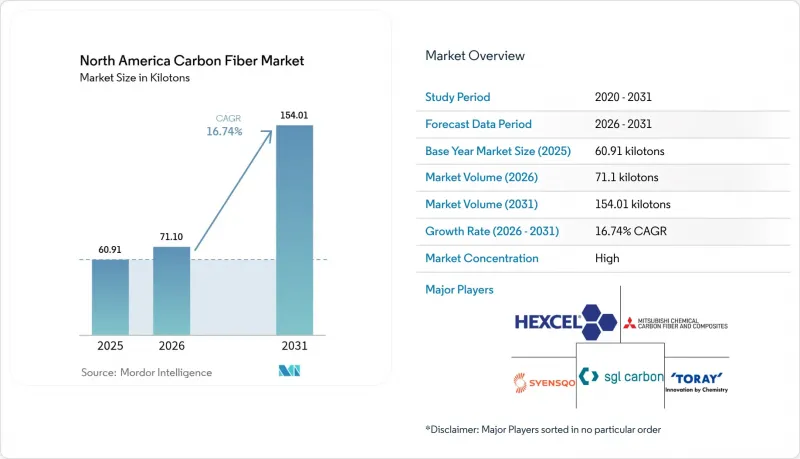
本報告按原料(聚丙烯腈(PAN)、石油瀝青、人造絲)、類型(原生碳纖維(VCF)、再生碳纖維(RCF))、應用(複合材料、纖維等)、終端用戶產業(航太與國防、替代能源等)和地區(美國、加拿大等)進行細分。市場預測以數量(噸)為單位。
北美碳纖維市場趨勢與洞察
輕型車輛需求不斷成長
汽車電氣化使北美碳纖維市場成為新型輕量化策略的核心。通用汽車(GM)的初步試驗表明,汽車製造商正在使用自動化纖維鋪放線將結構部件整合到其旗艦車型中。美國能源局提供的聯邦研發資金正在加速用於電池組外殼的延展性碳纖維複合材料的開發。燃油效率法規和消費者對更長續航里程的期望,將在未來幾年內持續支撐大眾生產平台上的碳纖維需求。
在航太和國防領域的應用日益廣泛
航太領域在北美碳纖維市場繼續佔據主導地位,因為高模量纖維對於下一代飛機和高超音速防禦系統至關重要。東麗公司為NASA的HiCAM專案提供熱固性和熱塑性預浸料,並致力於開發可快速製造的複合材料機翼。柯林斯太空公司投資2億美元,擴大其位於斯波坎工廠的碳碳煞車片產能;通用電氣太空公司則在美國投入近10億美元用於複合材料零件的生產,進一步鞏固了長期需求前景。
法規帶來的原物料供應風險
白宮和加拿大政府對關鍵資料的審查表明,將加強對聚丙烯腈(PAN)前驅體進口的監管。諸如更嚴格的出口管制清單和環境許可等政策調整,可能會導致北美碳纖維市場供應緊張,並推高合規成本。
細分市場分析
到2025年,聚丙烯腈(PAN)將佔據北美碳纖維市場91.20%的佔有率。這一細分市場受益於其成熟的強度重量比和完善的供應鏈。相較之下,石油瀝青和人造絲預計將以18.25%的複合年成長率成長,因為汽車和建設產業的買家更注重降低成本而非極高的抗張強度。 Advanced Carbon Products LLC公司正在開發基於中間相瀝青的碳纖維前驅體,與傳統的PAN基製造方法相比,這將顯著降低成本。
需求的轉變使那些提供多樣化前驅體選擇的供應商受益。瀝青的產率(超過70%)高於聚丙烯腈(PAN,55%),假設爐內能耗不變,這可以降低每公斤成本。對於壓力容器和民用基礎設施等大眾市場應用而言,這些經濟優勢使得替代前驅體成為越來越可行的選擇。
在航太和國防領域,完全可追溯性至關重要,因此,到2025年,原生碳纖維在北美碳纖維市場仍佔75.40%的佔有率。同時,再生纖維預計將以18.48%的複合年成長率成長。 Vartega公司成功地實現了與原生纖維相當的機械性能,同時將成本降低了一半,並將二氧化碳排放量減少了96-99%。
原始設備製造商 (OEM) 對再生中間材料的採用率正在不斷提高。波音公司採用 KyronTEX 側壁板表明,即使使用再生材料,也能滿足嚴格的客艙內裝要求。如今,採用再生纖維的汽車射出成型成型化合物可將成品成本降低高達 30%,這正推動其大規模應用。
其他好處:
- Excel格式的市場預測(ME)表
- 3個月的分析師支持
目錄
第1章:引言
- 研究假設和市場定義
- 調查範圍
第2章:調查方法
第3章執行摘要
第4章 市場狀況
- 市場概覽
- 市場促進因素
- 對輕型車輛的需求增加
- 在航太和國防領域的應用擴展
- 在風力發電領域擴大應用
- 高性能運動器材的擴張
- 大型車輛氫氣儲存槽簡介
- 市場限制因素
- 高水準的研發支出和資本投資。
- 法規帶來的原物料供應風險
- 缺乏回收基礎設施和品質參差不齊
- 價值鏈分析
- 波特五力模型
第5章 市場規模與成長預測
- 按成分
- 聚丙烯腈(PAN)
- 石油瀝青和人造絲
- 按類型
- 原生碳纖維(VCF)
- 再生碳纖維(RCF)
- 透過使用
- 複合材料
- 紡織品
- 微電極
- 催化劑
- 按最終用戶行業分類
- 航太/國防
- 替代能源
- 車
- 建築和基礎設施
- 體育用品
- 其他終端用戶產業(航運和海事)
- 按地區
- 美國
- 加拿大
- 墨西哥
- 其他北美國家
第6章 競爭情勢
- 市場集中度
- 策略趨勢
- 市佔率和排名分析
- 公司簡介
- A&P Technology, Inc.
- ACP Composites Inc.
- DowAksa
- Gurit Services AG
- Hexcel Corporation
- HS HYOSUNG USA
- Jiangsu Hengshen Co., Ltd.
- Mitsubishi Chemical Carbon Fiber and Composites Inc.
- Present Advanced Composites Inc.
- SGL Carbon
- Syensqo
- TEIJIN LIMITED
- Toray Industries Inc.
- Vartega Inc.
第7章 市場機會與未來展望
According to Mordor Intelligence, the North America carbon fiber market size is expected to grow from 60.91 kilotons in 2025 to 71.1 kilotons in 2026 and is forecast to reach 154.01 kilotons by 2031 at 16.74% CAGR over 2026-2031.
This report is Segmented by Raw Material (Polyacrylonitrile (PAN), Petroleum Pitch and Rayon), Type (Virgin Carbon Fiber (VCF), Recycled Carbon Fiber (RCF)), Application (Composite Materials, Textiles, and More), End-User Industry (Aerospace and Defense, Alternative Energy, and More), and Geography (United States, Canada, and More). The Market Forecasts are Provided in Terms of Volume (tons).
North America Carbon Fiber Market Trends and Insights
Rising Demand from Lightweight Vehicles
Automotive electrification positions the North America carbon fiber market at the center of new lightweight strategies. Automakers use automated-fiber-placement lines to integrate structural parts in mainstream models, as shown by General Motors' pilot trials. Federal R&D funding from the U.S. Department of Energy accelerates ductile carbon-fiber composite development for battery-pack housings. Regulations on fuel economy and consumer range expectations underpin sustained multi-year demand across volume platforms.
Accelerating Usage in Aerospace and Defense
Aerospace keeps its lead within the North America carbon fiber market because next-generation aircraft and hypersonic defense systems require high-modulus fiber. Toray supplies thermoset and thermoplastic prepregs for NASA's HiCAM program to improve fast-build composite wings. Collins Aerospace invested USD 200 million to enlarge Spokane carbon-carbon brake capacity, while GE Aerospace earmarked almost USD 1 billion for U.S. composite part production, reinforcing long-cycle demand visibility.
Regulatory-Driven Supply Risk for Raw Materials
Critical-material reviews by the White House and the Canadian government signal heightened scrutiny of PAN precursor imports. Policy shifts, such as export-control lists or stricter environmental permits, could pinch supply and raise compliance costs for the North America carbon fiber market.
Other drivers and restraints analyzed in the detailed report include:
- Growing Utilization from Wind Energy Sector
- Expansion of High-Performance Sporting Goods
- Limited Recycling Infrastructure and Quality Variance
For complete list of drivers and restraints, kindly check the Table Of Contents.
Segment Analysis
PAN commanded 91.20% of the North America carbon fiber market in 2025. The segment benefits from proven strength-to-weight ratios and well-understood supply chains. Petroleum-pitch and rayon, in contrast, are set to grow at an 18.25% CAGR because auto and construction buyers prioritize lower cost over ultimate tensile strength. Advanced Carbon Products LLC has developed a mesophase pitch carbon fiber precursor, offering a significant cost-saving opportunity compared to the conventional PAN-based production method.
Demand shifts favor suppliers that diversify precursor choice. Higher yield rates that exceed 70% for pitch versus 55% for PAN can cut per-kilogram costs when furnace energy remains constant. For mass-market uses such as pressure vessels or civil infrastructure, these economics make alternative precursors increasingly credible options.
Virgin fiber retained 75.40% share of the North America carbon fiber market size in 2025 because aerospace and defense require full traceability. Recycled fiber, however, is projected to post a 18.48% CAGR. Vartega reached mechanical properties comparable to virgin fiber but at half the cost and 96-99% lower CO2 footprint.
OEM acceptance of recycled intermediates is rising. Boeing's use of KyronTEX sidewall panels shows that strict cabin-interior requirements can be met with reclaimed content. Automotive injection-molding compounds with recycled strands now cut finished-part cost by up to 30%, spurring volume adoption.
Complete Report Scope:
- By Raw Material
- Polyacrylonitrile (PAN)
- Peroleum Pitch and Rayon
- By Type
- Virgin Carbon Fiber (VCF)
- Recycled Carbon Fiber (RCF)
- By Application
- Composite Materials
- Textiles
- Micro-electrodes
- Catalysis
- By End-user Industry
- Aerospace and Defense
- Alternative Energy
- Automotive
- Construction and Infrastructure
- Sporting Goods
- Other End-user Industries (Marine and Maritime)
- By Geography
- United States
- Canada
- Mexico
- Rest of North America
List of Companies Covered in this Report:
- A&P Technology, Inc.
- ACP Composites Inc.
- DowAksa
- Gurit Services AG
- Hexcel Corporation
- HS HYOSUNG USA
- Jiangsu Hengshen Co., Ltd.
- Mitsubishi Chemical Carbon Fiber and Composites Inc.
- Present Advanced Composites Inc.
- SGL Carbon
- Syensqo
- TEIJIN LIMITED
- Toray Industries Inc.
- Vartega Inc.
Additional Benefits:
- The market estimate (ME) sheet in Excel format
- 3 months of analyst support
TABLE OF CONTENTS
1 Introduction
- 1.1 Study Assumptions and Market Definition
- 1.2 Scope of the Study
2 Research Methodology
3 Executive Summary
4 Market Landscape
- 4.1 Market Overview
- 4.2 Market Drivers
- 4.2.1 Rising Demand from Lightweight Vehicles
- 4.2.2 Accelerating Usage in Aerospace and Defense
- 4.2.3 Growing Utilization from Wind Energy Sector
- 4.2.4 Expansion of High-Performance Sporting Goods
- 4.2.5 Adoption in Hydrogen Storage Tanks for Heavy-Duty Mobility
- 4.3 Market Restraints
- 4.3.1 High Research and Development, and Capital Expenditure
- 4.3.2 Regulatory-Driven Supply Risk for Raw Materials
- 4.3.3 Limited Recycling Infrastructure and quality variance
- 4.4 Value Chain Analysis
- 4.5 Porter's Five Forces
- 4.5.1 Bargaining Power of Suppliers
- 4.5.2 Bargaining Power of Buyers
- 4.5.3 Threat of New Entrants
- 4.5.4 Threat of Substitutes
- 4.5.5 Competitive Rivalry
5 Market Size and Growth Forecasts (Volume)
- 5.1 By Raw Material
- 5.1.1 Polyacrylonitrile (PAN)
- 5.1.2 Peroleum Pitch and Rayon
- 5.2 By Type
- 5.2.1 Virgin Carbon Fiber (VCF)
- 5.2.2 Recycled Carbon Fiber (RCF)
- 5.3 By Application
- 5.3.1 Composite Materials
- 5.3.2 Textiles
- 5.3.3 Micro-electrodes
- 5.3.4 Catalysis
- 5.4 By End-user Industry
- 5.4.1 Aerospace and Defense
- 5.4.2 Alternative Energy
- 5.4.3 Automotive
- 5.4.4 Construction and Infrastructure
- 5.4.5 Sporting Goods
- 5.4.6 Other End-user Industries (Marine and Maritime)
- 5.5 By Geography
- 5.5.1 United States
- 5.5.2 Canada
- 5.5.3 Mexico
- 5.5.4 Rest of North America
6 Competitive Landscape
- 6.1 Market Concentration
- 6.2 Strategic Moves
- 6.3 Market Share(%)/Ranking Analysis
- 6.4 Company Profiles (includes Global level Overview, Market level overview, Core Segments, Financials as available, Strategic Information, Market Rank/Share for key companies, Products and Services, and Recent Developments)
- 6.4.1 A&P Technology, Inc.
- 6.4.2 ACP Composites Inc.
- 6.4.3 DowAksa
- 6.4.4 Gurit Services AG
- 6.4.5 Hexcel Corporation
- 6.4.6 HS HYOSUNG USA
- 6.4.7 Jiangsu Hengshen Co., Ltd.
- 6.4.8 Mitsubishi Chemical Carbon Fiber and Composites Inc.
- 6.4.9 Present Advanced Composites Inc.
- 6.4.10 SGL Carbon
- 6.4.11 Syensqo
- 6.4.12 TEIJIN LIMITED
- 6.4.13 Toray Industries Inc.
- 6.4.14 Vartega Inc.
7 Market Opportunities and Future Outlook
- 7.1 White-space and unmet-need assessment

 碳纖維及碳纖維增強塑膠市場-2026-2032年全球市場預測
 特種纖維材料市場:預測至2034年-按纖維類型、形態、製造流程、應用、最終用戶和地區分類的全球分析碳纖維市場:依纖維種類、等級、原料、樹脂相容性及應用分類-2026-2032年全球市場預測
 2026-2030年全球碳纖維市場
 碳纖維:市場佔有率分析、產業趨勢與統計、成長預測(2026-2031)
 聚芳酸酯纖維市場規模、佔有率和成長分析:按纖維類型、應用、最終用途、通路和地區分類-2026-2033年產業預測
 標準模量碳纖維市場規模、佔有率和成長分析:按產品類型、絲束尺寸、形狀、應用、終端用戶產業、分銷管道和地區分類-2026-2033年產業預測
 碳纖維及碳纖維增強複合材料市場規模、佔有率及成長分析:依纖維類型、樹脂類型、製造流程、應用、最終用戶、形狀及地區分類-2026-2033年產業預測
 全球碳纖維市場:依原料、要素、產品類型、纖維類型、應用、終端用戶產業及地區分類-預測至2031年綠色碳纖維市場預測至2034年—按類型、原料、應用和地區分類的全球分析