


 |
市場調查報告書
商品編碼
2121178
船舶及海洋遠端資訊處理市場機會、成長促進因素、產業趨勢分析及2026-2035年預測Boat and Ship Telematics Market Opportunity, Growth Drivers, Industry Trend Analysis, and Forecast 2026 - 2035 |
||||||

全球船舶和海洋遠端資訊處理市場預計到 2025 年將達到 67 億美元,年複合成長率為 9.5%,到 2035 年將達到 163 億美元。
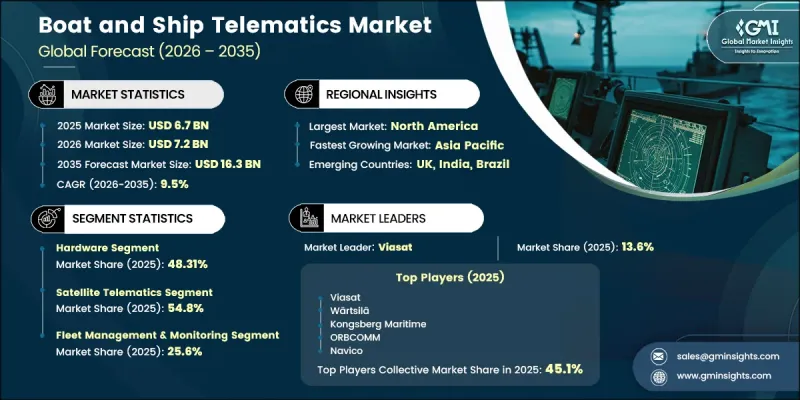
日益嚴格的海事安全要求和日益嚴苛的環境法規催生了對船舶互聯技術的強勁需求。監管機構更加重視營運監控、排放氣體管理、船舶安保、燃油效率和環境報告,敦促船隊營運商採用先進的遠端資訊處理解決方案。這些系統使營運商能夠獲取最新的船舶數據,提高營運可視性,同時滿足監管報告要求。海事環境標準的不斷發展預計將進一步提升航運業對互聯監控能力的需求。同時,不斷上漲的燃油成本和營運費用迫使船舶營運商精簡船隊並控制不必要的支出。遠端資訊處理技術能夠更深入地了解船舶運作情況,使企業能夠就資產性能、燃油消耗、航線規劃和船隊運轉率做出更明智的決策。隨著商業營運商越來越重視成本最佳化、資產生產力和營運透明度,預計在預測期內,船舶遠端資訊處理解決方案的採用率將加速成長。
| 市場範圍 | |
|---|---|
| 開始年份 | 2025 |
| 預測期 | 2026-2035 |
| 起始金額 | 67億美元 |
| 預測金額 | 163億美元 |
| 複合年成長率 | 9.5% |
預計到2025年,硬體產業將佔據48.31%的市場。對船上通訊、定位、監控和控制設備的強勁需求持續支撐著該產業的主導地位。船東和船隊營運商正在增加對GPS/GNSS接收器、AIS應答器、衛星通訊終端、船上感測器、船用天線和遠端資訊處理控制單元的投資。這些硬體組件為收集、傳輸和處理船舶相關資訊提供了必要的基礎設施。對導航性能、船隊可視性、引擎監控、燃油管理以及監管要求的日益重視,正在推動船上設備的現代化。商用和休閒船舶互聯基礎設施的擴展也促進了硬體需求。隨著海事營運商追求更可靠、更整合的監控能力,採用先進的遠端資訊處理硬體預計將繼續成為市場發展的關鍵驅動力。
到2025年,衛星遠端資訊處理產業將佔據54.8%的市場。該產業充分利用衛星連接的優勢,即使在地面網路覆蓋有限或缺失的海域,也能保持通訊和資料傳輸。這項能力使得基於衛星的遠端資訊處理技術對於在廣大地理區域作業且需要穩定連接的船舶尤為重要。衛星解決方案支援船舶追蹤、導航、通訊、船隊管理和監管要求等關鍵海事功能。其廣泛的覆蓋範圍使營運商即使在船舶航行於傳統通訊基礎設施覆蓋範圍之外時,也能保持對關鍵船舶資訊的存取。隨著遠端海事活動的持續擴展和對可靠船舶連接需求的不斷成長,預計衛星遠端資訊處理技術將在整個預測期內保持其主導地位。
美國船舶和海洋遠端資訊處理市場佔據83.6%的市場佔有率,預計2025年市場規模將達到19億美元。美國在該市場的強勢地位反映了其龐大的商業航運活動、完善的水路運輸基礎設施、發達的休閒遊艇產業以及互聯船舶技術的日益普及。該地區的營運商正擴大採用遠端資訊處理平台,以提高船舶營運的透明度並支援更有效率的船隊管理。成熟的海事技術生態系統以及對營運效率和合規性的日益關注也推動了市場的發展。
目錄
第1章:調查方法和範圍
第2章執行摘要
第3章 行業洞察
- 產業生態系分析
- 供應商情況
- 成本結構
- 利潤率
- 每個階段增加的價值
- 垂直整合趨勢
- 顛覆者
- 影響產業的因素
- 成長促進因素
- 嚴格的海事安全與環境法規
- 優先事項:提高燃油效率和降低營運成本
- 全球海運貿易的成長
- 航運業的數位化和自動化
- 市場限制因素
- 引入遠端資訊處理技術並將其改裝到現有船舶上的初始成本很高。
- 偏遠近海和深海地區的通訊環境有許多限制和高成本。
- 市場機遇
- 對自主和遠端操作船舶日益成長的需求,為先進的遠端資訊處理平台創造了新的機會。
- 隨著智慧港口和數位化海事基礎設施的擴展,對互聯船舶解決方案的需求正在增加。
- 預測性維護和人工智慧分析的日益普及,為減少船舶停機時間帶來了巨大潛力。
- 漁船隊和內河航道的日益數位化為遠端資訊處理營運商帶來了尚未開發的成長機會。
- 成長促進因素
- 成長潛力分析
- 價格分析
- 2022-2025年歷史價格趨勢分析
- 依球員類型分類的定價策略(高級球員、超值球員、成本加成球員)
- 監理情勢
- 北美洲
- 美國海岸警衛隊防衛隊-船舶監視和AIS相關規定
- 美國聯邦通訊委員會 (FCC) - 海事無線電和衛星通訊
- 歐洲
- 歐洲海事安全局 - SafeSeaNet 和海事數位服務
- 歐盟 (EU) – 歐盟 MRV 法規
- 亞太地區
- 新加坡海事及港務管理局-數位港口和智慧航運法規
- 國土交通省 - 海事安全及船舶設備標準
- 拉丁美洲
- 巴西海軍-有關海上交通和船舶監視的規定
- 巴拿馬海事局 - 船舶登記和海上安全要求
- 中東和非洲
- 沙烏地阿拉伯港務局(Mawani)-智慧港口和海事數位化法規
- 南非海事安全局 - 船舶追蹤和海事安全
- 北美洲
- 技術與創新展望
- 最新技術
- 利用衛星進行遠端資訊處理和連接
- 蜂窩(4G/5G)車載資訊服務
- 利用AIS進行船舶追蹤與監控
- 利用GNSS/GPS進行定位和導航
- 新興技術
- 人工智慧驅動的預測性維護和船舶分析
- 利用物聯網的智慧船舶遠端資訊處理
- 用於即時船舶資料處理的邊緣運算
- 自主船舶的遠端資訊處理與遠端控制
- 最新技術
- 波特的分析
- PESTLE分析
- 2025年成本細分分析
- 專利分析
- 人工智慧和生成式人工智慧對市場的影響
- 利用人工智慧改造現有經營模式
- 按細分市場分類的生成式人工智慧用例和部署藍圖
- 風險、限制和監管考量
- 永續性和環境方面
- 永續計劃
- 減少廢棄物策略
- 生產中的能源效率
- 具有環保意識的舉措
- 考慮碳足跡
- 預測假設和情境分析
- 基本案例:驅動複合年成長率的關鍵宏觀經濟與產業變量
- 樂觀情境:宏觀經濟與產業的順風
- 悲觀情景:宏觀經濟放緩或產業逆風
第4章 競爭情勢
- 介紹
- 企業市佔率分析
- 北美洲
- 歐洲
- 亞太地區
- 拉丁美洲
- 中東和非洲
- 競爭定位矩陣
- 主要進展
- 併購
- 夥伴關係和聯盟
- 新產品發布
- 業務拓展計劃及資金籌措
- 按公司規模進行基準測試
- 排名分類標準與遴選標準
- 按銷售額、地區和創新能力分類的層級定位矩陣。
第5章 市場估計與預測:依組件分類,2022-2035年
- 硬體
- GPS和導航系統
- 感測器和物聯網設備
- 衛星轉發器和天線
- 通訊調變解調器和系統
- 汽車顯示器和介面設備
- 軟體
- 車隊管理軟體
- 路線最佳化平台
- 遠端監控和診斷軟體
- 應用於預測性維護
- 安全和監控軟體
- 服務
- 安裝和整合服務
- 託管連線服務
- 數據分析和報告服務
第6章 市場估計與預測:依技術分類,2022-2035年
- 衛星遠端資訊處理
- 蜂窩遠端資訊處理
- 混合系統
第7章 市場估計與預測:依功能分類,2022-2035年
- 導航和定位
- 車隊管理/監控
- 安全保障
- 通訊和連接
- 環境合規與報告
- 貨物和資產追蹤
第8章 市場估算與預測:依船舶類型分類,2022-2035年
- 商業貨物
- 客船
- 漁業和水產養殖
- 海上能源
- 政府/軍隊
- 休閒休閒船艇
第9章 市場估價與預測:依銷售管道分類,2022-2035年
- 原始設備製造商與造船廠之間的合作
- 售後改裝
第10章 市場估價與預測:依地區分類,2022-2035年
- 北美洲
- 美國
- 加拿大
- 歐洲
- 英國
- 德國
- 法國
- 義大利
- 西班牙
- 比利時
- 荷蘭
- 瑞典
- 俄羅斯
- 亞太地區
- 中國
- 印度
- 日本
- 澳洲
- 新加坡
- 韓國
- 越南
- 印尼
- 泰國
- 拉丁美洲
- 巴西
- 墨西哥
- 阿根廷
- 中東和非洲
- 南非
- 沙烏地阿拉伯
- UAE
第11章:公司簡介
- 世界公司
- KVH Industries
- Iridium Communications
- Viasat
- Saab
- Kongsberg Maritime
- Wartsila
- Furuno Electric
- Garmin
- Thales
- L3Harris Technologies
- 當地公司
- Raymarine
- Intellian Technologies
- SRT Marine Systems
- Kpler
- Pole Star Global
- ShipIn Systems
- CLS
- Anschutz
- ComNav Marine
- Jotron
The Global Boat and Ship Telematics Market was valued at USD 6.7 billion in 2025 and is estimated to grow at a CAGR of 9.5% to reach USD 16.3 billion by 2035.
Rising maritime safety requirements and increasingly stringent environmental regulations are creating strong demand for connected vessel technologies. Regulatory authorities are placing greater emphasis on operational monitoring, emissions management, vessel security, fuel efficiency, and environmental reporting, encouraging fleet operators to integrate advanced telematics solutions. These systems give operators access to timely vessel data and help them improve operational visibility while supporting regulatory reporting requirements. The continuous evolution of maritime environmental standards is expected to further increase the need for connected monitoring capabilities across the shipping industry. At the same time, higher fuel expenses and rising operating costs are pushing vessel operators to improve fleet efficiency and control unnecessary expenditures. Telematics technology can provide greater insight into vessel operations, enabling companies to make more informed decisions regarding asset performance, fuel consumption, routing, and fleet utilization. As commercial operators increasingly prioritize cost optimization, asset productivity, and operational transparency, the adoption of boat and ship telematics solutions is expected to accelerate throughout the forecast period.
| Market Scope | |
|---|---|
| Start Year | 2025 |
| Forecast Year | 2026-2035 |
| Start Value | $6.7 Billion |
| Forecast Value | $16.3 Billion |
| CAGR | 9.5% |
The hardware segment accounted for the 48.31% share in 2025. Strong demand for onboard communication, positioning, monitoring, and control equipment continues to support the segment's leading position. Vessel owners and fleet operators are increasing investments in GPS/GNSS receivers, AIS transponders, satellite communication terminals, onboard sensors, marine antennas, and telematics control units. These hardware components provide the infrastructure required to collect, transmit, and process vessel-related information. Growing emphasis on navigation performance, fleet visibility, engine monitoring, fuel management, and regulatory requirements is encouraging operators to modernize onboard equipment. The expansion of connected vessel infrastructure across both commercial and recreational applications is also contributing to hardware demand. As maritime operators seek more reliable and integrated monitoring capabilities, the deployment of advanced telematics hardware is expected to remain a major component of market development.
The satellite telematics segment held 54.8% share in 2025. The segment benefits from the ability of satellite connectivity to maintain communication and data transmission across maritime areas where terrestrial networks provide limited or no coverage. This capability makes satellite-based telematics particularly important for vessels that operate across broad geographic areas and require consistent connectivity. Satellite solutions support essential maritime functions, including vessel tracking, navigation, communication, fleet supervision, and regulatory requirements. Their broad coverage enables operators to maintain access to critical vessel information even when ships travel outside conventional communication infrastructure. Continued expansion of long-distance maritime activities and growing demand for reliable vessel connectivity are expected to sustain the leading position of satellite telematics during the forecast period.
United States Boat and Ship Telematics Market held an 83.6% share, generating USD 1.9 billion in 2025. The country's strong position reflects the scale of its commercial maritime activities, established water transportation infrastructure, developed recreational boating industry, and growing acceptance of connected vessel technologies. Operators across the region are increasingly adopting telematics platforms to gain improved visibility into vessel operations and support more efficient fleet management. The presence of an established maritime technology ecosystem and increasing attention toward operational efficiency and regulatory compliance are also supporting market development.
Major companies operating in the global boat and ship telematics industry include Wartsila, Furuno Electric, ORBCOMM, Saab, Iridium Communications, Garmin, Kongsberg Maritime, Viasat, Thales, Navico Group, KVH Industries, Inmarsat, L3Harris Technologies, and other prominent industry participants. Companies in the boat and ship telematics market are pursuing several strategies to expand their market foothold and strengthen their competitive positions. Leading participants are investing in product development to improve connectivity, data accuracy, monitoring capabilities, automation, and system integration. Companies are also expanding their technology portfolios by combining telematics hardware, software, communication infrastructure, and analytics capabilities into more comprehensive solutions. Strategic collaborations, technology partnerships, distribution agreements, and geographic expansion are helping market participants reach new customer groups and strengthen regional coverage. Businesses are also focusing on improving platform scalability and interoperability so operators can integrate telematics technologies with existing maritime systems. Continued investment in research and development allows companies to introduce more efficient and reliable solutions while responding to changing regulatory requirements. In addition, providers are emphasizing customer support, service capabilities, and customized solutions to improve retention and build long-term relationships. These strategies are helping companies increase adoption, broaden their customer base, and reinforce their positions in the growing boat and ship telematics market.
Table of Contents
Chapter 1 Methodology & Scope
- 1.1 Research approach
- 1.2 Quality Commitments
- 1.2.1 GMI AI policy & data integrity commitment
- 1.2.1.1 Source consistency protocol
- 1.2.1 GMI AI policy & data integrity commitment
- 1.3 Research Trail & Confidence Scoring
- 1.3.1 Research Trail Components
- 1.3.2 Scoring Components
- 1.4 Data Collection
- 1.4.1 Partial list of primary sources
- 1.5 Data mining sources
- 1.5.1 Paid sources
- 1.5.1.1 Sources, by region
- 1.5.1 Paid sources
- 1.6 Base estimates and calculations
- 1.6.1 Base year calculation
- 1.7 Forecast
- 1.7.1 Quantified market impact analysis
- 1.7.1.1 Mathematical impact of growth parameters on forecast
- 1.7.1 Quantified market impact analysis
- 1.8 Research transparency addendum
- 1.8.1 Source attribution framework
- 1.8.2 Quality assurance metrics
- 1.8.3 Our commitment to trust
Chapter 2 Executive Summary
- 2.1 Industry 360° synopsis
- 2.2 Key market trends
- 2.2.1 Regional
- 2.2.2 Component
- 2.2.3 Technology
- 2.2.4 Function
- 2.2.5 Vessel Type
- 2.2.6 Sales Channel
- 2.3 TAM Analysis, 2026-2035
- 2.4 CXO perspectives: Strategic imperatives
Chapter 3 Industry Insights
- 3.1 Industry ecosystem analysis
- 3.1.1 Supplier landscape
- 3.1.2 Cost structure
- 3.1.3 Profit margin
- 3.1.4 Value addition at each stage
- 3.1.5 Vertical integration trends
- 3.1.6 Disruptors
- 3.2 Industry impact forces
- 3.2.1 Growth drivers
- 3.2.1.1 Stringent maritime safety and environmental regulations
- 3.2.1.2 Fuel-efficiency and operating-cost reduction priorities
- 3.2.1.3 Growth in global seaborne trade
- 3.2.1.4 Maritime digitalization and automation
- 3.2.2 Market Restraints
- 3.2.2.1 High upfront costs for telematics deployment and retrofitting existing vessels.
- 3.2.2.2 Limited and expensive connectivity in remote offshore and deep-sea regions.
- 3.2.3 Market Opportunities
- 3.2.3.1 Rising demand for autonomous and remotely operated vessels is creating new opportunities for advanced telematics platforms.
- 3.2.3.2 Expansion of smart ports and digital maritime infrastructure is increasing the need for connected vessel solutions.
- 3.2.3.3 Growing adoption of predictive maintenance and AI-driven analytics offers significant potential for reducing vessel downtime.
- 3.2.3.4 Increasing digitalization of fishing fleets and inland waterways presents untapped growth opportunities for telematics providers.
- 3.2.1 Growth drivers
- 3.3 Growth potential analysis
- 3.4 Pricing Analysis (Driven by Primary Research)
- 3.4.1 Historical Price Trend Analysis, 2022-2025
- 3.4.2 Pricing Strategy by Player Type (Premium / Value / Cost-plus)
- 3.5 Regulatory landscape
- 3.5.1 North America
- 3.5.1.1 United States Coast Guard – Vessel Monitoring & AIS Regulations
- 3.5.1.2 Federal Communications Commission – Maritime Radio & Satellite Communication
- 3.5.2 Europe
- 3.5.2.1 European Maritime Safety Agency – SafeSeaNet & Maritime Digital Services
- 3.5.2.2 European Union – EU MRV Regulation
- 3.5.3 Asia-Pacific
- 3.5.3.1 Maritime and Port Authority of Singapore – Digital Port & Smart Shipping Regulations
- 3.5.3.2 Ministry of Land, Infrastructure, Transport and Tourism – Maritime Safety & Vessel Equipment Standards
- 3.5.4 Latin America
- 3.5.4.1 Brazilian Navy – Maritime Traffic & Vessel Monitoring Regulations
- 3.5.4.2 Maritime Authority of Panama – Vessel Registration & Maritime Safety Requirements
- 3.5.5 Middle East & Africa
- 3.5.5.1 Saudi Ports Authority (Mawani) – Smart Ports & Maritime Digitalization Regulations
- 3.5.5.2 South African Maritime Safety Authority – Vessel Tracking & Maritime Safety
- 3.5.1 North America
- 3.6 Technology and Innovation landscape
- 3.6.1 Current technologies
- 3.6.1.1 Satellite-Based Telematics & Connectivity
- 3.6.1.2 Cellular (4G/5G) Telematics
- 3.6.1.3 AIS-Based Vessel Tracking & Monitoring
- 3.6.1.4 GNSS/GPS-Based Positioning & Navigation
- 3.6.2 Emerging technologies
- 3.6.2.1 AI-Powered Predictive Maintenance & Vessel Analytics
- 3.6.2.2 IoT-Enabled Smart Vessel Telematics
- 3.6.2.3 Edge Computing for Real-Time Vessel Data Processing
- 3.6.2.4 Autonomous Vessel Telematics & Remote Operations
- 3.6.1 Current technologies
- 3.7 Porter’s analysis
- 3.8 PESTEL analysis
- 3.9 Cost breakdown analysis, 2025
- 3.10 Patent analysis (Driven by Primary Research)
- 3.11 Impact of AI & generative AI on the market
- 3.11.1 AI-Driven Disruption of Existing Business Models
- 3.11.2 GenAI use cases & adoption roadmap by segment
- 3.11.3 Risks, Limitations & Regulatory Considerations
- 3.12 Sustainability and environmental aspects
- 3.12.1 Sustainable practices
- 3.12.2 Waste reduction strategies
- 3.12.3 Energy efficiency in production
- 3.12.4 Eco-friendly Initiatives
- 3.12.5 Carbon footprint considerations
- 3.13 Forecast assumptions & scenario analysis (Driven by Primary Research)
- 3.13.1 Base Case - key macro & industry variables driving CAGR
- 3.13.2 Optimistic Scenarios - Favorable Macro and Industry Tailwinds
- 3.13.3 Pessimistic Scenario - Macroeconomic slowdown or industry headwinds
Chapter 4 Competitive Landscape, 2025
- 4.1 Introduction
- 4.2 Company market share analysis
- 4.2.1 North America
- 4.2.2 Europe
- 4.2.3 Asia-Pacific
- 4.2.4 Latin America
- 4.2.5 Middle East & Africa
- 4.3 Competitive positioning matrix
- 4.4 Key developments
- 4.4.1 Mergers & acquisitions
- 4.4.2 Partnerships & collaborations
- 4.4.3 New product launches
- 4.4.4 Expansion plans and funding
- 4.5 Company tier benchmarking
- 4.5.1 Tier classification criteria & qualifying thresholds
- 4.5.2 Tier positioning matrix by revenue, geography & innovation
Chapter 5 Market Estimates & Forecast, By Component, 2022 - 2035 ($Mn)
- 5.1 Key trends
- 5.2 Hardware
- 5.2.1 GPS & Navigation Systems
- 5.2.2 Sensors & IoT Devices
- 5.2.3 Satellite Transponders & Antennas
- 5.2.4 Communication Modems & Systems
- 5.2.5 Onboard Display & Interface Devices
- 5.3 Software
- 5.3.1 Fleet Management Software
- 5.3.2 Route Optimization Platforms
- 5.3.3 Remote Monitoring & Diagnostics Software
- 5.3.4 Predictive Maintenance Applications
- 5.3.5 Security & Surveillance Software
- 5.4 Services
- 5.4.1 Installation & Integration Services
- 5.4.2 Managed Connectivity Services
- 5.4.3 Data Analytics & Reporting Services
Chapter 6 Market Estimates & Forecast, By Technology, 2022 - 2035 ($Mn)
- 6.1 Key trends
- 6.2 Satellite Telematics
- 6.3 Cellular Telematics
- 6.4 Hybrid Systems
Chapter 7 Market Estimates & Forecast, By Function, 2022 - 2035 ($Mn)
- 7.1 Key trends
- 7.2 Navigation & Positioning
- 7.3 Fleet Management & Monitoring
- 7.4 Safety & Security
- 7.5 Communication & Connectivity
- 7.6 Environmental Compliance & Reporting
- 7.7 Cargo & Asset Tracking
Chapter 8 Market Estimates & Forecast, By Vessel Type, 2022 - 2035 ($Mn)
- 8.1 Key trends
- 8.2 Commercial Cargo
- 8.3 Passenger
- 8.4 Fishing & Aquaculture
- 8.5 Offshore & Energy
- 8.6 Government & Military
- 8.7 Leisure & Recreational Boats
Chapter 9 Market Estimates & Forecast, By Sales Channel, 2022 - 2035 ($Mn)
- 9.1 Key trends
- 9.2 OEM & Shipyard Integration
- 9.3 Aftermarket & Retrofit
Chapter 10 Market Estimates & Forecast, By Region, 2022 - 2035 ($Mn)
- 10.1 North America
- 10.1.1 US
- 10.1.2 Canada
- 10.2 Europe
- 10.2.1 UK
- 10.2.2 Germany
- 10.2.3 France
- 10.2.4 Italy
- 10.2.5 Spain
- 10.2.6 Belgium
- 10.2.7 Netherlands
- 10.2.8 Sweden
- 10.2.9 Russia
- 10.3 Asia Pacific
- 10.3.1 China
- 10.3.2 India
- 10.3.3 Japan
- 10.3.4 Australia
- 10.3.5 Singapore
- 10.3.6 South Korea
- 10.3.7 Vietnam
- 10.3.8 Indonesia
- 10.3.9 Thailand
- 10.4 Latin America
- 10.4.1 Brazil
- 10.4.2 Mexico
- 10.4.3 Argentina
- 10.5 MEA
- 10.5.1 South Africa
- 10.5.2 Saudi Arabia
- 10.5.3 UAE
Chapter 11 Company Profiles
- 11.1 Global Players
- 11.1.1 KVH Industries
- 11.1.2 Iridium Communications
- 11.1.3 Viasat
- 11.1.4 Saab
- 11.1.5 Kongsberg Maritime
- 11.1.6 Wartsila
- 11.1.7 Furuno Electric
- 11.1.8 Garmin
- 11.1.9 Thales
- 11.1.10 L3Harris Technologies
- 11.2 Regional Players
- 11.2.1 Raymarine
- 11.2.2 Intellian Technologies
- 11.2.3 SRT Marine Systems
- 11.2.4 Kpler
- 11.2.5 Pole Star Global
- 11.2.6 ShipIn Systems
- 11.2.7 CLS
- 11.2.8 Anschutz
- 11.2.9 ComNav Marine
- 11.2.10 Jotron

 船舶維修產品市場規模、佔有率和成長分析:按產品類型、船舶材質、應用、分銷管道和地區分類-2026-2033年產業預測
 船舶市場規模、佔有率和成長分析:按船舶類型、推進系統、材質、通路和地區分類-2026-2033年產業預測
 2026年全球休閒與國防動力艇市場報告2026年全球單層甲板船市場報告
 船舶市場規模、佔有率、成長及全球產業分析:按類型、應用和地區的洞察,2026-2034年的預測
 船舶遠端資訊處理市場-全球產業規模、佔有率、趨勢、機會和預測,按技術、功能、應用、組件、地區和競爭細分,2020-2030 年
 船屋市場機會、成長動力、產業趨勢分析及 2025 - 2034 年預測船屋市場-按類型、應用、地區和預測的全球市場規模甲板船市場機會、成長動力、產業趨勢分析與 2025 - 2034 年預測全球船用馬桶市場規模(按產品、應用、地區、範圍和預測)