


 |
市場調查報告書
商品編碼
2101574
電動汽車電池回收及材料再利用市場:商業機會、成長要素、產業趨勢分析及2026-2035年預測Electric Vehicle (EV) Battery Recycling and Material Recovery Market Opportunity, Growth Drivers, Industry Trend Analysis, and Forecast 2026 - 2035 |
||||||

全球電動車電池材料回收市場預計到 2025 年將達到 35 億美元,並以 30.5% 的複合年成長率成長,到 2035 年將達到 461 億美元。
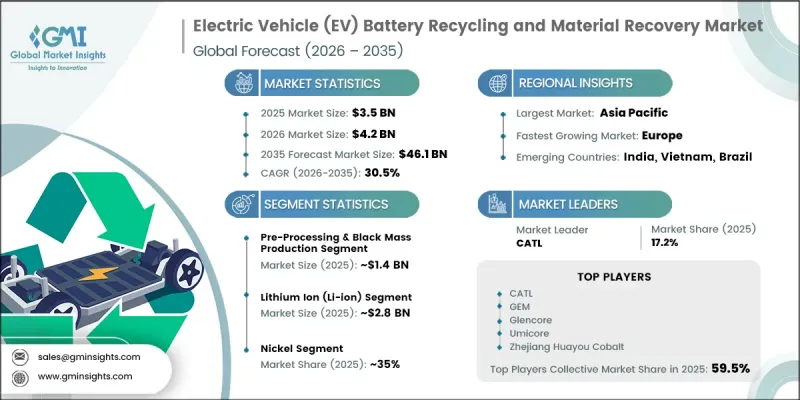
隨著全球電動車 (EV) 的普及速度不斷加快,對永續電池生命週期管理解決方案的需求日益成長,電動車電池回收和材料再生市場正在迅速擴張。預計越來越多的電動車達到運作終點,將產生大量需要收集、處理和材料再生的廢棄電池。由於電動車電池的運作通常約為 8 至 12 年,回收公司面臨著建立高效收集網路的更大機會。人們對關鍵電池材料的供應、安全和永續性的日益關注,正在推動對回收技術和循環經濟解決方案的投資。那些早期就已建立電池收集、拆解和回收能力的公司,將能夠從不斷成長的廢棄電池供應和日益成長的再生材料需求中獲益。隨著全球電動車產量的持續成長,電池回收和材料再生系統正成為永續交通基礎設施的重要組成部分。
| 市場範圍 | |
|---|---|
| 開始年份 | 2025 |
| 預測期 | 2026-2035 |
| 初始市場規模 | 35億美元 |
| 預測金額 | 461億美元 |
| 複合年成長率 | 30.5% |
廢棄電動車電池數量的不斷成長為回收商提供了回收寶貴材料並支持構建循環電池供應鏈的巨大機會。減少對新開採原料依賴的日益重視,正推動對先進回收基礎設施和回收技術的投資。隨著廢電池數量的持續成長,那些建立高效回收網路、加工設施和材料回收能力的企業,有望更可靠地掌握未來的電池回收機會。
預處理和黑料生產環節佔據39.5%的市場佔有率,預計2025年市場規模將達到14億美元。該環節的主導地位得益於廢棄舊電池和製造廢棄物流入回收管道的數量不斷增加。環節包括電池回收、分類、放電管理、拆解、破碎和分離等工序,最終生產出含有電池製造所需有價值材料的黑料。
鋰離子電池佔79.3%的市場佔有率,預計2025年市場規模將達28億美元。由於鋰離子電池在包括電動車在內的交通運輸領域的廣泛應用,它仍然是最大的電池類別。各種鋰離子電池的化學成分中含有許多有價值的元素,需要高效的回收和再利用過程。電動車在全球範圍內的快速普及以及需要報廢處理的鋰離子電池數量的不斷增加,推動了對能夠回收關鍵電池材料的回收技術的強勁需求。
預計到2025年,美國電動車電池回收和材料再利用市場規模將達3.208億美元。政府支持國內電池供應鏈的各項措施持續推動對回收基礎設施和關鍵材料回收能力的投資。隨著國內電動車製造業的擴張和電池產能的提升,生產廢棄物和廢棄電池的產生量也不斷增加,這為回收企業發展可擴展的回收業務創造了更多機會。
目錄
第1章:調查方法
第2章執行摘要
第3章 行業洞察
- 產業生態系分析
- 供應商情況
- 利潤率
- 成本結構
- 每個階段增加的價值
- 影響價值鏈的因素
- 中斷
- 影響產業的因素
- 促進因素
- 電動車的加速普及和電池壽命即將終結
- 保障基本礦產供應面臨的挑戰及國內採購義務
- 嚴格的監管要求
- 汽車製造商為實現閉合迴路電池供應鏈所做的努力
- 產業潛在風險與挑戰
- 高昂的預處理和物流成本阻礙了回收的經濟可行性。
- 鈷和鋰價格的波動正在削弱回收商利潤率的可預測性。
- 市場機遇
- 超級工廠規模的回收設施正在推動單位成本的降低。
- 黑彌撒作為一種可交易商品
- 在回收前整合二次利用電池可以延長收益週期。
- 促進因素
- 技術與創新展望
- 最新科技趨勢
- 火冶煉
- 濕式冶金浸出
- 直接回收
- 新興技術
- 大規模直接陰極再生
- 電化學回收系統
- 最新科技趨勢
- 成長潛力分析
- 監理情勢
- 北美洲
- 美國環保署
- 美國環保署的通用廢棄物管理條例
- 加拿大環境保護法(CEPA)
- 歐洲
- 歐盟法規 2023/1542
- 英國關於廢棄電池和蓄電池的法規
- 亞太地區
- 工業資訊化部(MIIT)
- 澳洲國家廢棄物政策行動計劃
- LATAM
- 哥倫比亞國家電動車戰略(ENME)
- 巴西國家固態廢棄物政策
- 中東和非洲
- 沙烏地阿拉伯國家廢棄物管理中心(MWAN)
- 南非廢棄物法(NEMWA)
- 北美洲
- 波特的分析
- PESTLE分析
- 成本細分分析
- 專利分析
- 永續性和環境方面
- 永續計劃
- 減少廢棄物策略
- 生產中的能源效率
- 具有環保意識的舉措
- 考慮碳足跡
- 人工智慧和生成式人工智慧對市場的影響
- 利用人工智慧改造現有經營模式
- 按細分市場分類的生成式人工智慧用例和部署藍圖
- 風險、限制和監管考量
- 下游產業對煉油和冶煉能力的依賴性
- 系統中的電池恢復效率和損耗率
- 預測假設和情境分析
- 基本案例:驅動複合年成長率的關鍵宏觀經濟與產業變量
- 樂觀情境:宏觀經濟與產業的順風
- 悲觀情景:宏觀經濟放緩或產業逆風
第4章 競爭情勢
- 介紹
- 企業市佔率分析
- 北美洲
- 歐洲
- 亞太地區
- LATAM
- 中東和非洲
- 主要市場公司的競爭分析
- 競爭定位矩陣
- 主要進展
- 併購
- 夥伴關係和聯盟
- 新產品發布
- 業務拓展計劃及資金籌措
- 按公司規模進行基準測試
- 排名分類標準與遴選標準
- 按銷售額、地區和創新能力分類的層級定位矩陣。
第5章 市場估算與預測:依回收製程分類,2026-2035年
- 濕式冶金
- 熱冶金法
- 直接回收
- 預處理和黑體生產
第6章 市場估價與預測:依電池化學成分分類,2026-2035年
- 鋰離子電池(Li-ion)
- NMC(鎳、錳、鈷)
- 磷酸鋰鐵(LFP)
- 其他
- 鎳氫電池(NiMH)
- 鉛酸
- 其他
第7章 市場估計與預測:依材料回收率分類,2026-2035年
- 鋰
- 鈷
- 鎳
- 錳
- 銅
- 其他
第8章 市場估計與預測:依電池類型分類,2026-2035年
- 報廢電動汽車電池
- 生產廢棄物(超級工廠廢棄物)
- 有缺陷和被召回的電池
第9章 市場估計與預測:依地區分類,2026-2035年
- 北美洲
- 美國
- 加拿大
- 歐洲
- 德國
- 英國
- 法國
- 義大利
- 西班牙
- 荷蘭
- 瑞典
- 挪威
- 亞太地區
- 中國
- 印度
- 日本
- 韓國
- 澳洲
- 印尼
- 泰國
- 越南
- 馬來西亞
- 拉丁美洲
- 巴西
- 墨西哥
- 智利
- 阿根廷
- 中東和非洲
- UAE
- 沙烏地阿拉伯
- 南非
第10章:公司簡介
- 世界公司
- Umicore
- Glencore
- Redwood Materials
- CATL
- GEM
- Ecobat
- Cirba Solutions
- Fortum
- American Battery Technology Company(ABTC)
- Veolia
- 當地公司
- Accurec-Recycling
- SNAM Groupe
- Gravita India
- SK Tes
- Stena Recycling
- Zhejiang Huayou Cobalt
- LOHUM Cleantech
- 新興企業
- Aqua Metals
- Cylib
- Green Li-ion Pte. Ltd.
The Global Electric Vehicle Battery Recycling and Material Recovery Market was valued at USD 3.5 billion in 2025 and is estimated to grow at a CAGR of 30.5% to reach USD 46.1 billion by 2035.
The electric vehicle battery recycling and material recovery market is experiencing rapid expansion as global EV adoption continues to accelerate and creates increasing demand for sustainable battery lifecycle management solutions. The rising number of electric vehicles reaching the end of their operational lifespan is expected to generate a significant supply of used batteries requiring collection, processing, and material recovery. EV batteries generally operate for approximately 8 to 12 years, creating a growing opportunity for recycling companies to establish efficient recovery networks. Increasing concerns regarding the availability, security, and sustainability of critical battery materials are encouraging investments in recycling technologies and circular economy solutions. Companies developing early capabilities in battery collection, dismantling, and recycling are positioned to benefit from the expanding availability of end-of-life batteries and increasing demand for recovered materials. As EV manufacturing continues to scale globally, battery recycling and material recovery systems are becoming essential components of sustainable transportation infrastructure.
| Market Scope | |
|---|---|
| Start Year | 2025 |
| Forecast Year | 2026-2035 |
| Start Value | $3.5 Billion |
| Forecast Value | $46.1 Billion |
| CAGR | 30.5% |
The growing volume of retired electric vehicle batteries is creating significant opportunities for recyclers to recover valuable materials and support the development of a circular battery supply chain. Increasing focus on reducing dependence on newly extracted raw materials is encouraging investments in advanced recycling infrastructure and recovery technologies. Organizations that establish efficient collection networks, processing facilities, and material recovery capabilities are expected to gain stronger access to future battery recycling opportunities as the number of end-of-life batteries continues to rise.
The preprocessing and black mass production segment accounted for 39.5% share, generating USD 1.4 billion in 2025. The segment's leading position is supported by the growing volume of end-of-life batteries and manufacturing waste entering recycling channels. This stage includes battery collection, sorting, discharge management, dismantling, shredding, and separation processes that produce black mass containing valuable materials used in battery manufacturing.
The lithium-ion (Li-ion) segment held 79.3% share, generating USD 2.8 billion in 2025. Lithium-ion batteries continue to represent the largest battery category due to their extensive adoption across electric mobility applications. Different lithium-ion chemistries contain valuable elements that require efficient recycling and recovery processes. The rapid expansion of EV adoption worldwide and the increasing number of lithium-ion batteries requiring end-of-life management are driving strong demand for recycling technologies capable of recovering essential battery materials.
U.S. Electric Vehicle Battery Recycling and Material Recovery Market reached USD 320.8 million in 2025. Government initiatives supporting domestic battery supply chains continue to encourage investment in recycling infrastructure and critical material recovery capabilities. Expanding electric vehicle manufacturing activities and increasing battery production capacity within the country are generating greater volumes of manufacturing waste and used batteries, creating additional opportunities for recycling companies to develop scalable recovery operations.
Key companies operating in the global electric vehicle battery recycling and material recovery market include Redwood Materials, CATL, Umicore, Ecobat, GEM, Fortum, Cylib, Zhejiang Huayou Cobalt, Glencore, and LOHUM Cleantech. Companies operating in the electric vehicle battery recycling and material recovery market are strengthening their competitive positions by expanding recycling capacity, improving material recovery technologies, and developing integrated battery lifecycle solutions. Market participants are investing in advanced processing methods to increase recovery efficiency and improve access to valuable battery materials. Strategic partnerships with automakers, battery manufacturers, and supply chain participants are helping companies secure feedstock sources and expand operational capabilities. Businesses are also focusing on regional recycling facilities, technology innovation, and closed-loop battery solutions to support sustainable material supply chains.
Table of Contents
Chapter 1 Methodology
- 1.1 Research approach
- 1.2 Quality Commitments
- 1.2.1 GMI AI policy & data integrity commitment
- 1.3 Research Trail & Confidence Scoring
- 1.3.1 Research Trail Components
- 1.3.2 Scoring Components
- 1.4 Data Collection
- 1.5 Data mining sources
- 1.5.1 Paid sources
- 1.6 Base estimates and calculations
- 1.6.1 Base year calculation
- 1.7 Forecast model
- 1.7.1 Quantified market impact analysis
- 1.8 Research transparency addendum
- 1.8.1 Source attribution framework
- 1.8.2 Quality assurance metrics
- 1.8.3 Our commitment to trust
Chapter 2 Executive Summary
- 2.1 Industry 360° synopsis
- 2.2 Key market trends
- 2.2.1 Regional
- 2.2.2 Recycling Process
- 2.2.3 Battery Chemistry
- 2.2.4 Material Recovery
- 2.2.5 Battery Source
- 2.3 TAM analysis, 2026-2035
- 2.4 CXO perspectives: Strategic imperatives
Chapter 3 Industry Insights
- 3.1 Industry ecosystem analysis
- 3.1.1 Supplier landscape
- 3.1.2 Profit margin
- 3.1.3 Cost structure
- 3.1.4 Value addition at each stage
- 3.1.5 Factor affecting the value chain
- 3.1.6 Disruptions
- 3.2 Industry impact forces
- 3.2.1 Growth drivers
- 3.2.1.1 Accelerating EV Adoption & Imminent End-of-Life Battery Wave
- 3.2.1.2 Critical Mineral Supply Security Imperatives & Domestic Content Mandates
- 3.2.1.3 Stringent Regulatory Mandates
- 3.2.1.4 Closed-Loop Battery Supply Chain Commitments by Automotive OEMs
- 3.2.2 Industry pitfalls and challenges
- 3.2.2.1 High Pre-Processing & Logistics Costs Suppressing Recycling Economics
- 3.2.2.2 Cobalt & Lithium Price Volatility Eroding Recycler Margin Predictability
- 3.2.3 Market opportunities
- 3.2.3.1 Gigafactory-Scale Recycling Facilities Driving Unit Cost Reduction
- 3.2.3.2 Black Mass as a Tradable Commodity
- 3.2.3.3 Second-Life Battery Integration Prior to Recycling Extending Revenue Lifecycle
- 3.2.1 Growth drivers
- 3.3 Technology and innovation landscape
- 3.3.1 Current technological trends
- 3.3.1.1 Pyrometallurgical smelting
- 3.3.1.2 Hydrometallurgical leaching
- 3.3.1.3 Direct recycling
- 3.3.2 Emerging technologies
- 3.3.2.1 Direct cathode regeneration at scale
- 3.3.2.2 Electrochemical recovery systems
- 3.3.1 Current technological trends
- 3.4 Growth potential analysis
- 3.5 Regulatory landscape
- 3.5.1 North America
- 3.5.1.1 U.S. Environmental Protection Agency
- 3.5.1.2 EPA Universal Waste Regulations
- 3.5.1.3 Canadian Environmental Protection Act (CEPA)
- 3.5.2 Europe
- 3.5.2.1 EU Regulation 2023/1542
- 3.5.2.2 UK Waste Batteries and Accumulators Regulations
- 3.5.3 Asia Pacific
- 3.5.3.1 Ministry of Industry and Information Technology (MIIT)
- 3.5.3.2 National Waste Policy Action Plan Australia
- 3.5.4 LATAM
- 3.5.4.1 Colombia National Electric Mobility Strategy (ENME)
- 3.5.4.2 Brazil National Solid Waste Policy
- 3.5.5 MEA
- 3.5.5.1 Saudi National Center for Waste Management (MWAN)
- 3.5.5.2 South Africa Waste Act (NEMWA)
- 3.5.1 North America
- 3.6 Porter's analysis
- 3.7 PESTEL analysis
- 3.8 Cost breakdown analysis
- 3.9 Patent analysis (Driven by Primary Research)
- 3.10 Sustainability and environmental aspects
- 3.10.1 Sustainable Practices
- 3.10.2 Waste Reduction Strategies
- 3.10.3 Energy Efficiency in Production
- 3.10.4 Eco-friendly Initiatives
- 3.10.5 Carbon Footprint Considerations
- 3.11 Impact of AI & generative AI on the market
- 3.11.1 AI-driven disruption of existing business models
- 3.11.2 GenAI use cases & adoption roadmap by segment
- 3.11.3 Risks, limitations & regulatory considerations
- 3.12 Downstream Dependency on Refining & Smelting Capacity
- 3.13 Battery Collection Efficiency & Loss Rates in the System
- 3.14 Forecast assumptions & scenario analysis (Driven by Primary Research)
- 3.14.1 Base Case - Key Macro & Industry Variables Driving CAGR
- 3.14.2 Optimistic Scenarios - Favorable macro and industry tailwinds
- 3.14.3 Pessimistic Scenario - Macroeconomic slowdown or industry headwinds
Chapter 4 Competitive Landscape, 2025
- 4.1 Introduction
- 4.2 Company market share analysis
- 4.2.1 North America
- 4.2.2 Europe
- 4.2.3 Asia Pacific
- 4.2.4 LATAM
- 4.2.5 MEA
- 4.3 Competitive analysis of major market players
- 4.4 Competitive positioning matrix
- 4.5 Key developments
- 4.5.1 Mergers & acquisitions
- 4.5.2 Partnerships & collaborations
- 4.5.3 New product launches
- 4.5.4 Expansion plans and funding
- 4.6 Company tier benchmarking
- 4.6.1 Tier classification criteria & qualifying thresholds
- 4.6.2 Tier positioning matrix by revenue, geography & innovation
Chapter 5 Market Estimates and Forecast, By Recycling Process, 2026 - 2035 ($ Mn, Metric Tons)
- 5.1 Key trends
- 5.2 Hydrometallurgical
- 5.3 Pyrometallurgical
- 5.4 Direct Recycling
- 5.5 Pre-Processing & Black Mass Production
Chapter 6 Market Estimates and Forecast, By Battery Chemistry, 2026 - 2035 ($ Mn, Metric Tons)
- 6.1 Key trends
- 6.2 Lithium-Ion (Li-ion)
- 6.2.1 NMC (Nickel Manganese Cobalt)
- 6.2.2 LFP (Lithium Iron Phosphate)
- 6.2.3 Others
- 6.3 Nickel-Metal Hydride (NiMH)
- 6.4 Lead-Acid
- 6.5 Others
Chapter 7 Market Estimates and Forecast, By Material Recovery, 2026 - 2035 ($ Mn, Metric Tons)
- 7.1 Key trends
- 7.2 Lithium
- 7.3 Cobalt
- 7.4 Nickel
- 7.5 Manganese
- 7.6 Copper
- 7.7 Others
Chapter 8 Market Estimates and Forecast, By Battery Source, 2026 - 2035 ($ Mn, Metric Tons)
- 8.1 Key trends
- 8.2 End-of-Life (EoL) EV Batteries
- 8.3 Manufacturing Scrap (Gigafactory Waste)
- 8.4 Defective & Recalled Batteries
Chapter 9 Market Estimates & Forecast, By Region, 2026 - 2035 ($ Mn, Metric Tons)
- 9.1 Key trends
- 9.2 North America
- 9.2.1 US
- 9.2.2 Canada
- 9.3 Europe
- 9.3.1 Germany
- 9.3.2 UK
- 9.3.3 France
- 9.3.4 Italy
- 9.3.5 Spain
- 9.3.6 Netherlands
- 9.3.7 Sweden
- 9.3.8 Norway
- 9.4 Asia Pacific
- 9.4.1 China
- 9.4.2 India
- 9.4.3 Japan
- 9.4.4 South Korea
- 9.4.5 Australia
- 9.4.6 Indonesia
- 9.4.7 Thailand
- 9.4.8 Vietnam
- 9.4.9 Malaysia
- 9.5 Latin America
- 9.5.1 Brazil
- 9.5.2 Mexico
- 9.5.3 Chile
- 9.5.4 Argentina
- 9.6 MEA
- 9.6.1 UAE
- 9.6.2 Saudi Arabia
- 9.6.3 South Africa
Chapter 10 Company Profiles
- 10.1 Global players
- 10.1.1 Umicore
- 10.1.2 Glencore
- 10.1.3 Redwood Materials
- 10.1.4 CATL
- 10.1.5 GEM
- 10.1.6 Ecobat
- 10.1.7 Cirba Solutions
- 10.1.8 Fortum
- 10.1.9 American Battery Technology Company (ABTC)
- 10.1.10 Veolia
- 10.2 Regional players
- 10.2.1 Accurec-Recycling
- 10.2.2 SNAM Groupe
- 10.2.3 Gravita India
- 10.2.4 SK Tes
- 10.2.5 Stena Recycling
- 10.2.6 Zhejiang Huayou Cobalt
- 10.2.7 LOHUM Cleantech
- 10.3 Emerging players
- 10.3.1 Aqua Metals
- 10.3.2 Cylib
- 10.3.3 Green Li-ion Pte. Ltd.

 汽車電池回收市場預測至2034年-全球分析(按電池類型和化學成分、電池來源、車輛類型、回收流程、回收材料、應用、最終用戶和地區分類)
 2026年全球電動汽車電池回收市場報告
 電動車電池回收市場:按電池類型、回收工藝、供應來源、最終用戶和車輛類型分類-2026年至2032年全球市場預測電動車電池回收市場預測至2032年:按電池化學成分、來源、回收流程、材料、回收階段、最終用戶和地區分類的全球分析
 汽車鋰離子電池回收市場機會、成長促進因素、產業趨勢分析及預測(2025-2034年)電動汽車電池修復市場預測(至 2032 年):按電池類型、服務類型、修復流程、分銷管道、應用、最終用戶和地區進行的全球分析
 EV電池回收市場:2025-2035年
 2035 年全球電動車電池回收市場:依材料提取(鋰、鎳、鈷、錳、鐵、鈷、石墨、鋼、鋁)、電池化學(LFP、NMC、NCA)、車輛類型、回收流程和地區分類電動汽車電池回收市場-2025年至2030年的預測
 電動車電池再利用與回收:全球市場