


 |
市場調查報告書
商品編碼
2101551
鋰金屬負極箔市場:商業機會、成長要素、產業趨勢分析及2026-2035年預測Lithium Metal Anode Foil Market Opportunity, Growth Drivers, Industry Trend Analysis, and Forecast 2026 - 2035 |
||||||

全球鋰金屬負極箔市場預計到 2025 年將達到 10 億美元,到 2035 年將以 19.4% 的複合年成長率成長,達到 59 億美元。
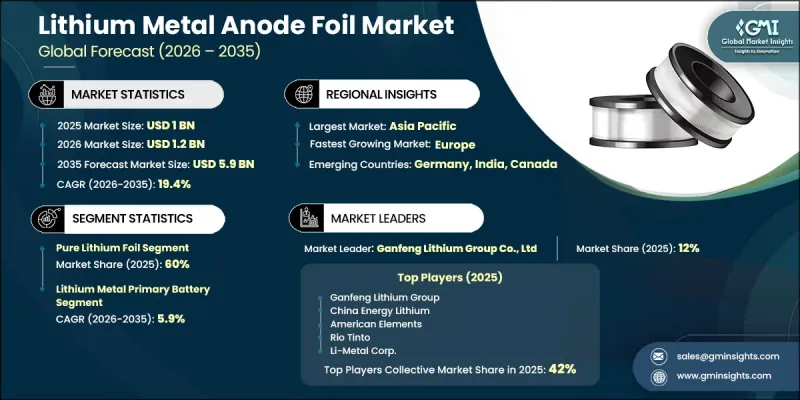
市場擴張的驅動力來自全固態電池技術的快速商業化、傳統鋰離子電池生產中預鋰化需求的成長以及鋰硫電池系統新機會的湧現。從石墨基負極到鋰金屬結構的轉變是下一代儲能領域最重要的材料變革之一。鋰金屬負極的理論比容量為3860 mAh/g,約為石墨的10倍,能夠實現先進電動車平台所需的400-500 Wh/kg能量密度目標。固態電池的研發仍是推動市場結構性成長要素。這是因為這些系統需要極薄的鋰金屬箔(通常厚度小於20 µm)才能達到所需的體積效率。隨著固態電池技術從實驗室檢驗階段邁向商業化前的規模化生產階段,整個電池供應鏈對高精度鋰金屬箔的需求預計將顯著成長。
| 市場範圍 | |
|---|---|
| 開始年份 | 2025 |
| 預測期 | 2026-2035 |
| 初始市場規模 | 10億美元 |
| 預測金額 | 59億美元 |
| 複合年成長率 | 19.4% |
預計到2035年,純鋰箔市場規模將達22.4億美元。該市場涵蓋兩大主要應用領域:用於固態電池開發和航太系統的高純度鋰箔,以及用於預鋰化製程和一次電池系統的低純度鋰箔。高純度鋰箔的生產需要嚴格的表面品管、極低的缺陷密度,並且需要在特殊的惰性環境下進行處理和包裝,這些都使其與標準工業鋰箔的生產截然不同。
鋰金屬一次電池領域已發展成熟,預計2025年將佔51%的市場。該領域包括用於國防、航太和醫療設備應用的鋰基一次電池系統。這些系統採用厚度為50–150 µm、純度為2N–3N的鋰金屬箔,滿足在嚴苛運轉環境下實現長壽命和高可靠性儲能的要求。
預計2025年,北美鋰金屬負極箔市場規模將達到1.476億美元,約佔全球市場的18%。美國仍是主要的需求中心,而加拿大正崛起成為重要的生產中心。旨在加強關鍵國內礦產供應鏈的監管和政策框架正在推動對鋰金屬箔製造的投資。包括電塗裝的新生產方法減少了對傳統乾式軋延系統的依賴,有助於建立符合區域法規的策略性獨立供應鏈。
目錄
第1章:調查方法和範圍
第2章執行摘要
第3章 行業洞察
- 產業生態系分析
- 供應商情況
- 利潤率
- 每個階段增加的價值
- 影響價值鏈的因素
- 中斷
- 影響產業的因素
- 促進因素
- 固態電池商業化的加速發展正在推動對鋰金屬負極箔的結構性需求。
- 電動車的快速普及對高能量密度負極材料產生了大規模的需求。
- 預鋰化技術的應用正在擴大鋰箔在傳統鋰離子電池生產線的應用。
- 產業潛在風險與挑戰
- 大規模生產無缺陷超薄箔(20µM)的技術複雜性。
- 持續枝晶形成和循環穩定性的挑戰導致大規模生產延遲。
- 市場機遇
- 鋰硫(Li-S)電池平台的出現為負極箔材創造了新的需求促進因素。
- 歐洲和北美供應鏈的多元化正在促成新的區域生產基地的建立。
- 促進因素
- 成長潛力分析
- 監理情勢
- 波特的分析
- PESTLE分析
- 技術與創新展望
- 最新科技趨勢
- 新興技術
- 價格趨勢
- 按地區
- 按箔材類型
- 未來市場趨勢
- 專利趨勢
- 貿易統計
- 主要進口國
- 主要出口國
- 永續性和環境方面
- 永續計劃
- 減少廢棄物策略
- 生產中的能源效率
- 具有環保意識的舉措
- 考慮碳足跡
第4章 競爭情勢
- 介紹
- 企業市佔率分析
- 按地區
- 北美洲
- 歐洲
- 亞太地區
- LATAM
- 中東和非洲
- 按地區
- 企業矩陣分析
- 主要市場公司的競爭分析
- 競爭定位矩陣
- 主要進展
- 併購
- 夥伴關係和聯盟
- 新產品發布
- 業務拓展計劃
第5章 市場估價與預測:依箔材類型分類,2022-2035年
- 純鋰箔
- 鋰銅複合箔
- 鋰合金箔
第6章 市場估計與預測:依應用領域分類,2022-2035年
- 全固態電池
- 半固態電池
- 鋰金屬一次電池
- 鋰離子電池(預鋰化)
- 鋰硫電池
- 其他
第7章 市場估價與預測:依最終使用者分類,2022-2035年
- 汽車和電動車
- 家用電子產品
- 能源儲存系統
- 航太/國防
- 醫療器材
- 其他
第8章 市場估計與預測:依地區分類,2022-2035年
- 北美洲
- 美國
- 加拿大
- 歐洲
- 德國
- 英國
- 法國
- 西班牙
- 義大利
- 其他歐洲國家
- 亞太地區
- 中國
- 印度
- 日本
- 澳洲
- 韓國
- 其他亞太國家
- 拉丁美洲
- 巴西
- 墨西哥
- 阿根廷
- 其他拉丁美洲國家
- 中東和非洲
- 沙烏地阿拉伯
- 南非
- UAE
- 其他中東和非洲國家
第9章:公司簡介
- Ganfeng Lithium Group Co., Ltd
- China Energy Lithium Co., Ltd.
- American Elements
- Rio Tinto
- Li-Metal Corp.
- Fuji Chemi Trading Co., Ltd.
- SMI Ltd.(Strategic Metal Investments Ltd.)
- Techinstro
- Goodfellow
- Nanoshel LLC
- YDL Battery
- TOB New Energy(Xiamen TOB New Energy Technology Co., Ltd.)
The Global Lithium Metal Anode Foil Market was valued at USD 1 billion in 2025 and is estimated to grow at a CAGR of 19.4% to reach USD 5.9 billion by 2035.
Market expansion is supported by the rapid commercialization of solid-state battery technologies, increasing demand for prelithiation in conventional lithium-ion production, and emerging opportunities in lithium-sulfur battery systems. The shift from graphite-based anodes to lithium metal architectures is one of the most significant material transitions in next-generation energy storage. Lithium metal anodes offer a theoretical specific capacity of 3,860 mAh/g, nearly ten times higher than graphite, enabling energy density targets of 400-500 Wh/kg required for advanced electric vehicle platforms. Solid-state battery development remains the primary structural growth driver, as these systems require ultra-thin lithium metal foils, typically at or below 20 µm, to achieve the required volumetric efficiency. As solid-state technologies progress from laboratory validation to pre-commercial scaling, demand for high-precision lithium metal foil is expected to accelerate significantly across the battery supply chain.
| Market Scope | |
|---|---|
| Start Year | 2025 |
| Forecast Year | 2026-2035 |
| Start Value | $1 Billion |
| Forecast Value | $5.9 Billion |
| CAGR | 19.4% |
The pure lithium foil segment is expected to reach USD 2.24 billion by 2035. This segment serves two primary application categories, including high-purity grades used in solid-state battery development and aerospace systems, as well as lower-purity grades used in prelithiation processes and primary battery systems. Higher-grade materials require strict surface quality control, low defect density, and specialized inert handling and packaging processes, which distinguish them from standard industrial lithium foil production.
The lithium metal primary battery segment held 51% share in 2025 owing to its mature stage of development. This segment includes lithium-based primary battery systems used in defense, aerospace, and medical device applications. These systems rely on lithium metal foil in thickness ranges of 50-150 µm and purity levels between 2N and 3N, supporting long-life, high-reliability energy storage requirements in critical operational environments.
North America Lithium Metal Anode Foil Market accounted for USD 147.6 million in 2025, representing nearly 18% of the global market. The United States remains the primary demand hub, while Canada is emerging as an important production base. Regulatory and policy frameworks focused on strengthening domestic critical mineral supply chains have encouraged investment in lithium metal foil manufacturing. New production approaches, including electrodeposition-based methods that reduce dependence on conventional dry-room rolling systems, are contributing to the development of regionally compliant and strategically independent supply chains.
Major companies operating in the global lithium metal anode foil market include Ganfeng Lithium Group Co., Ltd., China Energy Lithium Co., Ltd., American Elements, Rio Tinto (LIOVIX(R)), Li-Metal Corp., Fuji Chemi Trading Co., Ltd., SMI Ltd. (Strategic Metal Investments Ltd.), Techinstro, Goodfellow, MTI Corporation, Nanoshel LLC, YDL Battery, and TOB New Energy (Xiamen TOB New Energy Technology Co., Ltd.). Companies operating in the lithium metal anode foil market are strengthening their position by expanding production capabilities and investing in advanced manufacturing technologies that improve foil uniformity, purity, and thickness control. Many firms are focusing on scaling up solid-state battery supply readiness by aligning product specifications with emerging OEM requirements. Strategic investments in electrodeposition technologies, automated production systems, and inert-atmosphere processing environments are helping reduce production variability and improve yield efficiency. Companies are also forming partnerships with battery manufacturers, automotive OEMs, and research institutions to accelerate commercialization timelines.
Table of Contents
Chapter 1 Methodology & Scope
- 1.1 Market scope and definition
- 1.2 Research design
- 1.2.1 Research approach
- 1.2.2 Data collection methods
- 1.3 Data mining sources
- 1.3.1 Global
- 1.3.2 Regional/Country
- 1.4 Base estimates and calculations
- 1.4.1 Base year calculation
- 1.4.2 Key trends for market estimation
- 1.5 Primary research and validation
- 1.5.1 Primary sources
- 1.6 Forecast model
- 1.7 Research assumptions and limitations
Chapter 2 Executive Summary
- 2.1 Industry 360° synopsis
- 2.2 Key market trends
- 2.2.1 Foil Type
- 2.2.2 Application
- 2.2.3 End-user
- 2.2.4 Regional
- 2.3 TAM Analysis, 2026-2035
- 2.4 CXO perspectives: Strategic imperatives
- 2.5 Future outlook and strategic recommendations
Chapter 3 Industry Insights
- 3.1 Industry ecosystem analysis
- 3.1.1 Supplier landscape
- 3.1.2 Profit margin
- 3.1.3 Value addition at each stage
- 3.1.4 Factor affecting the value chain
- 3.1.5 Disruptions
- 3.2 Industry impact forces
- 3.2.1 Growth drivers
- 3.2.1.1 Accelerating commercialization of solid-state batteries driving structural demand for lithium metal anode foil
- 3.2.1.2 Rapid ev adoption creating large-scale requirement for high-energy-density anode materials
- 3.2.1.3 Prelithiation technology adoption expanding lithium foil use in conventional li-ion manufacturing lines
- 3.2.2 Industry pitfalls and challenges
- 3.2.2.1 Technical complexity of manufacturing defect-free ultra-thin foil (20 µM) at commercial scale
- 3.2.2.2 Persistent dendrite formation & cycling stability challenges delaying mass-market deployment
- 3.2.3 Market opportunities
- 3.2.3.1 Emergence of lithium-sulfur (li-s) battery platforms creating new anode foil demand vectors
- 3.2.3.2 Supply chain diversification drive in europe & north america opening new regional production hubs
- 3.2.1 Growth drivers
- 3.3 Growth potential analysis
- 3.4 Regulatory landscape
- 3.4.1 North America
- 3.4.2 Europe
- 3.4.3 Asia Pacific
- 3.4.4 Latin America
- 3.4.5 Middle East & Africa
- 3.5 Porter’s analysis
- 3.6 PESTEL analysis
- 3.7 Technology and innovation landscape
- 3.7.1 Current technological trends
- 3.7.2 Emerging technologies
- 3.8 Price trends
- 3.8.1 By region
- 3.8.2 By foil type
- 3.9 Future market trends
- 3.10 Patent landscape
- 3.11 Trade statistics (HS code)
- 3.11.1 Major importing countries
- 3.11.2 Major exporting countries
- 3.12 Sustainability and environmental aspects
- 3.12.1 Sustainable practices
- 3.12.2 Waste reduction strategies
- 3.12.3 Energy efficiency in production
- 3.12.4 Eco-friendly initiatives
- 3.13 Carbon footprint consideration
Chapter 4 Competitive Landscape, 2025
- 4.1 Introduction
- 4.2 Company market share analysis
- 4.2.1 By region
- 4.2.1.1 North America
- 4.2.1.2 Europe
- 4.2.1.3 Asia Pacific
- 4.2.1.4 LATAM
- 4.2.1.5 MEA
- 4.2.1 By region
- 4.3 Company matrix analysis
- 4.4 Competitive analysis of major market players
- 4.5 Competitive positioning matrix
- 4.6 Key developments
- 4.6.1 Mergers & acquisitions
- 4.6.2 Partnerships & collaborations
- 4.6.3 New product launches
- 4.6.4 Expansion plans
Chapter 5 Market Estimates and Forecast, By Foil Type, 2022–2035 (USD Million) (Kilo Tons)
- 5.1 Key trends
- 5.2 Pure Lithium Foil
- 5.3 Li-Cu Composite Foil
- 5.4 Lithium Alloy Foil
Chapter 6 Market Estimates and Forecast, By Application, 2022–2035 (USD Million) (Kilo Tons)
- 6.1 Key trends
- 6.2 Solid-State Batteries
- 6.3 Semi-Solid Batteries
- 6.4 Lithium Metal Primary Batteries
- 6.5 Li-Ion Batteries (Prelithiation)
- 6.6 Li-S Batteries
- 6.7 Others
Chapter 7 Market Estimates and Forecast, By End-user, 2022–2035 (USD Million) (Kilo Tons)
- 7.1 Key trends
- 7.2 Automotive & EV
- 7.3 Consumer Electronics
- 7.4 Energy Storage Systems
- 7.5 Aerospace & Defense
- 7.6 Medical Devices
- 7.7 Others
Chapter 8 Market Estimates and Forecast, By Region, 2022–2035 (USD Million) (Kilo Tons)
- 8.1 Key trends
- 8.2 North America
- 8.2.1 U.S.
- 8.2.2 Canada
- 8.3 Europe
- 8.3.1 Germany
- 8.3.2 UK
- 8.3.3 France
- 8.3.4 Spain
- 8.3.5 Italy
- 8.3.6 Rest of Europe
- 8.4 Asia Pacific
- 8.4.1 China
- 8.4.2 India
- 8.4.3 Japan
- 8.4.4 Australia
- 8.4.5 South Korea
- 8.4.6 Rest of Asia Pacific
- 8.5 Latin America
- 8.5.1 Brazil
- 8.5.2 Mexico
- 8.5.3 Argentina
- 8.5.4 Rest of Latin America
- 8.6 Middle East and Africa
- 8.6.1 Saudi Arabia
- 8.6.2 South Africa
- 8.6.3 UAE
- 8.6.4 Rest of Middle East and Africa
Chapter 9 Company Profiles
- 9.1 Ganfeng Lithium Group Co., Ltd
- 9.2 China Energy Lithium Co., Ltd.
- 9.3 American Elements
- 9.4 Rio Tinto
- 9.5 Li-Metal Corp.
- 9.6 Fuji Chemi Trading Co., Ltd.
- 9.7 SMI Ltd. (Strategic Metal Investments Ltd.)
- 9.8 Techinstro
- 9.9 Goodfellow
- 9.10 Nanoshel LLC
- 9.11 YDL Battery
- 9.12 TOB New Energy (Xiamen TOB New Energy Technology Co., Ltd.)

 磷酸錳鐵鋰(LMFP)電池材料:市場佔有率分析、產業趨勢與統計、成長預測(2026-2031)
 鋰離子電池閉合迴路市場預測至2034年-全球分析(按回收製程類型、電池化學成分、來源、回收電池組件、回收材料的最終用途和地區分類)
 電池金屬市場規模、佔有率和趨勢分析報告:按金屬類型、應用、地區和細分市場分類的預測(2026-2033 年)鋰硫電池材料市場,全球預測至2032年:按組件、電池類型、容量範圍、應用和地區分類
 電池金屬市場規模、佔有率及成長分析(按金屬、應用和地區分類)-2026-2033年產業預測
 鋰電池隔膜用勃姆石-全球市佔率及排名、總收入及需求預測(2025-2031)
 電池金屬和關鍵礦物市場:2025-2035電池金屬-全球市場佔有率和排名、總收入和需求預測(2025-2031 年)