


 |
市場調查報告書
商品編碼
2119288
磷酸錳鐵鋰(LMFP)電池材料:市場佔有率分析、產業趨勢與統計、成長預測(2026-2031)Lithium Manganese Iron Phosphate (LMFP) Battery Materials - Market Share Analysis, Industry Trends & Statistics, Growth Forecasts (2026 - 2031) |
||||||

※ 本網頁內容可能與最新版本有所差異。詳細情況請與我們聯繫。
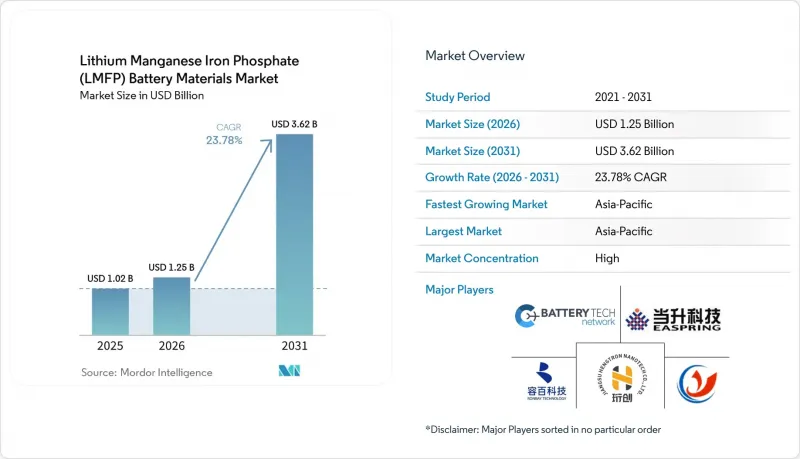
據 Mordor Intelligence 稱,2025 年鋰錳鐵磷酸鹽 (LMFP) 電池材料的市場規模估計為 10.2 億美元,預計將從 2026 年的 12.5 億美元成長到 2031 年的 36.2 億美元,2026 年至 2031 年的複合年成長率為 23.78%。
本報告材料類型(液態金屬磷酸鹽正極材料、負極材料等)、電池形狀(圓柱形電池、棱柱形電池等)、應用領域(電動車等)和地區(亞太地區、北美地區、歐洲地區、南美地區、中東和非洲地區)進行細分。市場預測以美元計價。
全球鋰錳鐵磷酸鹽(LMFP)電池材料市場趨勢與洞察。
電動車的普及以及對高能量密度電池的需求,而這種電池的成本要與磷酸鐵鋰電池相當。
鋰錳鐵磷酸鹽(LMFP)的能量密度可比傳統磷酸鐵鋰(LFP)高出15%至20%,同時成本結構與傳統LFP相當。這項特性推動了其在中檔電動車領域的應用,因為續航里程、成本和安全性是影響車輛設計決策的重要因素。到2025年,LFP將在電動車電池的引入方面超越鎳基電池,從而為鋰錳鐵磷酸鹽(LMFP)電池材料市場的發展建立大規模的生產和供應基礎。寧德時代(CATL)的高錳含量M3P平台已應用於續航里程達700公里的「智捷S7」車型,而榮貝的純LMFP配方也於2026年開始小批量應用於汽車。 LMFP無需像高鎳電池化學系統那樣受到鎳和鈷供應的限制,因此可以拓展市場。歐盟電池法規 2023/1542 規定,從 2025 年 8 月起,必須披露碳足跡和供應鏈實質審查,這為低鈷依賴性的正極材料創造了合規優勢。
電網級電池能源儲存系統系統的擴展
電網級電池能源儲存系統系統為磷酸錳鐵鋰(LMFP)電池材料市場提供了一個非乘用車領域的需求管道。儲能系統採購商擴大採用設計續航時間為4小時的系統,而更高的機架單元能量密度提高了固定安裝位置的可用容量。 LMFP還具有熱穩定性,這對於儲能系統開發商在考慮防火安全和保險要求時至關重要。因此,這種化學成分適用於那些空間、授權和運作安全會影響採購決策的應用情境。電池能源儲存系統系統的合約期限可達15至20年,比汽車車型週期具有更長遠的需求前景。這些長期合約可以支撐專案開發商從規劃階段過渡到建造階段時正極材料的採購量。
錳溶解、薑-櫃員應變和容量減少。
循環充放電和高溫條件下錳的浸出仍是鋰鐵鋰電池(LMFP)商業化規模化生產的主要技術瓶頸。 2024年的一項研究表明,浸出的Mn²⁺離子會從正極遷移並沉積在石墨負極上,導致固體電解質界面(SEI)劣化和鋰損失。隨著循環次數的增加,這種劣化過程會更加顯著。 2025年的一項研究指出,Mn³⁺離子的Jahn- 櫃員應變是晶格應變的原因,這種應變會在高錳負載下限制鋰離子的擴散。使用低總莫耳濃度LiPF₆和LiFSI的混合鹽電解已顯示出對錳沉積的抑製作用。與標準LFP電解的生產相比,這些配方需要更嚴格的合成控制,這可能會在工業應用普及之前保持較高的成本。
細分市場分析
2025年,磷酸錳鐵鋰(LMFP)正極材料將佔LMFP電池材料市場69.45%的佔有率,預計到2031年將以26.13%的複合年成長率成長。正極是LMFP材料鏈中的關鍵價值組件,因為它很大程度上決定了電池的電壓、能量密度和循環特性。擴大生產規模也將有助於降低整體相關材料的成本。矽碳複合材料負極與LMFP正極結合使用,可提高指定電池容量下的續航里程,從而支持此價值鏈的發展。這種組合可能會促使市場需求轉向高容量的矽石墨混合物。此外,LMFP電池的工作截止電壓較高,約4.3V,因此需要採取措施控制錳的溶解,也凸顯了電解和隔膜材料的重要性。
基於雙(氟磺醯)亞胺鋰(LiFSI)的鹽與氟化助溶劑的混合物能夠滿足所需的電解性能,因此對專用配方的需求日益成長。其他類別的導電添加劑、黏結劑和集電器也受益於LMFP活性顆粒的小型化。這縮短了鋰的擴散距離,但也需要更大表面積的炭黑和更嚴格的黏結劑規格。對於隔膜材料,需要更精確地控制孔徑,以容納更細的顆粒並在高電壓下保持穩定性。雖然標準LFP正極材料在2019年至2025年間以個位數的速度成長,但LMFP的商業化生產起步規模要小得多。
區域分析
預計到2025年,亞太地區將佔磷酸錳鋰(LMFP)電池材料市場45.02%的佔有率,並在2031年之前以25.83%的複合年成長率成長。中國憑藉其正極材料生產基礎設施、成熟的電池製造地以及迪納諾尼克(Dynanonic)位於曲靖、年產11萬噸的LMFP生產基地(該基地已於2024年中期全面運作),保持著這一市場地位。 2026年5月,迪納諾尼克宣布投資87億元人民幣(約12億美元)用於兩個磷基材料項目。印度正透過正極材料項目建設相關產能,其中包括Agratas Energy Storage Solutions在班加羅爾建設的價值4億美元的研發中心,以及Altomin和Himadri Specialty Chemicals計劃建設的LFP和LMFP產能。
在韓國,Ronbay公司位於忠州的正極材料生產線正在擴大供應,旨在滿足美國的採購需求。在日本,Panasonic正在為一項計畫於2027年啟動的計畫認證大型圓柱形磷酸鐵鋰(LMFP)電池。這些活動正在擴大亞太地區磷酸鐵鋰(LMFP)電池材料市場的產能,涵蓋正極材料、電池和終端應用領域。除亞太地區外,北美和歐洲仍是政策主導投資最重要的地區。在歐洲,歐盟電池法規下將於2027年2月生效的「數位電池護照」的要求正在促進歐盟內部電池材料的供應。寧德時代(CATL)和Stellantis公司正在投資41億歐元(約47.5億美元)在西班牙薩拉戈薩建造一座50吉瓦時的磷酸鐵鋰超級工廠,目標是在2026年下半年投產。
Dynanonik 和 ICL 集團正在薩倫托投資 2.85 億歐元(3.1 億美元)建造磷酸鐵鋰 (LFP) 和液態金屬磷酸鐵鋰 (LMFP) 工廠,以滿足 LMFP 電池材料市場的需求。南美洲憑藉著「鋰三角」資源和前景廣闊的礦業夥伴關係,在上游領域扮演著至關重要的角色。中東和非洲的需求與清潔能源項目所需的系統互連用相關,這兩個地區目前都依賴進口材料。這些地區的長期需求將取決於儲能專案能否從開發階段進入採購階段。
其他好處:
- Excel格式的市場預測(ME)表
- 3個月的分析師支持
目錄
第1章:引言
- 研究假設和市場定義
- 調查範圍
第2章:調查方法
第3章執行摘要
第4章 市場狀況
- 市場概覽
- 市場促進因素
- 電動車的普及以及對高能量密度電池的需求日益成長,而這種電池的成本應與磷酸鐵鋰電池相當。
- 電網級電池儲能系統的擴展
- 降低鈷和鎳供應鏈風險。
- 電池材料製造本地化
- 高度柔軟性的磷酸鋰/磷酸鋰生產線和混合策略
- 再生錳和閉合迴路材料供應
- 市場限制因素
- 錳溶解、薑-櫃員應變和容量減少。
- 雙電壓環境下的行為與電池管理複雜性
- 來自 LFP、NMC 和新興固態電池化學系統的競爭。
- 已公佈的LMFP產能的商業利用率較低。
- 價值鏈分析
- 波特五力分析
第5章 市場規模與成長預測
- 依材料類型
- LMFP陰極材料
- 陽極材料
- 電解質材料
- 分離材料
- 其他(導電添加劑、黏合劑、集電器)
- 按細胞形狀
- 圓柱形單元格
- 矩形單元格
- 其他(囊狀細胞)
- 透過使用
- 電動車
- 電池儲能系統
- 家用電子產品
- 其他(工業應用)
- 按地區
- 亞太地區
- 中國
- 印度
- 日本
- 韓國
- 東南亞國協
- 其他亞太國家
- 北美洲
- 美國
- 加拿大
- 墨西哥
- 歐洲
- 德國
- 英國
- 法國
- 義大利
- 北歐國家
- 其他歐洲國家
- 南美洲
- 巴西
- 阿根廷
- 其他南美國家
- 中東和非洲
- 沙烏地阿拉伯
- 南非
- 其他中東和非洲國家
- 亞太地區
第6章 競爭情勢
- 市場集中度
- 策略趨勢
- 市佔率和排名分析
- 公司簡介
- Beijing Easpring Material Technology Co., LTD
- BYD Europe BV
- CALB Group Co., Ltd.
- Contemporary Amperex Technology Co., Limited.
- Gotion
- Guangzhou Tinci Materials Technology Co., Ltd.
- Hunan Reshine New Material Co. Ltd.
- Hunan Yuneng New Energy Battery Material Co., Ltd.
- Integrals Power
- Jiangsu Hengtron Nanotech Co., Ltd.
- Livium Ltd
- NANO
- REPT BATTERO Energy Co., Ltd.
- Ronbay New Energy Technology Co., Ltd.
- Shenzhen Dynanonic Co., Ltd.
- SVOLT Energy
- XTC New Energy Materials(Xiamen)Co., Ltd.
第7章 市場機會與未來展望
According to Mordor Intelligence, the lithium manganese iron phosphate (LMFP) battery materials market size is estimated at USD 1.02 billion in 2025 and is estimated to grow from USD 1.25 billion in 2026 to USD 3.62 billion by 2031, at a CAGR of 23.78% during the forecast period (2026-2031).
This report is Segmented by Material Type (LMFP Cathode Materials, Anode Materials, and More), Cell Format (Cylindrical Cells, Prismatic Cells, and More), Application (Electric Vehicles and More), and Geography (Asia-Pacific, North America, Europe, South America, and Middle-East and Africa). The Market Forecasts are Provided in Terms of Value (USD).
Global Lithium Manganese Iron Phosphate (LMFP) Battery Materials Market Trends and Insights
EV Adoption and Demand for Higher Energy Density at LFP-Like Cost
LMFP can deliver 15% to 20% higher energy density than conventional LFP while maintaining a comparable cost structure. This combination supports its use in mid-range electric vehicles, where range, cost, and safety influence vehicle design decisions. LFP surpassed nickel-based chemistries in electric vehicle battery deployments in 2025, creating a larger production and supplier base from which the Lithium Manganese Iron Phosphate (LMFP) Battery Materials Market can develop. Contemporary Amperex Technology Co. Limited (CATL)'s manganese-rich M3P platform powered the Zhijie S7, which claims a 700 km range, while Ronbay's pure-use LMFP formulation entered small-batch vehicle deployment in 2026. LMFP can expand without the nickel and cobalt supply constraints that affect nickel-rich battery chemistries. The EU Battery Regulation 2023/1542 has required carbon footprint declarations and supply chain due diligence since August 2025, creating a compliance benefit for cathode choices with lower cobalt exposure.
Expansion of Grid-Scale Battery Energy Storage Systems
Grid-scale battery energy storage provides the Lithium Manganese Iron Phosphate (LMFP) Battery Materials Market with a demand channel beyond passenger vehicles. Storage buyers increasingly use systems designed for a 4-hour duration, where higher energy density per rack bay can improve usable capacity within a fixed site. LMFP also retains the thermal stability that storage developers consider when addressing fire safety and insurance requirements. This makes the chemistry relevant in applications where available space, permitting, and operating safety influence procurement decisions. Battery energy storage system agreements can extend for 15 to 20 years, providing longer demand visibility than vehicle model cycles. These longer contracts may support cathode procurement quantities as project developers move from pipeline planning to construction.
Manganese Dissolution, Jahn-Teller Distortion, and Capacity Fade
Manganese dissolution during cycling and at elevated temperatures remains a key technical constraint on LMFP commercial scale-up. A 2024 study found that dissolved Mn2+ ions migrate from the positive electrode and deposit on the graphite negative electrode, contributing to solid-electrolyte interface degradation and lithium inventory loss. The failure process becomes more pronounced as the cycle count increases. A 2025 study identified Jahn-Teller distortion of Mn3+ ions as a cause of lattice strain, which can limit lithium-ion diffusion at higher manganese loadings. Mixed-salt electrolytes using LiPF6 and LiFSI at lower total molarity have improved the suppression of manganese deposition. These formulations require tighter synthesis control than standard LFP electrolyte production, which may maintain a cost premium until industrial use becomes more widespread.
Other drivers and restraints analyzed in the detailed report include:
- Lower Exposure to Cobalt and Nickel Supply-Chain Risk
- Localization of Battery Material Manufacturing
- Dual-Voltage Behavior and Battery Management Complexity
For complete list of drivers and restraints, kindly check the Table Of Contents.
Segment Analysis
LMFP cathode materials accounted for 69.45% of the Lithium Manganese Iron Phosphate (LMFP) Battery Materials Market share in 2025 and are forecast to grow at a CAGR of 26.13% through 2031. The cathode determines much of the cell's voltage, energy density, and cycle behavior, making it the primary value component in the LMFP materials chain. Production scale also supports cost reduction across complementary materials. Anode materials support this value chain, as silicon-carbon composite anodes can pair with LMFP cathodes to deliver a greater range from a given pack size. This pairing can shift demand toward higher-capacity silicon-graphite blends. Electrolyte and separator materials are increasingly important because LMFP has a higher operating-voltage cutoff of nearly 4.3 V and requires measures to control manganese dissolution.
Lithium bis(fluorosulfonyl)imide (LiFSI)-based salt blends and fluorinated co-solvents can support the required electrolyte performance, creating demand for specialized formulations. Conductive additives, binders, and current collectors in the other category also gain from smaller LMFP active particles, which reduce lithium diffusion distances but require higher-surface-area carbon black and tighter binder specifications. Separator materials require tighter pore-size control to accommodate smaller particles and maintain stability at elevated voltages. Standard LFP cathodes grew at a measured single-digit pace from 2019 to 2025, while LMFP commercial production started from a much lower base.
Complete Report Scope:
- By Material Type
- LMFP Cathode Materials
- Anode Materials
- Electrolyte Materials
- Separator Materials
- Others (Conductive Additives, Binders, Current Collectors)
- By Cell Format
- Cylindrical Cells
- Prismatic Cells
- Others (Pouch Cells)
- By Application
- Electric Vehicles
- Battery Energy Storage Systems
- Consumer Electronics
- Others (Industrial Applications)
- By Geography
- Asia-Pacific
- China
- India
- Japan
- South Korea
- ASEAN Countries
- Rest of Asia-Pacific
- North America
- United States
- Canada
- Mexico
- Europe
- Germany
- United Kingdom
- France
- Italy
- NORDIC Countries
- Rest of Europe
- South America
- Brazil
- Argentina
- Rest of South America
- Middle-East and Africa
- Saudi Arabia
- South Africa
- Rest of Middle-East and Africa
- Asia-Pacific
Geography Analysis
Asia-Pacific held 45.02% of the Lithium Manganese Iron Phosphate (LMFP) Battery Materials Market share in 2025 and is forecast to grow at a CAGR of 25.83% through 2031. China holds this position through cathode production infrastructure, an established cell manufacturing base, and Dynanonic's 110,000-ton-per-year LMFP facility in Qujing, which reached full utilization by mid-2024. In May 2026, Dynanonic announced a CNY 8.7 billion (USD 1.2 billion) investment in two phosphate-based material projects. India is building related capacity through cathode projects, including Agratas Energy Storage Solutions' USD 400 million research and development center in Bengaluru and planned LFP and LMFP capacity from Altmin and Himadri Specialty Chemical.
South Korea adds supply through Ronbay's Chungju cathode line, which targets United States sourcing requirements. In Japan, Panasonic is qualifying large-format cylindrical LMFP cells for programs scheduled to begin in 2027. These activities add regional capacity in the Lithium Manganese Iron Phosphate (LMFP) Battery Materials Market across cathode materials, cells, and end-use applications. North America and Europe remain the most policy-driven investment areas outside Asia-Pacific. In Europe, digital battery passport requirements, which take effect in February 2027 under the EU Battery Regulation, support battery material supply within the European Union. CATL and Stellantis are developing a 50 GWh LFP gigafactory in Zaragoza, Spain, with an investment of EUR 4.1 billion (USD 4.75 billion), and target production in late 2026.
Dynanonic and ICL Group are developing a EUR 285 million (USD 310 million) LFP and LMFP plant in Sallent, to serve the Lithium Manganese Iron Phosphate (LMFP) Battery Materials Market. South America has an upstream role through lithium-triangle resources and prospective mine partnerships. Demand in the Middle-East and Africa is linked to grid-storage needs under clean-energy programs, although both regions currently rely on imported materials. Their longer-term demand depends on storage projects moving from development to procurement.
- Beijing Easpring Material Technology Co., LTD
- BYD Europe B.V.
- CALB Group Co., Ltd.
- Contemporary Amperex Technology Co., Limited.
- Gotion
- Guangzhou Tinci Materials Technology Co., Ltd.
- Hunan Reshine New Material Co. Ltd.
- Hunan Yuneng New Energy Battery Material Co., Ltd.
- Integrals Power
- Jiangsu Hengtron Nanotech Co., Ltd.
- Livium Ltd
- NANO
- REPT BATTERO Energy Co., Ltd.
- Ronbay New Energy Technology Co., Ltd.
- Shenzhen Dynanonic Co., Ltd.
- SVOLT Energy
- XTC New Energy Materials (Xiamen) Co., Ltd.
Additional Benefits:
- The market estimate (ME) sheet in Excel format
- 3 months of analyst support
TABLE OF CONTENTS
1 Introduction
- 1.1 Study Assumptions and Market Definition
- 1.2 Scope of the Study
2 Research Methodology
3 Executive Summary
4 Market Landscape
- 4.1 Market Overview
- 4.2 Market Drivers
- 4.2.1 EV Adoption and Demand for Higher Energy Density at LFP-Like Cost
- 4.2.2 Expansion of Grid-Scale Battery Energy Storage Systems
- 4.2.3 Lower Exposure to Cobalt and Nickel Supply-Chain Risk
- 4.2.4 Localization of Battery Material Manufacturing
- 4.2.5 Flexible LFP-LMFP Production Lines and Blending Strategies
- 4.2.6 Recycling-Derived Manganese and Closed-Loop Material Supply
- 4.3 Market Restraints
- 4.3.1 Mn-Dissolution, Jahn-Teller Distortion, and Capacity Fade
- 4.3.2 Dual-Voltage Behavior and Battery Management Complexity
- 4.3.3 Competition from LFP, NMC, and Emerging Solid-State Chemistries
- 4.3.4 Low Commercial Utilization of Announced LMFP Capacity
- 4.4 Value Chain Analysis
- 4.5 Porter's Five Forces Analysis
- 4.5.1 Threat of New Entrants
- 4.5.2 Bargaining Power of Suppliers
- 4.5.3 Bargaining Power of Buyers
- 4.5.4 Threat of Substitutes
- 4.5.5 Competitive Rivalry
5 Market Size and Growth Forecasts (Value)
- 5.1 By Material Type
- 5.1.1 LMFP Cathode Materials
- 5.1.2 Anode Materials
- 5.1.3 Electrolyte Materials
- 5.1.4 Separator Materials
- 5.1.5 Others (Conductive Additives, Binders, Current Collectors)
- 5.2 By Cell Format
- 5.2.1 Cylindrical Cells
- 5.2.2 Prismatic Cells
- 5.2.3 Others (Pouch Cells)
- 5.3 By Application
- 5.3.1 Electric Vehicles
- 5.3.2 Battery Energy Storage Systems
- 5.3.3 Consumer Electronics
- 5.3.4 Others (Industrial Applications)
- 5.4 By Geography
- 5.4.1 Asia-Pacific
- 5.4.1.1 China
- 5.4.1.2 India
- 5.4.1.3 Japan
- 5.4.1.4 South Korea
- 5.4.1.5 ASEAN Countries
- 5.4.1.6 Rest of Asia-Pacific
- 5.4.2 North America
- 5.4.2.1 United States
- 5.4.2.2 Canada
- 5.4.2.3 Mexico
- 5.4.3 Europe
- 5.4.3.1 Germany
- 5.4.3.2 United Kingdom
- 5.4.3.3 France
- 5.4.3.4 Italy
- 5.4.3.5 NORDIC Countries
- 5.4.3.6 Rest of Europe
- 5.4.4 South America
- 5.4.4.1 Brazil
- 5.4.4.2 Argentina
- 5.4.4.3 Rest of South America
- 5.4.5 Middle-East and Africa
- 5.4.5.1 Saudi Arabia
- 5.4.5.2 South Africa
- 5.4.5.3 Rest of Middle-East and Africa
- 5.4.1 Asia-Pacific
6 Competitive Landscape
- 6.1 Market Concentration
- 6.2 Strategic Moves
- 6.3 Market Share (%)/Ranking Analysis
- 6.4 Company Profiles (includes Global Overview, Market Overview, Core Segments, Financials as available, Strategic Information, Products and Services, and Recent Developments)
- 6.4.1 Beijing Easpring Material Technology Co., LTD
- 6.4.2 BYD Europe B.V.
- 6.4.3 CALB Group Co., Ltd.
- 6.4.4 Contemporary Amperex Technology Co., Limited.
- 6.4.5 Gotion
- 6.4.6 Guangzhou Tinci Materials Technology Co., Ltd.
- 6.4.7 Hunan Reshine New Material Co. Ltd.
- 6.4.8 Hunan Yuneng New Energy Battery Material Co., Ltd.
- 6.4.9 Integrals Power
- 6.4.10 Jiangsu Hengtron Nanotech Co., Ltd.
- 6.4.11 Livium Ltd
- 6.4.12 NANO
- 6.4.13 REPT BATTERO Energy Co., Ltd.
- 6.4.14 Ronbay New Energy Technology Co., Ltd.
- 6.4.15 Shenzhen Dynanonic Co., Ltd.
- 6.4.16 SVOLT Energy
- 6.4.17 XTC New Energy Materials (Xiamen) Co., Ltd.
7 Market Opportunities and Future Outlook
- 7.1 White-Space and Unmet-Need Assessment

 鋰金屬負極箔市場:商業機會、成長要素、產業趨勢分析及2026-2035年預測
 鋰離子電池閉合迴路市場預測至2034年-全球分析(按回收製程類型、電池化學成分、來源、回收電池組件、回收材料的最終用途和地區分類)
 電池金屬市場規模、佔有率和趨勢分析報告:按金屬類型、應用、地區和細分市場分類的預測(2026-2033 年)鋰硫電池材料市場,全球預測至2032年:按組件、電池類型、容量範圍、應用和地區分類
 電池金屬市場規模、佔有率及成長分析(按金屬、應用和地區分類)-2026-2033年產業預測
 鋰電池隔膜用勃姆石-全球市佔率及排名、總收入及需求預測(2025-2031)
 電池金屬和關鍵礦物市場:2025-2035電池金屬-全球市場佔有率和排名、總收入和需求預測(2025-2031 年)