


 |
市場調查報告書
商品編碼
2083316
全球播種機及撒播機市場機會、成長要素、產業趨勢分析及2026-2035年預測Global Seed Drill and Broadcast Seeder Machinery Market Opportunity, Growth Drivers, Industry Trend Analysis, and Forecast 2026 - 2035 |
||||||

全球播種和廣播設備市場預計到 2025 年價值 70.3 億美元,並將以 5.97% 的複合年成長率成長,到 2035 年達到 125 億美元。
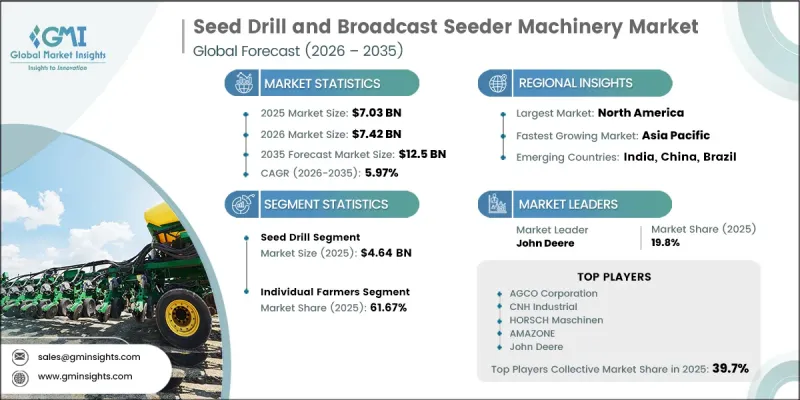
播種機和撒播機市場的成長主要受人工播種方式轉變為先進機械化的播種技術所驅動。全球農業生產者面臨越來越大的壓力,需要提高生產力、最佳化資源利用並應對持續的勞動力短缺問題,這導致對高效播種設備的需求不斷成長。隨著全部區域勞動力供應日益緊張,生產者正在投資能夠提供更高作業效率和更穩定田間作業性能的機械設備。機械化播種解決方案因其能夠提高播種精度、提升作物出苗率並減少對季節性工人的依賴而日益受到認可。此外,農業機械技術的進步使農民能夠實現更高的精準度、作業柔軟性和成本效益。除了農業實踐的持續現代化之外,對提高作物產量和最大化農場盈利的日益重視預計將推動播種機和撒播機市場在預測期內持續成長。
| 市場範圍 | |
|---|---|
| 開始年份 | 2025 |
| 預測期 | 2026-2035 |
| 初始市場規模 | 70.3億美元 |
| 預測金額 | 125億美元 |
| 複合年成長率 | 5.97% |
預計到2025年,播種機市場規模將達到46.4億美元,佔市佔率的66%。由於播種機能夠實現精準播種、均勻株距和一致的播種深度,預計該細分市場將在整個預測期內保持其主導地位。這些特性能夠改善種子與土壤的接觸,促進作物出苗,使播種機成為各種農業作業的首選。播種機在支援高效播種作業方面的有效性,持續推動農民廣泛採用播種機,以提高生產力並最佳化田間作業效果。
截至2025年,個體農戶將佔61.67%的市佔率。在農業機械化和生產力提升方面投資增加的推動下,這群人將繼續在市場成長中發揮重要作用。中型農場的農民仍然是播種設備最活躍的買家之一,因為他們需要在營運效率和長期盈利之間取得平衡。大規模農業企業也對市場價值貢獻顯著,因為這些企業通常會投資於融合精密農業功能、數位化連接和增強型操作能力的先進設備配置,以提高播種精度和農地管理效率。
到2025年,北美播種機和撒播機的市佔率將達到30.86%。對先進農業機械的強勁需求、高度的機械化水平以及對精密農業技術的持續投資,正在推動該地區的市場成長。大規模商業化農業生產持續推動對高容量播種機的需求,這些播種機能夠提高效率並最大限度地提高產量。此外,精密農業技術的進步和先進機械的普及應用,也協助該地區成為全球市場的主導者。農業生產的持續現代化以及對提高農業產量的重視,預計將維持北美市場的長期成長。
目錄
第1章:調查方法和範圍
第2章執行摘要
第3章 行業洞察
- 產業生態系分析
- 供應鏈分析
- 主要原料及產地
- 供應商集中度與單一來源風險評估
- 電子和半導體供應鏈中斷的影響
- 售後市場和備件的區域供應情況
- 影響產業的因素
- 促進因素
- 全球糧食需求不斷成長,以及提高農業生產力的必要性日益凸顯。
- 農業勞動力短缺正在加速農業機械化的引入。
- 開發中國家的政府補貼和機械化計劃
- 透過引入精密農業來提高播種效率和產量
- 產業潛在風險與挑戰
- 高昂的資本投資成本阻礙了小規模農戶採用這項技術。
- 土地碎片化降低了大型設備的運作效率。
- 機會
- 犁地農業和保護性農業的推廣,增加了對專用播種機的需求。
- 電氣化和混合動力推進:下一代設備類別
- 無人機載式和空中播種機的商業化
- 撒哈拉以南非洲和東南亞地區尚未開發的機械化潛力
- 促進因素
- 成長潛力分析
- 技術與創新展望
- 精準播種技術(GPS、變數施肥技術、RTK)
- 將物聯網和感測器整合到最新的播種機中
- 噴霧式播種機設計中氣動和液壓技術的進步
- 犁地和直播技術的演變
- 一種用於電動和混合動力推進系統的新平台
- 無人機/無人飛行器搭載式空中播種系統
- 監理框架
- 農業機械排放氣體法規(歐盟第五階段,EPA第四階段)
- 政府機械化補貼計劃
- 關於印度農業機械化(SMAM)的報告
- 歐盟通用農業政策(CAP)對農業機械的支持
- 來自美國農業部(USDA)保護計劃的設備津貼。
- 農業機械操作員的安全與勞動標準
- 影響設備設計的環境和土壤保護條例
- 關鍵市場趨勢與顛覆性因素
- 未來市場趨勢
- 價格分析
- 依設備類型及推進方式分析歷史價格趨勢
- 依球員類型分類的定價策略(高級球員、超值球員、成本加成球員)
- 貿易數據分析
- 按設備類型分類的進出口量和進口額趨勢
- 關稅對主要貿易路線和播種機的影響
- 人工智慧和生成式人工智慧對市場的影響
- 利用人工智慧改造現有機器經營模式
- Genai按細分市場的應用範例和實施藍圖(預測播種、自主田間規劃)
- 人工智慧在農業機械領域的風險、限制與監管考量
- 生產能力和生產情況
- 按地區和主要生產國分類的已安裝製造能力
- 運轉率和擴張計劃
- 投資與資金籌措分析
- 農業機械製造領域資本投資趨勢
- 播種和種植設備產業的併購趨勢
- 創業投資和私募股權投資正湧入精準孵化的新創公司。
- 波特的分析
- PESTLE分析
第4章 競爭情勢
- 介紹
- 企業市佔率分析
- 按地區
- 企業矩陣分析
- 主要市場公司的競爭分析
- 競爭定位矩陣
- 主要進展
- 併購
- 夥伴關係和聯盟
- 新產品發布
- 業務拓展計劃
第5章 市場估算與預測:依設備類型分類,2022-2035年
- 主要趨勢
- 播種機
- 單盤播種機
- 雙圓盤播種機
- 氣吸式播種機
- Nautil/Conservation型播種機
- 肥料和播種機
- 廣播種子
- 車載式播種機
- 可拖曳式播種機
- 自走式播種機
- 飛機/無人機搭載式播種機
第6章 市場估計與預測:依驅動類型分類,2022-2035年
- 主要趨勢
- 手動型/手動操作型
- 單行手動播種機
- 多行手推式播種機
- 曳引機懸掛式(動力輸出軸驅動)
- 三點式掛接類型
- 半掛式/拖曳式
- 自推進式
- 引擎驅動的自推進裝置
- 電動/電池驅動的自推進車輛(新型)
第7章 市場估計與預測:依作物分類,2022-2035年
- 主要趨勢
- 穀物和穀類
- 小麥
- 玉米
- 米
- 大麥和高粱
- 豆類和豆莢
- 大豆
- 鷹嘴豆和扁豆
- 花生
- 油籽
- 菜籽/喇叭菜籽
- 向日葵
- 芥末芝麻
- 牧草/飼料作物
- 黑麥草和梯牧草
- 紫花苜蓿三葉草
- 覆蓋作物和其他
- 透過多種品種混合播種的方式播種覆蓋作物
- 恢復和植被恢復用途
第8章 市場估算與預測:依最終使用者分類,2022-2035年
- 主要趨勢
- 私人農場主
- 小規模農戶(不到5公頃)
- 中型農場經營者(5-50公頃)
- 大型農業經營者(50公頃或以上)
- 農業承包商和合作社
- 商業播種承包商
- 農業合作社和生產者組織
- 政府和研究機構
- 政府農業發展機構
- 農業大學和研發農場
第9章 市場估計與預測:依地區分類,2022-2035年
- 主要趨勢
- 北美洲
- 美國
- 加拿大
- 歐洲
- 德國
- 英國
- 法國
- 義大利
- 西班牙
- 亞太地區
- 中國
- 印度
- 日本
- 韓國
- 澳洲
- 拉丁美洲
- 巴西
- 墨西哥
- 阿根廷
- 中東和非洲
- UAE
- 沙烏地阿拉伯
- 南非
第10章:公司簡介
- Deere &Company(John Deere)
- AGCO Corporation
- Great Plains Manufacturing Inc
- CNH Industrial NV
- CLAAS KGaA mbH
- Kubota Corporation
- Yanmar Holdings Co., Ltd
- SAME DEUTZ-FAHR Group(SDF)
- ISEKI &Co., Ltd
- AMAZONEN-WERKE H. Dreyer SE &Co. KG
- HORSCH Maschinen GmbH
- LEMKEN GmbH &Co. KG
- Vaderstad AB
- Kverneland Group(Part of Kubota)
- Bourgault Industries Ltd
- Maschio Gaspardo Group
- Morris Industries Ltd
- SKY Agriculture
- Salford Group
The Global Seed Drill and Broadcast Seeder Machinery Market was valued at USD 7.03 billion in 2025 and is estimated to grow at a CAGR of 5.97% to reach USD 12.5 billion by 2035.
Growth in the seed drill and broadcast seeder machinery market is driven by the increasing transition from manual planting methods to advanced mechanized seeding technologies. Agricultural producers worldwide are facing mounting pressure to improve productivity, optimize resource utilization, and address ongoing labor shortages, leading to greater demand for efficient planting equipment. Declining labor availability across farming regions is encouraging growers to invest in machinery capable of delivering higher operational efficiency and consistent field performance. Mechanized seeding solutions are increasingly recognized for their ability to improve planting accuracy, enhance crop establishment, and reduce dependence on seasonal labor. Furthermore, advancements in agricultural equipment technology are enabling farmers to achieve greater precision, operational flexibility, and cost efficiency. The continued modernization of agricultural practices, coupled with growing emphasis on improving crop yields and maximizing farm profitability, is expected to support sustained expansion of the Seed Drill and Broadcast Seeder Machinery Market throughout the forecast period.
| Market Scope | |
|---|---|
| Start Year | 2025 |
| Forecast Year | 2026-2035 |
| Start Value | $7.03 Billion |
| Forecast Value | $12.5 Billion |
| CAGR | 5.97% |
The seed drill segment accounted for USD 4.64 billion, representing 66% share in 2025. The segment is expected to maintain its dominant position over the forecast period due to its ability to provide precise seed placement, uniform spacing, and consistent planting depth. These capabilities contribute to improved seed-to-soil contact and enhanced crop establishment, making seed drills a preferred choice across a wide range of agricultural operations. Their effectiveness in supporting efficient planting practices continues to drive widespread adoption among farmers seeking to improve productivity and optimize field performance.
The individual farmers segment held a 61.67% share in 2025. This segment continues to play a critical role in market growth, supported by increasing investments in farm mechanization and productivity enhancement. Farmers operating medium-sized agricultural holdings remain among the most active purchasers of seeding equipment due to their need to balance operational efficiency with long-term profitability. Larger farming operations also contribute significantly to market value, as they often invest in advanced equipment configurations that incorporate precision agriculture capabilities, digital connectivity, and enhanced operational features designed to improve planting accuracy and field management efficiency.
North America Seed Drill and Broadcast Seeder Machinery Market held a 30.86% share in 2025. Strong demand for advanced agricultural equipment, extensive mechanization levels, and continued investment in precision farming technologies are supporting regional market growth. Large-scale commercial farming operations continue to drive demand for high-capacity planting equipment capable of improving efficiency and maximizing productivity. In addition, increasing adoption of precision agriculture practices and technologically advanced machinery is contributing to the region's leadership position within the global market. Ongoing modernization of farming operations and a strong focus on improving agricultural output are expected to sustain long-term growth across North America.
Major companies operating in the Global Seed Drill and Broadcast Seeder Machinery Market include AGCO Corporation, John Deere, AMAZONE, CNH Industrial, HORSCH Maschinen, Vaderstad, Kuhn Group, Great Plains, Bourgault Industries, LEMKEN, Maschio Gaspardo, Morris Industries, Kubota, Kverneland Group, and CLAAS. Companies participating in the seed drill and broadcast seeder machinery market are implementing a variety of strategic initiatives to strengthen their market position and expand their customer base. Product innovation remains a major priority, with manufacturers investing in advanced precision planting technologies, automation capabilities, digital connectivity, and smart farming solutions. Many companies are enhancing their equipment portfolios with features that improve planting accuracy, operational efficiency, and ease of use. Strategic partnerships with agricultural technology providers, distributors, and financing organizations are helping market participants broaden their reach and improve customer access to modern equipment.
Table of Contents
Chapter 1 Methodology & Scope
- 1.1 Research approach
- 1.2 Quality Commitments
- 1.2.1 GMI AI policy & data integrity commitment
- 1.2.1.1 Source consistency protocol
- 1.2.1 GMI AI policy & data integrity commitment
- 1.3 Research Trail & Confidence Scoring
- 1.3.1 Research Trail Components
- 1.3.2 Scoring Components
- 1.4 Data Collection
- 1.4.1 Partial list of primary sources
- 1.5 Data mining sources
- 1.5.1 Paid sources
- 1.5.1.1 Sources, by region
- 1.5.1 Paid sources
- 1.6 Base estimates and calculations
- 1.6.1 Base year calculation for any one approach
- 1.7 Forecast model
- 1.7.1 Quantified market impact analysis
- 1.7.1.1 Mathematical impact of growth parameters on forecast
- 1.7.1 Quantified market impact analysis
- 1.8 Research transparency addendum
- 1.8.1 Source attribution framework
- 1.8.2 Quality assurance metrics
- 1.8.2.1 Our commitment to trust
Chapter 2 Executive Summary
- 2.1 Industry 360° synopsis, 2022 - 2035
- 2.2 Key market trends
- 2.2.1 Region
- 2.2.2 Equipment Type
- 2.2.3 Propulsion Type
- 2.2.4 Crop Application
- 2.2.5 End-user
Chapter 3 Industry Insights
- 3.1 Industry ecosystem analysis
- 3.2 Supply chain analysis
- 3.2.1 Key input materials & sourcing geography
- 3.2.2 Supplier concentration & single-source risk assessment
- 3.2.3 Electronics & semiconductor supply chain disruption impact
- 3.2.4 Aftermarket & spare parts availability by region
- 3.3 Industry impact forces
- 3.3.1 Growth drivers
- 3.3.1.1 Rising global food demand & agricultural productivity imperative
- 3.3.1.2 Farm labor shortages accelerating mechanization adoption
- 3.3.1.3 Government subsidies & mechanization programs in developing economies
- 3.3.1.4 Precision agriculture integration enhancing seeding efficiency & yield
- 3.3.2 Industry pitfalls & challenges
- 3.3.2.1 High capital investment cost limiting smallholder adoption
- 3.3.2.2 Fragmented land holdings reducing operational efficiency of large equipment
- 3.3.3 Opportunities
- 3.3.3.1 No-till & conservation farming adoption expanding demand for specialized drills
- 3.3.3.2 Electrification & hybrid propulsion next-generation equipment category
- 3.3.3.3 Drone-mounted & aerial broadcast seeder commercialization
- 3.3.3.4 Untapped mechanization potential in sub-Saharan Africa & Southeast Asia
- 3.3.1 Growth drivers
- 3.4 Growth potential analysis
- 3.5 Technology & innovation landscape
- 3.5.1 Precision seeding technologies (GPS, variable rate technology, RTK)
- 3.5.2 IoT & sensor integration in modern seed drills
- 3.5.3 Pneumatic & hydraulic advances in broadcast seeder design
- 3.5.4 No-till & direct seeding technology evolution
- 3.5.5 Electric & hybrid propulsion emerging platforms
- 3.5.6 Drone / UAV-mounted aerial seeding systems
- 3.6 Regulatory framework
- 3.6.1 Emission standards for agricultural machinery (EU stage V, EPA tier 4)
- 3.6.2 Government mechanization subsidy programs
- 3.6.2.1 India sub-mission on agricultural mechanization (SMAM)
- 3.6.2.2 EU Common Agricultural Policy (CAP) machinery support
- 3.6.2.3 USA USDA conservation program equipment grants
- 3.6.2.4 Safety & occupational standards for farm machinery operators
- 3.6.2.5 Environmental & soil protection regulations affecting equipment design
- 3.7 Major market trends and disruptions
- 3.8 Future market trends
- 3.9 Pricing analysis (driven by primary research)
- 3.9.1 Historical price trend analysis by equipment type & propulsion (driven by primary research)
- 3.9.2 Pricing strategy by player type (premium/value/cost-plus) (driven by primary research)
- 3.10 Trade data analysis (driven by primary research)
- 3.10.1 Import/export volume & value trends by equipment category (driven by primary research)
- 3.10.2 Key trade corridors & tariff impact on seeder machinery (driven by primary research)
- 3.11 Impact of AI & generative AI on the market
- 3.11.1 AI-driven disruption of existing machinery business models
- 3.11.2 Genai use cases & adoption roadmap by segment (predictive seeding, autonomous field planning)
- 3.11.3 Risks, limitations & regulatory considerations for AI in farm machinery
- 3.12 Capacity & production landscape (driven by primary research)
- 3.12.1 Manufacturing capacity installed by region & key producer (driven by primary research)
- 3.12.2 Capacity utilization rates & expansion pipelines (driven by primary research)
- 3.13 Investment & funding analysis
- 3.13.1 Historical capex trends in agricultural equipment manufacturing
- 3.13.2 M&A activity in the seeder & planting equipment segment
- 3.13.3 Venture & private equity flows into Precision Seeding Startups
- 3.14 Porter’s analysis
- 3.15 PESTEL analysis
Chapter 4 Competitive Landscape, 2025
- 4.1 Introduction
- 4.2 Company market share analysis
- 4.2.1 By Region
- 4.2.1.1 North America
- 4.2.1.2 Europe
- 4.2.1.3 Asia Pacific
- 4.2.1.4 Latin America
- 4.2.1.5 Middle East and Africa
- 4.2.1 By Region
- 4.3 Company matrix analysis
- 4.4 Competitive analysis of major market players
- 4.5 Competitive positioning matrix
- 4.6 Key developments
- 4.6.1 Mergers & acquisitions
- 4.6.2 Partnerships & collaborations
- 4.6.3 New product launches
- 4.6.4 Expansion plans
Chapter 5 Market Estimates and Forecast, By Equipment Type, 2022 - 2035 (USD Billion) (Thousand Units)
- 5.1 Key Trends
- 5.2 Seed Drills
- 5.2.1 Single-Disc Seed Drill
- 5.2.2 Double-Disc Seed Drill
- 5.2.3 Air / Pneumatic Seed Drill
- 5.2.4 No-Till / Conservation Seed Drill
- 5.2.5 Fertilizer-Cum Seed Drill
- 5.3 Broadcast Seeders
- 5.3.1 Mounted Broadcast Seeder
- 5.3.2 Tow-Behind Broadcast Seeder
- 5.3.3 Self-Propelled Broadcast Seeder
- 5.3.4 Aerial / Drone-Mounted Broadcast Seeder
Chapter 6 Market Estimates and Forecast, By Propulsion Type, 2022 - 2035 (USD Billion) (Thousand Units)
- 6.1 Key Trends
- 6.2 Manual/Hand-Operated
- 6.2.1 Single-Row Manual Seeders
- 6.2.2 Multi-Row Push Seeders
- 6.3 Tractor-Mounted (PTO-Driven)
- 6.3.1 Three-Point Hitch-Mounted
- 6.3.2 Semi-Mounted / Trailed
- 6.4 Self-Propelled
- 6.4.1 Engine-Driven Self-Propelled Units
- 6.4.2 Electric / Battery-Powered Self-Propelled (Emerging)
Chapter 7 Market Estimates and Forecast, By Crop Application, 2022 - 2035 (USD Billion) (Thousand Units)
- 7.1 Key Trends
- 7.2 Cereals & Grains
- 7.2.1 Wheat
- 7.2.2 Maize/Corn
- 7.2.3 Rice
- 7.2.4 Barley & Sorghum
- 7.3 Legumes & Pulses
- 7.3.1 Soybean
- 7.3.2 Chickpea & Lentils
- 7.3.3 Groundnut
- 7.4 Oilseeds
- 7.4.1 Canola/Rapeseed
- 7.4.2 Sunflower
- 7.4.3 Mustard & Sesame
- 7.5 Grass & Forage Crops
- 7.5.1 Ryegrass & Timothy
- 7.5.2 Alfalfa & Clover
- 7.6 Cover Crops & Others
- 7.6.1 Mixed Species Cover Crop Seeding
- 7.6.2 Restoration & Revegetation Applications
Chapter 8 Market Estimates and Forecast, By End User, 2022 - 2035 (USD Billion) (Thousand Units)
- 8.1 Key Trends
- 8.2 Individual Farmers
- 8.2.1 Smallholder Farmers (< 5 Hectares)
- 8.2.2 Mid-Scale Farm Operators (5-50 Hectares)
- 8.2.3 Large-Scale Farm Operators (> 50 Hectares)
- 8.3 Agricultural Contractors & Cooperatives
- 8.3.1 Commercial Seeding Contractors
- 8.3.2 Farming Cooperatives & Producer Groups
- 8.4 Government & Research Institutes
- 8.4.1 Government Agricultural Development Agencies
- 8.4.2 Agricultural Universities And R&D Farms
Chapter 9 Market Estimates & Forecast, By Region, 2022 - 2035, (USD Billion) (Thousand Units)
- 9.1 Key Trends
- 9.2 North America
- 9.2.1 U.S.
- 9.2.2 Canada
- 9.3 Europe
- 9.3.1 Germany
- 9.3.2 U.K.
- 9.3.3 France
- 9.3.4 Italy
- 9.3.5 Spain
- 9.4 Asia Pacific
- 9.4.1 China
- 9.4.2 India
- 9.4.3 Japan
- 9.4.4 South Korea
- 9.4.5 Australia
- 9.5 Latin America
- 9.5.1 Brazil
- 9.5.2 Mexico
- 9.5.3 Argentina
- 9.6 MEA
- 9.6.1 UAE
- 9.6.2 Saudi Arabia
- 9.6.3 South Africa
Chapter 10 Company Profiles
- 10.1 Deere & Company (John Deere)
- 10.2 AGCO Corporation
- 10.3 Great Plains Manufacturing Inc
- 10.4 CNH Industrial NV
- 10.5 CLAAS KGaA mbH
- 10.6 Kubota Corporation
- 10.7 Yanmar Holdings Co., Ltd
- 10.8 SAME DEUTZ-FAHR Group (SDF)
- 10.9 ISEKI & Co., Ltd
- 10.10 AMAZONEN-WERKE H. Dreyer SE & Co. KG
- 10.11 HORSCH Maschinen GmbH
- 10.12 LEMKEN GmbH & Co. KG
- 10.13 Vaderstad AB
- 10.14 Kverneland Group (Part of Kubota)
- 10.15 Bourgault Industries Ltd
- 10.16 Maschio Gaspardo Group
- 10.17 Morris Industries Ltd
- 10.18 SKY Agriculture
- 10.19 Salford Group

 2026年全球搭乘用式插秧機市場報告
 播種施肥機械:市場佔有率分析、產業趨勢與統計、成長預測(2026-2031)2026年全球智慧播種機市場報告
 播種機市場:2026-2032年全球市場預測(依產品類型、播種方式、運作模式、農場規模、行距、動力來源、行數、安裝方式、應用領域及銷售管道)
 全球播種和種植設備市場
 種植設備市場:按類型、作物類型、設計和地區分類-預測至2031年化肥機械市場:2026-2032年全球市場預測(依產品類型、動力來源、部署方式、技術、作物類型、最終用戶和銷售管道)
 智慧播種機市場機會、成長要素、產業趨勢分析及2026-2035年預測種植工具市場:依產品類型、動力來源、材料、應用、通路和最終用戶分類-全球預測,2026-2032年自走式蔬菜移植市場:按類型、引擎功率、種植行數、價格範圍、通路、最終用戶和應用分類-2026-2032年全球預測