


 |
市場調查報告書
商品編碼
2113712
播種施肥機械:市場佔有率分析、產業趨勢與統計、成長預測(2026-2031)Agricultural Planting and Fertilizing Machinery - Market Share Analysis, Industry Trends & Statistics, Growth Forecasts (2026 - 2031) |
||||||

※ 本網頁內容可能與最新版本有所差異。詳細情況請與我們聯繫。
2025 年播種施肥機械市場規模為 15.5 億美元,預計到 2031 年將達到 20.9 億美元,而 2026 年為 16.3 億美元,預測期(2026-2031 年)複合年成長率為 5.13%。
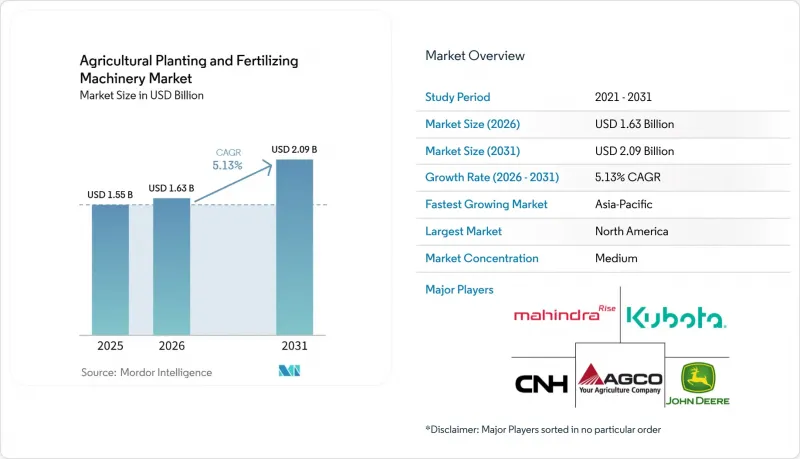
本報告按類型(播種機械和施肥機械)和地區(北美、歐洲、亞太、南美以及中東和非洲)進行細分。市場預測以美元計價。
全球播種施肥機械市場趨勢及洞察。
農業勞動力減少
全部區域勞動力供應趨緊,直接推動了播種和施肥機械市場的發展。根據美國農業部經濟研究局的數據顯示,H-2A認證的就業機會從2005會計年度的約4.8萬個增加到2024會計年度的約38.5萬個;而美國農業統計局的報告顯示,2024年農業從業人員的平均時薪將達到19.10美元。因此,農民越來越重視播種機、氣吸式播種機、移植機和肥料等設備,這些設備可以減少對勞動力的依賴,並幫助他們在有限的播種時間內完成播種。
農業機械化率的提高
此外,隨著多個農業生產國的農業機械化率持續提高,播種施肥機械市場也不斷擴大。這一趨勢在亞洲尤為顯著,政策支持、機械融資計劃和合約僱用模式鼓勵農民不再僅僅購買基礎曳引機,而是轉向更先進的田間設備,以提高播種施肥效率。中國和印度在這一轉型過程中繼續發揮核心作用,兩國持續支持農業機械現代化和精密農業的發展。因此,播種施肥機械市場受益於更廣泛的潛在客戶群體,尤其是那些能夠在一個作業週期內完成播種和施肥的設備。
高初始資本投入
播種和施肥機械市場仍面臨最大的障礙:高昂的初始設備成本。 2025年發表在《南非植物與土壤雜誌》上的一項研究指出,高昂的初始投資成本是精密農業推廣應用的主要障礙。此外,2025年發表在《永續糧食系統前沿》上的一項巴西研究顯示,南里奧格蘭德州64.6%的受訪農民仍未採用精密農業技術。即使有補貼,農民也常常面臨大量的自付費用,這些費用可能會吞噬幾個季度的營運利潤。這種成本限制了先進播種機、移植機和肥料的普及,尤其是在機械化潛力巨大的市場。
細分市場分析
2025年,播種機將佔據農業機械播種和施肥市場60.4%的佔有率,成為本次調查範圍內最大的產品類型。這個類別之所以能保持領先地位,是因為播種和移植是普遍的田間作業,無論種植的是穀物、油籽、豆類、水稻還是園藝作物,播種機都是適應性最強的機械類型,能夠適應各種土壤條件和農場規模。此外,隨著生產者越來越重視均勻發芽、精確的溝距和減少重疊播種,精密播種機和氣吸式播種機在高價值的行栽系統中也越來越受歡迎。
預計肥料機械將成為成長最快的產品類型,2026年至2031年的複合年成長率將達到6.7%。這反映了播種和施肥機械市場中養分效率日益成長的重要性。變數施肥機、行內施肥機和播種/施肥一體機能夠幫助農民減少田間作業次數,最佳化養分施用時間,降低柴油消耗,並將養分更精準地輸送到作物根系附近。迪爾公司在2026年推出了適用於2027款播種機的雙產品施肥系統,將行內施肥(採用ExactShot技術)和行邊施肥(採用ExactRate技術)相結合,展現了這一發展方向。這將使行內養分投入量減少高達66%。儘管剩餘的市場機會仍集中在對成本較為敏感的地區,主要集中在機械播種機和主流播種機領域,但整體價值構成正穩步向一體化播種和施肥系統轉變。
區域分析
2025年,北美地區佔全球播種和施肥機械市場價值的35.0%,而亞太地區預計將在2026年至2031年間以7.7%的複合年成長率(CAGR)實現最高成長。北美地區之所以能保持主導地位,得益於其大規模的行栽作物種植、完善的經銷商網路,以及在整體商業性播種活動中廣泛採用的導航系統、自動斷電功能和精準施肥系統。 2025年12月,美國農業部自然資源保護局表示,將透過一項7億美元的再生農業試驗計畫進一步刺激市場需求,該計畫旨在支持犁地耕作系統和改良養分管理等再生農業實踐。亞太地區的成長速度更快,因為中國和印度持續透過補貼計畫、智慧農業機械升級和增加設備取得管道來支援機械化,深化了整體播種和施肥作業的機械化程度。
南美洲仍然是重要的成長要素。這主要源自於巴西大豆和玉米雙季種植系統對高產能播種機和肥料的需求,以便在有限的季節內覆蓋大片田地。在歐洲,尤其是在德國、法國和英國,隨著農場不斷向更精準的播種和施肥系統轉型,對設備更換和升級的需求顯著成長。丹麥報告稱,2023年所有種植區精密農業技術的採用率都很高,顯示歐洲先進地區正在超越初始採用階段,邁向系統完善和持續升級。雖然中東和非洲的市場規模仍然較小,但這兩個地區正透過糧食安全措施、對沙漠農業的投資以及降低擁有門檻的計量型機械化模式,創造新的需求。
預計播種施肥機械市場將呈現區域性擴張,主要受成熟經濟體更新換代需求和新興農業系統初期應用的推動。在北美和歐洲,未來的成長預計主要由高階播種單元升級、可變施肥平台以及有助於農場更高效地管理生產力和投入成本的整合數位生態系統驅動。在亞太地區、非洲和南美洲部分地區,市場擴張將主要依賴持續的補貼、可負擔的資金籌措以及將機械使用權與所有權分開的服務型存取模式。這種區域格局表明,播種施肥機械市場將實現已開發國家高附加價值技術銷售與新興農業地區更廣泛的機械應用之間的平衡。
其他好處:
- Excel格式的市場預測(ME)表
- 3個月的分析師支持
目錄
第1章:引言
- 研究假設和市場定義
- 調查範圍
第2章:調查方法
第3章執行摘要
第4章 市場狀況
- 市場概覽
- 市場促進因素
- 農業勞動力減少
- 農業機械化率的提高
- 精密農業正變得越來越普及。
- 政府補貼和低利率貸款計劃
- 農業技術即服務設備利用模式
- 為促進再生農業精準投入,提供排碳權獎勵。
- 市場限制因素
- 初始投資額相對較高。
- 複雜的運作和維護要求
- 半導體關稅和感測器供應波動
- 人們對連網設備的資料隱私和網路安全問題感到擔憂
- 監理情勢
- 技術展望
- 波特五力模型
第5章 市場規模與成長預測
- 按類型
- 種植機械
- 播種機
- 播種機
- 移植機
- 施肥機
- 種子和肥料組合播種機
- 肥料撒佈器
- 液態肥料和啟動肥料撒佈機
- 種植機械
- 按地區
- 北美洲
- 美國
- 加拿大
- 墨西哥
- 其他北美國家
- 南美洲
- 巴西
- 阿根廷
- 其他南美國家
- 歐洲
- 德國
- 英國
- 法國
- 義大利
- 西班牙
- 俄羅斯
- 其他歐洲國家
- 亞太地區
- 中國
- 印度
- 日本
- 澳洲
- 印尼
- 泰國
- 其他亞太國家
- 中東
- 沙烏地阿拉伯
- 土耳其
- 阿拉伯聯合大公國
- 其他中東國家
- 非洲
- 南非
- 奈及利亞
- 埃及
- 其他非洲國家
- 北美洲
第6章 競爭情勢
- 市場集中度
- 策略趨勢
- 市佔率分析
- 公司簡介
- Deere & Company
- CNH Industrial NV
- AGCO Corporation
- Kubota Corporation
- Mahindra & Mahindra Limited
- CLAAS KGaA mbH
- Bucher Industries AG
- Maschio Gaspardo SpA
- Vaderstad AB
- Kinze Manufacturing, Inc.
- HORSCH Maschinen GmbH
- AMAZONEN-WERKE H. DREYER SE & Co. KG
- Bourgault Industries Ltd.
- Topcon Positioning Systems, Inc.(Topcon Corporation)
- LEMKEN GmbH & Co. KG
第7章 市場機會與未來展望
According to Mordor Intelligence, the agricultural planting and fertilizing machinery market size was valued at USD 1.55 billion in 2025 and estimated to grow from USD 1.63 billion in 2026 to reach USD 2.09 billion by 2031, at a CAGR of 5.13% during the forecast period (2026-2031).
This report is Segmented by Type (Planting Machinery and Fertilizing Machinery) and Geography (North America, Europe, Asia-Pacific, South America, Middle East, and Africa). The Market Forecasts are Provided in Terms of Value (USD).
Global Agricultural Planting and Fertilizing Machinery Market Trends and Insights
Decline in Farm Labor Availability
The agricultural planting and fertilizing machinery market is gaining direct support from tighter labor availability across major farming regions. The United States Department of Agriculture (USDA) Economic Research Service showed that H-2A certified positions rose from nearly 48,000 in fiscal 2005 to about 385,000 in fiscal 2024, while the National Agricultural Statistics Service reported average gross farm wages for hired workers at USD 19.10 per hour in 2024. As a result, farms are placing greater value on seed drills, pneumatic planters, transplanters, and fertilizer applicators that reduce labor dependence and protect narrow planting windows.
Increased Farm Mechanization Rates
The agricultural planting and fertilizing machinery market is also expanding because farm mechanization rates continue to rise across several crop-producing economies. The trend is particularly visible in Asia, where policy support, machinery financing programs, and custom-hiring models are helping farmers move beyond basic tractor adoption toward more advanced field equipment that improves seeding and fertilizer placement efficiency. China and India remain central to this transition because both countries continue to support agricultural machinery modernization and precision farming initiatives. As a result, the agricultural planting and fertilizing machinery market is benefiting from a broader addressable customer base, particularly for equipment that combines planting and fertilizer application within a single operating cycle.
High Initial Equipment Investment
The agricultural planting and fertilizing machinery market still faces its strongest barrier in the form of high upfront equipment cost. A 2025 study published in the South African Journal of Plant and Soil identified high initial investment cost as a major barrier to precision agriculture adoption, while a 2025 Frontiers in Sustainable Food Systems study in Brazil found that 64.6% of surveyed farmers in Rio Grande do Sul remained non-adopters of precision agriculture technologies. Even when subsidy programs are available, farmers often continue to face meaningful co-payment burdens that can consume multiple seasons of operating margin. This cost constraint limits penetration of advanced planters, transplanters, and fertilizer applicators, particularly in markets where mechanization potential remains high.
Other drivers and restraints analyzed in the detailed report include:
- Growing Adoption of Precision Agriculture
- Government Subsidies And Low-Interest Credit Lines
- Semiconductor Tariff and Sensor Supply Volatility
For complete list of drivers and restraints, kindly check the Table Of Contents.
Segment Analysis
Planting Machinery accounted for 60.4% of the agricultural planting and fertilizing machinery market share in 2025, making it the largest product category across the report scope. The category maintains its lead because seeding and crop establishment remain universal field operations across cereals, oilseeds, pulses, rice, and horticulture systems, while seed drills remain the most adaptable machine type across varying soil conditions and farm sizes. Precision and pneumatic planters are also strengthening their position in high-value row-crop systems as growers place greater emphasis on emergence uniformity, row accuracy, and overlap reduction.
Fertilizing Machinery is projected to be the fastest-growing product category with a CAGR of 6.7% during 2026-2031, reflecting the rising importance of nutrient efficiency within the agricultural planting and fertilizing machinery market. Variable-rate spreaders, in-furrow applicators, and seed-cum-fertilizer drills help farms reduce field passes, improve nutrient timing, and lower diesel consumption while placing nutrients closer to the crop root zone. Deere & Company demonstrated this direction in 2026 when it introduced a dual-product fertilizer system for 2027 model-year planters that combines ExactShot in-furrow application with ExactRate alongside-the-row placement, enabling up to 66% savings in in-furrow nutrient input. The remaining market opportunity continues to center on mechanical drills and mainstream planters in cost-sensitive regions, although the overall value mix is steadily shifting toward integrated planting and fertilizing systems.
Complete Report Scope:
- By Type
- Planting Machinery
- Seed Drills
- Planters
- Transplanters
- Fertilizing Machinery
- Seed-cum-Fertilizer Drills
- Fertilizer Spreaders
- Liquid and Starter Fertilizer Applicators
- Planting Machinery
- By Geography
- North America
- United States
- Canada
- Mexico
- Rest of North America
- South America
- Brazil
- Argentina
- Rest of South America
- Europe
- Germany
- United Kingdom
- France
- Italy
- Spain
- Russia
- Rest of Europe
- Asia-Pacific
- China
- India
- Japan
- Australia
- Indonesia
- Thailand
- Rest of Asia-Pacific
- Middle East
- Saudi Arabia
- Turkey
- United Arab Emirates
- Rest of Middle East
- Africa
- South Africa
- Nigeria
- Egypt
- Rest of Africa
- North America
Geography Analysis
North America accounted for 35.0% of the global agricultural planting and fertilizing machinery market value in 2025, while Asia-Pacific is projected to record the fastest CAGR of 7.7% during 2026-2031. North America maintains its leadership because of large row-crop farming operations, well-developed dealer networks, and deeper penetration of guidance, shutoff, and precision nutrient application systems across commercial planting activities. The United States Department of Agriculture Natural Resources Conservation Service added another demand signal in December 2025 through its USD 700 million Regenerative Pilot Program, which supports regenerative farming practices, including no-till systems and improved nutrient management. Asia-Pacific is expanding more rapidly because China and India continue to support mechanization through subsidy programs, upgrades to intelligent machinery, and broader access to equipment, thereby deepening mechanization across planting and fertilizing operations.
South America remains an important growth contributor because Brazil's soybean and corn double-crop systems require high-capacity planters and fertilizer spreaders capable of covering large field areas within narrow seasonal windows. Europe is characterized more by replacement and upgrade demand, particularly in Germany, France, and the United Kingdom, where farms continue shifting toward more precise drilling and nutrient application systems. Denmark reported high penetration of precision agriculture technologies across crop areas in 2023, highlighting how advanced parts of Europe are moving beyond initial adoption toward system refinement and repeat upgrades. The Middle East and Africa remain smaller in scale, though both regions are generating new demand through food security initiatives, desert farming investments, and pay-per-use mechanization models that reduce ownership barriers.
The agricultural planting and fertilizing machinery market is anticipated to expand regionally, driven by replacement demand in mature economies and first-time adoption in developing agricultural systems. In North America and Europe, future growth is likely to be driven primarily by premium row-unit upgrades, variable-rate fertilizer platforms, and integrated digital ecosystems that help farms manage productivity and input costs more efficiently. Across Asia-Pacific, Africa, and parts of South America, expansion will depend more on subsidy continuity, affordable financing, and service-based access models that separate machinery usage from ownership. This regional mix is anticipated to keep the agricultural planting and fertilizing machinery market balanced between high-value technology sales in developed economies and broader unit adoption across emerging farming regions.
- Deere & Company
- CNH Industrial N.V.
- AGCO Corporation
- Kubota Corporation
- Mahindra & Mahindra Limited
- CLAAS KGaA mbH
- Bucher Industries AG
- Maschio Gaspardo S.p.A.
- Vaderstad AB
- Kinze Manufacturing, Inc.
- HORSCH Maschinen GmbH
- AMAZONEN-WERKE H. DREYER SE & Co. KG
- Bourgault Industries Ltd.
- Topcon Positioning Systems, Inc. (Topcon Corporation)
- LEMKEN GmbH & Co. KG
Additional Benefits:
- The market estimate (ME) sheet in Excel format
- 3 months of analyst support
TABLE OF CONTENTS
1 Introduction
- 1.1 Study Assumptions and Market Definition
- 1.2 Scope of the Study
2 Research Methodology
3 Executive Summary
4 Market Landscape
- 4.1 Market Overview
- 4.2 Market Drivers
- 4.2.1 Decline in farm labor availability
- 4.2.2 Increased farm mechanization rates
- 4.2.3 Growing adoption of precision agriculture
- 4.2.4 Government subsidies and low-interest credit lines
- 4.2.5 Agriculture-Technology-as-a-Service equipment access models
- 4.2.6 Regenerative-farming carbon-credit incentives for precision input placement
- 4.3 Market Restraints
- 4.3.1 High initial equipment investment
- 4.3.2 Complex operation and maintenance requirements
- 4.3.3 Semiconductor tariff and sensor supply volatility
- 4.3.4 Data privacy and cybersecurity concerns around connected machinery
- 4.4 Regulatory Landscape
- 4.5 Technological Outlook
- 4.6 Porter's Five Forces
- 4.6.1 Bargaining Power of Suppliers
- 4.6.2 Bargaining Power of Buyers
- 4.6.3 Threat of New Entrants
- 4.6.4 Threat of Substitute Products
- 4.6.5 Intensity of Competitive Rivalry
5 Market Size and Growth Forecasts (Value, USD)
- 5.1 By Type
- 5.1.1 Planting Machinery
- 5.1.1.1 Seed Drills
- 5.1.1.2 Planters
- 5.1.1.3 Transplanters
- 5.1.2 Fertilizing Machinery
- 5.1.2.1 Seed-cum-Fertilizer Drills
- 5.1.2.2 Fertilizer Spreaders
- 5.1.2.3 Liquid and Starter Fertilizer Applicators
- 5.1.1 Planting Machinery
- 5.2 By Geography
- 5.2.1 North America
- 5.2.1.1 United States
- 5.2.1.2 Canada
- 5.2.1.3 Mexico
- 5.2.1.4 Rest of North America
- 5.2.2 South America
- 5.2.2.1 Brazil
- 5.2.2.2 Argentina
- 5.2.2.3 Rest of South America
- 5.2.3 Europe
- 5.2.3.1 Germany
- 5.2.3.2 United Kingdom
- 5.2.3.3 France
- 5.2.3.4 Italy
- 5.2.3.5 Spain
- 5.2.3.6 Russia
- 5.2.3.7 Rest of Europe
- 5.2.4 Asia-Pacific
- 5.2.4.1 China
- 5.2.4.2 India
- 5.2.4.3 Japan
- 5.2.4.4 Australia
- 5.2.4.5 Indonesia
- 5.2.4.6 Thailand
- 5.2.4.7 Rest of Asia-Pacific
- 5.2.5 Middle East
- 5.2.5.1 Saudi Arabia
- 5.2.5.2 Turkey
- 5.2.5.3 United Arab Emirates
- 5.2.5.4 Rest of Middle East
- 5.2.6 Africa
- 5.2.6.1 South Africa
- 5.2.6.2 Nigeria
- 5.2.6.3 Egypt
- 5.2.6.4 Rest of Africa
- 5.2.1 North America
6 Competitive Landscape
- 6.1 Market Concentration
- 6.2 Strategic Moves
- 6.3 Market Share Analysis
- 6.4 Company Profiles (Includes Global level Overview, Market level Overview, Core Segments, Financials as Available, Strategic Information, Market Rank/Share for key companies, Products & Services, and Recent Developments)
- 6.4.1 Deere & Company
- 6.4.2 CNH Industrial N.V.
- 6.4.3 AGCO Corporation
- 6.4.4 Kubota Corporation
- 6.4.5 Mahindra & Mahindra Limited
- 6.4.6 CLAAS KGaA mbH
- 6.4.7 Bucher Industries AG
- 6.4.8 Maschio Gaspardo S.p.A.
- 6.4.9 Vaderstad AB
- 6.4.10 Kinze Manufacturing, Inc.
- 6.4.11 HORSCH Maschinen GmbH
- 6.4.12 AMAZONEN-WERKE H. DREYER SE & Co. KG
- 6.4.13 Bourgault Industries Ltd.
- 6.4.14 Topcon Positioning Systems, Inc. (Topcon Corporation)
- 6.4.15 LEMKEN GmbH & Co. KG
7 Market Opportunities and Future Outlook

 底卸式播種機市場:全球市場預測,2026-2032年播種機市場趨勢:全球市場預測(2026-2032年)曳引機式機械播種機市場:全球市場預測,2026-2032年肥料與種子處理系統市場:全球市場預測,2026-2032年
 2026年全球搭乘用式插秧機市場報告
 樹木移植機市場規模、佔有率和成長分析:按產品類型、樹木尺寸、驅動系統、最終用戶、應用、分銷管道和地區分類-2026-2033年產業預測2026年全球智慧播種機市場報告
 全球播種機及撒播機市場機會、成長要素、產業趨勢分析及2026-2035年預測
 種植設備市場:按類型、作物類型、設計和地區分類-預測至2031年化肥機械市場:2026-2032年全球市場預測(依產品類型、動力來源、部署方式、技術、作物類型、最終用戶和銷售管道)