

 |
市場調查報告書
商品編碼
2083271
漫畫市場機會、成長促進因素、產業趨勢分析及2026-2035年預測。Manga Market Opportunity, Growth Drivers, Industry Trend Analysis, and Forecast 2026 - 2035 |
||||||

據估計,到 2025 年,全球漫畫市場價值將達到 101 億美元,年複合成長率為 7%,到 2035 年將達到 200 億美元。
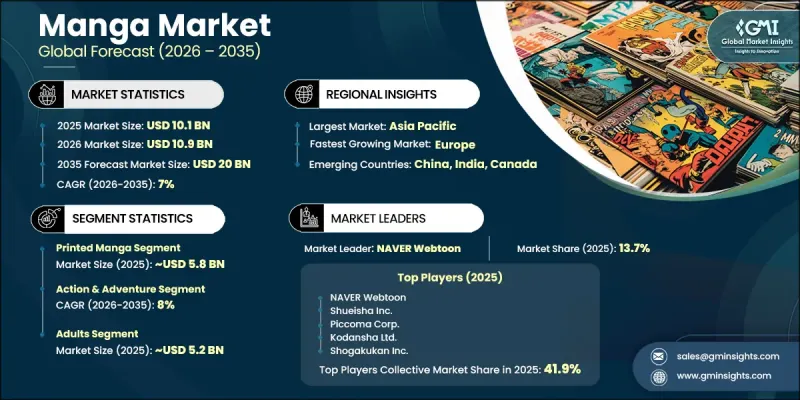
漫畫市場成長的驅動力主要來自漫畫內容的國際普及、對數位發行平台投資的增加,以及漫畫智慧財產權與更廣泛的全球娛樂生態系統的融合程度不斷提高。數位管道的普及使得出版商能夠比以往任何時候都更有效率地觸及北美、歐洲、亞太地區和其他新興市場的讀者。漫畫與動畫內容的緊密聯繫是成長要素之一,這種聯繫不斷擴大受眾範圍,並促進讀者的長期參與。隨著內容在多個平台上的普及,消費者可以透過日益多樣化的形式接觸漫畫,從而增強整體市場需求。此外,利潤豐厚的發行管道也使漫畫產業受益匪淺,出版商能夠在拓展新市場的同時最大限度地降低收購成本。而且,成熟智慧財產權的長期價值透過持續的消費者互動、授權機會和內容拓展,持續為產生收入提供支持。這些因素共同促成了全球漫畫市場的永續成長。
| 市場範圍 | |
|---|---|
| 開始年份 | 2025 |
| 預測期 | 2026-2035 |
| 起始金額 | 101億美元 |
| 預測金額 | 200億美元 |
| 複合年成長率 | 7% |
預計到2025年,紙本漫畫的銷售額將達到58億美元,市佔率高達57%。儘管數位閱讀平台發展迅猛,紙質漫畫在關鍵市場仍佔有重要的商業性地位。這一領域受益於消費者對傳統閱讀以外的強勁需求,例如收藏版、實體收藏和禮品贈送等。成熟的零售分銷網路和穩定的消費者購買行為持續支撐著該領域的成長。雖然數位消費正在蓬勃發展,但紙本漫畫仍然是整個行業收入的重要組成部分,並持續吸引全球各地的忠實讀者。
預計到2025年,動作冒險類漫畫將佔據33.5%的市場。其主導地位得益於其廣泛的受眾群體、強大的讀者參與度和維持長期讀者忠誠度的能力。這類型漫畫憑藉其引人入勝的故事情節、鮮活的人物塑造和豐富的內容,在紙本和電子版領域均持續保持著巨大的市場需求。持續在多個娛樂管道的曝光進一步推動了該類型的成長,並鞏固了其在全球漫畫產業中的主導地位。
預計到2025年,亞太地區漫畫市場規模將達到72億美元,佔全球市場的71.5%。該地區是漫畫製作、出版、發行和智慧財產權開發的重要中心。完善的出版生態系統、強勁的消費需求、先進的數位基礎設施和強大的內容創作能力,持續鞏固亞太地區在全球漫畫產業的主導地位。此外,該地區仍然是國際漫畫內容的主要來源地,為全球市場的成長提供支援。
全球漫畫市場呈現相對集中的競爭格局,小學館、講談社、Piccoma、NAVER Webtoon和集英社等主要廠商佔據了相當大的市場佔有率。這些公司在全球漫畫市場的內容創作、出版、數位發行、授權和智慧財產權商業化方面繼續發揮核心作用。漫畫市場的企業正採取各種策略來增強自身競爭力並擴大市場佔有率。數位平台的開發仍然是重點,出版商大力投資行動應用程式、訂閱服務和線上發行管道,以吸引更廣泛的受眾。與娛樂公司、內容傳送發行商和技術供應商建立策略合作夥伴關係,有助於企業最大限度地發揮其智慧財產權的價值,並提升其全球知名度。許多公司正在加強多語言出版能力和在地化工作,以促進其在國際市場的滲透。
目錄
第1章:調查方法
第2章執行摘要
第3章 行業洞察
- 產業生態系分析
- 影響價值鏈的因素
- 利潤率分析
- 中斷
- 前景
- 製造商
- 中斷
- 供應商情況
- 主要新聞和舉措
- 技術與創新展望
- 監理情勢
- 影響因素
- 成長促進因素
- 動畫的日益普及帶動了全球對漫畫的需求。
- 數位平台的普及提高了世界各地讀者獲取漫畫的途徑。
- 年輕讀者群的擴大將促進漫畫消費的長期成長。
- 產業潛在風險與挑戰
- 盜版問題對正版漫畫的產生收入了負面影響。
- 高昂的出版成本給漫畫出版商的利潤率帶來了壓力。
- 機會
- 數位漫畫定期訂閱為全球創造了持續的商機。
- 人工智慧翻譯大大改善了海外讀者獲取漫畫的途徑。
- 成長促進因素
- 波特的分析
- PESTLE分析
- 貿易數據分析
- 漫畫印刷品及授權流程的進出口量及進口額趨勢
- 主要貿易路線及關稅影響(日本、北美、歐洲、東南亞)
- 人工智慧和生成式人工智慧對市場的影響
- 人工智慧改變了現有的經營模式(與機器翻譯和掃描翻譯競爭)。
- GenAI 各細分領域的應用案例和實施藍圖(AI 驅動的藝術、故事生成和個人化)
- 風險、限制與監管的考量(創作者權利、版權、真實性)
- 目前分銷基礎設施和通路滲透情況
- 按地區與業態(現代零售與傳統零售)分類的通路覆蓋率
- 缺乏最後一公里基礎設施和不斷變化的管道
第4章 競爭情勢
- 介紹
- 企業市佔率分析
- 競爭定位矩陣
- 戰略展望矩陣
- 主要市場公司的競爭分析
- 主要進展
- 併購
- 夥伴關係和聯盟
- 新產品發布
- 業務拓展計劃
第5章 市場估計與預測:依內容形式分類,2022-2035年
- 印刷版漫畫
- 數位漫畫
第6章 市場估計與預測:依類型分類,2022-2035年
- 動作與冒險
- 科幻/奇幻/異世界
- 愛情劇
- 運動的
- 恐怖驚悚片
- 其他
第7章 市場估計與預測:依人口統計群體分類,2022-2035年
- 成人
- 10-17歲的青少年
- 兒童(10歲以下)
第8章 市場估算與預測:依通路分類,2022-2035年
- 線上
- 離線
第9章 市場估計與預測:依地區分類,2022-2035年
- 北美洲
- 美國
- 加拿大
- 歐洲
- 德國
- 英國
- 法國
- 義大利
- 西班牙
- 亞太地區
- 中國
- 印度
- 日本
- 韓國
- 澳洲
- 拉丁美洲
- 巴西
- 墨西哥
- 阿根廷
- 中東和非洲
- UAE
- 沙烏地阿拉伯
- 南非
第10章:公司簡介
- 世界公司
- Shueisha Inc.
- Kodansha Ltd.
- Shogakukan Inc.
- Kadokawa Corporation
- VIZ Media LLC
- Hakusensha Inc.
- Futabasha Publishers Ltd.
- 本地公司
- Seven Seas Entertainment, Inc.
- Yen Press LLC
- Bilibili Comics Pte. Ltd.
- Dark Horse Comics
- Square Enix Co., Ltd.
- Akita Publishing Co., Ltd.
- Panini Comics
- 新興企業
- NAVER Webtoon/Webtoon Entertainment
- Lezhin Comics
- Piccoma Corp.
- Omoi(KiraKira Media Inc.)
- Mangamo Inc.
- Tokyopop
- MediBang Inc.
The Global Manga Market was valued at USD 10.1 billion in 2025 and is estimated to grow at a CAGR of 7% to reach USD 20 billion by 2035.
Market growth is supported by the expanding international reach of manga content, rising investment in digital distribution platforms, and stronger integration between manga intellectual property and the broader global entertainment ecosystem. Increasing accessibility through digital channels has enabled publishers to reach readers across North America, Europe, Asia Pacific, and other emerging markets more efficiently than ever before. One of the most significant growth drivers is the close relationship between manga and animated content, which continues to broaden audience exposure and encourage long-term reader engagement. As content becomes available across multiple platforms, consumers are increasingly interacting with manga through a variety of formats, strengthening overall market demand. The industry also benefits from favorable distribution economics, allowing publishers to expand into new regions while minimizing acquisition costs. Additionally, the long-term value of established intellectual property continues to support revenue generation through recurring consumer engagement, licensing opportunities, and content expansion initiatives. These factors collectively contribute to the sustained growth trajectory of the global manga market.
| Market Scope | |
|---|---|
| Start Year | 2025 |
| Forecast Year | 2026-2035 |
| Start Value | $10.1 Billion |
| Forecast Value | $20 Billion |
| CAGR | 7% |
The printed manga segment generated USD 5.8 billion in 2025, representing 57% share. Despite the rapid expansion of digital reading platforms, physical manga publications continue to hold substantial commercial importance across major markets. The segment benefits from strong consumer demand for collectible editions, physical ownership, and gifting preferences, which extend beyond traditional reading purposes. Established retail distribution networks and consistent consumer purchasing behavior continue to support the segment's performance. While digital consumption is expanding, printed manga remains a critical component of overall industry revenue and continues to attract a loyal readership base worldwide.
The action & adventure segment held a 33.5% share in 2025. Its leadership position is supported by broad demographic appeal, strong reader engagement, and the ability to maintain long-term audience loyalty. The genre consistently generates substantial demand across both physical and digital formats due to compelling storytelling, dynamic character development, and extensive content portfolios. Continued visibility across multiple entertainment channels further supports genre growth and reinforces its dominant position within the global manga industry.
Asia Pacific Manga Market reached USD 7.2 billion in 2025, accounting for 71.5% share. The region serves as the primary hub for manga creation, publication, distribution, and intellectual property development. A well-established publishing ecosystem, strong consumer demand, advanced digital infrastructure, and extensive content production capabilities continue to reinforce Asia Pacific's dominant role within the global manga landscape. The region also remains a key source of internationally distributed manga content, supporting growth across global markets.
The global manga market demonstrates a moderately concentrated competitive environment, with leading companies including Shogakukan Inc., Kodansha Ltd., Piccoma Corp., NAVER Webtoon, and Shueisha Inc. collectively holding a significant share of the market. These companies continue to play a central role in content creation, publishing, digital distribution, licensing, and intellectual property commercialization across global markets. Companies operating in the manga market are implementing a variety of strategies to strengthen their competitive position and expand their market presence. Digital platform development remains a primary focus, with publishers investing heavily in mobile applications, subscription services, and online distribution channels to attract broader audiences. Strategic collaborations with entertainment companies, content distributors, and technology providers are helping organizations maximize intellectual property value and increase global visibility. Many companies are expanding multilingual publishing capabilities and localization efforts to improve penetration in international markets.
Table of Contents
Chapter 1 Research Methodology
- 1.1 Research approach
- 1.2 Quality Commitments
- 1.2.1 GMI AI policy & data integrity commitment
- 1.2.1.1 Source consistency protocol
- 1.2.1 GMI AI policy & data integrity commitment
- 1.3 Research Trail & Confidence Scoring
- 1.3.1 Research Trail Components
- 1.3.2 Scoring Components
- 1.4 Data Collection
- 1.4.1 Partial list of primary sources
- 1.5 Data mining sources
- 1.5.1 Paid sources
- 1.5.1.1 Sources, by region
- 1.5.1 Paid sources
- 1.6 Base estimates and calculations
- 1.6.1 Base year calculation for any one approach
- 1.7 Forecast model
- 1.7.1 Quantified market impact analysis
- 1.7.1.1 Mathematical impact of growth parameters on forecast
- 1.7.1 Quantified market impact analysis
- 1.8 Research transparency addendum
- 1.8.1 Source attribution framework
- 1.8.2 Quality assurance metrics
- 1.8.3 Our commitment to trust
Chapter 2 Executive Summary
- 2.1 Industry 360° synopsis, 2022 - 2035
- 2.2 Key market trends
- 2.2.1 Regional
- 2.2.2 Content Format
- 2.2.3 Genre
- 2.2.4 Demographics
- 2.2.5 Distribution Channel
Chapter 3 Industry Insights
- 3.1 Industry ecosystem analysis
- 3.1.1 Factor affecting the value chain
- 3.1.2 Profit margin analysis
- 3.1.3 Disruptions
- 3.1.4 Future outlook
- 3.1.5 Manufacturers
- 3.1.6 Distributors
- 3.2 Supplier landscape
- 3.3 Key news & initiatives
- 3.4 Technology & Innovation Landscape
- 3.5 Regulatory landscape
- 3.6 Impact on forces
- 3.6.1 Growth drivers
- 3.6.1.1 Growing anime popularity increases global manga readership demand
- 3.6.1.2 Rising digital platform adoption improves manga accessibility globally
- 3.6.1.3 Expanding youth audiences support long-term manga consumption growth
- 3.6.2 Industry pitfalls & challenges
- 3.6.2.1 Piracy issues negatively affect legitimate manga revenue generation
- 3.6.2.2 High publishing costs pressure manga company profit margins
- 3.6.3 Opportunities
- 3.6.3.1 Digital manga subscriptions create recurring revenue opportunities globally
- 3.6.3.2 AI-assisted translation improves international manga accessibility significantly
- 3.6.1 Growth drivers
- 3.7 Porter's analysis
- 3.8 PESTEL analysis
- 3.8.1 Pricing analysis (driven by primary research)
- 3.8.2 Historical price trend analysis (driven by primary research)
- 3.8.3 Pricing strategy by player type (premium / value / cost-plus) (driven by primary research)
- 3.8.4 Regional pricing differentials & purchasing power parity adjustments
- 3.8.5 Subscription tier pricing models vs. transactional pricing dynamics
- 3.9 Trade data analysis (driven by paid database)
- 3.9.1 Import/export volume & value trends - printed manga & licensing flows
- 3.9.2 Key trade corridors & tariff impact (Japan, North America, Europe, Southeast Asia)
- 3.10 Impact of AI & generative AI on the market
- 3.10.1 AI-driven disruption of existing business models (auto-translation, scanlation competition)
- 3.10.2 GenAI use cases & adoption roadmap by segment (AI-assisted art, story generation, personalization)
- 3.10.3 Risks, limitations & regulatory considerations (creator rights, copyright, authenticity)
- 3.11 Distribution infrastructure & channel penetration landscape (driven by primary research)
- 3.11.1 Channel coverage by region & format (modern vs. traditional trade) (driven by primary research)
- 3.11.2 Last-mile infrastructure gaps & emerging channel shifts (driven by primary research)
Chapter 4 Competitive Landscape, 2025
- 4.1 Introduction
- 4.2 Company market share analysis
- 4.3 Competitive positioning matrix
- 4.4 Strategic outlook matrix
- 4.5 Competitive analysis of major market players
- 4.6 Key developments
- 4.6.1 Mergers & acquisitions
- 4.6.2 Partnerships & collaborations
- 4.6.3 New product launches
- 4.6.4 Expansion plans
Chapter 5 Market Estimates & Forecast, By Content Format, 2022-2035 (USD Billion) (Million Units)
- 5.1 Key trends
- 5.2 Printed Manga
- 5.3 Digital Manga
Chapter 6 Market Estimates & Forecast, By Genre, 2022-2035 (USD Billion) (Million Units)
- 6.1 Key trends
- 6.2 Action & Adventure
- 6.3 Sci-Fi & Fantasy / Isekai
- 6.4 Romance & Drama
- 6.5 Sports
- 6.6 Horror & Thriller
- 6.7 Others
Chapter 7 Market Estimates & Forecast, By Demographics, 2022-2035 (USD Billion) (Million Units)
- 7.1 Key trends
- 7.2 Adults
- 7.3 Teenagers (10-17 years)
- 7.4 Children (Below 10 years)
Chapter 8 Market Estimates & Forecast, By Distribution Channel, 2022-2035 (USD Billion) (Million Units)
- 8.1 Key trends
- 8.2 Online
- 8.3 Offline
Chapter 9 Market Estimates & Forecast, By Region, 2022 - 2035, (USD Billion) (Million Units)
- 9.1 Key trends
- 9.2 North America
- 9.2.1 U.S.
- 9.2.2 Canada
- 9.3 Europe
- 9.3.1 Germany
- 9.3.2 U.K.
- 9.3.3 France
- 9.3.4 Italy
- 9.3.5 Spain
- 9.4 Asia Pacific
- 9.4.1 China
- 9.4.2 India
- 9.4.3 Japan
- 9.4.4 South Korea
- 9.4.5 Australia
- 9.5 Latin America
- 9.5.1 Brazil
- 9.5.2 Mexico
- 9.5.3 Argentina
- 9.6 MEA
- 9.6.1 UAE
- 9.6.2 Saudi Arabia
- 9.6.3 South Africa
Chapter 10 Company Profiles
- 10.1 Global players
- 10.1.1 Shueisha Inc.
- 10.1.2 Kodansha Ltd.
- 10.1.3 Shogakukan Inc.
- 10.1.4 Kadokawa Corporation
- 10.1.5 VIZ Media LLC
- 10.1.6 Hakusensha Inc.
- 10.1.7 Futabasha Publishers Ltd.
- 10.2 Regional players
- 10.2.1 Seven Seas Entertainment, Inc.
- 10.2.2 Yen Press LLC
- 10.2.3 Bilibili Comics Pte. Ltd.
- 10.2.4 Dark Horse Comics
- 10.2.5 Square Enix Co., Ltd.
- 10.2.6 Akita Publishing Co., Ltd.
- 10.2.7 Panini Comics
- 10.3 Emerging players
- 10.3.1 NAVER Webtoon / Webtoon Entertainment
- 10.3.2 Lezhin Comics
- 10.3.3 Piccoma Corp.
- 10.3.4 Omoi (KiraKira Media Inc.)
- 10.3.5 Mangamo Inc.
- 10.3.6 Tokyopop
- 10.3.7 MediBang Inc.

 2026-2030年全球數位漫畫市場
 漫畫市場機會、成長要素、產業趨勢分析及2026-2035年預測。
 2026-2030年全球漫畫市場
 漫畫市場:2026年至2032年全球市場預測(按類型、格式、受眾和發行管道分類)
 2026-2034年全球漫畫市場規模、佔有率、趨勢和成長分析報告全球漫畫市場規模、佔有率、趨勢和成長分析報告(2026-2034)漫畫市場規模、佔有率、成長及全球產業分析:按類型、應用和地區分類的洞察,2026-2034 年預測
 漫畫市場,依內容、讀者群、性別、通路及地區分類漫畫訂閱服務市場(按訂閱類型、漫畫格式、類型、客戶類型、類型重點和分銷管道分類),全球預測,2026-2032年
 漫畫市場規模、佔有率和成長分析(按類型、分銷管道、最終用戶和地區分類)-2026-2033年產業預測