


 |
市場調查報告書
商品編碼
2083130
2026 年至 2035 年無菌加工包裝材料的市場機會、成長促進因素、產業趨勢分析與預測。Aseptic Processing and Packaging Materials Market Opportunity, Growth Drivers, Industry Trend Analysis, and Forecast 2026 - 2035 |
||||||

全球無菌加工和包裝材料市場預計到 2025 年將達到 575 億美元,年複合成長率為 7.5%,到 2035 年將達到 1,188 億美元。
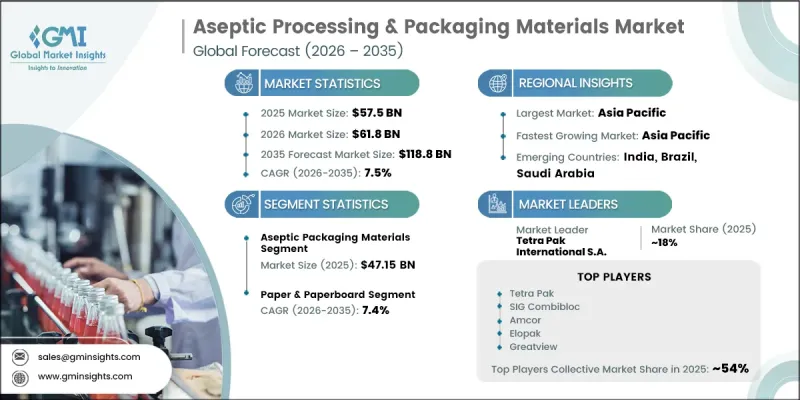
食品、飲料、製藥和生物技術產業對無菌包裝解決方案的需求不斷成長,是推動市場成長的主要動力。生命科學製造領域一次性加工系統的推廣應用,以及消費者對無需冷藏的常溫保存產品的日益青睞,為整個價值鏈創造了巨大的商機。都市化加快、消費模式轉變以及包裝食品需求的成長,進一步促進了市場擴張,尤其是在開發中國家。該行業的成長體現在多個環節,包括原料生產、包裝、填充技術和最終用途。一個顯著的市場趨勢是,包裝形式正朝著永續的方向發展,旨在提高可回收性並降低材料複雜性。製造商正在投資先進的包裝和創新的阻隔技術,以滿足不斷變化的環境要求,同時保持產品品質和保存期限。隨著對高效、安全和永續包裝解決方案的需求持續成長,預計未來十年無菌加工和包裝材料市場將保持強勁的成長動能。
| 市場範圍 | |
|---|---|
| 開始年份 | 2025 |
| 預測期 | 2026-2035 |
| 起始金額 | 575億美元 |
| 預測金額 | 1188億美元 |
| 複合年成長率 | 7.5% |
預計到2025年,無菌包裝材料市場規模將達到471.5億美元,並在2026年至2035年間以7.3%的複合年成長率成長。與其他終端用戶產業相比,食品飲料產業包裝材料的使用量極大,因此該細分市場佔據了較大的市場佔有率。消費者對保存期限更長的產品的需求不斷成長,加上無菌包裝技術的日益普及,持續推動著專用包裝材料的消費。隨著製造商致力於提高包裝效率、產品安全性和永續性,預計在整個預測期內,對先進無菌包裝材料的需求將保持強勁。
預計到2025年,紙和紙板市場規模將達到197億美元,市佔率將維持在34%。市場成長主要得益於各產品類型對環保包裝解決方案的需求不斷成長。紙和紙板材料憑藉其輕盈的特性、適用於長期儲存包裝系統以及卓越的永續性,繼續保持著強勁的市場地位。消費者對永續包裝日益成長的偏好以及製造商為提高可回收性所做的持續努力,預計將支撐全球市場對紙基無菌包裝材料的長期需求。
預計到2025年,北美無菌加工和包裝材料市場佔有率將達到25.5%,並在2035年之前以7.1%的複合年成長率成長。這一區域成長主要得益於對製藥生產能力的持續投資以及日益嚴格的食品安全要求。隨著製造商將無菌生產環境、產品品質和營運效率置於優先地位,對無菌材料的需求不斷成長。先進加工技術的日益普及和對生命科學基礎設施投資的增加,也進一步推動了全部區域市場的成長。此外,對法規遵循和高性能包裝解決方案的日益重視,也增強了北美市場的前景。
目錄
第1章:調查方法和範圍
第2章執行摘要
第3章 行業洞察
- 產業生態系分析
- 供應商情況
- 利潤率
- 每個階段增加的價值
- 影響價值鏈的因素
- 中斷
- 影響產業的因素
- 成長促進因素
- 產業潛在風險與挑戰
- 市場機遇
- 成長潛力分析
- 監理情勢
- 北美洲
- 歐洲
- 亞太地區
- 拉丁美洲
- 中東和非洲
- 波特的分析
- PESTLE分析
- 價格趨勢
- 按地區
- 按服務類型
- 未來市場趨勢
- 技術與創新展望
- 最新科技趨勢
- 新興技術
- 專利趨勢
- 貿易統計
- 主要進口國
- 主要出口國
- 永續性和環境方面
- 永續計劃
- 減少廢棄物策略
- 生產中的能源效率
- 具有環保意識的舉措
- 考慮碳足跡
第4章 競爭情勢
- 介紹
- 企業市佔率分析
- 按地區
- 北美洲
- 歐洲
- 亞太地區
- 拉丁美洲
- 中東和非洲
- 按地區
- 主要市場公司的競爭分析
- 競爭定位矩陣
- 主要進展
- 併購
- 夥伴關係和聯盟
- 新產品發布
- 業務拓展計劃
第5章 市場估算與預測:依產品類型分類,2022-2035年
- 無菌處理材料
- 滅菌過濾器和薄膜過濾材料
- 用於一次性生物程序的容器和組件
- 消毒和去污劑( H2O2 ,PAA)
- 墊圈、密封件和無菌屏障組件
- CIP/SIP 的化學品和製程耗材
- 無菌包裝材料
- 紙和紙板層壓板
- 塑膠薄膜、瓶子、包裝袋
- 金屬箔和罐頭
- 玻璃容器
- 封蓋/封口系統
- 其他(塗層、混合材料、新興技術)
第6章 市場估算與預測:依材料類型分類,2022-2035年
- 紙張和紙板
- 塑膠
- 金屬
- 玻璃
- 其他
第7章 市場估計與預測:依應用領域分類,2022-2035年
- 食物
- 飲料
- 製藥
- 化妝品和個人護理
- 其他
第8章 市場估計與預測:依地區分類,2022-2035年
- 北美洲
- 美國
- 加拿大
- 歐洲
- 德國
- 英國
- 法國
- 西班牙
- 義大利
- 其他歐洲國家
- 亞太地區
- 中國
- 印度
- 日本
- 澳洲
- 韓國
- 其他亞太國家
- 拉丁美洲
- 巴西
- 墨西哥
- 阿根廷
- 其他拉丁美洲國家
- 中東和非洲
- 沙烏地阿拉伯
- 南非
- UAE
- 其他中東和非洲國家
第9章:公司簡介
- Tetra Pak International SA
- SIG Combibloc Group AG
- Amcor plc
- Elopak AS
- Greatview Aseptic Packaging Co. Ltd
- Sartorius AG
- Berry Global Group, Inc.
- Mondi plc
- SCHOTT AG
- Uflex Limited
- Ecolean AB
- Huhtamaki Oyj
- Gerresheimer AG
- Constantia Flexibles Group GmbH
- Goglio SpA
The Global Aseptic Processing & Packaging Materials Market was valued at USD 57.5 billion in 2025 and is estimated to grow at a CAGR of 7.5% to reach USD 118.8 billion by 2035.
Market growth is driven by increasing demand for sterile packaging solutions across food, beverage, pharmaceutical, and biotechnology industries. The expansion of single-use processing systems in life sciences manufacturing and the growing preference for shelf-stable products that do not require refrigeration are creating significant opportunities across the value chain. Rising urbanization, changing consumption patterns, and increasing demand for packaged food products are further supporting market expansion, particularly in developing economies. The industry is witnessing growth across multiple stages, including raw material production, packaging conversion, filling technologies, and end-use applications. A notable trend shaping the market is the increasing shift toward sustainable packaging formats designed to improve recyclability and reduce material complexity. Manufacturers are investing in advanced packaging structures and innovative barrier technologies to meet evolving environmental requirements while maintaining product integrity and shelf-life performance. As demand for efficient, safe, and sustainable packaging solutions continues to rise, the Aseptic Processing & Packaging Materials Market is expected to maintain strong momentum over the coming decade.
| Market Scope | |
|---|---|
| Start Year | 2025 |
| Forecast Year | 2026-2035 |
| Start Value | $57.5 Billion |
| Forecast Value | $118.8 Billion |
| CAGR | 7.5% |
The aseptic packaging materials segment generated USD 47.15 billion in 2025 and is projected to grow at a CAGR of 7.3% between 2026 and 2035. The segment's significant market share reflects the substantial volume of packaging materials utilized across food and beverage applications compared to other end-use industries. Increasing demand for extended shelf-life products, coupled with growing adoption of aseptic packaging technologies, continues to drive consumption of specialized packaging materials. As manufacturers focus on improving packaging efficiency, product safety, and sustainability, demand for advanced aseptic packaging materials is expected to remain strong throughout the forecast period.
The paper and paperboard segment accounted for USD 19.7 billion in 2025, holding 34% share. Market growth is supported by increasing demand for environmentally responsible packaging solutions across multiple product categories. Paper and paperboard materials continue to maintain a strong position due to their lightweight characteristics, compatibility with long shelf-life packaging systems, and favorable sustainability profile. Growing consumer preference for sustainable packaging and ongoing efforts by manufacturers to improve recyclability are expected to support long-term demand for paper-based aseptic packaging materials across global markets.
North America Aseptic Processing & Packaging Materials Market accounted for 25.5% share in 2025 and is forecast to grow at a CAGR of 7.1% through 2035. Regional growth is being supported by continued investments in pharmaceutical manufacturing capacity and increasingly stringent food safety requirements. Demand for aseptic materials is rising as manufacturers prioritize sterile production environments, product quality, and operational efficiency. The growing adoption of advanced processing technologies and expanding investments in life sciences infrastructure are further contributing to market growth across the region. Increasing focus on regulatory compliance and high-performance packaging solutions continues to strengthen the market outlook in North America.
Key companies operating in the Global Aseptic Processing & Packaging Materials Market include Amcor plc, Tetra Pak International S.A., SIG Combibloc Group AG, Elopak AS, Berry Global Group, Inc., Mondi plc, Sartorius AG, Greatview Aseptic Packaging Co. Ltd, Huhtamaki Oyj, SCHOTT AG, Uflex Limited, Ecolean AB, Gerresheimer AG, Constantia Flexibles Group GmbH, and Goglio S.p.A. Companies operating in the Aseptic Processing & Packaging Materials Market are focusing on innovation, sustainability, and capacity expansion to strengthen their competitive position. Significant investments in research and development are enabling manufacturers to introduce advanced packaging materials with improved barrier properties, enhanced recyclability, and greater operational efficiency. Strategic partnerships and long-term agreements with food, beverage, pharmaceutical, and biotechnology companies are helping market participants expand their customer base and secure recurring revenue streams. Many companies are also investing in sustainable packaging technologies and alternative material solutions to align with evolving environmental regulations and consumer preferences.
Table of Contents
Chapter 1 Methodology & Scope
- 1.1 Market scope and definition
- 1.2 Research design
- 1.2.1 Research approach
- 1.2.2 Data collection methods
- 1.3 Data mining sources
- 1.3.1 Global
- 1.3.2 Regional/Country
- 1.4 Base estimates and calculations
- 1.4.1 Base year calculation
- 1.4.2 Key trends for market estimation
- 1.5 Primary research and validation
- 1.5.1 Primary sources
- 1.6 Forecast model
- 1.7 Research assumptions and limitations
Chapter 2 Executive Summary
- 2.1 Industry 360° synopsis
- 2.2 Key market trends
- 2.2.1 Offering type
- 2.2.2 Material type
- 2.2.3 Application
- 2.2.4 Regional
- 2.3 TAM Analysis, 2026-2035
- 2.4 CXO perspectives: Strategic imperatives
Chapter 3 Industry Insights
- 3.1 Industry ecosystem analysis
- 3.1.1 Supplier landscape
- 3.1.2 Profit margin
- 3.1.3 Value addition at each stage
- 3.1.4 Factor affecting the value chain
- 3.1.5 Disruptions
- 3.2 Industry impact forces
- 3.2.1 Growth drivers
- 3.2.2 Industry pitfalls and challenges
- 3.2.3 Market opportunities
- 3.3 Growth potential analysis
- 3.4 Regulatory landscape
- 3.4.1 North America
- 3.4.2 Europe
- 3.4.3 Asia Pacific
- 3.4.4 Latin America
- 3.4.5 Middle East & Africa
- 3.5 Porter’s analysis
- 3.6 PESTEL analysis
- 3.7 Price trends
- 3.7.1 By region
- 3.7.2 By Offering type
- 3.8 Future market trends
- 3.9 Technology and Innovation landscape
- 3.9.1 Current technological trends
- 3.9.2 Emerging technologies
- 3.10 Patent Landscape
- 3.11 Trade statistics (HS code)
- 3.11.1 Major importing countries
- 3.11.2 Major exporting countries
- 3.12 Sustainability and environmental aspects
- 3.12.1 Sustainable practices
- 3.12.2 Waste reduction strategies
- 3.12.3 Energy efficiency in production
- 3.12.4 Eco-friendly initiatives
- 3.13 Carbon footprint consideration
Chapter 4 Competitive Landscape, 2025
- 4.1 Introduction
- 4.2 Company market share analysis
- 4.2.1 By region
- 4.2.1.1 North America
- 4.2.1.2 Europe
- 4.2.1.3 Asia Pacific
- 4.2.1.4 LATAM
- 4.2.1.5 MEA
- 4.2.1 By region
- 4.3 Competitive analysis of major market players
- 4.4 Competitive positioning matrix
- 4.5 Key developments
- 4.5.1 Mergers & acquisitions
- 4.5.2 Partnerships & collaborations
- 4.5.3 New Product Launches
- 4.5.4 Expansion Plans
Chapter 5 Market Estimates and Forecast, By Offering Type, 2022-2035 (USD Billion) (Tons)
- 5.1 Key trends
- 5.2 Aseptic Processing Materials
- 5.2.1 Sterilizing Filters & Membrane Filtration Media
- 5.2.2 Single-Use Bioprocess Containers & Assemblies
- 5.2.3 Sterilization & Decontamination Agents (H2O2, PAA)
- 5.2.4 Gaskets, Seals & Sterile Barrier Components
- 5.2.5 CIP/SIP Chemical Materials & Process Consumables
- 5.3 Aseptic Packaging Materials
- 5.3.1 Paper & Paperboard Laminates
- 5.3.2 Plastic Films, Bottles & Pouches
- 5.3.3 Metal Foils & Cans
- 5.3.4 Glass Containers
- 5.3.5 Closure & Cap Systems
- 5.3.6 Others (Coatings, Hybrid, Emerging)
Chapter 6 Market Estimates and Forecast, By Material Type, 2022-2035 (USD Billion) (Tons)
- 6.1 Key trends
- 6.2 Paper & Paperboard
- 6.3 Plastic
- 6.4 Metal
- 6.5 Glass
- 6.6 Others
Chapter 7 Market Estimates and Forecast, By Application, 2022-2035 (USD Billion) (Tons)
- 7.1 Key trends
- 7.2 Food
- 7.3 Beverages
- 7.4 Pharmaceutical
- 7.5 Cosmetics & Personal Care
- 7.6 Others
Chapter 8 Market Estimates and Forecast, By Region, 2022-2035 (USD Billion) (Tons)
- 8.1 Key trends
- 8.2 North America
- 8.2.1 U.S.
- 8.2.2 Canada
- 8.3 Europe
- 8.3.1 Germany
- 8.3.2 UK
- 8.3.3 France
- 8.3.4 Spain
- 8.3.5 Italy
- 8.3.6 Rest of Europe
- 8.4 Asia Pacific
- 8.4.1 China
- 8.4.2 India
- 8.4.3 Japan
- 8.4.4 Australia
- 8.4.5 South Korea
- 8.4.6 Rest of Asia Pacific
- 8.5 Latin America
- 8.5.1 Brazil
- 8.5.2 Mexico
- 8.5.3 Argentina
- 8.5.4 Rest of Latin America
- 8.6 Middle East and Africa
- 8.6.1 Saudi Arabia
- 8.6.2 South Africa
- 8.6.3 UAE
- 8.6.4 Rest of Middle East and Africa
Chapter 9 Company Profiles
- 9.1 Tetra Pak International S.A.
- 9.2 SIG Combibloc Group AG
- 9.3 Amcor plc
- 9.4 Elopak AS
- 9.5 Greatview Aseptic Packaging Co. Ltd
- 9.6 Sartorius AG
- 9.7 Berry Global Group, Inc.
- 9.8 Mondi plc
- 9.9 SCHOTT AG
- 9.10 Uflex Limited
- 9.11 Ecolean AB
- 9.12 Huhtamaki Oyj
- 9.13 Gerresheimer AG
- 9.14 Constantia Flexibles Group GmbH
- 9.15 Goglio S.p.A

 2026-2030年全球無菌包裝市場
 北美無菌包裝:市場佔有率分析、產業趨勢與統計及成長預測(2026-2031 年)無菌包裝:市場佔有率分析、產業趨勢與統計、成長預測(2026-2031)
 無菌包裝市場:2026-2032年全球市場預測(依產品類型、材料、滅菌方法、填充技術、應用、最終用戶及通路分類)
 2034年乳製品無菌包裝市場預測-按包裝形式、材料、技術、產品類型、最終用戶和地區分類的全球分析
 無菌包裝市場報告:按類型、材料、應用和地區分類(2026-2034 年)
 全球無菌包裝市場分析:市場規模、佔有率、應用及預測(2018-2034)
 無菌包裝市場:依材料、類型、應用、地區分類全球無菌包裝市場:市場規模、趨勢與預測(2034 年)
 無菌包裝食品市場規模、佔有率和成長分析:按材料類型、包裝類型、應用、最終用途和地區分類-2026-2033年產業預測