

 |
市場調查報告書
商品編碼
2071417
大型變頻驅動器市場機會、成長促進因素、產業趨勢分析及2026-2035年預測Large Scale Variable Frequency Drives Market Opportunity, Growth Drivers, Industry Trend Analysis, and Forecast 2026 - 2035 |
||||||

預計到 2025 年,全球大型變頻驅動器市場規模將達到 22 億美元,並預計以 6% 的複合年成長率成長,到 2035 年達到 40 億美元。
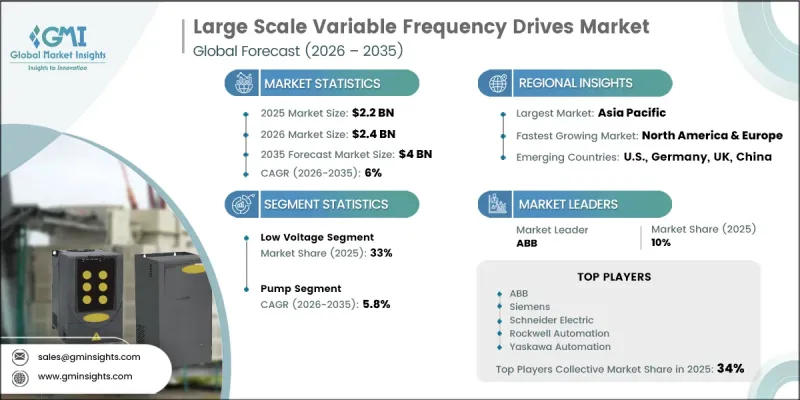
需求成長源自於工業馬達系統電力消耗量,而變頻驅動器(VFD)正日益成為降低營運成本和排放的關鍵效率最佳化工具。從發電、水資源管理到採礦、化工和電網現代化等各個工業領域的資本投資持續推動著VFD的應用,VFD也擴大被整合到大型電子機械系統中,成為標準控制組件。在發展中地區,新的工業項目催生了對具備遠端監控和物聯網診斷功能的大容量驅動器的新需求。同時,在已開發市場,老舊的恆速馬達系統正透過現代化改造計畫逐步淘汰。工業流程的電氣化和自動化正在從根本上支撐著該市場的長期成長,因為它持續推動著各行業能源績效的提升和合規性的提高。
| 市場範圍 | |
|---|---|
| 開始年份 | 2025 |
| 預測期 | 2026-2035 |
| 起始金額 | 22億美元 |
| 預測金額 | 40億美元 |
| 複合年成長率 | 6% |
預計到2025年,低壓驅動單元將佔據33%的市場佔有率,並在2035年之前以4.7%的複合年成長率成長。這些驅動裝置通常工作電壓低於1千伏,廣泛應用於中等規模的電力應用,例如輔助通風系統、二次泵運作以及製造環境中的輸送機機構。由於核心應用市場的成熟以及標準化產品類型競爭加劇(尤其是來自亞洲區域製造商的競爭,而價格壓力不斷上升),該細分市場的成長相對緩慢。
預計到2025年,泵浦應用領域將佔據42.2%的市場佔有率,並在2035年之前以5.8%的複合年成長率成長。變頻驅動器廣泛應用於泵浦系統中,可根據即時需求調節馬達轉速,與定速馬達相比,顯著提高了能源效率。變頻驅動器在石油和天然氣行業中應用尤為廣泛,因為泵浦控制系統對於開採和輸送過程至關重要。此外,由於公共產業現代化改造和城市基礎設施建設的持續推進,變頻驅動器在供水和污水處理基礎設施中的應用也在不斷擴展。
預計到2025年,北美大型變頻驅動器市佔率將達到20.9%,並在2035年之前以6.3%的複合年成長率成長。美國憑藉其在工業電機部署方面的豐富經驗、廣泛的能源和流程基礎設施以及專注於提高能源效率的法律規範,仍然是該地區的主要貢獻者。聯邦層級的能源效率提升舉措和各行業的合規要求,持續推動傳統馬達系統被先進的變頻驅動技術所取代,尤其是在流程工業、公共產業和能源密集型企業中。
目錄
第1章:調查方法和範圍
第2章執行摘要
第3章 行業洞察
- 產業生態系分析
- 原物料供應及採購分析
- 影響價值鏈的關鍵因素
- 中斷
- 影響產業的因素
- 成長促進因素
- 產業潛在風險與挑戰
- 成長潛力分析
- 監理情勢
- 波特的分析
- PESTLE分析
- 價格趨勢分析,2022-2035年
- 透過電壓
- 按地區
- 新機會和趨勢
- 利用物聯網技術實現數位轉型
- 進入新興市場
- 投資分析及未來展望
- 人工智慧和生成式人工智慧對市場的影響
- 利用人工智慧最佳化生產
- 預測性維護和故障檢測
第4章 競爭情勢
- 介紹
- 企業市佔率分析:按地區分類
- 北美洲
- 歐洲
- 亞太地區
- 中東和非洲
- 拉丁美洲
- 競爭定位矩陣
- 主要進展
- 併購
- 夥伴關係和聯盟
- 新產品發布
- 業務拓展計劃及資金籌措
第5章 市場規模及預測:依電壓等級分類,2022-2035年
- 低的
- 中等的
第6章 市場規模與預測:依應用領域分類,2022-2035年
- 泵浦
- 扇子
- 輸送帶
- 壓縮機
- 擠出機
- 其他
第7章 市場規模及預測:依最終用途分類,2022-2035年
- 石油和天然氣
- 發電
- 採礦和金屬
- 紙漿和造紙
- 海上
- 其他
第8章 市場規模及預測:依地區分類,2022-2035年
- 北美洲
- 美國
- 加拿大
- 墨西哥
- 歐洲
- 德國
- 英國
- 法國
- 義大利
- 西班牙
- 俄羅斯
- 丹麥
- 亞太地區
- 中國
- 日本
- 印度
- 澳洲
- 韓國
- 中東和非洲
- 沙烏地阿拉伯
- UAE
- 南非
- 拉丁美洲
- 巴西
- 阿根廷
第9章:公司簡介
- ABB
- Benshaw
- Delta Electronics
- Eaton
- Emotron
- Fuji Electric
- GE Vernova
- General Atomics
- Hiconics Technology
- Hitachi Hi-Rel Power Electronics
- Ingeteam
- NIDEC
- Rockwell Automation
- Schneider Electric
- Shenzhen INVT Electric
- Siemens
- TMEIC
- Triol
- VEM Group
- Wolong Electric Group
- Xi'an XICHI Electric
- YASKAWA Automation & Drives
The Global Large Scale Variable Frequency Drives Market was valued at USD 2.2 billion in 2025 and is estimated to grow at a CAGR of 6% to reach USD 4 billion by 2035.
Demand growth is tied to the fact that industrial motor systems account for nearly 45% of global electricity consumption, positioning variable frequency drives as a key efficiency optimization tool for reducing operational costs and emissions. Industrial capital spending across power generation, water management, mining, chemicals, and grid modernization continues to reinforce adoption, with VFDs increasingly embedded in large electromechanical systems as standard control components. In developing regions, new industrial projects are generating fresh demand for high-capacity drives equipped with remote monitoring and IoT-based diagnostics, while developed markets are focused on replacing aging fixed-speed motor systems through modernization programs. The market's long-term growth is structurally driven, as electrification and automation of industrial processes continue to improve energy performance and regulatory compliance across sectors.
| Market Scope | |
|---|---|
| Start Year | 2025 |
| Forecast Year | 2026-2035 |
| Start Value | $2.2 Billion |
| Forecast Value | $4 Billion |
| CAGR | 6% |
The low voltage segment held 33% share in 2025 and is projected to grow at a CAGR of 4.7% through 2035. These drives, typically operating below 1 kV, are widely used in mid-range power applications such as auxiliary ventilation systems, secondary pumping operations, and conveyor mechanisms within manufacturing environments. Growth in this segment is relatively moderate due to market maturity in core applications and increasing pricing pressure from regional manufacturers, particularly in Asia, which is intensifying competition in standardized product categories.
The pump application segment held a 42.2% share in 2025, growing at a CAGR of 5.8% through 2035. Variable frequency drives are widely used in pumping systems to regulate motor speed according to real-time demand, significantly improving energy efficiency compared to fixed-speed alternatives. Strong adoption is observed in oil and gas operations, where pump control systems are essential for extraction and transport processes, as well as in water and wastewater infrastructure, which continues to expand due to ongoing utility modernization programs and urban infrastructure development.
North America Large Scale Variable Frequency Drives Market accounted for 20.9% share in 2025 and is projected to grow at a CAGR of 6.3% through 2035. The United States remains the primary regional contributor, supported by a large installed base of industrial motors, extensive energy and process infrastructure, and regulatory frameworks focused on energy efficiency improvements. Federal-level efficiency initiatives and industrial compliance requirements continue to encourage the replacement of legacy motor systems with advanced variable speed drive technologies, particularly in process industries, utilities, and energy-intensive operations.
Major players operating in the global large scale variable frequency drives market include ABB, Siemens, Schneider Electric, Rockwell Automation, Yaskawa Automation & Drives, TMEIC, GE Vernova, and NIDEC. Companies in the large scale variable frequency drives market are strengthening their position through continuous investment in high-efficiency power electronics and advanced motor control algorithms that improve energy optimization across industrial systems. They are expanding their product portfolios with digitalized drives that integrate IoT connectivity, predictive maintenance, and remote diagnostics capabilities. Strategic collaborations with industrial automation providers and EPC contractors are enabling deeper integration of VFDs into large-scale infrastructure projects. Manufacturers are also focusing on modular and scalable drive architectures to meet diverse application requirements across voltage ranges and industries. Expansion into emerging markets is being supported by localized manufacturing and service networks to reduce deployment costs and improve responsiveness.
Table of Contents
Chapter 1 Methodology & Scope
- 1.1 Research design
- 1.2 Quality commitment
- 1.2.1 GMI AI policy & data integrity commitment
- 1.2.1.1 Source consistency protocol
- 1.2.1 GMI AI policy & data integrity commitment
- 1.3 Research trail & confidence scoring
- 1.3.1 Research trail components
- 1.3.2 Scoring components
- 1.4 Data collection
- 1.4.1 Partial list of primary sources
- 1.5 Data mining sources
- 1.5.1 Paid sources
- 1.5.1.1 Sources, by region
- 1.5.1 Paid sources
- 1.6 Base estimates and calculations
- 1.6.1 Base year calculation for any one approach
- 1.7 Market estimates & forecasts parameters
- 1.8 Forecast model
- 1.8.1 Quantified market impact analysis
- 1.8.1.1 Mathematical impact of growth parameters on forecast
- 1.8.1 Quantified market impact analysis
- 1.9 Research transparency addendum
- 1.9.1 Source attribution framework
- 1.9.2 Quality assurance metrics
- 1.9.3 Our commitment to trust
- 1.10 Market definitions
Chapter 2 Executive Summary
- 2.1 Industry synopsis, 2022 - 2035
- 2.2 Business trends
- 2.3 Voltage trends
- 2.4 Application trends
- 2.5 End-use trends
- 2.6 Regional trends
Chapter 3 Industry Insights
- 3.1 Industry ecosystem analysis
- 3.1.1 Raw material availability & sourcing analysis
- 3.1.2 Key factors affecting the value chain
- 3.1.3 Disruptions
- 3.2 Industry impact forces
- 3.2.1 Growth drivers
- 3.2.2 Industry pitfalls & challenges
- 3.3 Growth potential analysis
- 3.4 Regulatory landscape
- 3.5 Porter's analysis
- 3.5.1 Bargaining power of suppliers
- 3.5.2 Bargaining power of buyers
- 3.5.3 Threat of new entrants
- 3.5.4 Threat of substitutes
- 3.6 PESTEL analysis
- 3.6.1 Political factors
- 3.6.2 Economic factors
- 3.6.3 Social factors
- 3.6.4 Technological factors
- 3.6.5 Legal factors
- 3.6.6 Environmental factors
- 3.7 Price trend analysis, 2022-2035 (USD/Unit) (Driven by Primary Research)
- 3.7.1 By voltage (Driven by Primary Research)
- 3.7.2 By region (Driven by Primary Research)
- 3.8 Emerging opportunities & trends
- 3.8.1 Digital transformation with IoT technologies
- 3.8.2 Emerging market penetration
- 3.9 Investment analysis & future outlook
- 3.10 Impact of AI & Generative AI on the market (Solution Core)
- 3.10.1 AI-Driven production optimization (Solution Core)
- 3.10.2 Predictive maintenance & fault detection (Solution Core)
Chapter 4 Competitive Landscape, 2026
- 4.1 Introduction
- 4.2 Company market share analysis, by region, 2025
- 4.2.1 North America
- 4.2.2 Europe
- 4.2.3 Asia Pacific
- 4.2.4 Middle East & Africa
- 4.2.5 Latin America
- 4.3 Competitive positioning matrix
- 4.4 Key developments
- 4.4.1 Mergers & acquisitions
- 4.4.2 Partnerships & collaborations
- 4.4.3 New product launches
- 4.4.4 Expansion plans and funding
Chapter 5 Market Size and Forecast, By Voltage, 2022 - 2035 (USD Million, '000 Units)
- 5.1 Key trends
- 5.2 Low
- 5.3 Medium
Chapter 6 Market Size and Forecast, By Application, 2022 - 2035 (USD Million, '000 Units)
- 6.1 Key trends
- 6.2 Pump
- 6.3 Fan
- 6.4 Conveyor
- 6.5 Compressor
- 6.6 Extruder
- 6.7 Others
Chapter 7 Market Size and Forecast, By End-Use, 2022 - 2035 (USD Million, '000 Units)
- 7.1 Key trends
- 7.2 Oil & gas
- 7.3 Power generation
- 7.4 Mining & metals
- 7.5 Pulp & paper
- 7.6 Marine
- 7.7 Others
Chapter 8 Market Size and Forecast, By Region, 2022 - 2035 (USD Million, '000 Units)
- 8.1 Key trends
- 8.2 North America
- 8.2.1 U.S.
- 8.2.2 Canada
- 8.2.3 Mexico
- 8.3 Europe
- 8.3.1 Germany
- 8.3.2 UK
- 8.3.3 France
- 8.3.4 Italy
- 8.3.5 Spain
- 8.3.6 Russia
- 8.3.7 Denmark
- 8.4 Asia Pacific
- 8.4.1 China
- 8.4.2 Japan
- 8.4.3 India
- 8.4.4 Australia
- 8.4.5 South Korea
- 8.5 Middle East & Africa
- 8.5.1 Saudi Arabia
- 8.5.2 UAE
- 8.5.3 South Africa
- 8.6 Latin America
- 8.6.1 Brazil
- 8.6.2 Argentina
Chapter 9 Company Profiles
- 9.1 ABB
- 9.2 Benshaw
- 9.3 Delta Electronics
- 9.4 Eaton
- 9.5 Emotron
- 9.6 Fuji Electric
- 9.7 GE Vernova
- 9.8 General Atomics
- 9.9 Hiconics Technology
- 9.10 Hitachi Hi-Rel Power Electronics
- 9.11 Ingeteam
- 9.12 NIDEC
- 9.13 Rockwell Automation
- 9.14 Schneider Electric
- 9.15 Shenzhen INVT Electric
- 9.16 Siemens
- 9.17 TMEIC
- 9.18 Triol
- 9.19 VEM Group
- 9.20 Wolong Electric Group
- 9.21 Xi'an XICHI Electric
- 9.22 YASKAWA Automation & Drives

 驅動裝置市場報告:趨勢、預測及競爭分析(至2035年)
 中東和非洲變頻驅動器 (VFD) 市場:市場佔有率分析、行業趨勢和統計數據以及成長預測 (2026-2031)亞太地區變頻器市場:市場佔有率分析、產業趨勢與統計及成長預測(2026-2031)變頻驅動器(VFD):市場佔有率分析、行業趨勢和統計數據以及成長預測(2025-2030 年)
 變頻器市場:2026-2032年全球市場預測(依產品類型、電壓、額定功率、安裝方式、應用領域、最終用戶及銷售管道)
 變頻器市場規模、佔有率和趨勢分析報告:按產品類型、輸出範圍、應用、最終用途、地區和細分市場預測(2026-2033 年)
 2026年全球酪農真空幫浦變頻器市場報告
 變頻器市場規模、佔有率、趨勢和預測:按產品類型、輸出範圍、應用、最終用途和地區分類,2026-2034年
 變頻器市場:按部署模式、驅動類型、電壓範圍、應用、最終用途、最終用途產業和地區分類
 變頻器市場:市場規模、佔有率、成長率、全球產業分析、按類型、應用和地區分類的分析以及未來預測(2026-2034 年)