


 |
市場調查報告書
商品編碼
2124935
中東和非洲變頻驅動器 (VFD) 市場:市場佔有率分析、行業趨勢和統計數據以及成長預測 (2026-2031)Middle East And Africa Variable Frequency Drive (VFD) - Market Share Analysis, Industry Trends & Statistics, Growth Forecasts (2026 - 2031) |
||||||

※ 本網頁內容可能與最新版本有所差異。詳細情況請與我們聯繫。
根據 Mordor Intelligence 預測,中東和非洲的變頻驅動器 (VFD) 市場規模將從 2025 年的 10.1 億美元成長到 2026 年的 10.6 億美元,到 2031 年將達到 13.4 億美元,2026 年至 2031 年的複合年成長率為 4.78%。
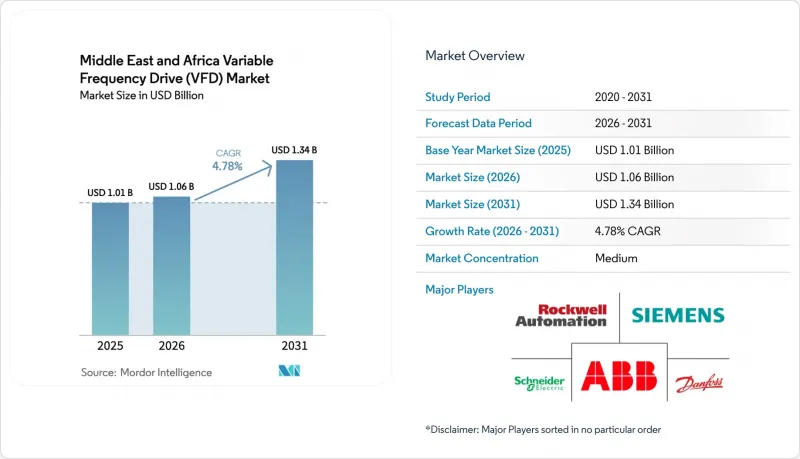
本報告按驅動類型(交流變頻器、直流驅動、伺服驅動)、額定輸出功率(小於5kW、5-30kW、30kW及以上)、電壓(低壓690V及以下、中壓690V以上)、最終用戶(石油天然氣、化學及石化、其他)、應用(泵浦、風機、壓縮機、其他)及地區細分。市場預測以美元(USD)計價。
中東和非洲變頻驅動器市場的趨勢和洞察
加強中東和非洲地區的能源效率法規
海灣合作理事會(GCC)各國政府現已強制要求新安裝的設備採用IE3和IE4能效等級的電機,這加速了變頻驅動系統的應用,以滿足高性能電機更高的湧入電流需求。沙烏地阿拉伯和阿拉伯聯合大公國的電力公司補貼計畫已將暖通空調(HVAC)維修的投資回收期縮短至三年以內,從而加快了用先進驅動器替換定速啟動器的進程。阿曼的電網營運商已開始對功率因數超過0.90的用戶處以罰款,鼓勵工業用戶改用主動式前端整流器的驅動器。多邊開發銀行正在將能源效率目標納入海水淡化和污水處理的融資標準,使變速控制成為貸款核准的強制性要求。這些措施共同為變頻驅動器市場奠定了可預測的基礎,同時也促進了以設備檢查和調整為中心的服務生態系統的發展。
大規模發展海水淡化和區域冷卻基礎設施
沙烏地阿拉伯國家水資源策略的目標是到2030年將海水淡化能力提高850萬立方公尺/天,這意味著逆滲透給水和濃鹽水循環迴路需要數千台5-75千瓦的泵浦驅動器。杜拜、杜哈和阿布扎比的區域供冷運營商報告稱,從節流閥轉向速度控制後,節能20-30%,這使得投資回報率對投資者更具吸引力。屋頂太陽能發電和餘熱回收的整合使負載曲線更加複雜,因此需要能夠追蹤可變壓力而不產生氣蝕的數位驅動器。 IEC 61800-9-2能源效率等級現在已成為規範中的常規標準,採購也正朝著更高等級的轉換器拓撲結構發展。隨著冷凍水網路擴展到NEOM和盧賽爾等多功能大型企劃,變頻驅動器市場正迎來與長期特許特許經營協議相關的巨額訂單,這些協議確保了維運收入。
受布蘭特原油價格波動驅動的不穩定資本投資週期。
根據美國能源資訊署 (EIA) 的預測,布蘭特原油價格預計將在 2025 年達到每桶 74 美元,隨後在 2026 年回落至每桶 66 美元,這將削弱石油依賴型經濟體的財政能力,並導致自動化預算延期。項目取消將對解決中游領域的瓶頸問題和擴建石化工廠產生最直接的影響,直接影響中壓變頻器的訂單。供應商正優先考慮機箱尺寸的整合以對沖庫存風險,但由於液化天然氣 (LNG) 工廠的規劃週期較長,時間上的差異不可避免。融資企業聯合組織對公共產業的美元債務越來越謹慎,這進一步減少了短期競標量。因此,儘管在整個生命週期內可以顯著節省成本,但變頻器市場的需求仍存在季度波動。
細分市場分析
到2025年,交流變頻器仍將佔據變頻器市場66.12%的佔有率,這得益於其在沙漠極端高溫和煉油廠運作環境下久經考驗的耐用性。伺服驅動器的複合年成長率(CAGR)為5.63%,因為太陽能追蹤器、機器人焊接機和取放設備等應用需要小於1°的定位精度。直流驅動器則主要應用於礦用提昇機等對扭力控制要求極高的小眾市場。驅動裝置的細分市場也反映了馬達標準的演變。 IEC認證的IE3和IE4馬達的出現,要求交流逆變器進行設計調整以適應更高的磁化電流,這使得現有供應商得以繼續保持其市場主導地位。
由於區域供冷廠和飲用水增壓泵的預期升級,預計到2031年交流變頻器的出貨量將保持穩定,但收入成長可能主要集中在整合邊緣分析功能的伺服驅動器上。供應商正透過整合方案釋放交叉銷售潛力。 ABB符合IE3標準的產品線將同步磁阻馬達與最佳化的驅動韌體結合,而WEG的軸向馬達和CFW900逆變器的組合則縮小了屋頂太陽能追蹤器的面積。這種整合方案將增強生態系統的整合,並促進變頻驅動器市場服務合約的擴展。
2025年,功率範圍在5-30kW的產品將佔市場需求的38.35%,此功率範圍與區域冷卻系統和市政水井中的水泵功率相當。 31-75kW功率範圍的產品正推動著埃及和摩洛哥等國的食品加工和紡織等中型工業自動化的發展,並以5.78%的複合年成長率成為成長最快的功率範圍。 5kW以下的機組在建築管理系統領域正逐漸獲得市場認可,而75kW以上的機組則用於海水淡化高壓幫浦和煉油廠的鼓風機。
像NEOM這樣的氫能中心對兆瓦級產品有著巨大的需求,儘管複雜的EPC(工程、採購、施工)流程在一定程度上緩解了銷售波動。同時,為達到ISO 50001能源目標,中小企業正將中功率驅動器作為快速解決方案,推動市場穩定擴張。區域組裝對產能的投資已將37kW撬裝設備的交貨週期縮短至四周,進一步增強了中功率變頻器市場的成長動能。
其他好處
- Excel格式的市場預測(ME)表
- 3個月的分析師支持
目錄
第1章:引言
- 研究假設和市場定義
- 調查範圍
第2章:調查方法
第3章執行摘要
第4章 市場狀況
- 市場概覽
- 市場促進因素
- 加強中東和非洲地區的能源效率法規
- 大規模發展海水淡化和區域冷卻基礎設施
- 太陽能發電(PV)的快速普及推動了對變速馬達的需求。
- 成熟油田向電動潛水泵過渡
- 利用政府資金實現工業自動化製造的在地化
- 即將啟動的綠色氫能大型企劃需要中壓變頻器
- 市場限制因素
- 受布蘭特原油價格波動驅動的不穩定資本投資週期。
- 海灣合作理事會地區以外售後服務網路的去中心化
- 高頻逆變器的引入受到電網電能品質限制的阻礙。
- 非洲電力電子元件進口關稅持續上漲
- 產業價值鏈分析
- 監理情勢
- 技術展望
- 宏觀經濟因素的影響
- 波特五力分析
第5章 市場規模與成長預測
- 透過驅動系統
- 交流變頻器
- 直流驅動器
- 伺服驅動器
- 按類型分類的額定輸出
- 小於5千瓦
- 5~30kW
- 31~75kW
- 75千瓦或以上
- 透過電壓
- 低電壓(690V 或以下)
- 中壓(690V以上)
- 最終用戶
- 石油和天然氣
- 化工/石油化工
- 金屬和採礦
- 發電
- 水和污水處理
- HVAC
- 紙漿和造紙
- 其他
- 透過使用
- 泵浦
- 扇子
- 壓縮機
- 輸送機
- 暖通空調系統
- 其他
- 按地區
- 中東
- 沙烏地阿拉伯
- 阿拉伯聯合大公國
- 卡達
- 科威特
- 其他中東國家
- 非洲
- 南非
- 埃及
- 奈及利亞
- 阿爾及利亞
- 其他非洲地區
- 中東
第6章 競爭情勢
- 市場集中度
- 策略趨勢
- 市佔率分析
- 公司簡介
- ABB Ltd.
- Siemens AG
- Schneider Electric SE
- Rockwell Automation, Inc.
- Danfoss A/S
- Yaskawa Electric Corporation
- Toshiba Mitsubishi Electric Industrial Systems Corporation
- Mitsubishi Electric Corporation
- Fuji Electric Co., Ltd.
- Hitachi Energy Ltd.
- Nidec Corporation
- CG Power and Industrial Solutions Ltd.
- WEG SA
- Eaton Corporation plc
- Invertek Drives Ltd.
- Delta Electronics, Inc.
- LS Electric Co., Ltd.
- Bonfiglioli Riduttori SpA
- SEW-Eurodrive GmbH and Co KG
- Leroy-Somer(Emerson Electric Co., Ltd.)
第7章 市場機會與未來展望
According to Mordor Intelligence, the variable frequency drive market size in the Middle East and Africa is expected to grow from USD 1.01 billion in 2025 to USD 1.06 billion in 2026 and is forecast to reach USD 1.34 billion by 2031 at 4.78% CAGR over 2026-2031.
This report is Segmented by Drive Type (AC Drives, DC Drives, and Servo Drives), Power Rating (Below 5 KW, 5-30 KW, and More), Voltage (Low-Voltage <=690V and Medium-Voltage >690V), End-User (Oil and Gas, Chemicals and Petrochemicals, and More), Application (Pumps, Fans, Compressors, and More), and Region. The Market Forecasts are Provided in Terms of Value (USD).
Middle East And Africa Variable Frequency Drive (VFD) Market Trends and Insights
Intensifying Energy-Efficiency Mandates Across Middle East and Africa
Governments across GCC states now specify IE3 and IE4 motor efficiency classes for new installations, prompting widespread adoption of inverter-driven systems to match the higher in-rush requirements of premium motors. Utility rebate programs in Saudi Arabia and the UAE cut payback periods for HVAC retrofits to under three years, accelerating replacement of fixed-speed starters with modern drives. Grid operators in Oman have begun applying power-factor penalties above 0.90, nudging industrial users toward drives equipped with active front-end rectifiers. Multilateral development banks have embedded efficiency targets into desalination and wastewater funding criteria, making variable speed control a prerequisite for loan approval. Together, these policies create a predictable baseline for the variable frequency drive market while fostering a services ecosystem around inspection and tuning of installed bases.
Massive Build-Out of Desalination and District-Cooling Infrastructure
Saudi Arabia's National Water Strategy calls for 8.5 million m3/day of incremental desalination by 2030, translating into thousands of 5-75 kW pump drives for reverse-osmosis feed and brine recirculation circuits. District-cooling operators in Dubai, Doha, and Abu Dhabi report 20-30% energy savings after migrating from throttling valves to speed control, bolstering payback narratives for financiers. Integration of rooftop solar and waste-heat recovery complicates load profiles, heightening the need for digital drives that track variable head pressures without cavitation. Specifications now routinely cite IEC 61800-9-2 efficiency classes, steering procurement toward higher-grade converter topologies. As chilled-water networks extend to mixed-use megaprojects like NEOM and Lusail, the variable frequency drive market gains high-volume orders linked to long-dated concession agreements that secure O&M revenues.
Volatile Capex Cycles Tied to Brent-Crude Price Swings
EIA projections place Brent at USD 74 /bbl in 2025 before sliding to USD 66 /bbl in 2026, narrowing fiscal buffers for oil-weighted economies and leading to deferred automation budgets. Project cancellations ripple fastest through mid-stream debottlenecking and petrochemical expansions, directly denting medium-voltage drive orders. Suppliers prioritize frame-size consolidation to hedge inventory risk, yet long planning horizons for LNG trains make timing mismatches inevitable. Loan syndicates become cautious on dollar-denominated debt for utilities, further trimming near-term tender volumes. Consequently, the variable frequency drive market endures uneven quarterly demand despite compelling lifecycle savings.
Other drivers and restraints analyzed in the detailed report include:
- Rapid Solar-PV Integration Driving Need for Variable-Speed Motors
- Government-Funded Localization of Industrial Automation Manufacturing
- Fragmented Aftermarket Service Networks Outside GCC
For complete list of drivers and restraints, kindly check the Table Of Contents.
Segment Analysis
AC drives retained 66.12% share of the 2025 variable frequency drive market size thanks to proven durability in desert heat and refinery duty cycles. Servo drives posted a 5.63% CAGR as solar trackers, robotic welders, and pick-and-place units demanded sub-1° positioning accuracy. DC drives linger in niche mining hoists where torque control is paramount. The drive-type mix also reflects evolving motor standards; IEC-certified IE3 and IE4 motors prompt design tweaks in AC inverters to manage higher magnetizing currents, keeping established suppliers in pole position.
Projected upgrades across district-cooling plants and potable-water boosters sustain AC volume through 2031, yet incremental revenue skews toward servo units embedded with edge analytics. Vendors unlock cross-sell potential via integrated packages. ABB's IE3-ready line couples synchronous reluctance motors with tailored drive firmware, while WEG's axial-flux motor plus CFW900 inverter packs tighten the footprint for rooftop solar trackers. Such packaging deepens ecosystem stickiness and elevates service attachment in the variable frequency drive market.
Products spanning 5-30 kW met 38.35% of 2025 demand, mirroring pump sizes in district-cooling loops and municipal well fields. The 31-75 kW class lifts fastest at 5.78% CAGR, riding medium-scale industrial automation across food processing and textiles in Egypt and Morocco. Sub-5 kW units flourish in building management, while >75 kW frames anchor desalination high-pressure pumps and refinery blowers.
Hydrogen hubs like NEOM create outsized pull for multi-megawatt ratings, but complex EPC cycles temper volume swings. Conversely, SME factories chasing ISO 50001 energy targets adopt mid-range drives as quick wins, reinforcing steady expansion. Capacity investments by regional assemblers shorten delivery to four weeks for 37-kW skids, strengthening the variable frequency drive market's mid-band momentum.
Complete Report Scope:
- By Drive Type
- AC Drives
- DC Drives
- Servo Drives
- By Power Rating
- Below 5 kW
- 5 - 30 kW
- 31 - 75 kW
- Above 75 kW
- By Voltage
- Low-Voltage (<=690 V)
- Medium-Voltage (>690 V)
- By End-User
- Oil and Gas
- Chemicals and Petrochemicals
- Metals and Mining
- Power Generation
- Water and Wastewater
- HVAC
- Pulp and Paper
- Other End-User Industries
- By Application
- Pumps
- Fans
- Compressors
- Conveyors
- HVAC Systems
- Other Applications
- By Region
- Middle East
- Saudi Arabia
- United Arab Emirates
- Qatar
- Kuwait
- Rest of Middle East
- Africa
- South Africa
- Egypt
- Nigeria
- Algeria
- Rest of Africa
- Middle East
List of Companies Covered in this Report:
- ABB Ltd.
- Siemens AG
- Schneider Electric SE
- Rockwell Automation, Inc.
- Danfoss A/S
- Yaskawa Electric Corporation
- Toshiba Mitsubishi Electric Industrial Systems Corporation
- Mitsubishi Electric Corporation
- Fuji Electric Co., Ltd.
- Hitachi Energy Ltd.
- Nidec Corporation
- CG Power and Industrial Solutions Ltd.
- WEG S.A.
- Eaton Corporation plc
- Invertek Drives Ltd.
- Delta Electronics, Inc.
- LS Electric Co., Ltd.
- Bonfiglioli Riduttori S.p.A.
- SEW-Eurodrive GmbH and Co KG
- Leroy-Somer (Emerson Electric Co., Ltd.)
Additional Benefits:
- The market estimate (ME) sheet in Excel format
- 3 months of analyst support
TABLE OF CONTENTS
1 INTRODUCTION
- 1.1 Study Deliverables and Assumptions
- 1.2 Scope of the Study
2 RESEARCH METHODOLOGY
3 EXECUTIVE SUMMARY
4 MARKET LANDSCAPE
- 4.1 Market Overview
- 4.2 Market Drivers
- 4.2.1 Intensifying energy-efficiency mandates across Middle East and Africa
- 4.2.2 Massive build-out of desalination and district-cooling infrastructure
- 4.2.3 Rapid solar-PV integration driving need for variable-speed motors
- 4.2.4 Shift toward electric submersible pumps in mature oilfields
- 4.2.5 Government-funded localization of industrial automation manufacturing
- 4.2.6 Upcoming green-hydrogen mega-projects requiring medium-voltage VFDs
- 4.3 Market Restraints
- 4.3.1 Volatile capex cycles tied to Brent-crude price swings
- 4.3.2 Fragmented aftermarket service networks outside GCC
- 4.3.3 Limited grid-power quality hindering high-frequency inverter adoption
- 4.3.4 Persistent import tariffs on power-electronic components in Africa
- 4.4 Industry Value Chain Analysis
- 4.5 Regulatory Landscape
- 4.6 Technological Outlook
- 4.7 Impact of Macroeconomic Factors
- 4.8 Porter's Five Forces Analysis
- 4.8.1 Bargaining Power of Suppliers
- 4.8.2 Bargaining Power of Buyers
- 4.8.3 Threat of New Entrants
- 4.8.4 Threat of Substitutes
- 4.8.5 Intensity of Competitive Rivalry
5 MARKET SIZE AND GROWTH FORECASTS (VALUES)
- 5.1 By Drive Type
- 5.1.1 AC Drives
- 5.1.2 DC Drives
- 5.1.3 Servo Drives
- 5.2 By Power Rating
- 5.2.1 Below 5 kW
- 5.2.2 5 - 30 kW
- 5.2.3 31 - 75 kW
- 5.2.4 Above 75 kW
- 5.3 By Voltage
- 5.3.1 Low-Voltage (<=690 V)
- 5.3.2 Medium-Voltage (>690 V)
- 5.4 By End-User
- 5.4.1 Oil and Gas
- 5.4.2 Chemicals and Petrochemicals
- 5.4.3 Metals and Mining
- 5.4.4 Power Generation
- 5.4.5 Water and Wastewater
- 5.4.6 HVAC
- 5.4.7 Pulp and Paper
- 5.4.8 Other End-User Industries
- 5.5 By Application
- 5.5.1 Pumps
- 5.5.2 Fans
- 5.5.3 Compressors
- 5.5.4 Conveyors
- 5.5.5 HVAC Systems
- 5.5.6 Other Applications
- 5.6 By Region
- 5.6.1 Middle East
- 5.6.1.1 Saudi Arabia
- 5.6.1.2 United Arab Emirates
- 5.6.1.3 Qatar
- 5.6.1.4 Kuwait
- 5.6.1.5 Rest of Middle East
- 5.6.2 Africa
- 5.6.2.1 South Africa
- 5.6.2.2 Egypt
- 5.6.2.3 Nigeria
- 5.6.2.4 Algeria
- 5.6.2.5 Rest of Africa
- 5.6.1 Middle East
6 COMPETITIVE LANDSCAPE
- 6.1 Market Concentration
- 6.2 Strategic Moves
- 6.3 Market Share Analysis
- 6.4 Company Profiles (includes Global level Overview, Market level overview, Core Segments, Financials as available, Strategic Information, Market Rank/Share for key companies, Products and Services, and Recent Developments)
- 6.4.1 ABB Ltd.
- 6.4.2 Siemens AG
- 6.4.3 Schneider Electric SE
- 6.4.4 Rockwell Automation, Inc.
- 6.4.5 Danfoss A/S
- 6.4.6 Yaskawa Electric Corporation
- 6.4.7 Toshiba Mitsubishi Electric Industrial Systems Corporation
- 6.4.8 Mitsubishi Electric Corporation
- 6.4.9 Fuji Electric Co., Ltd.
- 6.4.10 Hitachi Energy Ltd.
- 6.4.11 Nidec Corporation
- 6.4.12 CG Power and Industrial Solutions Ltd.
- 6.4.13 WEG S.A.
- 6.4.14 Eaton Corporation plc
- 6.4.15 Invertek Drives Ltd.
- 6.4.16 Delta Electronics, Inc.
- 6.4.17 LS Electric Co., Ltd.
- 6.4.18 Bonfiglioli Riduttori S.p.A.
- 6.4.19 SEW-Eurodrive GmbH and Co KG
- 6.4.20 Leroy-Somer (Emerson Electric Co., Ltd.)
7 MARKET OPPORTUNITIES AND FUTURE OUTLOOK
- 7.1 White-space and Unmet-need assessment

 驅動裝置市場報告:趨勢、預測及競爭分析(至2035年)
 亞太地區變頻器市場:市場佔有率分析、產業趨勢與統計及成長預測(2026-2031)變頻驅動器(VFD):市場佔有率分析、行業趨勢和統計數據以及成長預測(2025-2030 年)
 變頻器市場:2026-2032年全球市場預測(依產品類型、電壓、額定功率、安裝方式、應用領域、最終用戶及銷售管道)
 大型變頻驅動器市場機會、成長促進因素、產業趨勢分析及2026-2035年預測
 變頻器市場規模、佔有率和趨勢分析報告:按產品類型、輸出範圍、應用、最終用途、地區和細分市場預測(2026-2033 年)
 2026年全球酪農真空幫浦變頻器市場報告
 變頻器市場規模、佔有率、趨勢和預測:按產品類型、輸出範圍、應用、最終用途和地區分類,2026-2034年
 變頻器市場:按部署模式、驅動類型、電壓範圍、應用、最終用途、最終用途產業和地區分類
 變頻器市場:市場規模、佔有率、成長率、全球產業分析、按類型、應用和地區分類的分析以及未來預測(2026-2034 年)