


 |
市場調查報告書
商品編碼
2113308
亞太地區變頻器市場:市場佔有率分析、產業趨勢與統計及成長預測(2026-2031)Asia-Pacific Variable Frequency Drives - Market Share Analysis, Industry Trends & Statistics, Growth Forecasts (2026 - 2031) |
||||||

※ 本網頁內容可能與最新版本有所差異。詳細情況請與我們聯繫。
據 Mordor Intelligence 稱,亞太地區變頻驅動器 (VFD) 市場預計到 2026 年將達到 110.6 億美元,高於 2025 年的 104.7 億美元,預計到 2031 年將達到 145.4 億美元。
預計從 2026 年到 2031 年,其複合年成長率將達到 5.62%。
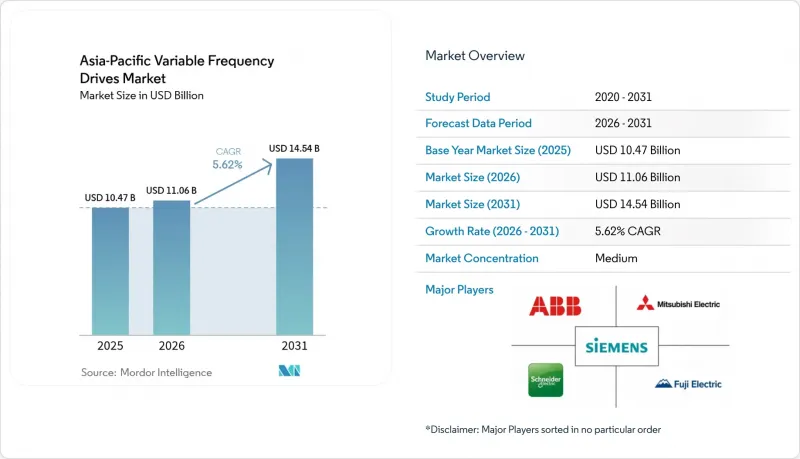
本報告按類型(交流電、直流、伺服驅動)、電壓等級(低壓、中壓)、額定功率(微型、低功率、中功率、高功率)、應用(泵浦、風機、壓縮機、輸送機、暖通空調、其他)、終端用戶產業(石油天然氣、能源發電、其他)和地區進行細分。市場預測以美元計價。
亞太地區變頻器市場趨勢及洞察。
中國和印度的政府主導的工業能源效率法規
目前,各國法規均將工業設備升級與量化的能源效率目標掛鉤。在中國,相關標準的適用範圍將於2024年擴展至23個產品類型,工廠將被要求採用高效率馬達及相應的驅動器,預計將顯著增加維修的數量。新德里預算撥款650億印度盧比(約7.8億美元),用於將350萬台灌溉泵累計為太陽能供電,並將變頻器直接整合到分散式可再生能源系統中。這些措施與中國2060年碳中和目標以及印度的可再生能源推廣政策相一致,正在整個供應鏈中產生連鎖反應,鼓勵本地原始設備製造商(OEM)為其配備大量符合IEC標準的感測器的驅動器申請大規模認證。目前,能夠證明節能20%至40%的供應商在政府採購中享有優先權。
資料中心的快速擴張對高精度HVAC驅動器提出了更高的要求。
預計到2025年,亞太地區資料中心的資本支出將超過750億美元,超過北美地區。伺服器密度的增加導致熱負荷上升,促使營運商從恆速冷卻器轉向基於變頻驅動(VFD)的冷卻迴路。北京和新加坡的PUE(電源使用效率)法規推動了動態氣流控制的發展,而碳化矽(SiC)功率級的應用每年可降低高達17%的暖通空調(HVAC)能耗。整合現場匯流排和網路安全增強韌體的驅動器能夠向建築管理系統提供即時回饋,使冷卻不再只是成本中心,而是影響效能的關鍵因素。
來自低成本中國供應商的競爭
包括Inovance和Hiconics在內的中國供應商採取激進的定價策略,給高階品牌的利潤率帶來了壓力,尤其是在40kW以下的功率區間。在北京綠色產業政策的支持下,這些公司的產品定價比全球平均低15%至25%。雖然客戶受益於更低的初始投資成本,但日益激烈的價格競爭威脅到先進拓撲結構和網路安全安全功能等長期研發資金。領先的一級供應商正在透過將硬碟與數位服務合約和延長保固期捆綁銷售來應對這一挑戰,並將企業發展從關注前期成本轉向強調生命週期價值。
細分市場分析
交流變頻器用途廣泛,可應用於泵浦、風扇和輸送機等多種設備,預計2025年仍將佔據73.40%的市場佔有率。亞太地區伺服單元用變頻驅動器市場預計將以8.02%的複合年成長率快速成長,主要得益於機器人、數控加工和協作機器人的普及。從生命週期經濟角度來看,交流驅動器在恆定轉矩應用上具有優勢,但伺服單元的定位精度可達±0.01°以內,因此其更高的價格溢價是合理的。在當前週期中,伺服應用最廣泛的領域是韓國和日本的電子組裝。碳化矽(SiC)功率級和整合式編碼器可實現微秒級回饋,從而降低過沖和缺陷率。隨著原始設備製造商(OEM)不斷縮小設備尺寸, 基板安裝式驅動器和PCB定子馬達減少了機櫃面積,使其能夠適應空間有限的工廠車間。
服務模式也在不斷多元化。交流變頻器通常提供五年保固和基本監控功能,而伺服驅動器則整合了雲端儀錶板,用於追蹤扭矩波動和振動。供應商正大力提升銷售維護即服務 (MaaS) 契約,該合約利用演算法提前數週預測軸承磨損情況。這種從一次性銷售轉向經常性收入的轉變,正在重塑亞太地區整個變頻驅動器市場的分銷管道獎勵機制。
到2025年,電壓低於690V的低壓系統將佔出貨量的86.90%,這反映了該地區中小型馬達的集中度。然而,由於石化聯合裝置、海水淡化廠和地鐵項目泵浦運作規模的不斷擴大,預計中壓市場將以6.85%的複合年成長率成長。隨著IEC首次推出高壓馬達能源效率評級,EPC承包商擴大採用主動式前端配置以滿足總諧波失真(THD)限制。在溫度超過40 度C的市場,亞太地區變頻器市場中空冷式中壓馬達組的佔有率正在擴大,供應商正致力於開發耐高溫、不易降低額定值的散熱合金。
產品策略正朝著模組化組件的方向發展。可拉出的電源單元簡化了現場更換,而數位孿生技術透過模擬與脆弱電網的諧波相互作用,將試運行時間縮短了20%。低壓平台不斷創新,引入了再生煞車和安全扭力關閉(STO)功能,以滿足部署自動導引運輸車(AGV)的物流和倉儲業客戶的需求。
其他好處
- Excel格式的市場預測(ME)表
- 3個月的分析師支持
目錄
第1章:引言
- 研究假設和市場定義
- 調查範圍
第2章:調查方法
第3章執行摘要
第4章 市場狀況
- 市場概覽
- 市場促進因素
- 中國和印度的政府主導的工業能效強制規定
- 2023年及以後製造業自動化浪潮
- 不斷上漲的電費正在推動節能維修。
- 資料中心的快速擴張對高精度空調系統提出了更高的要求。
- 東南亞基礎設施建設熱潮帶動了對水泵和風扇需求的成長。
- 採礦和船舶設備向電力推進的過渡
- 市場限制因素
- 來自中國低成本供應商的價格競爭
- 中壓驅動中諧波和電磁干擾法規的挑戰。
- 澳洲將停止對工業效率提升計畫的補貼。
- 東協地區變頻器試運行人員短缺
- 價值鏈分析
- 監管和技術展望
- 技術概述
- 波特五力分析
第5章 市場規模與成長預測
- 按類型
- AC
- DC
- 伺服驅動器
- 電壓等級
- 低電壓(690V 或以下)
- 中壓(1-35kV)
- 按類型分類的額定輸出
- 微波爐(5千瓦或以下)
- 低功率(6-40kW)
- 中功率(41-200kW)
- 高功率(200千瓦或以上)
- 透過使用
- 泵浦
- 扇子
- 壓縮機
- 輸送機
- HVAC
- 擠出機
- 其他
- 按最終用戶行業分類
- 石油和天然氣
- 能源和發電
- 用水和污水管理
- 食品和飲料加工
- 紙漿和造紙
- 金屬和採礦
- 化工/石油化工
- 海洋/造船
- 其他
- 國家
- 中國
- 日本
- 印度
- 韓國
- 亞太其他地區
第6章 競爭情勢
- 市場集中度
- 策略趨勢
- 市佔率分析
- 公司簡介
- ABB Ltd
- Siemens AG
- Mitsubishi Electric Corporation
- Schneider Electric SE
- Fuji Electric Co. Ltd
- Hitachi Ltd
- Toshiba Corporation
- Yaskawa Electric Corp.
- Delta Electronics Inc.
- Danfoss A/S
- Rockwell Automation Inc.
- Eaton Corporation plc
- Emerson Electric Co.
- Johnson Controls International plc
- Parker Hannifin Corp.
- WEG SA
- LS Electric Co. Ltd
- Inovance Technology Co. Ltd
- Nidec(Control Techniques)
- CHINT Group(Hiconics Drive)
第7章 市場機會與未來展望
According to Mordor Intelligence, Asia-Pacific variable frequency drives market size in 2026 is estimated at USD 11.06 billion, growing from 2025 value of USD 10.47 billion with 2031 projections showing USD 14.54 billion, growing at 5.62% CAGR over 2026-2031.
This report is Segmented by Type (AC, DC, and Servo Drives), Voltage Class (Low-Voltage and Medium-Voltage), Power Rating (Micro, Low, Medium, and High), Application (Pumps, Fans, Compressors, Conveyors, HVAC, and Others), End-User Industry (Oil and Gas, Energy and Power, and More), and Geography. The Market Forecasts are Provided in Terms of Value (USD).
Asia-Pacific Variable Frequency Drives Market Trends and Insights
Government-Led Industrial Energy-Efficiency Mandates in China and India
National regulations now tie industrial upgrades to quantified energy-performance targets. China's 2024 specification expansion to 23 product categories obliges factories to adopt premium-efficiency motors and matching drives, prompting a step-change in retrofit volumes. New Delhi's budget sets aside INR 6,500 crore (USD 780 million) to solarize 3.5 million irrigation pumps, directly embedding VFDs into distributed renewable systems. These measures, aligned with China's 2060 carbon-neutrality goal and India's renewable energy push, are cascading through supply chains, prompting local OEMs to certify IEC-compliant, sensor-rich drives at scale. Vendors able to prove 20-40% electricity savings now enjoy priority listing in government procurement.
Rapid Build-Out of Data Centers Requiring Precision HVAC Drives
Asia Pacific data-center capex is projected to surpass USD 75 billion by 2025, overtaking North America. Server-densification elevates thermal loads, so operators are shifting from fixed-speed chillers to VFD-based cooling loops. PUE mandates in Beijing and Singapore encourage dynamic airflow control, and silicon-carbide power stages are cutting HVAC energy draw by up to 17% annually. Drives with embedded fieldbus and cyber-secure firmware enable real-time feedback to building-management systems, turning cooling from a cost center into a performance variable.
Price Competition from Low-Cost Chinese Vendors
Aggressive pricing from Inovance, Hiconics, and other Chinese suppliers erodes margins for premium brands, particularly in the <40 kW bracket. With support from Beijing's green-industrial policy, these firms price 15-25% below global averages. While customers enjoy lower capex, a race-to-the-bottom threatens long-term R&D funding for advanced topologies and cybersecurity features. Tier-one players are countering by bundling drives with digital service contracts and extended warranties, repositioning themselves on lifecycle value rather than upfront cost.
Other drivers and restraints analyzed in the detailed report include:
- Manufacturing-Sector Automation Wave Post-2023
- Rising Electricity Tariffs Prompting Energy-Saving Retrofits
- Skilled Workforce Shortage for VFD Commissioning in ASEAN
For complete list of drivers and restraints, kindly check the Table Of Contents.
Segment Analysis
AC drives retained a 73.40% command of 2025 revenues, anchored by their versatility across pumps, fans, and conveyors. The Asia-Pacific variable frequency drives market size for servo units is forecast to jump at an 8.02% CAGR as robotics, CNC machining, and collaborative cobots proliferate. Lifecycle economics favour AC units in constant-torque uses, but the servo's higher price premium is justified by positional accuracy within +-0.01°. In the current cycle, servo adoption is strongest in electronics assembly lines of South Korea and Japan. Silicon-carbide power stages and embedded encoders now enable microsecond-level feedback, reducing overshoot and scrap rates. As OEMs miniaturize machinery, board-mount drives and PCB stator motors are shrinking cabinet footprints, enabling retrofit into crowded factory floors.
Service models are also diverging. AC drives typically ship with five-year warranties and basic monitoring, while servo packages bundle cloud dashboards that track torque ripple and vibration. Suppliers are upselling maintenance-as-a-service contracts that utilize algorithms to predict bearing wear weeks in advance. This shift from transactional sales to recurring revenue is reshaping channel incentives across the Asia-Pacific variable frequency drives market.
Low-voltage systems <690 V command 86.90% of 2025 shipments, a reflection of the region's concentration of small to mid-sized motors. Yet, the medium-voltage segment is expanding at a forecasted 6.85% CAGR as petrochemical complexes, desalination plants, and metro-rail projects scale up pump duties. IEC's first-ever efficiency grading for high-voltage motors has prompted EPC contractors to integrate active-front-end configurations to comply with THD limits. The Asia-Pacific variable frequency drives market share for air-cooled medium-voltage packages is growing in markets where ambient temperatures exceed 40°C, prompting vendors to develop derating-resistant heat-sink alloys.
Product strategy is converging on modular building blocks. Drawer-style power cells simplify field replacement; digital twins simulate harmonic interaction with weak grids, reducing commissioning time by 20%. Low-voltage platforms continue to innovate with regenerative braking and STO (Safe Torque Off) functions, catering to intralogistics and warehousing clients adopting automated guided vehicles.
Complete Report Scope:
- By Type
- AC Drives
- DC Drives
- Servo Drives
- By Voltage Class
- Low-Voltage (More than 690 V)
- Medium-Voltage (1 - 35 kV)
- By Power Rating (kW)
- Micro (Less than 5 kW)
- Low (6 - 40 kW)
- Medium (41 - 200 kW)
- High (More than 200 kW)
- By Application
- Pumps
- Fans
- Compressors
- Conveyors
- HVAC
- Extruders
- Others
- By End-User Industry
- Oil and Gas
- Energy and Power
- Water and Waste-water Management
- Food and Beverage Processing
- Pulp and Paper
- Metals and Mining
- Chemicals and Petrochemicals
- Marine and Shipbuilding
- Other Industries
- By Country
- China
- Japan
- India
- South Korea
- Rest of Asia-Pacific
List of Companies Covered in this Report:
- ABB Ltd
- Siemens AG
- Mitsubishi Electric Corporation
- Schneider Electric SE
- Fuji Electric Co. Ltd
- Hitachi Ltd
- Toshiba Corporation
- Yaskawa Electric Corp.
- Delta Electronics Inc.
- Danfoss A/S
- Rockwell Automation Inc.
- Eaton Corporation plc
- Emerson Electric Co.
- Johnson Controls International plc
- Parker Hannifin Corp.
- WEG SA
- LS Electric Co. Ltd
- Inovance Technology Co. Ltd
- Nidec (Control Techniques)
- CHINT Group (Hiconics Drive)
Additional Benefits:
- The market estimate (ME) sheet in Excel format
- 3 months of analyst support
TABLE OF CONTENTS
1 INTRODUCTION
- 1.1 Study Assumptions and Market Definition
- 1.2 Scope of the Study
2 RESEARCH METHODOLOGY
3 EXECUTIVE SUMMARY
4 MARKET LANDSCAPE
- 4.1 Market Overview
- 4.2 Market Drivers
- 4.2.1 Government-led Industrial Energy-Efficiency Mandates in China and India
- 4.2.2 Manufacturing-Sector Automation Wave Post-2023
- 4.2.3 Rising Electricity Tariffs Prompting Energy-Saving Retrofits
- 4.2.4 Rapid Build-out of Data Centres Requiring Precision HVAC Drives
- 4.2.5 Infrastructure Boom in Southeast Asia Boosting Pumps and Fans Demand
- 4.2.6 Shift to Electric Propulsion in Mining and Marine Equipment
- 4.3 Market Restraints
- 4.3.1 Price Competition from Low-Cost Chinese Vendors
- 4.3.2 Harmonic and EMI Compliance Challenges in Medium-Voltage Drives
- 4.3.3 Subsidy Withdrawal for Industrial Efficiency Projects in Australia
- 4.3.4 Skilled Workforce Shortage for VFD Commissioning in ASEAN
- 4.4 Value-Chain Analysis
- 4.5 Regulatory and Technological Outlook
- 4.6 Technology Snapshot
- 4.7 Porter's Five Forces Analysis
- 4.7.1 Threat of New Entrants
- 4.7.2 Bargaining Power of Buyers
- 4.7.3 Bargaining Power of Suppliers
- 4.7.4 Threat of Substitute Products
- 4.7.5 Intensity of Competitive Rivalry
5 MARKET SIZE AND GROWTH FORECASTS (VALUE)
- 5.1 By Type
- 5.1.1 AC Drives
- 5.1.2 DC Drives
- 5.1.3 Servo Drives
- 5.2 By Voltage Class
- 5.2.1 Low-Voltage (More than 690 V)
- 5.2.2 Medium-Voltage (1 - 35 kV)
- 5.3 By Power Rating (kW)
- 5.3.1 Micro (Less than 5 kW)
- 5.3.2 Low (6 - 40 kW)
- 5.3.3 Medium (41 - 200 kW)
- 5.3.4 High (More than 200 kW)
- 5.4 By Application
- 5.4.1 Pumps
- 5.4.2 Fans
- 5.4.3 Compressors
- 5.4.4 Conveyors
- 5.4.5 HVAC
- 5.4.6 Extruders
- 5.4.7 Others
- 5.5 By End-User Industry
- 5.5.1 Oil and Gas
- 5.5.2 Energy and Power
- 5.5.3 Water and Waste-water Management
- 5.5.4 Food and Beverage Processing
- 5.5.5 Pulp and Paper
- 5.5.6 Metals and Mining
- 5.5.7 Chemicals and Petrochemicals
- 5.5.8 Marine and Shipbuilding
- 5.5.9 Other Industries
- 5.6 By Country
- 5.6.1 China
- 5.6.2 Japan
- 5.6.3 India
- 5.6.4 South Korea
- 5.6.5 Rest of Asia-Pacific
6 COMPETITIVE LANDSCAPE
- 6.1 Market Concentration
- 6.2 Strategic Moves
- 6.3 Market Share Analysis
- 6.4 Company Profiles (includes Global-level Overview, Market-level Overview, Core Segments, Financials as available, Strategic Information, Market Rank/Share, Products and Services, Recent Developments)
- 6.4.1 ABB Ltd
- 6.4.2 Siemens AG
- 6.4.3 Mitsubishi Electric Corporation
- 6.4.4 Schneider Electric SE
- 6.4.5 Fuji Electric Co. Ltd
- 6.4.6 Hitachi Ltd
- 6.4.7 Toshiba Corporation
- 6.4.8 Yaskawa Electric Corp.
- 6.4.9 Delta Electronics Inc.
- 6.4.10 Danfoss A/S
- 6.4.11 Rockwell Automation Inc.
- 6.4.12 Eaton Corporation plc
- 6.4.13 Emerson Electric Co.
- 6.4.14 Johnson Controls International plc
- 6.4.15 Parker Hannifin Corp.
- 6.4.16 WEG SA
- 6.4.17 LS Electric Co. Ltd
- 6.4.18 Inovance Technology Co. Ltd
- 6.4.19 Nidec (Control Techniques)
- 6.4.20 CHINT Group (Hiconics Drive)
7 MARKET OPPORTUNITIES AND FUTURE OUTLOOK
- 7.1 White-space and Unmet-need Assessment

 驅動裝置市場報告:趨勢、預測及競爭分析(至2035年)
 中東和非洲變頻驅動器 (VFD) 市場:市場佔有率分析、行業趨勢和統計數據以及成長預測 (2026-2031)變頻驅動器(VFD):市場佔有率分析、行業趨勢和統計數據以及成長預測(2025-2030 年)
 變頻器市場:2026-2032年全球市場預測(依產品類型、電壓、額定功率、安裝方式、應用領域、最終用戶及銷售管道)
 大型變頻驅動器市場機會、成長促進因素、產業趨勢分析及2026-2035年預測
 變頻器市場規模、佔有率和趨勢分析報告:按產品類型、輸出範圍、應用、最終用途、地區和細分市場預測(2026-2033 年)
 2026年全球酪農真空幫浦變頻器市場報告
 變頻器市場規模、佔有率、趨勢和預測:按產品類型、輸出範圍、應用、最終用途和地區分類,2026-2034年
 變頻器市場:按部署模式、驅動類型、電壓範圍、應用、最終用途、最終用途產業和地區分類
 變頻器市場:市場規模、佔有率、成長率、全球產業分析、按類型、應用和地區分類的分析以及未來預測(2026-2034 年)