

 |
市場調查報告書
商品編碼
2071288
2026 年至 2035 年鬍鬚護理產品的市場機會、成長要素、產業趨勢分析與預測。Beard Grooming Products Market Opportunity, Growth Drivers, Industry Trend Analysis, and Forecast 2026 - 2035 |
||||||

全球鬍鬚護理產品市場預計到 2025 年將達到 207 億美元,年複合成長率為 5.1%,到 2035 年將達到 345 億美元。
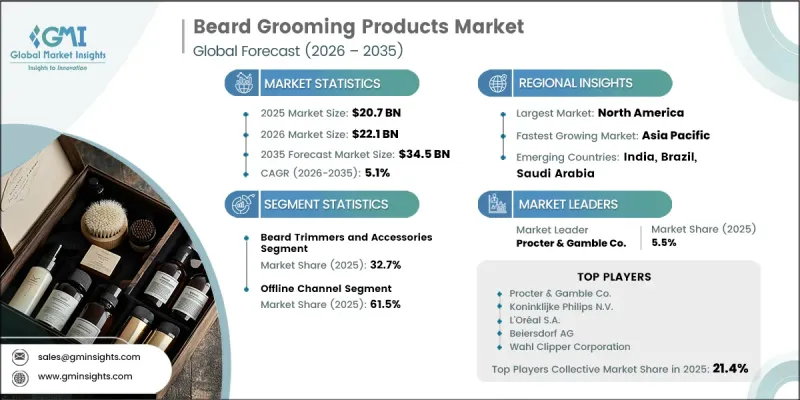
市場擴張的驅動力來自男士整裝儀容習慣的長期變化、鬍鬚護理流程日益普及以及數位化零售平台的快速發展,這些因素提升了產品在全球範圍內的可及性。鬍鬚護理作為日常個人護理的重要組成部分,其重要性日益凸顯,同時消費者對產品品質和功效的認知也在不斷提高,這些因素共同推動了需求的成長。在許多地區,鬍鬚仍然具有重要的文化、社會和個人意義,這也有助於維持產品的持續需求。此外,開發中國家可支配收入的成長促使消費者購買價格較高的男士護理產品,並轉向高階品牌。在消費者滲透率相對較高的成熟市場,製造商正致力於研發先進的配方、採用優質原料並強化品牌定位,以維持收入成長並在競爭激烈的市場環境中脫穎而出。
| 市場範圍 | |
|---|---|
| 開始年份 | 2025 |
| 預測期 | 2026-2035 |
| 上市時的市場規模 | 207億美元 |
| 預測金額 | 345億美元 |
| 複合年成長率 | 5.1% |
截至2025年,鬍鬚修剪器及配件市場佔有率將達到32.7%。預計到2035年,該細分市場將以5.7%的複合年成長率成長,成為業界成長最快的產品類型。其主導地位得益於理容工具在鬍鬚護理和造型中發揮的關鍵作用。消費者無論偏好其他鬍鬚護理產品,都依賴修剪和剃須工具,從而確保了持續強勁的需求。這項特點保證了該細分市場擁有穩定的需求基礎,並為面向廣泛消費群體的長期成長提供了支持。
預計到2025年,線下分銷通路將佔據61.5%的市場。實體店在消費者的購買決策中仍然扮演著至關重要的角色,因為許多消費者更傾向於在購買前親自查看男士護理產品。線下通路的優點在於能夠與消費者建立更緊密的聯繫,提升產品可見度,並能直接提供豐富的鬍鬚護理解決方案。儘管電子商務持續成長,傳統零售店仍然貢獻了可觀的銷售額,並且仍然是整體市場分銷策略中不可或缺的一部分。
預計到2035年,北美鬍鬚護理產品市場將以5.3%的複合年成長率成長,成為全球成長最快的地區之一。市場需求主要受以下因素驅動:男士護理產品的普及、消費者在個人護理方面的強勁支出以及對高階鬍鬚護理產品日益成長的興趣。該地區產品認知度高、零售體系完善,且消費者群體越來越重視高品質的男士護理產品,這些都為製造商提供了持續的機會。
目錄
第1章:調查方法和範圍
第2章執行摘要
第3章 行業洞察
- 產業生態系分析
- 供應商情況
- 利潤率
- 每個階段增加的價值
- 影響價值鏈的因素
- 影響產業的因素
- 促進因素
- 人們對整裝儀容和自我護理的興趣日益濃厚
- 文化規範的改變
- 數位媒體的影響
- 電子商務數位平台的普及
- 產業潛在風險與挑戰
- 市場飽和
- 監理合規
- 機會
- 環保產品研發方面的創新
- 新興市場和數位管道的成長
- 促進因素
- 成長潛力分析
- 監理框架
- 標準和合規要求
- 區域監理框架
- 認證標準
- 關鍵市場趨勢與顛覆性因素
- 技術與創新展望
- 當前趨勢
- 新進展
- 價格分析
- 對過去價格趨勢的分析
- 按業務類型分類的定價策略(溢價/價值/成本加成)
- 未來市場趨勢
- 貿易數據分析
- 進出口量及進口額趨勢
- 主要貿易路線及關稅的影響
- 人工智慧和生成式人工智慧對市場的影響
- 利用人工智慧改造現有經營模式
- 針對特定領域的生成式人工智慧應用案例和實施藍圖
- 風險、限制和監管考量
- 波特的分析
- PESTLE分析
- 目前分銷基礎設施和通路滲透情況
- 按地區與業態(現代零售與傳統零售)分類的通路覆蓋率
- 最後一公里基礎設施和不斷變化的管道方面的差異
- 消費行為分析
- 購買模式
- 偏好分析
- 不同地區的消費行為差異
- 電子商務對購買決策的影響
第4章 競爭情勢
- 介紹
- 企業市佔率分析
- 按地區
- 企業矩陣分析
- 主要市場公司的競爭分析
- 競爭定位矩陣
- 主要進展
- 併購
- 夥伴關係和聯盟
- 新產品發布
- 業務拓展計劃
第5章 市場估算與預測:依產品類型分類,2022-2035年
- 鬍鬚油
- 含有單一產地載體油的產品
- 含有多種油的產品
- 特殊/複合產品
- 鬍鬚膏/鬍鬚霜
- 鬍鬚膏
- 輕盈定型護髮膏
- 中型定型潤唇膏
- 強力定型膏
- 鬍鬚啫咖哩和鬍鬚蠟
- 鬍鬚啫咖哩
- 鬍鬚蠟
- 鬍鬚清潔劑和護髮素
- 標準鬍鬚洗髮精
- 二合一鬍鬚洗髮精和護髮素
- 藥用/去屑鬍鬚洗髮精
- 沖洗鬍鬚護理劑
- 免洗鬍鬚護理劑和柔順劑
- 鬍鬚修剪器及配件
- 電動修剪器和理髮器
- 手動剪刀和造型工具
- 梳子和刷子
- 應用工具、範本和其他工具
- 鬍鬚護理產品及其他
- 鬍鬚精華液
- 局部生髮產品
- 口服生髮補充劑
- 鬍鬚顏色和頭髮染色
- 套裝和禮品套裝
第6章 市場估計與預測:依價格分類,2022-2035年
- 低的
- 中等的
- 高的
第7章 市場估計與預測:依應用領域分類,2022-2035年
- 藥用
- 一般
第8章 市場估算與預測:依最終用途分類,2022-2035年
- 個人使用
- 商業用途
第9章 市場估價與預測:依通路分類,2022-2035年
- 線上
- 電子商務
- 公司網站
- 離線
- 超級市場/大賣場
- 專業零售店
- 其他(例如獨立經營零售商店)
第10章 市場估價與預測:依地區分類,2022-2035年
- 北美洲
- 美國
- 加拿大
- 歐洲
- 德國
- 英國
- 法國
- 義大利
- 西班牙
- 亞太地區
- 中國
- 印度
- 日本
- 韓國
- 澳洲
- 拉丁美洲
- 巴西
- 墨西哥
- 阿根廷
- 中東和非洲
- UAE
- 沙烏地阿拉伯
- 南非
第11章:公司簡介
- 世界公司
- Procter & Gamble Co.
- Business Overview
- Financial Data
- Product Landscape
- Strategic Outlook
- SWOT Analysis
- L'Oreal SA
- Beiersdorf AG
- Edgewell Personal Care Co.
- Unilever PLC
- Combe Inc.(Just For Men)
- Harry's Inc.
- Koninklijke Philips NV
- Spectrum Brands Holdings(Remington)
- Wahl Clipper Corporation
- Procter & Gamble Co.
- 該地區的領先企業
- Beardbrand
- Brickell Brands
- Every Man Jack
- Honest Amish
- Mountaineer Brand
- Viking Revolution
- 新興企業
- Bossman Brands
- Grave Before Shave
- Professor Fuzzworthy
- SCOTCH PORTER
- Wild Willies
The Global Beard Grooming Products Market was valued at USD 20.7 billion in 2025 and is estimated to grow at a CAGR of 5.1% to reach USD 34.5 billion by 2035.
Market expansion is driven by long-term shifts in male grooming habits, wider adoption of facial hair care routines, and the rapid development of digital retail platforms that have improved product accessibility worldwide. Demand growth is increasingly supported by the growing importance of beard maintenance as part of everyday personal care, along with rising consumer awareness regarding product quality and grooming effectiveness. In many regions, facial hair continues to hold cultural, social, and personal significance, contributing to sustained product demand. Additionally, increasing disposable incomes across developing economies are encouraging consumers to purchase higher-value grooming products and transition toward premium branded solutions. In mature markets, where consumer penetration levels are relatively high, manufacturers are focusing on advanced formulations, premium ingredients, and stronger brand positioning to maintain revenue growth and differentiate their offerings in an increasingly competitive environment.
| Market Scope | |
|---|---|
| Start Year | 2025 |
| Forecast Year | 2026-2035 |
| Start Value | $20.7 Billion |
| Forecast Value | $34.5 Billion |
| CAGR | 5.1% |
The beard trimmers and accessories segment accounted for 32.7% share in 2025. The segment is projected to grow at a CAGR of 5.7% through 2035, making it the fastest-growing product category within the industry. Its leadership position is supported by the essential role that grooming tools play in beard maintenance and styling routines. Demand remains consistently strong because consumers rely on trimming and shaping equipment regardless of their preferences for other beard care products. This characteristic provides the segment with a stable demand foundation and supports long-term growth opportunities across a wide range of consumer groups.
The offline distribution channels segment held a 61.5% share in 2025. Physical retail locations continue to play an important role in purchasing decisions, as many consumers prefer evaluating grooming products in person before making a purchase. The offline channel benefits from strong consumer engagement, product visibility, and direct access to a broad assortment of beard grooming solutions. Despite the ongoing growth of e-commerce, traditional retail outlets continue to generate substantial sales and remain a critical component of overall market distribution strategies.
North America Beard Grooming Products Market is expected to grow at a CAGR of 5.3% through 2035, matching the strongest regional growth rates globally. Market demand is supported by widespread adoption of grooming products, strong consumer spending on personal care, and increasing interest in premium beard maintenance solutions. The region continues to offer favorable opportunities for manufacturers due to high product awareness, established retail infrastructure, and a consumer base that increasingly values quality-focused grooming products.
Key participants operating in the global beard grooming products market include Beiersdorf AG, Viking Revolution, Brickell Brands, Every Man Jack, L'Oreal S.A., Wahl Clipper Corporation, Beardbrand, Bossman Brands, SCOTCH PORTER, Harry's Inc., Honest Amish, Procter & Gamble Co., Mountaineer Brand, Koninklijke Philips N.V., Grave Before Shave, Combe Inc., Wild Willies, Spectrum Brands Holdings, Edgewell Personal Care Co., Professor Fuzzworthy, and Unilever PLC. Companies competing in the beard grooming products market are implementing a range of strategies to strengthen their market presence and improve competitive positioning. Product innovation remains a primary focus, with manufacturers introducing premium formulations, specialized grooming solutions, and multifunctional products designed to meet evolving consumer preferences. Many companies are expanding their digital commerce capabilities and leveraging social media marketing to increase brand awareness and customer engagement. Strategic investments in product quality, ingredient transparency, and premium packaging are helping brands differentiate themselves in a crowded marketplace. Businesses are also broadening their product portfolios to address diverse grooming needs while targeting new customer segments.
Table of Contents
Chapter 1 Methodology & Scope
- 1.1 Research approach
- 1.2 Quality Commitments
- 1.2.1 GMI AI policy & data integrity commitment
- 1.2.1.1 Source consistency protocol
- 1.2.1 GMI AI policy & data integrity commitment
- 1.3 Research Trail & Confidence Scoring
- 1.3.1 Research Trail Components
- 1.3.2 Scoring Components
- 1.4 Data Collection
- 1.4.1 Partial list of primary sources
- 1.5 Data mining sources
- 1.5.1 Paid sources
- 1.5.1.1 Sources, by region
- 1.5.1 Paid sources
- 1.6 Base estimates and calculations
- 1.6.1 Base year calculation for any one approach
- 1.7 Forecast model
- 1.7.1 Quantified market impact analysis
- 1.7.1.1 Mathematical impact of growth parameters on forecast
- 1.7.1 Quantified market impact analysis
- 1.8 Research transparency addendum
- 1.8.1 Source attribution framework
- 1.8.2 Quality assurance metrics
- 1.8.2.1 Our commitment to trust
Chapter 2 Executive Summary
- 2.1 Industry 360° synopsis, 2022 - 2035
- 2.2 Key market trends
- 2.2.1 Region
- 2.2.2 By product type
- 2.2.3 By price
- 2.2.4 By purpose
- 2.2.5 By end use
- 2.2.6 By distribution channel
Chapter 3 Industry Insights
- 3.1 Industry ecosystem analysis
- 3.1.1 Supplier landscape
- 3.1.2 Profit margin
- 3.1.3 Value addition at each stage
- 3.1.4 Factor affecting the value chain
- 3.2 Industry impact forces
- 3.2.1 Growth drivers
- 3.2.1.1 Increasing emphasis on personal grooming and self- care
- 3.2.1.2 Evolving cultural norms
- 3.2.1.3 Digital media influence
- 3.2.1.4 E- commerce & digital platform penetration
- 3.2.2 Industry pitfalls & challenges
- 3.2.2.1 Market saturation
- 3.2.2.2 Regulatory compliance
- 3.2.3 Opportunities
- 3.2.3.1 Innovations in development of eco- friendly products
- 3.2.3.2 Growth in emerging markets and digital channels
- 3.2.1 Growth drivers
- 3.3 Growth potential analysis
- 3.4 Regulatory framework
- 3.4.1 Standards & compliance requirements
- 3.4.2 Regional regulatory frameworks
- 3.4.3 Certification standards
- 3.5 Major market trends and disruptions
- 3.6 Technology/innovation landscape
- 3.6.1 Current trends
- 3.6.2 Emerging trends
- 3.7 Pricing Analysis (driven by primary research)
- 3.7.1 Historical price trend analysis (driven by primary research)
- 3.7.2 Pricing strategy by player type (premium / value / cost- plus) (driven by primary research)
- 3.8 Future market trends
- 3.9 Trade data analysis (driven by paid database) (HS Code- 3307/ 3305)
- 3.9.1 Import/export volume & value trends (driven by primary research)
- 3.9.2 Key trade corridors & tariff impact (driven by primary research)
- 3.10 Impact of AI & Generative AI on the Market
- 3.10.1 AI- driven disruption of existing business models
- 3.10.2 Gen- AI use cases & adoption roadmap by segment
- 3.10.3 Risks, limitations & regulatory considerations
- 3.11 Porter's analysis
- 3.12 PESTEL analysis
- 3.13 Distribution infrastructure & channel penetration landscape (driven by primary research)
- 3.13.1 Channel coverage by region & format (modern vs. Traditional trade) (driven by primary research)
- 3.13.2 Last- mile infrastructure gaps & emerging channel shifts (driven by primary research)
- 3.14 Consumer behavior analysis
- 3.14.1 Purchasing patterns
- 3.14.2 Preference analysis
- 3.14.3 Regional variations in consumer behavior
- 3.14.4 Impact of e- commerce on buying decisions
Chapter 4 Competitive Landscape, 2025
- 4.1 Introduction
- 4.2 Company market share analysis
- 4.2.1 By Region
- 4.2.1.1 North America
- 4.2.1.2 Europe
- 4.2.1.3 Asia Pacific
- 4.2.1.4 Latin America
- 4.2.1.5 Middle East and Africa
- 4.2.1 By Region
- 4.3 Company matrix analysis
- 4.4 Competitive analysis of major market players
- 4.5 Competitive positioning matrix
- 4.6 Key developments
- 4.6.1 Mergers & acquisitions
- 4.6.2 Partnerships & collaborations
- 4.6.3 New product launches
- 4.6.4 Expansion plans
Chapter 5 Market Estimates & Forecast, By Product Type, 2022 - 2035 (USD Billion, Thousand Units)
- 5.1 Key trends
- 5.2 Beard oil
- 5.2.1 Single- origin carrier oil formulations
- 5.2.2 Multi- oil blended formulations
- 5.2.3 Specialty & infused formulations
- 5.3 Beard cream & balm
- 5.3.1 Beard butter & cream
- 5.3.2 Light- hold conditioning balm
- 5.3.3 Medium- hold balm
- 5.3.4 Strong- hold styling balm
- 5.4 Beard gel & wax
- 5.4.1 Beard gel
- 5.4.2 Beard wax
- 5.5 Beard cleanser & conditioner
- 5.5.1 Standard beard wash
- 5.5.2 2-in-1 beard wash & conditioner
- 5.5.3 Medicated / anti- dandruff beard wash
- 5.5.4 Rinse-out beard conditioner
- 5.5.5 Leave-in beard conditioner & detangler
- 5.6 Beard trimmers & accessories
- 5.6.1 Electric trimmers & clippers
- 5.6.2 Manual scissors & shaping tools
- 5.6.3 Combs & brushes
- 5.6.4 Applicators, stencils & other tools
- 5.7 Beard treatment products & others
- 5.7.1 Beard serum
- 5.7.2 Topical growth products
- 5.7.3 Ingestible growth supplements
- 5.7.4 Beard colour & dye
- 5.7.5 Kits & gift sets
Chapter 6 Market Estimates & Forecast, By Price, 2022 - 2035 (USD Billion, Thousand Units)
- 6.1 Key trends
- 6.2 Low
- 6.3 Medium
- 6.4 High
Chapter 7 Market Estimates & Forecast, By Purpose, 2022 - 2035 (USD Billion, Thousand Units)
- 7.1 Key trends
- 7.2 Medicated
- 7.3 General purpose
Chapter 8 Market Estimates & Forecast, By End use, 2022 - 2035 (USD Billion, Thousand Units)
- 8.1 Key trends
- 8.2 Individual use
- 8.3 Commercial use
Chapter 9 Market Estimates & Forecast, By Distribution Channel, 2022 - 2035 (USD Billion, Thousand Units)
- 9.1 Key trends
- 9.2 Online
- 9.2.1 E- commerce
- 9.2.2 Company websites
- 9.3 Offline
- 9.3.1 Supermarkets/hypermarket
- 9.3.2 Specialty retail stores
- 9.3.3 Others (independent retailer etc.)
Chapter 10 Market Estimates & Forecast, By Region, 2022 - 2035, (USD Billion) (Thousand Units)
- 10.1 Key trends
- 10.2 North America
- 10.2.1 U.S.
- 10.2.2 Canada
- 10.3 Europe
- 10.3.1 Germany
- 10.3.2 U.K.
- 10.3.3 France
- 10.3.4 Italy
- 10.3.5 Spain
- 10.4 Asia Pacific
- 10.4.1 China
- 10.4.2 India
- 10.4.3 Japan
- 10.4.4 South Korea
- 10.4.5 Australia
- 10.5 Latin America
- 10.5.1 Brazil
- 10.5.2 Mexico
- 10.5.3 Argentina
- 10.6 MEA
- 10.6.1 UAE
- 10.6.2 Saudi Arabia
- 10.6.3 South Africa
Chapter 11 Company Profiles
- 11.1 Global Companies
- 11.1.1 Procter & Gamble Co.
- 11.1.1.1 Business Overview
- 11.1.1.2 Financial Data
- 11.1.1.3 Product Landscape
- 11.1.1.4 Strategic Outlook
- 11.1.1.5 SWOT Analysis
- 11.1.2 L'Oreal S.A.
- 11.1.3 Beiersdorf AG
- 11.1.4 Edgewell Personal Care Co.
- 11.1.5 Unilever PLC
- 11.1.6 Combe Inc. (Just For Men)
- 11.1.7 Harry's Inc.
- 11.1.8 Koninklijke Philips N.V.
- 11.1.9 Spectrum Brands Holdings (Remington)
- 11.1.10 Wahl Clipper Corporation
- 11.1.1 Procter & Gamble Co.
- 11.2 Regional Champions
- 11.2.1 Beardbrand
- 11.2.2 Brickell Brands
- 11.2.3 Every Man Jack
- 11.2.4 Honest Amish
- 11.2.5 Mountaineer Brand
- 11.2.6 Viking Revolution
- 11.3 Emerging Players
- 11.3.1 Bossman Brands
- 11.3.2 Grave Before Shave
- 11.3.3 Professor Fuzzworthy
- 11.3.4 SCOTCH PORTER
- 11.3.5 Wild Willies

 鬍鬚護理產品市場:2026-2032年全球市場預測(依產品類型、成分類型、產品形態、年齡層、通路和最終用戶分類)
 鬍鬚護理產品市場報告:趨勢、預測和競爭分析(至2035年)
 鬍鬚護理產品市場報告:按產品、產品類型、年齡層、銷售管道、最終用戶和地區分類(2026-2034 年)
 全球鬍鬚修剪器市場規模、佔有率、趨勢和成長分析報告(2026-2034年)
 智慧理髮器市場 - 全球產業規模、佔有率、趨勢、機會及預測(按類型、最終用途、分銷管道、地區和競爭格局分類,2021-2031年)
 鬍鬚護理市場規模、佔有率、成長分析(按產品類型、產品應用、價格分佈、銷售管道、類別、最終用戶和地區分類)-2026-2033年產業預測全球鬍鬚膏市場-產業規模、佔有率、趨勢、機會和預測,按類型、包裝、銷售通路、地區和競爭格局分類,2020-2030年預測
 2032 年極簡美容訂閱市場預測:按產品類型、訂閱模式、性別、價格分佈、分銷管道和地區進行的全球分析剃鬚套件市場(按產品類型、分銷管道和最終用戶)-2025-2030 年全球預測
 全球鬍鬚美容產品市場