


 |
市場調查報告書
商品編碼
2071208
作物營養用合成生物微生物市場:市場機會、成長要素、產業趨勢分析及2026-2035年預測Synthetic Biology Microbes for Crop Nutrition Market Opportunity, Growth Drivers, Industry Trend Analysis, and Forecast 2026 - 2035 |
||||||

預計到 2025 年,全球用於作物營養的合成生物學微生物市場價值將達到 2.34 億美元,年複合成長率為 15.5%,到 2035 年將達到 10 億美元。
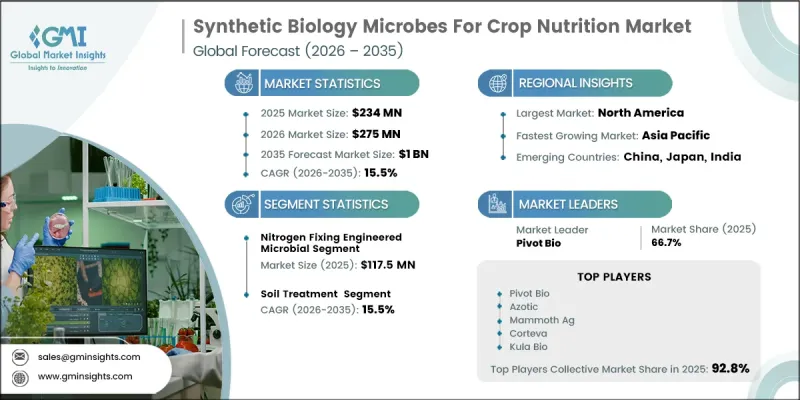
作物營養用合成生物學微生物產業的成長主要得益於關鍵農業地區有利的監管趨勢、基因改造微生物技術的商業化進程以及受傳統化肥價格持續波動影響的農業投入經濟格局的變化。除了經濟效益之外,貫穿整個農業價值鏈的永續性目標也推動了相關技術的應用,這些技術既能減少對化學肥料的依賴,又能支持環境績效目標的實現。這些趨勢正在更廣泛的農業相關人員者中創造需求,並將市場機會擴展到最初注重成本的採用者之外。儘管發展勢頭強勁,但微生物在不同環境和土壤條件下的性能穩定性仍面臨技術挑戰。此外,利用先進基因改造技術開發的產品必須滿足法規核准要求才能應用於商業性農業生產。隨著創新不斷加速,作物營養用合成生物學微生物市場預計將在全球永續作物生產系統中佔據日益重要的地位。
| 市場範圍 | |
|---|---|
| 開始年份 | 2025 |
| 預測期 | 2026-2035 |
| 初始市場規模 | 2.34億美元 |
| 預測金額 | 10億美元 |
| 複合年成長率 | 15.5% |
2025年,用於固氮的基因改造微生物市場銷售額達到1.175億美元,市佔率50.2%。預計未來該市場將以16.5%的複合年成長率成長,到2035年達到5.411億美元。該市場的商業性吸引力在於其能夠透過先進的微生物工程技術提高生物氮的有效性。這些技術旨在使固氮活性在更廣泛的農業條件下維持,為種植者提供替代性的養分管理方案,同時協助提高肥料利用效率和作物整體產量。
依應用領域分類,土壤處理市場預計2025年將達到1.17億美元。這一成長主要得益於將微生物溶液直接施用於根系生長區的施用方法的廣泛應用。這種方法能夠使微生物溶液快速建立並與植物生長系統相互作用。此外,此施用方法與現代農業機械和精密農業技術高度相容,使種植者無需進行重大操作調整即可將生物作物營養技術融入現有的田間管理方案中。
預計2025年,北美作物營養用合成生物微生物市場規模將達1.43億美元,市佔率高達61.1%。市場擴張的促進因素包括:清晰的法規環境、農業生物技術投資的不斷成長以及生物營養管理解決方案帶來的可觀經濟效益。商業性化應用的進步、先進農業實踐的普及以及人們對永續作物生產方式日益成長的興趣,進一步鞏固了該地區的主導地位,並持續為市場的長期發展創造有利條件。
目錄
第1章:調查方法和範圍
第2章執行摘要
第3章 行業洞察
- 產業生態系分析
- 供應商情況
- 利潤率
- 每個階段增加的價值
- 影響價值鏈的因素
- 中斷
- 影響產業的因素
- 促進因素
- 產業潛在風險與挑戰
- 市場機遇
- 成長潛力分析
- 監理情勢
- 波特的分析
- PESTLE分析
- 價格趨勢
- 按地區
- 依產品類型
- 未來市場趨勢
- 技術與創新展望
- 最新科技趨勢
- 新興技術
- 專利趨勢
- 貿易統計
- 主要進口國
- 主要出口國
- 永續性和環境方面
- 永續計劃
- 減少廢棄物策略
- 生產中的能源效率
- 具有環保意識的舉措
第4章 競爭情勢
- 介紹
- 企業市佔率分析
- 按地區
- 北美洲
- 歐洲
- 亞太地區
- LATAM
- 中東和非洲
- 按地區
- 企業矩陣分析
- 主要市場公司的競爭分析
- 競爭定位矩陣
- 主要進展
- 併購
- 夥伴關係和聯盟
- 新產品發布
- 業務拓展計劃
第5章 市場估算與預測:依產品類型分類,2022年至2035年
- 固氮微生物
- 根瘤菌(共生)
- 固氮菌(非共生型)
- 固氮螺菌
- 基因改造的固氮細菌
- 其他固氮菌
- 磷酸鹽可溶性微生物
- 磷酸鹽溶解性細菌(PSB)
- 菌根真菌(叢枝菌根真菌和外生菌根真菌)
- 能夠調動鉀和微量營養素的微生物
- 鐵動員細菌
- 溶解鋅的微生物
- 鉀溶性細菌
- 合成微生物群落(SynComs)
- 兩種微生物的混合物
- 多菌株聯合體
- 自適應智慧聯盟
- 其他
- 產生植物荷爾蒙的微生物
- 壓力耐受性增強劑
- 新型基因改造細菌菌株
第6章 市場估計與預測:依應用領域分類,2022年至2035年
- 種子處理
- 土壤處理
- 葉面噴布
第7章 市場估計與預測:依最終用戶產業分類,2022年至2035年
- 穀類和穀類食品
- 玉米
- 小麥
- 米
- 大麥、高粱、燕麥、小米
- 油籽/豆類
- 大豆
- 花生
- 菜籽/芥菜籽、向日葵
- 鷹嘴豆、扁豆
- 水果和蔬菜
- 水果(草莓、果樹等)
- 蔬菜(番茄、綠葉蔬菜、瓜類等)
- 經濟作物和其他
- 棉布
- 甘蔗
- 種植作物(咖啡、茶、棕櫚、橡膠)
- 草坪和觀賞植物
第8章 市場估計與預測:依地區分類,2022年至2035年
- 北美洲
- 美國
- 加拿大
- 歐洲
- 德國
- 英國
- 法國
- 西班牙
- 義大利
- 其他歐洲國家
- 亞太地區
- 中國
- 印度
- 日本
- 澳洲
- 韓國
- 其他亞太國家
- 拉丁美洲
- 巴西
- 墨西哥
- 阿根廷
- 其他拉丁美洲國家
- 中東和非洲
- 沙烏地阿拉伯
- 南非
- UAE
- 其他中東和非洲國家
第9章:公司簡介
- Pivot Bio
- Azotic
- Mammoth Ag
- Corteva
- Kula Bio
- Novonesis
- BASF SE
- Synthia Bio
- Jord BioScience
- Switch Bioworks
The Global Synthetic Biology Microbes for Crop Nutrition Market was valued at USD 234 million in 2025 and is estimated to grow at a CAGR of 15.5% to reach USD 1 billion by 2035.
Growth across the synthetic biology microbes for crop nutrition industry is being supported by favorable regulatory developments in key agricultural regions, increasing commercialization of engineered microbial technologies, and changing farm input economics influenced by ongoing volatility in conventional fertilizer costs. In addition to economic benefits, sustainability targets established throughout agricultural value chains are encouraging the adoption of technologies that help reduce fertilizer dependency while supporting environmental performance goals. These trends are creating demand from a broader range of agricultural stakeholders and expanding market opportunities beyond the initial group of cost-focused adopters. Despite strong momentum, technical challenges remain associated with microbial performance consistency across varying environmental and soil conditions. Furthermore, products developed using advanced genetic modification techniques must satisfy regulatory approval requirements before being introduced for commercial agricultural use. As innovation continues to accelerate, the synthetic biology microbes for crop nutrition market is expected to gain increasing importance within sustainable crop production systems worldwide.
| Market Scope | |
|---|---|
| Start Year | 2025 |
| Forecast Year | 2026-2035 |
| Start Value | $234 Million |
| Forecast Value | $1 Billion |
| CAGR | 15.5% |
The nitrogen-fixing engineered microbes segment generated USD 117.5 million in 2025, accounting for a 50.2% share, and is projected to reach USD 541.1 million by 2035 while advancing at a CAGR of 16.5%. The commercial attractiveness of this segment is linked to its ability to enhance biological nitrogen availability through advanced microbial engineering approaches. These technologies are designed to maintain nitrogen fixation activity under a wider range of agricultural conditions, providing growers with an alternative nutrient management solution while supporting efforts to improve fertilizer-use efficiency and overall crop productivity.
Based on the application, the soil treatment segment accounted for USD 117 million in 2025. Growth is supported by the widespread adoption of application methods that position microbial solutions directly within the root development zone, enabling rapid establishment and interaction with emerging plant systems. This delivery approach aligns effectively with modern agricultural equipment and precision farming practices, allowing growers to incorporate biological crop nutrition technologies into existing field management programs without major operational adjustments.
North America Synthetic Biology Microbes for Crop Nutrition Market generated USD 143 million in 2025, accounting for 61.1% share. Market expansion is supported by a well-defined regulatory environment, increasing investment in agricultural biotechnology, and favorable economic returns associated with biological nutrient management solutions. Strong commercial adoption, advanced farming practices, and growing interest in sustainable crop production methods continue to reinforce the region's leadership position and create favorable conditions for long-term market development.
Key companies operating in the Global Synthetic Biology Microbes for Crop Nutrition Market include Corteva Agriscience, Kula Bio, Pivot Bio, Mammoth Ag, and Azotic Technologies. Companies participating in the synthetic biology microbes for crop nutrition industry focus on research and development, product commercialization, strategic collaborations, and geographic expansion to strengthen their market position. Significant investments are being directed toward enhancing microbial performance, improving nutrient delivery efficiency, and increasing product consistency under diverse agricultural conditions. Industry participants are also establishing partnerships with agricultural distributors, crop input suppliers, and farming organizations to accelerate market penetration and broaden customer reach. Regulatory engagement and compliance initiatives remain a priority as companies work to secure approvals for advanced biological products. In addition, firms are expanding demonstration programs, field validation activities, and grower education efforts to increase technology adoption. These strategies collectively support brand differentiation, strengthen competitive positioning, and create long-term growth opportunities within the evolving agricultural biotechnology landscape.
Table of Contents
Chapter 1 Methodology & Scope
- 1.1 Research approach
- 1.2 Quality Commitments
- 1.2.1 GMI AI policy & data integrity commitment
- 1.2.1.1 Source consistency protocol
- 1.2.1 GMI AI policy & data integrity commitment
- 1.3 Research Trail & Confidence Scoring
- 1.3.1 Research Trail Components
- 1.3.2 Scoring Components
- 1.4 Data Collection
- 1.4.1 Partial list of primary sources
- 1.5 Data mining sources
- 1.5.1 Paid sources
- 1.5.1.1 Sources, by region
- 1.5.1 Paid sources
- 1.6 Base estimates and calculations
- 1.6.1 Base year calculation for any one approach
- 1.7 Forecast model
- 1.7.1 Quantified market impact analysis
- 1.7.1.1 Mathematical impact of growth parameters on forecast
- 1.7.1 Quantified market impact analysis
- 1.8 Research transparency addendum
- 1.8.1 Source attribution framework
- 1.8.2 Quality assurance metrics
- 1.8.3 Our commitment to trust
Chapter 2 Executive Summary
- 2.1 Industry 360° synopsis
- 2.2 Key market trends
- 2.2.1 Regional
- 2.2.2 By Microbial Type
- 2.2.3 By Application
- 2.2.4 By Crop Type
- 2.3 TAM Analysis, 2026 2035
- 2.4 CXO perspectives: Strategic imperatives
Chapter 3 Industry Insights
- 3.1 Industry ecosystem analysis
- 3.1.1 Supplier landscape
- 3.1.2 Profit margin
- 3.1.3 Value addition at each stage
- 3.1.4 Factor affecting the value chain
- 3.1.5 Disruptions
- 3.2 Industry impact forces
- 3.2.1 Growth drivers
- 3.2.2 Industry pitfalls and challenges
- 3.2.3 Market opportunities
- 3.3 Growth potential analysis
- 3.4 Regulatory landscape
- 3.4.1 North America
- 3.4.2 Europe
- 3.4.3 Asia Pacific
- 3.4.4 Latin America
- 3.4.5 Middle East & Africa
- 3.5 Porter's analysis
- 3.6 PESTEL analysis
- 3.7 Price trends
- 3.7.1 By region
- 3.7.2 By product type
- 3.8 Future market trends
- 3.9 Technology and Innovation landscape
- 3.9.1 Current technological trends
- 3.9.2 Emerging technologies
- 3.10 Patent Landscape
- 3.11 Trade statistics (HS code)
- 3.11.1 Major importing countries
- 3.11.2 Major exporting countries
- 3.12 Sustainability and environmental aspects
- 3.12.1 Sustainable practices
- 3.12.2 Waste reduction strategies
- 3.12.3 Energy efficiency in production
- 3.12.4 Eco friendly initiatives
Chapter 4 Competitive Landscape, 2025
- 4.1 Introduction
- 4.2 Company market share analysis
- 4.2.1 By region
- 4.2.1.1 North America
- 4.2.1.2 Europe
- 4.2.1.3 Asia Pacific
- 4.2.1.4 LATAM
- 4.2.1.5 MEA
- 4.2.1 By region
- 4.3 Company matrix analysis
- 4.4 Competitive analysis of major market players
- 4.5 Competitive positioning matrix
- 4.6 Key developments
- 4.6.1 Mergers & acquisitions
- 4.6.2 Partnerships & collaborations
- 4.6.3 New Product Launches
- 4.6.4 Expansion Plans
Chapter 5 Market Estimates and Forecast, By Product Type, 2022 to 2035 (USD Million) (Tons)
- 5.1 Key trends
- 5.2 Nitrogen Fixing Microbes
- 5.2.1 Rhizobium (Symbiotic)
- 5.2.2 Azotobacter (Non Symbiotic)
- 5.2.3 Azospirillum
- 5.2.4 Engineered Nitrogen Fixers
- 5.2.5 Other Nitrogen Fixing Bacteria
- 5.3 Phosphate Solubilizing Microbes
- 5.3.1 Phosphate Solubilizing Bacteria (PSB)
- 5.3.2 Mycorrhizal Fungi (AMF & ECM)
- 5.4 Potassium & Micronutrient Mobilizing Microbes
- 5.4.1 Iron Mobilizing Bacteria
- 5.4.2 Zinc Solubilizing Microbes
- 5.4.3 Potassium Solubilizing Bacteria
- 5.5 Synthetic Microbial Communities (SynComs)
- 5.5.1 Dual Organism Blends
- 5.5.2 Multi Strain Consortia
- 5.5.3 Adaptive Intelligent Consortia
- 5.6 Others
- 5.6.1 Phytohormone Producing Microbes
- 5.6.2 Stress Tolerance Enhancers
- 5.6.3 Novel Engineered Strains
Chapter 6 Market Estimates and Forecast, By Application, 2022 to 2035 (USD Million) (Tons)
- 6.1 Key trends
- 6.2 Seed Treatment
- 6.3 Soil Treatment
- 6.4 Foliar Application
Chapter 7 Market Estimates and Forecast, By End User Industry, 2022 to 2035 (USD Million) (Tons)
- 7.1 Key trends
- 7.2 Cereals & Grains
- 7.2.1 Corn/Maize
- 7.2.2 Wheat
- 7.2.3 Rice
- 7.2.4 Barley, Sorghum, Oats, Millet
- 7.3 Oilseeds & Pulses
- 7.3.1 Soybeans
- 7.3.2 Peanuts
- 7.3.3 Canola/Rapeseed, Sunflower
- 7.3.4 Chickpeas, Lentils
- 7.4 Fruits & Vegetables
- 7.4.1 Fruits (Strawberries, Tree Fruits, Others)
- 7.4.2 Vegetables (Tomatoes, Leafy Greens, Cucurbits, Others)
- 7.5 Cash Crops & Others
- 7.5.1 Cotton
- 7.5.2 Sugarcane
- 7.5.3 Plantation Crops (Coffee, Tea, Palm, Rubber)
- 7.5.4 Turf & Ornamentals
Chapter 8 Market Estimates and Forecast, By Region, 2022 to 2035 (USD Million) (Tons)
- 8.1 Key trends
- 8.2 North America
- 8.2.1 U.S.
- 8.2.2 Canada
- 8.3 Europe
- 8.3.1 Germany
- 8.3.2 UK
- 8.3.3 France
- 8.3.4 Spain
- 8.3.5 Italy
- 8.3.6 Rest of Europe
- 8.4 Asia Pacific
- 8.4.1 China
- 8.4.2 India
- 8.4.3 Japan
- 8.4.4 Australia
- 8.4.5 South Korea
- 8.4.6 Rest of Asia Pacific
- 8.5 Latin America
- 8.5.1 Brazil
- 8.5.2 Mexico
- 8.5.3 Argentina
- 8.5.4 Rest of Latin America
- 8.6 Middle East and Africa
- 8.6.1 Saudi Arabia
- 8.6.2 South Africa
- 8.6.3 UAE
- 8.6.4 Rest of Middle East and Africa
Chapter 9 Company Profiles
- 9.1 Pivot Bio
- 9.2 Azotic
- 9.3 Mammoth Ag
- 9.4 Corteva
- 9.5 Kula Bio
- 9.6 Novonesis
- 9.7 BASF SE
- 9.8 Synthia Bio
- 9.9 Jord BioScience
- 9.10 Switch Bioworks

 美國農業微量元素市場:產品、應用與國家分析及預測(2026-2035 年)
 2026-2034年全球作物營養用合成生物學微生物市場規模、佔有率、趨勢與成長分析報告
 含硫微量元素肥料市場:商業機會、成長要素、產業趨勢分析及2026-2035年預測。農業微量營養素市場機會、成長要素、產業趨勢分析及2026-2035年預測
 作物微量元素:全球市場
 農業次要營養元素市場分析及預測(至2035年):類型、產品、應用、形式、技術、最終用戶、成分、製程、服務和設備全球微量營養素市場規模、佔有率、趨勢和成長分析報告(2026-2034年)全球農業微量元素市場規模、佔有率、趨勢和成長分析報告(2026-2034年)
 農業螯合鐵微量元素市場報告:按應用和地區分類
 全球作物營養解決方案市場預測(至2032年):按產品類型、配方、作物類型、分銷管道、應用方法、最終用戶和地區分類