


 |
市場調查報告書
商品編碼
2045862
含硫微量元素肥料市場:商業機會、成長要素、產業趨勢分析及2026-2035年預測。Sulfur-Based Micronutrients Market Opportunity, Growth Drivers, Industry Trend Analysis, and Forecast 2026 - 2035 |
||||||

預計到 2025 年,全球含硫微量元素肥料市場價值將達到 4.815 億美元,年複合成長率為 9%,到 2035 年將達到 11 億美元。
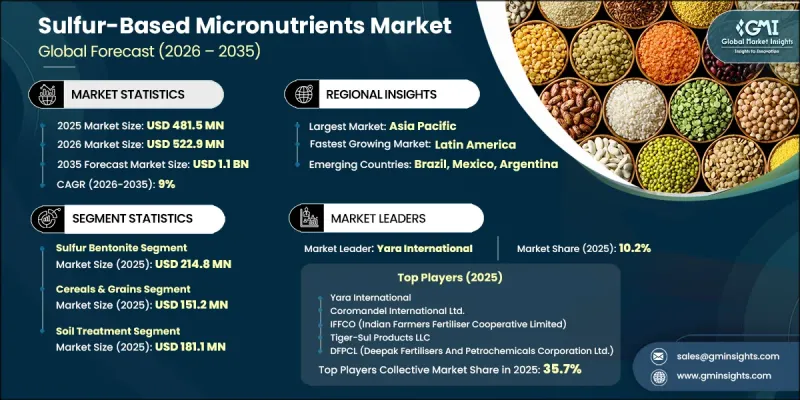
該市場的成長主要受對高效作物營養解決方案日益成長的需求所驅動,這些解決方案旨在解決硫元素缺乏問題並提高土壤整體生產力。含硫微量元素肥料透過促進蛋白質形成和葉綠素合成,在植物生長中發揮至關重要的作用,因此對於提高作物產量和品質至關重要。這些營養元素可透過土壤處理和葉面噴布施用,從而能夠精準地糾正各種作物類型的營養缺乏問題。人們對永續農業、土壤健康管理和平衡施肥實踐的日益關注進一步推動了市場需求。此外,現代農業系統擴大採用精準營養管理技術,以最佳化肥料利用並減少養分流失。農業集約化的持續推進、部分地區土壤肥力的下降以及有機質循環利用的不足,也促成了對含硫微量元素肥料解決方案的持續需求。隨著全球糧食生產需求的成長,無論是開發中國家還是已開發國家,農業市場都越來越依賴這些投入品來維持穩定的生產力,並在不同的氣候和土壤條件下改善作物生長。
| 市場範圍 | |
|---|---|
| 開始年份 | 2025 |
| 預測期 | 2026-2035 |
| 初始市場規模 | 4.815億美元 |
| 預測市場規模 | 11億美元 |
| 複合年成長率 | 9% |
隨著農民日益重視土壤檢測、精密農業和高效施肥方法,含硫微量元素肥料產業正蓬勃發展。人們對土壤微量元素缺乏的認知不斷提高,促使多種作物開始採用強化硫肥。此外,採用多種必需元素相結合的綜合養分管理系統來改善土壤肥力和作物產量,也推動了市場成長。肥料配方技術的進步提高了養分的使用率和吸收率,進一步提升了農業生產力。擴大農業調查範圍和加強政府對土壤健康改善計畫的支持,也促進了產業發展。此外,對高品質食品生產和永續農業實踐的需求不斷成長,也推動了現代農業系統中基於微量元素的解決方案的長期應用。
預計到2025年,硫磺膨潤土市場規模將達到2.148億美元。隨著農業生產者轉向使用旨在改善土壤肥力並糾正特定微量元素缺乏的多營養素肥料系統,該細分市場的需求正在不斷成長。將硫磺膨潤土與其他微量元素結合的產品因其能夠控制硫的釋放並提高整體養分利用率而備受關注。農民越來越傾向於採用綜合營養解決方案而非單一營養素施用,這進一步推動了該細分市場的成長。農民正擴大利用這些先進配方來改善土壤結構、提高養分吸收率,並在不同的農業條件下實現更穩定的作物產量。
預計到2025年,穀物市場規模將達到1.512億美元。由於穀物作物對養分需求高且易受缺硫影響,該領域對含硫微量元素肥料的需求正在不斷成長。這些作物高度依賴均衡的養分供應來維持產量並支持高效的生長週期。現代農業技術和集約化耕作方式的日益普及,進一步推動了穀物生產中對先進營養管理的需求。農民越來越關注產量穩定性和提高穀物品質,促使含硫微量元素肥料在該作物領域的應用不斷擴大。
預計北美含硫微量元素肥料市場規模將從2025年的1.176億美元成長到2035年的2.719億美元。此區域成長主要得益於土壤檢測的普及和注重養分最佳化的先進作物管理系統的廣泛應用。高密度耕作方式以及人們對土壤缺硫問題的日益關注也進一步推動了微量元素肥料的使用。尤其值得一提的是,美國農業部門正致力於透過數據驅動的養分管理方法來維持土壤肥力平衡,這顯著提升了穀物、油籽和經濟作物生產系統的市場需求。
目錄
第1章:調查方法和範圍
第2章執行摘要
第3章 行業洞察
- 產業生態系分析
- 供應商情況
- 利潤率
- 每個階段增加的價值
- 影響價值鏈的因素
- 中斷
- 影響產業的因素
- 促進因素
- 耕地硫缺乏症加重
- 人們對均衡作物營養的興趣日益濃厚
- 全球高營養需求作物種植面積擴大
- 潛在風險和挑戰
- 不同土壤類型中硫有效性的差異
- 不當施用方法對養分利用效率的影響
- 機會
- 精密農業中施肥技術的引進
- 先進硫磺複合系統的開發
- 促進因素
- 成長潛力分析
- 監理情勢
- 波特的分析
- PESTLE分析
- 價格趨勢
- 按地區
- 按類型
- 未來市場趨勢
- 技術與創新展望
- 最新科技趨勢
- 新興技術
- 專利趨勢
- 貿易統計
- 主要進口國
- 主要出口國
- 永續性和環境方面
- 永續計劃
- 減少廢棄物策略
- 生產中的能源效率
- 具有環保意識的舉措
- 考慮碳足跡
第4章 競爭情勢
- 介紹
- 企業市佔率分析
- 按地區
- 北美洲
- 歐洲
- 亞太地區
- LATAM
- 中東和非洲
- 按地區
- 企業矩陣分析
- 主要市場公司的競爭分析
- 競爭定位矩陣
- 主要進展
- 併購
- 夥伴關係和聯盟
- 新產品發布
- 業務拓展計劃
第5章 市場估計與預測:依類型分類,2022-2035年
- 硫磺膨潤土
- 硫磺、膨潤土、鋅
- 硫磺、膨潤土、鉬
- 硫磺、膨潤土、錳
- 硫磺、膨潤土、鐵
- 其他
第6章 市場估算與預測:依作物類型分類,2022-2035年
- 穀類和穀類食品
- 水果和蔬菜
- 油籽/豆類
- 經濟作物
- 其他
第7章 市場估計與預測:依應用領域分類,2022-2035年
- 土壤處理
- 葉面噴布
- 施肥和灌溉
- 水耕法
- 其他
第8章 市場估計與預測:依地區分類,2022-2035年
- 北美洲
- 美國
- 加拿大
- 歐洲
- 德國
- 英國
- 法國
- 西班牙
- 義大利
- 其他歐洲國家
- 亞太地區
- 中國
- 印度
- 日本
- 澳洲
- 韓國
- 其他亞太國家
- 拉丁美洲
- 巴西
- 墨西哥
- 阿根廷
- 其他拉丁美洲國家
- 中東和非洲
- 沙烏地阿拉伯
- 南非
- UAE
- 其他中東和非洲國家
第9章:公司簡介
- Yara International
- Coromandel International Ltd.
- Aries Agro Limited
- DFPCL(Deepak Fertilisers And Petrochemicals Corporation Ltd.)
- IFFCO(Indian Farmers Fertiliser Cooperative Limited)
- HBT India(Hindustan Bec Tec India Pvt. Ltd.)
- Tessenderlo Kerley Inc.
- Agroasia
- Sohar Sulphur Fertilizers LLC
- Mirabelle Agro Manufacturing Pvt Ltd
The Global Sulfur-Based Micronutrients Market was valued at USD 481.5 million in 2025 and is estimated to grow at a CAGR of 9% to reach USD 1.1 billion by 2035.
The market growth is driven by the increasing need for efficient crop nutrition solutions that address sulfur deficiencies and improve overall soil productivity. Sulfur-based micronutrients play a vital role in plant development by supporting protein formation and chlorophyll synthesis, making them essential for improving crop yield and quality. These nutrients are applied through soil treatment and foliar spray methods, enabling targeted correction of nutrient deficiencies across diverse crop types. Rising focus on sustainable agriculture, soil health management, and balanced fertilization practices is further strengthening market demand. In addition, modern farming systems are increasingly adopting precision nutrient management techniques to optimize fertilizer usage and reduce nutrient loss. Continuous agricultural intensification, declining soil fertility in several regions, and limited organic matter recycling are also contributing to sustained demand for sulfur-based micronutrient solutions. As global food production requirements increase, both developing and developed agricultural markets are increasingly relying on these inputs to maintain consistent productivity and improve crop performance under varying climatic and soil conditions.
| Market Scope | |
|---|---|
| Start Year | 2025 |
| Forecast Year | 2026-2035 |
| Start Value | $481.5 Million |
| Forecast Value | $1.1 Billion |
| CAGR | 9% |
The sulfur-based micronutrients industry is evolving as farmers increasingly prioritize soil testing, precision agriculture, and efficient nutrient application methods. Growing awareness of micronutrient deficiencies in soils is encouraging wider adoption of sulfur-enriched fertilizers across multiple crop categories. The market is also benefiting from a shift toward integrated nutrient management systems that combine multiple essential elements to enhance soil fertility and crop efficiency. Advancements in fertilizer formulation technologies are improving nutrient availability and uptake, further supporting agricultural productivity. Expanding agricultural research and increasing government support for soil health improvement programs are also reinforcing industry growth. In addition, rising demand for high-quality food production and sustainable farming practices is encouraging long-term use of micronutrient-based solutions in modern agriculture systems.
The sulfur bentonite segment accounted for USD 214.8 million in 2025. This segment is witnessing increasing adoption as agricultural producers shift toward multi-nutrient fertilizer systems designed to improve soil fertility and correct specific micronutrient deficiencies. Products combining sulfur bentonite with additional micronutrients are gaining traction due to their ability to provide controlled sulfur release and enhance overall nutrient efficiency. The growing preference for integrated nutrient solutions over single-nutrient applications is further supporting segment expansion. Farmers are increasingly using these advanced formulations to improve soil structure, enhance nutrient uptake, and achieve more stable crop yields across varying agricultural conditions.
The cereals and grains segment captured USD 151.2 million in 2025. Demand for sulfur-based micronutrients in this segment is rising due to the high nutrient requirements of cereal crops and their sensitivity to sulfur deficiency. These crops depend heavily on balanced nutrient availability to maintain productivity and support efficient growth cycles. Increasing adoption of modern farming practices and intensive cultivation methods is further driving the need for enhanced nutrient management in cereal production. Farmers are increasingly focusing on improving yield stability and grain quality, which is contributing to the growing application of sulfur-based micronutrient solutions in this crop category.
North America Sulfur-Based Micronutrients Market is expected to grow from USD 117.6 million in 2025 to USD 271.9 million by 2035. The region's growth is supported by widespread adoption of soil testing practices and advanced crop management systems that emphasize nutrient optimization. High-intensity farming practices and increasing awareness of sulfur deficiencies in soil are encouraging greater use of micronutrient-based fertilizers. The agricultural sector in the United States is particularly focused on maintaining balanced soil fertility through data-driven nutrient management approaches, which is strengthening market demand across cereal, oilseed, and commercial crop production systems.
Key companies operating in the Global Sulfur-Based Micronutrients Market include Yara International, Coromandel International Ltd., Aries Agro Limited, Deepak Fertilisers and Petrochemicals Corporation Ltd., IFFCO, Hindustan Bio Tec India Pvt. Ltd., Tiger-Sul Products LLC, Agroasia, Sohar Sulphur Fertilizers LLC, and Mirabelle Agro Manufacturing Pvt Ltd. Companies operating in the sulfur-based micronutrients market are adopting multiple strategic approaches to strengthen their competitive position and expand global presence. Leading players are investing in research and development to improve product formulations, enhance nutrient efficiency, and develop controlled-release technologies that improve crop absorption. Many companies are expanding their product portfolios to include multi-nutrient combinations that address multiple soil deficiencies simultaneously. Strategic partnerships with agricultural distributors, cooperatives, and government-backed farming programs are helping companies improve market penetration. In addition, firms are increasing their focus on region-specific product development tailored to local soil conditions and crop requirements. Expansion of manufacturing capacity and strengthening of supply chain networks are further supporting market reach. Companies are also investing in farmer education initiatives and precision agriculture solutions to promote efficient fertilizer use, which is helping to build long-term demand and strengthen market footholds in the global agricultural sector.
Table of Contents
Chapter 1 Methodology & Scope
- 1.1 Market scope and definition
- 1.2 Research design
- 1.2.1 Research approach
- 1.2.2 Data collection methods
- 1.3 Data mining sources
- 1.3.1 Global
- 1.3.2 Regional/Country
- 1.4 Base estimates and calculations
- 1.4.1 Base year calculation
- 1.4.2 Key trends for market estimation
- 1.5 Primary research and validation
- 1.5.1 Primary sources
- 1.6 Forecast model
- 1.7 Research assumptions and limitations
Chapter 2 Executive Summary
- 2.1 Industry 360° synopsis
- 2.2 Key market trends
- 2.2.1 Type
- 2.2.2 Crop Type
- 2.2.3 Application
- 2.2.4 Regional
- 2.3 TAM Analysis, 2026-2035
- 2.4 CXO perspectives: Strategic imperatives
- 2.5 Future outlook and strategic recommendations
Chapter 3 Industry Insights
- 3.1 Industry ecosystem analysis
- 3.1.1 Supplier landscape
- 3.1.2 Profit margin
- 3.1.3 Value addition at each stage
- 3.1.4 Factor affecting the value chain
- 3.1.5 Disruptions
- 3.2 Industry impact forces
- 3.2.1 Growth drivers
- 3.2.1.1 Rising sulfur deficiency in cultivated soils
- 3.2.1.2 Increased focus on balanced crop nutrition
- 3.2.1.3 Expansion of high nutrient-demand crops globally
- 3.2.2 Pitfalls/challenge
- 3.2.2.1 Variability in sulfur availability across soils
- 3.2.2.2 Improper application affecting nutrient utilization efficiency
- 3.2.3 Opportunities
- 3.2.3.1 Adoption of precision agriculture nutrient practices
- 3.2.3.2 Development of advanced sulfur formulations systems
- 3.2.1 Growth drivers
- 3.3 Growth potential analysis
- 3.4 Regulatory landscape
- 3.4.1 North America
- 3.4.2 Europe
- 3.4.3 Asia Pacific
- 3.4.4 Latin America
- 3.4.5 Middle East & Africa
- 3.5 Porter's analysis
- 3.6 PESTEL analysis
- 3.7 Price trends
- 3.7.1 By region
- 3.7.2 By type
- 3.8 Future market trends
- 3.9 Technology and innovation landscape
- 3.9.1 Current technological trends
- 3.9.2 Emerging technologies
- 3.10 Patent landscape
- 3.11 Trade statistics (HS code)
- 3.11.1 Major importing countries
- 3.11.2 Major exporting countries
- 3.12 Sustainability and environmental aspects
- 3.12.1 Sustainable practices
- 3.12.2 Waste reduction strategies
- 3.12.3 Energy efficiency in production
- 3.12.4 Eco-friendly initiatives
- 3.13 Carbon footprint consideration
Chapter 4 Competitive Landscape, 2025
- 4.1 Introduction
- 4.2 Company market share analysis
- 4.2.1 By region
- 4.2.1.1 North America
- 4.2.1.2 Europe
- 4.2.1.3 Asia Pacific
- 4.2.1.4 LATAM
- 4.2.1.5 MEA
- 4.2.1 By region
- 4.3 Company matrix analysis
- 4.4 Competitive analysis of major market players
- 4.5 Competitive positioning matrix
- 4.6 Key developments
- 4.6.1 Mergers & acquisitions
- 4.6.2 Partnerships & collaborations
- 4.6.3 New product launches
- 4.6.4 Expansion plans
Chapter 5 Market Estimates and Forecast, By Type, 2022-2035 (USD Million) (Kilo Tons)
- 5.1 Key trends
- 5.2 Sulfur-bentonite
- 5.3 Sulfur-bentonite-zinc
- 5.4 Sulfur-bentonite-molybdenum
- 5.5 Sulfur-bentonite-manganese
- 5.6 Sulfur-bentonite-iron
- 5.7 Other
Chapter 6 Market Estimates and Forecast, By Crop Type, 2022-2035 (USD Million) (Kilo Tons)
- 6.1 Key trends
- 6.2 Cereals & grains
- 6.3 Fruit & vegetables
- 6.4 Oilseeds & pulses
- 6.5 Commercial crops
- 6.6 Others
Chapter 7 Market Estimates and Forecast, By Application, 2022-2035 (USD Million) (Kilo Tons)
- 7.1 Key trends
- 7.2 Soil treatment
- 7.3 Foliar spray
- 7.4 Fertigation
- 7.5 Hydroponics
- 7.6 Others
Chapter 8 Market Estimates and Forecast, By Region, 2022-2035 (USD Million) (Kilo Tons)
- 8.1 Key trends
- 8.2 North America
- 8.2.1 U.S.
- 8.2.2 Canada
- 8.3 Europe
- 8.3.1 Germany
- 8.3.2 UK
- 8.3.3 France
- 8.3.4 Spain
- 8.3.5 Italy
- 8.3.6 Rest of Europe
- 8.4 Asia Pacific
- 8.4.1 China
- 8.4.2 India
- 8.4.3 Japan
- 8.4.4 Australia
- 8.4.5 South Korea
- 8.4.6 Rest of Asia Pacific
- 8.5 Latin America
- 8.5.1 Brazil
- 8.5.2 Mexico
- 8.5.3 Argentina
- 8.5.4 Rest of Latin America
- 8.6 Middle East and Africa
- 8.6.1 Saudi Arabia
- 8.6.2 South Africa
- 8.6.3 UAE
- 8.6.4 Rest of Middle East and Africa
Chapter 9 Company Profiles
- 9.1 Yara International
- 9.2 Coromandel International Ltd.
- 9.3 Aries Agro Limited
- 9.4 DFPCL (Deepak Fertilisers And Petrochemicals Corporation Ltd.)
- 9.5 IFFCO (Indian Farmers Fertiliser Cooperative Limited)
- 9.6 HBT India (Hindustan Bec Tec India Pvt. Ltd.)
- 9.7 Tessenderlo Kerley Inc.
- 9.8 Agroasia
- 9.9 Sohar Sulphur Fertilizers LLC
- 9.10 Mirabelle Agro Manufacturing Pvt Ltd

 美國農業微量元素市場:產品、應用與國家分析及預測(2026-2035 年)
 2026-2034年全球作物營養用合成生物學微生物市場規模、佔有率、趨勢與成長分析報告
 作物營養用合成生物微生物市場:市場機會、成長要素、產業趨勢分析及2026-2035年預測農業微量營養素市場機會、成長要素、產業趨勢分析及2026-2035年預測
 作物微量元素:全球市場
 農業次要營養元素市場分析及預測(至2035年):類型、產品、應用、形式、技術、最終用戶、成分、製程、服務和設備全球微量營養素市場規模、佔有率、趨勢和成長分析報告(2026-2034年)全球農業微量元素市場規模、佔有率、趨勢和成長分析報告(2026-2034年)
 農業螯合鐵微量元素市場報告:按應用和地區分類
 全球作物營養解決方案市場預測(至2032年):按產品類型、配方、作物類型、分銷管道、應用方法、最終用戶和地區分類