


 |
市場調查報告書
商品編碼
2061427
化妝品應用中蛋白質水解物的市場機會、成長促進因素、產業趨勢分析及2026-2035年預測Protein Hydrolysates in Cosmetic Applications Market Opportunity, Growth Drivers, Industry Trend Analysis, and Forecast 2026 - 2035 |
||||||

預計到 2025 年,全球化妝品應用蛋白質水解物市場價值將達到 2.982 億美元,並以 8.9% 的複合年成長率成長,到 2035 年將達到 6.864 億美元。
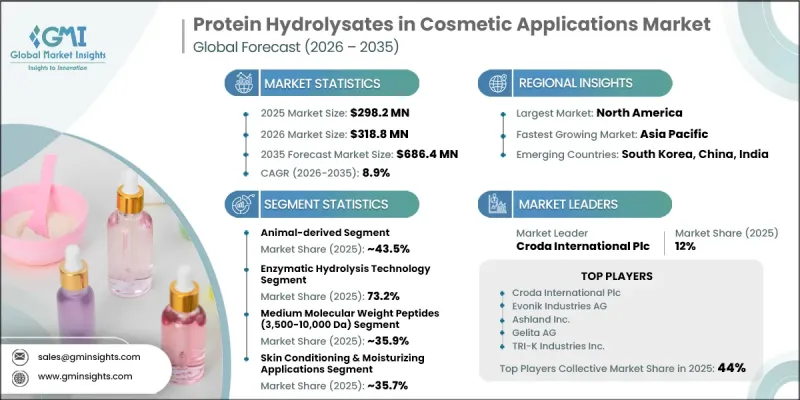
由於生物活性胜肽在化妝品和個人保健產品配方中的應用日益廣泛,市場正在不斷擴張。這些產品專注於滋養肌膚、抗衰老、保濕和增強皮膚屏障功能。採用先進水解技術生產的蛋白質水解物正擴大被添加到護膚產品中,以滿足消費者對高效且科學的美容解決方案不斷變化的需求。在皮膚科靈感化妝品和健康護膚日益成長的推動下,製造商正在開發具有特定功能的高生物利用度成分。此外,消費者對天然來源和永續化妝品成分的需求不斷成長,也推動了源自環保來源的蛋白質水解物的使用量增加。胜肽研究、皮膚生物學和萃取技術的進步使企業能夠開發出穩定性更高、功效更強的專業化配方。成分透明度的提高、潔淨標示的興起以及對多功能護膚品的日益關注,都進一步加速了市場成長。水解蛋白具有保濕、改善膚質和增強化妝品功效的能力,這使其在下一代美容和個人護理應用中的重要性日益增加。
| 市場範圍 | |
|---|---|
| 開始年份 | 2025 |
| 預測期 | 2026-2035 |
| 起始金額 | 2.982億美元 |
| 預測金額 | 6.864億美元 |
| 複合年成長率 | 8.9% |
動物源蛋白水解物市佔率高達43.5%,預計到2035年將以7.9%的複合年成長率成長。這些水解物因其在護膚護髮化妝品配方中的長期應用而持續保持強勁的市場地位。其氨基酸組成以及與傳統化妝品基質的相容性,使其成為尋求高效配方成分的製造商的首選。消費者對高效護膚護髮產品的持續需求,不斷推動化妝品產業對動物源蛋白水解物的應用。
預計到2025年,酵素水解製程將佔據73.2%的市場佔有率,並在2026年至2035年間以9.3%的複合年成長率成長。該工藝之所以備受青睞,是因為它能夠在保持生物活性和配方相容性的同時,產生特定的胜肽結構。酶水解過程有助於開發具有可控分子特徵的特化胜肽,以滿足不斷變化的護膚需求。製造商越來越依賴這種方法來生產具有保濕、抗衰老和改善皮膚屏障功能的化妝品成分,同時保持產品的穩定性和配方安全性。
預計到2025年,北美化妝品用水解蛋白市佔率將達到35.4%。消費者對科學護膚產品和生物活性化妝品成分的強勁需求持續推動全部區域市場的擴張。在美國,消費者對含有胜肽和先進活性成分的高階護膚產品的需求尤其顯著,他們越來越重視產品的可見效果和潔淨標示配方。人們對皮膚健康、抗衰老解決方案和多功能化妝品的日益關注,推動了酶促肽在高階和大眾市場美容產品中的應用。化妝品科學的持續創新以及對成分透明度的日益重視,進一步鞏固了北美在全球市場中的地位。
目錄
第1章:調查方法和範圍
第2章執行摘要
第3章 行業洞察
- 產業生態系分析
- 供應商情況
- 利潤率
- 每個階段增加的價值
- 影響價值鏈的因素
- 中斷
- 影響產業的因素
- 成長促進因素
- 對天然和永續化妝品原料的需求日益成長
- 消費者對抗老化效果的意識日益增強
- 人們對純素和無動物實驗替代品的偏好日益成長
- 產業潛在風險與挑戰
- 嚴格的分子量規定(歐盟限值為 3.5 kDa)
- 過敏原問題和安全評估要求
- 市場機遇
- 新型生物活性胜肽在藥用化妝品的應用
- 海洋來源蛋白質的未開發潛力
- 成長促進因素
- 成長潛力分析
- 監理情勢
- 北美洲
- 歐洲
- 亞太地區
- 拉丁美洲
- 中東和非洲
- 波特的分析
- PESTLE分析
- 價格趨勢
- 按地區
- 按蛋白質來源
- 未來市場趨勢
- 技術與創新展望
- 最新科技趨勢
- 新興技術
- 專利趨勢
- 貿易統計
- 主要進口國
- 主要出口國
- 永續性和環境方面
- 永續計劃
- 減少廢棄物策略
- 生產中的能源效率
- 具有環保意識的舉措
- 考慮碳足跡
第4章 競爭情勢
- 介紹
- 企業市佔率分析
- 按地區
- 北美洲
- 歐洲
- 亞太地區
- 拉丁美洲
- 中東和非洲
- 按地區
- 企業矩陣分析
- 主要市場公司的競爭分析
- 競爭定位矩陣
- 主要進展
- 併購
- 夥伴關係和聯盟
- 新產品發布
- 業務拓展計劃
第5章 市場估計與預測:依蛋白質來源分類,2022-2035年
- 動物源性
- 海洋膠原蛋白水解物
- 魚膠原膠原蛋白水解物
- 甲殼類和軟體動物水解蛋白
- 牛膠原蛋白水解物
- 水解乳蛋白質
- 角蛋白水解物(羊毛/羽毛)
- 海洋膠原蛋白水解物
- 植物來源
- 大豆蛋白水解物
- 小麥蛋白水解物
- 米蛋白質水解物
- 新興原料(豌豆、大麻、藜麥)
- 燕麥和玉米蛋白水解物
- 海洋來源
- 微藻類蛋白水解物(螺旋藻、小球藻)
- 大型海藻(海藻)蛋白質水解物
- 源自微生物和發酵
- 酵母蛋白水解物
- 細菌發酵產物
- 源自精準發酵的化妝品胜肽
第6章 市場估算與預測:依加工方式分類,2022-2035年
- 酶水解技術
- 酸水解法
- 鹼性水解的應用
- 組合和順序處理
第7章 市場估算與預測:以分子量分類,2022-2035年
- 高分子量胜肽(超過10,000 Da)
- 中等分子量胜肽(3,500–10,000 Da)
- 低分子量胜肽(500–3,500 Da)
- 遊離氨基酸(小於500 Da)
第8章 市場估算與預測:依分子量分類,2022-2035年
- 護膚和保濕
- 護髮和修復用途
- 成膜/保護應用
- 抗老化和改善皺紋
- 用於緩解刺激和鎮靜。
- 頭皮護理和預防脫髮
第9章 市場估計與預測:依地區分類,2022-2035年
- 北美洲
- 美國
- 加拿大
- 歐洲
- 德國
- 英國
- 法國
- 西班牙
- 義大利
- 其他歐洲國家
- 亞太地區
- 中國
- 印度
- 日本
- 澳洲
- 韓國
- 其他亞太國家
- 拉丁美洲
- 巴西
- 墨西哥
- 阿根廷
- 其他拉丁美洲國家
- 中東和非洲
- 沙烏地阿拉伯
- 南非
- UAE
- 其他中東和非洲國家
第10章:公司簡介
- Croda International Plc
- Evonik Industries AG
- Ashland Inc.
- Gelita AG
- TRI-K Industries Inc.
- Kelisema Srl
- SILAB
- Lucas Meyer Cosmetics
- NEW ALLIANCE FINE CHEM PVT LTD
- Innovative Healthcare India Pvt. Ltd.
- Cosmacon GmbH
- Aqua Bio Technology ASA
The Global Protein Hydrolysates in Cosmetic Applications Market was valued at USD 298.2 million in 2025 and is estimated to grow at a CAGR of 8.9% to reach USD 686.4 million by 2035.
The market is witnessing expansion as bioactive peptides gain stronger acceptance in cosmetic and personal care formulations focused on skin nourishment, anti-aging benefits, hydration support, and barrier enhancement. Protein hydrolysates produced through advanced hydrolysis techniques are increasingly incorporated into skincare products developed to address evolving consumer preferences for performance-driven and science-backed beauty solutions. Growing interest in dermatology-inspired cosmetics and wellness-oriented skincare is encouraging manufacturers to develop ingredients with enhanced bioavailability and targeted functionality. Consumers are also showing rising demand for naturally sourced and sustainable cosmetic ingredients, supporting wider use of protein hydrolysates derived from environmentally responsible sources. Advancements in peptide research, skin biology, and extraction technologies are enabling companies to create highly specialized formulations with improved stability and effectiveness. Increasing focus on ingredient transparency, clean-label positioning, and multifunctional skincare products is further accelerating market growth. The ability of hydrolyzed proteins to support moisture retention, improve skin texture, and enhance cosmetic performance continues to strengthen their importance in next-generation beauty and personal care applications.
| Market Scope | |
|---|---|
| Start Year | 2025 |
| Forecast Year | 2026-2035 |
| Start Value | $298.2 Million |
| Forecast Value | $686.4 Million |
| CAGR | 8.9% |
The animal-derived protein hydrolysates segment held a 43.5% share and is expected to grow at a CAGR of 7.9% through 2035. These hydrolysates continue to maintain strong market presence due to their long-standing use in cosmetic formulations designed for skin and hair conditioning applications. Their amino acid composition and compatibility with conventional cosmetic bases make them highly preferred among manufacturers seeking effective formulation ingredients. Consistent demand for performance-oriented skincare and haircare products continues to support the adoption of animal-derived hydrolysates across the cosmetics industry.
The enzymatic hydrolysis segment held a share of 73.2% in 2025 and is anticipated to grow at a CAGR of 9.3% between 2026 and 2035. This processing method remains widely preferred because it allows the production of targeted peptide structures while preserving biological activity and formulation compatibility. Enzymatic hydrolysis supports the development of specialized peptides with controlled molecular profiles that align with evolving skincare requirements. Manufacturers increasingly rely on this method to create cosmetic ingredients that support hydration, anti-aging performance, and skin barrier improvement while maintaining product stability and formulation safety.
North America Protein Hydrolysates in Cosmetic Applications Market accounted for 35.4% share in 2025. Strong consumer preference for scientifically supported skincare products and bioactive cosmetic ingredients continues to drive market expansion across the region. Demand for premium skincare formulations featuring peptides and advanced active ingredients is particularly strong in the U.S., where consumers increasingly prioritize visible product performance and clean-label formulations. Rising awareness regarding skin health, anti-aging solutions, and multifunctional cosmetic products is encouraging broader adoption of enzymatically derived peptides in both premium and mass-market beauty categories. Continued innovation in cosmetic science and increasing focus on ingredient transparency further strengthen North America's position within the global market.
Major companies operating in the Global Protein Hydrolysates in Cosmetic Applications Market include Croda International Plc, Evonik Industries AG, Ashland Inc., Gelita AG, TRI-K Industries Inc., Kelisema Srl, SILAB, Lucas Meyer Cosmetics, NEW ALLIANCE FINE CHEM PVT LTD, Innovative Healthcare India Pvt. Ltd., Cosmacon GmbH, and Aqua Bio Technology ASA. Companies operating in the protein hydrolysates in cosmetic applications market are implementing several strategies to strengthen their market position and expand their global presence. Leading manufacturers are investing heavily in research and development activities to create advanced peptide-based ingredients with enhanced functionality, stability, and skin compatibility. Businesses are also focusing on sustainable sourcing practices and environmentally responsible production methods to meet rising consumer demand for clean-label and eco-conscious cosmetic ingredients. Strategic collaborations with skincare brands, cosmetic formulators, and biotechnology firms are helping companies accelerate product innovation and expand application capabilities. In addition, manufacturers are increasing investments in advanced extraction and purification technologies to improve ingredient quality and performance.
Table of Contents
Chapter 1 Methodology & Scope
- 1.1 Market scope and definition
- 1.2 Research design
- 1.2.1 Research approach
- 1.2.2 Data collection methods
- 1.3 Data mining sources
- 1.3.1 Global
- 1.3.2 Regional/Country
- 1.4 Base estimates and calculations
- 1.4.1 Base year calculation
- 1.4.2 Key trends for market estimation
- 1.5 Primary research and validation
- 1.5.1 Primary sources
- 1.6 Forecast model
- 1.7 Research assumptions and limitations
Chapter 2 Executive Summary
- 2.1 Industry 360° synopsis
- 2.2 Key market trends
- 2.2.1 Regional trends
- 2.2.2 Protein source trends
- 2.2.3 Processing method trends
- 2.2.4 Molecular weight trends
- 2.2.5 Cosmetic application trends
- 2.3 TAM Analysis, 2025-2035
- 2.4 CXO perspectives: Strategic imperatives
- 2.4.1 Executive decision points
- 2.4.2 Critical success factors
- 2.5 Future Outlook and Strategic Recommendations
Chapter 3 Industry Insights
- 3.1 Industry ecosystem analysis
- 3.1.1 Supplier landscape
- 3.1.2 Profit margin
- 3.1.3 Value addition at each stage
- 3.1.4 Factor affecting the value chain
- 3.1.5 Disruptions
- 3.2 Industry impact forces
- 3.2.1 Growth drivers
- 3.2.1.1 Rising demand for natural & sustainable cosmetic ingredients
- 3.2.1.2 Increasing consumer awareness of anti-aging benefits
- 3.2.1.3 Growing preference for vegan & cruelty-free alternatives
- 3.2.2 Industry pitfalls and challenges
- 3.2.2.1 Stringent molecular weight regulations (EU-3.5 KDA restriction)
- 3.2.2.2 Allergenicity concerns & safety assessment requirements
- 3.2.3 Market opportunities
- 3.2.3.1 Emerging bioactive peptide applications in cosmeceuticals
- 3.2.3.2 Untapped potential in marine-derived protein sources
- 3.2.1 Growth drivers
- 3.3 Growth potential analysis
- 3.4 Regulatory landscape
- 3.4.1 North America
- 3.4.2 Europe
- 3.4.3 Asia Pacific
- 3.4.4 Latin America
- 3.4.5 Middle East & Africa
- 3.5 Porter’s analysis
- 3.6 PESTEL analysis
- 3.7 Price trends
- 3.7.1 By region
- 3.7.2 By Protein source
- 3.8 Future market trends
- 3.9 Technology and Innovation landscape
- 3.9.1 Current technological trends
- 3.9.2 Emerging technologies
- 3.10 Patent Landscape
- 3.11 Trade statistics (HS code)
- 3.11.1 Major importing countries
- 3.11.2 Major exporting countries
- 3.12 Sustainability and environmental aspects
- 3.12.1 Sustainable practices
- 3.12.2 Waste reduction strategies
- 3.12.3 Energy efficiency in production
- 3.12.4 Eco-friendly initiatives
- 3.13 Carbon footprint consideration
Chapter 4 Competitive Landscape, 2025
- 4.1 Introduction
- 4.2 Company market share analysis
- 4.2.1 By region
- 4.2.1.1 North America
- 4.2.1.2 Europe
- 4.2.1.3 Asia Pacific
- 4.2.1.4 LATAM
- 4.2.1.5 MEA
- 4.2.1 By region
- 4.3 Company matrix analysis
- 4.4 Competitive analysis of major market players
- 4.5 Competitive positioning matrix
- 4.6 Key developments
- 4.6.1 Mergers & acquisitions
- 4.6.2 Partnerships & collaborations
- 4.6.3 New Product Launches
- 4.6.4 Expansion Plans
Chapter 5 Market Estimates and Forecast, By Protein Source, 2022-2035 (USD Million) (Kilo Tons)
- 5.1 Key trends
- 5.2 Animal-derived
- 5.2.1 Marine collagen hydrolysates
- 5.2.1.1 Fish Collagen Hydrolysates
- 5.2.1.2 Shellfish & Mollusc Protein Hydrolysates
- 5.2.2 Bovine collagen hydrolysates
- 5.2.3 Milk protein hydrolysates
- 5.2.4 Keratin hydrolysates (wool & feather)
- 5.2.1 Marine collagen hydrolysates
- 5.3 Plant-derived
- 5.3.1 Soy protein hydrolysates
- 5.3.2 Wheat protein hydrolysates
- 5.3.3 Rice protein hydrolysates
- 5.3.4 Emerging sources (pea, hemp, quinoa)
- 5.3.5 Oat & corn protein hydrolysates
- 5.4 Marine-derived
- 5.4.1 Microalgae Protein Hydrolysates (Spirulina, Chlorella)
- 5.4.2 Macroalgae (Seaweed) Protein Hydrolysates
- 5.5 Microbial & fermentation-derived
- 5.5.1 Yeast protein hydrolysates
- 5.5.2 Bacterial fermentation products
- 5.5.3 Precision Fermentation-Derived Cosmetic Peptides
Chapter 6 Market Estimates and Forecast, By Processing Method, 2022-2035 (USD Million) (Kilo Tons)
- 6.1 Key trends
- 6.2 Enzymatic hydrolysis technology
- 6.3 Acid hydrolysis methods
- 6.4 Alkaline hydrolysis applications
- 6.5 Combination & sequential processing
Chapter 7 Market Estimates and Forecast, By Molecular Weight, 2022-2035 (USD Million) (Kilo Tons)
- 7.1 Key trends
- 7.2 High Molecular Weight Peptides (>10,000 Da)
- 7.3 Medium Molecular Weight Peptides (3,500-10,000 Da)
- 7.4 Low Molecular Weight Peptides (500-3,500 Da)
- 7.5 Free Amino Acids (<500 Da)
Chapter 8 Market Estimates and Forecast, By Molecular Weight, 2022-2035 (USD Million) (Kilo Tons)
- 8.1 Key trends
- 8.2 Skin conditioning & moisturizing applications
- 8.3 Hair conditioning & repair applications
- 8.4 Film-forming & protective applications
- 8.5 Anti-aging & wrinkle reduction
- 8.6 Anti-irritant & soothing applications
- 8.7 Scalp Care & Hair Loss Prevention
Chapter 9 Market Estimates and Forecast, By Region, 2022-2035 (USD Million) (Kilo Tons)
- 9.1 Key trends
- 9.2 North America
- 9.2.1 U.S.
- 9.2.2 Canada
- 9.3 Europe
- 9.3.1 Germany
- 9.3.2 UK
- 9.3.3 France
- 9.3.4 Spain
- 9.3.5 Italy
- 9.3.6 Rest of Europe
- 9.4 Asia Pacific
- 9.4.1 China
- 9.4.2 India
- 9.4.3 Japan
- 9.4.4 Australia
- 9.4.5 South Korea
- 9.4.6 Rest of Asia Pacific
- 9.5 Latin America
- 9.5.1 Brazil
- 9.5.2 Mexico
- 9.5.3 Argentina
- 9.5.4 Rest of Latin America
- 9.6 Middle East and Africa
- 9.6.1 Saudi Arabia
- 9.6.2 South Africa
- 9.6.3 UAE
- 9.6.4 Rest of Middle East and Africa
Chapter 10 Company Profiles
- 10.1 Croda International Plc
- 10.2 Evonik Industries AG
- 10.3 Ashland Inc.
- 10.4 Gelita AG
- 10.5 TRI-K Industries Inc.
- 10.6 Kelisema Srl
- 10.7 SILAB
- 10.8 Lucas Meyer Cosmetics
- 10.9 NEW ALLIANCE FINE CHEM PVT LTD
- 10.10 Innovative Healthcare India Pvt. Ltd.
- 10.11 Cosmacon GmbH
- 10.12 Aqua Bio Technology ASA

 2034年全球發酵蔬菜零食市場預測-依蔬菜種類、發酵方法、產品形式、包裝形式、通路及地區分類的分析
 單細胞蛋白水解物市場規模、佔有率和成長分析:按來源、形式、應用、最終用戶和地區分類-2026-2033年產業預測
 有機蛋白水解物市場機會、成長要素、產業趨勢分析及2026-2035年預測蛋白質水解物在老年營養領域的市場機會、成長要素、產業趨勢分析及2026-2035年預測發酵蛋白水解物市場機會、成長要素、產業趨勢分析及2026-2035年預測蛋清蛋白水解物市場機會、成長要素、產業趨勢分析及2026-2035年預測
 蛋白質水解物市場規模、佔有率及成長分析(依產品類型、形態類型、應用類型及地區分類)-2026-2033年產業預測
 全球蛋白質水解物市場規模、佔有率、趨勢和成長分析報告(2026-2034)單細胞蛋白水解物市場機會、成長促進因素、產業趨勢分析及預測(2025-2034年)精準發酵法製備蛋白水解物市場機會、成長促進因素、產業趨勢分析及預測(2025-2034年)