


 |
市場調查報告書
商品編碼
2061421
屋頂太陽能發電組件市場機會、成長要素、產業趨勢分析及2026-2035年預測。Rooftop Solar PV Module Market Opportunity, Growth Drivers, Industry Trend Analysis, and Forecast 2026 - 2035 |
||||||

預計到 2025 年,全球屋頂太陽能發電組件市場價值將達到 1,055 億美元,並預計以 10.4% 的複合年成長率成長,到 2035 年達到 2,776 億美元。
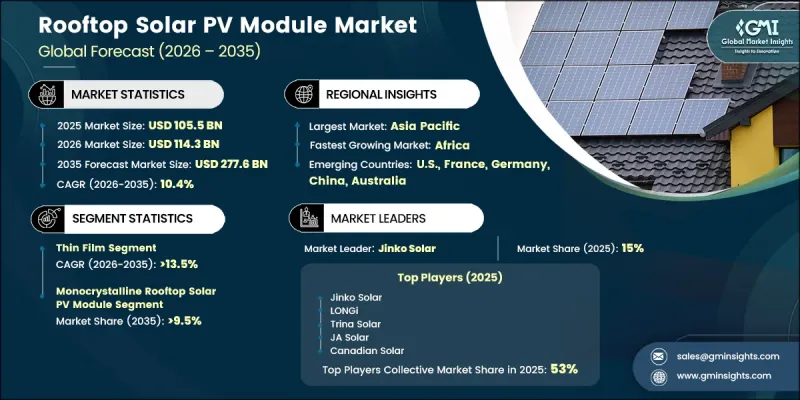
新興經濟體對永續能源解決方案的強勁需求以及不斷成長的電力消耗量持續加速全球屋頂太陽能發電系統的普及。對可靠且經濟高效的發電方式日益成長的需求,推動了住宅和商業建築對屋頂太陽能發電系統的採用。都市化和不斷擴大的建設活動進一步促進了市場成長。太陽光電技術的持續進步提高了組件的效率、耐用性和發電能力,同時降低了維護需求。製造商正日益專注於輕量化太陽能板、智慧型能源監控解決方案和先進的光伏技術,以提升屋頂系統的性能和安裝柔軟性。有利的監管政策和政府主導的可再生能源計劃也促進了太陽能的普及。對清潔能源基礎設施和碳排放舉措的投資增加,為屋頂太陽能組件產業創造了有利的成長機會。此外,簡化的安裝流程和緊湊的系統配置提高了屋頂的適用性,使太陽能組件更容易應用於現代能源領域。
| 市場範圍 | |
|---|---|
| 開始年份 | 2025 |
| 預測期 | 2026-2035 |
| 初始市場規模 | 1055億美元 |
| 預計金額 | 2776億美元 |
| 複合年成長率 | 10.4% |
預計到2025年,薄膜太陽能板市佔率將達到8.5%,並在2035年之前以13.5%的複合年成長率成長。整合式光伏技術的日益普及顯著推動了對薄膜太陽能模組的需求,這主要得益於其輕量化結構和靈活的設計能力。這些組件可以無縫整合到現代建築表面,從而支持永續和節能建築發展的發展趨勢。薄膜技術簡化了安裝要求,並簡化了運輸流程,這些優勢也對市場產生了積極影響。此外,更低的結構荷載要求和更高的安裝適應性進一步促進了產品在屋頂應用中的普及。
受高效能太陽光電技術日益成長的需求和美觀性提升的推動,預計到2035年,單晶矽屋頂太陽能組件市場將以9.5%的複合年成長率成長。單晶矽組件在屋頂太陽能發電系統中備受關注,因為它們能夠在有限的屋頂空間內實現更高的功率輸出。其高效率使其尤其適用於人口密集的都市區,在這些地區,最大限度地提高能源產量至關重要。生產成本的降低和製造技術的不斷進步正在進一步加速單晶矽光學模組在全球的普及。
預計2035年,美國屋頂太陽能模組市場規模將達130億美元。聯邦政府的獎勵、稅額扣抵、淨計量法規以及各州的太陽能支持計劃,顯著降低了安裝成本,並提高了消費者的長期投資回報率。人們對能源韌性、電網可靠性和供應鏈中斷的日益關注,也推動了美國屋頂太陽能系統的普及。此外,太陽能製造製程的技術進步、產能的提升以及物流網路的強化,使得屋頂太陽能系統在美國市場越來越經濟實惠,也更容易取得。
目錄
第1章:調查方法和範圍
第2章執行摘要
第3章 行業洞察
- 產業生態系統
- 原物料供應及採購分析
- 零件製造和分級結構
- 分銷網路和通路分析
- 監理情勢
- 區域淨計量和固定價格購買制度
- 強制性屋頂太陽能發電和建築規範
- 進口關稅、反傾銷稅和貿易壁壘
- 排碳權和獎勵機制
- 有關廢棄物管理和廢舊產品的規定
- 影響產業的因素
- 促進因素
- 產業潛在風險與挑戰
- 成長潛力分析
- 波特的分析
- PESTLE分析
- 技術與創新展望
- 下一代電池技術
- 雙面模組普及趨勢
- 建築一體化光伏(BIPV)的整合
- 模組效率基準與研發藍圖
- 成本結構分析
- 價格趨勢分析
- 對過去價格趨勢的分析
- 定價策略:按業務類型分類
- 貿易數據分析
- 進出口額趨勢
- 主要貿易路線及關稅的影響
- 生產能力和運轉率
- 各國具體生產能力
- 運轉率和擴張計劃
- 人工智慧和生成式人工智慧對市場的影響
- 預測性維護和故障檢測
- 電網最佳化和負載預測
- 利用數位雙胞胎進行模擬和測試
- 風險、限制和監管考量
- 新機會與趨勢
- 數位化和物聯網整合
- 投資分析及未來展望
第4章 競爭情勢
- 介紹
- 企業市場佔有率分析:按國家/地區分類
- 北美洲
- 歐洲
- 亞太地區
- 中東
- 非洲
- 拉丁美洲
- 主要市場公司的競爭分析
- 競爭定位矩陣
- 主要進展
- 併購
- 夥伴關係和聯盟
- 新產品發布
- 業務拓展計劃及資金籌措
- 按公司規模進行基準測試
- 排名分類標準與遴選標準
- 按銷售額、地區和創新能力分類的層級定位矩陣。
第5章 市場規模及預測:依技術分類,2022-2035年
- 薄膜
- 碲化鎘
- 非晶質
- 銅銦鎵二硒化物
- 晶體矽
第6章 市場規模與預測:依產品分類,2022-2035年
- 單晶
- PERC
- TopCon
- HJT
- IBC/TBC
- 多晶
第7章 市場規模及預測:依性別分類的互聯互通情況,2022-2035年
- 並網型
- 離網
第8章 市場規模及預測:依最終用途分類,2022-2035年
- 住宅
- 商業和工業
- 公用事業
第9章 市場規模及預測:依地區分類,2022-2035年
- 北美洲
- 美國
- 加拿大
- 墨西哥
- 歐洲
- 奧地利
- 挪威
- 丹麥
- 芬蘭
- 法國
- 德國
- 英國
- 亞太地區
- 中國
- 澳洲
- 印度
- 日本
- 韓國
- 中東
- 以色列
- 沙烏地阿拉伯
- UAE
- 約旦
- 阿曼
- 非洲
- 南非
- 埃及
- 阿爾及利亞
- 奈及利亞
- 摩洛哥
- 拉丁美洲
- 巴西
- 智利
- 阿根廷
- 秘魯
第10章:公司簡介
- AntaiSolar
- Canadian Solar
- EMMVEE SOLAR
- Hanwha Group
- Indosolar
- JA Solar Technology
- Jackson Group
- JinkoSolar
- LONGi Green Energy Technology
- Motech Industries
- Premier Energies
- REC Solar Holdings
- RENESOLA
- Risen Energy
- Shunfeng International Clean Energy
- SunPower Corporation
- Tata Power Solar Systems
- Trina Solar
- Vikram Solar
- Yingli Solar
The Global Rooftop Solar PV Module Market was valued at USD 105.5 billion in 2025 and is estimated to grow at a CAGR of 10.4% to reach USD 277.6 billion by 2035.
Strong demand for sustainable energy solutions and rising electricity consumption across emerging economies continue to accelerate rooftop solar PV installations worldwide. The increasing need for reliable and cost-effective electricity generation is encouraging the adoption of rooftop photovoltaic systems across residential and commercial infrastructure. Growing urbanization and expanding construction activities are further supporting market growth. Continuous advancements in solar technologies are enhancing module efficiency, durability, and energy generation capacity while lowering maintenance requirements. Manufacturers are increasingly focusing on lightweight solar panels, smart energy monitoring solutions, and advanced photovoltaic cell technologies to improve rooftop system performance and installation flexibility. Supportive regulatory policies and government-backed renewable energy programs are also contributing to widespread solar adoption. Rising investments in clean energy infrastructure and carbon reduction initiatives are creating favorable growth opportunities for the rooftop solar PV module industry. Additionally, simplified installation procedures and compact system configurations are improving rooftop compatibility, making solar PV modules more accessible for modern energy applications.
| Market Scope | |
|---|---|
| Start Year | 2025 |
| Forecast Year | 2026-2035 |
| Start Value | $105.5 Billion |
| Forecast Value | $277.6 Billion |
| CAGR | 10.4% |
The thin-film segment accounted for 8.5% share in 2025 and is expected to grow at a CAGR of 13.5% through 2035. Increasing adoption of building-integrated photovoltaic technologies is significantly driving demand for thin-film solar modules due to their lightweight structure and flexible design capabilities. These modules can be integrated seamlessly into modern architectural surfaces, supporting the growing trend toward sustainable, energy-efficient building development. The market is also benefiting from simplified installation requirements and easier transportation processes associated with thin-film technologies. Reduced structural load requirements and improved installation adaptability further support product deployment across rooftop applications.
The Monocrystalline Rooftop Solar PV Module Market is anticipated to grow at a CAGR 9.5% through 2035, driven by rising preference for high-efficiency solar technologies and improved visual appeal. Monocrystalline modules are gaining significant traction in rooftop solar installations because they deliver higher power output within limited roof space. Their enhanced efficiency levels make them particularly suitable for densely populated urban areas where maximizing energy production remains essential. Declining production costs and ongoing advancements in manufacturing technologies are further strengthening the adoption of monocrystalline solar modules worldwide.
U.S. Rooftop Solar PV Module Market is projected to reach USD 13 billion by 2035. Favorable federal incentives, tax credits, net metering regulations, and state-level solar support programs are substantially reducing installation costs and improving long-term investment returns for consumers. Rising concerns surrounding energy resilience, grid reliability, and supply chain disruptions are also encouraging increased rooftop solar adoption across the country. Furthermore, technological improvements in solar manufacturing processes, expanding production capacities, and enhanced logistics networks are making rooftop photovoltaic systems increasingly affordable and accessible throughout the U.S. market.
Major companies operating in the Global Rooftop Solar PV Module Market include AntaiSolar, Canadian Solar, EMMVEE SOLAR, Hanwha Group, Indosolar, JA Solar Technology, Jackson Group, JinkoSolar, LONGi, Motech Industries, Premier Energies, REC Solar Holdings, RENESOLA, Risen Energy, Shunfeng International Clean Energy, SunPower Corporation, Tata Power Solar, Trina Solar, Vikram Solar, and Yingli Solar. Leading companies in the rooftop solar PV module market are actively implementing several strategic initiatives to strengthen their market position and expand their global footprint. Manufacturers are heavily investing in research and development activities to improve module efficiency, durability, and energy conversion capabilities. Strategic partnerships, mergers, and collaborations are also helping companies enhance production capacities and strengthen supply chain networks. Many industry participants are focusing on expanding manufacturing facilities to meet growing global demand while reducing operational costs through economies of scale. Companies are additionally introducing advanced technologies such as smart monitoring systems, lightweight solar panels, and high-performance photovoltaic cells to differentiate their product portfolios.
Table of Contents
Chapter 1 Methodology & Scope
- 1.1 Research design
- 1.2 Quality commitment
- 1.2.1 GMI AI policy & data integrity commitment
- 1.2.1.1 Source consistency protocol
- 1.2.1 GMI AI policy & data integrity commitment
- 1.3 Research Trail & Confidence Scoring
- 1.3.1 Research Trail Components
- 1.3.2 Scoring Components
- 1.4 Data Collection
- 1.4.1 Partial list of primary sources
- 1.5 Data mining sources
- 1.5.1 Paid sources
- 1.5.1.1 Sources, by region
- 1.5.1 Paid sources
- 1.6 Base estimates and calculations
- 1.6.1 Base year calculation for any one approach
- 1.7 Forecast model
- 1.8 Research transparency addendum
- 1.8.1 Source attribution framework
- 1.8.2 Quality assurance metrics
- 1.8.3 Our commitment to trust
- 1.9 Market definitions
Chapter 2 Executive Summary
- 2.1 Industry synopsis, 2022 - 2035
- 2.2 Business trends
- 2.3 Technology trends
- 2.4 Product trends
- 2.5 Connectivity trends
- 2.6 End Use trends
- 2.7 Regional trends
Chapter 3 Industry Insights
- 3.1 Industry ecosystem
- 3.1.1 Raw material availability & sourcing analysis
- 3.1.2 Component manufacturing & tier structure
- 3.1.3 Distribution network & channel analysis
- 3.2 Regulatory landscape
- 3.2.1 Net Metering & Feed-in Tariff Policies by Region
- 3.2.2 Rooftop Solar Mandates & Building Codes
- 3.2.3 Import Tariffs, Anti-Dumping Duties & Trade Barriers
- 3.2.4 Carbon Credit & Incentive Schemes
- 3.2.5 Waste Management & End-of-Life Regulations
- 3.3 Industry impact forces
- 3.3.1 Growth drivers
- 3.3.2 Industry pitfalls & challenges
- 3.4 Growth potential analysis
- 3.5 Porter's analysis
- 3.5.1 Bargaining power of suppliers
- 3.5.2 Bargaining power of buyers
- 3.5.3 Threat of new entrants
- 3.5.4 Threat of substitutes
- 3.6 PESTEL analysis
- 3.6.1 Political factors
- 3.6.2 Economic factors
- 3.6.3 Social factors
- 3.6.4 Technological factors
- 3.6.5 Legal factors
- 3.6.6 Environmental factors
- 3.7 Technology & Innovation Landscape
- 3.7.1 Next-Generation cell technologies
- 3.7.2 Bifacial module adoption trajectory
- 3.7.3 Building-Integrated PV (BIPV) convergence
- 3.7.4 Module efficiency benchmarking & R&D roadmap
- 3.8 Cost structure analysis
- 3.9 Price trend analysis (Driven by Primary Research)
- 3.9.1 Historical price trend analysis
- 3.9.2 Pricing strategy by player type
- 3.10 Trade data analysis (Driven by Primary Research)
- 3.10.1 Import/export value trends
- 3.10.2 Key trade corridors & tariff impact
- 3.11 Production capacity & utilization (Driven by Primary Research)
- 3.11.1 Production capacity by country
- 3.11.2 Utilization rates and expansion pipeline
- 3.12 Impact of AI & generative AI on the market [SOLUTION CORE]
- 3.12.1 Predictive maintenance & fault detection
- 3.12.2 Grid optimization & load forecasting
- 3.12.3 Digital twin simulation & testing
- 3.12.4 Risks, limitations & regulatory considerations
- 3.13 Emerging opportunities & trends
- 3.14 Digitalization & IoT integration
- 3.15 Investment analysis and future outlook
Chapter 4 Competitive landscape, 2026
- 4.1 Introduction
- 4.2 Company market share analysis, by country, 2025
- 4.2.1 North America
- 4.2.2 Europe
- 4.2.3 Asia Pacific
- 4.2.4 Middle East
- 4.2.5 Africa
- 4.2.6 Latin America
- 4.3 Competitive analysis of major market players
- 4.4 Competitive positioning matrix
- 4.5 Key developments
- 4.5.1 Mergers & acquisitions
- 4.5.2 Partnerships & collaborations
- 4.5.3 New product launches
- 4.5.4 Expansion plans & funding
- 4.6 Company tier benchmarking
- 4.6.1 Tier classification criteria & qualifying thresholds
- 4.6.2 Tier positioning matrix by revenue, geography & innovation
Chapter 5 Market Size and Forecast, By Technology, 2022 - 2035 (USD Million & MW)
- 5.1 Key trends
- 5.2 Thin Film
- 5.2.1 Cadmium Telluride
- 5.2.2 Amorphous Silicon
- 5.2.3 Copper Indium Gallium Di-Selenide
- 5.3 Crystalline Silicon
Chapter 6 Market Size and Forecast, By Product, 2022 - 2035 (USD Million & MW)
- 6.1 Key trends
- 6.2 Monocrystalline
- 6.2.1 PERC
- 6.2.2 TopCon
- 6.2.3 HJT
- 6.2.4 IBC/TBC
- 6.3 Polycrystalline
Chapter 7 Market Size and Forecast, By Connectivity, 2022 - 2035 (USD Million & MW)
- 7.1 Key trends
- 7.2 On Grid
- 7.3 Off Grid
Chapter 8 Market Size and Forecast, By End Use, 2022 - 2035 (USD Million & MW)
- 8.1 Key trends
- 8.2 Residential
- 8.3 Commercial & Industrial
- 8.4 Utility
Chapter 9 Market Size and Forecast, By Region, 2022 - 2035 (USD Million & MW)
- 9.1 Key trends
- 9.2 North America
- 9.2.1 U.S.
- 9.2.2 Canada
- 9.2.3 Mexico
- 9.3 Europe
- 9.3.1 Austria
- 9.3.2 Norway
- 9.3.3 Denmark
- 9.3.4 Finland
- 9.3.5 France
- 9.3.6 Germany
- 9.3.7 UK
- 9.4 Asia Pacific
- 9.4.1 China
- 9.4.2 Australia
- 9.4.3 India
- 9.4.4 Japan
- 9.4.5 South Korea
- 9.5 Middle East
- 9.5.1 Israel
- 9.5.2 Saudi Arabia
- 9.5.3 UAE
- 9.5.4 Jordan
- 9.5.5 Oman
- 9.6 Africa
- 9.6.1 South Africa
- 9.6.2 Egypt
- 9.6.3 Algeria
- 9.6.4 Nigeria
- 9.6.5 Morocco
- 9.7 Latin America
- 9.7.1 Brazil
- 9.7.2 Chile
- 9.7.3 Argentina
- 9.7.4 Peru
Chapter 10 Company Profiles
- 10.1 AntaiSolar
- 10.2 Canadian Solar
- 10.3 EMMVEE SOLAR
- 10.4 Hanwha Group
- 10.5 Indosolar
- 10.6 JA Solar Technology
- 10.7 Jackson Group
- 10.8 JinkoSolar
- 10.9 LONGi Green Energy Technology
- 10.10 Motech Industries
- 10.11 Premier Energies
- 10.12 REC Solar Holdings
- 10.13 RENESOLA
- 10.14 Risen Energy
- 10.15 Shunfeng International Clean Energy
- 10.16 SunPower Corporation
- 10.17 Tata Power Solar Systems
- 10.18 Trina Solar
- 10.19 Vikram Solar
- 10.20 Yingli Solar

 太陽能板市場:按技術、電力系統類型、應用、國家和地區分類-全球產業分析、市場規模及佔有率和未來預測(2026-2033)
 多晶矽組件市場規模、佔有率和成長分析:按組件類型、額定功率、應用、安裝方式、最終用戶和地區分類-2026-2033年產業預測
 太陽能組件材料市場預測(2034 年)—按組件、材料類型、組件技術、應用和地區分類的全球分析
 太陽能發電系統平衡市場-2026-2032年全球市場預測太陽能發電工程、採購和施工 (EPC) 市場:2026-2032 年全球市場預測(按服務類型、太陽光電技術、追蹤器類型、容量、安裝類型和最終用途分類)全球公用事業規模太陽能發電市場預測至2034年—按安裝類型、容量範圍、所有權/營運、技術、應用和地區分類的分析
 太陽能板市場規模、佔有率和成長分析:按技術類型、併網方式、安裝類型、安裝結構、電池類型、輸出和地區分類-2026-2033年產業預測
 太陽能發電組件市場-全球產業規模、佔有率、趨勢、機會和預測:按技術、產品、連接方式、安裝方式、最終用途、地區和競爭格局分類,2021-2031年
 住宅太陽能發電組件市場機會、成長要素、產業趨勢分析及2026-2035年預測。太陽能發電組件市場機會、成長要素、產業趨勢分析及2026-2035年預測