


 |
市場調查報告書
商品編碼
2045865
垂直農業市場機會、成長要素、產業趨勢分析及2026-2035年預測Vertical Farming Market Opportunity, Growth Drivers, Industry Trend Analysis, and Forecast 2026 - 2035 |
||||||

2025 年全球垂直農業市場價值為 74 億美元,預計到 2035 年將達到 305 億美元,年複合成長率為 14.5%。
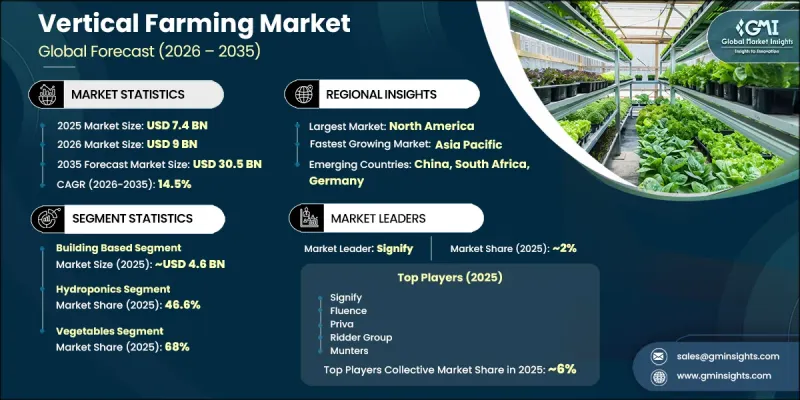
快速的都市化及其對耕地造成的壓力推動了市場成長,限制了傳統農業的擴張。這種限制正在加速向空間利用率更高的農業模式轉型,以期在更小的面積上實現更高的產量。同時,技術主導的農業創新正在變革食品生產系統,企業紛紛採用先進的環境控制解決方案,以最大限度地提高生產力和穩定性。消費者偏好的轉變也發揮重要作用,人們對新鮮、安全、無化學添加食品的需求日益成長。對傳統農業中使用合成農藥的擔憂促使消費者和零售商要求更清潔的生產系統。垂直農業透過室內氣候控制的種植方式滿足了這些期望,實現了全年生產,同時擺脫了對合成農藥的依賴。接近性城市中心進一步提高了供應鏈效率,並改善了產品的新鮮度、營養價值和保存期限。這些優勢的結合,使得垂直農業成為全球現代食品價值鏈和商業農業利益相關人員日益青睞的解決方案。
| 市場規模 | |
|---|---|
| 開始年份 | 2025 |
| 預測期 | 2026-2035 |
| 初始市場規模 | 74億美元 |
| 預計金額 | 305億美元 |
| 複合年成長率 | 14.5% |
預計到2025年,建築型農業市場規模將達到46億美元,並在2026年至2035年間以14.9%的複合年成長率成長。該市場呈現強勁成長勢頭,主要得益於越來越多的城市基礎設施被改造用於支持環境控制型農業。這些設施通常建在倉庫、改造後的工業用地或專為精密農業運作而設計的專用設施內。在這些設施中,溫度、濕度、光照條件和營養供應系統等環境參數可以嚴格控制。這種可控環境能夠實現全年穩定的作物生產,不受季節或氣候波動的影響,從而提高生產的可靠性和商業性化規模。
到2025年,水耕技術將佔據46.6%的市場。這種種植方法憑藉其高效性和操作柔軟性,已成為垂直農業領域的領先技術。水耕技術摒棄了土壤,代之以富含營養的水溶液,顯著降低了污染風險,同時加快了植物的生長週期。與傳統耕作方式相比,水耕技術大幅減少了用水量,有助於實現永續性目標。此外,水耕系統與自動化和可擴展的生產模式高度親和性,使其成為商業性農業運作和快速發展的城市農業生態系統的理想選擇。
美國垂直農業市場預計到2025年將達到19億美元,並在2026年至2035年間以5.6%的複合年成長率成長。美國是可控農業領域最先進的市場之一,這得益於強勁的投資流入、農業技術的農業科技生態系統以及對室內農業技術的早期應用。與大規模零售商的合作以及雄厚的創業投資資金籌措持續加速著產業的擴張,使得本地生產的農產品得以在都市區廣泛流通。消費者對無農藥食品日益成長的偏好,以及不斷增強的永續性,進一步推動了全美的需求成長。
目錄
第1章:調查方法和範圍
第2章執行摘要
第3章:行業洞察
- 工業生態系分析
- 供應商情況
- 利潤率
- 每個階段增加的價值
- 影響價值鏈的因素
- 影響產業的因素
- 促進因素
- 都市化和耕地短缺
- 新鮮、無農藥農產品的需求日益成長
- 氣候變遷和天氣變化
- 產業潛在風險與挑戰
- 需要大量的初始投資。
- 高能耗和營運成本
- 機會
- 將智慧城市與城市發展連結起來
- 分散式食品生產模式
- 在惡劣環境下進行溫控生產
- 促進因素
- 成長潛力分析
- 未來市場趨勢
- 技術與創新展望
- 最新科技趨勢
- 新技術
- 自動化和機器人技術的融合
- 感測器和物聯網技術
- 2025年價格趨勢
- 對過去價格趨勢的分析
- 根據參與企業的類型(高階、價值、成本加成)所製定的定價策略
- 價格比較:垂直農業與傳統農業
- 監理情勢
- 標準和合規要求
- 食品安全標準及合規性
- 區域監理框架
- 認證標準(有機、非基因改造)
- 分區和城市農業政策
- 貿易數據分析
- 進出口量及進口額趨勢
- 主要貿易路線及關稅的影響
- 人工智慧和生成式人工智慧對市場的影響
- 利用人工智慧改造現有經營模式
- 基於細分市場的生成式人工智慧的應用案例和部署藍圖
- 風險、限制和監管考量
- 波特的分析
- PESTLE分析
- 供應鏈分析
- 設備供應鏈
- 種子和遺傳資源的供應
- 分銷和物流網路
- 供應鏈脆弱性與韌性
- 生產能力和生產情況
- 設備產能:按地區和主要生產商分類
- 運轉率和擴張計劃
第4章 競爭情勢
- 介紹
- 企業市佔率分析
- 按地區
- 企業矩陣分析
- 主要市場公司的競爭分析
- 競爭定位矩陣
- 併購
- 夥伴關係和聯盟
- 新產品發布
- 業務拓展計劃
第5章 依結構分類的市場估計與預測,2022-2035年
- 貨櫃基地
- 基礎
第6章 依製程分類的市場估算與預測,2022-2035年
- 水耕法
- 氣耕
- 水耕法
第7章 市場估算與預測(按組件分類),2022-2035年
- 硬體
- 照明系統
- 水耕組件
- 氣候控制系統
- 感測器和監控設備
- 建材及結構構件
- 軟體
- 服務
第8章 依作物類型分類的市場估算與預測,2022-2035年
- 水果
- 蔬菜
第9章 2022-2035年各地區市場估算與預測
- 北美洲
- 美國
- 加拿大
- 歐洲
- 德國
- 英國
- 法國
- 義大利
- 西班牙
- 亞太地區
- 中國
- 印度
- 日本
- 韓國
- 澳洲
- 拉丁美洲
- 巴西
- 墨西哥
- 阿根廷
- 中東和非洲
- 沙烏地阿拉伯
- 阿拉伯聯合大公國
- 南非
第10章:公司簡介
- 世界公司
- AMS OSRAM AG
- Signify(Philips)
- Priva
- Netafim
- Munters
- Fluence
- OSRAM
- Seoul Semiconductor
- Heliospectra
- 當地公司
- Valoya
- Freight Farms
- Ridder
- DryGair
- IGS
- Lumileds
- Desert Aire
- Sollum Technologies
- C-LED
- 新興企業
- LED iBond
- Gardin Agritech
- AEssenseGrows
- Airlux Technologies
The Global Vertical Farming Market was valued at USD 7.4 billion in 2025 and is estimated to grow at a CAGR of 14.5% to reach USD 30.5 billion by 2035.
Market growth is influenced by rapid urbanization and the resulting pressure on arable land, which is limiting traditional agricultural expansion. This constraint is accelerating the shift toward space-efficient farming models that can deliver higher yields within smaller land footprints. At the same time, technology-led agricultural innovation is reshaping food production systems, with companies deploying advanced controlled-environment solutions to maximize productivity and consistency. Changing consumer preferences are also playing a key role, as demand rises for fresh, safe, and chemical-free food products. Concerns regarding synthetic pesticide use in conventional farming are pushing both consumers and retailers toward cleaner production systems. Vertical farming addresses these expectations through indoor, climate-controlled cultivation that eliminates synthetic pesticide dependence while ensuring year-round production. Proximity to urban centers further enhances supply chain efficiency, improving freshness, nutritional value, and shelf life. These combined advantages are making vertical farming an increasingly preferred solution for modern food supply chains and commercial agriculture stakeholders globally.
| Market Scope | |
|---|---|
| Start Year | 2025 |
| Forecast Year | 2026-2035 |
| Start Value | $7.4 Billion |
| Forecast Value | $30.5 Billion |
| CAGR | 14.5% |
The building-based segment accounted for USD 4.6 billion in 2025 and is projected to grow at a CAGR of 14.9% from 2026 to 2035. This segment has gained strong traction as urban infrastructure is increasingly repurposed to support controlled-environment agriculture. These facilities are commonly developed within warehouses, converted industrial properties, or purpose-built structures designed for precision farming operations. Such setups allow strict regulation of environmental parameters, including temperature, humidity, lighting conditions, and nutrient delivery systems. This controlled environment enables consistent crop output throughout the year, independent of seasonal or climatic variations, thereby strengthening production reliability and commercial scalability.
The hydroponics segment held a 46.6% share in 2025. This cultivation method has become the dominant technology in vertical farming due to its high efficiency and operational flexibility. By removing soil from the growing process and replacing it with nutrient-enriched water solutions, hydroponics significantly reduces contamination risks while accelerating plant growth cycles. It also requires substantially lower water usage compared to conventional agricultural practices, supporting sustainability objectives. In addition, hydroponic systems are highly compatible with automation and scalable production models, making them well-suited for commercial farming operations and rapidly growing urban agriculture ecosystems.
U.S. Vertical Farming Market was valued at USD 1.9 billion in 2025 and is projected to grow at a CAGR of 5.6% from 2026 to 2035. The country represents one of the most advanced markets for controlled-environment agriculture, supported by strong investment flows, a mature agri-tech ecosystem, and early adoption of indoor farming technologies. Large-scale retail partnerships and robust venture capital funding continue to accelerate industry expansion, enabling widespread distribution of locally grown produce in urban regions. High consumer preference for pesticide-free food products, combined with growing sustainability awareness, is further reinforcing demand across the country.
Key companies operating in the Global Vertical Farming Market include AMS OSRAM AG, Signify (Philips), Priva, Netafim, Munters, Fluence, OSRAM, Seoul Semiconductor, Heliospectra, Valoya, Freight Farms, Ridder, DryGair, IGS, Lumileds, Desert Aire, Sollum Technologies, C-LED, LED iBond, Gardin Agritech, AEssenseGrows, and Airlux Technologies. Companies in the vertical farming market are strengthening their position by investing heavily in automation, AI-driven crop monitoring systems, and advanced climate control technologies that improve yield efficiency and resource optimization. Strategic partnerships with retailers and food service providers are expanding market reach and ensuring stable demand channels. Players are also focusing on modular and scalable farm designs that can be deployed in urban environments with limited space availability. Continuous R&D efforts are enhancing LED lighting efficiency, nutrient delivery systems, and energy optimization solutions. Additionally, companies are expanding through collaborations with technology providers and agricultural research institutions to improve crop varieties and operational productivity.
Table of Contents
Chapter 1 Methodology & Scope
- 1.1 Market scope & definitions
- 1.2 Research design
- 1.2.1 Research approach
- 1.2.2 Data collection methods
- 1.3 Base estimates and calculations
- 1.3.1 Base year calculation
- 1.3.2 Market estimates & forecasts parameters
- 1.4 Forecast Model
- 1.4.1 Key trends for market estimates
- 1.4.2 Quantified market impact analysis
- 1.4.2.1 Mathematical impact of growth parameters on forecast
- 1.4.3 Scenario analysis framework
- 1.5 Primary research and validation
- 1.5.1 Some of the primary sources (but not limited to)
- 1.6 Data mining sources
- 1.6.1 Paid Sources
- 1.7 Primary research and validation
- 1.7.1 Primary sources
- 1.8 Research Trail & confidence scoring
- 1.8.1 Research trail components
- 1.8.2 Scoring components
- 1.9 Research transparency addendum
- 1.9.1 Source attribution framework
- 1.9.2 Quality assurance metrics
- 1.9.3 Our commitment to trust
- 1.10 Market Definitions
Chapter 2 Executive Summary
- 2.1 Industry 360° synopsis
- 2.2 Key market trends
- 2.2.1 Regional
- 2.2.2 Structure
- 2.2.3 Process
- 2.2.4 Component
- 2.2.5 Crop Type
Chapter 3 Industry Insights
- 3.1 Industry ecosystem analysis
- 3.1.1 Supplier Landscape
- 3.1.2 Profit Margin
- 3.1.3 Value addition at each stage
- 3.1.4 Factor affecting the value chain
- 3.2 Industry impact forces
- 3.2.1 Growth drivers
- 3.2.1.1 Urbanization & limited arable land availability
- 3.2.1.2 Growing demand for fresh, pesticide-free produce
- 3.2.1.3 Climate change & weather variability
- 3.2.2 Industry pitfalls & challenges
- 3.2.2.1 High initial capital investment requirements
- 3.2.2.2 Significant energy consumption & operating costs
- 3.2.3 Opportunities
- 3.2.3.1 Integration with smart cities & urban development
- 3.2.3.2 Decentralized food production models
- 3.2.3.3 Climate-controlled production in extreme environments
- 3.2.1 Growth drivers
- 3.3 Growth potential analysis
- 3.4 Future market trends
- 3.5 Technology and Innovation landscape
- 3.5.1 Current technological trends
- 3.5.2 Emerging technologies
- 3.5.3 Automation & Robotics Integration
- 3.5.4 Sensor & IoT Technologies
- 3.6 Price trends, 2025
- 3.6.1 Historical Price Trend Analysis
- 3.6.2 Pricing Strategy by Player Type (Premium / Value / Cost-plus)
- 3.6.3 Price Comparison: Vertical Farm vs. Traditional Agriculture
- 3.7 Regulatory landscape
- 3.7.1 Standards and compliance requirements
- 3.7.2 Food Safety Standards & Compliance
- 3.7.3 Regional Regulatory Frameworks
- 3.7.4 Certification Standards (Organic, Non-GMO)
- 3.7.5 Zoning & Urban Agriculture Policies
- 3.8 Trade Data Analysis (Driven by Primary Research) (HS code - 8436.80.90)
- 3.8.1 Import/export volume & value trends (driven by primary research)
- 3.8.2 Key trade corridors & tariff impact (driven by primary research)
- 3.9 Impact of AI & Generative AI on the Market
- 3.9.1 AI-Driven disruption of existing business models
- 3.9.2 GenAI use cases & adoption roadmap by segment
- 3.9.3 Risks, limitations & regulatory considerations
- 3.10 Porter's analysis
- 3.11 PESTEL analysis
- 3.12 Supply chain analysis
- 3.12.1 Equipment supply chain
- 3.12.2 Seed & genetics supply
- 3.12.3 Distribution & logistics networks
- 3.12.4 Supply chain vulnerabilities & resilience
- 3.13 Capacity & Production Landscape (Driven by Primary Research)
- 3.13.1 Installed Capacity by Region & Key Producer (Driven by Primary Research)
- 3.13.2 Capacity Utilization Rates & Expansion Pipelines (Driven by Primary Research)
Chapter 4 Competitive Landscape, 2025
- 4.1 Introduction
- 4.2 Company market share analysis
- 4.2.1 By Region
- 4.2.1.1 North America
- 4.2.1.2 Europe
- 4.2.1.3 Asia Pacific
- 4.2.1.4 Latin America
- 4.2.1.5 Middle East & Africa
- 4.2.1 By Region
- 4.3 Company matrix analysis
- 4.4 Competitive analysis of major market players
- 4.5 Competitive positioning matrix
- 4.6 Key developments
- 4.6.1 Mergers & acquisitions
- 4.6.2 Partnerships & collaborations
- 4.6.3 New product launches
- 4.6.4 Expansion plans
Chapter 5 Market Estimates & Forecast, By Structure, 2022 - 2035, (USD Billion)
- 5.1 Key trends
- 5.2 Shipping-container based
- 5.3 Building based
Chapter 6 Market Estimates & Forecast, By Process, 2022 - 2035, (USD Billion)
- 6.1 Key trends
- 6.2 Hydroponics
- 6.3 Aeroponics
- 6.4 Aquaponics
Chapter 7 Market Estimates & Forecast, By Component, 2022 - 2035, (USD Billion)
- 7.1 Key trends
- 7.2 Hardware
- 7.2.1 Lighting systems
- 7.2.2 Hydroponic components
- 7.2.3 Climate control systems
- 7.2.4 Sensors & monitoring equipment
- 7.2.5 Building materials & structural components
- 7.3 Software
- 7.4 Services
Chapter 8 Market Estimates & Forecast, By Crop Type, 2022 - 2035, (USD Billion)
- 8.1 Key trends
- 8.2 Fruits
- 8.3 Vegetables
Chapter 9 Market Estimates & Forecast, By Region, 2022 - 2035, (USD Billion)
- 9.1 Key trends
- 9.2 North America
- 9.2.1 U.S.
- 9.2.2 Canada
- 9.3 Europe
- 9.3.1 Germany
- 9.3.2 UK
- 9.3.3 France
- 9.3.4 Italy
- 9.3.5 Spain
- 9.4 Asia Pacific
- 9.4.1 China
- 9.4.2 India
- 9.4.3 Japan
- 9.4.4 South Korea
- 9.4.5 Australia
- 9.5 Latin America
- 9.5.1 Brazil
- 9.5.2 Mexico
- 9.5.3 Argentina
- 9.6 MEA
- 9.6.1 Saudi Arabia
- 9.6.2 UAE
- 9.6.3 South Africa
Chapter 10 Company Profiles
- 10.1 Global Players
- 10.1.1 AMS OSRAM AG
- 10.1.2 Signify (Philips)
- 10.1.3 Priva
- 10.1.4 Netafim
- 10.1.5 Munters
- 10.1.6 Fluence
- 10.1.7 OSRAM
- 10.1.8 Seoul Semiconductor
- 10.1.9 Heliospectra
- 10.2 Regional players
- 10.2.1 Valoya
- 10.2.2 Freight Farms
- 10.2.3 Ridder
- 10.2.4 DryGair
- 10.2.5 IGS
- 10.2.6 Lumileds
- 10.2.7 Desert Aire
- 10.2.8 Sollum Technologies
- 10.2.9 C-LED
- 10.3 Emerging players
- 10.3.1 LED iBond
- 10.3.2 Gardin Agritech
- 10.3.3 AEssenseGrows
- 10.3.4 Airlux Technologies

 全球垂直農業市場規模、佔有率、趨勢和成長分析報告(2026-2034年)
 到 2034 年,城市垂直農業向超本地化供應市場發展趨勢的市場預測——按作物類型、耕作系統、技術、基礎設施類型、供應模式和地區進行全球分析。
 垂直農業市場:2026-2032年全球市場預測(按產品、照明類型、作物類型、系統、農場規模、安裝類型和最終用戶分類)
 垂直農業:市場佔有率分析、產業趨勢與統計、成長預測(2026-2031)美國垂直農業:市場佔有率分析、產業趨勢與統計及成長預測(2026-2031 年)
 垂直農業市場分析與預測(至2035年):按類型、產品、服務、技術、組件、應用、最終用戶、安裝方法、設備和解決方案分類垂直漿果種植市場預測至2034年—全球分析(按漿果類型、栽培技術、組件、自動化程度、設施類型、應用、最終用戶、分銷管道和地區分類)
 垂直農業市場報告:按組成部分、結構、成長要素、應用和地區分類(2026-2034 年)
 2026年全球垂直農業市場報告2034年室內農業產品市場預測-按產品類型、種植方法、設施類型、種植規模、最終用戶和地區分類的全球分析