

 |
市場調查報告書
商品編碼
2038789
鮮切花市場商機、成長要素、產業趨勢分析及2026-2035年預測。Cut Flowers Market Opportunity, Growth Drivers, Industry Trend Analysis, and Forecast 2026 - 2035 |
||||||

預計到 2025 年,全球鮮切花市場價值將達到 442 億美元,並有望以 5.2% 的複合年成長率成長,到 2035 年達到 731 億美元。
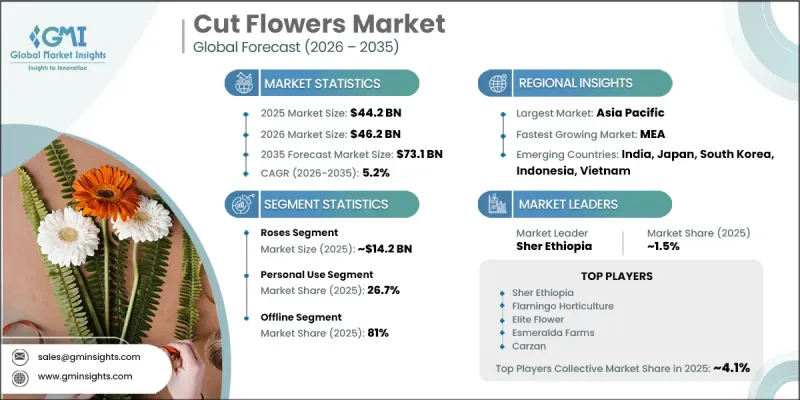
隨著鮮花在全球社交、文化和商業性活動中繼續扮演核心角色,鮮花市場正蓬勃發展。婚禮、公司聚會和私人慶典對花卉裝飾的需求不斷成長,顯著推動了市場成長。鮮切花被廣泛用於餐桌擺飾、花束和場地裝飾等裝飾佈置,其視覺吸引力和新鮮度是消費者購買的主要動力。消費者越來越偏好時令花卉和異國品種,這推動了整個供應鏈中客製化花卉設計和高階產品的供應。零售商和線上花卉平台正在拓展產品線,以滿足消費者對便利性、多樣性和當日送達服務日益成長的需求。可支配所得的增加和對體驗式節慶的偏好也促使消費者增加購買頻率。此外,飯店、餐廳和活動場所不斷將花卉美學融入環境,以提升顧客體驗和氛圍,這也推動了飯店、零售和企業禮品行業的需求成長。
| 市場範圍 | |
|---|---|
| 開始年份 | 2025 |
| 預測期 | 2026-2035 |
| 初始市場規模 | 442億美元 |
| 預測市場規模 | 731億美元 |
| 複合年成長率 | 5.2% |
預計到2025年,玫瑰市場規模將達到142億美元,並在2026年至2035年間以4.7%的複合年成長率成長。玫瑰憑藉其普世的吸引力、廣泛的供應量以及在不同地區所蘊含的深厚文化和情感意義,持續引領著鮮切花市場的發展。它們仍然是禮品、慶典佈置、婚禮和企業裝飾的首選,進一步鞏固了其商業性重要性。豐富的顏色、尺寸和雜交品種使供應商能夠滿足各個市場消費者多樣化的偏好。完善的種植系統和高效的國際供應鏈確保了穩定的生產、順暢的配送和全年不間斷的供應。玫瑰強大的象徵價值、奢華感以及在各種場合的高周轉率,進一步鞏固了其在全球鮮切花市場的主導地位。
預計到2025年,線下分銷管道將佔據81%的市場佔有率,並在2026年至2035年間以4.6%的複合年成長率成長。線下銷售之所以仍佔據主導地位,是因為消費者在購買前優先考慮鮮花的新鮮度、香氣和外觀。傳統花店、本地花店和專賣店讓顧客可以直接檢查品質並挑選自己喜歡的花束。這些管道對於緊急情況和活動相關的需求也至關重要,因為它們可以滿足即時購買的需求。實體店可以製作客製化花束,並為緊急訂單提供即時送達服務,這有助於提高客戶滿意度。完善的零售網路和本地供應商體系確保了都市區和郊區的廣泛覆蓋,從而維持了線下鮮花購買管道的主導地位。
預計到2025年,中國鮮切花市場規模將達到62億美元,並在2035年之前以6.3%的複合年成長率成長。中國鮮切花市場的成長得益於城市生活方式的普及、可支配收入的增加以及鮮花在日常禮品和裝飾中日益廣泛的應用。鮮花的用途已不再局限於傳統節日,而是擴展到日常生活和商業領域,例如婚禮、企業活動和住宅裝飾。各大城市已成為重要的消費中心,先進的物流和低溫運輸系統確保了產品的新鮮度和及時配送。尤其值得一提的是,主要產區強大的國內生產體系支撐了玫瑰、百合、菊花和康乃馨等花卉的大規模供應,進一步鞏固了中國在區域市場中的地位。
目錄
第1章:調查方法和範圍
第2章執行摘要
第3章業界考察
- 生態系分析
- 供應商情況
- 利潤率
- 每個階段增加的價值
- 影響價值鏈的因素
- 影響產業的因素
- 促進因素
- 婚禮、活動和慶典對鮮花裝飾的需求日益成長。
- 酒店、零售和企業禮品行業的擴張。
- 可支配所得增加和生活方式趨勢的改變
- 陷阱與挑戰
- 鮮切花的保鮮期會導致大量浪費。
- 季節性供應和對氣候條件的依賴性
- 機會
- 對異域珍稀花卉品種的需求日益成長
- 拓展企業禮品及訂閱式鮮花服務
- 促進因素
- 成長潛力分析
- 未來市場趨勢
- 科技與創新趨勢
- 當前技術趨勢
- 新興技術
- 監理情勢
- 標準和合規要求
- 區域法規結構
- 認證標準
- 波特五力分析
- PESTEL 分析
- 價格分析(基於初步調查)
- 對過去價格趨勢的分析(基於初步研究)
- 根據業務類型分類的定價策略(高階/價值/成本加成)(基於初步調查)
- 貿易數據分析(基於初步調查)
- 進出口數量和價值的變化趨勢(基於初步調查)
- 主要貿易走廊及關稅影響(基於初步調查)
- 分銷基礎設施和通路滲透狀況(基於初步調查)
- 按地區和形式(現代分銷與傳統分銷)分類的分銷網路覆蓋率(基於初步調查)
- 末端物流基礎設施的差異以及新通路的變化(基於初步研究)
第4章 競爭情勢
- 介紹
- 企業市佔率分析
- 按地區
- 北美洲
- 歐洲
- 亞太地區
- 拉丁美洲
- 中東和非洲
- 按地區
- 企業矩陣分析
- 主要市場公司的競爭分析
- 競爭定位矩陣
- 主要進展
- 併購
- 夥伴關係與合作
- 新產品發布
- 業務拓展計劃
第5章 市場估算與預測:依花卉類型分類,2022-2035年
- 玫瑰
- 康乃馨
- 菊花
- 鬱金香
- 百合
- 跑步
- 其他
第6章 市場估算與預測:依種植方式分類,2022-2035年
- 傳統的
- 有機的
第7章 市場估計與預測:依應用領域分類,2022-2035年
- 個人使用
- 派對/週年紀念
- 婚禮和大型活動
- 會議及相關活動
- 其他
第8章 市場估算與預測:依通路分類,2022-2035年
- 線上
- 離線
- 花店
- 超級市場
- 其他
第9章 市場估計與預測:依地區分類,2022-2035年
- 北美洲
- 美國
- 加拿大
- 歐洲
- 德國
- 英國
- 法國
- 義大利
- 西班牙
- 亞太地區
- 中國
- 印度
- 日本
- 韓國
- 澳洲
- 拉丁美洲
- 巴西
- 墨西哥
- 阿根廷
- 中東和非洲(MEA)
- 沙烏地阿拉伯
- 阿拉伯聯合大公國
- 南非
第10章:公司簡介
- Marginpar Group(Carzan Flowers)
- Danziger Group
- Esmeralda Farms
- Flamingo Horticulture
- Karen Roses Ltd.
- Multiflora Corp
- Dos Gringos
- Oserian Development Company
- Sher Ethiopia
- Red Lands Roses
- Alexandra Farms
- Rosaprima
- Elite Flower
- Shalimar Fresh/East African Growers
- AQ Roses
The Global Cut Flowers Market was valued at USD 44.2 billion in 2025 and is estimated to grow at a CAGR of 5.2% to reach USD 73.1 billion by 2035.
The market is gaining momentum as fresh flowers continue to play a central role in social, cultural, and commercial events across global regions. Rising demand for floral decoration in weddings, corporate gatherings, and private celebrations is significantly strengthening market growth. Cut flowers are widely used for decorative arrangements such as centerpieces, bouquets, and venue styling, where visual appeal and freshness are key purchase drivers. Consumers increasingly prefer seasonal and exotic flower varieties, which has encouraged customized floral designs and premium offerings across the supply chain. Retailers and online floral platforms are expanding their assortments to meet rising expectations for convenience, variety, and same-day delivery services. Increasing disposable income and the growing preference for experience-based celebrations are also contributing to higher purchase frequency. In addition, the hospitality, retail, and corporate gifting sectors are reinforcing demand, as hotels, restaurants, and event venues consistently integrate floral aesthetics into their environments to enhance customer experience and ambiance.
| Market Scope | |
|---|---|
| Start Year | 2025 |
| Forecast Year | 2026-2035 |
| Start Value | $44.2 Billion |
| Forecast Value | $ 73.1 Billion |
| CAGR | 5.2% |
The roses category generated USD 14.2 billion in 2025 and is projected to grow at a CAGR of 4.7% from 2026 to 2035. Roses continue to lead the cut flowers market due to their universal appeal, high availability, and strong cultural and emotional significance across regions. They remain a preferred choice for gifting, ceremonial arrangements, weddings, and corporate decor, reinforcing their commercial importance. The availability of roses in diverse colors, sizes, and hybrid forms allows suppliers to meet varied consumer preferences across different markets. Established cultivation systems and efficient international supply chains ensure consistent production, smooth distribution, and year-round availability. Their strong symbolic value, premium perception, and rapid turnover across multiple occasions further strengthen their dominant position in the global cut flowers landscape.
The offline distribution channel held an 81% share in 2025 and is projected to grow at a CAGR of 4.6% from 2026 to 2035. Offline sales remain dominant because consumers prioritize freshness, fragrance, and visual inspection before purchase. Traditional florists, local flower shops, and specialized retail outlets provide customers with the ability to evaluate quality directly and select personalized arrangements. These channels also support instant purchase fulfillment, making them essential for urgent and event-driven demand. Physical stores enable customized bouquet creation and immediate delivery for last-minute requirements, which strengthens customer satisfaction. Well-established retail networks and local vendor systems ensure wide accessibility across both urban and semi-urban regions, reinforcing the continued dominance of offline flower purchasing channels.
China Cut Flowers Market captured USD 6.2 billion in 2025 and is forecasted to grow at a CAGR of 6.3% through 2035. The market in China is expanding due to rising urban lifestyles, increasing disposable income levels, and the growing integration of flowers into everyday gifting and decoration practices. Floral usage has extended beyond traditional festivals into daily lifestyle and commercial applications, including weddings, corporate events, and home decoration. Major urban centers act as key consumption hubs, supported by advanced logistics and cold chain systems that ensure product freshness and timely distribution. Strong domestic production, especially from key growing regions, supports a large-scale supply of roses, lilies, chrysanthemums, and carnations, strengthening China's position in the regional market.
Major players operating in the Cut Flowers Industry include Alexandra Farms, AQ Roses, Marginpar Group (Carzan Flowers), Danziger Group, Dos Gringos, Elite Flower, Esmeralda Farms, Flamingo Horticulture, Karen Roses Ltd., Multiflora Corp, Oserian Development Company, Red Lands Roses, Rosaprima, Shalimar Fresh, and Sher Ethiopia. Key companies in the Cut Flowers Market are focusing on strengthening their supply chain efficiency through cold chain expansion and advanced logistics to maintain freshness during long-distance transportation. They are investing in greenhouse cultivation, breeding technologies, and high-yield flower varieties to ensure consistent production throughout the year. Digital sales channels and e-commerce partnerships are being expanded to improve customer reach and enable faster order fulfillment. Many players are also emphasizing product differentiation through premium floral designs, exotic varieties, and customized arrangements for weddings and corporate events. Sustainability practices, including water-efficient farming and eco-friendly packaging, are increasingly adopted to meet environmental expectations. Strategic collaborations with retailers, hospitality chains, and event management firms are also helping companies strengthen market penetration and build long-term demand stability.
Table of Contents
Chapter 1 Methodology & Scope
- 1.1 Market scope and definition
- 1.2 Research design
- 1.2.1 Research approach
- 1.2.2 Data collection methods
- 1.3 Data mining sources
- 1.3.1 Global
- 1.3.2 Regional/Country
- 1.4 Base estimates and calculations
- 1.4.1 Base year calculation
- 1.4.2 Key trends for market estimation
- 1.5 Primary research and validation
- 1.5.1 Primary sources
- 1.6 Forecast model
- 1.7 Research assumptions and limitations
Chapter 2 Executive Summary
- 2.1 Industry 360° synopsis
- 2.2 Key market trends
- 2.2.1 Regional
- 2.2.2 Flower Type
- 2.2.3 Cultivation Method
- 2.2.4 Application
- 2.2.5 Distribution channel
Chapter 3 Industry Insights
- 3.1 Industry ecosystem analysis
- 3.1.1 Supplier landscape
- 3.1.2 Profit margin
- 3.1.3 Value addition at each stage
- 3.1.4 Factor affecting the value chain
- 3.2 Industry impact forces
- 3.2.1 Growth drivers
- 3.2.1.1 Rising demand for floral decorations in weddings, events, and celebrations
- 3.2.1.2 Expansion of the hospitality, retail, and corporate gifting sectors
- 3.2.1.3 Rising disposable income and changing lifestyle trends
- 3.2.2 Pitfalls & Challenges
- 3.2.2.1 Perishable nature of cut flowers leading to high wastage
- 3.2.2.2 Seasonal availability and dependence on climatic conditions
- 3.2.3 Opportunities
- 3.2.3.1 Rising demand for exotic and rare flower varieties
- 3.2.3.2 Expansion of corporate gifting and subscription-based floral services
- 3.2.1 Growth drivers
- 3.3 Growth potential analysis
- 3.4 Future market trends
- 3.5 Technology and innovation landscape
- 3.5.1 Current technological trends
- 3.5.2 Emerging technologies
- 3.6 Regulatory landscape
- 3.6.1 Standards and compliance requirements
- 3.6.2 Regional regulatory frameworks
- 3.6.3 Certification standards
- 3.7 Porter's analysis
- 3.8 PESTEL analysis
- 3.9 Pricing Analysis (Driven by Primary Research)
- 3.9.1 Historical Price Trend Analysis (Driven by Primary Research)
- 3.9.2 Pricing Strategy by Player Type (Premium / Value / Cost-Plus) (Driven by Primary Research)
- 3.10 Trade Data Analysis (Driven by Primary Research)
- 3.10.1 Import/Export Volume & Value Trends (Driven by Primary Research)
- 3.10.2 Key Trade Corridors & Tariff Impact (Driven by Primary Research)
- 3.11 Distribution Infrastructure & Channel Penetration Landscape (Driven by Primary Research)
- 3.11.1 Channel Coverage by Region & Format (Modern vs. Traditional Trade) (Driven by Primary Research)
- 3.11.2 Last-Mile Infrastructure Gaps & Emerging Channel Shifts (Driven by Primary Research)
Chapter 4 Competitive Landscape, 2025
- 4.1 Introduction
- 4.2 Company market share analysis
- 4.2.1 By Region
- 4.2.1.1 North America
- 4.2.1.2 Europe
- 4.2.1.3 Asia Pacific
- 4.2.1.4 Latin America
- 4.2.1.5 Middle East & Africa
- 4.2.1 By Region
- 4.3 Company matrix analysis
- 4.4 Competitive analysis of major market players
- 4.5 Competitive positioning matrix
- 4.6 Key developments
- 4.6.1 Mergers & acquisitions
- 4.6.2 Partnerships & collaborations
- 4.6.3 New product launches
- 4.6.4 Expansion plans
Chapter 5 Market Estimates & Forecast, By Flower Type, 2022 - 2035, (USD Billion) (Thousand Units)
- 5.1 Key trends
- 5.2 Roses
- 5.3 Carnations
- 5.4 Chrysanthemums
- 5.5 Tulips
- 5.6 Lilies
- 5.7 Orchids
- 5.8 Others
Chapter 6 Market Estimates & Forecast, By Cultivation Method, 2022 - 2035, (USD Billion) (Thousand Units)
- 6.1 Key trends
- 6.2 Conventional
- 6.3 Organic
Chapter 7 Market Estimates & Forecast, By Application, 2022 - 2035, (USD Billion) (Thousand Units)
- 7.1 Key trends
- 7.2 Personal Use
- 7.3 Parties & Special Days
- 7.4 Wedding & Mega Events
- 7.5 Conference & Activities
- 7.6 Others
Chapter 8 Market Estimates & Forecast, By Distribution Channel, 2022 - 2035, (USD Billion) (Thousand Units)
- 8.1 Key trends
- 8.2 Online
- 8.3 Offline
- 8.3.1 Florists
- 8.3.2 Supermarkets
- 8.3.3 Others
Chapter 9 Market Estimates & Forecast, By Region, 2022 - 2035, (USD Billion) (Thousand Units)
- 9.1 Key trends
- 9.2 North America
- 9.2.1 U.S.
- 9.2.2 Canada
- 9.3 Europe
- 9.3.1 Germany
- 9.3.2 UK
- 9.3.3 France
- 9.3.4 Italy
- 9.3.5 Spain
- 9.4 Asia Pacific
- 9.4.1 China
- 9.4.2 India
- 9.4.3 Japan
- 9.4.4 South Korea
- 9.4.5 Australia
- 9.5 Latin America
- 9.5.1 Brazil
- 9.5.2 Mexico
- 9.5.3 Argentina
- 9.6 MEA
- 9.6.1 Saudi Arabia
- 9.6.2 UAE
- 9.6.3 South Africa
Chapter 10 Company Profiles
- 10.1 Marginpar Group (Carzan Flowers)
- 10.2 Danziger Group
- 10.3 Esmeralda Farms
- 10.4 Flamingo Horticulture
- 10.5 Karen Roses Ltd.
- 10.6 Multiflora Corp
- 10.7 Dos Gringos
- 10.8 Oserian Development Company
- 10.9 Sher Ethiopia
- 10.10 Red Lands Roses
- 10.11 Alexandra Farms
- 10.12 Rosaprima
- 10.13 Elite Flower
- 10.14 Shalimar Fresh / East African Growers
- 10.15 AQ Roses

 鮮切花市場-2026-2032年全球市場預測
 全球鮮切花市場規模、佔有率、趨勢及成長分析報告(2026-2034年)
 日本鮮花市場規模、佔有率、趨勢及預測(按產品類型、應用、分銷管道和地區分類,2026-2034年)
 全球鮮切花市場:市場規模、產業趨勢、機會分析及預測(2026-2035 年),依類型、用途、花色、通路及地區劃分
 鮮切花市場規模、佔有率及成長分析(按產品、應用、通路及地區分類)-2026-2033年產業預測
 鮮切花:全球市佔率及排名、總收入及需求預測(2025-2031年)
 切花市場-全球產業規模、佔有率、趨勢、機會和預測,按類型、應用、配銷通路、地區和競爭細分,2020-2030 年
 2025-2029年全球切花市場