


 |
市場調查報告書
商品編碼
1940849
泰國金屬包裝:市場佔有率分析、產業趨勢與統計、成長預測(2026-2031)Thailand Metal Packaging - Market Share Analysis, Industry Trends & Statistics, Growth Forecasts (2026 - 2031) |
||||||

※ 本網頁內容可能與最新版本有所差異。詳細情況請與我們聯繫。
預計泰國金屬包裝市場規模將從 2025 年的 18.4 億美元成長到 2026 年的 19.1 億美元,到 2031 年將達到 22.7 億美元,2026 年至 2031 年的複合年成長率為 3.58%。
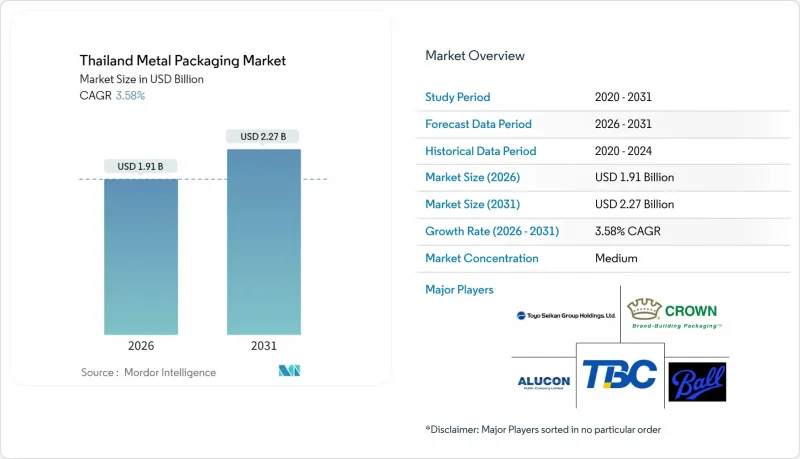
飲料灌裝商、食品加工商和出口型寵物食品製造商的強勁需求支撐著這一成長勢頭,而有利的貿易協定則維持了加工商的高運轉率。鋁的優勢強化了品牌所有者所追求的高階定位,而罐體製造商持續消除瓶頸,確保了在原料價格上漲的情況下供應安全。政府的永續性指令和廢料處理激勵措施進一步推動了金屬產品規格向循環利用方向發展。泰國通往東協和中東的成熟貨運路線縮短了前置作業時間,使當地灌裝商能夠平衡國內需求和盈利的出口生產,從而保護市場免受消費支出週期性放緩的影響。
泰國金屬包裝市場趨勢與洞察
為即飲飲料增加高附加價值
預計到2023年,泰國飲料填充商的銷售量將達到130.2億公升(相當於253.2億美元),體現了其高成本策略,該策略主要依賴鋁罐的阻隔性能和高階展示效果。注重健康的配方和功能性添加劑正以每年3.5%至4.5%的速度成長,而精美的罐身設計已成為高階機能飲料的視覺象徵。大型啤酒製造商和能量飲料品牌頻繁推出限量版產品,頻繁的規格變更也對反應敏捷的本地加工商有利。預計到2023年,非酒精飲料出口銷售額將達到27.8億美元,罐體生產線能夠一夜之間切換國內和區域SKU,從而增強了產量穩定性。皇冠控股預測,2024年全球飲料罐市場將成長4%,其中亞太地區的成長速度將超過其他地區。這些數據支撐了泰國灌裝商的持續需求。
泰國作為寵物食品出口基地的發展
預計泰國2023年加工食品出口額將達265億美元,監管機構已將寵物食品列為下一代關鍵出口產品。密封金屬容器至關重要。大型代加工商正在安裝針對鮪魚罐頭最佳化的蒸餾線,採購政策也明確規定使用能夠承受數週海運的拉伸和再拉伸罐。東部經濟走廊的稅收優惠政策持續吸引新的擠壓顆粒飼料生產商,確保了對本地罐頭供應商的長期穩定需求。從區域來看,越南、馬來西亞和菲律賓的寵物擁有率成長最快,這些市場的進口代理商推薦使用金屬容器,因為金屬具有良好的抗氧化性,這對營養成分的保存至關重要。隨著單位產量的增加,泰國加工商正在增強對捲材原料的採購能力,部分抵消了全球鋁價上漲的影響。
軋延鋼捲價格波動加劇
基準熱軋捲板價格受建築需求波動和地緣政治能源衝擊的影響,導致捲材價格在短期內超過加工商的成本加上合約價格。鋼罐製造商正在囤積庫存或進行遠期採購,佔據了原本可用於維修生產效率的營運資金。當價格飆升與金槍魚罐頭和油漆罐的固定價格競標同時發生時,缺乏國際採購規模的國內鋼廠面臨的利潤壓力最為顯著。鋁價曲線呈現更穩定的上升趨勢,促使一些食品包裝製造商考慮金屬替代品。除非上游製造商透過長期指數合約穩定供應,否則隨著加工商對老舊塗裝生產線進行精簡,泰國的鋼罐產能將面臨萎縮的風險。
細分市場分析
截至2025年,鋁在泰國金屬包裝市場佔據主導地位,市場佔有率高達74.22%,預計到2031年將繼續擴大其主導地位,複合年成長率預計為4.18%。 UACJ公司年產32萬噸的工廠供應薄鋁捲,Crown、Ball和Thai Beverage Can等公司將這些鋁捲軋製成啤酒罐和能量飲料罐。鋁的無限可再生滿足了循環經濟的需求,廢料利用率超過90%。生命週期評估有助於減少生命週期排放。
在泰國金屬包裝市場,鋁是出口寵物食品和清真認證水產品線的首選材料,因為這些產品對鋁的抗凹陷性、耐海水腐蝕性和可追溯性要求極高。同時,鋼材仍然是通用塗料、潤滑劑和低成本煉乳生產線的首選材料,因為在這些領域,價格競爭力比永續性更為重要。然而,隨著國內生產者延伸責任制(EPR)成本預計從2026年起上漲,鋁的整體擁有成本優勢將日益凸顯,即使在低成本類別中也是如此。鋁材的一體化供應鏈使加工商能夠透過長期承購協議對沖原料風險,從而確保即使全球價格上漲,擴大產能的經濟效益仍具有吸引力。
其他福利:
- Excel格式的市場預測(ME)表
- 3個月的分析師支持
目錄
第1章 引言
- 研究假設和市場定義
- 調查範圍
第2章調查方法
第3章執行摘要
第4章 市場情勢
- 市場概覽
- 宏觀經濟因素的影響
- 市場促進因素
- 為即飲飲料增加高附加價值
- 泰國寵物食品出口基地的成長
- 擴大清真認證罐裝水產品
- 政府提倡鋁循環經濟
- 電子商務食品銷售快速成長
- 釀酒產業正朝著更纖細、更時尚的罐裝形式轉型
- 市場限制
- 軋延鋼捲價格波動加劇
- 從源頭尋找生物聚合物袋的替代品
- 歐洲經濟共同體(EEC)以外地區回收基礎建設的延誤
- 氣霧劑工廠揮發性有機化合物(VOC)排放的嚴格規定
- 產業價值鏈分析
- 監管環境
- 技術展望
- 波特五力分析
- 供應商的議價能力
- 消費者議價能力
- 新進入者的威脅
- 替代品的威脅
- 競爭對手之間的競爭
第5章 市場規模與成長預測
- 依材料類型
- 鋁
- 鋼
- 依產品類型
- 能
- 食品罐頭
- 飲料罐
- 氣霧罐
- 散裝容器
- 運輸桶和罐
- 瓶蓋和封口
- 能
- 終端用戶產業
- 飲料
- 食物
- 油漆/化學品
- 工業和汽車用油
第6章 競爭情勢
- 市場集中度
- 策略趨勢
- 市佔率分析
- 公司簡介
- Toyo Seikan Group Holdings, Ltd.
- ALUCON Public Company Limited
- Crown Holdings, Inc.
- Ball Corporation
- Thai Beverage Can Co., Ltd.
- Bangkok Can Manufacturing Co., Ltd.
- Swan Industries(Thailand)Co., Ltd.
- Lohakij Rung Charoen Sub Co., Ltd.
- Next Can Innovation Co., Ltd.
- Asian-Pacific Can Co., Ltd.
- Standard Can Co., Ltd.
- Royal Can Industries Co., Ltd.
- Great Siam Metal Packaging Co., Ltd.
- Siam Toppan Packaging Co., Ltd.
- Perfect Can Manufacturing Co., Ltd.
- Can One(Thailand)Co., Ltd.
- Thai Oil Can Manufacturing Co., Ltd.
- Supreme Metal Container Co., Ltd.
- Thien Long Metal Can(Thailand)Co., Ltd.
- WR Will(Thailand)Ltd.
第7章 市場機會與未來展望
The Thailand metal packaging market is expected to grow from USD 1.84 billion in 2025 to USD 1.91 billion in 2026 and is forecast to reach USD 2.27 billion by 2031 at 3.58% CAGR over 2026-2031.
Robust demand from beverage fillers, food processors, and export-oriented pet-food manufacturers underpins this trajectory, while supportive trade pacts keep converter utilization rates high. Aluminum's dominance reinforces the premium positioning sought by brand owners, and continuous debottlenecking by can-stock mills has protected supply security despite raw-material inflation. Government sustainability mandates and preferential scrap-handling rules further tilt specifications toward circular-ready metal formats. Thailand's established freight corridors into ASEAN and the Middle East shorten lead times, allowing local fillers to balance domestic volumes with lucrative export runs and thereby insulate the market from periodic softness in private consumption.
Thailand Metal Packaging Market Trends and Insights
Premiumisation of Ready-to-Drink Beverages
Thailand's beverage fillers sold 13.02 billion liters worth USD 25.32 billion in 2023, locking in higher value-per-liter price points that rely on aluminum cans for barrier integrity and upscale shelf appea. Health-centric formulas and functional additives are growing 3.5-4.5% annually, and the sleek can profile has become a visual shorthand for premium performance drinks. Major brewers and energy-drink brands schedule frequent limited-edition runs, driving specification turnover that favors agile local converters. Export sales of non-alcoholic drinks delivered USD 2.78 billion in 2023, reinforcing volume certainty for can-body lines that can switch between domestic and regional SKUs overnight. Crown Holdings posted 4% global beverage-can growth in 2024 with Asia Pacific outpacing all other regions, a data point that validates persistent demand from Thai fillers.
Growth of Thailand's Pet-food Export Hub
Thailand shipped USD 26.5 billion in processed foods in 2023, with pet food singled out by regulators as a next-wave export champion requiring hermetically sealed metal formats. Leading co-packers have installed retort lines optimized for tuna-based diets, and their procurement policies specify drawn-and-redrawn cans that withstand multi-week sea freight. Eastern Economic Corridor tax incentives continue to attract new extruded-kibble producers, ensuring sticky long-term offtake for local can-stock suppliers. Regional pet ownership is climbing fastest in Vietnam, Malaysia, and the Philippines, and import agencies in those markets cite metal's oxygen resistance as critical to nutrient preservation. As unit volumes swell, Thai converters gain purchasing leverage on coil feedstock, partially offsetting global aluminum price firming.
Rising Price Volatility of Rolled Steel Coil
Benchmark HRC prices track construction demand swings and geopolitical energy shocks, pushing coil quotes beyond converters' cost-plus contracts on short notice. Steel-can makers carry thicker inventories or buy futures, tying up working capital that could otherwise fund efficiency retrofits. When spikes overlap with fixed-price tenders to tuna or paint fillers, margin compression hits fastest on domestically owned plants that lack global purchasing scale. Aluminum price curves have shown steadier climbs, nudging some food packers into metal substitution. Unless upstream mills stabilize supply with longer-term index deals, Thailand's steel-can capacity risks attrition as converters rationalize older coating lines.
Other drivers and restraints analyzed in the detailed report include:
- Expansion of Halal-certified Canned Seafood
- Government Push for Circular-economy Aluminium
- Substitution by Bio-polymer Pouches in Sauces
For complete list of drivers and restraints, kindly check the Table Of Contents.
Segment Analysis
Aluminum captured a commanding 74.22% of the Thailand metal packaging market share in 2025, and its 4.18% forecast CAGR ensures the substrate will widen its lead through 2031. UACJ's 320,000-ton mill supplies light-gauge coil that Crown, Ball, and Thai Beverage Can draw into bodies consumed by breweries and energy-drink brands. Aluminum's infinite recyclability resonates with circular-economy levies, and scrap yields north of 90% lower life-cycle emissions in life-cycle assessments.
Thailand metal packaging market buyers give aluminum premium preference on export-grade pet food and halal seafood lines where dent resistance, salty-brine compatibility, and regulatory traceability are paramount. Steel retains relevance on commodity paints, lubricants, and budget condensed-milk lines where price sensitivity overrides sustainability messaging. Still, national EPR fees are expected to rise from 2026, gradually tipping cost-of-ownership math toward aluminum even in value categories. The substrate's consolidated supply chain allows converters to hedge raw-material risk through long-term offtake deals, keeping capacity-addition economics attractive despite global price firming.
The Thailand Metal Packaging Market Report is Segmented by Material Type (Aluminium, Steel), Product Type (Cans, Bulk Containers, Shipping Barrels and Drums, and More), End-User Vertical (Beverage, Food, Paints and Chemicals, Industrial and Automotive Oils). The Market Forecasts are Provided in Terms of Value (USD).
List of Companies Covered in this Report:
- Toyo Seikan Group Holdings, Ltd.
- ALUCON Public Company Limited
- Crown Holdings, Inc.
- Ball Corporation
- Thai Beverage Can Co., Ltd.
- Bangkok Can Manufacturing Co., Ltd.
- Swan Industries (Thailand) Co., Ltd.
- Lohakij Rung Charoen Sub Co., Ltd.
- Next Can Innovation Co., Ltd.
- Asian-Pacific Can Co., Ltd.
- Standard Can Co., Ltd.
- Royal Can Industries Co., Ltd.
- Great Siam Metal Packaging Co., Ltd.
- Siam Toppan Packaging Co., Ltd.
- Perfect Can Manufacturing Co., Ltd.
- Can One (Thailand) Co., Ltd.
- Thai Oil Can Manufacturing Co., Ltd.
- Supreme Metal Container Co., Ltd.
- Thien Long Metal Can (Thailand) Co., Ltd.
- WR Will (Thailand) Ltd.
Additional Benefits:
- The market estimate (ME) sheet in Excel format
- 3 months of analyst support
TABLE OF CONTENTS
1 INTRODUCTION
- 1.1 Study Assumptions and Market Definition
- 1.2 Scope of the Study
2 RESEARCH METHODOLOGY
3 EXECUTIVE SUMMARY
4 MARKET LANDSCAPE
- 4.1 Market Overview
- 4.2 Impact of Macroeconomic Factors
- 4.3 Market Drivers
- 4.3.1 Premiumisation of Ready-to-Drink Beverages
- 4.3.2 Growth of Thailand's pet-food export hub
- 4.3.3 Expansion of halal-certified canned seafood
- 4.3.4 Government push for circular-economy aluminium
- 4.3.5 Rapid scale-up of E-commerce grocery formats
- 4.3.6 Brewery shift to sleek and slim can formats
- 4.4 Market Restraints
- 4.4.1 Rising price volatility of rolled steel coil
- 4.4.2 Substitution by bio-polymer pouches in sauces
- 4.4.3 Slow uptake of recycling infrastructure outside EEC
- 4.4.4 Stringent VOC emission norms for aerosol plants
- 4.5 Industry Value Chain Analysis
- 4.6 Regulatory Landscape
- 4.7 Technological Outlook
- 4.8 Porter's Five Forces Analysis
- 4.8.1 Bargaining Power of Suppliers
- 4.8.2 Bargaining Power of Consumers
- 4.8.3 Threat of New Entrants
- 4.8.4 Threat of Substitutes
- 4.8.5 Intensity of Competitive Rivalry
5 MARKET SIZE AND GROWTH FORECASTS (VALUE)
- 5.1 By Material Type
- 5.1.1 Aluminium
- 5.1.2 Steel
- 5.2 By Product Type
- 5.2.1 Cans
- 5.2.1.1 Food Cans
- 5.2.1.2 Beverage Cans
- 5.2.1.3 Aerosol Cans
- 5.2.2 Bulk Containers
- 5.2.3 Shipping Barrels and Drums
- 5.2.4 Caps and Closures
- 5.2.1 Cans
- 5.3 By End-user Vertical
- 5.3.1 Beverage
- 5.3.2 Food
- 5.3.3 Paints and Chemicals
- 5.3.4 Industrial and Automotive Oils
6 COMPETITIVE LANDSCAPE
- 6.1 Market Concentration
- 6.2 Strategic Moves
- 6.3 Market Share Analysis
- 6.4 Company Profiles (includes Global level Overview, Market level overview, Core Segments, Financials as available, Strategic Information, Market Rank/Share for key companies, Products and Services, and Recent Developments)
- 6.4.1 Toyo Seikan Group Holdings, Ltd.
- 6.4.2 ALUCON Public Company Limited
- 6.4.3 Crown Holdings, Inc.
- 6.4.4 Ball Corporation
- 6.4.5 Thai Beverage Can Co., Ltd.
- 6.4.6 Bangkok Can Manufacturing Co., Ltd.
- 6.4.7 Swan Industries (Thailand) Co., Ltd.
- 6.4.8 Lohakij Rung Charoen Sub Co., Ltd.
- 6.4.9 Next Can Innovation Co., Ltd.
- 6.4.10 Asian-Pacific Can Co., Ltd.
- 6.4.11 Standard Can Co., Ltd.
- 6.4.12 Royal Can Industries Co., Ltd.
- 6.4.13 Great Siam Metal Packaging Co., Ltd.
- 6.4.14 Siam Toppan Packaging Co., Ltd.
- 6.4.15 Perfect Can Manufacturing Co., Ltd.
- 6.4.16 Can One (Thailand) Co., Ltd.
- 6.4.17 Thai Oil Can Manufacturing Co., Ltd.
- 6.4.18 Supreme Metal Container Co., Ltd.
- 6.4.19 Thien Long Metal Can (Thailand) Co., Ltd.
- 6.4.20 WR Will (Thailand) Ltd.
7 MARKET OPPORTUNITIES AND FUTURE OUTLOOK
- 7.1 White-space and Unmet-Need Assessment

 2034年鋼包裝市場預測-按產品類型、材料類型、產能、終端用戶產業和地區分類的全球分析
 金屬包裝市場報告:按產品類型、材料、應用和地區分類(2026-2034 年)
 金屬包裝市場機會、成長要素、產業趨勢分析及2026-2035年預測
 金屬包裝市場規模、佔有率、成長及全球產業分析:按類型、應用和地區分類的洞察,2026-2034 年預測全球金屬包裝材料市場規模、佔有率、趨勢和成長分析報告(2026-2034年)
 金屬包裝市場:依材料、產品類型、最終用途產業及地區分類
 金屬包裝市場:依產品類型、材料類型、塗層類型、產品設計、生產技術和最終用途產業分類-2026-2032年全球預測
 2026-2030年全球輕量化金屬包裝市場
 金屬包裝:市場佔有率分析、產業趨勢與統計、成長預測(2026-2031)
 金屬包裝市場規模、佔有率及成長分析(依產品類型、材料、應用及地區分類)-2026-2033年產業預測