

 |
市場調查報告書
商品編碼
2027558
豪華露營市場機會、成長要素、產業趨勢分析及2026-2035年預測Glamping Market Opportunity, Growth Drivers, Industry Trend Analysis, and Forecast 2026 - 2035 |
||||||

2025年全球豪華露營市場價值26億美元,預估年複合成長率為8.3%,到2035年達到56億美元。
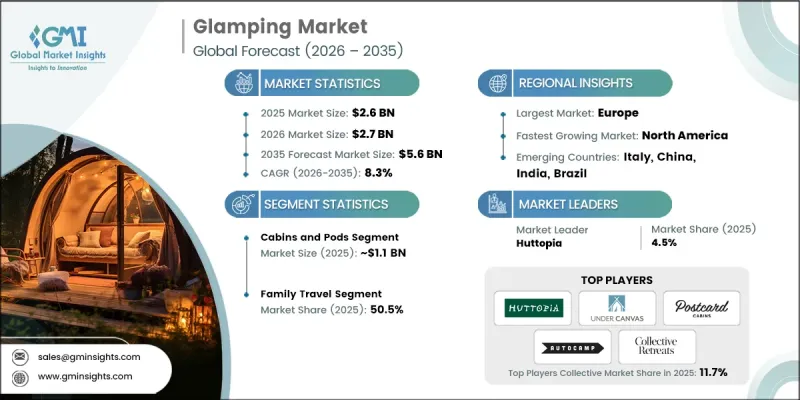
推動這一市場成長的因素是消費者對環保永續旅行體驗日益成長的需求。旅客越來越傾向於選擇能夠提供獨特戶外體驗並最大限度減少環境影響的住宿設施。包括政府、酒店業協會以及支持負責任旅遊和環保戶外住宿設施項目在內的各項永續發展舉措,正在促進豪華露營設施的發展。旨在最大限度減少環境影響並倡導負責任的戶外活動的法規和指南,也進一步支持了該行業的擴張。太陽能帳篷和採用回收及可再生材料製成的環保住宿設施等永續能源解決方案正日益受到關注,它們在不犧牲舒適度的前提下,為旅行者提供沉浸式的自然體驗,同時也滿足了人們對環保旅遊日益成長的需求。
| 市場規模 | |
|---|---|
| 開始年份 | 2025 |
| 預測期 | 2026-2035 |
| 上市時的市場規模 | 26億美元 |
| 預測金額 | 56億美元 |
| 複合年成長率 | 8.3% |
預計2035年,艙式住宿市場規模將達25億美元,2025年市場規模為11億美元。這些住宿設施將現代化的便利設施與自然環境完美融合,並配備隔熱牆、空調和設施齊全的浴室,是家庭和情侶的理想之選。艙式住宿使業者能夠提供可客製化且靈活的住宿選擇,滿足不同預算和偏好的需求,從而提升整體市場吸引力。
到2025年,家庭旅遊市場將佔據50.5%的佔有率。越來越多的家庭尋求兼具探險性和舒適性的戶外體驗,他們重視在自然中享受美好時光,同時又不犧牲便利性和安全性。豪華露營在家庭中日益流行,反映了人們對優質且便利體驗的需求,它為傳統露營提供了舒適的替代方案,同時也提供了豐富的戶外休閒機會。
到2025年,美國豪華露營市場將佔據80.5%的佔有率。該地區市場成長的主要驅動力是千禧世代和Z世代旅行者,他們更注重真實體驗而非物質享受。這群人追求「適合拍照上傳Instagram」的戶外住宿設施,例如豪華帳篷和設施齊全的露營車。此外,機構投資、夥伴關係以及與豪華露營品牌忠誠度忠誠度計畫的整合,正在提升豪華露營的專業化程度,擴大其影響力,並使其更加主流化和普及。
目錄
第1章:調查方法和範圍
第2章執行摘要
第3章業界考察
- 生態系分析
- 供應商情況
- 利潤率
- 每個階段增加的價值
- 影響價值鏈的因素
- 影響產業的因素
- 促進因素
- 豪華戶外體驗的需求日益成長
- 永續和環保旅遊越來越受歡迎。
- 可支配所得和旅遊支出增加
- 產業潛在風險與挑戰
- 較高的初始投資和維修成本
- 季節性需求波動會影響收入穩定性。
- 機會
- 位於風景優美、未受破壞的自然環境中的頂級生態豪華度假勝地。
- 體驗式和主題式豪華露營的概念
- 促進因素
- 成長潛力分析
- 未來市場趨勢
- 科技與創新趨勢
- 當前技術趨勢
- 新興技術
- 監理情勢
- 標準和合規要求
- 區域法規結構
- 認證標準
- 人工智慧和生成式人工智慧對市場的影響
- 利用人工智慧改造現有經營模式
- 針對特定領域的生成式人工智慧應用案例和實施藍圖
- 風險、限制和監管考量
- 價格分析(基於初步調查)
- 對過去價格趨勢的分析(基於初步研究)
- 根據公司類型分類的定價策略(溢價/價值/成本加成)(基於初步調查)
- 區域價格波動
- 原物料成本對定價的影響
- 波特的分析
- PESTEL 分析
第4章 競爭情勢
- 介紹
- 企業市佔率分析
- 按地區
- 企業矩陣分析
- 主要市場公司的競爭分析
- 競爭定位矩陣
- 主要進展
- 併購
- 夥伴關係與合作
- 新產品發布
- 業務拓展計劃
第5章 市場估算與預測:依產品類型分類,2022-2035年
- 艙室和吊艙
- 帳篷
- 蒙古包
- 樹屋
- 氣流
- 其他
第6章 市場估價與預測:依預約模式分類,2022-2035年
- 直接預訂
- 透過OTA和平台預訂
- 旅行社提供的旅遊套餐
第7章 市場估計與預測:依價格分類,2022-2035年
- 低價位
- 中價位
- 高價位範圍
第8章 市場估計與預測:依應用領域分類,2022-2035年
- 家庭旅行
- 情侶旅行
- 獨自旅行
- 健康靜修
- 其他
第9章 市場估價與預測:依通路分類,2022-2035年
- 線上
- 電子商務
- 企業網站
- 離線
- 超級市場/大賣場
- 專賣店
- 其他(個體店、百貨公司等)
第10章 市場估價與預測:依地區分類,2022-2035年
- 北美洲
- 美國
- 加拿大
- 歐洲
- 德國
- 法國
- 英國
- 義大利
- 西班牙
- 亞太地區
- 中國
- 印度
- 日本
- 韓國
- 澳洲
- 拉丁美洲
- 巴西
- 墨西哥
- 阿根廷
- 中東和非洲
- 南非
- 沙烏地阿拉伯
- 阿拉伯聯合大公國
第11章:公司簡介
- AutoCamp
- Beckons Collection
- Camp Denali
- Collective Retreats
- Conestoga Ranch
- Firelight Camps
- Huttopia
- Paperbark Camp
- Paws Up
- Postcard Cabins
- Tanja Lagoon Camp
- Terramor Outdoor Resort
- Under Canvas
- Westgate River Ranch
- Wigwam Holidays
The Global Glamping Market was valued at USD 2.6 billion in 2025 and is estimated to grow at a CAGR of 8.3% to reach USD 5.6 billion by 2035.
The market growth is driven by rising consumer demand for eco-friendly and sustainable travel experiences. Travelers increasingly prefer accommodations that minimize environmental impact while offering unique outdoor experiences. Governments, hospitality associations, and sustainability initiatives, including programs supporting responsible tourism and eco-conscious outdoor lodging, are encouraging the development of glamping sites. Regulations and guidelines, such as those promoting minimal environmental impact and responsible outdoor use, have further supported industry expansion. Sustainable energy solutions like solar-powered tents and eco-friendly accommodations crafted from recycled or renewable materials are gaining traction, providing travelers with immersive nature experiences without compromising comfort, while meeting the growing demand for environmentally responsible tourism.
| Market Scope | |
|---|---|
| Start Year | 2025 |
| Forecast Year | 2026-2035 |
| Start Value | $2.6 Billion |
| Forecast Value | $5.6 Billion |
| CAGR | 8.3% |
The cabins and pods segment accounted for USD 1.1 billion in 2025 and is expected to reach USD 2.5 billion by 2035. These accommodations combine modern amenities with natural surroundings, offering insulated walls, climate control, and full bathroom facilities, making them ideal for families and couples. Cabins and pods allow operators to provide customizable and flexible lodging options, catering to various budgets and preferences, and increasing overall market appeal.
The family travel segment held a 50.5% share in 2025. Families are increasingly seeking outdoor experiences that blend adventure with comfort, allowing quality time in nature without sacrificing convenience or safety. The growing popularity of glamping among families reflects the demand for premium yet accessible experiences, offering a comfortable alternative to traditional camping while providing ample opportunities for outdoor recreation.
U.S. Glamping Market captured 80.5% share in 2025. Market growth in the region is fueled by Millennials and Gen Z travelers who prioritize authentic, experience-driven stays over material possessions. This demographic seeks "Instagrammable" outdoor accommodations like luxury tents and fully equipped pods. Additionally, institutional investments, partnerships, and integration of glamping brands into loyalty programs have professionalized the sector, expanding its reach and making glamping more mainstream and accessible.
Key players operating in the Global Glamping Market include AutoCamp, Westgate River Ranch, Beckons Collection, Camp Denali, Collective Retreats, Conestoga Ranch, Firelight Camps, Huttopia, Paperbark Camp, Paws Up, Postcard Cabins, Tanja Lagoon Camp, Terramor Outdoor Resort, Under Canvas, and Wigwam Holidays. Key strategies adopted by companies in the Glamping Market include expanding their portfolio of eco-friendly and customizable lodging options, leveraging technology to enhance the guest experience, and forming strategic alliances with hospitality networks to increase visibility and access to loyal customer bases. Operators focus on developing premium yet sustainable accommodations to appeal to Millennials and Gen Z travelers while maintaining flexibility for family-oriented and mid-range offerings. Marketing campaigns emphasize experiential travel and social media engagement, and companies invest in operational efficiency through modular and scalable lodging solutions. Strategic partnerships with tourism boards, loyalty programs, and travel platforms also strengthen market presence and enhance brand recognition across competitive regions.
Table of Contents
Chapter 1 Methodology & Scope
- 1.1 Research approach
- 1.2 Quality Commitments
- 1.3 GMI AI policy & data integrity commitment
- 1.3.1 Source consistency protocol
- 1.4 Research Trail & Confidence Scoring
- 1.4.1 Research Trail Components
- 1.4.2 Scoring Components
- 1.5 Data Collection
- 1.5.1 Partial list of primary sources
- 1.6 Data mining sources
- 1.7 Paid sources
- 1.7.1 Sources, by region
- 1.8 Base estimates and calculations
- 1.8.1 Base year calculation for any one approach
- 1.9 Forecast model
- 1.9.1 Quantified market impact analysis
- 1.9.1.1 Mathematical impact of growth parameters on forecast
- 1.9.1 Quantified market impact analysis
- 1.10 Research transparency addendum
- 1.10.1 Source attribution framework
- 1.10.2 Quality assurance metrics
- 1.10.3 Our commitment to trust
Chapter 2 Executive Summary
- 2.1 Industry 360° synopsis
- 2.2 Key market trends
- 2.2.1 Regional
- 2.2.2 Accommodation type
- 2.2.3 Booking model
- 2.2.4 Price
- 2.2.5 Application
Chapter 3 Industry Insights
- 3.1 Industry ecosystem analysis
- 3.1.1 Supplier landscape
- 3.1.2 Profit margin
- 3.1.3 Value addition at each stage
- 3.1.4 Factor affecting the value chain
- 3.2 Industry impact forces
- 3.2.1 Growth drivers
- 3.2.1.1 Rising demand for luxury outdoor experiences
- 3.2.1.2 Increasing popularity of sustainable and eco-friendly tourism
- 3.2.1.3 Growth in disposable income and travel spending
- 3.2.2 Industry pitfalls & challenges
- 3.2.2.1 High initial investment and maintenance costs
- 3.2.2.2 Seasonal demand fluctuations affecting revenue stability
- 3.2.3 Opportunities
- 3.2.3.1 Premium eco-luxury retreats in underserved natural destinations
- 3.2.3.2 Experiential, theme-based glamping concepts
- 3.2.1 Growth drivers
- 3.3 Growth potential analysis
- 3.4 Future market trends
- 3.5 Technology and innovation landscape
- 3.5.1 Current technological trends
- 3.5.2 Emerging technologies
- 3.6 Regulatory landscape
- 3.6.1 Standards and compliance requirements
- 3.6.2 Regional regulatory frameworks
- 3.6.3 Certification standards
- 3.7 Impact of AI & generative AI on the market
- 3.7.1 AI-driven disruption of existing business models
- 3.7.2 Gen AI use cases & adoption roadmap by segment
- 3.7.3 Risks, limitations & regulatory considerations
- 3.8 Pricing analysis (driven by primary research)
- 3.8.1 Historical price trend analysis (driven by primary research)
- 3.8.2 Pricing strategy by player type (premium / value / cost-plus) (driven by primary research)
- 3.8.3 Regional price variations
- 3.8.4 Impact of raw material costs on pricing
- 3.9 Porter’s analysis
- 3.10 PESTEL analysis
Chapter 4 Competitive Landscape, 2025
- 4.1 Introduction
- 4.2 Company market share analysis
- 4.2.1 By region
- 4.2.1.1 North America
- 4.2.1.2 Europe
- 4.2.1.3 Asia Pacific
- 4.2.1.4 Latin America
- 4.2.1.5 Middle East and Africa
- 4.2.1 By region
- 4.3 Company matrix analysis
- 4.4 Competitive analysis of major market players
- 4.5 Competitive positioning matrix
- 4.6 Key developments
- 4.6.1 Mergers & acquisitions
- 4.6.2 Partnerships & collaborations
- 4.6.3 New product launches
- 4.6.4 Expansion plans
Chapter 5 Market Estimates & Forecast, By Product type, 2022-2035 (USD Billion)
- 5.1 Key trends
- 5.2 Cabins and pods
- 5.3 Tents
- 5.4 Yurts
- 5.5 Treehouses
- 5.6 Airstreams
- 5.7 Others
Chapter 6 Market Estimates & Forecast, By Booking Model, 2022-2035 (USD Billion)
- 6.1 Key trends
- 6.2 Direct booking
- 6.3 OTA & platform booking
- 6.4 Tour operator packages
Chapter 7 Market Estimates & Forecast, By Price, 2022-2035 (USD Billion)
- 7.1 Key trends
- 7.2 Low
- 7.3 Medium
- 7.4 High
Chapter 8 Market Estimates & Forecast, By Application, 2022-2035 (USD Billion)
- 8.1 Key trends
- 8.2 Family travel
- 8.3 Couples' getaways
- 8.4 Solo travel
- 8.5 Wellness retreats
- 8.6 Others
Chapter 9 Market Estimates & Forecast, By Distribution Channel, 2022-2035 (USD Billion)
- 9.1 Key trends
- 9.2 Online
- 9.2.1 E-Commerce
- 9.2.2 Company website
- 9.3 Offline
- 9.3.1 Supermarkets/Hypermarkets
- 9.3.2 Specialty Stores
- 9.3.3 Others (Individual stores, Departmental stores, etc.)
Chapter 10 Market Estimates & Forecast, By Region, 2022-2035 (USD Billion)
- 10.1 Key trends
- 10.2 North America
- 10.2.1 U.S.
- 10.2.2 Canada
- 10.3 Europe
- 10.3.1 Germany
- 10.3.2 France
- 10.3.3 UK
- 10.3.4 Italy
- 10.3.5 Spain
- 10.4 Asia Pacific
- 10.4.1 China
- 10.4.2 India
- 10.4.3 Japan
- 10.4.4 South Korea
- 10.4.5 Australia
- 10.5 Latin America
- 10.5.1 Brazil
- 10.5.2 Mexico
- 10.5.3 Argentina
- 10.6 MEA
- 10.6.1 South Africa
- 10.6.2 Saudi Arabia
- 10.6.3 UAE
Chapter 11 Company Profiles
- 11.1 AutoCamp
- 11.2 Beckons Collection
- 11.3 Camp Denali
- 11.4 Collective Retreats
- 11.5 Conestoga Ranch
- 11.6 Firelight Camps
- 11.7 Huttopia
- 11.8 Paperbark Camp
- 11.9 Paws Up
- 11.10 Postcard Cabins
- 11.11 Tanja Lagoon Camp
- 11.12 Terramor Outdoor Resort
- 11.13 Under Canvas
- 11.14 Westgate River Ranch
- 11.15 Wigwam Holidays

 全球豪華露營市場規模、佔有率、趨勢和成長分析報告(2026-2034年)豪華露營市場規模、佔有率、成長、全球產業分析、區域趨勢及2026年至2034年預測。
 豪華露營市場-2026-2032年全球市場預測全球豪華露營帳篷市場規模、佔有率、趨勢和成長分析報告(2026-2034)
 豪華露營市場-全球產業規模、佔有率、趨勢、機會和預測:按住宿類型、規模、用途、地區和競爭情況分類,2021-2031年
 日本豪華露營市場報告:按類型、年齡層、規模和地區分類(2026-2034年)
 豪華露營市場規模、佔有率和成長分析(按住宿設施類型、年齡層、規模、預訂方式和地區分類)-2026-2033年產業預測