


 |
市場調查報告書
商品編碼
2027543
酵母菌飲料市場機會、成長促進因素、產業趨勢分析及預測(2026-2035年)Yogurt Drinks Market Opportunity, Growth Drivers, Industry Trend Analysis, and Forecast 2026 - 2035 |
||||||

2025年全球酵母菌飲料市場規模預估為629億美元,預估至2035年將達973億美元,年複合成長率為4.3%。
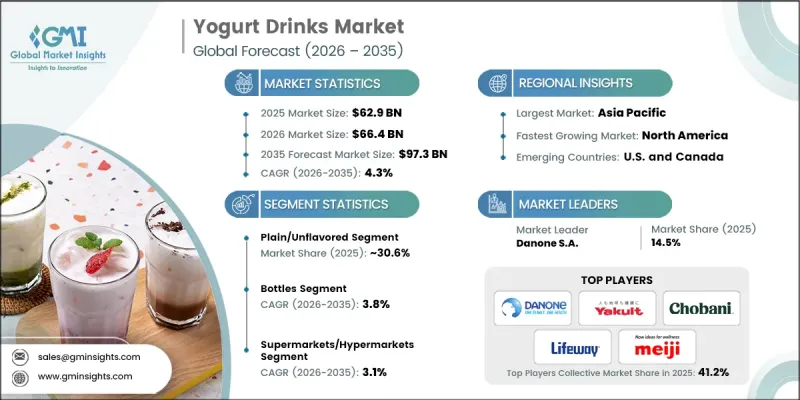
市場成長主要受消費者健康意識提升的驅動,尤其是對有助於消化、免疫力和促進整體健康的機能飲料的需求。隨著越來越多的消費者尋求不含乳製品的飲品以滿足純素食主義和乳糖不耐受人群的需求,人們對植物來源替代品的興趣日益濃厚,從而擴大了市場規模。同時,製造商正致力於創新,例如在酵母菌飲料中添加營養成分、維生素和益生菌,以增強其功能性。口味多樣化持續吸引廣泛的消費群體,而包裝創新則提升了產品的便利性和永續性。瓶裝產品憑藉其便攜性和品牌優勢仍然佔據主導地位,但其他包裝方式也越來越受到注重環保的消費者的青睞。這些趨勢共同表明,消費者正朝著高階、健康、便利的飲料解決方案轉變,而這正是推動市場持續擴張的關鍵因素。
| 市場範圍 | |
|---|---|
| 開始年份 | 2025 |
| 預測期 | 2026-2035 |
| 起始金額 | 629億美元 |
| 預測金額 | 973億美元 |
| 複合年成長率 | 4.3% |
預計到2025年,原味或無味酵母菌飲料市佔率將達到30.6%,並在2035年之前以2.6%的複合年成長率成長。這個細分市場持續吸引注重健康的消費者,他們優先考慮低糖、高蛋白質以及益生菌的益處。整個酵母菌飲料市場不斷發展,推出各種口味以滿足不同消費者的偏好和飲食需求,確保各個細分市場需求的穩定。
預計到2025年,瓶裝產品市佔率將達到44.3%,並在2026年至2035年間以3.8%的複合年成長率成長。其受歡迎程度主要得益於易用性、便攜性以及在多種零售通路的廣泛覆蓋範圍。瓶裝產品也提供了強大的品牌推廣機會,使生產商能夠有效地傳達其產品的益處和營養價值。此外,為了滿足消費者對便利性和環保解決方案的需求,各種替代包裝形式不斷湧現,推動產品展示方式的持續創新。
預計2026年至2035年,北美酵母菌飲料市場將以4.8%的複合年成長率成長。該地區市場成熟且持續擴張,主要受消費者對機能飲料和高階飲料的強勁需求所驅動。日益增強的健康意識以及對創新高附加價值產品的偏好,正在推動市場擴張。美國和加拿大在引領市場趨勢方面發揮主導作用,尤其是在植物來源配方和益生菌飲料領域。完善的零售網路,包括超級市場、便利商店和不斷發展的電商平台,為產品分銷提供了有力支持,並提升了產品供應和品牌知名度。
目錄
第1章:調查方法和範圍
第2章執行摘要
第3章業界考察
- 產業生態系分析
- 供應商情況
- 利潤率
- 每個階段增加的價值
- 影響價值鏈的因素
- 中斷
- 影響產業的因素
- 成長促進因素
- 全球消費者對有益於消化健康和免疫力的益生菌飲料的需求正在成長。
- 我們不斷擴大風味優格酵母菌飲料產品線,吸引了全球年輕消費者和各種不同口味的消費者。
- 全球範圍內有組織的零售和電子商務分銷管道的快速成長。
- 產業潛在風險與挑戰
- 對先進冷凍和低溫運輸物流日益成長的需求正在推高全球配送成本。
- 消費者對乳糖不耐症問題的日益關注正在抑制傳統乳製品優格酵母菌飲料的消費。
- 來自植物來源益生菌飲料和替代機能飲料。
- 市場機遇
- 消費者對添加益生菌、維生素和營養素的機能飲料的需求不斷成長。
- 受都市化和生活方式改變的推動,亞太地區市場快速擴張。
- 永續包裝和攜帶式包裝的創新正在提升消費者的便利性和吸引力。
- 成長促進因素
- 成長潛力分析
- 監理情勢
- 北美洲
- 歐洲
- 亞太地區
- 拉丁美洲
- 中東和非洲
- 波特的分析
- PESTEL 分析
- 價格趨勢
- 按地區
- 按口味
- 未來市場趨勢
- 科技與創新趨勢
- 當前技術趨勢
- 新興技術
- 專利趨勢
- 貿易統計(HS編碼)
- 主要進口國
- 主要出口國
- 永續性和環境方面
- 永續計劃
- 減少廢棄物策略
- 生產中的能源效率
- 具有環保意識的舉措
第4章 競爭情勢
- 介紹
- 企業市佔率分析
- 按地區
- 北美洲
- 歐洲
- 亞太地區
- 拉丁美洲
- 中東和非洲
- 按地區
- 企業矩陣分析
- 主要市場公司的競爭分析
- 競爭定位矩陣
- 主要進展
- 併購
- 夥伴關係與合作
- 新產品發布
- 業務拓展計劃
第5章 市場估價與預測:依口味類型分類,2022-2035年
- 無香/無香料
- 草莓
- 藍莓
- 芒果
- 桃
- 香草
- 混合漿果
- 其他
第6章 市場估價與預測:依包裝類型分類,2022-2035年
- 瓶子
- 利樂包裝/紙盒
- 杯子和容器
- 軟性袋
- 高階及特色產品
第7章 市場估價與預測:依通路分類,2022-2035年
- 超級市場/大賣場
- 便利商店
- 健康有機食品專賣店
- 線上零售商/電子商務
- 食品服務業
- 藥學與醫療保健
- 其他
第8章 市場估計與預測:依地區分類,2022-2035年
- 北美洲
- 美國
- 加拿大
- 歐洲
- 德國
- 英國
- 法國
- 西班牙
- 義大利
- 其他歐洲地區
- 亞太地區
- 中國
- 印度
- 日本
- 澳洲
- 韓國
- 亞太其他地區
- 拉丁美洲
- 巴西
- 墨西哥
- 阿根廷
- 其他拉丁美洲地區
- 中東和非洲
- 沙烏地阿拉伯
- 南非
- 阿拉伯聯合大公國
- 其他中東和非洲地區
第9章:公司簡介
- Arla Foods
- Chobani LLC
- Danone SA
- Fonterra Co-operative Group
- Lifeway Foods Inc.
- Meiji Holdings Co., Ltd.
- Morinaga Milk Industry
- Muller Group(UK)
- Nestle SA
- Nippon Luna Co., Ltd.
- Yakult Honsha Co., Ltd.
- Yotsuba Milk Products
The Global Yogurt Drinks Market was valued at USD 62.9 billion in 2025 and is estimated to grow at a CAGR of 4.3% to reach USD 97.3 billion by 2035.
Market growth is driven by rising consumer awareness of health and wellness, particularly the demand for functional beverages that support digestion, immunity, and overall well-being. Increasing interest in plant-based alternatives is expanding the market, as consumers seek dairy-free options aligned with vegan lifestyles and lactose-free dietary preferences. At the same time, manufacturers are focusing on innovation by enriching yogurt drinks with added nutrients, vitamins, and probiotics to enhance their functional appeal. Flavor diversification continues to attract a broad consumer base, while packaging innovations are improving convenience and sustainability. Bottled formats remain dominant due to portability and branding advantages, while alternative packaging options are gaining traction among consumers seeking environmentally responsible choices. These combined trends highlight a shift toward premium, health-focused, and convenient beverage solutions that continue to shape market expansion.
| Market Scope | |
|---|---|
| Start Year | 2025 |
| Forecast Year | 2026-2035 |
| Start Value | $62.9 Billion |
| Forecast Value | $97.3 Billion |
| CAGR | 4.3% |
The plain or unflavored yogurt drinks segment accounted for 30.6% share in 2025 and is expected to grow at a CAGR of 2.6% through 2035. This segment remains highly relevant among health-conscious consumers who prioritize low sugar content, high protein levels, and probiotic benefits. The broader yogurt drinks market continues to evolve with a wide variety of flavor profiles designed to meet diverse consumer preferences and dietary requirements, ensuring consistent demand across multiple segments.
The bottles segment held a 44.3% share in 2025 and is projected to grow at a CAGR of 3.8% from 2026 to 2035. Their widespread adoption is supported by ease of use, portability, and availability across multiple retail channels. Bottles also provide strong branding opportunities, allowing manufacturers to effectively communicate product benefits and nutritional value. In addition, alternative packaging formats are emerging to meet the needs of consumers seeking convenience and environmentally friendly solutions, contributing to ongoing innovation in product presentation.
North America Yogurt Drinks Market is expected to grow at a CAGR of 4.8% during 2026 to 2035. The region represents a mature yet expanding market, supported by strong consumer demand for functional and premium beverages. Increasing awareness of health benefits, combined with a preference for innovative and value-added products, is driving adoption. The United States and Canada play a leading role in shaping market trends, particularly in the areas of plant-based formulations and probiotic beverages. Distribution is supported by a well-developed retail network, including supermarkets, convenience stores, and growing e-commerce platforms, which enhance product accessibility and visibility.
Key players operating in the Global Yogurt Drinks Market include Danone S.A., Nestle S.A., Yakult Honsha Co., Ltd., Chobani LLC, Arla Foods, Fonterra Co-operative Group, Lifeway Foods Inc., Meiji Holdings Co., Ltd., Morinaga Milk Industry, Muller Group (UK), Nippon Luna Co., Ltd., and Yotsuba Milk Products. Companies in the Yogurt Drinks Market are implementing strategies such as expanding product portfolios with functional and plant-based offerings to meet evolving consumer preferences. Investments in research and development are enabling the creation of innovative formulations with enhanced nutritional benefits and improved taste profiles. Strategic partnerships and distribution agreements are helping companies strengthen their global reach and improve market penetration. Brands are also focusing on sustainable packaging solutions and eco-friendly production methods to align with environmental goals. Additionally, marketing initiatives that emphasize health benefits, convenience, and premium quality are being used to attract and retain consumers, while digital platforms are leveraged to boost brand visibility and engagement.
Table of Contents
Chapter 1 Methodology & Scope
- 1.1 Research approach
- 1.2 Quality Commitments
- 1.2.1 GMI AI policy & data integrity commitment
- 1.2.1.1 Source consistency protocol
- 1.2.1 GMI AI policy & data integrity commitment
- 1.3 Research Trail & Confidence Scoring
- 1.3.1 Research Trail Components
- 1.3.2 Scoring Components
- 1.4 Data Collection
- 1.4.1 Partial list of primary sources
- 1.5 Data mining sources
- 1.5.1 Paid sources
- 1.5.1.1 Sources, by region
- 1.5.1 Paid sources
- 1.6 Base estimates and calculations
- 1.6.1 Base year calculation for any one approach
- 1.7 Forecast model
- 1.7.1 Quantified market impact analysis
- 1.7.1.1 Mathematical impact of growth parameters on forecast
- 1.7.1 Quantified market impact analysis
- 1.8 Research transparency addendum
- 1.8.1 Source attribution framework
- 1.8.2 Quality assurance metrics
- 1.8.3 Our commitment to trust
Chapter 2 Executive Summary
- 2.1 Industry 360° synopsis
- 2.2 Key market trends
- 2.2.1 Regional
- 2.2.2 Flavor Type
- 2.2.3 Packaging Type
- 2.2.4 Distribution Channel
- 2.3 TAM Analysis, 2025-2034
- 2.4 CXO perspectives: Strategic imperatives
Chapter 3 Industry Insights
- 3.1 Industry ecosystem analysis
- 3.1.1 Supplier landscape
- 3.1.2 Profit margin
- 3.1.3 Value addition at each stage
- 3.1.4 Factor affecting the value chain
- 3.1.5 Disruptions
- 3.2 Industry impact forces
- 3.2.1 Growth drivers
- 3.2.1.1 Rising consumer preference for probiotic beverages supporting digestive health and immunity worldwide
- 3.2.1.2 Expanding flavored yogurt drink varieties attracting younger consumers and diverse taste preferences globally
- 3.2.1.3 Rapid growth of organized retail and e-commerce distribution channels globally
- 3.2.2 Industry pitfalls and challenges
- 3.2.2.1 High refrigeration and cold chain logistics requirements increasing distribution costs globally
- 3.2.2.2 Rising lactose intolerance concerns among consumers limiting traditional dairy yogurt drink consumption
- 3.2.2.3 Intense competition from plant-based probiotic beverages and alternative functional drinks
- 3.2.3 Market opportunities
- 3.2.3.1 Increasing demand for functional beverages with probiotics vitamins and added nutrients
- 3.2.3.2 Rapid market expansion across Asia Pacific driven by urbanization and lifestyle changes
- 3.2.3.3 Innovation in sustainable packaging and portable formats improving consumer convenience and appeal
- 3.2.1 Growth drivers
- 3.3 Growth potential analysis
- 3.4 Regulatory landscape
- 3.4.1 North America
- 3.4.2 Europe
- 3.4.3 Asia Pacific
- 3.4.4 Latin America
- 3.4.5 Middle East & Africa
- 3.5 Porter’s analysis
- 3.6 PESTEL analysis
- 3.7 Price trends
- 3.7.1 By region
- 3.7.2 By flavor
- 3.8 Future market trends
- 3.9 Technology and Innovation landscape
- 3.9.1 Current technological trends
- 3.9.2 Emerging technologies
- 3.10 Patent Landscape
- 3.11 Trade statistics (HS code)
- 3.11.1 Major importing countries
- 3.11.2 Major exporting countries
- 3.12 Sustainability and environmental aspects
- 3.12.1 Sustainable practices
- 3.12.2 Waste reduction strategies
- 3.12.3 Energy efficiency in production
- 3.12.4 Eco-friendly initiatives
Chapter 4 Competitive Landscape, 2025
- 4.1 Introduction
- 4.2 Company market share analysis
- 4.2.1 By region
- 4.2.1.1 North America
- 4.2.1.2 Europe
- 4.2.1.3 Asia Pacific
- 4.2.1.4 LATAM
- 4.2.1.5 MEA
- 4.2.1 By region
- 4.3 Company matrix analysis
- 4.4 Competitive analysis of major market players
- 4.5 Competitive positioning matrix
- 4.6 Key developments
- 4.6.1 Mergers & acquisitions
- 4.6.2 Partnerships & collaborations
- 4.6.3 New Product Launches
- 4.6.4 Expansion Plans
Chapter 5 Market Estimates and Forecast, By Flavor Type, 2022-2035 (USD Million) (Kilo Tons)
- 5.1 Key trends
- 5.2 Plain/Unflavored
- 5.3 Strawberry
- 5.4 Blueberry
- 5.5 Mango
- 5.6 Peach
- 5.7 Vanilla
- 5.8 Mixed Berries
- 5.9 Others
Chapter 6 Market Estimates and Forecast, By Packaging Type, 2022-2035 (USD Million) (Kilo Tons)
- 6.1 Key trends
- 6.2 Bottles
- 6.3 Tetra Packs/Cartons
- 6.4 Cups & Containers
- 6.5 Pouches & Flexible
- 6.6 Premium & Specialty
Chapter 7 Market Estimates and Forecast, By Distribution Channel, 2022-2035 (USD Million) (Kilo Tons)
- 7.1 Key trends
- 7.2 Supermarkets/Hypermarkets
- 7.3 Convenience Stores
- 7.4 Specialty Health/Organic Stores
- 7.5 Online Retailers/E-commerce
- 7.6 Foodservice Channels
- 7.7 Pharmacy & Healthcare
- 7.8 Others
Chapter 8 Market Estimates and Forecast, By Region, 2022-2035 (USD Million) (Kilo Tons)
- 8.1 Key trends
- 8.2 North America
- 8.2.1 U.S.
- 8.2.2 Canada
- 8.3 Europe
- 8.3.1 Germany
- 8.3.2 UK
- 8.3.3 France
- 8.3.4 Spain
- 8.3.5 Italy
- 8.3.6 Rest of Europe
- 8.4 Asia Pacific
- 8.4.1 China
- 8.4.2 India
- 8.4.3 Japan
- 8.4.4 Australia
- 8.4.5 South Korea
- 8.4.6 Rest of Asia Pacific
- 8.5 Latin America
- 8.5.1 Brazil
- 8.5.2 Mexico
- 8.5.3 Argentina
- 8.5.4 Rest of Latin America
- 8.6 Middle East and Africa
- 8.6.1 Saudi Arabia
- 8.6.2 South Africa
- 8.6.3 UAE
- 8.6.4 Rest of Middle East and Africa
Chapter 9 Company Profiles
- 9.1 Arla Foods
- 9.2 Chobani LLC
- 9.3 Danone S.A.
- 9.4 Fonterra Co-operative Group
- 9.5 Lifeway Foods Inc.
- 9.6 Meiji Holdings Co., Ltd.
- 9.7 Morinaga Milk Industry
- 9.8 Muller Group (UK)
- 9.9 Nestle S.A.
- 9.10 Nippon Luna Co., Ltd.
- 9.11 Yakult Honsha Co., Ltd.
- 9.12 Yotsuba Milk Products


