

 |
市場調查報告書
商品編碼
2027495
運動服市場機會、成長要素、產業趨勢分析及2026-2035年預測Activewear Market Opportunity, Growth Drivers, Industry Trend Analysis, and Forecast 2026 - 2035 |
||||||

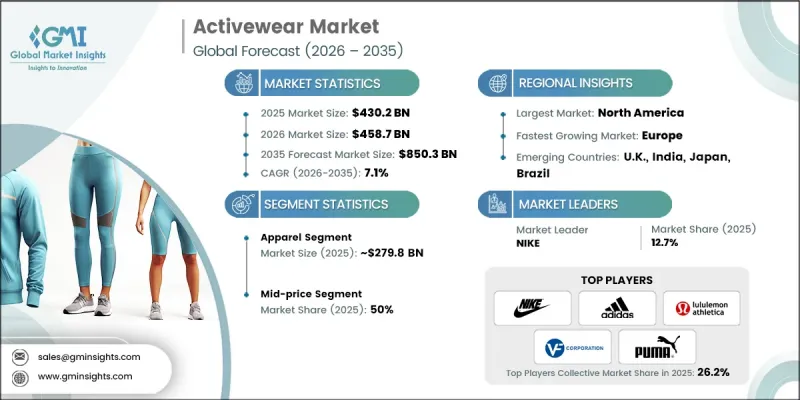
預計到 2025 年,全球運動服市場價值將達到 4,302 億美元,並以 7.1% 的複合年成長率成長,到 2035 年將達到 8,503 億美元。
隨著消費者日益重視健康、健身和整體福祉,運動服飾產業正經歷強勁成長。年輕一代將體能鍛鍊融入生活方式,尤其推動了市場需求,並持續促進產品的穩定成長。人們參與系統性健身活動的頻率增加,以及對休閒和健康生活方式的日益重視,進一步加速了市場發展勢頭。休閒的演變顯著擴大了消費群體,將高性能功能與現代時尚完美融合,使運動服成為運動之外的多種場合穿著的服裝。此外,吸濕排汗、彈性布料和耐用性等布料技術的進步也提升了這些產品的吸引力。實體店和線上通路的拓展也有助於擴大消費者覆蓋率。人們對長期健康益處的認知不斷提高,以及生活方式向便捷舒適方向的轉變,共同推動了全球不同消費群體對運動服飾產品的持續強勁需求。
| 市場範圍 | |
|---|---|
| 開始年份 | 2025 |
| 預測期 | 2026-2035 |
| 初始市場規模 | 4302億美元 |
| 預測金額 | 8503億美元 |
| 複合年成長率 | 7.1% |
預計到2025年,服裝業銷售額將達到2,798億美元,到2035年將達到5,544億美元。該行業憑藉其多功能性、頻繁的購買週期和廣泛的消費者支持,正引領市場成長。運動服飾已成為日常衣櫥中不可或缺的一部分,這主要得益於消費者對兼具舒適性、時尚性和功能性的產品的需求不斷成長。休閒風潮的持續發展進一步推動了需求,消費者越來越傾向於選擇能夠輕鬆應對各種日常活動的服裝。
到2025年,中價位產品將佔據50%的市場。該細分市場憑藉其兼具價格優勢與品質的產品,深受廣大消費者的喜愛。這類產品兼具耐用性、舒適性和時尚感,既適合運動人士,也適合日常穿著。適中的價格區間持續支撐著高銷量和廣泛的市場滲透。
到2025年,美國運動服飾市佔率將達到75.3%。美國市場的成長主要得益於根深蒂固的健身文化、日益成長的健康活動參與度以及消費者強大的購買力。數位健身平台和互聯訓練生態系統的蓬勃發展進一步推動了對高性能運動服飾的需求。強大的品牌認知度、持續的產品創新以及完善的電商基礎設施也為市場的持續擴張做出了貢獻。人們對預防性醫療保健的日益關注以及以生活方式主導的消費行為,也持續推動全部區域的重複購買。
目錄
第1章:調查方法和範圍
第2章執行摘要
第3章業界考察
- 生態系分析
- 供應商情況
- 利潤率
- 每個階段增加的價值
- 影響價值鏈的因素
- 影響產業的因素
- 促進因素
- 休閒和休閒服的需求日益成長
- 擴展客製化和個人化
- 可支配所得增加
- 產業潛在風險與挑戰
- 原物料價格波動
- 消費者偏好快速變化
- 機會
- 以永續發展主導導向的高階解決方案
- 年輕消費者對快時尚的需求日益成長
- 促進因素
- 成長潛力分析
- 未來市場趨勢
- 科技與創新趨勢
- 當前技術趨勢
- 新興技術
- 監理情勢
- 標準和合規要求
- 區域法規結構
- 認證標準
- 貿易數據分析
- 進出口量及進口額趨勢
- 主要貿易走廊及關稅的影響
- 人工智慧和生成式人工智慧對市場的影響
- 利用人工智慧改造現有經營模式
- 針對特定領域的生成式人工智慧應用案例和實施藍圖
- 風險、限制和監管考量
- 波特的分析
- PESTEL 分析
- 消費行為分析
- 購買模式
- 偏好分析
- 不同地區的消費行為差異
- 電子商務對購買決策的影響
第4章 競爭情勢
- 介紹
- 企業市佔率分析
- 按地區
- 企業矩陣分析
- 主要市場公司的競爭分析
- 競爭定位矩陣
- 主要進展
- 併購
- 夥伴關係與合作
- 新產品發布
- 業務拓展計劃
第5章 市場估算與預測:依產品類型分類,2022-2035年
- 服飾
- 頂部
- T恤
- 背心
- 運動胸罩
- 夾克
- 運動衫
- 其他物品(運動服、泳裝)
- 底部
- 貼身褲
- 概述
- 運動褲
- 運動褲
- 其他物品(瑜珈褲、裙子)
- 頂部
- 鞋類
- 配件
- 帽子
- 手套
- 其他(腕帶、腰帶)
第6章 市場估計與預測:依應用領域分類,2022-2035年
- 跑步
- 戶外運動
- 瑜珈和皮拉提斯
- 健身房和健身訓練
- 休閒活動
- 其他
第7章 市場估計與預測:依價格分類,2022-2035年
- 低價位
- 中號
- 高價位範圍
第8章 市場估算與預測:依消費群組分類,2022-2035年
- 適合兒童
- 男性
- 女士
第9章 市場估價與預測:依通路分類,2022-2035年
- 線上
- 電子商務
- 企業網站
- 離線
- 超級市場/大賣場
- 專賣店
- 其他(個體店、百貨公司等)
第10章 市場估價與預測:依地區分類,2022-2035年
- 北美洲
- 美國
- 加拿大
- 歐洲
- 德國
- 法國
- 英國
- 義大利
- 西班牙
- 亞太地區
- 中國
- 印度
- 日本
- 韓國
- 澳洲
- 拉丁美洲
- 巴西
- 墨西哥
- 阿根廷
- 中東和非洲(MEA)
- 南非
- 沙烏地阿拉伯
- 阿拉伯聯合大公國
第11章:公司簡介
- Adidas AG
- ASICS Corporation
- ASOS PLC
- Champion
- Columbia Sportswear Company
- Fila Holdings Corporation
- Gymshark
- Lululemon Athletica Inc.
- New Balance
- NIKE
- Patagonia
- PUMA SE
- Skechers
- Squat Wolf
- Under Armour Inc.
- VF Corporation
The Global Activewear Market was valued at USD 430.2 billion in 2025 and is estimated to grow at a CAGR of 7.1% to reach USD 850.3 billion by 2035.
The industry is witnessing strong expansion as consumers increasingly prioritize health, fitness, and overall well-being as part of their daily routines. Demand is particularly influenced by younger demographics who are integrating physical activity into their lifestyles, which continues to drive consistent product adoption. Growing participation in structured fitness activities, along with rising engagement in recreational and wellness-focused routines, is further accelerating market momentum. The evolution of athleisure has significantly broadened the consumer base by blending performance-driven functionality with modern fashion aesthetics, making activewear suitable for multiple occasions beyond exercise. Additionally, advancements in fabric technology, including moisture management, stretchability, and durability, are enhancing product appeal. Expanding retail accessibility through both physical and digital channels is also contributing to higher consumer reach. Increasing awareness around long-term health benefits, coupled with lifestyle shifts toward convenience and comfort, continues to strengthen the global demand outlook for activewear products across diverse consumer segments.
| Market Scope | |
|---|---|
| Start Year | 2025 |
| Forecast Year | 2026-2035 |
| Start Value | $430.2 Billion |
| Forecast Value | $850.3 Billion |
| CAGR | 7.1% |
The apparel segment generated USD 279.8 billion in 2025 and is anticipated to reach USD 554.4 billion by 2035. This segment leads the market due to its versatility, frequent purchase cycles, and widespread consumer adoption. Activewear clothing has become an integral part of everyday wardrobes, supported by rising demand for products that combine comfort, style, and performance. The continued growth of athleisure trends is further reinforcing demand, as consumers increasingly prefer apparel that can seamlessly transition across different daily activities.
The mid-price segment accounted for 50% share in 2025. This segment appeals to a wide range of consumers by offering a balanced combination of affordability and quality. Products in this category are designed to deliver durability, comfort, and contemporary styling, making them suitable for both active users and general lifestyle wear. The accessibility of mid-range pricing continues to support high-volume sales and broad market penetration.
United States Activewear Market held 75.3% share in 2025. Growth in the country is driven by a strong culture of fitness participation, increasing engagement in wellness-oriented activities, and high consumer spending capacity. The widespread adoption of digital fitness platforms and connected training ecosystems is further supporting demand for performance-oriented apparel. Strong brand visibility, ongoing product innovation, and a well-established e-commerce infrastructure are also contributing to sustained market expansion. Increasing focus on preventive health and lifestyle-driven purchasing behavior continues to encourage repeat consumption across the region.
Key companies operating in the Global Activewear Market include Nike, Adidas AG, Puma SE, Under Armour Inc., Lululemon Athletica Inc., ASICS Corporation, New Balance, Gymshark, Skechers, VF Corporation, Columbia Sportswear Company, Fila Holdings Corporation, Patagonia, ASOS PLC, Champion, and Squat Wolf. Companies in the Activewear Market are focusing on strengthening their competitive position through continuous product innovation and brand differentiation. They are investing heavily in advanced fabric technologies to enhance performance features such as breathability, flexibility, and durability. Strategic collaborations with influencers and fitness communities are being used to expand brand reach and engage younger audiences. Businesses are also prioritizing direct-to-consumer channels and digital platforms to improve customer experience and build stronger brand loyalty. Expanding product portfolios to include athleisure collections is helping companies tap into lifestyle-driven demand. Additionally, firms are emphasizing sustainability by incorporating recycled materials and responsible sourcing practices.
Table of Contents
Chapter 1 Methodology & Scope
- 1.1 Research approach
- 1.2 Quality Commitments
- 1.3 GMI AI policy & data integrity commitment
- 1.3.1 Source consistency protocol
- 1.4 Research Trail & Confidence Scoring
- 1.4.1 Research Trail Components
- 1.4.2 Scoring Components
- 1.5 Data Collection
- 1.5.1 Partial list of primary sources
- 1.6 Data mining sources
- 1.7 Paid sources
- 1.7.1 Sources, by region
- 1.8 Base estimates and calculations
- 1.8.1 Base year calculation for any one approach
- 1.9 Forecast model
- 1.9.1 Quantified market impact analysis
- 1.9.1.1 Mathematical impact of growth parameters on forecast
- 1.9.1 Quantified market impact analysis
- 1.10 Research transparency addendum
- 1.10.1 Source attribution framework
- 1.10.2 Quality assurance metrics
- 1.10.3 Our commitment to trust
Chapter 2 Executive Summary
- 2.1 Industry 360° synopsis
- 2.2 Key market trends
- 2.2.1 Regional
- 2.2.2 Product Type
- 2.2.3 Usage
- 2.2.4 Price
- 2.2.5 Consumer Group
- 2.2.6 Distribution Channel
Chapter 3 Industry Insights
- 3.1 Industry ecosystem analysis
- 3.1.1 Supplier landscape
- 3.1.2 Profit margin
- 3.1.3 Value addition at each stage
- 3.1.4 Factor affecting the value chain
- 3.2 Industry impact forces
- 3.2.1 Growth drivers
- 3.2.1.1 Rising demand for athleisure and casual wear
- 3.2.1.2 Growth of customization and personalization
- 3.2.1.3 Increased disposable income
- 3.2.2 Industry pitfalls & challenges
- 3.2.2.1 Price volatility of raw materials
- 3.2.2.2 Rapid change in consumer preference
- 3.2.3 Opportunities
- 3.2.3.1 Sustainability-driven premium solutions
- 3.2.3.2 Rising demand from younger consumers for fast fashion
- 3.2.1 Growth drivers
- 3.3 Growth potential analysis
- 3.4 Future market trends
- 3.5 Technology and innovation landscape
- 3.5.1 Current technological trends
- 3.5.2 Emerging technologies
- 3.6 Regulatory landscape
- 3.6.1 Standards and compliance requirements
- 3.6.2 Regional regulatory frameworks
- 3.6.3 Certification standards
- 3.7 Trade data analysis
- 3.7.1 Import/export volume & value trends
- 3.7.2 Key trade corridors & tariff impact
- 3.8 Impact of AI & generative AI on the market
- 3.8.1 AI-driven disruption of existing business models
- 3.8.2 Gen AI use cases & adoption roadmap by segment
- 3.8.3 Risks, limitations & regulatory considerations
- 3.9 Porter’s analysis
- 3.10 PESTEL analysis
- 3.11 Consumer behaviour analysis
- 3.11.1 Purchasing patterns
- 3.11.2 Preference analysis
- 3.11.3 Regional variations in consumer behaviour
- 3.11.4 Impact of e-commerce on buying decisions
Chapter 4 Competitive Landscape, 2025
- 4.1 Introduction
- 4.2 Company market share analysis
- 4.2.1 By region
- 4.2.1.1 North America
- 4.2.1.2 Europe
- 4.2.1.3 Asia Pacific
- 4.2.1.4 Latin America
- 4.2.1.5 Middle East and Africa
- 4.2.1 By region
- 4.3 Company matrix analysis
- 4.4 Competitive analysis of major market players
- 4.5 Competitive positioning matrix
- 4.6 Key developments
- 4.6.1 Mergers & acquisitions
- 4.6.2 Partnerships & collaborations
- 4.6.3 New product launches
- 4.6.4 Expansion plans
Chapter 5 Market Estimates & Forecast, By Product Type, 2022-2035 (USD Billion) (Million Units)
- 5.1 Key trends
- 5.2 Apparel
- 5.2.1 Top
- 5.2.1.1 T-shirts
- 5.2.1.2 Tank tops
- 5.2.1.3 Sports bras
- 5.2.1.4 Jackets
- 5.2.1.5 Sweatshirts
- 5.2.2 Others (track suits, swimmer suits)
- 5.2.2.1 Bottom
- 5.2.2.2 Leggings
- 5.2.2.3 Shorts
- 5.2.2.4 Sweatpants
- 5.2.2.5 Track pants
- 5.2.2.6 Others (yoga pants, skirts)
- 5.2.1 Top
- 5.3 Footwear
- 5.4 Accessories
- 5.4.1 Headwear
- 5.4.2 Gloves
- 5.4.3 Others (wrist bands, waist band)
Chapter 6 Market Estimates & Forecast, By Usage, 2022-2035 (USD Billion) (Million Units)
- 6.1 Key trends
- 6.2 Running
- 6.3 Outdoor sports
- 6.4 Yoga & pilates
- 6.5 Gym & fitness training
- 6.6 Recreational activities
- 6.7 Others
Chapter 7 Market Estimates & Forecast, By Price, 2022-2035 (USD Billion) (Million Units)
- 7.1 Key trends
- 7.2 Low
- 7.3 Medium
- 7.4 High
Chapter 8 Market Estimates & Forecast, By Consumer Group, 2022-2035 (USD Billion) (Million Units)
- 8.1 Key trends
- 8.2 Kids
- 8.3 Men
- 8.4 Women
Chapter 9 Market Estimates & Forecast, By Distribution Channel, 2022-2035 (USD Billion) (Million Units)
- 9.1 Key trends
- 9.2 Online
- 9.2.1 E-Commerce
- 9.2.2 Company website
- 9.3 Offline
- 9.3.1 Supermarkets/Hypermarkets
- 9.3.2 Specialty Stores
- 9.3.3 Others (Individual stores, Departmental stores, etc.)
Chapter 10 Market Estimates & Forecast, By Region, 2022-2035 (USD Billion) (Million Units)
- 10.1 Key trends
- 10.2 North America
- 10.2.1 U.S.
- 10.2.2 Canada
- 10.3 Europe
- 10.3.1 Germany
- 10.3.2 France
- 10.3.3 UK
- 10.3.4 Italy
- 10.3.5 Spain
- 10.4 Asia Pacific
- 10.4.1 China
- 10.4.2 India
- 10.4.3 Japan
- 10.4.4 South Korea
- 10.4.5 Australia
- 10.5 Latin America
- 10.5.1 Brazil
- 10.5.2 Mexico
- 10.5.3 Argentina
- 10.6 MEA
- 10.6.1 South Africa
- 10.6.2 Saudi Arabia
- 10.6.3 UAE
Chapter 11 Company Profiles
- 11.1 Adidas AG
- 11.2 ASICS Corporation
- 11.3 ASOS PLC
- 11.4 Champion
- 11.5 Columbia Sportswear Company
- 11.6 Fila Holdings Corporation
- 11.7 Gymshark
- 11.8 Lululemon Athletica Inc.
- 11.9 New Balance
- 11.10 NIKE
- 11.11 Patagonia
- 11.12 PUMA SE
- 11.13 Skechers
- 11.14 Squat Wolf
- 11.15 Under Armour Inc.
- 11.16 VF Corporation

 運動服市場-2026-2032年全球市場預測
 運動服市場規模、佔有率和成長分析:按產品類型、材料、性別、價格範圍、應用、分銷管道和地區分類-2026年至2033年產業預測
 女性運動服市場分析及預測(至2035年):依類型、產品、材料類型、技術、應用、最終用戶、功能、安裝類型、解決方案分類
 全球運動服市場規模、佔有率、趨勢和成長分析報告(2026-2034)
 運動服市場規模、佔有率、趨勢及預測(按產品類型、材料、價格範圍、年齡層、分銷管道、最終用戶和地區分類),2026-2034年
 運動服市場-全球產業規模、佔有率、趨勢、機會、預測:按類型、性別、通路、地區和競爭格局分類,2021-2031年
 運動服市場按產品、材料、最終用戶、分銷管道和地區分類日本運動服市場報告(按產品類型、材料類型、價格、年齡層、配銷通路、最終用戶和地區分類,2026-2034年)
 全球運動服市場女性運動服市場-全球產業規模、佔有率、趨勢、機會及預測,依產品類型(頂級、低階、其他)、按配銷通路(線下、線上)、按地區及競爭情況,2020-2030 年預測