


 |
市場調查報告書
商品編碼
2019085
對 2026 年至 2035 年植物性補充劑市場的商業機會、成長要素、產業趨勢和預測進行分析。Botanical Supplements Market Opportunity, Growth Drivers, Industry Trend Analysis, and Forecast 2026 - 2035 |
||||||

預計到 2025 年,全球植物性補充劑市場價值將達到 344 億美元,並預計以 7.6% 的複合年成長率成長,到 2035 年達到 672 億美元。
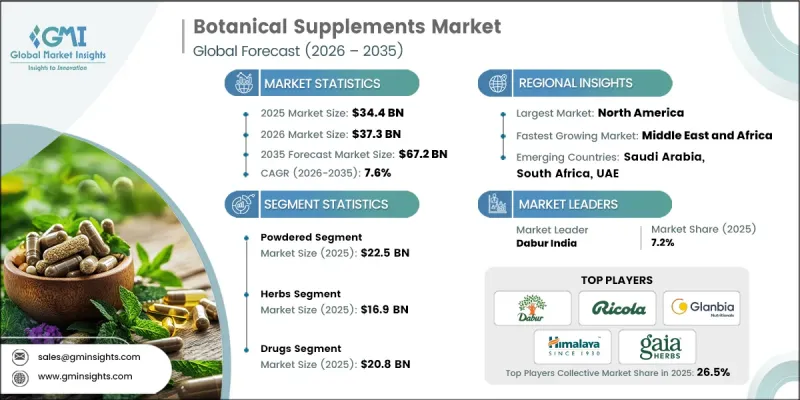
隨著消費者日益尋求以植物來源的健康解決方案來預防疾病並提升整體健康水平,市場正在不斷擴張。植物補充劑由植物成分製成,例如葉、根、花、種子和萃取物,其形式包括膠囊、粉末、茶和酊劑等。這些產品被定位為天然替代品,能夠支持多種健康功能,包括免疫力、促進消化、緩解壓力和能源平衡。消費者對潔淨標示產品的日益關注以及對不含合成添加劑配方的偏好是成長要素。萃取和品管方面的技術進步,包括改進的純化和檢驗方法,提高了產品的一致性、功效和安全性。數位轉型進一步加速了市場成長,電子商務平台和個人化營養管理工具使消費者能夠獲得量身定做的補充劑解決方案。因此,製造商正致力於創新、提高透明度和實現產品差異化,以滿足不斷變化的消費者期望和監管標準。
| 市場範圍 | |
|---|---|
| 開始年份 | 2025 |
| 預測期 | 2026-2035 |
| 上市時的市場規模 | 344億美元 |
| 預測金額 | 672億美元 |
| 複合年成長率 | 7.6% |
預計到2025年,粉劑市場規模將達到225億美元,主要得益於其用途廣泛且易於融入日常生活。植物粉末狀補充劑因其可與飲料和功能性營養產品混合,方便靈活調整劑量和服用,而廣受歡迎。其在健身、排毒和保健等領域的廣泛應用也支撐了強勁的市場需求。同時,膠囊型補充劑也因其劑量精準、保存期限長和服用方便而保持著很高的市場地位,成為那些尋求定期服用補充劑並保持穩定服用習慣的人士的可靠選擇。
預計到2025年,草藥產業規模將達到169億美元,反映了其在養生和傳統醫療保健體系中悠久的應用歷史。草藥成分被廣泛用於增強免疫功能、促進消化健康和緩解壓力。此外,根莖類植物因其富含生物活性化合物而備受關注,這些化合物與增強活力、減輕發炎和促進整體健康密切相關。對植物來源原料的持續依賴凸顯了天然成分和配方技術在推動產品創新的重要性。
預計到2035年,北美植物性膳食補充劑市場規模將達211億美元。該地區市場格局成熟,這得益於消費者較高的健康意識、完善的預防保健實踐以及健全的法規結構。天然保健品、機能性食品和膳食補充劑日益普及,推動了市場需求。美國在該市場中主導領先地位,這主要得益於可支配收入的成長、健康生活方式的普及以及植物來源的不斷增強。零售和數位分銷網路的擴張進一步提升了產品的可及性,而消費者對免疫力支持、適應原產品和個人化營養的日益關注也持續吸引廣泛的消費群體。
目錄
第1章:調查方法和範圍
第2章執行摘要
第3章業界考察
- 生態系分析
- 供應商情況
- 利潤率
- 每個階段增加的價值
- 影響價值鏈的因素
- 中斷
- 影響產業的因素
- 促進因素
- 健康意識日益增強
- 科學檢驗
- 數位和電子商務的擴張
- 產業潛在風險與挑戰
- 監管波動
- 品質和安全問題
- 市場機遇
- 個人化營養
- 創新配方
- 促進因素
- 成長潛力分析
- 監理情勢
- 北美洲
- 歐洲
- 亞太地區
- 拉丁美洲
- 中東和非洲
- 波特五力分析
- PESTEL 分析
- 科技與創新趨勢
- 當前技術趨勢
- 新興技術
- 價格趨勢
- 按地區
- 按形式
- 未來市場趨勢
- 專利趨勢
- 貿易統計(HS編碼)
- 主要進口國
- 主要出口國
- 永續性和環境方面
- 永續計劃
- 減少廢棄物策略
- 生產中的能源效率
- 環保意識的舉措
- 考慮碳足跡
第4章 競爭情勢
- 介紹
- 企業市佔率分析
- 按地區
- 北美洲
- 歐洲
- 亞太地區
- 拉丁美洲
- 中東和非洲
- 按地區
- 企業矩陣分析
- 主要市場公司的競爭分析
- 競爭定位矩陣
- 主要進展
- 併購
- 夥伴關係與合作
- 新產品發布
- 業務拓展計劃
第5章 市場估計與預測:依類型分類,2022-2035年
- 粉末
- 膠囊
- 液體
- 軟糖
第6章 市場估算與預測:依原料分類,2022-2035年
- 草藥
- 根/根莖
- 水果和漿果
- 其他
第7章 市場估計與預測:依應用領域分類,2022-2035年
- 製藥
- 化妝品
- 食品/飲料
- 其他
第8章 市場估算與預測:依通路分類,2022-2035年
- 藥局和專賣店
- 超級市場和大賣場
- 線上零售/電子商務
- 其他
第9章 市場估計與預測:依地區分類,2022-2035年
- 北美洲
- 美國
- 加拿大
- 歐洲
- 德國
- 英國
- 法國
- 西班牙
- 義大利
- 其他歐洲國家
- 亞太地區
- 中國
- 印度
- 日本
- 澳洲
- 韓國
- 亞太其他地區
- 拉丁美洲
- 巴西
- 墨西哥
- 阿根廷
- 其他拉丁美洲
- 中東和非洲
- 沙烏地阿拉伯
- 南非
- 阿拉伯聯合大公國
- 其他中東和非洲地區
第10章:公司簡介
- Dabur India
- Nature's Way Products LLC
- Ricola AG.
- Mondelez International
- Procter and Gamble
- 歐洲營養保健品Group Limited(英國)
- Gaia Herbs
- Himalaya Wellness Company
- Glanbia Nutritionals
- Botanicalife International of America, Inc.
- Blackmores Limited
The Global Botanical Supplements Market was valued at USD 34.4 billion in 2025 and is estimated to grow at a CAGR of 7.6% to reach USD 67.2 billion by 2035.
The market is expanding as consumers increasingly turn toward plant-based health solutions for preventive care and overall wellness. Botanical supplements, derived from plant sources such as leaves, roots, flowers, seeds, and extracts, are widely consumed in formats including capsules, powders, teas, and tinctures. These products are positioned as natural alternatives that support multiple health functions, including immunity, digestion, stress management, and energy balance. Rising awareness of clean-label products and the preference for formulations free from synthetic additives are key growth drivers. Technological advancements in extraction and quality control, including enhanced purification and verification methods, have improved product consistency, potency, and safety. Digital transformation has further accelerated market growth, with e-commerce platforms and personalized nutrition tools enabling consumers to access tailored supplement solutions. As a result, manufacturers are focusing on innovation, transparency, and product differentiation to meet evolving consumer expectations and regulatory standards.
| Market Scope | |
|---|---|
| Start Year | 2025 |
| Forecast Year | 2026-2035 |
| Start Value | $34.4 Billion |
| Forecast Value | $67.2 Billion |
| CAGR | 7.6% |
The powdered segment accounted for USD 22.5 billion in 2025, driven by its versatility and ease of integration into daily routines. Powdered botanical supplements are widely preferred because they can be blended into beverages and functional nutrition products, allowing flexible dosage and convenient consumption. Their adaptability across fitness, detoxification, and wellness applications supports strong demand. In parallel, capsule-based formats remain highly popular due to their precise dosing, extended shelf life, and convenience, making them a reliable choice for regular supplementation and consistent intake patterns.
The herbs segment captured USD 16.9 billion in 2025, reflecting their longstanding use in wellness and traditional health systems. Botanical ingredients derived from herbs are widely utilized for supporting immune function, digestive health, and stress management. Additionally, roots and rhizomes are gaining strong traction due to their concentrated bioactive properties, which are associated with improved vitality, reduced inflammation, and overall health support. The continued reliance on plant-based raw materials underscores the importance of natural ingredient sourcing and formulation expertise in driving product innovation.
North America Botanical Supplements Market is projected to reach USD 21.1 billion by 2035. The region demonstrates a mature market landscape supported by high consumer awareness, strong adoption of preventive healthcare practices, and well-established regulatory frameworks. Demand is reinforced by the increasing popularity of natural health products, functional foods, and dietary supplements. The United States plays a dominant role, driven by rising disposable incomes, widespread wellness-focused lifestyles, and growing scientific validation of plant-based formulations. Expanding retail and digital distribution networks further enhance accessibility, while increasing interest in immunity support, adaptogenic products, and personalized nutrition continues to attract a broad consumer base.
Major players operating in the Global Botanical Supplements Market include Dabur India, Nature's Way Products LLC, Ricola AG., Mondelez International, Procter and Gamble, Nutraceuticals Group Europe Ltd UK, Gaia Herbs, Himalaya Wellness Company, Glanbia Nutritionals, Botanicalife International of America, Inc., and Blackmores Limited. Companies operating in the Botanical Supplements Market are adopting a range of strategic initiatives to strengthen their market position and expand their global footprint. Key strategies include investing in advanced extraction technologies and research to improve product efficacy, purity, and consistency. Firms are also focusing on product innovation by developing customized formulations aligned with consumer health trends such as immunity, stress relief, and overall wellness. Strategic partnerships with distributors, healthcare providers, and e-commerce platforms help expand reach and enhance brand visibility. Additionally, companies emphasize clean-label positioning, sustainable sourcing, and transparent supply chains to build consumer trust. Expansion into emerging markets, digital marketing initiatives, and personalized nutrition solutions further support long-term growth and competitive differentiation.
Table of Contents
Chapter 1 Methodology & Scope
- 1.1 Market scope and definition
- 1.2 Research design
- 1.2.1 Research approach
- 1.2.2 Data collection methods
- 1.3 Data mining sources
- 1.3.1 Global
- 1.3.2 Regional/Country
- 1.4 Base estimates and calculations
- 1.4.1 Base year calculation
- 1.4.2 Key trends for market estimation
- 1.5 Primary research and validation
- 1.5.1 Primary sources
- 1.6 Forecast model
- 1.7 Research assumptions and limitations
Chapter 2 Executive Summary
- 2.1 Industry 360° synopsis
- 2.2 Key market trends
- 2.2.1 Form
- 2.2.2 Sources
- 2.2.3 Application
- 2.2.4 Distribution Channel
- 2.2.5 Regional
- 2.3 TAM Analysis, 2026-2035
- 2.4 CXO perspectives: Strategic imperatives
- 2.5 Future outlook and strategic recommendations
Chapter 3 Industry Insights
- 3.1 Industry ecosystem analysis
- 3.1.1 Supplier landscape
- 3.1.2 Profit margin
- 3.1.3 Value addition at each stage
- 3.1.4 Factor affecting the value chain
- 3.1.5 Disruptions
- 3.2 Industry impact forces
- 3.2.1 Growth drivers
- 3.2.1.1 Rising health awareness
- 3.2.1.2 Scientific validation
- 3.2.1.3 Digital & e-commerce expansion
- 3.2.2 Industry pitfalls and challenges
- 3.2.2.1 Regulatory variability
- 3.2.2.2 Quality & safety concern
- 3.2.3 Market opportunities
- 3.2.3.1 Personalized nutrition
- 3.2.3.2 Innovative formulations
- 3.2.1 Growth drivers
- 3.3 Growth potential analysis
- 3.4 Regulatory landscape
- 3.4.1 North America
- 3.4.2 Europe
- 3.4.3 Asia Pacific
- 3.4.4 Latin America
- 3.4.5 Middle East & Africa
- 3.5 Porter's analysis
- 3.6 PESTEL analysis
- 3.7 Technology and innovation landscape
- 3.7.1 Current technological trends
- 3.7.2 Emerging technologies
- 3.8 Price trends
- 3.8.1 By region
- 3.8.2 By form
- 3.9 Future market trends
- 3.10 Patent landscape
- 3.11 Trade statistics (HS code)
- 3.11.1 Major importing countries
- 3.11.2 Major exporting countries
- 3.12 Sustainability and environmental aspects
- 3.12.1 Sustainable practices
- 3.12.2 Waste reduction strategies
- 3.12.3 Energy efficiency in production
- 3.12.4 Eco-friendly initiatives
- 3.13 Carbon footprint consideration
Chapter 4 Competitive Landscape, 2025
- 4.1 Introduction
- 4.2 Company market share analysis
- 4.2.1 By region
- 4.2.1.1 North America
- 4.2.1.2 Europe
- 4.2.1.3 Asia Pacific
- 4.2.1.4 LATAM
- 4.2.1.5 MEA
- 4.2.1 By region
- 4.3 Company matrix analysis
- 4.4 Competitive analysis of major market players
- 4.5 Competitive positioning matrix
- 4.6 Key developments
- 4.6.1 Mergers & acquisitions
- 4.6.2 Partnerships & collaborations
- 4.6.3 New product launches
- 4.6.4 Expansion plans
Chapter 5 Market Estimates and Forecast, By Form, 2022-2035 (USD Billion) (Kilo Tons)
- 5.1 Key trends
- 5.2 Powdered
- 5.3 Capsules
- 5.4 Liquid
- 5.5 Gummies
Chapter 6 Market Estimates and Forecast, By Sources, 2022-2035 (USD Billion) (Kilo Tons)
- 6.1 Key trends
- 6.2 Herbs
- 6.3 Roots and Rhizomes
- 6.4 Fruits and Berries
- 6.5 Others
Chapter 7 Market Estimates and Forecast, By Application, 2022-2035 (USD Billion) (Kilo Tons)
- 7.1 Key trends
- 7.2 Drugs
- 7.3 Cosmetics
- 7.4 Food and Beverage
- 7.5 Others
Chapter 8 Market Estimates and Forecast, By Distribution Channel, 2022-2035 (USD Billion) (Kilo Tons)
- 8.1 Key trends
- 8.2 Pharmacies and Specialty Stores
- 8.3 Supermarkets and Hypermarkets
- 8.4 Online Retail / E-commerce
- 8.5 Others
Chapter 9 Market Estimates and Forecast, By Region, 2022-2035 (USD Billion) (Kilo Tons)
- 9.1 Key trends
- 9.2 North America
- 9.2.1 U.S.
- 9.2.2 Canada
- 9.3 Europe
- 9.3.1 Germany
- 9.3.2 UK
- 9.3.3 France
- 9.3.4 Spain
- 9.3.5 Italy
- 9.3.6 Rest of Europe
- 9.4 Asia Pacific
- 9.4.1 China
- 9.4.2 India
- 9.4.3 Japan
- 9.4.4 Australia
- 9.4.5 South Korea
- 9.4.6 Rest of Asia Pacific
- 9.5 Latin America
- 9.5.1 Brazil
- 9.5.2 Mexico
- 9.5.3 Argentina
- 9.5.4 Rest of Latin America
- 9.6 Middle East and Africa
- 9.6.1 Saudi Arabia
- 9.6.2 South Africa
- 9.6.3 UAE
- 9.6.4 Rest of Middle East and Africa
Chapter 10 Company Profiles
- 10.1 Dabur India
- 10.2 Nature's Way Products LLC
- 10.3 Ricola AG.
- 10.4 Mondelez International
- 10.5 Procter and Gamble
- 10.6 Nutraceuticals Group Europe Ltd UK
- 10.7 Gaia Herbs
- 10.8 Himalaya Wellness Company
- 10.9 Glanbia Nutritionals
- 10.10 Botanicalife International of America, Inc.
- 10.11 Blackmores Limited

 植物來源補充品市場報告:趨勢、預測和競爭分析(至2035年)
 植物來源膳食補充劑市場規模、佔有率和成長分析:按原料、劑型、應用、通路和地區分類-2026-2033年產業預測
 植物保健品市場-全球產業規模、佔有率、趨勢、機會、預測:依原料、劑型、應用、通路、地區及競爭格局分類,2021-2031年
 植物來源膳食補充劑市場:按應用、通路和地區分類
 植物性膳食補充劑市場分析及預測(至2035年):依類型、產品、應用、劑型、最終用戶、製程、技術及功能分類
 體重管理植物性補充劑市場規模、佔有率、成長及全球產業分析:按類型、應用和地區分類,並預測至2026-2034年全球植物保健品市場規模、佔有率、趨勢及成長分析報告(2026-2034)
 2032 年植物護膚補充劑市場預測:按形態、植物來源、分銷管道、應用和地區進行的全球分析2030 年植物膳食補充劑市場預測:按產品類型、形式、分銷管道、應用、最終用戶和地區進行的全球分析植物補充劑市場:預測(2025-2030)