


 |
市場調查報告書
商品編碼
1982373
水耕市場商機、成長要素、產業趨勢分析及2026-2035年預測。Aquaponics Market Opportunity, Growth Drivers, Industry Trend Analysis, and Forecast 2026 - 2035 |
||||||

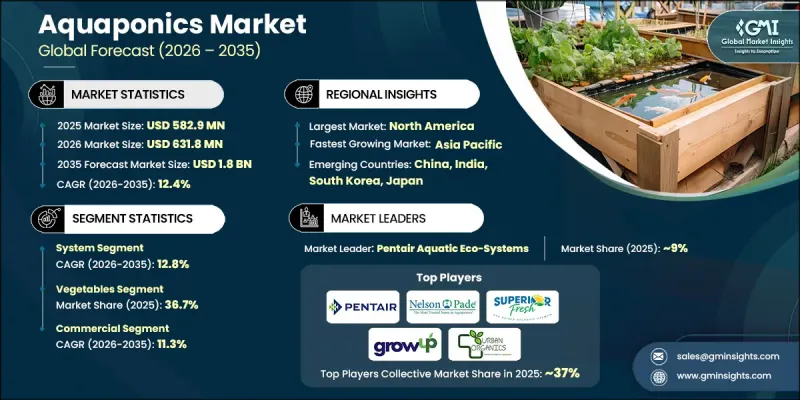
2025 年全球魚菜共生市場規模預計為 5.829 億美元,預計到 2035 年將達到 18 億美元,年複合成長率為 12.4%。
隨著農民和都市區種植者日益尋求替代傳統農業的方案(傳統農業耗水量大且依賴化學物質),對環保高效農業解決方案的需求正在推動農業發展。魚菜共生系統將養魚和蔬菜種植結合,形成一個閉迴路的營養循環系統,最大限度地減少用水量,並消除對化肥的需求。這種方法非常適合面臨水資源短缺和土地資源限制的地區,因為它透過環境可控的農業方式確保了穩定的產量。消費者對永續、可追溯和本地生產的食品的日益關注,促使商業經營者採用魚菜共生系統。政府的各項舉措,包括財政獎勵和支持性立法,進一步加速了魚菜共生系統的普及。城市農業計畫和商業農民正在投資魚菜共生系統,以滿足對新鮮本地農產品日益成長的需求,最大限度地提高資源利用效率,並全年保持作物的高品質。
| 市場規模 | |
|---|---|
| 開始年份 | 2025 |
| 預測期 | 2026-2035 |
| 初始市場規模 | 5.829億美元 |
| 預測金額 | 18億美元 |
| 複合年成長率 | 12.4% |
預計到2025年,系統市場規模將達到4.434億美元,並在2035年之前以12.8%的複合年成長率成長。由於其整合功能,將水箱、種植床、水泵和過濾裝置整合在一起,完整系統佔據了市場主導地位。這些完整系統使商業業者能夠同步魚類和植物的生產週期,減少安裝錯誤,並支援從小規模城市農場到大規模商業設施的擴充性。技術整合增強了水循環、營養分配和即時監測,從而進一步提高了營運效率。
預計到2025年,蔬菜市佔率將佔36.7%,到2035年將以7.2%的複合年成長率成長。綠葉蔬菜、香草和其他速生蔬菜在魚菜共生系統中生長旺盛,可實現一年多次收成並保持穩定的品質。可控的生長環境減少了農藥的使用,確保了農產品的安全且優質,深受餐廳、零售商和注重健康的消費者的青睞。與水果相比,魚菜共生種植風險較低,也促使更多農民採用這種種植方式。
美國魚菜共生市場預計到2025年將達到1.648億美元,並在2035年之前以12.2%的複合年成長率成長。人們對永續食品生產、城市農業計劃以及對有機和無農藥農產品的需求日益成長,是推動這一成長的主要因素。教育機構和研究機構正在擴大魚菜共生項目,而專業農場也在增加對商業規模系統的投資,這進一步促進了市場的擴張。
目錄
第1章:調查方法和範圍
第2章執行摘要
第3章業界考察
- 生態系分析
- 供應商情況
- 利潤率
- 每個階段增加的價值
- 影響價值鏈的因素
- 影響產業的因素
- 促進因素
- 對永續和資源高效型農業的需求日益成長
- 增加對城市和垂直農業的投資
- 人們日益擔憂全球糧食安全問題
- 陷阱與挑戰
- 高昂的初始設定成本和資本成本
- 技術複雜性與知識壁壘
- 機會
- 透過引入可再生能源降低營運成本。
- 向服務不足的地區和偏遠地區拓展業務。
- 促進因素
- 成長潛力分析
- 未來市場趨勢
- 科技與創新趨勢
- 當前技術趨勢
- 新興技術
- 價格趨勢
- 按地區
- 依產品
- 監理情勢
- 標準和合規要求
- 區域法規結構
- 認證標準
- 波特五力分析
- PESTEL 分析
第4章 競爭情勢
- 介紹
- 企業市佔率分析
- 按地區
- 北美洲
- 歐洲
- 亞太地區
- 拉丁美洲
- 中東和非洲
- 按地區
- 企業矩陣分析
- 主要市場公司的競爭分析
- 競爭定位矩陣
- 主要進展
- 併購
- 夥伴關係與合作
- 新產品發布
- 業務拓展計劃
第5章 市場估計與預測:依組件分類,2022-2035年
- 系統
- 栽培照明
- 泵浦和閥門
- 熱水器
- 充氣系統
- 監控系統
- 其他
- 軟體
第6章 市場估算與預測:依幀技術分類,2022-2035年
- 營養液膜栽培(NFT)
- 裝滿培養基的培養床
- 深水栽培(DWC)
- 其他
第7章 市場估計與預測:依農產品分類,2022-2035年
- 魚
- 蔬菜
- 水果
- 其他
第8章 市場估計與預測:依應用領域分類,2022-2035年
- 商業的
- 家庭生產
- 其他
第9章 市場估計與預測:依地區分類,2022-2035年
- 北美洲
- 美國
- 加拿大
- 歐洲
- 德國
- 英國
- 法國
- 義大利
- 西班牙
- 亞太地區
- 中國
- 印度
- 日本
- 韓國
- 澳洲
- 拉丁美洲
- 巴西
- 墨西哥
- 阿根廷
- 中東和非洲(MEA)
- 沙烏地阿拉伯
- 阿拉伯聯合大公國
- 南非
第10章:公司簡介
- Aquaculture Technology Group
- Aquaponic Lynx, LLC
- Aquaponic Solutions
- AquaSprouts
- Backyard Aquaponics
- Bright Agrotech
- EZ-Aquaponics
- FarmTek
- Greentrees International Pty Ltd
- GrowUp Urban Farms
- Nelson and Pade, Inc.
- Pentair Aquatic Eco-Systems
- Superior Fresh
- Symbiotic Systems
- Urban Organics
The Global Aquaponics Market was valued at USD 582.9 million in 2025 and is estimated to grow at a CAGR of 12.4% to reach USD 1.8 billion by 2035.
Demand for environmentally friendly and efficient farming solutions is driving growth, as farmers and urban growers increasingly seek alternatives to traditional, water-intensive, and chemical-dependent agriculture. By combining fish farming with vegetable cultivation, aquaponics creates a closed-loop nutrient system that minimizes water usage and eliminates the need for synthetic fertilizers. The method ensures stable yields through controlled environment agriculture, making it ideal for regions facing water scarcity or land constraints. Consumer awareness of sustainable, traceable, and locally produced food is rising, prompting commercial operators to adopt aquaponics. Government initiatives, including financial incentives and supportive legislation, further accelerate adoption. Urban agriculture programs and commercial farmers are investing in aquaponics to meet growing demand for fresh, local produce while maximizing resource efficiency and maintaining high crop quality year-round.
| Market Scope | |
|---|---|
| Start Year | 2025 |
| Forecast Year | 2026-2035 |
| Start Value | $582.9 Million |
| Forecast Value | $1.8 Billion |
| CAGR | 12.4% |
The system segment accounted for USD 443.4 million in 2025 and is expected to grow at a CAGR of 12.8% through 2035. Complete systems dominate the market due to their integrated functionality, which combines tanks, grow beds, pumps, and filtration units into one cohesive setup. Full systems allow commercial operators to synchronize fish and plant production cycles, reduce installation errors, and support scalability from small urban farms to large commercial facilities. Technological integration enhances water circulation, nutrient distribution, and real-time monitoring, further boosting operational efficiency.
The vegetables segment held a 36.7% share in 2025 and is projected to grow at a CAGR of 7.2% by 2035. Leafy greens, herbs, and other fast-growing vegetables thrive in aquaponic systems, offering multiple harvests per year and consistent quality. Controlled environments reduce pesticide use, ensuring safe, high-quality produce that appeals to restaurants, retailers, and health-conscious consumers. Lower cultivation risks compared to fruiting crops also drive farmer adoption.
U.S. Aquaponics Market reached USD 164.8 million in 2025 and is expected to grow at a CAGR of 12.2% through 2035. Rising interest in sustainable food production, urban farming initiatives, and the demand for organic, pesticide-free produce support growth. Educational institutions and research facilities are expanding aquaponics programs, while specialty farms are increasingly investing in commercial-scale systems, further driving market expansion.
Key players in the Global Aquaponics Market include Bright Agrotech, EZ-Aquaponics, FarmTek, GrowUp Urban Farms, Pentair Aquatic Eco-Systems, Urban Organics, Nelson and Pade, Inc., Symbiotic Systems, Aquaponic Solutions, AquaSprouts, Aquaculture Technology Group, Aquaponic Lynx, LLC, Superior Fresh, Greentrees International Pty Ltd., and Backyard Aquaponics. Companies in the Aquaponics Market are focusing on innovation, scalability, and sustainability to strengthen their market presence. They are investing in fully integrated system solutions with advanced automation for water and nutrient management, reducing labor and operational complexity. Strategic partnerships with urban farms, commercial growers, and educational institutions expand adoption and credibility. Product diversification, including modular and customizable systems for small-scale and large-scale operations, allows firms to cater to varied customer segments. Firms are also emphasizing sustainability through energy-efficient equipment, recyclable materials, and organic-friendly solutions.
Table of Contents
Chapter 1 Methodology & Scope
- 1.1 Market scope and definition
- 1.2 Research design
- 1.2.1 Research approach
- 1.2.2 Data collection methods
- 1.3 Data mining sources
- 1.3.1 Global
- 1.3.2 Regional/Country
- 1.4 Base estimates and calculations
- 1.4.1 Base year calculation
- 1.4.2 Key trends for market estimation
- 1.5 Primary research and validation
- 1.5.1 Primary sources
- 1.6 Forecast model
- 1.7 Research assumptions and limitations
Chapter 2 Executive Summary
- 2.1 Industry 360° synopsis
- 2.2 Key market trends
- 2.2.1 Component
- 2.2.2 By Framing Technique
- 2.2.3 Produce
- 2.2.4 Application
- 2.3 CXO perspectives: Strategic imperatives
- 2.3.1 Key decision points for industry executives
- 2.3.2 Critical success factors for market players
- 2.4 Future outlook and strategic recommendations
Chapter 3 Industry Insights
- 3.1 Industry ecosystem analysis
- 3.1.1 Supplier landscape
- 3.1.2 Profit margin
- 3.1.3 Value addition at each stage
- 3.1.4 Factor affecting the value chain
- 3.2 Industry impact forces
- 3.2.1 Growth drivers
- 3.2.1.1 Rising demand for sustainable and resource-efficient agriculture
- 3.2.1.2 Increased investment in urban and vertical farming initiatives
- 3.2.1.3 Growing global food security concerns
- 3.2.2 Pitfalls & Challenges
- 3.2.2.1 High initial setup and capital costs
- 3.2.2.2 Technical complexity and knowledge barriers
- 3.2.3 Opportunities
- 3.2.3.1 Integration of renewable energy to lower operating costs
- 3.2.3.2 Expansion into underserved and remote regions
- 3.2.1 Growth drivers
- 3.3 Growth potential analysis
- 3.4 Future market trends
- 3.5 Technology and innovation landscape
- 3.5.1 Current technological trends
- 3.5.2 Emerging technologies
- 3.6 Price trends
- 3.6.1 By region
- 3.6.2 By product
- 3.7 Regulatory landscape
- 3.7.1 Standards and compliance requirements
- 3.7.2 Regional regulatory frameworks
- 3.7.3 Certification standards
- 3.8 Porter’s analysis
- 3.9 PESTEL analysis
Chapter 4 Competitive Landscape, 2025
- 4.1 Introduction
- 4.2 Company market share analysis
- 4.2.1 By Region
- 4.2.1.1 North America
- 4.2.1.2 Europe
- 4.2.1.3 Asia Pacific
- 4.2.1.4 Latin America
- 4.2.1.5 Middle East & Africa
- 4.2.1 By Region
- 4.3 Company matrix analysis
- 4.4 Competitive analysis of major market players
- 4.5 Competitive positioning matrix
- 4.6 Key developments
- 4.6.1 Mergers & acquisitions
- 4.6.2 Partnerships & collaborations
- 4.6.3 New product launches
- 4.6.4 Expansion plans
Chapter 5 Market Estimates & Forecast, By Component, 2022 - 2035, (USD Million) (Thousand Units)
- 5.1 Key trends
- 5.2 System
- 5.2.1 Grow Lights
- 5.2.2 Pumps and Valves
- 5.2.3 Water Heaters
- 5.2.4 Aeration Systems
- 5.2.5 Monitoring and Control Systems
- 5.2.6 Others
- 5.3 Software
Chapter 6 Market Estimates & Forecast, By Framing Technique, 2022 - 2035, (USD Million) (Thousand Units)
- 6.1 Key trends
- 6.2 Nutrient Film Technique (NFT)
- 6.3 Media-Filled Growbeds
- 6.4 Deep Water Culture (DWC)
- 6.5 Others
Chapter 7 Market Estimates & Forecast, By Produce, 2022 - 2035, (USD Million) (Thousand Units)
- 7.1 Key trends
- 7.2 Fish
- 7.3 Vegetables
- 7.4 Fruits
- 7.5 Others
Chapter 8 Market Estimates & Forecast, By Application, 2022 - 2035, (USD Million) (Thousand Units)
- 8.1 Key trends
- 8.2 Commercial
- 8.3 Home Production
- 8.4 Others
Chapter 9 Market Estimates & Forecast, By Region, 2022 - 2035, (USD Million) (Thousand Units)
- 9.1 Key trends
- 9.2 North America
- 9.2.1 U.S.
- 9.2.2 Canada
- 9.3 Europe
- 9.3.1 Germany
- 9.3.2 UK
- 9.3.3 France
- 9.3.4 Italy
- 9.3.5 Spain
- 9.4 Asia Pacific
- 9.4.1 China
- 9.4.2 India
- 9.4.3 Japan
- 9.4.4 South Korea
- 9.4.5 Australia
- 9.5 Latin America
- 9.5.1 Brazil
- 9.5.2 Mexico
- 9.5.3 Argentina
- 9.6 MEA
- 9.6.1 Saudi Arabia
- 9.6.2 UAE
- 9.6.3 South Africa
Chapter 10 Company Profiles
- 10.1 Aquaculture Technology Group
- 10.2 Aquaponic Lynx, LLC
- 10.3 Aquaponic Solutions
- 10.4 AquaSprouts
- 10.5 Backyard Aquaponics
- 10.6 Bright Agrotech
- 10.7 EZ-Aquaponics
- 10.8 FarmTek
- 10.9 Greentrees International Pty Ltd
- 10.10 GrowUp Urban Farms
- 10.11 Nelson and Pade, Inc.
- 10.12 Pentair Aquatic Eco-Systems
- 10.13 Superior Fresh
- 10.14 Symbiotic Systems
- 10.15 Urban Organics

 水耕法:市佔率分析、產業趨勢與統計、成長預測(2026-2031)
 魚菜共生市場-2026-2032年全球市場預測
 魚菜共生農業市場預測至2034年-按系統類型、組件、魚類、作物類型、最終用戶和地區分類的全球分析
 2026年全球魚菜共生市場報告
 魚菜共生市場規模、佔有率、成長及全球產業分析:按類型、應用和地區分類的洞察,2026-2034 年預測全球海洋水族設備市場(按設備類型、服務類型、技術、最終用戶和分銷管道分類)預測(2026-2032年)
 水產養殖市場:全球產業分析、規模、佔有率、成長、趨勢與預測(2025-2032)
 魚菜共生市場-全球產業規模、佔有率、趨勢、機會及預測,依設備、方法(基於介質、營養膜技術和深水養殖)、應用、區域和競爭細分,2020-2030 年預測全球水產養殖市場:2025-2030 年預測2032 年全球魚菜共生市場預測:按系統類型、設備類型、產品、組件、營運規模、應用和地區分類