


 |
市場調查報告書
商品編碼
1982297
靜脈注射免疫球蛋白市場機會、成長要素、產業趨勢分析及2026-2035年預測。Intravenous Immunoglobulin (IVIg) Market Opportunity, Growth Drivers, Industry Trend Analysis, and Forecast 2026 - 2035 |
||||||

預計到 2025 年,全球靜脈注射免疫球蛋白 (IVIg) 市值將達到 133 億美元,並有望以 6.8% 的複合年成長率成長,到 2035 年達到 256 億美元。
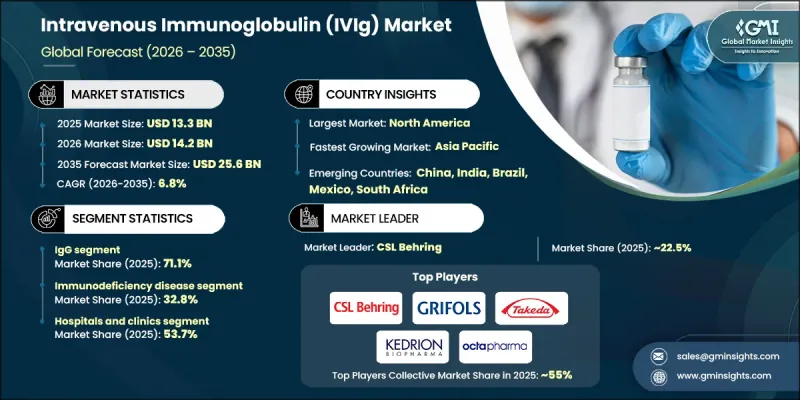
全球原發性和續發性免疫力缺乏率的不斷上升是推動該市場成長的主要因素。靜脈注射免疫球蛋白(IVIg)產品是由混合人類血漿製成的無菌濃縮抗體製劑,經由靜脈輸注給藥,以提供被動免疫。它們透過提供現成的抗體來支持免疫系統,這些抗體可以中和有害病原體並調節免疫反應。 IVIg的治療應用範圍正在從原發性免疫力缺乏擴展到自體自體免疫疾病和神經系統疾病,例如慢性脫髓鞘多發性神經炎、Guillain-Barré二氏症候群和重症肌無力。為了滿足全球需求,領先的生產商正在迅速擴大血漿採集中心,投資先進的血漿分離設備,並採取區域性血漿籌資策略。隨著臨床應用的不斷增加和供應鏈的持續投資,靜脈注射免疫球蛋白(IVIg)市場正處於強勁的成長軌道上。
| 市場範圍 | |
|---|---|
| 開始年份 | 2025 |
| 預測期 | 2026-2035 |
| 上市時的市場規模 | 133億美元 |
| 預測金額 | 256億美元 |
| 複合年成長率 | 6.8% |
預計到2025年,IgG將佔據71.1%的市場佔有率,這主要得益於其廣泛的臨床認可和在免疫防禦中發揮的關鍵作用。 IgG是循環系統中最常見的免疫球蛋白,也是治療原發性和續發性免疫力缺乏疾病的首選藥物。其需求涵蓋神經科、血液科和內科等多個專科,並有完善的法規和生產標準作為支撐。
預計到2025年,免疫不全症市場將佔據32.8%的市場佔有率,並在2026年至2035年間以6.9%的複合年成長率成長。該市場包括原發性免疫力缺乏、續發性免疫力缺乏缺陷、低丙種球蛋白血症和某些抗體缺陷。由於這些疾病是終身慢性病,需要頻繁注射靜脈注射免疫球蛋白(IVIg),從而確保了市場需求的持續穩定。
預計到2025年,北美靜脈注射免疫球蛋白(IVIg)市佔率將達52.5%。這主要得益於該地區先進的醫療基礎設施、自體免疫疾病和免疫不全症的高發生率、完善的保險報銷體係以及成熟的血漿採集網路。此外,主要企業的存在、持續的臨床研究以及創新治療通訊協定的早期應用,也進一步提升了該地區市場的成熟度。
目錄
第1章:調查方法和範圍
第2章執行摘要
第3章業界考察
- 生態系分析
- 影響產業的因素
- 促進因素
- 免疫不全症盛行率增加
- 老年人口增加
- 血漿採集、分離和純化技術的不斷進步。
- 擴大靜脈注射免疫球蛋白在神經系統疾病和自體免疫疾病的臨床應用
- 增加免疫球蛋白的醫療保健支出
- 產業潛在風險與挑戰
- 靜脈注射免疫球蛋白療法高成本
- 潛在的副作用和過敏反應
- 市場機遇
- 重組免疫球蛋白的開發
- 新興國家需求增加
- 促進因素
- 成長潛力分析
- 監理情勢
- 北美洲
- 歐洲
- 亞太地區
- 技術進步
- 當前技術趨勢
- 新興技術
- 還款狀態
- 未來市場趨勢
- 管道分析
- 波特五力分析
- PESTEL 分析
第4章 競爭情勢
- 介紹
- 企業市佔率分析
- 北美洲
- 歐洲
- 亞太地區
- 企業矩陣分析
- 主要市場公司的競爭分析
- 競爭定位矩陣
- 主要進展
- 併購
- 合作夥伴關係和合資企業
- 新產品發布
- 業務拓展計劃
第5章 市場估算與預測:依產品類型分類,2022-2035年
- IgG
- IgA
- IgM
- IgD
- IgE
第6章 市場估計與預測:依應用領域分類,2022-2035年
- 免疫不全症
- 原發性免疫力缺乏
- 次發性免疫力缺乏
- 低丙種球蛋白血症
- 特異性抗體缺乏症
- 慢性脫髓鞘多發性神經炎(CIDP)
- 重症肌無力
- 多灶性運動神經病變
- 特發性血小板減少紫斑症(ITP)
- 發炎性肌肉疾病
- Guillain-Barré二氏症候群
- 其他用途
第7章 市場估計與預測:依最終用途分類,2022-2035年
- 醫院和診所
- 門診手術中心
- 居家醫療設施
- 其他最終用戶
第8章 市場估計與預測:依地區分類,2022-2035年
- 北美洲
- 美國
- 加拿大
- 歐洲
- 德國
- 英國
- 法國
- 西班牙
- 義大利
- 荷蘭
- 亞太地區
- 日本
- 中國
- 印度
- 澳洲
- 韓國
- 拉丁美洲
- 巴西
- 墨西哥
- 阿根廷
- 中東和非洲
- 南非
- 沙烏地阿拉伯
- 阿拉伯聯合大公國
第9章:公司簡介
- ADMA Biologics
- Baxter International
- Biotest
- CSL Behring
- China Biologics Products
- Grifols SA
- Intas Pharmaceuticals
- Kedrion Biopharma
- LFB Biotechnologies
- Omrix Biopharmaceuticals(Johnson & Johnson)
- Octapharma AG
- Pfizer
- Shanghai RAAS Blood Products
- Takeda Pharmaceutical Company
The Global Intravenous Immunoglobulin (IVIg) Market was valued at USD 13.3 billion in 2025 and is estimated to grow at a CAGR of 6.8% to reach USD 25.6 billion by 2035.
The market is propelled by the rising incidence of both primary and secondary immunodeficiency disorders worldwide. IVIg products are sterile, concentrated antibody formulations derived from pooled human plasma, administered via intravenous infusion to provide passive immunity. They support the immune system by supplying ready-made antibodies that neutralize harmful pathogens and regulate immune responses. The therapeutic applications of IVIg have expanded beyond primary immunodeficiencies, increasingly addressing autoimmune and neurological disorders such as chronic inflammatory demyelinating polyneuropathy, Guillain-Barre syndrome, and myasthenia gravis. To meet global demand, leading manufacturers are rapidly expanding plasma collection centers, investing in advanced plasmapheresis equipment, and adopting regional plasma sourcing strategies. Increasing clinical adoption, combined with steady supply chain investments, is shaping a robust growth trajectory for the Intravenous Immunoglobulin (IVIg) Market.
| Market Scope | |
|---|---|
| Start Year | 2025 |
| Forecast Year | 2026-2035 |
| Start Value | $13.3 Billion |
| Forecast Value | $25.6 Billion |
| CAGR | 6.8% |
The IgG segment held a 71.1% share in 2025, driven by its broad clinical acceptance and key role in immune defense. IgG is the most prevalent immunoglobulin in circulation, making it the preferred choice for treating both primary and secondary immunodeficiencies. Its demand spans multiple specialties, including neurology, hematology, and internal medicine, reinforced by well-established regulatory and manufacturing standards.
The immunodeficiency disease segment accounted for 32.8% share in 2025 and is expected to grow at a CAGR of 6.9% during 2026-2035. This segment encompasses primary immunodeficiencies, secondary immunodeficiencies, hypogammaglobulinemia, and specific antibody deficiencies. Lifelong and chronic in nature, these conditions require frequent IVIg infusions, ensuring sustained market demand.
North America Intravenous Immunoglobulin (IVIg) Market held 52.5% share in 2025, supported by advanced healthcare infrastructure, high prevalence of autoimmune and immunodeficiency disorders, robust reimbursement systems, and an established plasma collection network. The presence of leading pharmaceutical companies, ongoing clinical research, and early adoption of innovative treatment protocols further strengthen market maturity in the region.
Key players in the Global Intravenous Immunoglobulin (IVIg) Market include Baxter International, CSL Behring, Octapharma AG, Grifols SA, Pfizer, Takeda Pharmaceutical Company, ADMA Biologics, Biotest, China Biologics Products, Omrix Biopharmaceuticals (Johnson & Johnson), LFB Biotechnologies, Kedrion Biopharma, Intas Pharmaceuticals, and Shanghai RAAS Blood Products. To strengthen the Intravenous Immunoglobulin (IVIg) Market position, companies are focusing on expanding plasma collection and fractionation capacities, investing in state-of-the-art plasmapheresis equipment, and developing regional sourcing strategies to ensure a stable supply of raw materials. They are also diversifying their product portfolios to target autoimmune and neurological disorders, while optimizing manufacturing processes to reduce costs and enhance efficiency. Strategic partnerships with hospitals, specialty clinics, and healthcare networks expand distribution channels.
Table of Contents
Chapter 1 Methodology and Scope
- 1.1 Market scope and definition
- 1.2 Research approach
- 1.3 Quality commitments
- 1.3.1 GMI AI policy and data integrity commitment
- 1.3.1.1 Source consistency protocol
- 1.3.1 GMI AI policy and data integrity commitment
- 1.4 Research trail and confidence scoring
- 1.4.1 Research trail components
- 1.4.2 Scoring components
- 1.5 Data collection
- 1.5.1 Partial list of primary sources
- 1.6 Data mining sources
- 1.6.1 Paid sources
- 1.6.1.1 Sources, by region
- 1.6.1 Paid sources
- 1.7 Base estimates and calculations
- 1.7.1 Revenue share analysis
- 1.7.2 Base year calculation
- 1.8 Forecast model
- 1.9 Research transparency addendum
- 1.9.1 Source attribution framework
- 1.9.2 Quality assurance metrics
- 1.9.3 Our commitment to trust
Chapter 2 Executive Summary
- 2.1 Industry 360° synopsis
- 2.2 Key market trends
- 2.2.1 Regional trends
- 2.2.2 Product type trends
- 2.2.3 Application trends
- 2.2.4 End use trends
- 2.3 CXO perspectives: Strategic imperatives
Chapter 3 Industry Insights
- 3.1 Industry ecosystem analysis
- 3.2 Industry impact forces
- 3.2.1 Growth drivers
- 3.2.1.1 Growing prevalence of immunodeficiency disorders
- 3.2.1.2 Increasing geriatric population
- 3.2.1.3 Growing advances in plasma collection, fractionation, and purification technologies
- 3.2.1.4 Rising clinical applications of IVIg in neurological and autoimmune disorders
- 3.2.1.5 Increasing healthcare expenditure for immunoglobulins
- 3.2.2 Industry pitfalls and challenges
- 3.2.2.1 High cost of IVIg therapy
- 3.2.2.2 Potential adverse effects and allergic reactions
- 3.2.3 Market opportunities
- 3.2.3.1 Development of recombinant immunoglobulins
- 3.2.3.2 Rising demand in emerging economies
- 3.2.1 Growth drivers
- 3.3 Growth potential analysis
- 3.4 Regulatory landscape
- 3.4.1 North America
- 3.4.2 Europe
- 3.4.3 Asia Pacific
- 3.5 Technological advancements
- 3.5.1 Current technological trends
- 3.5.2 Emerging technologies
- 3.6 Reimbursement scenario
- 3.7 Future market trends
- 3.8 Pipeline analysis
- 3.9 Porter's analysis
- 3.10 PESTEL analysis
Chapter 4 Competitive Landscape, 2025
- 4.1 Introduction
- 4.2 Company market share analysis
- 4.2.1 North America
- 4.2.2 Europe
- 4.2.3 Asia Pacific
- 4.3 Company matrix analysis
- 4.4 Competitive analysis of major market players
- 4.5 Competitive positioning matrix
- 4.6 Key developments
- 4.6.1 Mergers and acquisitions
- 4.6.2 Partnerships and collaborations
- 4.6.3 New product launches
- 4.6.4 Expansion plans
Chapter 5 Market Estimates and Forecast, By Product Type, 2022 - 2035 ($ Mn)
- 5.1 Key trends
- 5.2 IgG
- 5.3 IgA
- 5.4 IgM
- 5.5 IgD
- 5.6 IgE
Chapter 6 Market Estimates and Forecast, By Application, 2022 - 2035 ($ Mn)
- 6.1 Key trends
- 6.2 Immunodeficiency diseases
- 6.2.1 Primary immunodeficiencies
- 6.2.2 Secondary immunodeficiencies
- 6.2.3 Hypogammaglobulinemia
- 6.2.4 Specific antibody deficiency
- 6.3 Chronic Inflammatory demyelinating polyneuropathy (CIDP)
- 6.4 Myasthenia gravis
- 6.5 Multifocal motor neuropathy
- 6.6 Idiopathic thrombocytopenic purpura (ITP)
- 6.7 Inflammatory myopathies
- 6.8 Guillain-Barre syndrome
- 6.9 Other applications
Chapter 7 Market Estimates and Forecast, By End Use, 2022 - 2035 ($ Mn)
- 7.1 Key trends
- 7.2 Hospitals and clinics
- 7.3 Ambulatory surgical centers
- 7.4 Homecare settings
- 7.5 Other end users
Chapter 8 Market Estimates and Forecast, By Region, 2022 - 2035 ($ Mn)
- 8.1 Key trends
- 8.2 North America
- 8.2.1 U.S.
- 8.2.2 Canada
- 8.3 Europe
- 8.3.1 Germany
- 8.3.2 UK
- 8.3.3 France
- 8.3.4 Spain
- 8.3.5 Italy
- 8.3.6 Netherlands
- 8.4 Asia Pacific
- 8.4.1 Japan
- 8.4.2 China
- 8.4.3 India
- 8.4.4 Australia
- 8.4.5 South Korea
- 8.5 Latin America
- 8.5.1 Brazil
- 8.5.2 Mexico
- 8.5.3 Argentina
- 8.6 Middle East and Africa
- 8.6.1 South Africa
- 8.6.2 Saudi Arabia
- 8.6.3 UAE
Chapter 9 Company Profiles
- 9.1 ADMA Biologics
- 9.2 Baxter International
- 9.3 Biotest
- 9.4 CSL Behring
- 9.5 China Biologics Products
- 9.6 Grifols SA
- 9.7 Intas Pharmaceuticals
- 9.8 Kedrion Biopharma
- 9.9 LFB Biotechnologies
- 9.10 Omrix Biopharmaceuticals (Johnson & Johnson)
- 9.11 Octapharma AG
- 9.12 Pfizer
- 9.13 Shanghai RAAS Blood Products
- 9.14 Takeda Pharmaceutical Company

 高免疫球蛋白市場規模、佔有率和成長分析:按產品類型、給藥途徑、原料、應用、最終用戶、分銷管道和地區分類-2026-2033年產業預測
 免疫球蛋白產品市場:依產品類型、原料、給藥途徑及應用分類-2026-2032年全球市場預測
 人類免疫球蛋白(pH4)靜脈注射市場:按類型、疾病、通路和地區分類
 免疫球蛋白市場規模、佔有率、趨勢和預測:按產品、應用、給藥途徑和地區分類,2026-2034年
 免疫球蛋白市場規模、佔有率、成長及全球產業分析:按類型和應用、區域的洞察,2026-2034年的預測IgE過敏血液檢測市場:依檢測類型、技術、應用、最終用戶和通路分類-2026-2032年全球預測全球免疫球蛋白市場規模、佔有率、趨勢和成長分析報告(2026-2034年)人類高免疫球蛋白市場按產品類型、給藥途徑、應用和最終用戶分類-2026-2032年全球預測按給藥途徑、適應症、通路和最終用戶分類的高免疫球蛋白產品市場—2026-2032年全球預測特異性IgE血液檢測過敏檢測市場(按檢測類型、過敏原類型、過敏類型、應用和最終用戶分類),全球預測,2026-2032年