


 |
市場調查報告書
商品編碼
1936646
廢熱能源市場機會、成長要素、產業趨勢分析及預測(2026年至2035年)Waste Heat to Power Market Opportunity, Growth Drivers, Industry Trend Analysis, and Forecast 2026 - 2035 |
||||||

全球廢熱能源市場預計到 2025 年將達到 313 億美元,到 2035 年將達到 779 億美元,年複合成長率為 9%。
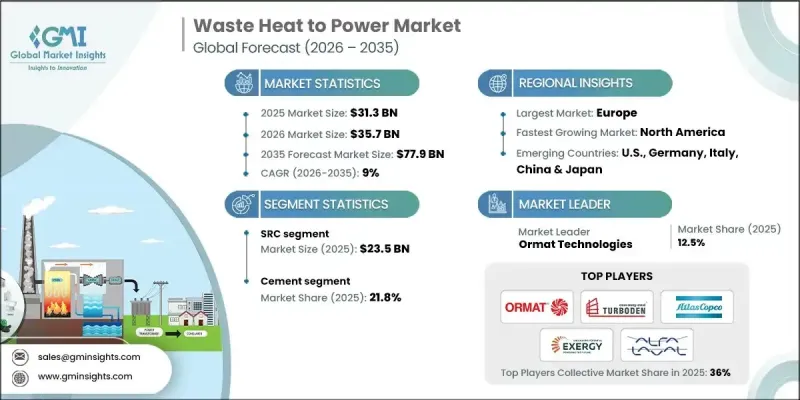
市場成長的驅動力來自日益嚴格的能源效率法規和不斷成長的工業脫碳需求。水泥、鋼鐵、玻璃、化學、紙漿和造紙等重工業的運作過程溫度很高,導致大量熱損失。餘熱發電系統能夠捕捉這些原本會被浪費的熱量並將其轉化為電能,幫助企業降低能耗、達到能源效率目標,並符合內部碳預算和ISO 50001等相關標準。能源價格的波動性使得現場發電尤為重要。熱電聯產系統能夠提供可靠、低成本的電力,同時降低對電網的依賴和尖峰時段。多廠部署能夠產生成本協同效應、提高功率因數並降低需量電價。在環境、社會和治理(ESG)計劃日益增多以及永續工業運作的推動下,熱電聯產系統正逐漸成為能源密集和排放密集型產業的策略性能源管理工具。從長遠來看,這些系統能夠為各行各業帶來可觀的成本節約和業務永續營運。
| 市場覆蓋範圍 | |
|---|---|
| 開始年份 | 2025 |
| 預測年份 | 2026-2035 |
| 起始值 | 313億美元 |
| 預測金額 | 779億美元 |
| 複合年成長率 | 9% |
預計2025年,蒸氣朗肯迴圈(SRC)市場規模將達到235億美元,並在2035年之前維持7.5%的複合年成長率。由於其久經考驗的汽輪機性能和廣泛的工廠運營商認可,SRC仍然是擁有高溫廢熱的行業的首選技術。它與現有鍋爐和蒸氣基礎設施的兼容性使其成為大型工業應用的理想選擇,從而促進了其在水泥、鋼鐵、石化和發電設施中的廣泛應用。 SRC系統長期穩定的運作記錄和可靠性增強了人們對其在連續工業流程中應用的信心。
預計到2025年,水泥產業將佔據21.8%的市場佔有率,並在2035年之前以8.5%的複合年成長率成長。水泥生產和煉廠的高溫製程會產生穩定的餘熱,可用於發電。不斷上漲的能源成本和脫碳壓力正促使工廠利用餘熱發電(WHP)系統來減少燃料消耗、外購電力以及對電網的依賴。監管要求和企業ESG(環境、社會和管治)舉措也進一步推動了餘熱發電的普及,使其成為提高能源效率、支持永續性目標和最佳化營運的有效解決方案。
預計2025年,北美廢熱發電市場規模將達33億美元。石油煉製、化學、鋼鐵、食品加工和水泥等能源密集產業會產生大量熱損失,這些熱損失可用於現場發電。有機朗肯迴圈(ORC)系統因其應對力不同的溫度曲線並可維修現有工業設施,而得到越來越廣泛的應用。清潔能源計畫的獎勵,加上不斷上漲的電價和企業永續性要求,正在加速廢熱發電系統作為一種經濟高效且環境友善的分散式發電解決方案的普及。
目錄
第1章調查方法和範圍
第2章執行摘要
第3章業界考察
- 生態系分析
- 監管環境
- 產業影響因素
- 促進要素
- 產業潛在風險與挑戰
- 成長潛力分析
- 波特五力分析
- PESTEL 分析
- 感應加熱系統的成本結構分析
- 新的機會與趨勢
- 投資分析及未來展望
- 將永續發展措施與工業4.0結合
第4章 競爭情勢
- 介紹
- 按地區分類的公司市佔率分析
- 北美洲
- 歐洲
- 亞太地區
- 中東和非洲
- 拉丁美洲
- 戰略儀錶板
- 策略舉措
- 競爭標竿分析
- 創新與永續性格局
第5章 依技術分類的市場規模及預測(2022-2035年)
- SRC
- ORC
- 卡琳娜
第6章 依應用領域分類的市場規模及預測(2022-2035年)
- 煉油
- 水泥
- 重金屬
- 化學
- 紙
- 食品/飲料
- 玻璃
- 其他
第7章 2022-2035年各地區市場規模及預測
- 北美洲
- 美國
- 加拿大
- 墨西哥
- 歐洲
- 德國
- 英國
- 義大利
- 法國
- 比利時
- 西班牙
- 俄羅斯
- 亞太地區
- 中國
- 澳洲
- 印度
- 日本
- 韓國
- 中東和非洲
- 沙烏地阿拉伯
- 阿拉伯聯合大公國
- 南非
- 拉丁美洲
- 巴西
- 阿根廷
第8章:公司簡介
- AC Boiler SpA
- ALFA LAVAL
- Atlas Copco
- Aura GmbH &CO. KG
- Climeon
- Cochran Ltd.
- Durr Group
- Exergy International Srl
- Forbes Marshall
- General Electric
- IHI Corporation
- Mitsubishi Heavy Industries, Ltd.
- Ormat Technologies
- Rentech Boiler System
- Siemens Energy
- Thermax Ltd
- Turboden
- Walchandnagar Industries Limited(WIL)
The Global Waste Heat to Power Market was valued at USD 31.3 billion in 2025 and is estimated to grow at a CAGR of 9% to reach USD 77.9 billion by 2035.
The market growth is driven by stricter energy efficiency regulations and the rising need for industrial decarbonization. Heavy industries such as cement, steel, glass, chemicals, and pulp & paper operate with high-temperature processes that generate significant thermal losses. WHP systems capture this otherwise wasted heat and convert it into electricity, helping facilities reduce energy consumption, meet efficiency targets, and comply with internal carbon budgets or ISO 50001-style programs. Energy price volatility makes self-generation particularly valuable, as WHP provides reliable, low-cost power while reducing dependence on the grid and exposure to peak tariffs. Multi-plant deployments create cost synergies, improve power factor, and lower demand charges. Increasing ESG commitments and the drive toward sustainable industrial operations have positioned WHP as a strategic energy management tool for energy- and emissions-intensive industries. Over time, these systems provide measurable cost savings and operational resilience across sectors.
| Market Scope | |
|---|---|
| Start Year | 2025 |
| Forecast Year | 2026-2035 |
| Start Value | $31.3 Billion |
| Forecast Value | $77.9 Billion |
| CAGR | 9% |
The Steam Rankine Cycle (SRC) segment reached USD 23.5 billion in 2025 and is forecasted to grow at a CAGR of 7.5% through 2035. SRC remains the preferred technology in industries with high-temperature waste heat availability due to its proven turbine performance and familiarity among plant operators. Its compatibility with existing boiler and steam infrastructure makes it ideal for large-scale industrial applications, supporting widespread adoption in cement, steel, petrochemical, and power generation facilities. The long operational history and reliability of SRC systems reinforce confidence in deploying them for continuous industrial processes.
The cement segment held a 21.8% share in 2025 and is expected to grow at a CAGR of 8.5% through 2035. High-temperature processes in cement and refinery operations create consistent waste heat streams suitable for electricity generation. Rising energy costs and decarbonization pressures are encouraging plants to leverage WHP systems to reduce fuel use, electricity purchases, and grid reliance. Regulatory requirements and corporate ESG initiatives further drive the adoption of WHP as a solution to enhance energy efficiency while supporting sustainability goals and operational optimization.
North America Waste Heat to Power Market generated USD 3.3 billion in 2025. Energy-intensive sectors such as petroleum refining, chemicals, steel, food processing, and cement contribute significant thermal losses that can be captured for on-site power generation. The adoption of Organic Rankine Cycle (ORC) systems is growing due to their flexibility in handling diverse temperature profiles and retrofitting capabilities for existing industrial sites. Incentives under clean energy programs, coupled with rising electricity costs and corporate sustainability mandates, are accelerating the deployment of WHP systems as a cost-effective and environmentally responsible solution for distributed power generation.
Key players operating in the Global Waste Heat to Power Market include AC Boiler SpA, ALFA LAVAL, Atlas Copco, Aura GmbH & CO. KG, Climeon, Cochran Ltd., Durr Group, Exergy International Srl, Forbes Marshall, General Electric, IHI Corporation, Mitsubishi Heavy Industries, Ltd., Ormat Technologies, Rentech Boiler System, Siemens Energy, Thermax Ltd, Turboden, and Walchandnagar Industries Limited (WIL). Companies in the waste heat to power market are adopting multiple strategies to strengthen their position and expand market share. These include investing in R&D to enhance efficiency and retrofit capabilities for diverse industrial heat sources. Firms are forming strategic alliances and partnerships with energy service providers and technology companies to expand deployment opportunities and integrate advanced control systems. Companies are also entering new geographic markets and providing turnkey solutions to increase adoption among heavy industrial clients.
Table of Contents
Chapter 1 Methodology & Scope
- 1.1 Research design
- 1.1.1 Research approach
- 1.1.2 Data collection methods
- 1.2 Base estimates and calculations
- 1.2.1 Base year calculation
- 1.2.2 Market estimates & forecast parameters
- 1.3 Forecast
- 1.3.1 Key trends for market estimates
- 1.3.2 Quantified market impact analysis
- 1.3.2.1 Mathematical impact of growth parameters on forecast
- 1.3.3 Scenario analysis framework
- 1.4 Primary research and validation
- 1.4.1 Some of the primary sources (but not limited to)
- 1.5 Data mining sources
- 1.5.1 Paid Sources
- 1.5.2 Sources, by region
- 1.6 Research trail & scoring components
- 1.6.1 Research trail components
- 1.6.2 Scoring components
- 1.7 Research transparency addendum
- 1.7.1 Source attribution framework
- 1.7.2 Quality assurance metrics
- 1.7.3 Our commitment to trust
- 1.8 Market definitions
Chapter 2 Executive Summary
- 2.1 Industry synopsis, 2022 - 2035
- 2.1.1 Business trends
- 2.1.2 Technology trends
- 2.1.3 Application trends
- 2.1.4 Regional trends
Chapter 3 Industry Insights
- 3.1 Industry ecosystem analysis
- 3.2 Regulatory landscape
- 3.3 Industry impact forces
- 3.3.1 Growth drivers
- 3.3.2 Industry pitfalls & challenges
- 3.4 Growth potential analysis
- 3.5 Porter's analysis
- 3.5.1 Bargaining power of suppliers
- 3.5.2 Bargaining power of buyers
- 3.5.3 Threat of new entrants
- 3.5.4 Threat of substitutes
- 3.6 PESTEL analysis
- 3.6.1 Political factors
- 3.6.2 Economic factors
- 3.6.3 Social factors
- 3.6.4 Technological factors
- 3.6.5 Legal factors
- 3.6.6 Environmental factors
- 3.7 Cost structure analysis of induction heating systems
- 3.8 Emerging opportunities & trends
- 3.9 Investment analysis & future prospects
- 3.10 Sustainability initiatives & industry 4.0 integration
Chapter 4 Competitive Landscape, 2025
- 4.1 Introduction
- 4.2 Company market share analysis, by region, 2025
- 4.2.1 North America
- 4.2.2 Europe
- 4.2.3 Asia Pacific
- 4.2.4 Middle East & Africa
- 4.2.5 Latin America
- 4.3 Strategic dashboard
- 4.4 Strategic initiatives
- 4.5 Competitive benchmarking
- 4.6 Innovation & sustainability landscape
Chapter 5 Market Size and Forecast, By Technology, 2022 - 2035 (USD Million & MW)
- 5.1 Key trends
- 5.2 SRC
- 5.3 ORC
- 5.4 Kalina
Chapter 6 Market Size and Forecast, By Application, 2022 - 2035 (USD Million & MW)
- 6.1 Key trends
- 6.2 Petroleum refining
- 6.3 Cement
- 6.4 Heavy Metal
- 6.5 Chemical
- 6.6 Paper
- 6.7 Food & beverage
- 6.8 Glass
- 6.9 Others
Chapter 7 Market Size and Forecast, By Region, 2022 - 2035 (USD Million & MW)
- 7.1 Key trends
- 7.2 North America
- 7.2.1 U.S.
- 7.2.2 Canada
- 7.2.3 Mexico
- 7.3 Europe
- 7.3.1 Germany
- 7.3.2 UK
- 7.3.3 Italy
- 7.3.4 France
- 7.3.5 Belgium
- 7.3.6 Spain
- 7.3.7 Russia
- 7.4 Asia Pacific
- 7.4.1 China
- 7.4.2 Australia
- 7.4.3 India
- 7.4.4 Japan
- 7.4.5 South Korea
- 7.5 Middle East & Africa
- 7.5.1 Saudi Arabia
- 7.5.2 UAE
- 7.5.3 South Africa
- 7.6 Latin America
- 7.6.1 Brazil
- 7.6.2 Argentina
Chapter 8 Company Profiles
- 8.1 AC Boiler SpA
- 8.2 ALFA LAVAL
- 8.3 Atlas Copco
- 8.4 Aura GmbH & CO. KG
- 8.5 Climeon
- 8.6 Cochran Ltd.
- 8.7 Durr Group
- 8.8 Exergy International Srl
- 8.9 Forbes Marshall
- 8.10 General Electric
- 8.11 IHI Corporation
- 8.12 Mitsubishi Heavy Industries, Ltd.
- 8.13 Ormat Technologies
- 8.14 Rentech Boiler System
- 8.15 Siemens Energy
- 8.16 Thermax Ltd
- 8.17 Turboden
- 8.18 Walchandnagar Industries Limited (WIL)


