

 |
市場調查報告書
商品編碼
1936567
機械往復式引擎市場機會、成長要素、產業趨勢分析及預測(2026年至2035年)Mechanical Reciprocating Engine Market Opportunity, Growth Drivers, Industry Trend Analysis, and Forecast 2026 - 2035 |
||||||

全球機械往復式引擎市場預計到 2025 年將達到 23 億美元,到 2035 年將達到 51 億美元,年複合成長率為 9.2%。
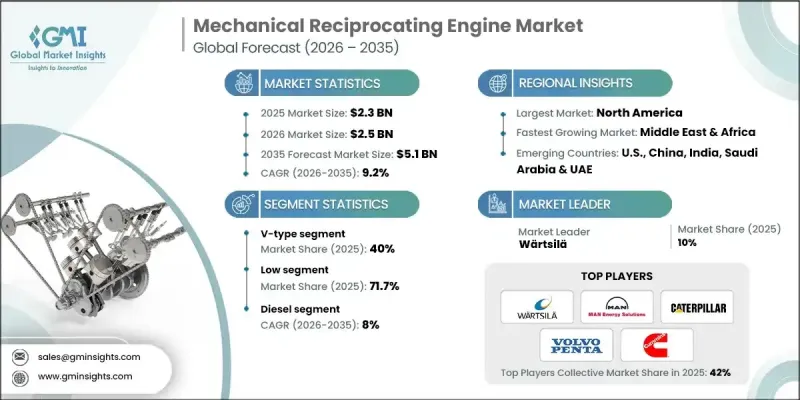
市場擴張得益於工業基礎設施的持續發展以及政府機構和私營部門不斷增加的資本投資。這些投資促進了產能擴張、設施現代化和更廣泛的產業多元化,共同創造了多個終端用戶領域的持續需求。機械往復式引擎憑藉其久經考驗的可靠性和適應性,在全球動力和運動系統中繼續發揮至關重要的作用。這些引擎透過連續的運行循環,將氣缸內活塞的直線運動轉化為旋轉運動,從而在各種運行條件下提供穩定的動力。對農村電氣化的日益重視、支持性的法規結構以及對備用和緊急電源需求的日益成長的認知,正在推動市場成長。政府主導的電力普及計畫進一步增強了需求。儘管機械往復式引擎技術已經成熟,但在持續和間歇運行環境下對可靠機械動力的需求不斷成長的驅動下,該行業仍在透過提高效率和最佳化排放氣體不斷發展。
| 市場覆蓋範圍 | |
|---|---|
| 開始年份 | 2025 |
| 預測年份 | 2026-2035 |
| 起始值 | 23億美元 |
| 預測金額 | 51億美元 |
| 複合年成長率 | 9.2% |
預計到2035年,直列式引擎市場規模將達14億美元。該市場的成長主要歸功於其結構簡單、性能可靠且易於維護。直列式引擎具有動力輸出穩定、運作效率高、使用壽命長等優點,使其成為成本控制、耐用性和易維護性要求較高的應用領域的理想選擇。其在眾多工業和交通運輸相關應用領域的廣泛適用性也持續支撐著市場需求的穩定成長。
預計到2025年,低速機械往復式引擎市佔率將達到71.7%,到2035年市場規模將達到35億美元。該細分市場受益於重型發電和推進系統日益成長的需求,這些系統需要長期穩定的性能。低速機械往復式引擎因其燃油效率高、機械強度高以及能夠在嚴苛負載條件下連續運轉而備受青睞,使其成為高能耗工業應用的首選。
據估計,到2025年,美國機械往復式引擎市場規模將達到8.262億美元,佔全球市場佔有率的74%。美國市場強勁成長的驅動力來自發電、船舶作業和工業設備應用領域對可靠高效引擎的持續需求。引擎技術的不斷進步、對監管要求的不斷滿足以及對排放氣體日益成長的關注,都在推動市場普及並增強市場的長期穩定性。
目錄
第1章調查方法和範圍
第2章執行摘要
第3章業界考察
- 生態系分析
- 原物料供應及採購分析
- 製造能力評估
- 供應鏈韌性與風險因素
- 配電網路分析
- 監管環境
- 產業影響因素
- 促進要素
- 產業潛在風險與挑戰
- 成長潛力分析
- 波特五力分析
- PESTEL 分析
- 船用往復式引擎成本結構分析
- 價格趨勢分析(美元/兆瓦)
- 按地區
- 按額定輸出
- 投資分析及未來展望
- 將永續發展措施與工業4.0結合
第4章 競爭情勢
- 介紹
- 按地區分類的公司市佔率分析
- 北美洲
- 歐洲
- 亞太地區
- 中東和非洲
- 拉丁美洲
- 戰略儀錶板
- 策略舉措
- 重要夥伴關係與合作
- 重大併購活動
- 產品創新與新產品發布
- 市場擴大策略
- 競爭標竿分析
- 創新與永續性格局
第5章 依燃料類型分類的市場規模及預測(2022-2035年)
- 氣體
- 柴油引擎
- 其他
第6章 依額定產量區分的市場規模及預測,2022-2035年
- 0.5 MW~1 MW
- 1兆瓦以上~2兆瓦
- 2兆瓦至3.5兆瓦
- 3.5兆瓦~5兆瓦以上
第7章 依成長速度分類的市場規模及預測,2022-2035年
- 慢速
- 中速
- 高速
8. 依汽缸配置分類的市場規模及預測,2022-2035年
- 系列
- V型
- 徑向
- 對置活塞
第9章 2022-2035年各地區市場規模及預測
- 北美洲
- 美國
- 加拿大
- 墨西哥
- 歐洲
- 英國
- 法國
- 德國
- 俄羅斯
- 義大利
- 西班牙
- 荷蘭
- 丹麥
- 亞太地區
- 中國
- 印度
- 日本
- 韓國
- 澳洲
- 泰國
- 新加坡
- 中東和非洲
- 阿拉伯聯合大公國
- 沙烏地阿拉伯
- 卡達
- 阿曼
- 科威特
- 埃及
- 土耳其
- 南非
- 拉丁美洲
- 巴西
- 阿根廷
- 智利
第10章:公司簡介
- AB Volvo Penta
- Caterpillar
- Cummins
- Deutz AG
- Doosan Corporation
- Escorts Kubota Limited
- Fairbanks Morse Defense
- GE Vernova
- JC Bamford Excavators Ltd.
- Kawasaki Heavy Industries, Ltd.
- KUBOTA Corporation
- Lister Petter
- MAN Energy Solutions
- Mitsubishi Heavy Industries
- Motorenfabrik Hatz GmbH &Co. KG
- Perkins Engines Company Limited
- Rehlko
- Rolls-Royce
- Siemens Energy
- Wartsila
The Global Mechanical Reciprocating Engine Market was valued at USD 2.3 billion in 2025 and is estimated to grow at a CAGR of 9.2% to reach USD 5.1 billion by 2035.
Market expansion is supported by the continued development of industrial infrastructure and rising capital investment from both government bodies and private sector participants. These investments are contributing to capacity expansion, facility modernization, and broader industrial diversification, which together are creating sustained demand across multiple end-use sectors. Mechanical reciprocating engines continue to play a critical role within global power and motion systems due to their proven reliability and adaptability. These engines operate by converting linear piston movement within cylinders into rotational mechanical output through sequential operating cycles, delivering dependable power across a wide range of operating conditions. Increasing focus on rural electrification, supportive regulatory frameworks, and heightened awareness of backup and emergency power requirements are reinforcing market growth. Government-led power access initiatives are further strengthening demand. Despite being a mature technology, the segment continues to evolve through efficiency improvements and emissions optimization, driven by rising requirements for dependable mechanical power in both continuous and intermittent operating environments.
| Market Scope | |
|---|---|
| Start Year | 2025 |
| Forecast Year | 2026-2035 |
| Start Value | $2.3 Billion |
| Forecast Value | $5.1 Billion |
| CAGR | 9.2% |
The inline engine configuration segment is projected to reach USD 1.4 billion by 2035. Growth in this segment is attributed to its simple structural layout, dependable performance, and ease of servicing. Engines with a linear cylinder arrangement provide stable output, operational efficiency, and long service life, making them well-suited for applications where cost control, durability, and maintenance simplicity are essential. Their broad applicability across multiple industrial and mobility-related uses continues to support steady demand.
The low-speed mechanical reciprocating engines segment accounted for 71.7% share in 2025 and is expected to reach USD 3.5 billion by 2035. This segment is benefiting from increasing reliance on heavy-duty power generation and propulsion systems that require consistent performance over extended operating periods. These engines are favored for their fuel efficiency, mechanical robustness, and ability to operate continuously under demanding load conditions, making them a preferred choice for energy-intensive industrial applications.
United States Mechanical Reciprocating Engine Market held 74% share, generating USD 826.2 million in 2025. Market strength in the country is driven by sustained demand for reliable and efficient engines across power generation, marine operations, and industrial equipment usage. Continued advancements in engine technology, adherence to regulatory requirements, and an increased focus on emissions performance are supporting adoption and reinforcing long-term market stability.
Key companies operating in the Global Mechanical Reciprocating Engine Market include Caterpillar, Cummins, Wartsila, MAN Energy Solutions, Mitsubishi Heavy Industries, Rolls-Royce, Siemens Energy, Kawasaki Heavy Industries, AB Volvo Penta, KUBOTA Corporation, Perkins Engines Company, Deutz AG, Fairbanks Morse Defense, GE Vernova, Doosan Corporation, Motorenfabrik Hatz, Escorts Kubota, JC Bamford Excavators, Lister Petter, and Rehlko. Companies active in the mechanical reciprocating engine market are strengthening their competitive position through technology enhancement, portfolio diversification, and strategic geographic expansion. Leading manufacturers are investing in improved fuel efficiency, emissions reduction technologies, and advanced control systems to meet evolving regulatory and customer requirements. Many players are expanding service networks and aftermarket support to improve lifecycle value and customer retention. Strategic partnerships with industrial operators and infrastructure developers are enabling tailored engine solutions for specific applications.
Table of Contents
Chapter 1 Methodology & Scope
- 1.1 Research approach
- 1.2 Quality commitments
- 1.2.1 GMI AI policy & data integrity commitment
- 1.2.1.1 Source consistency protocol
- 1.2.1 GMI AI policy & data integrity commitment
- 1.3 Research trail & confidence scoring
- 1.3.1 Research trail components
- 1.3.2 Scoring components
- 1.4 Data collection
- 1.4.1 Partial list of primary sources
- 1.5 Data mining sources
- 1.5.1 Paid sources
- 1.5.1.1 Sources, by region
- 1.5.1 Paid sources
- 1.6 Base estimates and calculations
- 1.6.1 Base year calculation for any one approach
- 1.7 Market estimates & forecasts parameters
- 1.8 Forecast model
- 1.8.1 Quantified market impact analysis
- 1.8.1.1 Mathematical impact of growth parameters on forecast
- 1.8.1 Quantified market impact analysis
- 1.9 Research transparency addendum
- 1.9.1 Source attribution framework
- 1.9.2 Quality assurance metrics
- 1.9.3 Our commitment to trust
- 1.10 Market definitions
Chapter 2 Executive Summary
- 2.1 Industry synopsis, 2022 - 2035
- 2.1.1 Business trends
- 2.1.2 Fuel trends
- 2.1.3 Rated power trends
- 2.1.4 Speed trends
- 2.1.5 Cylinder configuration trends
- 2.1.6 Regional trends
Chapter 3 Industry Insights
- 3.1 Industry ecosystem analysis
- 3.1.1 Raw material availability & sourcing analysis
- 3.1.2 Manufacturing capacity assessment
- 3.1.3 Supply chain resilience & risk factors
- 3.1.4 Distribution network analysis
- 3.2 Regulatory landscape
- 3.3 Industry impact forces
- 3.3.1 Growth drivers
- 3.3.2 Industry pitfalls & challenges
- 3.4 Growth potential analysis
- 3.5 Porter's analysis
- 3.5.1 Bargaining power of suppliers
- 3.5.2 Bargaining power of buyers
- 3.5.3 Threat of new entrants
- 3.5.4 Threat of substitutes
- 3.6 PESTEL analysis
- 3.6.1 Political factors
- 3.6.2 Economic factors
- 3.6.3 Social factors
- 3.6.4 Technological factors
- 3.6.5 Legal factors
- 3.6.6 Environmental factors
- 3.7 Cost structure analysis of marine reciprocating engines
- 3.8 Price trend analysis (USD/MW)
- 3.8.1 By region
- 3.8.2 By rated power
- 3.9 Investment analysis & future prospects
- 3.10 Sustainability initiatives & industry 4.0 integration
Chapter 4 Competitive Landscape, 2026
- 4.1 Introduction
- 4.2 Company market share analysis, by region, 2025
- 4.2.1 North America
- 4.2.2 Europe
- 4.2.3 Asia Pacific
- 4.2.4 Middle East & Africa
- 4.2.5 Latin America
- 4.3 Strategic dashboard
- 4.4 Strategic initiatives
- 4.4.1 Key partnerships & collaborations
- 4.4.2 Major M&A activities
- 4.4.3 Product innovations & launches
- 4.4.4 Market expansion strategies
- 4.5 Competitive benchmarking
- 4.6 Innovation & sustainability landscape
Chapter 5 Market Size and Forecast, By Fuel, 2022 - 2035 (USD Million & MW)
- 5.1 Key trends
- 5.2 Gas
- 5.3 Diesel
- 5.4 Others
Chapter 6 Market Size and Forecast, By Rated Power, 2022 - 2035 (USD Million & MW)
- 6.1 Key trends
- 6.2 0.5 MW - 1 MW
- 6.3 > 1 MW - 2 MW
- 6.4 > 2 MW - 3.5 MW
- 6.5 > 3.5 MW - 5 MW
Chapter 7 Market Size and Forecast, By Speed, 2022 - 2035 (USD Million & MW)
- 7.1 Key trends
- 7.2 Low
- 7.3 Medium
- 7.4 High
Chapter 8 Market Size and Forecast, By Cylinder Configuration, 2022 - 2035 (USD Million & MW)
- 8.1 Key trends
- 8.2 Inline
- 8.3 V-type
- 8.4 Radial
- 8.5 Opposed piston
Chapter 9 Market Size and Forecast, By Region, 2022 - 2035 (USD Million & MW)
- 9.1 Key trends
- 9.2 North America
- 9.2.1 U.S.
- 9.2.2 Canada
- 9.2.3 Mexico
- 9.3 Europe
- 9.3.1 UK
- 9.3.2 France
- 9.3.3 Germany
- 9.3.4 Russia
- 9.3.5 Italy
- 9.3.6 Spain
- 9.3.7 Netherlands
- 9.3.8 Denmark
- 9.4 Asia Pacific
- 9.4.1 China
- 9.4.2 India
- 9.4.3 Japan
- 9.4.4 South Korea
- 9.4.5 Australia
- 9.4.6 Thailand
- 9.4.7 Singapore
- 9.5 Middle East & Africa
- 9.5.1 UAE
- 9.5.2 Saudi Arabia
- 9.5.3 Qatar
- 9.5.4 Oman
- 9.5.5 Kuwait
- 9.5.6 Egypt
- 9.5.7 Turkey
- 9.5.8 South Africa
- 9.6 Latin America
- 9.6.1 Brazil
- 9.6.2 Argentina
- 9.6.3 Chile
Chapter 10 Company Profiles
- 10.1 AB Volvo Penta
- 10.2 Caterpillar
- 10.3 Cummins
- 10.4 Deutz AG
- 10.5 Doosan Corporation
- 10.6 Escorts Kubota Limited
- 10.7 Fairbanks Morse Defense
- 10.8 GE Vernova
- 10.9 JC Bamford Excavators Ltd.
- 10.10 Kawasaki Heavy Industries, Ltd.
- 10.11 KUBOTA Corporation
- 10.12 Lister Petter
- 10.13 MAN Energy Solutions
- 10.14 Mitsubishi Heavy Industries
- 10.15 Motorenfabrik Hatz GmbH & Co. KG
- 10.16 Perkins Engines Company Limited
- 10.17 Rehlko
- 10.18 Rolls-Royce
- 10.19 Siemens Energy
- 10.20 Wartsila

 先進觸媒技術市場分析及預測(至2035年):類型、產品、技術、應用、材料類型、最終用戶、製程、組件、安裝類型
 汽車引擎活塞環:市場佔有率分析、產業趨勢與統計、成長預測(2026-2031)
 2026年全球鋁活塞市場報告2026年全球氫內燃機市場報告
 引擎油底殼市場按車輛類型、材質、油底殼類型、通路和最終用途產業分類-2026-2032年全球預測
 往復式引擎市場機會、成長要素、產業趨勢分析及2026年至2035年預測氨柴油引擎市場按燃料類型、引擎類型、功率、應用和最終用途分類,全球預測(2026-2032)氨氣汽油引擎市場:按燃料類型、引擎排氣量、技術和應用分類,全球預測(2026-2032)雙燃料氨引擎市場:按功率輸出、引擎類型、燃料混合比、最終用途和應用分類的全球預測(2026-2032年)
 汽車油底殼市場:依應用、技術、產品類型、配銷通路、最終用戶、國家及地區分類-全球產業分析、市場規模、市場佔有率及2025-2032年預測