


 |
市場調查報告書
商品編碼
1936549
生質燃料市場機會、成長要素、產業趨勢分析及2026年至2035年預測Biofuel Market Opportunity, Growth Drivers, Industry Trend Analysis, and Forecast 2026 - 2035 |
||||||

全球生質燃料市場預計到 2025 年將達到 1,605 億美元,到 2035 年將達到 4,321 億美元,年複合成長率為 10.3%。
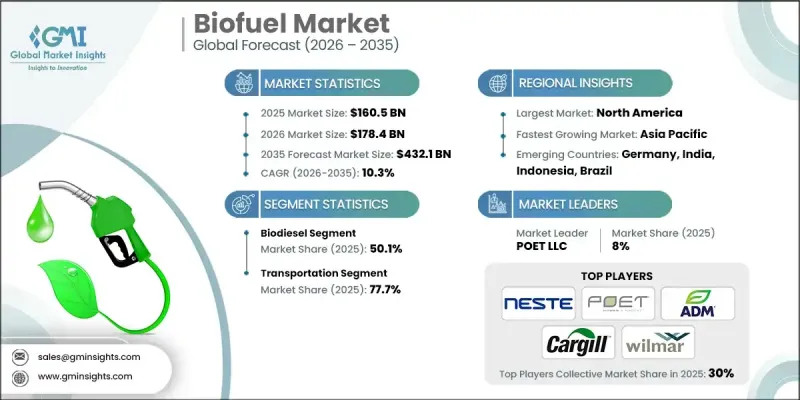
旨在推動交通運輸業脫碳的持續監管要求,正在全球範圍內推動可預測且永續的生質燃料需求。各國政府正日益將生命週期碳強度降低納入燃料政策,並建立合規市場,使低碳燃料生產商能夠獲得可交易的碳權額度。這些法規規範了檢驗和可追溯性,降低了買方風險,並強化了銷售合約。因此,公路、航空和海運領域對乙醇、生質柴油、可再生柴油(氫化植物油,HVO)、沼氣/壓縮生物氣(CBG)和永續航空燃料(SAF)的需求正在成長。積極的政策管理,包括合規時間表和豁免機制,維護了市場的確定性,使依賴穩定供應來開展產業計畫和資本計劃的農民、煉油商和燃料調配商受益。諸如低碳燃料標準(LCFS)等項目持續擴展,鼓勵以廢棄物和殘渣為基礎的生質燃料,擴大基礎設施和交通運輸領域的碳權額度機會,並支持利用廢棄食用油、動物脂肪、垃圾掩埋沼氣和有機廢棄物進行大規模生產。
| 市場覆蓋範圍 | |
|---|---|
| 開始年份 | 2025 |
| 預測年份 | 2026-2035 |
| 起始值 | 1605億美元 |
| 預測金額 | 4321億美元 |
| 複合年成長率 | 10.3% |
預計到2025年,生質柴油市佔率將達到50.1%,並在2035年之前以10.5%的複合年成長率成長。生產商正投資改造碳排放設施,以減少生命週期排放,提高在低碳燃料標準(LCFS)等框架下的碳排放強度(CI)評分,並在國內外合規市場獲得更高的經濟回報。生質柴油持續受益於嚴格的碳排放強度政策和不斷增加的監管獎勵,從而推動了以廢棄物和剩餘原料為原料的燃料的維修。
預計到2025年,交通運輸業將佔全球需求的77.7%,並在2035年之前以9.5%的複合年成長率成長。監管要求、合規主導的信貸市場以及可直接可再生燃料的普及,使得交通運輸業成為最穩定、最大的需求來源。各國政府正優先考慮在該領域生質燃料,尤其是在重型卡車、市政車輛和長途物流領域,因為生物燃料無需對車輛或基礎設施進行重大改造即時減少排放。能源安全問題以及減少對進口石化燃料依賴的需求,進一步推動了已開發經濟體和新興經濟體對生質燃料的採用。
預計到2025年,美國生質燃料市場規模將達到546億美元,佔93%的市場。其主導地位得益於成熟的法規環境、完善的原料供應鏈以及有利於低碳燃料的合規機制。能源安全優先事項、石化燃料價格波動以及企業致力於貨運、航空和航運業脫碳的承諾,都在增強政治支持,所有這些因素都在加速生質燃料的消費。
目錄
第1章調查方法和範圍
第2章執行摘要
第3章業界考察
- 生態系分析
- 監管環境
- 產業影響因素
- 促進要素
- 產業潛在風險與挑戰
- 成長潛力分析
- 波特五力分析
- PESTEL 分析
- 新的機會與趨勢
- 數位化和物聯網整合
- 拓展新興市場
第4章 競爭情勢
- 介紹
- 公司市佔率分析
- 北美洲
- 歐洲
- 亞太地區
- 中東和非洲
- 拉丁美洲
- 策略舉措
- 競爭標竿分析
- 戰略儀錶板
- 創新與科技趨勢
第5章 依燃料類型分類的市場規模及預測(2022-2035年)
- 生質柴油
- 乙醇
- 其他
第6章 依原料分類的市場規模及預測(2022-2035年)
- 粗粒顆粒
- 糖料作物
- 植物油
- 其他
第7章 依應用領域分類的市場規模及預測(2022-2035年)
- 運輸
- 航空領域
- 其他
第8章 2022-2035年各地區市場規模及預測
- 北美洲
- 美國
- 加拿大
- 墨西哥
- 歐洲
- 德國
- 法國
- 西班牙
- 英國
- 義大利
- 亞太地區
- 中國
- 印度
- 印尼
- 澳洲
- 韓國
- 中東和非洲
- 沙烏地阿拉伯
- 南非
- 拉丁美洲
- 巴西
- 阿根廷
第9章:公司簡介
- ADM
- Borregaard
- BTG Bioliquids
- Cargill
- Chevron Corporation
- Clariant
- COFCO
- CropEnergies
- FutureFuel
- Munzer Bioindustrie
- My Eco Energy
- Neste Corporation
- POET
- Praj Industries
- The Andersons
- TotalEnergies
- UPM
- Verbio
- Wilmar International
- Zilor
The Global Biofuel Market was valued at USD 160.5 billion in 2025 and is estimated to grow at a CAGR of 10.3% to reach USD 432.1 billion by 2035.
Continuous regulatory mandates aimed at decarbonizing transportation are driving predictable and durable demand for biofuels worldwide. Governments are increasingly embedding lifecycle carbon intensity reductions into fuel policies, creating compliance markets where producers can earn tradable credits for supplying lower-carbon fuels. These regulations standardize verification and traceability, reducing buyer risk and strengthening offtake agreements, which in turn boosts demand for ethanol, biodiesel, renewable diesel (HVO), biogas/CBG, and sustainable aviation fuels across road, aviation, and marine segments. Active policy management, including compliance timelines and waiver mechanisms, maintains market certainty, benefiting farmers, refiners, and fuel blenders who rely on consistent volumes for operational and capital planning. Programs such as Low Carbon Fuel Standards (LCFS) are expanding, incentivizing waste- and residue-based biofuels and broadening credit opportunities for infrastructure and transit, supporting large-scale production from used cooking oil, animal fats, landfill gas, and organic waste streams.
| Market Scope | |
|---|---|
| Start Year | 2025 |
| Forecast Year | 2026-2035 |
| Start Value | $160.5 Billion |
| Forecast Value | $432.1 billion |
| CAGR | 10.3% |
The biodiesel segment accounted for 50.1% share in 2025 and is projected to grow at a CAGR of 10.5% through 2035. Producers are investing in carbon capture retrofits to reduce lifecycle emissions, improve CI scores under LCFS-like frameworks, and qualify for higher economic returns in both domestic and export compliance markets. Biodiesel continues to benefit from stringent carbon-intensity policies and increasing regulatory incentives, encouraging fleets to adopt fuels derived from waste and residue feedstocks.
The transportation sector represented 77.7% share in 2025 and is expected to grow at a CAGR of 9.5% by 2035. Transport remains the most stable and largest demand center due to regulatory mandates, compliance-driven credit markets, and availability of drop-in renewable fuels. Governments prioritize biofuels in this sector because they achieve immediate emissions reductions without major vehicle or infrastructure modifications, especially in heavy-duty trucking, municipal fleets, and long-haul logistics. Energy security concerns and the need to reduce dependence on imported fossil fuels further reinforce biofuel adoption in developed and emerging economies.
U.S. Biofuel Market held 93% share, generating USD 54.6 billion in 2025. Leadership is driven by a mature regulatory ecosystem, well-developed feedstock supply chains, and compliance mechanisms that reward lower-carbon fuels. Political support is reinforced by energy security priorities, fossil fuel price volatility, and corporate decarbonization commitments from freight, aviation, and maritime industries, which collectively accelerate biofuel consumption.
Key players in the Global Biofuel Market include ADM, Borregaard, BTG Bioliquids, Cargill, Chevron Corporation, Clariant, COFCO, CropEnergies, FutureFuel, Munzer Bioindustrie, My Eco Energy, Neste Corporation, POET, Praj Industries, The Andersons, TotalEnergies, UPM, Verbio, Wilmar International, and Zilor. Companies in the biofuel industry are deploying several strategies to strengthen their market presence. They are investing in R&D to develop low-carbon and waste-based feedstocks, improving efficiency and compliance with regulatory frameworks. Strategic partnerships with local feedstock suppliers and transportation firms expand supply chains and market reach. Businesses are also investing in advanced production infrastructure, including carbon capture retrofits and scale-up of renewable diesel and sustainable aviation fuel capacity. Market penetration is further reinforced through government engagement, lobbying for favorable policies, and participation in compliance credit programs.
Table of Contents
Chapter 1 Methodology & Scope
- 1.1 Research approach
- 1.2 Quality commitment
- 1.2.1 GMI AI policy & data integrity commitment
- 1.2.1.1 Source consistency protocol
- 1.2.1 GMI AI policy & data integrity commitment
- 1.3 Research Trail & Confidence Scoring
- 1.3.1 Research Trail Components
- 1.3.2 Scoring Components
- 1.4 Data Collection
- 1.4.1 Partial list of primary sources
- 1.5 Data mining sources
- 1.5.1 Paid sources
- 1.5.1.1 Sources, by region
- 1.5.1 Paid sources
- 1.6 Base estimates and calculations
- 1.6.1 Base year calculation for any one approach
- 1.7 Forecast model
- 1.8 Research transparency addendum
- 1.8.1 Source attribution framework
- 1.8.2 Quality assurance metrics
- 1.8.3 Our commitment to trust
- 1.9 Market definitions
Chapter 2 Executive Summary
- 2.1 Industry synopsis, 2022 - 2035
- 2.1.1 Business trends
- 2.1.2 Fuel trends
- 2.1.3 Feedstock trends
- 2.1.4 Application trends
- 2.1.5 Regional trends
Chapter 3 Industry Insights
- 3.1 Industry ecosystem analysis
- 3.2 Regulatory landscape
- 3.3 Industry impact forces
- 3.3.1 Growth drivers
- 3.3.2 Industry pitfalls & challenges
- 3.4 Growth potential analysis
- 3.5 Porter's analysis
- 3.5.1 Bargaining power of suppliers
- 3.5.2 Bargaining power of buyers
- 3.5.3 Threat of new entrants
- 3.5.4 Threat of substitutes
- 3.6 PESTEL analysis
- 3.6.1 Political factors
- 3.6.2 Economic factors
- 3.6.3 Social factors
- 3.6.4 Technology factors
- 3.6.5 environmental factors
- 3.6.6 Legal factors
- 3.7 Emerging opportunities & trends
- 3.7.1 Digitalization and IoT integration
- 3.7.2 Emerging market penetration
Chapter 4 Competitive landscape, 2025
- 4.1 Introduction
- 4.2 Company market share analysis, 2025
- 4.2.1 North America
- 4.2.2 Europe
- 4.2.3 Asia Pacific
- 4.2.4 Middle East & Africa
- 4.2.5 Latin America
- 4.3 Strategic initiatives
- 4.4 Competitive benchmarking
- 4.5 Strategic dashboard
- 4.6 Innovation & technology landscape
Chapter 5 Market Size and Forecast, By Fuel, 2022 - 2035 (USD Million, Mtoe)
- 5.1 Key trends
- 5.2 Biodiesel
- 5.3 Ethanol
- 5.4 Others
Chapter 6 Market Size and Forecast, By Feedstock, 2022 - 2035 (USD Million, Mtoe)
- 6.1 Key trends
- 6.2 Coarse grain
- 6.3 Sugar crop
- 6.4 Vegetable oil
- 6.5 Others
Chapter 7 Market Size and Forecast, By Application, 2022 - 2035 (USD Million, Mtoe)
- 7.1 Key trends
- 7.2 Transportation
- 7.3 Aviation
- 7.4 Others
Chapter 8 Market Size and Forecast, By Region, 2022 - 2035 (USD Million, Mtoe)
- 8.1 Key trends
- 8.2 North America
- 8.2.1 U.S.
- 8.2.2 Canada
- 8.2.3 Mexico
- 8.3 Europe
- 8.3.1 Germany
- 8.3.2 France
- 8.3.3 Spain
- 8.3.4 UK
- 8.3.5 Italy
- 8.4 Asia Pacific
- 8.4.1 China
- 8.4.2 India
- 8.4.3 Indonesia
- 8.4.4 Australia
- 8.4.5 South Korea
- 8.5 Middle East & Africa
- 8.5.1 Saudi Arabia
- 8.5.2 South Africa
- 8.6 Latin America
- 8.6.1 Brazil
- 8.6.2 Argentina
Chapter 9 Company Profiles
- 9.1 ADM
- 9.2 Borregaard
- 9.3 BTG Bioliquids
- 9.4 Cargill
- 9.5 Chevron Corporation
- 9.6 Clariant
- 9.7 COFCO
- 9.8 CropEnergies
- 9.9 FutureFuel
- 9.10 Munzer Bioindustrie
- 9.11 My Eco Energy
- 9.12 Neste Corporation
- 9.13 POET
- 9.14 Praj Industries
- 9.15 The Andersons
- 9.16 TotalEnergies
- 9.17 UPM
- 9.18 Verbio
- 9.19 Wilmar International
- 9.20 Zilor

 生質燃料市場-全球產業規模、佔有率、趨勢、機會、預測:按形態、應用、原料、區域和競爭格局分類,2021-2031年
 生質燃料生產市場:預測(至2034年)-按生質燃料類型、生產流程、原料、形態、最終用戶和地區分類的全球分析
 生質燃料市場:2026-2032年全球市場預測(依生質燃料類型、製造流程、形態、原料類型、應用、最終用途及通路分類)
 生質燃料市場:依原料類型、燃料類型、應用、生產技術、終端用戶產業及地區分類乳化燃料市場:2026-2032年全球市場預測(按燃料類型、混合比例、分銷管道、應用和最終用戶分類)
 單細胞油市場規模、佔有率、成長及全球產業分析:按類型和應用、區域洞察及2026-2034年預測
 燃油品質感測器-全球市場佔有率和排名、總銷售量和需求預測(2026-2032 年)
 2026年全球生質燃料催化劑市場研究報告
 交通運輸用生質燃料的市場機會、成長要素、產業趨勢分析及 2026-2035 年預測。
 生質燃料:市場佔有率分析、產業趨勢與統計、成長預測(2026-2031)