


 |
市場調查報告書
商品編碼
1936543
商業褐藻市場機會、成長促進因素、產業趨勢分析及預測(2026-2035年)Brown Commercial Seaweed Market Opportunity, Growth Drivers, Industry Trend Analysis, and Forecast 2026 - 2035 |
||||||

全球商業褐藻市場預計到 2025 年將價值 201 億美元,到 2035 年達到 441 億美元,年複合成長率為 8%。
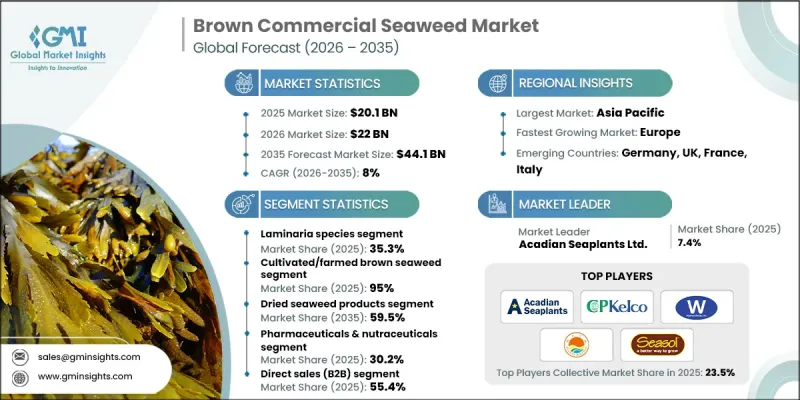
由於醫藥、食品、農業等行業的需求不斷成長,褐藻市場正在擴張。褐藻,尤其是海帶、泡葉藻和墨角藻等,因其富含營養物質和生物活性化合物而備受推崇,被廣泛應用於各個領域。消費者對天然、植物性和永續成分的日益青睞,推動了褐藻產品的廣泛應用。在農業領域,褐藻可用作生物肥料和土壤改良劑,其天然激素,如細胞分裂素和生長素,能夠提高作物產量、促進植物生長並增強其對環境壓力的抵抗力。在食品飲料領域,褐藻富含膳食纖維、礦物質和抗氧化成分,使其成為保健食品、機能飲料和點心的理想添加物。從褐藻中提取的生物活性化合物也因其抗氧化、抗發炎和抗衰老齡化特性而被廣泛應用於醫藥和化妝品領域。褐藻具有多功能、可再生和環保的特性,再加上植物來源和天然成分的趨勢,持續推動全球市場的強勁成長。
| 市場覆蓋範圍 | |
|---|---|
| 開始年份 | 2025 |
| 預測年份 | 2026-2035 |
| 起始金額 | 201億美元 |
| 預測金額 | 441億美元 |
| 複合年成長率 | 8% |
預計到2025年,海帶市佔率將達到35.3%,並在2035年之前以8.3%的複合年成長率成長。海帶和糖海帶仍然是最搶手的品種,這主要得益於食品、製藥和工業領域對其高藻酸鹽含量的強勁需求。隨著消費者越來越重視健康和保健,海帶和糖海帶衍生產品(例如膳食補充劑和機能性食品)在全球範圍內越來越受歡迎。
2025年,人工養殖褐藻佔了95%的市場佔有率,預計2026年至2035年將以8.1%的複合年成長率成長。這一成長主要得益於養殖技術的進步、消費者對產品品質穩定性的日益成長的需求,以及與野生海藻相比更低的環境影響。人工養殖海藻產量更高、品質更優,且符合永續性。此外,新興的「從農場到餐桌」和「直接面對消費者」模式也進一步推動了其在主要市場的普及。
預計到2025年,北美商業褐藻市佔率將達到13.3% 。意識提升,以及對植物來源和永續產品的偏好日益成長,正在推動該地區褐藻市場的成長。隨著成熟的食品、保健品和化妝品產業積極採用海藻成分,製造商正致力於開發創新產品。此外,北美地區對潔淨標示永續產品的日益重視,也推動了海藻在各種應用領域的進一步發展。
目錄
第1章調查方法和範圍
第2章執行摘要
第3章業界考察
- 生態系分析
- 供應商情況
- 利潤率
- 每個階段的附加價值
- 影響價值鏈的因素
- 中斷
- 產業影響因素
- 成長促進因素
- 產業潛在風險與挑戰
- 市場機遇
- 成長潛力分析
- 監管環境
- 北美洲
- 歐洲
- 亞太地區
- 拉丁美洲
- 中東和非洲
- 波特五力分析
- PESTEL 分析
- 價格趨勢
- 按地區
- 按類型
- 未來市場趨勢
- 科技與創新趨勢
- 當前技術趨勢
- 新興技術
- 專利狀態
- 貿易統計(HS編碼)(註:僅提供主要國家的貿易統計)
- 主要進口國
- 主要出口國
- 永續性和環境方面
- 永續努力
- 減少廢棄物策略
- 生產中的能源效率
- 環保舉措
- 考慮到碳足跡
第4章 競爭情勢
- 介紹
- 公司市佔率分析
- 按地區
- 北美洲
- 歐洲
- 亞太地區
- 拉丁美洲
- 中東和非洲
- 按地區
- 企業矩陣分析
- 主要市場公司的競爭分析
- 競爭定位矩陣
- 重大進展
- 併購
- 夥伴關係與合作
- 新產品發布
- 業務拓展計劃
第5章 市場估計與預測:依類型分類,2022-2035年
- 海帶
- 糖精
- 裙帶菜
- 結節藻
- 岩藻
- 馬尾藻
- 其他物種
第6章 按種植方式分類的市場估算與預測,2022-2035年
- 野生採集的褐藻
- 人工養殖/培育的褐藻
第7章 按類型分類的市場估計與預測,2022-2035年
- 乾海藻製品
- 生海藻
- 液體萃取物
- 精製/純化萃取物及其衍生
第8章 按應用領域分類的市場估算與預測,2022-2035年
- 藥品和營養補充劑
- 飼料和水產養殖
- 家禽飼料
- 豬飼料
- 水產飼料
- 寵物食品
- 反芻動物飼料
- 工業應用
- 生質燃料
- 生質塑膠和可生物分解包裝材料
- 生物化學物質
- 生物精煉
- 水處理和工業製程
- 農業
- 有機肥料
- 生物促效劑
- 土壤改良劑和調節劑
- 種子處理劑
- 生物農藥
- 食品/飲料
- 直接食物消費
- 食品原料
- 食品添加物
- 化妝品和個人護理
- 護膚
- 護髮
- 活性成分
第9章 按分銷管道分類的市場估算與預測,2022-2035年
- 直銷(B2B)
- 批發商和批發公司
- 線上B2B平台
- 零售/直接面對消費者
第10章 2022-2035年各地區市場估計與預測
- 北美洲
- 美國
- 加拿大
- 歐洲
- 德國
- 英國
- 法國
- 西班牙
- 義大利
- 其他歐洲地區
- 亞太地區
- 中國
- 印度
- 日本
- 澳洲
- 韓國
- 亞太其他地區
- 拉丁美洲
- 巴西
- 墨西哥
- 阿根廷
- 其他拉丁美洲地區
- 中東和非洲
- 沙烏地阿拉伯
- 南非
- 阿拉伯聯合大公國
- 其他中東和非洲地區
第11章 公司簡介
- Marcel Carrageenan
- W Hydrocolloids, Inc.
- Seasol International
- Algea
- Acadian Seaplants Ltd.
- CP Kelco
- Qingdao Seawin Biotech Group Co., Ltd.
- Mara Seaweed
- Pacific Harvest
- Indigrow Ltd.
The Global Brown Commercial Seaweed Market was valued at USD 20.1 billion in 2025 and is estimated to grow at a CAGR of 8% to reach USD 44.1 billion by 2035.
The market is expanding due to rising demand from pharmaceuticals, food, agriculture, and other industries. Brown seaweed species such as Laminaria, Ascophyllum, and Fucus are particularly valued for their rich nutrients and bioactive compounds, which are widely used across multiple sectors. Consumers are increasingly preferring natural, plant-based, and sustainable ingredients, which is fueling the adoption of brown seaweed products. In agriculture, brown seaweeds function as biofertilizers and soil conditioners, enhancing crop yields, promoting plant growth, and increasing resistance to environmental stresses through naturally occurring hormones like cytokinins and auxins. In food applications, their high dietary fiber, mineral content, and antioxidants make brown seaweed an attractive addition to health foods, functional beverages, and snacks. Bioactive compounds extracted from brown seaweed are also widely used in pharmaceuticals and cosmetics due to their antioxidant, anti-inflammatory, and anti-aging properties. The multifunctional, renewable, and eco-friendly nature of brown seaweed, combined with trends toward plant-based and natural products, continues to drive robust market growth worldwide.
| Market Scope | |
|---|---|
| Start Year | 2025 |
| Forecast Year | 2026-2035 |
| Start Value | $20.1 Billion |
| Forecast Value | $44.1 Billion |
| CAGR | 8% |
The laminaria species segment held 35.3% share in 2025 and is anticipated to grow at a CAGR of 8.3% through 2035. Laminaria and Saccharina species remain the most sought-after varieties due to their high alginate content, which drives strong demand from the food, pharmaceutical, and industrial sectors. As consumers increasingly prioritize health and wellness, products derived from Laminaria and Saccharina, such as dietary supplements and functional foods, are becoming more popular globally.
The cultivated or farmed brown seaweed segment held 95% in 2025 and is projected to grow at a CAGR of 8.1% during 2026-2035. Growth is fueled by advancements in aquaculture technology, the rising demand for consistent product quality, and lower environmental impact compared to wild-harvested seaweed. Cultivated seaweed provides higher yields, superior quality, and aligns with sustainability trends, while emerging farm-gate and direct-to-consumer models further support adoption in key markets.
North America Brown Commercial Seaweed Market accounted for 13.3% share in 2025. The region is driven by rising consumer awareness of health benefits and increasing preference for plant-based and sustainable products. Established food, nutraceutical, and cosmetic industries are actively incorporating seaweed ingredients, prompting manufacturers to focus on innovative product launches. Additionally, North America's emphasis on clean-label and sustainable products is encouraging further inclusion of seaweed across multiple applications.
Key players operating in the Global Brown Commercial Seaweed Market include Pacific Harvest, CP Kelco, Acadian Seaplants Ltd., W Hydrocolloids, Inc., Algea, Mara Seaweed, Marcel Carrageenan, Seasol International, Qingdao Seawin Biotech Group Co., Ltd., and Indigrow Ltd. Companies in the brown commercial seaweed market are employing multiple strategies to strengthen their market position and expand their global footprint. They are investing heavily in R&D to develop high-value bioactive extracts and new formulations for food, pharmaceutical, and cosmetic applications. Strategic partnerships with aquaculture farms, research institutions, and distributors are formed to ensure a consistent supply and expand geographic reach. Companies are also focusing on sustainability initiatives, such as eco-friendly harvesting and cultivation practices, to meet consumer demand for natural and plant-based products.
Table of Contents
Chapter 1 Methodology & Scope
- 1.1 Market scope and definition
- 1.2 Research design
- 1.2.1 Research approach
- 1.2.2 Data collection methods
- 1.3 Data mining sources
- 1.3.1 Global
- 1.3.2 Regional/Country
- 1.4 Base estimates and calculations
- 1.4.1 Base year calculation
- 1.4.2 Key trends for market estimation
- 1.5 Primary research and validation
- 1.5.1 Primary sources
- 1.6 Forecast model
- 1.7 Research assumptions and limitations
Chapter 2 Executive Summary
- 2.1 Industry 3600 synopsis
- 2.2 Key market trends
- 2.2.1 Regional
- 2.2.2 Species type
- 2.2.3 Cultivation type
- 2.2.4 Form
- 2.2.5 Application
- 2.2.6 Distribution channel
- 2.3 TAM Analysis, 2026-2035
- 2.4 CXO perspectives: Strategic imperatives
- 2.4.1 Executive decision points
- 2.4.2 Critical success factors
- 2.5 Future Outlook and Strategic Recommendations
Chapter 3 Industry Insights
- 3.1 Industry ecosystem analysis
- 3.1.1 Supplier landscape
- 3.1.2 Profit margin
- 3.1.3 Value addition at each stage
- 3.1.4 Factor affecting the value chain
- 3.1.5 Disruptions
- 3.2 Industry impact forces
- 3.2.1 Growth drivers
- 3.2.2 Industry pitfalls and challenges
- 3.2.3 Market opportunities
- 3.3 Growth potential analysis
- 3.4 Regulatory landscape
- 3.4.1 North America
- 3.4.2 Europe
- 3.4.3 Asia Pacific
- 3.4.4 Latin America
- 3.4.5 Middle East & Africa
- 3.5 Porter's analysis
- 3.6 PESTEL analysis
- 3.7 Price trends
- 3.7.1 By region
- 3.7.2 By type
- 3.8 Future market trends
- 3.9 Technology and Innovation landscape
- 3.9.1 Current technological trends
- 3.9.2 Emerging technologies
- 3.10 Patent Landscape
- 3.11 Trade statistics (HS code) (Note: the trade statistics will be provided for key countries only)
- 3.11.1 Major importing countries
- 3.11.2 Major exporting countries
- 3.12 Sustainability and environmental aspects
- 3.12.1 Sustainable practices
- 3.12.2 Waste reduction strategies
- 3.12.3 Energy efficiency in production
- 3.12.4 Eco-friendly initiatives
- 3.13 Carbon footprint consideration
Chapter 4 Competitive Landscape, 2025
- 4.1 Introduction
- 4.2 Company market share analysis
- 4.2.1 By region
- 4.2.1.1 North America
- 4.2.1.2 Europe
- 4.2.1.3 Asia Pacific
- 4.2.1.4 LATAM
- 4.2.1.5 MEA
- 4.2.1 By region
- 4.3 Company matrix analysis
- 4.4 Competitive analysis of major market players
- 4.5 Competitive positioning matrix
- 4.6 Key developments
- 4.6.1 Mergers & acquisitions
- 4.6.2 Partnerships & collaborations
- 4.6.3 New Product Launches
- 4.6.4 Expansion Plans
Chapter 5 Market Estimates and Forecast, By Species Type, 2022-2035 (USD Billion) (Kilo Tons)
- 5.1 Key trends
- 5.2 Laminaria Species
- 5.3 Saccharina Species
- 5.4 Undaria pinnatifida
- 5.5 Ascophyllum nodosum
- 5.6 Fucus Species
- 5.7 Sargassum Species
- 5.8 Other Species
Chapter 6 Market Estimates and Forecast, By Cultivation Type, 2022-2035 (USD Billion) (Kilo Tons)
- 6.1 Key trends
- 6.2 Wild-harvested brown seaweed
- 6.3 Cultivated/farmed brown seaweed
Chapter 7 Market Estimates and Forecast, By Form, 2022-2035 (USD Billion) (Kilo Tons)
- 7.1 Key trends
- 7.2 Dried seaweed products
- 7.3 Fresh seaweed
- 7.4 Liquid extracts
- 7.5 Purified/refined extracts & derivatives
Chapter 8 Market Estimates and Forecast, By Application, 2022-2035 (USD Billion) (Kilo Tons)
- 8.1 Key trends
- 8.2 Pharmaceuticals & nutraceuticals
- 8.3 Animal feed & aquaculture
- 8.3.1 Poultry feed
- 8.3.2 Swine feed
- 8.3.3 Aquaculture feed
- 8.3.4 Pet food
- 8.3.5 Ruminant feed
- 8.4 Industrial applications
- 8.4.1 Biofuels
- 8.4.2 Bioplastics & biodegradable packaging
- 8.4.3 Biochemicals
- 8.4.4 Biorefineries
- 8.4.5 Water treatment & industrial processes
- 8.5 Agriculture
- 8.5.1 Organic fertilizers
- 8.5.2 Biostimulants
- 8.5.3 Soil amendments & conditioners
- 8.5.4 Seed treatments
- 8.5.5 Biopesticides
- 8.6 Food & beverages
- 8.6.1 Direct food consumption
- 8.6.2 Food ingredients
- 8.6.3 Food additives
- 8.7 Cosmetics & personal care
- 8.7.1 Skincare
- 8.7.2 Haircare
- 8.7.3 Active ingredients
Chapter 9 Market Estimates and Forecast, By Distribution Channel, 2022-2035 (USD Billion) (Kilo Tons)
- 9.1 Key trends
- 9.2 Direct sales (B2B)
- 9.3 Distributors & wholesalers
- 9.4 Online B2B platforms
- 9.5 Retail & direct-to-consumer
Chapter 10 Market Estimates and Forecast, By Region, 2022-2035 (USD Billion) (Kilo Tons)
- 10.1 Key trends
- 10.2 North America
- 10.2.1 U.S.
- 10.2.2 Canada
- 10.3 Europe
- 10.3.1 Germany
- 10.3.2 UK
- 10.3.3 France
- 10.3.4 Spain
- 10.3.5 Italy
- 10.3.6 Rest of Europe
- 10.4 Asia Pacific
- 10.4.1 China
- 10.4.2 India
- 10.4.3 Japan
- 10.4.4 Australia
- 10.4.5 South Korea
- 10.4.6 Rest of Asia Pacific
- 10.5 Latin America
- 10.5.1 Brazil
- 10.5.2 Mexico
- 10.5.3 Argentina
- 10.5.4 Rest of Latin America
- 10.6 Middle East and Africa
- 10.6.1 Saudi Arabia
- 10.6.2 South Africa
- 10.6.3 UAE
- 10.6.4 Rest of Middle East and Africa
Chapter 11 Company Profiles
- 11.1 Marcel Carrageenan
- 11.2 W Hydrocolloids, Inc.
- 11.3 Seasol International
- 11.4 Algea
- 11.5 Acadian Seaplants Ltd.
- 11.6 CP Kelco
- 11.7 Qingdao Seawin Biotech Group Co., Ltd.
- 11.8 Mara Seaweed
- 11.9 Pacific Harvest
- 11.10 Indigrow Ltd.

 海藻市場分析及預測(至2035年):類型、產品類型、形態、應用、最終用戶、技術、組成成分、簡介、製程
 全球高級海藻調味料市場規模、佔有率、趨勢和成長分析報告(2026-2034年)
 海藻風味市場機會、成長要素、產業趨勢分析及預測(2026年至2035年)
 商業褐藻市場規模、佔有率和成長分析(按等級、應用、培養技術、產品形態、收穫方法和地區分類)—產業預測(2026-2033 年)
 全球美食海藻調味品市場海帶產品的世界市場
 到 2030 年全球海藻香料市場預測:按類型、形式、分銷管道、應用和地區分類世界海藻市場
 全球海帶產品市場規模、佔有率及趨勢分析報告,依形式(粉末、液體和片狀)、依應用(農業、食品、藥品等)、依類型(新鮮、乾和鹹)、區域展望和預測, 2024 - 2031