

 |
市場調查報告書
商品編碼
1936542
濕紙巾市場機會、成長要素、產業趨勢分析及2026年至2035年預測Wet Wipes Market Opportunity, Growth Drivers, Industry Trend Analysis, and Forecast 2026 - 2035 |
||||||

全球濕紙巾市場預計到 2025 年將達到 51 億美元,到 2035 年將達到 89 億美元,年複合成長率為 5.8%。
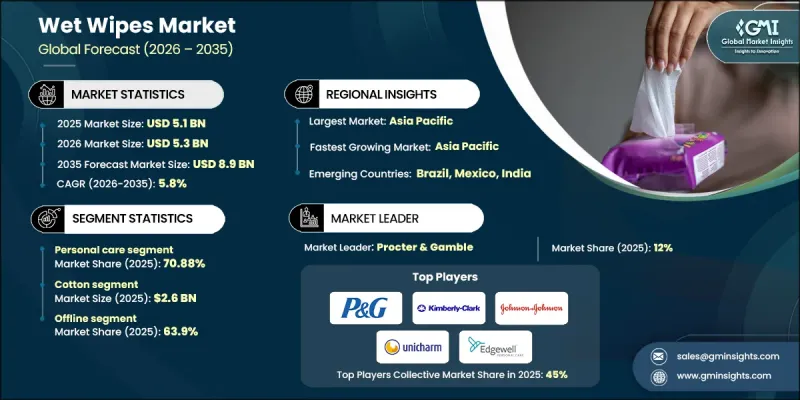
隨著越來越多的製造商響應日益增強的環保意識、日益嚴格的法規以及不斷變化的消費者期望,市場正在經歷重大變革時期。各大品牌正加速轉型為無塑膠材料、溫和配方和永續性產品設計。傳統的合成不織布和刺激性防腐劑正逐漸被植物來源可生物分解纖維和注重皮膚相容性和安全性的溫和乳液所取代。由於衛生意識的增強、便利的產品形式以及訂閱和線上購買模式的普及,市場需求依然強勁。同時,多個地區的監管壓力迫使企業重新評估材料選擇、標籤規範和廢棄物責任。消費者對正確處理方法和永續消費的日益了解,正在加速可堆肥材料和環保包裝的普及。不織布製造技術的不斷進步,正使濕紙巾從簡單的消耗品演變為兼具柔軟性、耐用性、吸水性和可生物分解性的理想解決方案。
| 市場覆蓋範圍 | |
|---|---|
| 開始年份 | 2025 |
| 預測年份 | 2026-2035 |
| 起始值 | 51億美元 |
| 預測金額 | 89億美元 |
| 複合年成長率 | 5.8% |
到2025年,個人護理應用領域將佔據70.88%的市場。該領域的主導地位歸功於擦拭巾已深度融入日常衛生習慣。消費者越來越依賴這些產品進行快速且有效率的清潔,從而在各個年齡層和不同生活方式人群中創造了穩定的需求。便利性、便攜性和溫和配方等特點持續鞏固個人護理擦拭巾的全球主導地位。
到2025年,棉質擦拭巾市場將佔據51%的佔有率,並創造26億美元的收入。棉花仍然是消費者追求天然、柔軟和可生物分解材料的首選,尤其是在敏感肌膚產品中。其奢華的觸感和舒適度使其在對溫和性和材料品質要求較高的應用場景中得到廣泛應用,而編織類替代品則僅限於一些特殊用途。
預計到2025年,美國擦拭巾市佔率將達到85%,成為領先的區域市場。家庭、個人衛生和嬰兒護理等領域的高日均使用量推動了強勁的需求。消費者越來越傾向選擇注重肌膚平衡和健康的配方產品,這促使各大品牌拓展產品線,從標準衛生用品轉向滿足美國和加拿大消費者更專業的個人護理需求。
目錄
第1章調查方法和範圍
第2章執行摘要
第3章業界考察
- 生態系分析
- 供應商情況
- 利潤率
- 每個階段的附加價值
- 影響價值鏈的因素
- 產業影響因素
- 促進要素
- 過渡到無塑膠和可生物分解材料
- 消費者需求加速成長
- 產業潛在風險與挑戰
- 環境影響及下水道堵塞
- 監管障礙
- 機會
- 不含塑膠、可生物分解的不織布
- 方便旅行和「便攜」的產品
- 促進要素
- 成長潛力分析
- 未來市場趨勢
- 科技與創新趨勢
- 當前技術趨勢
- 新興技術
- 價格趨勢
- 按地區
- 按類型
- 監管環境
- 標準和合規要求
- 區域法規結構
- 認證標準
- 波特五力分析
- PESTEL 分析
第4章 競爭情勢
- 介紹
- 公司市佔率分析
- 按地區
- 企業矩陣分析
- 主要市場公司的競爭分析
- 競爭定位矩陣
- 重大進展
- 併購
- 夥伴關係與合作
- 新產品發布
- 擴張計劃
第5章 依產品類型分類的市場估算與預測,2022-2035年
- 個人護理濕紙巾
- 臉部擦拭巾
- 擦拭巾
- 擦拭巾
- 嬰兒擦拭巾
- 其他
- 家用濕紙巾
第6章 按材料分類的市場估算與預測,2022-2035年
- 棉布
- 不織布
- 織物
第7章 2022-2035年按價格區間分類的市場估計與預測
- 低價位
- 中號
- 高價位範圍
第8章 按包裝尺寸分類的市場估算與預測,2022-2035年
- 最多 50 張
- 50至100張
- 超過100張擦拭巾
第9章 依最終用戶分類的市場估算與預測,2022-2035年
- 個人
- 商業的
第10章 按分銷管道分類的市場估算與預測,2022-2035年
- 線上管道
- 電子商務
- 公司網站
- 離線頻道
- 大型零售商店
- 專賣店
- 其他
第11章 2022-2035年各地區市場估計與預測
- 北美洲
- 美國
- 加拿大
- 歐洲
- 德國
- 英國
- 法國
- 義大利
- 西班牙
- 亞太地區
- 中國
- 日本
- 印度
- 澳洲
- 韓國
- 拉丁美洲
- 巴西
- 墨西哥
- 阿根廷
- 中東和非洲
- 南非
- 沙烏地阿拉伯
- 阿拉伯聯合大公國
第12章:公司簡介
- Cora
- Cottons
- Johnson &Johnson
- Kimberly-Clark Corporation
- L. Organic
- Lil-Lets
- Lola
- Natracare
- Organyc
- Playtex
- Procter &Gamble
- Unilever
- The Honest Company
- Unicharm Corporation
- Veeda
The Global Wet Wipes Market was valued at USD 5.1 billion in 2025 and is estimated to grow at a CAGR of 5.8% to reach USD 8.9 billion by 2035.
The market is undergoing a notable transformation as manufacturers respond to rising environmental awareness, tighter regulations, and changing consumer expectations. Brands are increasingly shifting toward plastic-free materials, skin-friendly formulations, and sustainability-focused product designs. Traditional synthetic nonwovens and harsh preservatives are gradually being replaced by plant-based and biodegradable fibers, along with gentler lotions that prioritize skin compatibility and safety testing. Demand has remained resilient due to heightened hygiene awareness, convenient product formats, and growing adoption of subscription-based and online purchasing models. At the same time, regulatory pressure in several regions is pushing companies to rethink material choices, labeling practices, and waste responsibility. Growing consumer understanding of proper disposal methods and sustainable consumption is accelerating the adoption of compostable materials and environmentally responsible packaging. Continuous advancements in nonwoven manufacturing are elevating wet wipes from simple disposable products to engineered solutions that balance softness, durability, absorbency, and biodegradability.
| Market Scope | |
|---|---|
| Start Year | 2025 |
| Forecast Year | 2026-2035 |
| Start Value | $5.1 Billion |
| Forecast Value | $8.9 Billion |
| CAGR | 5.8% |
The personal care applications segment accounted for 70.88% share in 2025. This segment leads because wipes are deeply integrated into everyday hygiene routines. Consumers increasingly rely on these products for quick, efficient cleansing, driving consistent demand across multiple age groups and lifestyles. The emphasis on convenience, portability, and gentle formulations continues to reinforce the dominance of personal care wipes worldwide.
In 2025, the cotton-based wipes segment held a 51% share and generated USD 2.6 billion. Cotton remains a preferred material for consumers seeking natural, soft, and biodegradable options, particularly in products designed for sensitive skin. Its premium perception and comfort characteristics support widespread use in applications where mildness and material quality are critical, while woven alternatives remain limited to specialized use cases.
United States Wet Wipes Market accounted for 85% share in 2025, making it the leading regional market. Strong demand is supported by high daily usage across household, personal hygiene, and infant care categories. Consumers are increasingly drawn to formulations positioned around skin balance and wellness, encouraging brands to diversify offerings beyond standard hygiene products and address more specialized personal care needs across the U.S. and Canada.
Key companies operating in the Global Wet Wipes Market include Procter & Gamble, Kimberly-Clark Corporation, Unilever, Johnson & Johnson, Unicharm Corporation, The Honest Company, Natracare, Organyc, Cora, Playtex, Lola, Veeda, L. Organic, Cottons, and Lil-Lets. Companies in the wet wipes market strengthen their market position through sustainability-driven innovation, portfolio diversification, and strong consumer engagement. Many players invest in biodegradable substrates, cleaner formulations, and eco-conscious packaging to align with regulatory expectations and consumer values. Product differentiation through targeted use cases helps brands expand beyond traditional hygiene categories. Firms also enhance their digital presence through direct-to-consumer platforms and subscription models to build loyalty. Strategic pricing, premium positioning, and transparent labeling improve brand trust. Ongoing investment in material science and manufacturing efficiency enables companies to balance performance, cost, and environmental responsibility while maintaining a competitive foothold.
Table of Contents
Chapter 1 Methodology and Scope
- 1.1 Market scope and definition
- 1.2 Research design
- 1.2.1 Research approach
- 1.2.2 Data collection methods
- 1.3 Data mining sources
- 1.3.1 Global
- 1.3.2 Regional/Country
- 1.4 Base estimates and calculations
- 1.4.1 Base year calculation
- 1.4.2 Key trends for market estimation
- 1.5 Primary research and validation
- 1.5.1 Primary sources
- 1.6 Forecast model
- 1.7 Research assumptions and limitations
Chapter 2 Executive Summary
- 2.1 Industry 360° synopsis
- 2.2 Key market trends
- 2.2.1 Regional
- 2.2.2 Product Type
- 2.2.3 Material
- 2.2.4 Price Range
- 2.2.5 Packaging Size
- 2.2.6 End User,
- 2.2.7 Distribution Channel
- 2.3 CXO perspectives: Strategic imperatives
- 2.3.1 Key decision points for industry executives
- 2.3.2 Critical success factors for market players
- 2.4 Future outlook and strategic recommendations
Chapter 3 Industry Insights
- 3.1 Industry ecosystem analysis
- 3.1.1 Supplier landscape
- 3.1.2 Profit margin
- 3.1.3 Value addition at each stage
- 3.1.4 Factor affecting the value chain
- 3.2 Industry impact forces
- 3.2.1 Growth drivers
- 3.2.1.1 Shift to Plastic-Free, Biodegradable
- 3.2.1.2 Acceleration of consumer demand
- 3.2.2 Industry pitfalls & challenges
- 3.2.2.1 Environmental burden & sewer blockages
- 3.2.2.2 Regulatory Hurdles
- 3.2.3 Opportunities
- 3.2.3.1 Plastic Free & Biodegradable Nonwovens
- 3.2.3.2 Travel-friendly & "On-the-go"
- 3.2.1 Growth drivers
- 3.3 Growth potential analysis
- 3.4 Future market trends
- 3.5 Technology and innovation landscape
- 3.5.1 Current technological trends
- 3.5.2 Emerging technologies
- 3.6 Price trends
- 3.6.1 By region
- 3.6.2 By type
- 3.7 Regulatory landscape
- 3.7.1 Standards and compliance requirements
- 3.7.2 Regional regulatory frameworks
- 3.7.3 Certification standards
- 3.8 Porter's analysis
- 3.9 PESTEL analysis
Chapter 4 Competitive Landscape, 2025
- 4.1 Introduction
- 4.2 Company market share analysis
- 4.2.1 By region
- 4.2.1.1 North America
- 4.2.1.2 Europe
- 4.2.1.3 Asia Pacific
- 4.2.1.4 Latin America
- 4.2.1.5 Middle East and Africa
- 4.2.1 By region
- 4.3 Company matrix analysis
- 4.4 Competitive analysis of major market players
- 4.5 Competitive positioning matrix
- 4.6 Key developments
- 4.6.1 Mergers & acquisitions
- 4.6.2 Partnerships & collaborations
- 4.6.3 New product launches
- 4.6.4 Expansion plans
Chapter 5 Market Estimates & Forecast, By Product Type, 2022 - 2035, (USD Billion)
- 5.1 Key trends
- 5.2 Personal care wet wipes
- 5.2.1 Face wipes
- 5.2.2 Body wipes
- 5.2.3 Intimate wipes
- 5.2.4 Baby wipes
- 5.2.5 Others
- 5.3 Household wet wipes
Chapter 6 Market Estimates & Forecast, By Material, 2022 - 2035, (USD Billion)
- 6.1 Key trends
- 6.2 Cotton
- 6.3 Non-woven fabrics
- 6.4 Woven fabrics
Chapter 7 Market Estimates & Forecast, By Price Range, 2022 - 2035, (USD Billion)
- 7.1 Key trends
- 7.2 Low
- 7.3 Medium
- 7.4 High
Chapter 8 Market Estimates & Forecast, By Packaging Size, 2022 - 2035, (USD Billion)
- 8.1 Key trends
- 8.2 Upto 50 wipes
- 8.3 50-100 wipes
- 8.4 More than 100 wipes
Chapter 9 Market Estimates & Forecast, By End User, 2022 - 2035, (USD Billion)
- 9.1 Key trends
- 9.2 Individual
- 9.3 Commercial
Chapter 10 Market Estimates & Forecast, By Distribution Channel, 2022 - 2035, (USD Billion)
- 10.1 Key trends
- 10.2 Online channels
- 10.2.1 E-commerce
- 10.2.2 Company websites
- 10.3 Offline channels
- 10.3.1 Mega Retail Store
- 10.3.2 Specialty stores
- 10.3.3 Others
Chapter 11 Market Estimates and Forecast, By Region, 2022 - 2035 (USD Billion)
- 11.1 Key trends
- 11.2 North America
- 11.2.1 U.S.
- 11.2.2 Canada
- 11.3 Europe
- 11.3.1 Germany
- 11.3.2 UK
- 11.3.3 France
- 11.3.4 Italy
- 11.3.5 Spain
- 11.4 Asia Pacific
- 11.4.1 China
- 11.4.2 Japan
- 11.4.3 India
- 11.4.4 Australia
- 11.4.5 South Korea
- 11.5 Latin America
- 11.5.1 Brazil
- 11.5.2 Mexico
- 11.5.3 Argentina
- 11.6 Middle East and Africa
- 11.6.1 South Africa
- 11.6.2 Saudi Arabia
- 11.6.3 UAE
Chapter 12 Company Profiles
- 12.1 Cora
- 12.2 Cottons
- 12.3 Johnson & Johnson
- 12.4 Kimberly-Clark Corporation
- 12.5 L. Organic
- 12.6 Lil-Lets
- 12.7 Lola
- 12.8 Natracare
- 12.9 Organyc
- 12.10 Playtex
- 12.11 Procter & Gamble
- 12.12 Unilever
- 12.13 The Honest Company
- 12.14 Unicharm Corporation
- 12.15 Veeda

 清潔、擦洗和擦拭市場—2026-2032年全球市場預測不織布擦拭巾市場-2026-2032年全球市場預測濕紙巾市場-2026-2032年全球市場預測擦拭巾市場:2026-2032年全球市場預測(依產品種類、材料類型、用途、最終用途及通路分類)
 2026 年至 2035 年可閃濕擦拭巾的市場機會、成長促進因素、產業趨勢分析與預測。生物分解濕紙巾市場:商業機會、成長要素、產業趨勢分析及2026-2035年預測
 擦拭巾市場-全球產業規模、佔有率、趨勢、機會和預測:按產品類型、銷售管道、地區和競爭格局分類,2021-2031年
 砂布市場:依產品類型、材料類型、最終用戶和地區分類。
 濕紙巾市場規模、佔有率、成長及全球產業分析:按類型和應用分類,區域洞察及2026-2034年預測純水可沖洗擦拭巾市場:按產品類型、材料、包裝類型、價格範圍、最終用戶和分銷管道分類,全球預測(2026-2032年)