

 |
市場調查報告書
商品編碼
1928961
智慧鎖市場機會、成長要素、產業趨勢分析及2026年至2035年預測Smart Lock Market Opportunity, Growth Drivers, Industry Trend Analysis, and Forecast 2026 - 2035 |
||||||

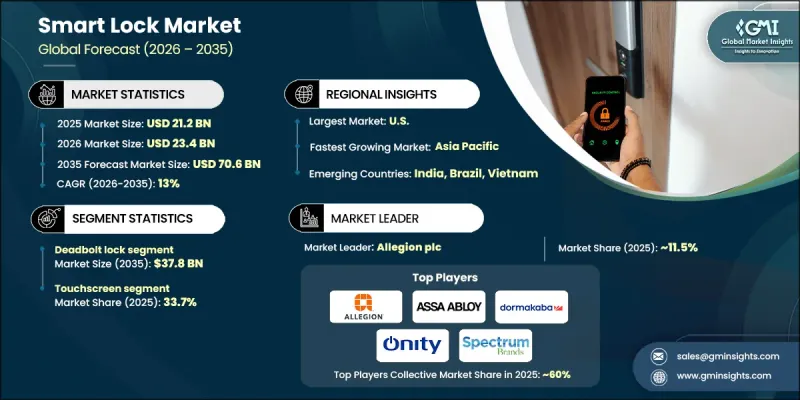
全球智慧鎖市場預計到 2025 年將達到 212 億美元,到 2035 年將達到 706 億美元,年複合成長率為 13%。
智慧家庭環境的快速普及推動了市場成長。消費者越來越習慣數位化安防解決方案。隨著智慧家庭將多種智慧設備整合到一個統一的生態系統中,對智慧門禁的需求也隨之成長。無縫連接、集中管理和增強的安全性已成為現代住宅和建築的標準配備。生活方式的改變和都市化的加快,使得智慧門鎖作為遠端高效管理門禁的實用解決方案更具吸引力。便利性、自動化和即時監控正在改變消費者的購買行為,他們更傾向於那些既能簡化日常操作又能增強安全性的系統。加密、認證和設備互通性的進步也提升了消費者對智慧門鎖系統的信任度。隨著住宅和商業空間對數位化門禁的接受度不斷提高,智慧門鎖如今已被視為現代基礎設施的核心要素,而非可有可無的升級選項,這為全球市場的持續擴張提供了有力支撐。
| 市場覆蓋範圍 | |
|---|---|
| 開始年份 | 2025 |
| 預測年份 | 2026-2035 |
| 起始值 | 212億美元 |
| 預測金額 | 706億美元 |
| 複合年成長率 | 13% |
預計到 2025 年,門栓鎖市場規模將達到 105 億美元,到 2035 年將達到 378 億美元。這一市場主導地位的驅動力是消費者對門栓鎖機制的強大信任,人們普遍認為,門栓鎖與智慧功能結合,能夠提供很高的實體安全性。
預計到2025年,觸控螢幕產品市場規模將達到71億美元,佔整體市佔率的33.7%。這些產品因其時尚的外觀、易用性以及與高階智慧家居設計偏好的契合而廣受歡迎。
預計到 2025 年,美國智慧鎖市場規模將達到 58 億美元,從 2026 年到 2035 年的複合年成長率將達到 13.3%。較高的普及率和消費者對連網安全解決方案的強烈認知意味著美國將繼續保持其作為智慧鎖普及領先市場的地位。
目錄
第1章調查方法和範圍
第2章執行摘要
第3章業界考察
- 生態系分析
- 供應商情況
- 利潤率
- 每個階段的附加價值
- 影響價值鏈的因素
- 產業影響因素
- 促進要素
- 家庭自動化和物聯網的興起
- 對更高安全性和便利性的需求日益成長
- 與更廣泛的數位身分和安全生態系統整合
- 產業潛在風險與挑戰
- 隱私和資料收集問題
- 網路安全漏洞與消費者不信任
- 機會
- 以價格實惠的智慧鎖解決方案拓展新興市場
- 與基於雲端的存取控制系統整合,用於商業應用
- 促進要素
- 成長潛力分析
- 未來市場趨勢
- 價格趨勢分析
- 地區和產品類型
- 科技與創新趨勢
- 目前技術
- 新興技術
- 法律規範
- 按地區
- 波特五力分析
- PESTEL 分析
第4章 競爭情勢
- 介紹
- 公司市佔率分析
- 按地區
- 企業矩陣分析
- 主要市場公司的競爭分析
- 競爭定位矩陣
- 產品系列基準測試
- 重大進展
- 併購
- 夥伴關係與合作
- 新產品發布
- 擴張計劃
第5章 依產品類型分類的市場估算與預測,2022-2035年
- 門栓鎖
- 槓桿手柄
- 掛鎖
- 其他
6. 2022-2035年按解鎖機制分類的市場估算與預測
- 鍵盤
- 觸控螢幕
- 基於應用程式
- 混合
- 生物識別
- 其他
第7章 依連接方式分類的市場估計與預測,2022-2035年
- Wi-Fi
- Bluetooth
- Z-wave
- 其他
第8章 2022-2035年按價格區間分類的市場估算與預測
- 價格低廉(100美元以下)
- 中檔(100-300美元)
- 高價位(超過300美元)
第9章 依最終用戶分類的市場估算與預測,2022-2035年
- 商業的
- 餐飲(飯店、餐廳、咖啡廳)
- 醫院
- 辦公室
- 購物中心
- 其他
- 住宅
- 公寓
- 獨立式住宅
- 工業的
- 政府
- 運輸/物流
- 追蹤
- 飛機場
- 其他
- 其他
第10章 按分銷管道分類的市場估算與預測,2022-2035年
- 線上管道
- 電子商務
- 公司網站
- 離線頻道
- 專賣店
- 大型零售商店
- 其他
第11章 2022-2035年各地區市場估計與預測
- 北美洲
- 美國
- 加拿大
- 歐洲
- 德國
- 英國
- 法國
- 義大利
- 西班牙
- 亞太地區
- 中國
- 印度
- 日本
- 韓國
- 澳洲
- 拉丁美洲
- 巴西
- 墨西哥
- 阿根廷
- 中東和非洲
- 阿拉伯聯合大公國
- 沙烏地阿拉伯
- 南非
第12章:公司簡介
- Allegion plc
- Assa Abloy
- Avent Security
- August Home Inc.
- Cansec Systems Ltd.
- Dormakaba
- Honeywell International Inc.
- Onity Inc.
- Salto Systems SL
- Schlage
- Spectrum Brands, Inc.
- U-tec Group Inc.
- UniKey Technologies, Inc.
- Yale Locks
The Global Smart Lock Market was valued at USD 21.2 billion in 2025 and is estimated to grow at a CAGR of 13% to reach USD 70.6 billion by 2035.
Growth is driven by the rapid adoption of connected living environments, where consumers are becoming increasingly comfortable with digitally enabled security solutions. As households integrate multiple smart devices into unified ecosystems, demand for intelligent access control is rising in parallel. Consumers now expect seamless connectivity, centralized control, and enhanced safety as standard features in modern homes and buildings. Shifting lifestyle patterns and growing urbanization are further reinforcing the appeal of smart locks as a practical solution for managing access remotely and efficiently. Convenience, automation, and real-time monitoring are reshaping purchasing behavior, with users favoring systems that simplify daily routines while strengthening security. Advancements in encryption, authentication, and device interoperability are also improving confidence in connected locking systems. As acceptance of digital access grows across residential and commercial spaces, smart locks are increasingly viewed as a core component of modern infrastructure rather than a discretionary upgrade, supporting sustained market expansion worldwide.
| Market Scope | |
|---|---|
| Start Year | 2025 |
| Forecast Year | 2026-2035 |
| Start Value | $21.2 Billion |
| Forecast Value | $70.6 Billion |
| CAGR | 13% |
The deadbolt lock segment generated USD 10.5 billion in 2025 and is expected to reach USD 37.8 billion by 2035. This dominance is supported by strong consumer trust in deadbolt mechanisms, which are widely perceived as offering high levels of physical security when combined with smart functionality.
The touchscreen category generated USD 7.1 billion in 2025 and held a share of 33.7%. These products are favored for their modern appearance, ease of use, and alignment with premium smart home design preferences.
U.S. Smart Lock Market was valued at USD 5.8 billion in 2025 and is forecast to grow at a CAGR of 13.3% from 2026 to 2035. High adoption of connected security solutions and strong consumer awareness continue to position the country as a leading market for smart lock deployment.
Key companies active in the Global Smart Lock Market include Assa Abloy, Allegion plc, Yale Locks, Schlage, Dormakaba, Salto Systems S.L., Honeywell International Inc., August Home Inc., Spectrum Brands, Inc., Onity Inc., UniKey Technologies, Inc., U-tec Group Inc., Avent Security, and Cansec Systems Ltd. Companies operating in the Global Smart Lock Market are focusing on technology innovation, ecosystem compatibility, and product differentiation to strengthen their market position. Many players are investing heavily in research and development to enhance security features, improve user interfaces, and ensure seamless integration with broader smart home platforms. Expanding partnerships with property developers, hospitality operators, and commercial facilities is helping brands scale adoption. Firms are also emphasizing mobile-based access management and cloud-enabled services to improve customer experience.
Table of Contents
Chapter 1 Methodology & Scope
- 1.1 Market scope and definition
- 1.2 Research design
- 1.2.1 Research approach
- 1.2.2 Data collection methods
- 1.3 Data mining sources
- 1.3.1 Global
- 1.3.2 Regional/Country
- 1.4 Base estimates and calculations
- 1.4.1 Base year calculation
- 1.4.2 Key trends for market estimation
- 1.5 Primary research and validation
- 1.5.1 Primary sources
- 1.6 Forecast model
- 1.7 Research assumptions and limitations
Chapter 2 Executive Summary
- 2.1 Industry 3600 synopsis
- 2.2 Key market trends
- 2.2.1 Regional trends
- 2.2.2 Product type trends
- 2.2.3 Unlocking mechanism trends
- 2.2.4 Connectivity type trends
- 2.2.5 Price range trends
- 2.2.6 End use trends
- 2.2.7 Distribution channel trends
- 2.3 CXO perspective: Strategic imperatives
- 2.3.1 Key decision points for industry executives
- 2.3.2 Critical success factors for market players
- 2.4 Future outlook and strategic recommendations
- 2.5 Strategic recommendations
- 2.5.1 Supply chain diversification strategy
- 2.5.2 Product portfolio enhancement
- 2.5.3 Partnership and alliance opportunities
- 2.5.4 Cost management and pricing strategy
- 2.6 Decision framework
- 2.6.1 Investment priority matrix
- 2.6.2 ROI analysis
Chapter 3 Industry Insights
- 3.1 Industry ecosystem analysis
- 3.1.1 Supplier Landscape
- 3.1.2 Profit Margin
- 3.1.3 Value addition at each stage
- 3.1.4 Factor affecting the value chain
- 3.2 Industry impact forces
- 3.2.1 Growth drivers
- 3.2.1.1 Proliferation of home automation & IoT
- 3.2.1.2 Rising demand for enhanced security & convenience
- 3.2.1.3 Integration with broader digital identity and security ecosystem
- 3.2.2 Industry pitfalls & challenges
- 3.2.2.1 Privacy and data collection concerns
- 3.2.2.2 Cybersecurity vulnerabilities and consumer mistrust
- 3.2.3 Opportunities
- 3.2.3.1 Expansion into emerging markets with affordable smart lock solutions
- 3.2.3.2 Integration with cloud-based access management for commercial applications
- 3.2.1 Growth drivers
- 3.3 Growth potential analysis
- 3.4 Future market trends
- 3.5 Price trend analysis
- 3.5.1 Region and product type
- 3.6 Technology and innovation landscape
- 3.6.1 Current technology
- 3.6.2 Emerging technologies
- 3.7 Regulatory framework
- 3.7.1 By region
- 3.7.1.1 North America
- 3.7.1.2 Europe
- 3.7.1.3 Asia Pacific
- 3.7.1.4 Latin America
- 3.7.1.5 Middle East and Africa
- 3.7.1 By region
- 3.8 Porter's five forces analysis
- 3.9 PESTEL analysis
Chapter 4 Competitive Landscape, 2025
- 4.1 Introduction
- 4.2 Company market share analysis
- 4.2.1 By Region
- 4.2.1.1 North America
- 4.2.1.2 Europe
- 4.2.1.3 Asia Pacific
- 4.2.1.4 Latin America
- 4.2.1.5 Middle East and Africa
- 4.2.1 By Region
- 4.3 Company matrix analysis
- 4.4 Competitive analysis of major market players
- 4.5 Competitive positioning matrix
- 4.6 Product portfolio benchmarking
- 4.7 Key developments
- 4.7.1 Mergers & acquisitions
- 4.7.2 Partnerships & collaborations
- 4.7.3 New Product Launches
- 4.7.4 Expansion Plans
Chapter 5 Market Estimates & Forecast, By Product Type 2022 - 2035 (USD Billion) (Million Units)
- 5.1 Key trends
- 5.2 Deadbolt Lock
- 5.3 Lever Handle
- 5.4 Padlock
- 5.5 Others
Chapter 6 Market Estimates & Forecast, By Unlocking Mechanism, 2022 - 2035 (USD Billion) (Million Units)
- 6.1 Key trends
- 6.2 Keyboard
- 6.3 Touchscreen
- 6.4 App Based
- 6.5 Hybrid
- 6.6 Biometric
- 6.7 Others
Chapter 7 Market Estimates & Forecast, By Connectivity Type, 2022 - 2035 (USD Billion) (Million Units)
- 7.1 Key trends
- 7.2 Wi-Fi
- 7.3 Bluetooth
- 7.4 Z-wave
- 7.5 Others
Chapter 8 Market Estimates & Forecast, By Price Range, 2022 - 2035 (USD Billion) (Million Units)
- 8.1 Key trends
- 8.2 Low (<100$)
- 8.3 Mid (100$-300$)
- 8.4 High (>300$)
Chapter 9 Market Estimates & Forecast, By End User, 2022 - 2035 (USD Billion) (Million Units)
- 9.1 Key trends
- 9.2 Commercial
- 9.2.1 HoReCa
- 9.2.2 Hospitals
- 9.2.3 Offices
- 9.2.4 Malls
- 9.2.5 Others
- 9.3 Residential
- 9.3.1 Condominium
- 9.3.2 Individual Houses
- 9.4 Industrial
- 9.5 Government
- 9.6 Transportation and Logistics
- 9.6.1 Trucks
- 9.6.2 Airports
- 9.6.3 Others
- 9.7 Others
Chapter 10 Market Estimates & Forecast, By Distribution Channel, 2022 - 2035, (USD Billion) (Million Units)
- 10.1 Key trends
- 10.2 Online channels
- 10.2.1 E-commerce
- 10.2.2 Company websites
- 10.3 Offline channels
- 10.3.1 Specialty Stores
- 10.3.2 Mega Retail stores
- 10.3.3 Others
Chapter 11 Market Estimates & Forecast, By Region, 2022 - 2035, (USD Billion) (Million Units)
- 11.1 Key trends
- 11.2 North America
- 11.2.1 U.S.
- 11.2.2 Canada
- 11.3 Europe
- 11.3.1 Germany
- 11.3.2 U.K.
- 11.3.3 France
- 11.3.4 Italy
- 11.3.5 Spain
- 11.4 Asia Pacific
- 11.4.1 China
- 11.4.2 India
- 11.4.3 Japan
- 11.4.4 South Korea
- 11.4.5 Australia
- 11.5 Latin America
- 11.5.1 Brazil
- 11.5.2 Mexico
- 11.5.3 Argentina
- 11.6 MEA
- 11.6.1 UAE
- 11.6.2 Saudi Arabia
- 11.6.3 South Africa
Chapter 12 Company Profiles (Business Overview, Financial Data, Product Landscape, Strategic Outlook, SWOT Analysis)
- 12.1 Allegion plc
- 12.2 Assa Abloy
- 12.3 Avent Security
- 12.4 August Home Inc.
- 12.5 Cansec Systems Ltd.
- 12.6 Dormakaba
- 12.7 Honeywell International Inc.
- 12.8 Onity Inc.
- 12.9 Salto Systems S.L.
- 12.10 Schlage
- 12.11 Spectrum Brands, Inc.
- 12.12 U-tec Group Inc.
- 12.13 UniKey Technologies, Inc.
- 12.14 Yale Locks

 2026年全球智慧鎖市場報告
 智慧鎖市場分析及預測(至2035年):依類型、產品類型、技術、組件、應用、最終用戶、功能、安裝類型及解決方案分類
 智慧鎖:市場佔有率分析、產業趨勢與統計、成長預測(2026-2031)美國智慧鎖:市場佔有率分析、產業趨勢與統計、成長預測(2026-2031)
 智慧鎖市場 - 全球產業規模、佔有率、趨勢、機會及預測(按產品類型、最終用戶、分銷管道、地區和競爭格局分類,2021-2031年)
 日本智慧鎖市場報告:按鎖類型、通訊協定、最終用戶和地區分類,2026-2034年
 智慧鎖市場:按產品類型、解鎖機制、應用和地區分類
 智慧鎖市場:2025年至2030年預測
 美國智慧鎖市場規模、佔有率和趨勢分析報告:按產品、應用、通訊協定、身份驗證方法、地區和細分市場預測,2025 年至 2030 年智慧鎖市場規模、佔有率、趨勢分析報告:按產品、應用、通訊協定、認證方法、地區、細分市場預測,2025-2030 年