


 |
市場調查報告書
商品編碼
1928945
合成生物學市場機會、成長要素、產業趨勢分析及預測(2026-2035年)Synthetic Biology Market Opportunity, Growth Drivers, Industry Trend Analysis, and Forecast 2026 - 2035 |
||||||

全球合成生物學市場預計到 2025 年將達到 256 億美元,到 2035 年將達到 1,281 億美元,年複合成長率為 17.5%。
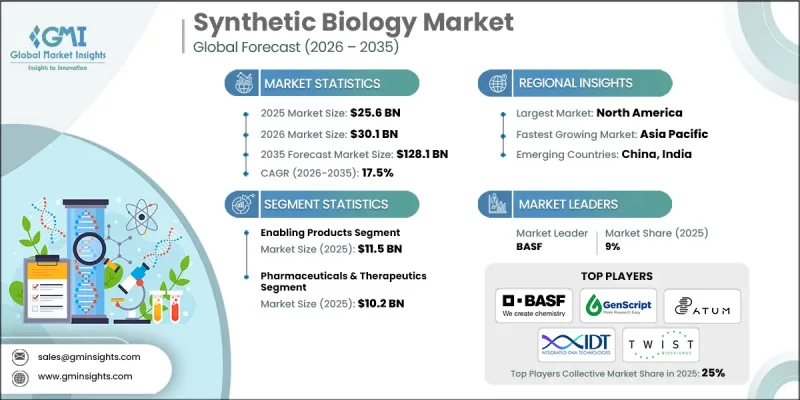
合成生物學透過將工程原理與生物學結合,設計出新的生物構件、裝置和系統,徹底改變了生物系統的建構方式。該領域已從簡單的基因工程發展到能夠精確編程細胞功能的高級平台。這一轉變得益於DNA合成和定序技術、計算生物學的突破以及對生物設計的深刻理解。市場涵蓋平台產品,例如寡核苷酸、酵素和底盤生物體;核心產品,例如合成基因、細胞和DNA文庫;以及應用產品,例如藥物、工業化學品、生質燃料和生物材料。 CRISPR-Cas9等前沿基因組編輯技術正在加速合成生物學在治療、農業和工業領域的應用,同時為傳統的資源密集型製程提供永續的替代方案。
| 市場覆蓋範圍 | |
|---|---|
| 開始年份 | 2025 |
| 預測年份 | 2026-2035 |
| 起始值 | 256億美元 |
| 預測金額 | 1281億美元 |
| 複合年成長率 | 17.5% |
平台產品市場預計到2025年將達到115億美元,到2035年將以16.5%的複合年成長率成長。此類別涵蓋合成生物學研發所需的關鍵工具和試劑,包括寡核苷酸、聚合酵素和連接酶等酶、克隆試劑盒、細菌、酵母和哺乳動物細胞株等平台生物體,以及用於設計和模擬的軟體平台。其市場主導地位反映了這些產品在支持所有合成生物學工作中所發揮的基礎性作用。
預計到2025年,藥物和治療領域市場規模將達到102億美元,到2035年將以14.5%的複合年成長率成長。這領域涵蓋細胞和基因療法、mRNA疫苗、生技藥品製劑和生物合成小分子藥物。隨著多種產品獲得商業性和臨床檢驗,藥物和治療領域已成為合成生物學中商業性程度最高的領域。
美國合成生物學市場預計到 2025 年將達到 86 億美元,到 2035 年將達到 431 億美元。政府的大力支持推動了研發工作,2020 年多個機構撥款 1.61 億美元用於生物製造和生質能源,2022 年能源部撥款 1.78 億美元用於開發石油基產品的永續替代品。
目錄
第1章調查方法和範圍
第2章執行摘要
第3章業界考察
- 生態系分析
- 供應商情況
- 利潤率
- 每個階段的附加價值
- 影響價值鏈的因素
- 中斷
- 產業影響因素
- 促進要素
- 產業潛在風險與挑戰
- 市場機遇
- 成長潛力分析
- 監管環境
- 北美洲
- 歐洲
- 亞太地區
- 拉丁美洲
- 中東和非洲
- 波特分析
- PESTEL 分析
- 價格趨勢
- 按地區
- 未來市場趨勢
- 科技與創新趨勢
- 當前技術趨勢
- 新興技術
- 專利狀態
- 貿易統計(HS編碼)(註:僅提供主要國家的貿易統計)
- 主要進口國
- 主要出口國
- 永續性和環境方面
- 永續努力
- 減少廢棄物策略
- 生產中的能源效率
- 環保舉措
- 碳足跡考量
第4章 競爭情勢
- 介紹
- 公司市佔率分析
- 按地區
- 北美洲
- 歐洲
- 亞太地區
- 拉丁美洲
- 中東和非洲
- 按地區
- 企業矩陣分析
- 主要市場公司的競爭分析
- 競爭定位矩陣
- 重大進展
- 併購
- 夥伴關係與合作
- 新產品發布
- 擴張計劃
第5章 依產品類型分類的市場規模及預測(2022-2035年)
- 核心產品
- 合成核酸
- 基因組編輯工具與試劑
- 酵素和蛋白質
- 基礎生物體和細胞株
- 基因部分載體
- 其他
- 平台產品
- 生物資訊學和計算工具
- 自動化和機器人技術
- 微流體與實驗室晶片
- 其他
- 已實現產品
- 治療產品
- 生質燃料和可再生能源
- 生物基化學品和材料
- 食品和營養產品
- 農產品
- 診斷/生物感測器
- 其他
第6章 依技術分類的市場規模及預測(2022-2035年)
- 核苷酸合成與定序技術
- 基因工程技術
- 生物資訊學和計算生物學
- 微流體和小型化
- 其他
第7章 依應用領域分類的市場規模及預測(2022-2035年)
- 藥品和治療藥物
- 細胞和基因治療
- 生物製品生產
- 疫苗研發
- 藥物發現與開發
- 診斷和生物感測
- 醫學診斷
- 環境監測
- 食品安全與品質
- 生物防禦與安全
- 工業化學品/材料
- 特用化學品
- 聚合物和塑膠
- 工業酵素
- 生物材料和纖維
- 農業和食品生產
- 作物改良
- 農業生物製品
- 畜牧業和水產養殖
- 食品原料/添加物
- 能源與生質燃料
- 第一代和第二代生質燃料
- 先進生質燃料
- 氫能和新興燃料
- 原料轉化
- 環境應用技術
- 生物修復
- 碳捕獲與利用
- 污水處理
- 環境監測網路
- 其他
第8章 依底盤類型分類的市場規模及預測(2022-2035年)
- 細菌底盤
- 酵母底盤
- 哺乳動物細胞底盤
- 植物性底盤
- 藻類和光合作用底盤
- 其他
第9章 2022-2035年各地區市場規模及預測
- 北美洲
- 美國
- 加拿大
- 歐洲
- 英國
- 德國
- 法國
- 義大利
- 西班牙
- 其他歐洲地區
- 亞太地區
- 中國
- 印度
- 日本
- 韓國
- 澳洲
- 亞太其他地區
- 拉丁美洲
- 巴西
- 墨西哥
- 阿根廷
- 其他拉丁美洲地區
- 中東和非洲
- 南非
- 沙烏地阿拉伯
- 阿拉伯聯合大公國
- 其他中東和非洲地區
第10章:公司簡介
- Novozymes
- BASF
- GenScript
- ATUM
- Integrated DNA Technologies
- Twist Bioscience
- Biomax Informatics
- Pareto Biotechnologies
- Blue Heron
- TeselaGenSyntrox
- Thermo Fisher Scientific
- Gevo Inc
- Royal DSM
- Bristol-Myers Squibb
- Amyris
- Genomatica
- Synthetic Genomics
- Codexis
- Butamax Scarab Genomics
- Scarab Genomics
- MorphoSys
- Ginkgo Bioworks
- Evolva
- Igenbio
The Global Synthetic Biology Market was valued at USD 25.6 billion in 2025 and is estimated to grow at a CAGR of 17.5% to reach USD 128.1 billion by 2035.
Synthetic biology is revolutionizing the way we engineer biological systems by integrating engineering principles with biology to design novel biological components, devices, and systems. The field has evolved from simple genetic engineering to advanced platforms that enable precise programming of cellular functions. This transformation is driven by breakthroughs in DNA synthesis and sequencing, computational biology, and deeper insights into biological design. The market spans enabling products such as oligonucleotides, enzymes, and chassis organisms; core products including synthetic genes, cells, and DNA libraries; and enabled products covering pharmaceuticals, industrial chemicals, biofuels, and biomaterials. Cutting-edge genome editing technologies like CRISPR-Cas9 have accelerated the adoption of synthetic biology across therapeutics, agriculture, and industrial sectors, while also offering sustainable alternatives to traditional resource-intensive processes.
| Market Scope | |
|---|---|
| Start Year | 2025 |
| Forecast Year | 2026-2035 |
| Start Value | $25.6 Billion |
| Forecast Value | $128.1 Billion |
| CAGR | 17.5% |
The enabling products segment reached USD 11.5 billion in 2025 and is expected to grow at a CAGR of 16.5% through 2035. This category includes essential tools and reagents required for synthetic biology R&D, such as oligonucleotides, enzymes like polymerases and ligases, cloning kits, chassis organisms like bacterial, yeast, and mammalian cell lines, and software platforms for design and simulation. Its dominance reflects the foundational role these products play in supporting all synthetic biology initiatives.
The pharmaceuticals and therapeutics segment reached USD 10.2 billion in 2025 and is projected to grow at a CAGR of 14.5% through 2035. This segment encompasses cell and gene therapies, mRNA vaccines, engineered biologics, and biosynthetic small molecules. Commercial and clinical validation has been achieved for multiple products, positioning pharmaceuticals and therapeutics as the most commercially advanced area of synthetic biology.
U.S. Synthetic Biology Market was valued at USD 8.6 billion in 2025 and is expected to reach USD 43.1 billion by 2035. Strong government backing supports research and development, including USD 161 million allocated by various agencies in 2020 for biomanufacturing and bioenergy, alongside USD 178 million from the Department of Energy in 2022 aimed at developing sustainable alternatives to petroleum-based products.
Leading companies in the Global Synthetic Biology Market include Novozymes, GenScript, Thermo Fisher Scientific, Ginkgo Bioworks, Twist Bioscience, Integrated DNA Technologies, ATUM, Blue Heron, Amyris, BASF, Biomax Informatics, Pareto Biotechnologies, Gevo Inc., Royal DSM, Bristol-Myers Squibb, Genomatica, Synthetic Genomics, Codexis, Butamax Scarab Genomics, MorphoSys, Evolva, and Igenbio. Key strategies adopted by synthetic biology companies to strengthen their market presence include investing heavily in research and development to create advanced, high-precision solutions, expanding product portfolios through acquisitions and strategic partnerships, and forming collaborations with academic and industrial research institutions. Companies are also focusing on scaling manufacturing capabilities, integrating AI and computational tools for better biological design, and entering emerging geographic markets to expand their global footprint.
Table of Contents
Chapter 1 Methodology & Scope
- 1.1 Market scope and definition
- 1.2 Research design
- 1.2.1 Research approach
- 1.2.2 Data collection methods
- 1.3 Data mining sources
- 1.3.1 Global
- 1.3.2 Regional/Country
- 1.4 Base estimates and calculations
- 1.4.1 Base year calculation
- 1.4.2 Key trends for market estimation
- 1.5 Primary research and validation
- 1.5.1 Primary sources
- 1.6 Forecast model
- 1.7 Research assumptions and limitations
Chapter 2 Executive Summary
- 2.1 Industry 3600 synopsis
- 2.2 Key market trends
- 2.2.1 Product type
- 2.2.2 Technology
- 2.2.3 Application
- 2.2.4 Chassis type
- 2.3 TAM analysis, 2026-2035
- 2.4 CXO perspectives: Strategic imperatives
- 2.4.1 Executive decision points
- 2.4.2 Critical success factors
- 2.5 Outlook and strategic recommendations
Chapter 3 Industry Insights
- 3.1 Industry ecosystem analysis
- 3.1.1 Supplier landscape
- 3.1.2 Profit margin
- 3.1.3 Value addition at each stage
- 3.1.4 Factor affecting the value chain
- 3.1.5 Disruptions
- 3.2 Industry impact forces
- 3.2.1 Growth drivers
- 3.2.2 Industry pitfalls and challenges
- 3.2.3 Market opportunities
- 3.3 Growth potential analysis
- 3.4 Regulatory landscape
- 3.4.1 North America
- 3.4.2 Europe
- 3.4.3 Asia Pacific
- 3.4.4 Latin America
- 3.4.5 Middle East & Africa
- 3.5 Porter';s analysis
- 3.6 PESTEL analysis
- 3.7 Price trends
- 3.7.1 By region
- 3.8 Future market trends
- 3.9 Technology and innovation landscape
- 3.9.1 Current technological trends
- 3.9.2 Emerging technologies
- 3.10 Patent landscape
- 3.11 Trade statistics (HS code) (Note: the trade statistics will be provided for key countries only)
- 3.11.1 Major importing countries
- 3.11.2 Major exporting countries
- 3.12 Sustainability and environmental aspects
- 3.12.1 Sustainable practices
- 3.12.2 Waste reduction strategies
- 3.12.3 Energy efficiency in production
- 3.12.4 Eco-friendly initiatives
- 3.13 Carbon footprint considerations
Chapter 4 Competitive Landscape, 2025
- 4.1 Introduction
- 4.2 Company market share analysis
- 4.2.1 By region
- 4.2.1.1 North America
- 4.2.1.2 Europe
- 4.2.1.3 Asia Pacific
- 4.2.1.4 Latin America
- 4.2.1.5 Middle East & Africa
- 4.2.1 By region
- 4.3 Company matrix analysis
- 4.4 Competitive analysis of major market players
- 4.5 Competitive positioning matrix
- 4.6 Key developments
- 4.6.1 Mergers & acquisitions
- 4.6.2 Partnerships & collaborations
- 4.6.3 New product launches
- 4.6.4 Expansion plans
Chapter 5 Market Size and Forecast, By Product Type, 2022-2035 (USD Billion)
- 5.1 Key trends
- 5.2 Core products
- 5.2.1 Synthetic nucleic acids
- 5.2.2 Genome editing tools & reagents
- 5.2.3 Enzymes & proteins
- 5.2.4 Chassis organisms & cell lines
- 5.2.5 Genetic parts & vectors
- 5.2.6 Others
- 5.3 Enabling products
- 5.3.1 Bioinformatics & computational tools
- 5.3.2 Automation & robotics
- 5.3.3 Microfluidics & lab-on-chip
- 5.3.4 Others
- 5.4 Enabled products
- 5.4.1 Therapeutic products
- 5.4.2 Biofuels & renewable energy
- 5.4.3 Bio-based chemicals & materials
- 5.4.4 Food & nutrition products
- 5.4.5 Agricultural products
- 5.4.6 Diagnostics & biosensors
- 5.4.7 Others
Chapter 6 Market Size and Forecast, By Technology, 2022-2035 (USD Billion)
- 6.1 Key trends
- 6.2 Nucleotide Synthesis & Sequencing Technologies
- 6.3 Genetic Engineering Technologies
- 6.4 Bioinformatics & Computational Biology
- 6.5 Microfluidics & Miniaturization
- 6.6 Others
Chapter 7 Market Size and Forecast, By Application, 2022-2035 (USD Billion)
- 7.1 Key trends
- 7.2 Pharmaceuticals & therapeutics
- 7.2.1 Cell & gene therapies
- 7.2.2 Biologics production
- 7.2.3 Vaccine development
- 7.2.4 Drug discovery & development
- 7.3 Diagnostics & biosensing
- 7.3.1 Medical diagnostics
- 7.3.2 Environmental monitoring
- 7.3.3 Food safety & quality
- 7.3.4 Biodefense & security
- 7.4 Industrial chemicals & materials
- 7.4.1 Specialty chemicals
- 7.4.2 Polymers & plastics
- 7.4.3 Industrial enzymes
- 7.4.4 Biomaterials & textiles
- 7.5 Agriculture & food production
- 7.5.1 Crop improvement
- 7.5.2 Agricultural biologicals
- 7.5.3 Livestock & aquaculture
- 7.5.4 Food ingredients & additives
- 7.6 Energy & biofuels
- 7.6.1 First & second generation biofuels
- 7.6.2 Advanced biofuels
- 7.6.3 Hydrogen & emerging fuels
- 7.6.4 Feedstock conversion
- 7.7 Environmental applications
- 7.7.1 Bioremediation
- 7.7.2 Carbon capture & utilization
- 7.7.3 Wastewater treatment
- 7.7.4 Environmental monitoring networks
- 7.8 Others
Chapter 8 Market Size and Forecast, By Chassis Type, 2022-2035 (USD Billion)
- 8.1 Key trends
- 8.2 Bacterial chassis
- 8.3 Yeast chassis
- 8.4 Mammalian cell chassis
- 8.5 Plant chassis
- 8.6 Algal & photosynthetic chassis
- 8.7 Others
Chapter 9 Market Size and Forecast, By Region, 2022-2035 (USD Billion)
- 9.1 Key trends
- 9.2 North America
- 9.2.1 U.S.
- 9.2.2 Canada
- 9.3 Europe
- 9.3.1 UK
- 9.3.2 Germany
- 9.3.3 France
- 9.3.4 Italy
- 9.3.5 Spain
- 9.3.6 Rest of Europe
- 9.4 Asia Pacific
- 9.4.1 China
- 9.4.2 India
- 9.4.3 Japan
- 9.4.4 South Korea
- 9.4.5 Australia
- 9.4.6 Rest of Asia Pacific
- 9.5 Latin America
- 9.5.1 Brazil
- 9.5.2 Mexico
- 9.5.3 Argentina
- 9.5.4 Rest of Latin America
- 9.6 Middle East & Africa
- 9.6.1 South Africa
- 9.6.2 Saudi Arabia
- 9.6.3 UAE
- 9.6.4 Rest of Middle East & Africa
Chapter 10 Company Profiles
- 10.1 Novozymes
- 10.2 BASF
- 10.3 GenScript
- 10.4 ATUM
- 10.5 Integrated DNA Technologies
- 10.6 Twist Bioscience
- 10.7 Biomax Informatics
- 10.8 Pareto Biotechnologies
- 10.9 Blue Heron
- 10.10 TeselaGenSyntrox
- 10.11 Thermo Fisher Scientific
- 10.12 Gevo Inc
- 10.13 Royal DSM
- 10.14 Bristol-Myers Squibb
- 10.15 Amyris
- 10.16 Genomatica
- 10.17 Synthetic Genomics
- 10.18 Codexis
- 10.19 Butamax Scarab Genomics
- 10.20 Scarab Genomics
- 10.21 MorphoSys
- 10.22 Ginkgo Bioworks
- 10.23 Evolva
- 10.24 Igenbio

 合成生物學市場分析及預測(至2035年):依類型、產品類型、服務、技術、組件、應用、最終使用者及流程分類
 全球合成生物學工具市場規模、佔有率、趨勢和成長分析報告(2026-2034)全球合成生物學市場規模、佔有率、趨勢和成長分析報告(2026-2034)
 合成生物學市場-全球產業規模、佔有率、趨勢、機會及預測(依技術、產品、最終用戶、地區及競爭格局分類,2021-2031年)
 農業合成生物學市場按產品類型、技術平台、配方、應用領域和最終用戶分類-2026年至2032年全球預測
 合成生物學市場規模、佔有率和趨勢分析報告:按產品、技術、應用、最終用途、地區和細分市場預測(2026-2033 年)分子開關作為治療標靶:藥物發現、藥物傳遞機制與適應症(2026)
 合成生物學市場規模、佔有率和成長分析(按工具、應用、技術和地區分類)-2026-2033年產業預測
 全球合成生物學和生物製造市場(2026-2036)
 合成生物學市場:依產品、技術、應用、最終用戶、國家及地區分類-全球產業分析、市場規模、市場佔有率及2025-2032年預測