


 |
市場調查報告書
商品編碼
1928897
8級卡車市場成長機會、成長要素、產業趨勢分析及2026年至2035年預測Class 8 Trucks Market Opportunity, Growth Drivers, Industry Trend Analysis, and Forecast 2026 - 2035 |
||||||

全球 8 級卡車市場預計到 2025 年將達到 2,694 億美元,到 2035 年將達到 4,112 億美元,年複合成長率為 4.7%。
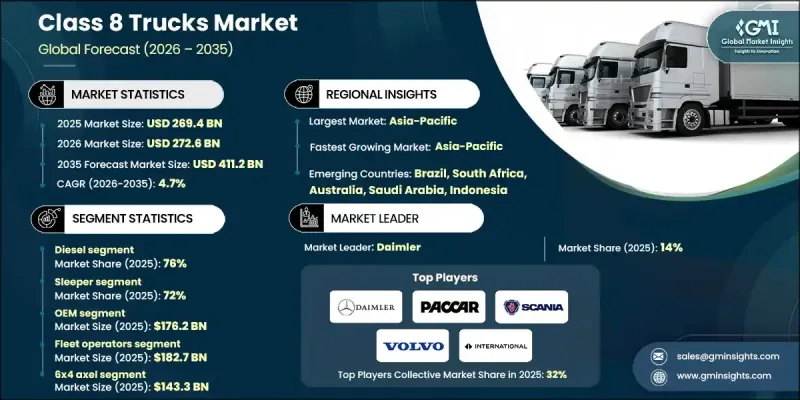
重型卡車營運範圍的擴大支撐了市場成長,而這又得益於區域合作的加強和政策協調的推進。全球貿易活動的持續成長,以及供應鏈互聯互通的增強和跨境業務活動的日益頻繁,都強化了對高效長途貨運的需求。基礎設施建設和物流走廊的擴張提升了區域互聯互通,促進了8級卡車在散裝運輸貨物的進一步應用。運輸標準和跨境法規的協調統一提高了網路相容性,便利了貨運,並鼓勵了車輛投資的成長。這些發展透過加快貨物運輸速度和強化重型卡車在全球物流中的作用,為經濟成長提供了支持。隨著貿易量的成長和供應鏈的日益複雜,對可靠、高運力卡車運輸解決方案的需求持續成長,推動了全球8級卡車市場的持續成長。
| 市場覆蓋範圍 | |
|---|---|
| 開始年份 | 2025 |
| 預測年份 | 2026-2035 |
| 起始值 | 2694億美元 |
| 預測金額 | 4112億美元 |
| 複合年成長率 | 4.7% |
預計到2025年,柴油卡車市佔率將達到76%,並在2026年至2035年間以3.5%的複合年成長率成長。由於其高扭矩輸出、耐用性和長途貨運的適用性,柴油卡車在重型運輸領域仍然至關重要。即使在嚴苛的負載條件下,柴油卡車也能持續為需要穩定性能的產業提供支援。
2025年,OEM銷售管道通路的營收將達到1,762億美元。該通路包括透過授權經銷商網路銷售的新卡車以及車隊營運商的直接訂單。由於標準化的規格、製造商提供的保固、具有競爭力的融資方案以及可靠的殘值支持,OEM採購在大車隊中仍然佔據主導地位。
預計到2025年,中國8級卡車市場規模將達到1,028.4億美元。憑藉強大的工業基礎和蓬勃發展的電子商務,中國在全球貨運和物流領域扮演著舉足輕重的角色。一汽、東風汽車、中遠汽車和比亞迪等國內製造商透過提供具成本效益的柴油和替代能源重型卡車,確立了穩固的市場地位。高度整合的供應鏈支撐著從原料採購、零件生產到整車組裝的整個生產流程。
目錄
第1章調查方法和範圍
第2章執行摘要
第3章業界考察
- 生態系分析
- 供應商情況
- 原物料供應商
- 零件供應商
- 製造商
- 服務供應商
- 分銷管道
- 最終用途
- 成本結構
- 利潤率
- 每個階段的附加價值
- 垂直整合趨勢
- 顛覆者
- 供應商情況
- 影響因素
- 促進要素
- 貨運量增加和電子商務物流的擴張
- 車隊更新和舊車輛管理
- 排放氣體和能源效率法規
- 基礎設施和工業投資
- 產業潛在風險與挑戰
- 初始購買成本高
- 經濟週期性和貨運低迷
- 市場機遇
- 向替代動力傳動系統過渡
- ADAS(進階駕駛輔助系統)與安全系統
- 互聯互通、遠端資訊處理和預測性維護
- 模組化平台與輕量化設計
- 促進要素
- 技術趨勢與創新生態系統
- 目前技術
- 新興技術
- 成長潛力分析
- 監管環境
- 北美洲
- 聯邦機動車輛安全標準(FMVSS)
- 美國環保署(EPA)關於重型卡車的排放氣體和溫室氣體法規
- 加拿大機動車輛安全法規 (MVSR)
- 歐洲
- 聯合國歐洲經濟委員會(UNECE)條例
- 歐6排放氣體法規
- 歐盟車輛類型認證和低排放氣體區合規性
- 亞太地區
- 中國GB標準
- 汽車業標準(AIS)
- 國土交通省(MLIT)重型車輛安全及排放氣體法規
- 東協商用卡車統一車輛法規
- 拉丁美洲
- 巴西交通安全局 (Contran) 和國家計量院 (INMETRO) 標準
- 阿根廷 INTI/IRAM 標準
- 墨西哥NOM標準
- 中東和非洲
- 沙烏地阿拉伯 SASO 標準
- 南非SANS/NRCS法規
- 阿拉伯聯合大公國證券及市場管理局/全球證券監理機構規定
- 北美洲
- 波特分析
- PESTEL 分析
- 價格趨勢
- 按地區
- 依產品
- 成本細分分析
- 專利分析
- 生產統計
- 生產基地
- 消費基礎
- 出口和進口
- 永續性和環境方面
- 汽車導航系統的碳足跡
- 循環經濟戰略
- 永續導航功能
- 企業永續性舉措
- 氣候變遷對航行的影響
- 8級卡車動力傳動系統總成車隊營運總擁有成本框架
- 資本投資/購置成本
- 燃料/能源成本
- 維護和服務成本
- 殘值/轉售價值
- 技術整合的影響
- 8級卡車動力傳動系統過渡藍圖
- 從柴油向天然氣過渡的趨勢
- 電池電動車和氫燃料電池汽車之間的權衡
- 替代動力傳動系統的區域可行性
- 基礎設施發展現況及技術風險評估
- 車隊採購決策與經濟框架
- OEM平台策略與模組化架構趨勢
第4章 競爭情勢
- 介紹
- 公司市佔率分析
- 北美洲
- 歐洲
- 亞太地區
- 拉丁美洲
- 中東和非洲
- 競爭定位矩陣
- 戰略展望矩陣
- 重大進展
- 併購
- 夥伴關係與合作
- 新產品發布
- 企業擴張計畫和資金籌措
第5章 依燃料類型分類的市場估算與預測,2022-2035年
- 柴油引擎
- 天然氣
- 油電混合車
- 其他
第6章 計程車市場估算與預測,2022-2035年
- 天
- 軌枕
7. 按車軸分類的市場估算與預測,2022-2035 年
- 4x2
- 6x4
- 6x2
第8章 按馬力分類的市場估算與預測,2022-2035年
- 不到300馬力
- 300馬力至400馬力
- 400馬力至500馬力
- 超過500馬力
第9章 按應用領域分類的市場估算與預測,2022-2035年
- 貨運
- 公共產業服務
- 建築和採礦
- 其他
第10章 依所有權類型分類的市場估計與預測,2022-2035年
- 車隊營運商
- 獨立企業
第11章 依銷售管道分類的市場估計與預測,2022-2035年
- OEM
- 獨立零售商
第12章 2022-2035年各地區市場估算與預測
- 北美洲
- 美國
- 加拿大
- 歐洲
- 英國
- 德國
- 法國
- 義大利
- 西班牙
- 比利時
- 荷蘭
- 瑞典
- 俄羅斯
- 亞太地區
- 中國
- 印度
- 日本
- 澳洲
- 新加坡
- 韓國
- 越南
- 印尼
- 拉丁美洲
- 巴西
- 墨西哥
- 阿根廷
- 中東和非洲
- 南非
- 沙烏地阿拉伯
- 阿拉伯聯合大公國
第13章:公司簡介
- 世界公司
- DAF Trucks
- Daimler/Freightliner
- Iveco
- Kenworth
- Mack Trucks
- MAN
- PACCAR
- Peterbilt
- Scania
- Volvo
- Region players
- Dongfeng
- Eicher
- FAW Jiefang
- Ford
- GMC
- Hino
- International Truck/Navistar
- Isuzu
- Mitsubishi Fuso
- UD Trucks
- 新興製造商
- BYD
- Tesla
- Nikola
- Hyzon Motors
- Sinotruk
The Global Class 8 Trucks Market was valued at USD 269.4 billion in 2025 and is estimated to grow at a CAGR of 4.7% to reach USD 411.2 billion by 2035.
Growth is supported by increasing regional cooperation and policy alignment that are expanding the operational reach of heavy-duty trucks. The continuous rise in global trade activity has strengthened demand for efficient long-distance freight transportation, as supply chains become more interconnected and business activity expands across borders. Infrastructure development and logistics corridor enhancements are improving connectivity between regions, encouraging greater deployment of class 8 trucks for large-volume cargo movement. Harmonization of transport standards and cross-border regulations has enhanced network compatibility, facilitating smoother freight operations and driving increased fleet investments. These developments support economic growth by enabling faster movement of goods while reinforcing the role of heavy-duty trucks in global logistics. As trade volumes rise and supply chains become more complex, demand for reliable and high-capacity trucking solutions continues to increase, positioning the class 8 trucks market for sustained growth worldwide.
| Market Scope | |
|---|---|
| Start Year | 2025 |
| Forecast Year | 2026-2035 |
| Start Value | $269.4 Billion |
| Forecast Value | $411.2 Billion |
| CAGR | 4.7% |
The diesel-powered trucks segment accounted for 76% share in 2025 and is expected to grow at a CAGR of 3.5% from 2026 to 2035. These vehicles remain essential for heavy-duty hauling due to their high torque output, durability, and suitability for long-distance freight operations. Diesel trucks continue to support industries that require consistent performance under demanding load conditions.
The OEM sales channel segment generated USD 176.2 billion in 2025. This segment includes newly manufactured trucks sold through authorized dealer networks and direct orders placed by fleet operators. OEM purchasing remains dominant among large fleets due to standardized specifications, manufacturer-backed warranties, competitive financing options, and assured residual value support.
China Class 8 Trucks Market generated USD 102.84 billion in 2025. The country plays a central role in global freight and logistics due to its strong industrial base and expanding e-commerce sector. Domestic manufacturers such as FAW, Dongfeng, Sinotruk, and BYD hold a strong market position by offering cost-effective diesel and alternative-energy heavy-duty trucks. A well-integrated supply chain supports efficient sourcing of materials, component production, and vehicle assembly.
Key companies operating in the Global Class 8 Trucks Market include Volvo Trucks, Daimler, Scania, Freightliner, MAN, Kenworth, Peterbilt, Mack Trucks, Isuzu Motors, and International Motors. Companies in the Global Class 8 Trucks Market focus on strengthening their market position through product innovation, fleet optimization solutions, and geographic expansion. Manufacturers invest in improving fuel efficiency, powertrain reliability, and vehicle durability to meet evolving freight demands. Strategic partnerships with logistics providers and fleet operators help secure long-term supply contracts. Companies also expand financing, leasing, and after-sales service programs to improve customer retention. Investments in manufacturing efficiency and supply chain integration allow firms to control costs and maintain competitive pricing.
Table of Contents
Chapter 1 Methodology & Scope
- 1.1 Market scope and definition
- 1.2 Research design
- 1.2.1 Research approach
- 1.2.2 Data collection methods
- 1.3 Data mining sources
- 1.3.1 Global
- 1.3.2 Regional/Country
- 1.4 Base estimates and calculations
- 1.4.1 Base year calculation
- 1.4.2 Key trends for market estimation
- 1.5 Primary research and validation
- 1.5.1 Primary sources
- 1.6 Forecast model
- 1.7 Research assumptions and limitations
Chapter 2 Executive Summary
- 2.1 Industry 360° synopsis
- 2.2 Key market trends
- 2.2.1 Regional
- 2.2.2 Fuel
- 2.2.3 Cab
- 2.2.4 Axle
- 2.2.5 Horsepower
- 2.2.6 Ownership
- 2.2.7 Application
- 2.2.8 Sales Channel
- 2.3 TAM Analysis, 2026-2035
- 2.4 CXO perspectives: Strategic imperatives
- 2.4.1 Key decision points for industry executives
- 2.4.2 Critical success factors for market players
- 2.5 Future outlook and strategic recommendations
Chapter 3 Industry Insights
- 3.1 Industry ecosystem analysis
- 3.1.1 Supplier landscape
- 3.1.1.1 Raw material suppliers
- 3.1.1.2 Component suppliers
- 3.1.1.3 Manufacturers
- 3.1.1.4 Service providers
- 3.1.1.5 Distribution channel
- 3.1.1.6 End Use
- 3.1.2 Cost structure
- 3.1.3 Profit margin
- 3.1.4 Value addition at each stage
- 3.1.5 Vertical integration trends
- 3.1.6 Disruptors
- 3.1.1 Supplier landscape
- 3.2 Impact on forces
- 3.2.1 Growth drivers
- 3.2.1.1 Freight growth & e-commerce logistics expansion
- 3.2.1.2 Fleet replacement & aging vehicle parcels
- 3.2.1.3 Emissions & efficiency regulations
- 3.2.1.4 Infrastructure & industrial investment
- 3.2.2 Industry pitfalls & challenges
- 3.2.2.1 High upfront purchase costs
- 3.2.2.2 Economic cyclicality & freight downturns
- 3.2.3 Market opportunities
- 3.2.3.1 Shift toward alternative powertrains
- 3.2.3.2 Advanced driver assistance & safety systems
- 3.2.3.3 Connectivity, telematics & predictive maintenance
- 3.2.3.4 Modular platforms & lightweight
- 3.2.1 Growth drivers
- 3.3 Technology trends & innovation ecosystem
- 3.3.1 Current technologies
- 3.3.2 Emerging technologies
- 3.4 Growth potential analysis
- 3.5 Regulatory landscape
- 3.5.1 North America
- 3.5.1.1 U.S. Federal Motor Vehicle Safety Standards (FMVSS)
- 3.5.1.2 U.S. EPA Emissions & Greenhouse Gas Standards for Heavy-Duty Trucks
- 3.5.1.3 Canada Motor Vehicle Safety Regulations (MVSR)
- 3.5.2 Europe
- 3.5.2.1 UNECE Regulations
- 3.5.2.2 Euro VI Emission Standards
- 3.5.2.3 EU Vehicle Type Approval & Low-Emission Zone Compliance
- 3.5.3 Asia-Pacific
- 3.5.3.1 China GB standards
- 3.5.3.2 India Automotive Industry Standards (AIS)
- 3.5.3.3 Japan MLIT Heavy Vehicle Safety and Emission Regulations
- 3.5.3.4 ASEAN Harmonized Vehicle Regulations for commercial trucks
- 3.5.4 Latin America
- 3.5.4.1 Brazil Contran & INMETRO standards
- 3.5.4.2 Argentina INTI / IRAM standards
- 3.5.4.3 Mexico NOM standards
- 3.5.5 Middle East & Africa
- 3.5.5.1 Saudi Arabia SASO standards
- 3.5.5.2 South Africa SANS / NRCS regulations
- 3.5.5.3 UAE ESMA / GSO regulations
- 3.5.1 North America
- 3.6 Porter';s analysis
- 3.7 PESTEL analysis
- 3.8 Price trends
- 3.8.1 By region
- 3.8.2 By product
- 3.9 Cost breakdown analysis
- 3.10 Patent analysis
- 3.11 Production statistics
- 3.11.1 Production hubs
- 3.11.2 Consumption hubs
- 3.11.3 Export and import
- 3.12 Sustainability and environmental aspects
- 3.12.1 Carbon footprint of navigation systems
- 3.12.2 Circular economic strategies
- 3.12.3 Sustainable navigation features
- 3.12.4 Corporate sustainability initiatives
- 3.12.5 Climate change impact on navigation
- 3.13 Powertrain & Fleet Operations TCO Framework for class 8 Trucks
- 3.13.1 CapEx / Acquisition Costs
- 3.13.2 Fuel / Energy Costs
- 3.13.3 Maintenance & Service Costs
- 3.13.4 Residual / Resale Value
- 3.13.5 Technology Integration Impact
- 3.14 Powertrain transition roadmap for class 8 trucks
- 3.14.1 Diesel-to-gas transition dynamics
- 3.14.2 Battery-electric vs hydrogen fuel cell trade-offs
- 3.14.3 Regional feasibility of alternative powertrains
- 3.14.4 Infrastructure readiness and technology risk assessment
- 3.15 Fleet purchase decision and economics framework
- 3.16 OEM platform strategy and modular architecture trends
Chapter 4 Competitive Landscape, 2025
- 4.1 Introduction
- 4.2 Company market share analysis
- 4.2.1 North America
- 4.2.2 Europe
- 4.2.3 Asia-Pacific
- 4.2.4 Latin America
- 4.2.5 Middle East & Africa
- 4.3 Competitive positioning matrix
- 4.4 Strategic outlook matrix
- 4.5 Key developments
- 4.5.1 Mergers & acquisitions
- 4.5.2 Partnerships & collaborations
- 4.5.3 New product launches
- 4.5.4 Expansion plans and funding
Chapter 5 Market Estimates & Forecast, By Fuel, 2022 - 2035 ($Bn, Units)
- 5.1 Key trends
- 5.2 Diesel
- 5.3 Natural gas
- 5.4 Hybrid electric
- 5.5 Others
Chapter 6 Market Estimates & Forecast, By Cab, 2022 - 2035 ($Bn, units)
- 6.1 Key trends
- 6.2 Day
- 6.3 Sleeper
Chapter 7 Market Estimates & Forecast, By Axle, 2022 - 2035 ($Bn, Units)
- 7.1 Key trends
- 7.2 4x2
- 7.3 6x4
- 7.4 6x2
Chapter 8 Market Estimates & Forecast, By Horsepower, 2022 - 2035 ($Bn, Units)
- 8.1 Key trends
- 8.2 Below 300HP
- 8.3 300HP - 400HP
- 8.4 400HP - 500HP
- 8.5 500HP & Above
Chapter 9 Market Estimates & Forecast, By Application, 2022 - 2035 ($Bn, Units)
- 9.1 Key trends
- 9.2 Freight delivery
- 9.3 Utility services
- 9.4 Construction & mining
- 9.5 Others
Chapter 10 Market Estimates & Forecast, By Ownership, 2022 - 2035 ($Bn, Units)
- 10.1 Key trends
- 10.2 Fleet operator
- 10.3 Independent operator
Chapter 11 Market Estimates & Forecast, By Sales Channel, 2022 - 2035 ($Bn, Units)
- 11.1 Key trends
- 11.2 OEM
- 11.3 Independent dealer
Chapter 12 Market Estimates & Forecast, By Region, 2022 - 2035 ($Bn, Units)
- 12.1 North America
- 12.1.1 US
- 12.1.2 Canada
- 12.2 Europe
- 12.2.1 UK
- 12.2.2 Germany
- 12.2.3 France
- 12.2.4 Italy
- 12.2.5 Spain
- 12.2.6 Belgium
- 12.2.7 Netherlands
- 12.2.8 Sweden
- 12.2.9 Russia
- 12.3 Asia Pacific
- 12.3.1 China
- 12.3.2 India
- 12.3.3 Japan
- 12.3.4 Australia
- 12.3.5 Singapore
- 12.3.6 South Korea
- 12.3.7 Vietnam
- 12.3.8 Indonesia
- 12.4 Latin America
- 12.4.1 Brazil
- 12.4.2 Mexico
- 12.4.3 Argentina
- 12.5 MEA
- 12.5.1 South Africa
- 12.5.2 Saudi Arabia
- 12.5.3 UAE
Chapter 13 Company Profiles
- 13.1 Global players
- 13.1.1 DAF Trucks
- 13.1.2 Daimler / Freightliner
- 13.1.3 Iveco
- 13.1.4 Kenworth
- 13.1.5 Mack Trucks
- 13.1.6 MAN
- 13.1.7 PACCAR
- 13.1.8 Peterbilt
- 13.1.9 Scania
- 13.1.10 Volvo
- 13.2 Region players
- 13.2.1 Dongfeng
- 13.2.2 Eicher
- 13.2.3 FAW Jiefang
- 13.2.4 Ford
- 13.2.5 GMC
- 13.2.6 Hino
- 13.2.7 International Truck / Navistar
- 13.2.8 Isuzu
- 13.2.9 Mitsubishi Fuso
- 13.2.10 UD Trucks
- 13.3 Emerging players
- 13.3.1 BYD
- 13.3.2 Tesla
- 13.3.3 Nikola
- 13.3.4 Hyzon Motors
- 13.3.5 Sinotruk

 中重型商用車中冷器市場-全球產業規模、佔有率、趨勢、機會與預測:按類型、引擎類型、設計類型、地區和競爭格局分類,2021-2031年
 2026 年至 2035 年 7 級卡車的市場機會、成長要素、產業趨勢分析與預測。
 2026年全球中重型商用車市場報告
 重型商用車市場規模、佔有率、成長和全球產業分析:按類型、應用和地區分類的洞察,以及 2026-2034 年的預測。
 7級卡車市場:依動力系統和地區分類中型商用車市場規模、佔有率、成長和全球行業分析:按類型、應用和地區的洞察,2026-2034年的預測
 8級卡車市場:按卡車類型、推進系統、變速箱、引擎功率和最終用途分類-2026-2032年全球預測全球7級卡車市場規模、佔有率、趨勢和成長分析報告(2026-2034年)全球8級卡車市場規模、佔有率、趨勢和成長分析報告(2026-2034年)中重型商用車排氣系統市場-全球產業規模、佔有率、趨勢、機會及預測(依燃料類型、後處理類型、零件類型、地區及競爭格局分類,2021-2031年)