


 |
市場調查報告書
商品編碼
1928875
相機鏡頭市場機會、成長要素、產業趨勢分析及2026年至2035年預測Camera Lens Market Opportunity, Growth Drivers, Industry Trend Analysis, and Forecast 2026 - 2035 |
||||||

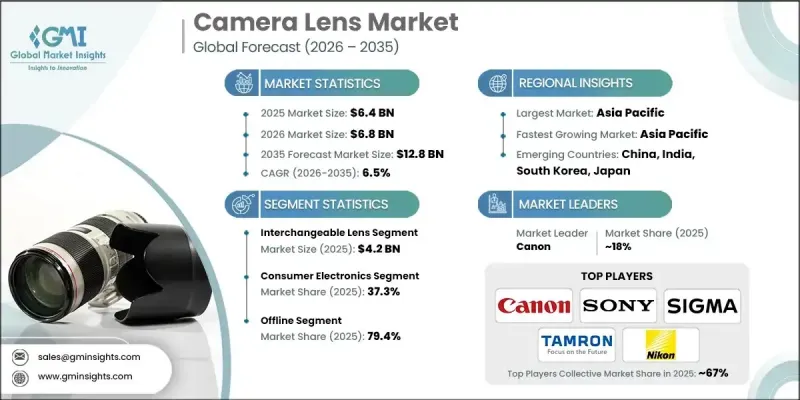
全球相機鏡頭市場預計到 2025 年將達到 64 億美元,到 2035 年將達到 128 億美元,年複合成長率為 6.5%。
內容創作、社群媒體影片製作和影片部落格(vlogging)的蓬勃發展,推動了對高品質相機鏡頭的需求。創作者們越來越需要能夠提供專業級影像品質、清晰對焦和出色低光性能的鏡頭。頻繁的內容上傳和線上平台的日益普及,促使用戶投資購買先進的攝影器材。攝影和影片領域的教育、研討會和技能提升項目,也促進了鏡頭的廣泛應用。光學防手震、更大光圈和改進的鍍膜等技術創新,吸引了從業餘愛好者到專業人士的廣泛用戶群。無反光鏡相機的日益普及,在不犧牲影像品質的前提下實現了緊湊的設計,也進一步推動了市場成長。這些系統依賴可更換鏡頭,從而催生了對各種焦距和特殊光學元件鏡頭的需求。業餘愛好者和專業人士都從中受益,獲得了更大的創作自由和更出色的攝影影片表現。
| 市場覆蓋範圍 | |
|---|---|
| 開始年份 | 2025 |
| 預測年份 | 2026-2035 |
| 起始值 | 64億美元 |
| 預測金額 | 128億美元 |
| 複合年成長率 | 6.5% |
預計到2025年,可更換鏡頭市場規模將達到42億美元,並在2035年之前以6.6%的複合年成長率成長。其市場主導地位歸功於其多功能性和在各種攝影應用中出色的影像品質。使用者可以透過更換鏡頭實現不同的構圖和創造性效果,而先進的光學設計、抗反射膜和防手震系統則提高了在各種光照條件下的成像清晰度。
預計到2025年,家用電子電器領域將佔據37.3%的市場佔有率,並在2026年至2035年間以6.8%的複合年成長率成長。這一成長主要得益於智慧型手機、平板電腦、穿戴式裝置和網路攝影機等產品中相機鏡頭的整合。消費者對用於社交媒體、影片串流媒體和攝影的高品質影像的需求,推動了具備自動對焦、光學變焦和低光性能等功能的緊湊型高效鏡頭的普及。
中國相機鏡頭市場預計到2025年將達到69億美元,2026年至2035年複合年成長率將達到5.3%。智慧型手機和微單相機的普及推動了這一需求,都市區用戶和內容創作者對多功能鏡頭的需求日益成長,以滿足攝影和短影片的需求。國內廠商正利用在地化生產優勢,以具競爭力的價格提供技術先進的產品,而電子商務的蓬勃發展也提升了消費者獲取高品質專業鏡頭的管道。
目錄
第1章調查方法和範圍
第2章執行摘要
第3章業界考察
- 生態系分析
- 供應商情況
- 利潤率
- 每個階段的附加價值
- 影響價值鏈的因素
- 產業影響因素
- 促進要素
- 拓展內容創作、影片和社群媒體影片製作
- 專業人士和攝影愛好者對無反光鏡相機的接受度越來越高
- 光學影像防手震和自動對焦系統的技術進步
- 挑戰與困難
- 專業和特殊鏡頭高成本
- 相機支架分散,各品牌間相容性問題
- 機會
- 對輕巧便攜鏡頭的需求日益成長
- 第三方鏡頭製造商的成長,提供了更具成本效益的替代方案
- 促進要素
- 成長潛力分析
- 未來市場趨勢
- 科技與創新趨勢
- 當前技術趨勢
- 新興技術
- 價格趨勢
- 按地區
- 依產品
- 監管環境
- 標準和合規要求
- 區域法規結構
- 認證標準
- 貿易統計(HS編碼-9002)
- 主要進口國
- 主要出口國
- 波特分析
- PESTEL 分析
第4章 競爭情勢
- 介紹
- 公司市佔率分析
- 按地區
- 北美洲
- 歐洲
- 亞太地區
- 拉丁美洲
- 中東和非洲
- 按地區
- 企業矩陣分析
- 主要市場公司的競爭分析
- 競爭定位矩陣
- 重大進展
- 併購
- 夥伴關係與合作
- 新產品發布
- 擴張計劃
第5章 按類型分類的市場估算與預測,2022-2035年
- 內建鏡頭
- 可更換鏡頭
第6章 2022-2035年按價格區間分類的市場估計與預測
- 低價位
- 中號
- 高價位範圍
7. 依最終用途分類的市場估計與預測,2022-2035 年
- 專業用戶
- 個人
- 製造商
- 家用電子電器
- 車
- 醫學領域
- 其他
第8章 按分銷管道分類的市場估算與預測,2022-2035年
- 線上
- 離線
第9章 2022-2035年各地區市場估算與預測
- 北美洲
- 美國
- 加拿大
- 歐洲
- 德國
- 英國
- 法國
- 義大利
- 西班牙
- 亞太地區
- 中國
- 印度
- 日本
- 韓國
- 澳洲
- 拉丁美洲
- 巴西
- 墨西哥
- 阿根廷
- 中東和非洲
- 沙烏地阿拉伯
- 阿拉伯聯合大公國
- 南非
第10章:公司簡介
- Canon
- Carl Zeiss
- Fujifilm Holdings Corporation
- Leica Camera
- Nikon Corporation
- Panasonic
- RICHO Imaging Co.
- Samyang Optics
- Schneider Kreuznach
- Sigma Corporation
- Sony Corporation
- Tamron Co.
- Viltrox Co.
- Voigtlander
- Yongnuo
The Global Camera Lens Market was valued at USD 6.4 billion in 2025 and is estimated to grow at a CAGR of 6.5% to reach USD 12.8 billion by 2035.
The expansion of content creation, social media video production, and vlogging is fueling demand for high-quality camera lenses. Creators increasingly require lenses that deliver professional-level imagery, sharp focus, and superior low-light performance. Frequent content uploads and the growing popularity of online platforms are prompting users to invest in advanced imaging equipment. Photography and videography education, workshops, and skill development programs are encouraging wider adoption of lenses. Technological advancements such as optical stabilization, wide apertures, and improved coatings attract both hobbyists and professional photographers. The rising popularity of mirrorless cameras, which offer compact designs without sacrificing image quality, is further boosting market growth. These systems rely on interchangeable lenses, creating demand for a wide array of focal lengths and specialized optics. Both amateur and professional users benefit from enhanced creative flexibility and performance in photography and videography.
| Market Scope | |
|---|---|
| Start Year | 2025 |
| Forecast Year | 2026-2035 |
| Start Value | $6.4 Billion |
| Forecast Value | $12.8 Billion |
| CAGR | 6.5% |
The interchangeable lens segment generated USD 4.2 billion in 2025 and is expected to grow at a CAGR of 6.6% through 2035. Its dominance stems from versatility and superior image quality across a range of photography applications. Users can swap lenses to achieve different compositions and creative effects, while advanced optics, anti-reflective coatings, and stabilization systems improve clarity in varied lighting conditions.
The consumer electronics segment accounted for 37.3% share in 2025 and is forecast to grow at a CAGR of 6.8% from 2026 to 2035. This growth is driven by the integration of camera lenses in smartphones, tablets, wearable devices, and webcams. Consumers demand high-quality imaging for social media, video streaming, and photography, prompting the adoption of compact, efficient lenses with features like autofocus, optical zoom, and low-light capability.
China Camera Lens Market reached USD 6.9 billion in 2025 and is projected to grow at a CAGR of 5.3% from 2026 to 2035. The demand is fueled by smartphone and mirrorless camera adoption, with urban users and content creators seeking versatile lenses for photography and short-form video. Domestic manufacturers benefit from local production advantages, offering technologically advanced products at competitive prices, while e-commerce expansion improves accessibility to premium and specialized lens options.
Major players in the Global Camera Lens Market include Sony Corporation, Carl Zeiss, Nikon Corporation, Sigma Corporation, Panasonic, Fujifilm Holdings Corporation, Tamron Co., Viltrox Co., Canon, Schneider Kreuznach, RICHO Imaging Co., Leica Camera, Samyang Optics, Voigtlander, and Yongnuo. Companies in the Global Camera Lens Market strengthen their foothold by investing in research and development to launch lenses with advanced features such as optical stabilization, low-light optimization, and wide-aperture performance. Strategic partnerships with camera manufacturers and content creators enable tailored solutions for professional and enthusiast users. Expansion into emerging markets increases brand presence, while leveraging e-commerce platforms enhances product accessibility.
Table of Contents
Chapter 1 Methodology & Scope
- 1.1 Market scope and definition
- 1.2 Research design
- 1.2.1 Research approach
- 1.2.2 Data collection methods
- 1.3 Data mining sources
- 1.3.1 Global
- 1.3.2 Regional/Country
- 1.4 Base estimates and calculations
- 1.4.1 Base year calculation
- 1.4.2 Key trends for market estimation
- 1.5 Primary research and validation
- 1.5.1 Primary sources
- 1.6 Forecast model
- 1.7 Research assumptions and limitations
Chapter 2 Executive Summary
- 2.1 Industry 3600 synopsis
- 2.2 Key market trends
- 2.2.1 Regional
- 2.2.2 Type
- 2.2.3 Price Range
- 2.2.4 End use
- 2.2.5 Distribution channel
- 2.3 CXO perspectives: Strategic imperatives
- 2.3.1 Key decision points for industry executives
- 2.3.2 Critical success factors for market players
- 2.4 Future outlook and strategic recommendations
Chapter 3 Industry Insights
- 3.1 Industry ecosystem analysis
- 3.1.1 Supplier landscape
- 3.1.2 Profit margin
- 3.1.3 Value addition at each stage
- 3.1.4 Factor affecting the value chain
- 3.2 Industry impact forces
- 3.2.1 Growth drivers
- 3.2.1.1 Expansion of content creation, vlogging, and social media video production
- 3.2.1.2 Growing adoption of mirrorless cameras across professional and enthusiast users
- 3.2.1.3 Technological advancements in optical stabilization and autofocus systems
- 3.2.2 Pitfalls & Challenges
- 3.2.2.1 High cost of professional-grade and specialty lenses
- 3.2.2.2 Compatibility fragmentation across camera mounts and brands
- 3.2.3 Opportunities
- 3.2.3.1 Rising demand for compact and lightweight lenses
- 3.2.3.2 Growth of third-party lens manufacturers offering cost-effective alternatives
- 3.2.1 Growth drivers
- 3.3 Growth potential analysis
- 3.4 Future market trends
- 3.5 Technology and innovation landscape
- 3.5.1 Current technological trends
- 3.5.2 Emerging technologies
- 3.6 Price trends
- 3.6.1 By region
- 3.6.2 By product
- 3.7 Regulatory landscape
- 3.7.1 Standards and compliance requirements
- 3.7.2 Regional regulatory frameworks
- 3.7.3 Certification standards
- 3.8 Trade statistics (HS Code - 9002)
- 3.8.1 Major importing countries
- 3.8.2 Major exporting countries
- 3.9 Porter';s analysis
- 3.10 PESTEL analysis
Chapter 4 Competitive Landscape, 2025
- 4.1 Introduction
- 4.2 Company market share analysis
- 4.2.1 By Region
- 4.2.1.1 North America
- 4.2.1.2 Europe
- 4.2.1.3 Asia Pacific
- 4.2.1.4 Latin America
- 4.2.1.5 Middle East & Africa
- 4.2.1 By Region
- 4.3 Company matrix analysis
- 4.4 Competitive analysis of major market players
- 4.5 Competitive positioning matrix
- 4.6 Key developments
- 4.6.1 Mergers & acquisitions
- 4.6.2 Partnerships & collaborations
- 4.6.3 New product launches
- 4.6.4 Expansion plans
Chapter 5 Market Estimates & Forecast, By Type, 2022 - 2035, (USD Billion) (Thousand Units)
- 5.1 Key trends
- 5.2 Built-in lens
- 5.3 Interchangeable lens
Chapter 6 Market Estimates & Forecast, By Price Range, 2022 - 2035, (USD Billion) (Thousand Units)
- 6.1 Key trends
- 6.2 Low
- 6.3 Medium
- 6.4 High
Chapter 7 Market Estimates & Forecast, By End Use, 2022 - 2035, (USD Billion) (Thousand Units)
- 7.1 Key trends
- 7.2 Professional users
- 7.3 Individuals
- 7.4 Manufacturers
- 7.4.1 Consumer Electronics
- 7.4.2 Automotive
- 7.4.3 Medical
- 7.4.4 Others
Chapter 8 Market Estimates & Forecast, By Distribution Channel, 2022 - 2035, (USD Billion) (Thousand Units)
- 8.1 Key trends
- 8.2 Online
- 8.3 Offline
Chapter 9 Market Estimates & Forecast, By Region, 2022 - 2035, (USD Billion) (Thousand Units)
- 9.1 Key trends
- 9.2 North America
- 9.2.1 U.S.
- 9.2.2 Canada
- 9.3 Europe
- 9.3.1 Germany
- 9.3.2 UK
- 9.3.3 France
- 9.3.4 Italy
- 9.3.5 Spain
- 9.4 Asia Pacific
- 9.4.1 China
- 9.4.2 India
- 9.4.3 Japan
- 9.4.4 South Korea
- 9.4.5 Australia
- 9.5 Latin America
- 9.5.1 Brazil
- 9.5.2 Mexico
- 9.5.3 Argentina
- 9.6 MEA
- 9.6.1 Saudi Arabia
- 9.6.2 UAE
- 9.6.3 South Africa
Chapter 10 Company Profiles
- 10.1 Canon
- 10.2 Carl Zeiss
- 10.3 Fujifilm Holdings Corporation
- 10.4 Leica Camera
- 10.5 Nikon Corporation
- 10.6 Panasonic
- 10.7 RICHO Imaging Co.
- 10.8 Samyang Optics
- 10.9 Schneider Kreuznach
- 10.10 Sigma Corporation
- 10.11 Sony Corporation
- 10.12 Tamron Co.
- 10.13 Viltrox Co.
- 10.14 Voigtlander
- 10.15 Yongnuo

 全球二手相機鏡頭市場規模、佔有率、趨勢和成長分析報告(2026-2034年)
 2026 年至 2035 年二手相機鏡頭的市場機會、成長要素、產業趨勢和預測。2026 年至 2035 年二手相機和鏡頭的市場機會、成長要素、產業趨勢和預測。
 智慧型手機相機鏡頭市場報告:按技術類型、相容性、分銷管道和地區分類(2026-2034 年)相機鏡頭市場報告:按類型、銷售管道、應用和地區分類(2026-2034 年)
 智慧型相機鏡頭市場:按解析度和地區分類
 餅乾鏡頭市場:2026-2032年全球市場預測(按焦距、光學設計、應用、銷售管道和最終用戶分類)相機鏡頭市場:按應用和地區分類
 智慧型手機相機鏡頭:市場佔有率分析、產業趨勢與統計、成長預測(2026-2031)廣角定焦鏡頭市場:以對焦方式、感光元件格式、應用、最終用戶和通路分類-2026-2032年全球預測