


 |
市場調查報告書
商品編碼
2044225
智慧型手機相機鏡頭:市場佔有率分析、產業趨勢與統計、成長預測(2026-2031)Smartphone Camera Lens - Market Share Analysis, Industry Trends & Statistics, Growth Forecasts (2026 - 2031) |
||||||

※ 本網頁內容可能與最新版本有所差異。詳細情況請與我們聯繫。
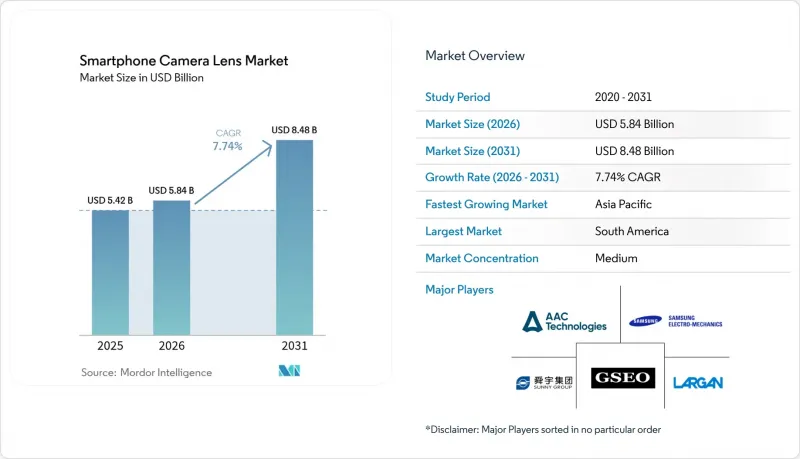
2025 年智慧型手機相機鏡頭市場價值 54.2 億美元,預計到 2031 年將達到 84.8 億美元,而 2026 年為 58.4 億美元,預測期(2026-2031 年)複合年成長率為 7.74%。
隨著設備製造商用7片或8片玻璃-塑膠混合鏡片取代基礎塑膠光學元件,尤其是在潛望和可變光圈組件中,鏡頭模組的平均售價持續上漲。長焦變焦功能正擴展到中階智慧型手機,為供應商提供了一種有望抵消全球智慧型手機出貨量放緩影響的途徑。支援人工智慧驅動的運算攝影的多相機配置需要超廣角、微距和景深鏡頭,這也推動了市場需求。精密玻璃模壓產能已接近滿載運轉率,預計隨著單晶片缺陷率高於傳統廣角模組,產能壓力將進一步加大。
全球智慧型手機相機鏡頭市場趨勢及洞察
潛望鏡和遠攝模組的快速普及
預計到2025年,潛望式長焦鏡頭模組的應用範圍將從售價1,000美元的旗艦機型擴展到400-600美元的設備,從而縮小高階和中階設備在光學變焦性能方面的差距。每個組件包含7-8個玻璃-塑膠混合透鏡和稜鏡,因此潛望式變焦功能的加入會使平均售價增加18-22%。儘管大立光電的出貨量年增了34%,但由於棱鏡對準公差小於5微米,其缺陷率比廣角鏡頭高出約12-15個百分點。目前,OEM廠商正將5倍至10倍光學變焦作為行銷重點,以提高消費者對鏡頭品質的認知。由於精密玻璃模壓產能的限制,預計潛望式變焦技術的應用將持續到2027年,這將進一步提升供應商的利潤率。
像素競賽,相機像素超過 5000 萬,推高了鏡頭的平均售價。
索尼的 2 億像素 LYT-901 感測器樹立了光學標桿,其調製傳遞函數 (MTF) 值在 100 lp/mm 解析度下超過 0.6,迫使鏡頭製造商採用非球面鏡片和先進鍍膜技術。三星的 ISOCELL HP5 感光元件雖然能夠實現更薄的相機組件,但也推高了模組成本,導致旗艦機型的光學子系統單價高達 80-100 美元。高階鏡頭和入門鏡頭的價格差距如今已達 3-6 倍,即便全球行動電話出貨量保持平穩,廠商仍在優先發展高階專案。像素數量的增加也導致成像圈擴大,需要更大的鏡頭直徑和更多的鏡片元件。這些因素解釋了為什麼到 2025 年,混合鏡頭將佔據近一半的市場。
全球智慧型手機出貨量已趨於平穩。
到2025年,隨著鏡頭更換週期超過三年,全球出貨量預計將停滯在12億台左右,印度市場將萎縮1%。根據TechInsights研究顯示,2025年上半年全球出貨量預計僅成長4%,而售價超過600美元的鏡頭銷售量預計將成長8%,凸顯了市場正從追求數量轉向追求品質。儘管高階市場表現強勁,但這種市場飽和使得鏡頭需求成長仍維持在個位數。旗艦機型的出貨量佔比不到四分之一,卻貢獻了近一半的鏡頭相關收入,這使得供應商面臨收入集中度過高的風險。因此,即使高階需求略有下降,也可能迅速擠壓利潤空間。
細分市場分析
預計到2031年,長焦鏡頭將以8.58%的複合年成長率成長,成為整體成長最快的技術,即使智慧型手機出貨量趨於穩定,其在智慧型手機相機鏡頭市場的佔有率仍在不斷擴大。隨著潛望式變焦模組被整合到售價400至600美元的智慧型手機中,出貨量也不斷成長,使得品牌能夠將5倍至10倍光學變焦作為主流功能進行宣傳。到2025年,廣角鏡頭仍將佔據智慧型手機相機鏡頭市場42.36%的佔有率,但隨著創新投資轉向輔助相機,其成長已停滯不前。由於採用人工智慧驅動的線性校正技術,120度視角得以實現,超廣角設計的重要性日益凸顯;而隨著高解析度長焦鏡頭能夠拍攝近距離特寫,微距感測器正逐漸被淘汰。佳能的SPAD原型鏡頭擁有26檔動態範圍,這表明未來的長焦鏡頭需要超過95%的透光率,這意味著需要在鏡頭組中整合更多的鏡片。
由於鏡頭元件數量增加以及棱鏡組件的應用,長焦鏡頭模組的價格比廣角鏡頭模組高出 40% 至 50%,這促使大立光和舜宇光學等供應商將產能集中於這種盈利更高的產品配置。每個潛望式鏡頭需要 7 至 8 個玻璃-塑膠混合元件,這增加了模具的複雜性和良率風險。雖然由於稜鏡對準公差小於 5微米,其單件缺陷率比傳統模組高出約 12% 至 15 個百分點,但由於每次增加潛望式變焦功能,平均售價 (ASP) 都會提高 18% 至 22%,因此利潤率仍然可觀。超廣角鏡頭模組採用線性校正演算法,並使用自由曲面非球面玻璃,其成本比傳統塑膠設計高出 25% 至 30%。微距和景深功能整合到高解析度二次性鏡頭中,在減少感光元件數量的同時,保持了每部智慧型手機的鏡頭總收入。
預計到2025年,玻璃-塑膠混合鏡頭將佔智慧型手機相機鏡頭市場佔有率的47.89%,並以8.39%的複合年成長率(CAGR)在2028年超越全塑膠鏡頭。混合鏡頭由兩到三片玻璃鏡片和四到五片塑膠鏡片組成,兼顧了色差控制和輕量化設計。全玻璃鏡頭採用七片玻璃鏡片堆疊結構,重量增加15-20%,製造成本增加高達40%,目前僅限於折疊式設備及超高階機型。全塑膠鏡頭目前僅限於售價低於200美元的設備,但隨著中階廠商推出混合鏡頭升級方案以區分其攝影機,全塑膠鏡頭的市場佔有率正在萎縮。隨著華為、OPPO和vivo等廠商推出多片式長焦鏡頭,舜宇光學在2025年上半年的混合鏡頭銷售量增加了一倍以上。
製造程序能力是決定性因素。大立光的精密玻璃模壓技術實現了小於0.2微米的表面精度,這是塑膠材質無法達到的,從而確保2000萬像素感測器在100線對/毫米的調製傳遞函數(MTF)超過0.6。一種新的聚合物配方將熱膨脹係數從70 ppm/ 度C降低到50 ppm/ 度C,縮小了與玻璃材質在焦距偏移方面的差異,但對於潛望鏡式鏡頭設計仍然不夠理想。在折疊式智慧型手機中,混合材質鏡頭更受歡迎,因為塑膠材質可以減輕鉸鏈側的重量,而玻璃材質則可以增強鏡頭疊層的剛性,使其能夠承受反覆折疊式。隨著影像處理使透射率目標值超過92%,混合材質鏡頭將成為中高階機械鏡頭的標準配置,鞏固其在智慧型手機相機鏡頭市場的主流地位。
區域分析
亞太地區受中國在鏡頭製造和組裝的優勢驅動,預計到2025年將佔全球銷售額的64.22%,其中廣東和江蘇兩省佔據了全球大部分產能。印度的生產連結獎勵計畫計畫正促使相機模組的生產轉移到泰米爾納德邦和卡納塔克邦,從而縮短了蘋果和三星的前置作業時間。塔塔電子收購緯創的iPhone工廠標誌著這一轉變,並加速了鏡頭和執行器的在地採購。越南正在崛起為第二大生產中心,LG Innotek V3工廠的擴建使其本地產能加倍。
南美洲是成長最快的地區,複合年成長率高達 8.79%,這主要得益於 5G 的部署和行動影片需求的不斷成長(平均每月達到 9GB)。中國 OEM 廠商榮耀、OPPO 和 vivo 正在巴西、阿根廷和智利擴大市場佔有率。在這些國家,預計到 2024 年,售價低於 200 美元的智慧型手機出貨量將加倍,而售價高於 600 美元的高階市場也在擴張。這種兩極化的市場格局推動了對鏡頭的需求,既包括注重成本的模組,也包括利潤豐厚的混合產品。
北美和歐洲合計約佔全球整體銷售額的三分之一,但其更換週期超過3.5年,導致複合年成長率僅6.5%-7.0%,低於全球整體平均成長率。中東和非洲總合市佔率不足10%。儘管5G網路投資正在提高市場滲透率,但價格限制使得鏡片的平均售價維持在8-12美元之間,且全塑膠設計佔據主導地位。外匯波動以及奈及利亞和埃及的關稅進一步限制了市場成長。
其他好處
- Excel格式的市場預測(ME)表
- 3個月的分析師支持
目錄
第1章:引言
- 研究假設和市場定義
- 調查範圍
第2章:調查方法
第3章執行摘要
第4章 市場狀況
- 市場概覽
- 市場促進因素
- 配備多個相機的智慧型手機的普及
- 像素競賽,相機像素超過 5000 萬,推高了鏡頭的平均售價。
- 潛望鏡和遠攝模組的快速普及
- 以人工智慧為中心的計算攝影技術的要求
- 印度和越南的鏡頭供應鏈本地化
- 用於折疊式和穿戴式設備的玻璃塑膠自由曲面鏡片
- 市場限制因素
- 全球智慧型手機出貨量趨於飽和
- 中低價位行動電話面臨嚴峻的價格壓力
- 多層混合透鏡的良率挑戰
- 與精密玻璃成型工具相關的出口管制風險
- 宏觀經濟因素對市場的影響
- 產業價值鏈分析
- 監理情勢
- 技術展望
- 波特五力分析
- 供應商的議價能力
- 買方的議價能力
- 新進入者的威脅
- 替代品的威脅
- 競爭公司之間的競爭
第5章 市場規模與成長預測
- 鏡頭技術
- 廣泛/主要
- 超寬螢幕
- 長焦鏡頭
- 宏觀/深度
- 透過鏡頭材料
- 全玻璃
- 全塑膠
- 玻璃塑膠混合物
- 相機位置
- 後主發球檯
- 後副
- 正面
- 透過製造程序
- 玻璃壓縮成型
- 射出成型
- 精密玻璃模壓
- 其他製造程序
- 智慧型手機價格範圍
- 旗艦
- 中階
- 入門級
- 按地區
- 北美洲
- 美國
- 加拿大
- 墨西哥
- 南美洲
- 巴西
- 阿根廷
- 南美洲其他地區
- 歐洲
- 英國
- 德國
- 法國
- 義大利
- 其他歐洲國家
- 亞太地區
- 中國
- 日本
- 印度
- 韓國
- 亞太其他地區
- 中東和非洲
- 中東
- 阿拉伯聯合大公國
- 沙烏地阿拉伯
- 其他中東國家
- 非洲
- 南非
- 埃及
- 其他非洲地區
- 中東
- 北美洲
第6章 競爭情勢
- 市場集中度
- 策略趨勢
- 市佔率分析
- 公司簡介
- Largan Precision Co. Ltd.
- Sunny Optical Technology(Group)Co. Ltd.
- Samsung Electro-Mechanics Co. Ltd.
- Genius Electronic Optical Co. Ltd.
- AAC Technologies Holdings Inc.
- LG Innotek Co. Ltd.
- Kantatsu Co. Ltd.
- Sekonix Co. Ltd.
- Asia Optical Co. Inc.
- Kinko Optical Co. Ltd.
- Haesung Optics Co. Ltd.
- OFILM Group Co. Ltd.
- Newmax Technology Co. Ltd.
- KMOT Co. Ltd.
- Tianyang Optical Technology Co. Ltd.
- Ability Opto-Electronics Technology Co. Ltd.
- Tamron Co. Ltd.
- Hoya Group
- Nidec Sankyo Corp.
- Calin Technology Co. Ltd.
- Fujinon Corporation
- Sekonic Holdings
- Light Co.
- Truemax Engineering Co. Ltd.
第7章 市場機會與未來展望
The smartphone camera lens market size was valued at USD 5.42 billion in 2025 and estimated to grow from USD 5.84 billion in 2026 to reach USD 8.48 billion by 2031, at a CAGR of 7.74% during the forecast period (2026-2031).
Average selling prices for lens modules continue to climb as device makers replace basic plastic optics with 7- or 8-element glass-plastic hybrids, especially in periscope and variable-aperture assemblies. Telescopic zoom capability is expanding into mid-range handsets, giving suppliers a lucrative path to offset stagnant global smartphone shipments. Demand also benefits from multi-camera configurations that require ultra-wide, macro, and depth lenses to support AI-driven computational photography. Precision glass-molding capacity, already operating near full utilization, is set to tighten further as per-unit defects remain higher than conventional wide-angle modules.
Global Smartphone Camera Lens Market Trends and Insights
Rapid Adoption of Periscope and Telephoto Modules
Periscope telephoto modules moved from USD 1,000 flagships to USD 400-600 handsets in 2025, shrinking the optical-zoom gap between premium and mid-range devices. Each assembly relies on 7- or 8-element glass-plastic hybrids plus a prism, so average selling prices jump 18-22% when periscope zoom is added. Shipments rose 34% year over year at Largan Precision, yet prism alignment tolerances below 5 µm keep reject rates roughly 12-15 points higher than for wide-angle lenses. OEM marketing now highlights 5x to 10x optical zoom as a headline feature, reinforcing consumer awareness of lens quality. Capacity constraints in precision glass molding suggest that periscope penetration will continue to lift supplier margins through 2027.
Megapixel Race Above 50 MP Lifting Lens ASPs
Sony's 200 MP LYT-901 sensor sets an optical benchmark of modulation-transfer-function values above 0.6 at 100 lp/mm, forcing lens makers to use aspheric glass and advanced coatings. Samsung's ISOCELL HP5 keeps camera stacks thinner but raises module cost, pushing flagship optical subsystems toward USD 80-100 per phone. The gulf between high-end and entry optics now reaches a 3-6X price multiple, so vendors prioritize premium projects even while global handset volumes flatten. Higher pixel counts also widen image circles, which drives larger lens diameters and additional elements. These requirements explain why hybrid lenses gained nearly half the market in 2025.
Global Smartphone Unit Saturation
Worldwide shipments stalled near 1.2 billion units and India's market slid 1% in 2025, as replacement cycles stretched beyond three years. TechInsights tracked only 4% global unit growth in 1H 2025 versus 8% revenue growth for devices above USD 600, highlighting a shift to value over volume. This saturation caps lens demand growth at single-digit rates even while premium tiers thrive. Suppliers face revenue concentration risk because flagship models represent under one-quarter of units yet almost half of lens income. Any downturn in premium demand could therefore compress margins quickly.
Other drivers and restraints analyzed in the detailed report include:
- AI-Centric Computational Photography Requirements
- Proliferation of Multi-Camera Smartphones
- Aggressive Pricing Pressure in Mid- and Low-Tier Handsets
For complete list of drivers and restraints, kindly check the Table Of Contents.
Segment Analysis
Telephoto optics posted an 8.58% CAGR to 2031, the quickest pace among all technologies, so their slice of the smartphone camera lens market size is expanding even as total handset units plateau. Shipments rose when periscope zoom modules migrated into USD 400-600 phones, allowing brands to advertise 5x to 10x optical zoom as a mainstream feature. Wide-angle lenses still held 42.36% smartphone camera lens market share in 2025, but their growth stalled because innovation dollars now chase auxiliary cameras. Ultra-wide designs gained relevance after AI rectilinear correction unlocked 120-degree fields of view, while macro sensors began to disappear as high-resolution telephotos can crop in for close-ups. Canon's 26-stop-range SPAD prototype suggests future telephotos will demand >95% light transmission, which pushes even more glass into lens stacks.
Higher element counts and prism assemblies lift telephoto module prices 40-50% above wide units, so suppliers such as Largan and Sunny Optical funnel capacity toward this richer mix. Each periscope lens requires 7-8 glass-plastic hybrid elements, raising both tooling complexity and yield risk. Prism alignment tolerances under 5 µm keep per-unit defect rates roughly 12-15 points above conventional modules, yet profit margins remain attractive because ASPs rise 18-22% whenever periscope zoom is added. Ultra-wide modules, bolstered by rectilinear algorithms, now feature free-form aspheric glass that costs 25-30% more than earlier plastic designs. Macro and depth functions consolidate into higher-resolution secondaries, trimming sensor counts while sustaining total lens revenue per phone.
Glass-plastic hybrids captured 47.89% of 2025 revenue, and their 8.39% CAGR means they will overtake all-plastic designs in smartphone camera lens market share before 2028. Hybrid stacks mix two or three glass elements with four or five plastic ones, marrying chromatic-aberration control to weight savings. All-glass lenses remain confined to foldables and ultra-premium models because a seven-element glass stack weighs 15-20% more and costs up to 40% extra to build. All-plastic optics linger in sub-USD 200 devices, but their share erodes as mid-range makers tout hybrid upgrades for camera differentiation. Sunny Optical more than doubled hybrid-lens revenue in 1H 2025 as Huawei, OPPO, and vivo launched multi-element telephotos.
Process capability is the swing factor. Precision glass molding from Largan achieves surface accuracy below 0.2 µm, impossible with plastics, which ensures MTF above 0.6 at 100 lp/mm for 200 MP sensors. New polymer formulas cut thermal expansion from 70 ppm / °C to 50 ppm / °C, narrowing the focus-shift gap with glass, yet not enough for periscope designs. Foldable phones also favor hybrids because plastic keeps hinge-side weight down, while glass stiffens the stack to withstand repeated folding. As AI imaging pushes transmission targets past 92%, hybrids become the default for mid- and high-end tiers, locking in their path to majority status in the smartphone camera lens market size.
The Smartphone Camera Lens Market Report is Segmented by Lens Technology (Telephoto, Macro/Depth, and More), Lens Material (All-Glass, All-Plastic, and More), Camera Position (Rear-Primary, Rear-Secondary, Front/Facing), Manufacturing Process (Injection Moulding, Precision Glass Moulding, and More), Smartphone Tier (Flagship, Mid-Range, Entry-Level), and Geography. The Market Forecasts are Provided in Terms of Value (USD).
Geography Analysis
Asia-Pacific retained 64.22% of 2025 revenue thanks to China's dominance in lens fabrication and assembly, with Guangdong and Jiangsu provinces hosting a majority of global capacity. India's Production-Linked Incentive scheme is redirecting camera module work to Tamil Nadu and Karnataka, trimming lead times for Apple and Samsung. Tata Electronics' takeover of Wistron's iPhone plant exemplifies this shift, accelerating localized sourcing of lenses and actuators. Vietnam is emerging as a secondary center as LG Innotek's V3 expansion doubles local output.
South America is the fastest-growing region at an 8.79% CAGR, propelled by 5G rollouts and a rising preference for mobile video that averages 9 GB per month. Chinese OEMs HONOR, OPPO, and vivo capture share in Brazil, Argentina, and Chile, where smartphones priced under USD 200 doubled shipments in 2024 yet a premium segment above USD 600 is also expanding. This bifurcation fuels lens demand for both cost-sensitive modules and high-margin hybrids.
North America and Europe together account for roughly one-third of global revenue but trail the worldwide growth rate at 6.5-7.0% CAGR because replacement cycles now exceed 3.5 years. Middle East and Africa collectively hold under 10% share; 5G network investments lift penetration, yet affordability keeps lens ASPs in the USD 8-12 range and supports mainly all-plastic designs. Currency volatility and tariffs in Nigeria and Egypt add further constraints.
- Largan Precision Co. Ltd.
- Sunny Optical Technology (Group) Co. Ltd.
- Samsung Electro-Mechanics Co. Ltd.
- Genius Electronic Optical Co. Ltd.
- AAC Technologies Holdings Inc.
- LG Innotek Co. Ltd.
- Kantatsu Co. Ltd.
- Sekonix Co. Ltd.
- Asia Optical Co. Inc.
- Kinko Optical Co. Ltd.
- Haesung Optics Co. Ltd.
- OFILM Group Co. Ltd.
- Newmax Technology Co. Ltd.
- KMOT Co. Ltd.
- Tianyang Optical Technology Co. Ltd.
- Ability Opto-Electronics Technology Co. Ltd.
- Tamron Co. Ltd.
- Hoya Group
- Nidec Sankyo Corp.
- Calin Technology Co. Ltd.
- Fujinon Corporation
- Sekonic Holdings
- Light Co.
- Truemax Engineering Co. Ltd.
Additional Benefits:
- The market estimate (ME) sheet in Excel format
- 3 months of analyst support
TABLE OF CONTENTS
1 INTRODUCTION
- 1.1 Study Assumptions and Market Definition
- 1.2 Scope of the Study
2 RESEARCH METHODOLOGY
3 EXECUTIVE SUMMARY
4 MARKET LANDSCAPE
- 4.1 Market Overview
- 4.2 Market Drivers
- 4.2.1 Proliferation of Multi-Camera Smartphones
- 4.2.2 Megapixel Race Above 50 MP Lifting Lens ASPs
- 4.2.3 Rapid Adoption of Periscope and Telephoto Modules
- 4.2.4 AI-Centric Computational Photography Requirements
- 4.2.5 Localised Lens Supply-Chain Build-Out in India and Vietnam
- 4.2.6 Glass-Plastic Free-Form Lenses for Foldables and Wearables
- 4.3 Market Restraints
- 4.3.1 Global Smartphone Unit Saturation
- 4.3.2 Aggressive Pricing Pressure in Mid- and Low-Tier Handsets
- 4.3.3 High-Layer Hybrid Lens Yield Challenges
- 4.3.4 Export-Control Risk on Precision Glass-Moulding Tools
- 4.4 Impact of Macroeconomic Factors on the Market
- 4.5 Industry Value Chain Analysis
- 4.6 Regulatory Landscape
- 4.7 Technological Outlook
- 4.8 Porter's Five Forces Analysis
- 4.8.1 Bargaining Power of Suppliers
- 4.8.2 Bargaining Power of Buyers
- 4.8.3 Threat of New Entrants
- 4.8.4 Threat of Substitute Products
- 4.8.5 Intensity of Competitive Rivalry
5 MARKET SIZE AND GROWTH FORECASTS (VALUE)
- 5.1 By Lens Technology
- 5.1.1 Wide/Primary
- 5.1.2 Ultra-Wide
- 5.1.3 Telephoto
- 5.1.4 Macro/Depth
- 5.2 By Lens Material
- 5.2.1 All-Glass
- 5.2.2 All-Plastic
- 5.2.3 Glass-Plastic Hybrid
- 5.3 By Camera Position
- 5.3.1 Rear-Primary
- 5.3.2 Rear-Secondary
- 5.3.3 Front/Facing
- 5.4 By Manufacturing Process
- 5.4.1 Glass Compression Moulding
- 5.4.2 Injection Moulding
- 5.4.3 Precision Glass Moulding
- 5.4.4 Other Manufacturing Process
- 5.5 By Smartphone Tier
- 5.5.1 Flagship
- 5.5.2 Mid-Range
- 5.5.3 Entry-Level
- 5.6 By Geography
- 5.6.1 North America
- 5.6.1.1 United States
- 5.6.1.2 Canada
- 5.6.1.3 Mexico
- 5.6.2 South America
- 5.6.2.1 Brazil
- 5.6.2.2 Argentina
- 5.6.2.3 Rest of South America
- 5.6.3 Europe
- 5.6.3.1 United Kingdom
- 5.6.3.2 Germany
- 5.6.3.3 France
- 5.6.3.4 Italy
- 5.6.3.5 Rest of Europe
- 5.6.4 Asia-Pacific
- 5.6.4.1 China
- 5.6.4.2 Japan
- 5.6.4.3 India
- 5.6.4.4 South Korea
- 5.6.4.5 Rest of Asia-Pacific
- 5.6.5 Middle East and Africa
- 5.6.5.1 Middle East
- 5.6.5.1.1 United Arab Emirates
- 5.6.5.1.2 Saudi Arabia
- 5.6.5.1.3 Rest of Middle East
- 5.6.5.2 Africa
- 5.6.5.2.1 South Africa
- 5.6.5.2.2 Egypt
- 5.6.5.2.3 Rest of Africa
- 5.6.5.1 Middle East
- 5.6.1 North America
6 COMPETITIVE LANDSCAPE
- 6.1 Market Concentration
- 6.2 Strategic Moves
- 6.3 Market Share Analysis
- 6.4 Company Profiles (includes Global Level Overview, Market Level Overview, Core Segments, Financials as available, Strategic Information, Market Rank/Share, Products and Services, Recent Developments)
- 6.4.1 Largan Precision Co. Ltd.
- 6.4.2 Sunny Optical Technology (Group) Co. Ltd.
- 6.4.3 Samsung Electro-Mechanics Co. Ltd.
- 6.4.4 Genius Electronic Optical Co. Ltd.
- 6.4.5 AAC Technologies Holdings Inc.
- 6.4.6 LG Innotek Co. Ltd.
- 6.4.7 Kantatsu Co. Ltd.
- 6.4.8 Sekonix Co. Ltd.
- 6.4.9 Asia Optical Co. Inc.
- 6.4.10 Kinko Optical Co. Ltd.
- 6.4.11 Haesung Optics Co. Ltd.
- 6.4.12 OFILM Group Co. Ltd.
- 6.4.13 Newmax Technology Co. Ltd.
- 6.4.14 KMOT Co. Ltd.
- 6.4.15 Tianyang Optical Technology Co. Ltd.
- 6.4.16 Ability Opto-Electronics Technology Co. Ltd.
- 6.4.17 Tamron Co. Ltd.
- 6.4.18 Hoya Group
- 6.4.19 Nidec Sankyo Corp.
- 6.4.20 Calin Technology Co. Ltd.
- 6.4.21 Fujinon Corporation
- 6.4.22 Sekonic Holdings
- 6.4.23 Light Co.
- 6.4.24 Truemax Engineering Co. Ltd.
7 MARKET OPPORTUNITIES AND FUTURE OUTLOOK
- 7.1 White-Space and Unmet-Need Assessment

 全球二手相機鏡頭市場規模、佔有率、趨勢和成長分析報告(2026-2034年)
 2026 年至 2035 年二手相機鏡頭的市場機會、成長要素、產業趨勢和預測。2026 年至 2035 年二手相機和鏡頭的市場機會、成長要素、產業趨勢和預測。
 智慧型手機相機鏡頭市場報告:按技術類型、相容性、分銷管道和地區分類(2026-2034 年)相機鏡頭市場報告:按類型、銷售管道、應用和地區分類(2026-2034 年)
 智慧型相機鏡頭市場:按解析度和地區分類
 餅乾鏡頭市場:2026-2032年全球市場預測(按焦距、光學設計、應用、銷售管道和最終用戶分類)相機鏡頭市場:按應用和地區分類廣角定焦鏡頭市場:以對焦方式、感光元件格式、應用、最終用戶和通路分類-2026-2032年全球預測緊湊型鏡頭產生器市場:按類型、技術、分銷管道、應用、最終用戶分類,全球預測(2026-2032)