


 |
市場調查報告書
商品編碼
1892861
挖溝機市場機會、成長促進因素、產業趨勢分析及預測(2025-2034年)Trenchers Market Opportunity, Growth Drivers, Industry Trend Analysis, and Forecast 2025 - 2034 |
||||||

2024 年全球挖溝機市場價值為 8.391 億美元,預計到 2034 年將以 3.4% 的複合年成長率成長至 11.6 億美元。
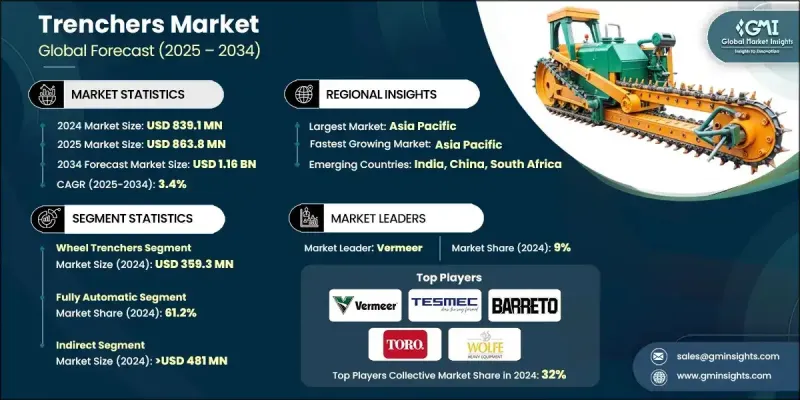
州和地方政府基礎設施項目的擴張,包括公路、鐵路網路和城市發展,推動了對挖溝機的需求,用於開挖公用設施、地基和排水系統的溝槽。隨著數十億美元投資於交通升級和智慧城市計劃,承包商擴大購買高性能挖溝機,以高效完成專案並降低人力成本。製造商也積極回應,推出諸如GPS整合和自動深度控制等先進功能,實現更精確的挖溝作業。都市化進程的加快,以及對電力、水和燃氣分配網路需求的成長,進一步推高了對挖溝機的需求。公用事業公司更傾向於使用挖溝機來保持溝槽深度的一致性,從而最大限度地減少地表損傷並降低修復成本。此外,地下電纜的普及和土壤條件的多樣化也要求挖溝設備能夠適應各種溝槽寬度和應用場景。
| 市場範圍 | |
|---|---|
| 起始年份 | 2024 |
| 預測年份 | 2025-2034 |
| 起始值 | 8.391億美元 |
| 預測值 | 11.6億美元 |
| 複合年成長率 | 3.4% |
2024年,輪式挖溝機市場規模達3.593億美元,佔市場主導地位。輪式挖溝機因其能夠高精度、高速度地切割瀝青、混凝土和壓實土壤等堅硬表面而備受青睞,使其成為大型基礎設施和公用設施項目不可或缺的工具。其獨特的設計確保了溝槽深度和寬度的一致性,減少了後續的地面修復工作,從而降低了專案的整體成本。
到2024年,全自動挖溝機市佔率將達到61.2%。全自動挖溝機因其精準性、安全性以及對熟練工人依賴性的降低而日益受到青睞。自動化可確保溝槽深度和方向的一致性,從而減少誤差並提高工程品質。從事公用設施網路和光纖安裝的承包商越來越傾向於選擇配備自動化控制系統的挖溝機,因為這種挖溝機能夠簡化操作流程並最大限度地減少停機時間,尤其是在時間緊迫的專案中。
美國挖溝機市場佔79.5%的佔有率,預計2024年市場規模將達到1.983億美元。美國市場的領先地位得益於大規模的基礎設施現代化、廣泛的光纖部署以及對智慧城市、再生能源管道和公用事業網路的投資。強大的租賃生態系統和領先製造商的存在進一步鞏固了美國市場,使其成為GPS定位和自動化挖溝設備的創新中心。
目錄
第1章:方法論與範圍
第2章:執行概要
第3章:行業洞察
- 產業生態系分析
- 供應商格局
- 利潤率
- 每個階段的價值增加
- 影響價值鏈的因素
- 產業影響因素
- 成長促進因素
- 基礎建設開發投資
- 公用設施安裝擴建
- 光纖網路部署
- 陷阱與挑戰
- 高昂的設備成本
- 熟練勞動力短缺
- 機會
- 租賃服務
- 自動化技術進步
- 成長促進因素
- 成長潛力分析
- 未來市場趨勢
- 技術與創新格局
- 當前技術趨勢
- 新興技術
- 價格趨勢
- 按地區
- 依產品類型
- 監管環境
- 標準和合規要求
- 區域監理框架
- 認證標準
- 貿易統計(HS編碼-842959)
- 主要進口國
- 主要出口國
- 差距分析
- 風險評估與緩解
- 波特的分析
- PESTEL 分析
第4章:競爭格局
- 介紹
- 公司市佔率分析
- 按地區
- 公司矩陣分析
- 主要市場參與者的競爭分析
- 競爭定位矩陣
- 關鍵進展
- 併購
- 合作夥伴關係與合作
- 新產品發布
- 擴張計劃
第5章:市場估算與預測:依產品類型分類,2021-2034年
- 輪式挖溝機
- 鍊式挖溝機
- 微型挖溝機
- 岩石溝渠工
第6章:市場估算與預測:依營運模式分類,2021-2034年
- 手動的
- 半自動
- 全自動
第7章:市場估算與預測:依電源類型分類,2021-2034年
- 柴油引擎
- 電的
- 汽油
第8章:市場估算與預測:依應用領域分類,2021-2034年
- 石油和天然氣管道安裝
- 電力電纜和光纖安裝
- 排水和灌溉
- 道路建設
- 農業溝渠
- 電信網路建設
- 其他(居民公用設施等)
第9章:市場估算與預測:依最終用途產業分類,2021-2034年
- 建造
- 農業
- 電信
- 石油和天然氣
- 公用事業
- 礦業
- 其他(園林綠化等)
第10章:市場估價與預測:依配銷通路分類,2021-2034年
- 直接的
- 間接
第11章:市場估計與預測:按地區分類,2021-2034年
- 北美洲
- 美國
- 加拿大
- 歐洲
- 德國
- 英國
- 法國
- 義大利
- 西班牙
- 亞太地區
- 中國
- 日本
- 印度
- 澳洲
- 韓國
- 拉丁美洲
- 巴西
- 墨西哥
- 阿根廷
- 中東和非洲
- 南非
- 沙烏地阿拉伯
- 阿拉伯聯合大公國
第12章:公司簡介
- Barreto Manufacturing
- Bobcat Company
- Cleveland Trencher Company
- Ditch Witch
- Gravis Robotics
- Inter-Drain
- Mastenbroek Ltd.
- Miah Trenchers
- Simex Srl
- Takeuchi Manufacturing
- Tesmec SpA
- Toro Company
- Trencor
- Vermeer Manufacturing Company
- Wolfe Heavy Equipment
The Global Trenchers Market was valued at USD 839.1 million in 2024 and is estimated to grow at a CAGR of 3.4% to reach USD 1.16 billion by 2034.
The expansion of infrastructure projects by state and local governments, including highways, rail networks, and urban development, has driven the demand for trenching machines to create trenches for utilities, foundations, and drainage systems. With billions being invested in transportation upgrades and smart city initiatives, contractors are increasingly purchasing high-performance trenchers to complete projects efficiently while reducing labor costs. Manufacturers are responding by introducing advanced features such as GPS integration and automatic depth control, enabling more precise trenching operations. Rising urbanization, coupled with the growing need for electricity, water, and gas distribution networks, is further increasing demand. Utility companies prefer trenchers for consistent trench depth, which minimizes surface damage and lowers restoration costs. Additionally, the growth of underground cabling and diverse soil conditions necessitates versatile trenching equipment suitable for a variety of trench widths and applications.
| Market Scope | |
|---|---|
| Start Year | 2024 |
| Forecast Year | 2025-2034 |
| Start Value | $839.1 Million |
| Forecast Value | $1.16 Billion |
| CAGR | 3.4% |
The wheel trenchers segment generated USD 359.3 million in 2024, dominating the market. Wheel trenchers are preferred for their ability to cut through tough surfaces such as asphalt, concrete, and compacted soil with high accuracy and speed, making them indispensable for large-scale infrastructure and utility projects. Their design ensures consistent trench depth and width, reducing the need for surface repairs and cutting overall project expenses.
The fully automatic segment accounted for a 61.2% share in 2024. Fully automated trenchers are gaining traction due to their precision, safety, and reduced dependence on skilled labor. Automation ensures uniform trench depth and alignment, reducing errors and improving project quality. Contractors working on utility networks and fiber optic installations increasingly favor trenchers with automated controls, which streamline operations and minimize downtime, especially in time-sensitive projects.
U.S. Trenchers Market held 79.5% share, generating USD 198.3 million in 2024. The country's leadership is driven by large-scale infrastructure modernization, extensive fiber optic deployment, and investments in smart cities, renewable energy pipelines, and utility networks. A strong rental ecosystem and the presence of leading manufacturers further reinforce the U.S. market, establishing it as a hub for innovation in GPS-enabled and automated trenching equipment.
Key players operating in the Global Trenchers Market include Wolfe Heavy Equipment, Inter-Drain, Miah Trenchers, Gravis Robotics, Ditch Witch, Tesmec S.p.A., Simex S.r.l., Trencor, Takeuchi Manufacturing, Toro Company, Cleveland Trencher Company, Barreto Manufacturing, Bobcat Company, and Mastenbroek Ltd. Companies in the Global Trenchers Market are strengthening their position through several strategic initiatives. They are investing in research and development to introduce automated, GPS-integrated, and high-performance trenching machines tailored to diverse soil types and trenching requirements. Strategic partnerships with construction and utility firms improve distribution channels and market access. Manufacturers are expanding geographically to capture emerging markets while enhancing their service and rental networks to increase customer reach. Emphasis on product durability, precision, and compliance with safety standards ensures long-term customer trust.
Table of Contents
Chapter 1 Methodology and Scope
- 1.1 Market scope and definition
- 1.2 Research design
- 1.2.1 Research approach
- 1.2.2 Data collection methods
- 1.3 Data mining sources
- 1.3.1 Global
- 1.3.2 Regional/Country
- 1.4 Base estimates and calculations
- 1.4.1 Base year calculation
- 1.4.2 Key trends for market estimation
- 1.5 Primary research and validation
- 1.5.1 Primary sources
- 1.6 Forecast model
- 1.7 Research assumptions and limitations
Chapter 2 Executive Summary
- 2.1 Industry 360° synopsis
- 2.2 Key market trends
- 2.2.1 Regional
- 2.2.2 Product type
- 2.2.3 Mode of Operation
- 2.2.4 Power source
- 2.2.5 Application
- 2.2.6 End Use industry
- 2.2.7 Distribution channel
- 2.3 CXO perspectives: strategic imperatives
- 2.3.1 Key decision points for industry executives
- 2.3.2 Critical success factors for market players
- 2.4 Future outlook and strategic recommendations
Chapter 3 Industry Insights
- 3.1 Industry ecosystem analysis
- 3.1.1 Supplier landscape
- 3.1.2 Profit margin
- 3.1.3 Value addition at each stage
- 3.1.4 Factor affecting the value chain
- 3.2 Industry impact forces
- 3.2.1 Growth drivers
- 3.2.1.1 Infrastructure development investments
- 3.2.1.2 Utility installation expansion
- 3.2.1.3 Fiber optic network deployment
- 3.2.2 Pitfalls & Challenges
- 3.2.2.1 High equipment costs
- 3.2.2.2 Skilled labor shortage
- 3.2.3 Opportunities
- 3.2.3.1 Rental and leasing services
- 3.2.3.2 Technological advancements in automation
- 3.2.1 Growth drivers
- 3.3 Growth potential analysis
- 3.4 Future market trends
- 3.5 Technology and innovation landscape
- 3.5.1 Current technological trends
- 3.5.2 Emerging technologies
- 3.6 Price trends
- 3.6.1 By region
- 3.6.2 By product type
- 3.7 Regulatory landscape
- 3.7.1 Standards and compliance requirements
- 3.7.2 Regional regulatory frameworks
- 3.7.3 Certification standards
- 3.8 Trade statistics (HS code-842959)
- 3.8.1 Major importing countries
- 3.8.2 Major exporting countries
- 3.9 Gap Analysis
- 3.10 Risk assessment and mitigation
- 3.11 Porter's analysis
- 3.12 PESTEL analysis
Chapter 4 Competitive Landscape, 2024
- 4.1 Introduction
- 4.2 Company market share analysis
- 4.2.1 By region
- 4.2.1.1 North America
- 4.2.1.2 Europe
- 4.2.1.3 Asia Pacific
- 4.2.1.4 Latin America
- 4.2.1.5 Middle East and Africa
- 4.2.1 By region
- 4.3 Company matrix analysis
- 4.4 Competitive analysis of major market players
- 4.5 Competitive positioning matrix
- 4.6 Key developments
- 4.6.1 Mergers & acquisitions
- 4.6.2 Partnerships & collaborations
- 4.6.3 New product launches
- 4.6.4 Expansion plans
Chapter 5 Market Estimates and Forecast, By Product Type, 2021 - 2034 (USD Million) (Units)
- 5.1 Key trends
- 5.2 Wheel trencher
- 5.3 Chain trencher
- 5.4 Micro trencher
- 5.5 Rock Trencher
Chapter 6 Market Estimates and Forecast, By Mode of Operation, 2021 - 2034 (USD Million) (Units)
- 6.1 Key trends
- 6.2 Manual
- 6.3 Semi-automatic
- 6.4 Fully automatic
Chapter 7 Market Estimates and Forecast, By Power Source, 2021 - 2034 (USD Million) (Units)
- 7.1 Key trends
- 7.2 Diesel
- 7.3 Electric
- 7.4 Gasoline
Chapter 8 Market Estimates and Forecast, By Application, 2021 - 2034 (USD Million) (Units)
- 8.1 Key trends
- 8.2 Oil & gas pipeline installation
- 8.3 Energy cable and fiber optic installation
- 8.4 Drainage and irrigation
- 8.5 Road construction
- 8.6 Agricultural trenching
- 8.7 Telecom networks construction
- 8.8 Others (residential utilities, etc.)
Chapter 9 Market Estimates and Forecast, By End Use Industry, 2021 - 2034 (USD Million) (Units)
- 9.1 Key trends
- 9.2 Construction
- 9.3 Agriculture
- 9.4 Telecommunications
- 9.5 Oil & gas
- 9.6 Utilities
- 9.7 Mining
- 9.8 Others (Landscaping, etc.)
Chapter 10 Market Estimates and Forecast, By Distribution Channel, 2021 - 2034 (USD Million) (Units)
- 10.1 Key trends
- 10.2 Direct
- 10.3 Indirect
Chapter 11 Market Estimates and Forecast, By Region, 2021 - 2034 (USD Million) (Units)
- 11.1 Key trends
- 11.2 North America
- 11.2.1 U.S.
- 11.2.2 Canada
- 11.3 Europe
- 11.3.1 Germany
- 11.3.2 UK
- 11.3.3 France
- 11.3.4 Italy
- 11.3.5 Spain
- 11.4 Asia Pacific
- 11.4.1 China
- 11.4.2 Japan
- 11.4.3 India
- 11.4.4 Australia
- 11.4.5 South Korea
- 11.5 Latin America
- 11.5.1 Brazil
- 11.5.2 Mexico
- 11.5.3 Argentina
- 11.6 Middle East and Africa
- 11.6.1 South Africa
- 11.6.2 Saudi Arabia
- 11.6.3 UAE
Chapter 12 Company Profiles
- 12.1 Barreto Manufacturing
- 12.2 Bobcat Company
- 12.3 Cleveland Trencher Company
- 12.4 Ditch Witch
- 12.5 Gravis Robotics
- 12.6 Inter-Drain
- 12.7 Mastenbroek Ltd.
- 12.8 Miah Trenchers
- 12.9 Simex S.r.l.
- 12.10 Takeuchi Manufacturing
- 12.11 Tesmec S.p.A.
- 12.12 Toro Company
- 12.13 Trencor
- 12.14 Vermeer Manufacturing Company
- 12.15 Wolfe Heavy Equipment


