


 |
市場調查報告書
商品編碼
1892818
馬鈴薯蛋白市場機會、成長促進因素、產業趨勢分析及預測(2026-2035年)Potato Protein Market Opportunity, Growth Drivers, Industry Trend Analysis, and Forecast 2026 - 2035 |
||||||

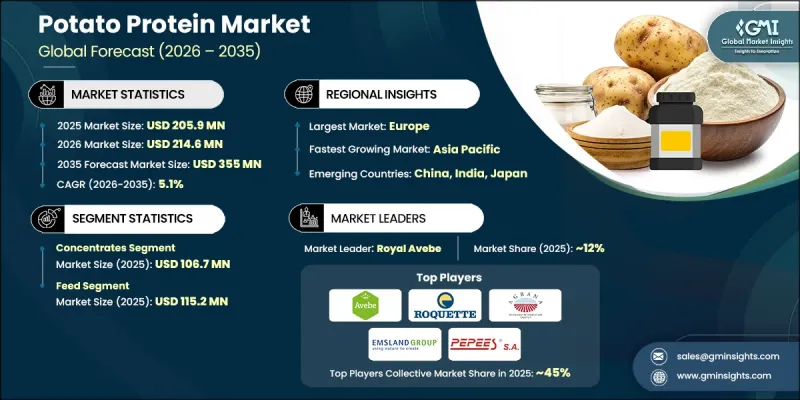
2025 年全球馬鈴薯蛋白市場價值為 2.059 億美元,預計到 2035 年將以 5.1% 的複合年成長率成長至 3.55 億美元。
食品、營養和飼料產業對植物性優質蛋白質原料的需求不斷成長,推動了市場成長。馬鈴薯蛋白源自馬鈴薯塊莖,透過先進的工業萃取和純化工藝,生產出營養和功能性能優異的濃縮蛋白和分離蛋白。這些蛋白以其均衡的胺基酸組成、95%以上的消化率和低致敏性而著稱,因此更容易被消費者接受。加工效率和蛋白質回收率的不斷提高,在保持蛋白質天然功能的同時,提高了產量。現代化的過濾系統和最佳化的加工條件,使生產商能夠提供純度高、品質穩定的產品。加工技術的持續創新,拓展了馬鈴薯蛋白的功能多樣性,使其能夠有效應用於各種配方中。永續性考量和資源利用率的提高進一步增強了其市場吸引力。乾燥和顆粒工程技術的進步,提高了分散性、穩定性和復水性能,促進了其更廣泛的應用。綜上所述,這些因素使馬鈴薯蛋白成為尋求清潔標籤、植物性蛋白原料的生產商的可靠且可擴展的解決方案。
| 市場範圍 | |
|---|---|
| 起始年份 | 2025 |
| 預測年份 | 2026-2035 |
| 起始值 | 2.059億美元 |
| 預測值 | 3.55億美元 |
| 複合年成長率 | 5.1% |
2025年,分離乳清蛋白市場規模達到9,470萬美元,預計未來將持續成長,這主要得益於專業營養品和高階食品領域的需求。這些產品經過精心設計,具有精準的功能特性和溶解性,並儘可能減少添加劑,以滿足嚴格的營養標準。高純度和高消化率的要求支撐了其高階定價,由於加工過程複雜,分離乳清蛋白的價格通常比濃縮乳清蛋白高出40%至60%。
到 2025 年,飼料應用領域市場規模將達到 1.152 億美元。該領域受益於專業動物營養對高消化率蛋白質來源的持續需求,從而支撐了長期穩定的消費。
2025年美國馬鈴薯蛋白市場價值4,830萬美元。國內強勁的需求得益於先進的食品加工基礎設施、成熟的植物性產業,以及食品和動物營養產業對清潔標籤和無過敏原成分的高度採用。
目錄
第1章:方法論與範圍
第2章:執行概要
第3章:行業洞察
- 產業生態系分析
- 供應商格局
- 利潤率
- 每個階段的價值增加
- 影響價值鏈的因素
- 中斷
- 產業影響因素
- 成長促進因素
- 產業陷阱與挑戰
- 市場機遇
- 成長潛力分析
- 監管環境
- 北美洲
- 歐洲
- 亞太地區
- 拉丁美洲
- 中東和非洲
- 波特的分析
- PESTEL 分析
- 技術與創新格局
- 當前技術趨勢
- 新興技術
- 價格趨勢
- 按地區
- 按類型
- 未來市場趨勢
- 技術與創新格局
- 當前技術趨勢
- 新興技術
- 專利格局
- 貿易統計(HS編碼)(註:僅提供重點國家的貿易統計資料)
- 主要進口國
- 主要出口國
- 永續性和環境方面
- 永續實踐
- 減少廢棄物策略
- 生產中的能源效率
- 環保舉措
- 碳足跡考量
第4章:競爭格局
- 介紹
- 公司市佔率分析
- 按地區
- 北美洲
- 歐洲
- 亞太地區
- 拉丁美洲
- MEA
- 按地區
- 公司矩陣分析
- 主要市場參與者的競爭分析
- 競爭定位矩陣
- 關鍵進展
- 併購
- 合作夥伴關係與合作
- 新產品發布
- 擴張計劃
第5章:市場估算與預測:依類型分類,2022-2035年
- 分離物
- 濃縮物
- 其他
第6章:市場估算與預測:依應用領域分類,2022-2035年
- 食品和飲料
- 肉類替代品
- 不含乳製品
- 糖果
- 麵包店
- 加工食品
- 典型食物
- 其他
- 餵食
第7章:市場估計與預測:依地區分類,2022-2035年
- 北美洲
- 美國
- 加拿大
- 歐洲
- 德國
- 英國
- 法國
- 西班牙
- 義大利
- 歐洲其他地區
- 亞太地區
- 中國
- 印度
- 日本
- 澳洲
- 韓國
- 亞太其他地區
- 拉丁美洲
- 巴西
- 墨西哥
- 阿根廷
- 拉丁美洲其他地區
- 中東和非洲
- 沙烏地阿拉伯
- 南非
- 阿拉伯聯合大公國
- 中東和非洲其他地區
第8章:公司簡介
- Royal Avebe
- Emsland Group
- Roquette Freres
- KMC Ingredients
- AKV AMBA
- PEPEES Group
- Kemin Industries
- Bioriginal Food and Science Corporation
- AGRANA Group
- PPZ Niechlow SA
- Finnamyl
- Nutragreenlife Biotechnology Co., Ltd.
- Hongjiu Biotech Co., Ltd.
The Global Potato Protein Market was valued at USD 205.9 million in 2025 and is estimated to grow at a CAGR of 5.1% to reach USD 355 million by 2035.
Market growth is supported by rising demand for plant-based, high-quality protein ingredients across food, nutrition, and feed industries. Potato protein is derived from potato tubers through advanced industrial extraction and purification processes that produce concentrates and isolates with strong nutritional and functional performance. These proteins are recognized for balanced amino acid composition, digestibility levels above 95%, and low allergenic potential, which supports broader consumer acceptance. Ongoing advancements in processing efficiency and protein recovery have improved yield while preserving native protein functionality. Modern filtration systems and optimized processing conditions enable manufacturers to deliver high-purity products with consistent quality. Continuous innovation in processing techniques has expanded the functional versatility of potato protein, allowing it to perform effectively across diverse formulations. Sustainability considerations and improved resource utilization further strengthen market appeal. Enhanced drying and particle engineering technologies have improved dispersibility, stability, and rehydration performance, supporting wider adoption. Together, these factors position potato protein as a reliable and scalable solution for manufacturers seeking clean-label, plant-derived protein ingredients.
| Market Scope | |
|---|---|
| Start Year | 2025 |
| Forecast Year | 2026-2035 |
| Start Value | $205.9 Million |
| Forecast Value | $355 Million |
| CAGR | 5.1% |
The isolates segment generated USD 94.7 million in 2025 and is expected to grow steadily due to demand from specialized nutrition and premium food categories. These products are designed with precise functional and solubility characteristics and minimal additives to meet strict nutritional standards. High purity and digestibility requirements support premium pricing, with isolates typically priced 40% to 60% higher than concentrates due to advanced processing complexity.
The feed applications segment reached USD 115.2 million in 2025. This segment benefits from consistent demand for highly digestible protein sources in specialized animal nutrition, supporting stable long-term consumption.
U.S. Potato Protein Market was valued at USD 48.3 million in 2025. Strong domestic demand is supported by advanced food processing infrastructure, a well-established plant-based sector, and high adoption of clean-label and allergen-free ingredients across the food and animal nutrition industries.
Key companies operating in the Global Potato Protein Market include Roquette Freres, Royal Avebe, Emsland Group, KMC Ingredients, AGRANA Group, AKV AMBA, Kemin Industries, PEPEES Group, Bioriginal Food and Science Corporation, Finnamyl, PPZ Niechlow S.A., Nutragreenlife Biotechnology Co., Ltd., and Hongjiu Biotech Co., Ltd. Companies in the Global Potato Protein Market are strengthening their competitive position through continuous investment in processing innovation, sustainability initiatives, and capacity expansion. Manufacturers focus on improving extraction efficiency and protein functionality to meet evolving customer specifications. Strategic partnerships with food and feed producers help secure long-term supply agreements and expand application reach. Many players emphasize clean-label positioning and traceable sourcing to align with regulatory and consumer expectations.
Table of Contents
Chapter 1 Methodology & Scope
- 1.1 Market scope and definition
- 1.2 Research design
- 1.2.1 Research approach
- 1.2.2 Data collection methods
- 1.3 Data mining sources
- 1.3.1 Global
- 1.3.2 Regional/Country
- 1.4 Base estimates and calculations
- 1.4.1 Base year calculation
- 1.4.2 Key trends for market estimation
- 1.5 Primary research and validation
- 1.5.1 Primary sources
- 1.6 Forecast model
- 1.7 Research assumptions and limitations
Chapter 2 Executive Summary
- 2.1 Industry 3600 synopsis
- 2.2 Key market trends
- 2.2.1 Type
- 2.2.2 Application
- 2.2.3 Regional
- 2.3 TAM Analysis, 2025-2035
- 2.4 CXO perspectives: Strategic imperatives
- 2.4.1 Executive decision points
- 2.4.2 Critical success factors
- 2.5 Future outlook and strategic recommendations
Chapter 3 Industry Insights
- 3.1 Industry ecosystem analysis
- 3.1.1 Supplier landscape
- 3.1.2 Profit margin
- 3.1.3 Value addition at each stage
- 3.1.4 Factor affecting the value chain
- 3.1.5 Disruptions
- 3.2 Industry impact forces
- 3.2.1 Growth drivers
- 3.2.2 Industry pitfalls and challenges
- 3.2.3 Market opportunities
- 3.3 Growth potential analysis
- 3.4 Regulatory landscape
- 3.4.1 North America
- 3.4.2 Europe
- 3.4.3 Asia Pacific
- 3.4.4 Latin America
- 3.4.5 Middle East & Africa
- 3.5 Porter's analysis
- 3.6 PESTEL analysis
- 3.7 Technology and innovation landscape
- 3.7.1 Current technological trends
- 3.7.2 Emerging technologies
- 3.8 Price trends
- 3.8.1 By region
- 3.8.2 By type
- 3.9 Future market trends
- 3.10 Technology and innovation landscape
- 3.10.1 Current technological trends
- 3.10.2 Emerging technologies
- 3.11 Patent landscape
- 3.12 Trade statistics (HS code) (Note: the trade statistics will be provided for key countries only)
- 3.12.1 Major importing countries
- 3.12.2 Major exporting countries
- 3.13 Sustainability and environmental aspects
- 3.13.1 Sustainable practices
- 3.13.2 Waste reduction strategies
- 3.13.3 Energy efficiency in production
- 3.13.4 Eco-friendly initiatives
- 3.14 Carbon footprint consideration
Chapter 4 Competitive Landscape, 2025
- 4.1 Introduction
- 4.2 Company market share analysis
- 4.2.1 By region
- 4.2.1.1 North America
- 4.2.1.2 Europe
- 4.2.1.3 Asia Pacific
- 4.2.1.4 LATAM
- 4.2.1.5 MEA
- 4.2.1 By region
- 4.3 Company matrix analysis
- 4.4 Competitive analysis of major market players
- 4.5 Competitive positioning matrix
- 4.6 Key developments
- 4.6.1 Mergers & acquisitions
- 4.6.2 Partnerships & collaborations
- 4.6.3 New product launches
- 4.6.4 Expansion plans
Chapter 5 Market Estimates and Forecast, By Type, 2022-2035 (USD Million) (Kilo Tons)
- 5.1 Key trends
- 5.2 Isolates
- 5.3 Concentrates
- 5.4 Others
Chapter 6 Market Estimates and Forecast, By Application, 2022-2035 (USD Million) (Kilo Tons)
- 6.1 Key trends
- 6.2 Food & Beverages
- 6.2.1 Meat Analogue
- 6.2.2 Dairy-free
- 6.2.3 Confectionery
- 6.2.4 Bakery
- 6.2.5 Processed foods
- 6.2.6 Typical foods
- 6.2.7 Others
- 6.3 Feed
Chapter 7 Market Estimates and Forecast, By Region, 2022-2035 (USD Million) (Kilo Tons)
- 7.1 Key trends
- 7.2 North America
- 7.2.1 U.S.
- 7.2.2 Canada
- 7.3 Europe
- 7.3.1 Germany
- 7.3.2 UK
- 7.3.3 France
- 7.3.4 Spain
- 7.3.5 Italy
- 7.3.6 Rest of Europe
- 7.4 Asia Pacific
- 7.4.1 China
- 7.4.2 India
- 7.4.3 Japan
- 7.4.4 Australia
- 7.4.5 South Korea
- 7.4.6 Rest of Asia Pacific
- 7.5 Latin America
- 7.5.1 Brazil
- 7.5.2 Mexico
- 7.5.3 Argentina
- 7.5.4 Rest of Latin America
- 7.6 Middle East and Africa
- 7.6.1 Saudi Arabia
- 7.6.2 South Africa
- 7.6.3 UAE
- 7.6.4 Rest of Middle East and Africa
Chapter 8 Company Profiles
- 8.1 Royal Avebe
- 8.2 Emsland Group
- 8.3 Roquette Freres
- 8.4 KMC Ingredients
- 8.5 AKV AMBA
- 8.6 PEPEES Group
- 8.7 Kemin Industries
- 8.8 Bioriginal Food and Science Corporation
- 8.9 AGRANA Group
- 8.10 PPZ Niechlow S.A.
- 8.11 Finnamyl
- 8.12 Nutragreenlife Biotechnology Co., Ltd.
- 8.13 Hongjiu Biotech Co., Ltd.

 全球馬鈴薯蛋白市場規模、佔有率、趨勢和成長分析報告(2026-2034年)
 馬鈴薯蛋白市場:按類型、應用、通路和地區分類
 馬鈴薯蛋白市場規模、佔有率及成長分析(依產品類型、應用、通路、最終用戶及地區分類)-2026-2033年產業預測
 馬鈴薯蛋白市場-全球產業規模、佔有率、趨勢、機會和預測,按類型(濃縮物、分離物)、應用、性質(有機、常規)、地區和競爭格局分類,2020-2030年預測馬鈴薯蛋白市場:2025 年至 2030 年預測
 全球馬鈴薯蛋白市場:產業分析、規模、佔有率、成長、趨勢和預測(2025-2032 年)全球馬鈴薯蛋白市場規模:按類型、原產地、應用、地區、範圍和預測
 馬鈴薯分離蛋白市場報告:2030 年趨勢、預測與競爭分析
 全球馬鈴薯蛋白市場
 全球馬鈴薯蛋白市場規模、佔有率和趨勢分析報告(依類型(分離和濃縮)、依應用(動物飼料、補充劑、烘焙和糖果、肉類等)、區域展望和預測,2024 - 2031 年)