

 |
市場調查報告書
商品編碼
1892809
水療市場機會、成長促進因素、產業趨勢分析及預測(2026-2035年)Spa Market Opportunity, Growth Drivers, Industry Trend Analysis, and Forecast 2026 - 2035 |
||||||

2025年全球水療市場規模估計為743億美元,預計到2035年將以12.7%的複合年成長率成長至2,439億美元。
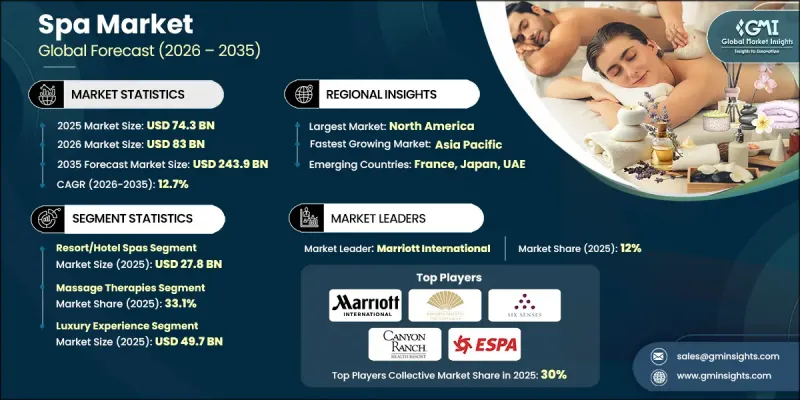
隨著越來越多的消費者將預防性健康、減壓和整體健康放在首位,整個產業的成長速度持續加快。人們越來越傾向於選擇水療服務來放鬆身心、煥發活力,並進行全面的自我護理,這進一步強化了人們對水療的看法轉變:從將其視為奢侈享受,轉變為將其視為支持長期健康的中心。社群媒體放大了這一趨勢,健康領域的意見領袖們積極宣傳平衡、正念和修復性日常習慣的重要性。隨著人們對情緒健康、放鬆和免疫力的認知不斷提高,水療中心將繼續保持優勢,吸引更廣泛、更多元化的客戶群。後疫情時代的生活方式重塑也提升了人們對自然療法和客製化健康體驗的興趣,促使水療中心將營養指導、冥想課程、瑜伽計畫和專業物理治療服務融入其產品中。如今,消費者已將健康視為日常生活的重要組成部分,預計水療產業將在未來幾年保持強勁的成長動能。
| 市場範圍 | |
|---|---|
| 起始年份 | 2025 |
| 預測年份 | 2026-2035 |
| 起始值 | 743億美元 |
| 預測值 | 2439億美元 |
| 複合年成長率 | 12.7% |
預計到2025年,度假村和飯店水療中心市場規模將達到278億美元。這些水療中心已成為高階飯店服務的標誌性特徵,為賓客提供在寧靜優美的環境中放鬆身心、煥發活力的完美體驗。其魅力在於提供專屬的療癒體驗,與奢華旅行和休閒住宿相得益彰。
2024年,按摩療法市佔率達33.1%。按摩服務因其有效緩解壓力、促進血液循環和改善整體健康狀況,仍然是水療中心的核心組成部分。從深層組織按摩、運動按摩到以放鬆為主的護理,各種物理治療技術持續滿足水療客戶尋求舒適體驗和針對性緩解的多樣化需求。
美國水療市場佔75.7%的市場佔有率,預計2024年市場規模將達186億美元。美國擁有全球最發達的水療產業之一,這主要得益於消費者對高階健康服務、先進治療技術和個人化療愈體驗日益成長的需求。隨著健康旅遊的快速發展,以及消費者對奢華和醫療導向水療服務興趣的日益濃厚,美國市場仍然是全球水療產業成長的主要貢獻者。
目錄
第1章:方法論與範圍
第2章:執行概要
第3章:行業洞察
- 產業生態系分析
- 供應商格局
- 利潤率
- 每個階段的價值增加
- 影響價值鏈的因素
- 產業影響因素
- 成長促進因素
- 健康意識日益增強
- 都市化和收入成長
- 健康旅遊的成長
- 產業陷阱與挑戰
- 熟練勞動力短缺
- 客戶期望與客戶維繫
- 機會
- 醫療美容服務拓展
- 先進療法和技術治療
- 成長促進因素
- 成長潛力分析
- 未來市場趨勢
- 服務創新格局
- 水療與養生文化
- 個人化服務
- 現代與傳統療法結合
- 消費者服務偏好分析
- 按包裝
- 生活方式
- 按人口統計數據
- 按服務類型
- 監管環境
- 標準和合規要求
- 區域監理框架
- 認證標準
- 波特的分析
- PESTEL 分析
第4章:競爭格局
- 介紹
- 公司市佔率分析
- 按地區
- 公司矩陣分析
- 主要市場參與者的競爭分析
- 競爭定位矩陣
- 關鍵進展
- 併購
- 合作夥伴關係與合作
- 新產品發布
- 擴張計劃
第5章:市場估算與預測:依水療類型分類,2022-2035年
- 按摩療法
- 臉部護理
- 身體磨砂膏及裹敷
- 醫療美容程序
- 其他
第6章:市場估算與預測:依服務類型分類,2022-2035年
- 日間水療中心
- 度假村/飯店水療中心
- 醫療水療中心
- 目的地水療中心
- 健康靜修
- 其他
第7章:市場估算與預測:基於顧客偏好,2022-2035年
- 奢華體驗
- 經濟實惠的體驗
第8章:市場估算與預測:依年齡層別分類,2022-2035年
- 18歲以下
- 19至35歲
- 36至50
- 50歲以上
第9章:市場估算與預測:依最終用途分類,2022-2035年
- 男人
- 女性
第10章:市場估計與預測:依地區分類,2022-2035年
- 北美洲
- 美國
- 加拿大
- 歐洲
- 德國
- 英國
- 法國
- 義大利
- 西班牙
- 亞太地區
- 中國
- 日本
- 印度
- 澳洲
- 韓國
- 拉丁美洲
- 巴西
- 墨西哥
- 阿根廷
- 中東和非洲
- 南非
- 沙烏地阿拉伯
- 阿拉伯聯合大公國
第11章:公司簡介
- Aspira Spa
- Canyon Ranch
- ESPA
- Forest Essentials
- Four Seasons Hotels & Resorts
- Hyatt Regency Spa
- JW Marriott Spa
- Mandarin Oriental Hotel Group
- Miraval
- Rancho La Puerta
- Six Senses
- Thalasso Spa
- The BodyHoliday
- The Oberoi Spa
- The Ritz-Carlton Spa
The Global Spa Market was estimated at USD 74.3 billion in 2025 and is estimated to grow at a CAGR of 12.7% to reach USD 243.9 billion by 2035.
Growth across the industry continues to accelerate as more consumers prioritize preventive wellness, stress reduction, and overall health. People are increasingly turning to spa services for mental relaxation, physical rejuvenation, and holistic self-care, reinforcing the shift from viewing spas as luxury indulgences to recognizing them as centers that support long-term well-being. Social media has amplified this movement, with wellness influencers promoting the importance of balance, mindfulness, and restorative routines. As awareness around emotional health, relaxation, and immunity rises, spas remain well-positioned to attract a broader and more diverse clientele. The post-pandemic lifestyle reset has also heightened interest in natural healing methods and customized wellness experiences, encouraging spas to incorporate nutritional guidance, meditation sessions, yoga programs, and specialized therapeutic treatments into their offerings. With consumers now viewing wellness as essential to their everyday lives, the spa industry is expected to maintain strong momentum in the years ahead.
| Market Scope | |
|---|---|
| Start Year | 2025 |
| Forecast Year | 2026-2035 |
| Start Value | $74.3 Billion |
| Forecast Value | $243.9 Billion |
| CAGR | 12.7% |
In 2025, the resort and hotel spas segment generated USD 27.8 billion. These spa facilities have become a defining feature of premium hospitality, offering guests a seamless blend of relaxation and wellness in calming environments enhanced by scenic surroundings. Their appeal lies in providing exclusive, restorative experiences that complement luxury travel and leisure stays.
The massage therapies segment held 33.1% share in 2024. Massage services remain a central component of spa offerings due to their effectiveness in relieving stress, promoting circulation, and improving overall well-being. A wide spectrum of therapeutic techniques ranging from deep tissue and sports massages to relaxation-focused treatments continues to meet the diverse needs of spa clients seeking both comfort and targeted relief.
U.S. Spa Market held 75.7% share and generated USD 18.6 billion in 2024. The country maintains one of the world's most developed spa landscapes, driven by rising demand for premium wellness services, advanced treatment technologies, and personalized therapeutic experiences. With wellness tourism expanding rapidly and consumers showing growing interest in luxury and medically oriented spa services, the U.S. market remains a major contributor to global industry growth.
Major players in the Global Spa Market include Mandarin Oriental Hotel Group, Six Senses, JW Marriott Spa, The Ritz-Carlton Spa, Forest Essentials, ESPA, Hyatt Regency Spa, The Oberoi Spa, Four Seasons Hotels & Resorts, Aspira Spa, Miraval, Thalasso Spa, Rancho La Puerta, Canyon Ranch, and The BodyHoliday. Companies within the Spa Market strengthen their competitive position by expanding service portfolios, integrating advanced technologies, and enhancing personalization across treatment offerings. Many providers are adopting data-driven wellness programs, customizing therapies based on individual preferences, lifestyle needs, and health goals. Strategic collaborations with beauty, skincare, and holistic health brands allow spas to introduce premium products and curated treatment lines that elevate client experiences. Businesses also invest in immersive environments such as nature-inspired spaces, sensory rooms, and wellness lounges to differentiate their services.
Table of Contents
Chapter 1 Methodology and Scope
- 1.1 Market scope and definition
- 1.2 Research design
- 1.2.1 Research approach
- 1.2.2 Data collection methods
- 1.3 Data mining sources
- 1.3.1 Global
- 1.3.2 Regional/Country
- 1.4 Base estimates and calculations
- 1.4.1 Base year calculation
- 1.4.2 Key trends for market estimation
- 1.5 Primary research and validation
- 1.5.1 Primary sources
- 1.6 Forecast model
- 1.7 Research assumptions and limitations
Chapter 2 Executive Summary
- 2.1 Industry 3600 synopsis
- 2.2 Key market trends
- 2.2.1 Regional
- 2.2.2 Spa type
- 2.2.3 Service type
- 2.2.4 Customer preference
- 2.2.5 Age group
- 2.2.6 End use
- 2.3 CXO perspectives: Strategic imperatives
- 2.3.1 Key decision points for industry executives
- 2.3.2 Critical success factors for market players
- 2.4 Future outlook and strategic recommendations
Chapter 3 Industry Insights
- 3.1 Industry ecosystem analysis
- 3.1.1 Supplier landscape
- 3.1.2 Profit margin
- 3.1.3 Value addition at each stage
- 3.1.4 Factor affecting the value chain
- 3.2 Industry impact forces
- 3.2.1 Growth drivers
- 3.2.1.1 Rising health & wellness awareness
- 3.2.1.2 Urbanization & rising incomes
- 3.2.1.3 Growth of wellness tourism
- 3.2.2 Industry pitfalls & challenges
- 3.2.2.1 Skilled labor shortage
- 3.2.2.2 Client expectations & retention
- 3.2.3 Opportunities
- 3.2.3.1 Medical & aesthetic services expansion
- 3.2.3.2 Advanced therapies & technological treatments
- 3.2.1 Growth drivers
- 3.3 Growth potential analysis
- 3.4 Future market trends
- 3.5 Service innovation landscape
- 3.5.1 Spa & wellnes culture
- 3.5.2 Personalized services
- 3.5.3 Mixed modern & traditional therapies
- 3.6 Consumer service preference analysis
- 3.6.1 By Package
- 3.6.2 By Lifestyle
- 3.6.3 By Demographics
- 3.6.4 By Service type
- 3.7 Regulatory landscape
- 3.7.1 Standards and compliance requirements
- 3.7.2 Regional regulatory frameworks
- 3.7.3 Certification standards
- 3.8 Porter's analysis
- 3.9 PESTEL analysis
Chapter 4 Competitive Landscape, 2025
- 4.1 Introduction
- 4.2 Company market share analysis
- 4.2.1 By region
- 4.2.1.1 North America
- 4.2.1.2 Europe
- 4.2.1.3 Asia Pacific
- 4.2.1.4 Latin America
- 4.2.1.5 Middle East and Africa
- 4.2.1 By region
- 4.3 Company matrix analysis
- 4.4 Competitive analysis of major market players
- 4.5 Competitive positioning matrix
- 4.6 Key developments
- 4.6.1 Mergers & acquisitions
- 4.6.2 Partnerships & collaborations
- 4.6.3 New product launches
- 4.6.4 Expansion plans
Chapter 5 Market Estimates and Forecast, By Spa Type, 2022 - 2035 (USD Billion)
- 5.1 Key trends
- 5.2 Massage therapies
- 5.3 Facial treatments
- 5.4 Body scrubs & wraps
- 5.5 Medical & cosmetic procedures
- 5.6 Others
Chapter 6 Market Estimates and Forecast, By Service Type, 2022 - 2035 (USD Billion)
- 6.1 Key trends
- 6.2 Day spas
- 6.3 Resort/hotel spas
- 6.4 Medical spas
- 6.5 Destination spas
- 6.6 Wellness retreats
- 6.7 Others
Chapter 7 Market Estimates and Forecast, By Customer Preference, 2022 - 2035 (USD Billion)
- 7.1 Key trends
- 7.2 Luxury experience
- 7.3 Budget-friendly experience
Chapter 8 Market Estimates and Forecast, By Age Group, 2022 - 2035 (USD Billion)
- 8.1 Key trends
- 8.2 Below 18
- 8.3 19 to 35
- 8.4 36 to 50
- 8.5 Above 50
Chapter 9 Market Estimates and Forecast, By End Use, 2022 - 2035 (USD Billion)
- 9.1 Key trends
- 9.2 Men
- 9.3 Women
Chapter 10 Market Estimates and Forecast, By Region, 2022 - 2035 (USD Billion)
- 10.1 Key trends
- 10.2 North America
- 10.2.1 U.S.
- 10.2.2 Canada
- 10.3 Europe
- 10.3.1 Germany
- 10.3.2 UK
- 10.3.3 France
- 10.3.4 Italy
- 10.3.5 Spain
- 10.4 Asia Pacific
- 10.4.1 China
- 10.4.2 Japan
- 10.4.3 India
- 10.4.4 Australia
- 10.4.5 South Korea
- 10.5 Latin America
- 10.5.1 Brazil
- 10.5.2 Mexico
- 10.5.3 Argentina
- 10.6 Middle East and Africa
- 10.6.1 South Africa
- 10.6.2 Saudi Arabia
- 10.6.3 UAE
Chapter 11 Company Profiles
- 11.1 Aspira Spa
- 11.2 Canyon Ranch
- 11.3 ESPA
- 11.4 Forest Essentials
- 11.5 Four Seasons Hotels & Resorts
- 11.6 Hyatt Regency Spa
- 11.7 JW Marriott Spa
- 11.8 Mandarin Oriental Hotel Group
- 11.9 Miraval
- 11.10 Rancho La Puerta
- 11.11 Six Senses
- 11.12 Thalasso Spa
- 11.13 The BodyHoliday
- 11.14 The Oberoi Spa
- 11.15 The Ritz-Carlton Spa

 水療和美容沙龍市場:2026-2032年全球市場預測(按服務類型、客戶性別、客戶年齡層和銷售管道)泳池及水療市場:全球市場按產品類型、組件、服務、分銷管道和最終用途分類的預測 - 2026-2032 年
 水療市場規模、佔有率、趨勢和預測:按類型、最終用戶和地區分類,2026-2034 年
 全球泳池及水療市場規模、佔有率、趨勢及成長分析報告(2026-2034年)水療服務市場規模、佔有率、成長率及全球產業分析:按類型、應用和地區分類,並預測至2026-2034年
 水療服務市場 - 全球產業規模、佔有率、趨勢、機會及預測(按類型、服務類型、最終用戶、地區和競爭格局分類,2021-2031年)日本水療市場報告(按類型(沙龍水療、酒店及度假村水療、醫療水療、目的地水療、溫泉水療及其他)、最終用戶(男性、女性)和地區分類,2026-2034年)全球水療服務市場-2025-2030年預測
 2025-2035年全球水療服務市場
 水療市場,依服務、水療類型、最終用戶、地區分類