


 |
市場調查報告書
商品編碼
1892716
永續建築化學品市場機會、成長促進因素、產業趨勢分析及預測(2025-2034年)Sustainable Construction Chemicals Market Opportunity, Growth Drivers, Industry Trend Analysis, and Forecast 2025 - 2034 |
||||||

2024 年全球永續建築化學品市場價值為 721 億美元,預計到 2034 年將以 6.3% 的複合年成長率成長至 1,322 億美元。
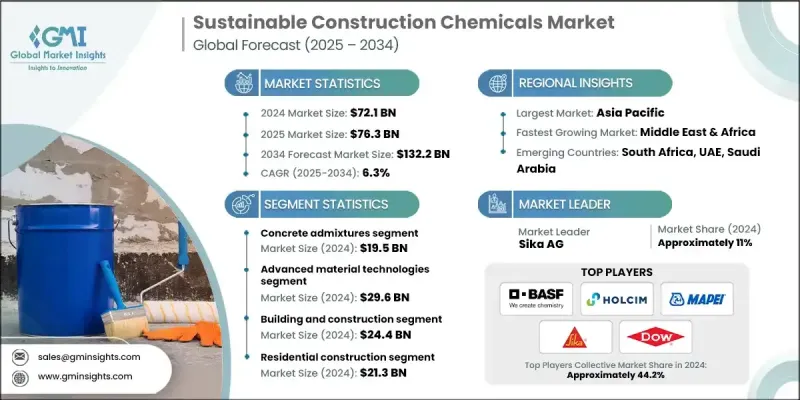
該市場涵蓋種類繁多的產品,例如生物基防水塗料、環保型黏合劑和密封劑、保溫材料以及旨在提高耐久性並減少環境影響的特種化學品。這些產品正在幫助建築業降低碳足跡並延長材料使用壽命。更嚴格的環境法規、對節能建築日益成長的需求以及人們對永續建築實踐的認知不斷提高,都推動了該市場的成長。在歐洲,監管框架正促使建築業採用低碳、可回收材料和創新化學解決方案。政策驅動的需求與技術進步的結合,使建築業能夠提供具有韌性和環保意識的基礎設施,同時滿足消費者不斷變化的對永續性的期望。
| 市場範圍 | |
|---|---|
| 起始年份 | 2024 |
| 預測年份 | 2025-2034 |
| 起始值 | 721億美元 |
| 預測值 | 1322億美元 |
| 複合年成長率 | 6.3% |
到2024年,混凝土外加劑市場佔有率將達到27%。這些外加劑能夠提升混凝土的機械性能、耐久性和環保性能。許多產品都添加了生物基或回收成分,有效降低了基礎設施和商業建築項目中使用的混凝土的碳足跡。
2024年,先進材料技術領域的市場規模達到296億美元,預計2025年至2034年將以2.2%的複合年成長率成長。奈米材料、自修復塗層和高性能添加劑的創新正在提升建築的強度、韌性和永續性。這些技術使建築業能夠建造維護成本低的建築,同時滿足現代環境性能和耐久性標準。
2024年,歐洲永續建築化學品市場規模達175億美元。諸如《建築能源法案》(GEG)等法規以及《2050年氣候行動計畫》中的各項舉措,正推動製造商採用低影響原料和節能配方進行創新。各公司正在推出一系列產品,從再生材料添加劑到無溶劑塗料,這些產品在確保長期性能的同時,也符合生態標準。此類監管框架正在塑造市場對產品生命週期永續性和室內環境品質的預期,從而鼓勵對更環保的解決方案進行投資。
目錄
第1章:方法論
第2章:執行概要
第3章:行業洞察
- 產業生態系分析
- 供應商格局
- 利潤率
- 每個階段的價值增加
- 影響價值鏈的因素
- 中斷
- 產業影響因素
- 成長促進因素
- 產業陷阱與挑戰
- 市場機遇
- 成長潛力分析
- 監管環境
- 北美洲
- 歐洲
- 亞太地區
- 拉丁美洲
- 中東和非洲
- 波特的分析
- PESTEL 分析
- 價格趨勢
- 按地區
- 依產品
- 未來市場趨勢
- 技術與創新格局
- 當前技術趨勢
- 新興技術
- 專利格局
- 貿易統計(註:僅提供重點國家的貿易統計)
- 主要進口國
- 主要出口國
- 永續性和環境方面
- 永續實踐
- 減少廢棄物策略
- 生產中的能源效率
- 環保舉措
- 碳足跡考量
第4章:競爭格局
- 介紹
- 公司市佔率分析
- 按地區
- 北美洲
- 歐洲
- 亞太地區
- 拉丁美洲
- MEA
- 按地區
- 公司矩陣分析
- 主要市場參與者的競爭分析
- 競爭定位矩陣
- 關鍵進展
- 併購
- 合作夥伴關係與合作
- 新產品發布
- 擴張計劃
第5章:市場估算與預測:依產品類型分類,2021-2034年
- 混凝土外加劑
- 高效減水劑和減水劑
- 引氣劑
- 加速劑和減速劑
- 特種外加劑
- 防水和防護塗層
- 膜系統
- 液態塗料
- 結晶防水
- 生物基防護解決方案
- 黏合劑和密封劑
- 結構膠合劑
- 建築密封劑
- 生物基黏合劑系統
- 低揮發性有機化合物配方
- 絕緣材料
- 生物基絕緣材料
- 再生材料隔熱材料
- 相變材料
- 氣凝膠技術
- 特種建築化學品
- 自癒材料
- 碳負排放混凝土
- 地聚合物系統
- 智慧建築材料
第6章:市場估計與預測:依技術分類,2021-2034年
- 生物基技術
- 植物性原料
- 微生物生產系統
- 酶促過程
- 生物技術應用
- 再生材料技術
- 消費後回收材料
- 工業後廢棄物的利用
- 循環經濟解決方案
- 廢棄物製化學品工藝
- 低碳技術
- 碳捕獲與利用
- 再生能源併網
- 節能生產
- 碳中和配方
- 先進材料技術
- 奈米科技應用
- 智慧材料系統
- 自癒技術
- 相變材料
第7章:市場估計與預測:依應用領域分類,2021-2034年
- 住宅建築
- 獨棟住宅
- 多戶住宅
- 經濟適用房項目
- 綠色住宅開發
- 商業建築
- 辦公大樓
- 零售空間
- 醫療機構
- 教育建築
- 基礎設施建設
- 交通基礎設施
- 供水和污水系統
- 能源基礎設施
- 智慧城市項目
- 工業建築
- 製造工廠
- 倉庫和配送中心
- 資料中心
- 清潔能源設施
第8章:市場估算與預測:依最終用途產業分類,2021-2034年
- 建築施工
- 基礎設施建設
- 工業應用
- 交通運輸部門
- 能源和公用事業
- 海洋和近海
- 採礦和礦產
- 農業和食品加工
第9章:市場估計與預測:依地區分類,2021-2034年
- 北美洲
- 美國
- 加拿大
- 歐洲
- 德國
- 英國
- 法國
- 義大利
- 西班牙
- 歐洲其他地區
- 亞太地區
- 中國
- 印度
- 日本
- 澳洲
- 韓國
- 亞太其他地區
- 拉丁美洲
- 巴西
- 墨西哥
- 阿根廷
- 拉丁美洲其他地區
- 中東和非洲
- 沙烏地阿拉伯
- 南非
- 阿拉伯聯合大公國
- 中東和非洲其他地區
第10章:公司簡介
- BASF SE (Master Builders Solutions)
- Sika AG
- Ashland
- Holcim
- Cemex
- 3M Company
- Arkema SA
- Clariant AG
- Evonik Industries AG
- MAPEI SpA
- The Dow Chemical Company
The Global Sustainable Construction Chemicals Market was valued at USD 72.1 billion in 2024 and is estimated to grow at a CAGR of 6.3% to reach USD 132.2 billion by 2034.
The market includes a wide array of products such as bio-based waterproofing coatings, eco-friendly adhesives and sealants, insulation materials, and specialty chemicals designed to enhance durability while reducing environmental impact. These products are helping the construction industry lower carbon footprints and extend material lifespans. Growth in this market is being fueled by stricter environmental regulations, rising demand for energy-efficient buildings, and greater awareness of sustainable construction practices. Across Europe, regulatory frameworks are compelling the industry to adopt low-carbon, recyclable materials and innovative chemical solutions. This combination of policy-driven demand and technological advancement is enabling the construction sector to deliver resilient, eco-conscious infrastructure while meeting evolving consumer expectations for sustainability.
| Market Scope | |
|---|---|
| Start Year | 2024 |
| Forecast Year | 2025-2034 |
| Start Value | $72.1 Billion |
| Forecast Value | $132.2 Billion |
| CAGR | 6.3% |
The concrete admixture segment held a 27% share in 2024. These admixtures enhance mechanical properties, durability, and environmental performance. Many products incorporate biobased or recycled components, effectively lowering the carbon footprint of concrete used in both infrastructure and commercial construction projects.
The advanced material technologies segment was valued at USD 29.6 billion in 2024 and is expected to grow at a CAGR of 2.2% from 2025 to 2034. Innovations in nanomaterials, self-healing coatings, and high-performance additives are improving building strength, resilience, and sustainability. These technologies allow the construction industry to develop low-maintenance structures while meeting modern standards for environmental performance and durability.
Europe Sustainable Construction Chemicals Market reached USD 17.5 billion in 2024. Regulations such as the Building Energy Act (GEG) and initiatives under the Climate Action Plan 2050 are driving manufacturers to innovate with low-impact raw materials and energy-efficient formulations. Companies are introducing products ranging from recycled-content admixtures to solvent-free coatings that deliver long-term performance without compromising ecological standards. Such regulatory frameworks are shaping market expectations regarding lifecycle sustainability and indoor environmental quality, encouraging investment in greener solutions.
Key players in the Global Sustainable Construction Chemicals Market include Sika AG, BASF SE, Holcim Ltd, MAPEI S.p.A., The Dow Chemical Company, and others. Companies in the Sustainable Construction Chemicals Market are employing several strategies to strengthen their presence. Many are investing in research and development to create eco-friendly, high-performance products, including recycled-content materials and solvent-free coatings. Strategic partnerships with distributors and construction firms expand market reach, while mergers and acquisitions help consolidate portfolios and enter new regions. Firms are also emphasizing sustainability certifications and eco-labels to meet regulatory requirements and attract environmentally conscious buyers.
Table of Contents
Chapter 1 Methodology
- 1.1 Market scope and definition
- 1.2 Research design
- 1.2.1 Research approach
- 1.2.2 Data collection methods
- 1.3 Data mining sources
- 1.3.1 Global
- 1.3.2 Regional/Country
- 1.4 Base estimates and calculations
- 1.4.1 Base year calculation
- 1.4.2 Key trends for market estimation
- 1.5 Primary research and validation
- 1.5.1 Primary sources
- 1.6 Forecast model
- 1.7 Research assumptions and limitations
Chapter 2 Executive Summary
- 2.1 Industry 360° synopsis
- 2.2 Key market trends
- 2.2.1 Regional
- 2.2.2 Product Type
- 2.2.3 Technology
- 2.2.4 Application
- 2.2.5 End use Industry
- 2.3 TAM Analysis, 2025-2034
- 2.4 CXO perspectives: Strategic imperatives
- 2.4.1 Executive decision points
- 2.4.2 Critical success factors
- 2.5 Future Outlook and Strategic Recommendations
Chapter 3 Industry Insights
- 3.1 Industry ecosystem analysis
- 3.1.1 Supplier Landscape
- 3.1.2 Profit Margin
- 3.1.3 Value addition at each stage
- 3.1.4 Factor affecting the value chain
- 3.1.5 Disruptions
- 3.2 Industry impact forces
- 3.2.1 Growth drivers
- 3.2.2 Industry pitfalls and challenges
- 3.2.3 Market opportunities
- 3.3 Growth potential analysis
- 3.4 Regulatory landscape
- 3.4.1 North America
- 3.4.2 Europe
- 3.4.3 Asia Pacific
- 3.4.4 Latin America
- 3.4.5 Middle East & Africa
- 3.5 Porter's analysis
- 3.6 PESTEL analysis
- 3.7 Price trends
- 3.7.1 By region
- 3.7.2 By product
- 3.8 Future market trends
- 3.9 Technology and Innovation landscape
- 3.9.1 Current technological trends
- 3.9.2 Emerging technologies
- 3.10 Patent Landscape
- 3.11 Trade statistics (Note: the trade statistics will be provided for key countries only)
- 3.11.1 Major importing countries
- 3.11.2 Major exporting countries
- 3.12 Sustainability and Environmental Aspects
- 3.12.1 Sustainable Practices
- 3.12.2 Waste Reduction Strategies
- 3.12.3 Energy Efficiency in Production
- 3.12.4 Eco-friendly Initiatives
- 3.13 Carbon Footprint Considerations
Chapter 4 Competitive Landscape, 2024
- 4.1 Introduction
- 4.2 Company market share analysis
- 4.2.1 By region
- 4.2.1.1 North America
- 4.2.1.2 Europe
- 4.2.1.3 Asia Pacific
- 4.2.1.4 LATAM
- 4.2.1.5 MEA
- 4.2.1 By region
- 4.3 Company matrix analysis
- 4.4 Competitive analysis of major market players
- 4.5 Competitive positioning matrix
- 4.6 Key developments
- 4.6.1 Mergers & acquisitions
- 4.6.2 Partnerships & collaborations
- 4.6.3 New Product Launches
- 4.6.4 Expansion Plans
Chapter 5 Market Estimates and Forecast, By Product Type, 2021- 2034 (USD Billion, Kilo Tons)
- 5.1 Key trends
- 5.2 Concrete admixtures
- 5.2.1 Superplasticizers and water reducers
- 5.2.2 Air-entraining agents
- 5.2.3 Accelerating and retarding agents
- 5.2.4 Specialty admixtures
- 5.3 Waterproofing and protective coatings
- 5.3.1 Membrane systems
- 5.3.2 Liquid applied coatings
- 5.3.3 Crystalline waterproofing
- 5.3.4 Bio-based protective solutions
- 5.4 Adhesives and sealants
- 5.4.1 Structural adhesives
- 5.4.2 Construction sealants
- 5.4.3 Bio-based adhesive systems
- 5.4.4 Low-voc formulations
- 5.5 Insulation materials
- 5.5.1 Bio-based insulation
- 5.5.2 Recycled content insulation
- 5.5.3 Phase change materials
- 5.5.4 Aerogel technologies
- 5.6 Specialty construction chemicals
- 5.6.1 Self-healing materials
- 5.6.2 Carbon-negative concrete
- 5.6.3 Geopolymer systems
- 5.6.4 Smart construction materials
Chapter 6 Market Estimates and Forecast, By Technology, 2021 - 2034 (USD Billion, Kilo Tons)
- 6.1 Key trends
- 6.2 Bio-based technologies
- 6.2.1 Plant-based raw materials
- 6.2.2 Microbial production systems
- 6.2.3 Enzymatic processes
- 6.2.4 Biotechnology applications
- 6.3 Recycled content technologies
- 6.3.1 Post-consumer recycled materials
- 6.3.2 Post-industrial waste utilization
- 6.3.3 Circular economy solutions
- 6.3.4 Waste-to-chemical processes
- 6.4 Low-carbon technologies
- 6.4.1 Carbon capture and utilization
- 6.4.2 Renewable energy integration
- 6.4.3 Energy-efficient production
- 6.4.4 Carbon-neutral formulations
- 6.5 Advanced material technologies
- 6.5.1 Nanotechnology applications
- 6.5.2 Smart material systems
- 6.5.3 Self-healing technologies
- 6.5.4 Phase change materials
Chapter 7 Market Estimates and Forecast, By Application, 2021 - 2034 (USD Billion, Kilo Tons)
- 7.1 Key trends
- 7.2 Residential construction
- 7.2.1 Single-family homes
- 7.2.2 Multi-family housing
- 7.2.3 Affordable housing projects
- 7.2.4 Green residential developments
- 7.3 Commercial construction
- 7.3.1 Office buildings
- 7.3.2 Retail spaces
- 7.3.3 Healthcare facilities
- 7.3.4 Educational buildings
- 7.4 Infrastructure development
- 7.4.1 Transportation infrastructure
- 7.4.2 Water and wastewater systems
- 7.4.3 Energy infrastructure
- 7.4.4 Smart city projects
- 7.5 Industrial construction
- 7.5.1 Manufacturing facilities
- 7.5.2 Warehouses and distribution centers
- 7.5.3 Data centers
- 7.5.4 Clean energy facilities
Chapter 8 Market Estimates and Forecast, By End use Industry, 2021 - 2034 (USD Billion, Kilo Tons)
- 8.1 Key trends
- 8.2 Building and construction
- 8.3 Infrastructure development
- 8.4 Industrial applications
- 8.5 Transportation sector
- 8.6 Energy and utilities
- 8.7 Marine and offshore
- 8.8 Mining and minerals
- 8.9 Agriculture and food processing
Chapter 9 Market Estimates and Forecast, By Region, 2021 - 2034 (USD Billion, Kilo Tons)
- 9.1 Key trends
- 9.2 North America
- 9.2.1 U.S.
- 9.2.2 Canada
- 9.3 Europe
- 9.3.1 Germany
- 9.3.2 UK
- 9.3.3 France
- 9.3.4 Italy
- 9.3.5 Spain
- 9.3.6 Rest of Europe
- 9.4 Asia Pacific
- 9.4.1 China
- 9.4.2 India
- 9.4.3 Japan
- 9.4.4 Australia
- 9.4.5 South Korea
- 9.4.6 Rest of Asia Pacific
- 9.5 Latin America
- 9.5.1 Brazil
- 9.5.2 Mexico
- 9.5.3 Argentina
- 9.5.4 Rest of Latin America
- 9.6 Middle East & Africa
- 9.6.1 Saudi Arabia
- 9.6.2 South Africa
- 9.6.3 UAE
- 9.6.4 Rest of Middle East & Africa
Chapter 10 Company Profiles
- 10.1 BASF SE (Master Builders Solutions)
- 10.2 Sika AG
- 10.3 Ashland
- 10.4 Holcim
- 10.5 Cemex
- 10.6 3M Company
- 10.7 Arkema S.A
- 10.8 Clariant AG
- 10.9 Evonik Industries AG
- 10.10 MAPEI S.p.A.
- 10.11 The Dow Chemical Company

 可再生原料化學品市場:市場規模、佔有率和趨勢分析(按產品、最終用途和地區分類),細分市場預測(2026-2033 年)
 環保建設化學品市場預測至2034年:按產品類型、技術、應用和地區分類的全球分析全球可再生原料化學品市場預測(至2034年):依原料類型、化學品類型、最終用戶及地區分類全球永續特種化學品市場預測(至2032年):依產品種類、原料、應用及地區分類
 永續化學品市場-全球產業規模、佔有率、趨勢、機會和預測,依產品、應用、地區和競爭格局分類,2020-2030年預測
 再生原料化學品市場機會、成長促進因素、產業趨勢分析及預測(2025-2034年)全球生物基和永續性原料市場:預測(至2032年)-按產品類型、原料類型、技術、應用和地區分類的分析永續造紙化學品市場機會、成長動力、產業趨勢分析及 2025 - 2034 年預測
 永續化學品用下一代原料市場:按產品、應用、地區和國家的分析和預測(2025-2034年)
 永續的化學原料的全球市場(2025年~2035年)