

 |
市場調查報告書
商品編碼
1892704
超級電容器材料市場機會、成長促進因素、產業趨勢分析及預測(2025-2034年)Supercapacitor Materials Market Opportunity, Growth Drivers, Industry Trend Analysis, and Forecast 2025 - 2034 |
||||||

2024 年全球超級電容器材料市場價值為 26 億美元,預計到 2034 年將以 14.9% 的複合年成長率成長至 125 億美元。
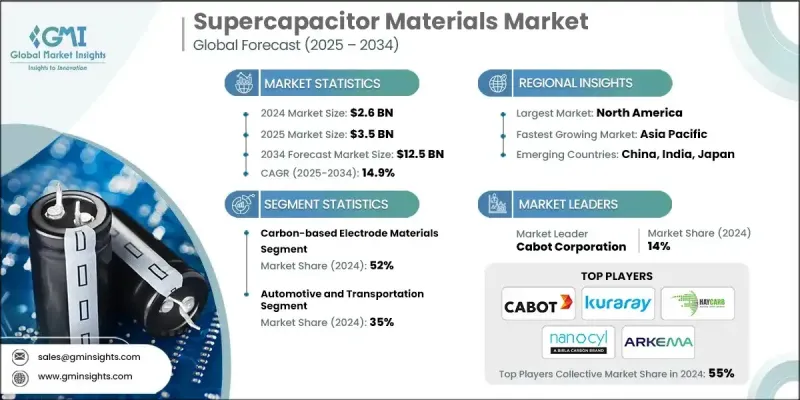
由於其設計注重瞬時功率輸出和極高的循環耐久性,超級電容器這一細分市場持續區別於傳統儲能技術。行業趨勢表明,超級電容器將實現強勁的長期成長,其成長速度將超過許多其他儲能類別。電動車需求的不斷成長正顯著提升全球對先進儲能材料的需求。同時,軟性及紡織基元件正逐步應用於實際場景,顯示可適應不同應用場景的超級電容器正逐漸具備商業價值。材料科學的進步,例如具有高比電容的三元氧化物以及可提供顯著表面性能的氧化石墨烯複合材料,透過提高整體能量密度和增強長循環穩定性,推動了這一轉變。穿戴式和軟性電源組件在智慧服裝、醫療監測系統和需要快速、安全功率輸出的個人電子產品等領域持續受到關注。這些發展凸顯了市場環境的創新和整合潛力持續加速,並將超級電容器材料定位為下一代儲能技術的關鍵組成部分。
| 市場範圍 | |
|---|---|
| 起始年份 | 2024 |
| 預測年份 | 2025-2034 |
| 起始值 | 26億美元 |
| 預測值 | 125億美元 |
| 複合年成長率 | 14.9% |
預計到2024年,金屬氧化物儲能材料將佔據18%的市場佔有率,這主要得益於其贗電容特性,該特性能夠提升整體電容,但仍需最佳化導電性能並進行結構設計控制。水合氧化釕的性能已達到650 F/g,而鎳-銅-鈷等三元金屬氧化物的比電容達到596 C/g,相關元件的能量密度接近96 Wh/kg,功率密度約841 W/kg。這些進展表明,工程複合材料有助於縮小以能量為導向的儲能和以功率為導向的儲能之間的差距,同時又不犧牲快速反應。
到2024年,能源和電網相關領域將佔據22%的市場佔有率,反映出隨著再生能源裝置容量的擴大,對電壓和頻率管理的需求日益成長。工業環境繼續依賴超級電容器進行尖峰負載控制,在低至-40°C的溫度下可靠運作(需搭配合適的電解質),並在對即時響應和高循環壽命要求極高的系統中發揮備用功能。
預計到2024年,北美超級電容器材料市場將佔據20%的佔有率。該地區的成長得益於有利的儲能政策框架和製造業回流計劃,例如針對獨立儲能的投資稅收抵免政策和聯邦能源監管委員會(FERC)第841號令,該法令允許企業更廣泛地參與批發市場。美國正在籌建的項目包括一座由能源部資助、價值5000萬美元的碳奈米管和導電添加劑生產設施,以及一項價值10億美元的超級電容器製造園區評估項目,該園區旨在服務汽車、國防和人工智慧產業。
目錄
第1章:方法論與範圍
第2章:執行概要
第3章:行業洞察
- 產業生態系分析
- 供應商格局
- 利潤率
- 每個階段的價值增加
- 影響價值鏈的因素
- 中斷
- 產業影響因素
- 成長促進因素
- 產業陷阱與挑戰
- 市場機遇
- 成長潛力分析
- 監管環境
- 北美洲
- 歐洲
- 亞太地區
- 拉丁美洲
- 中東和非洲
- 波特的分析
- PESTEL 分析
- 價格趨勢
- 按地區
- 未來市場趨勢
- 技術與創新格局
- 當前技術趨勢
- 新興技術
- 專利格局
- 貿易統計(HS編碼)(註:僅提供重點國家的貿易統計資料)
- 主要進口國
- 主要出口國
- 永續性和環境方面
- 永續實踐
- 減少廢棄物策略
- 生產中的能源效率
- 環保舉措
- 碳足跡考量
第4章:競爭格局
- 介紹
- 公司市佔率分析
- 按地區
- 北美洲
- 歐洲
- 亞太地區
- 拉丁美洲
- 中東和非洲
- 按地區
- 公司矩陣分析
- 主要市場參與者的競爭分析
- 競爭定位矩陣
- 關鍵進展
- 併購
- 合作夥伴關係與合作
- 新產品發布
- 擴張計劃
第5章:市場規模及預測:依材料類型分類,2021-2034年
- 碳基電極材料
- 活性碳
- 石墨烯及石墨烯衍生物
- 碳奈米管
- 碳氣凝膠和3D碳結構
- 碳纖維和活性碳纖維
- 其他
- 金屬氧化物材料
- 導電聚合物材料
- 複合材料和混合材料
- 電解質材料
- 集流體和基板材料
- 其他
第6章:市場規模及預測:依應用領域分類,2021-2034年
- 汽車與運輸
- 消費性電子產品
- 能源與電網應用
- 工業設備
- 醫療器材
- 海洋與近海
- 航太與國防
第7章:市場規模及預測:依地區分類,2021-2034年
- 北美洲
- 美國
- 加拿大
- 歐洲
- 英國
- 德國
- 法國
- 義大利
- 西班牙
- 歐洲其他地區
- 亞太地區
- 中國
- 印度
- 日本
- 韓國
- 澳洲
- 亞太其他地區
- 拉丁美洲
- 巴西
- 墨西哥
- 阿根廷
- 拉丁美洲其他地區
- 中東和非洲
- 南非
- 沙烏地阿拉伯
- 阿拉伯聯合大公國
- 中東和非洲其他地區
第8章:公司簡介
- Cabot Corporation
- Kuraray
- Haycarb
- Applied Graphene Materials
- Nanocyl
- Arkema Group
- YUNASKO
- IOXUS
- Nippon Chemi-Con Corporation
- Tecate Group
- Skeleton Technologies
The Global Supercapacitor Materials Market was valued at USD 2.6 billion in 2024 and is estimated to grow at a CAGR of 14.9% to reach USD 12.5 billion by 2034.
The segment continues to set itself apart from traditional storage technologies because its design favors instant power delivery and extremely high cycling durability. Industry trends point to strong, long-term expansion that surpasses many energy-oriented storage categories. Rising electric vehicle demand is sharply increasing the need for advanced energy storage materials worldwide. At the same time, flexible and textile-based devices are progressing into real-world applications, demonstrating that adaptable supercapacitor formats are becoming commercially relevant. Advancements in material science, including ternary oxides with elevated specific capacitance and graphene-oxide combinations offering substantial surface-based performance, are supporting this shift by improving overall energy density and strengthening long-cycle stability. Wearable and flexible power components see consistent traction within smart clothing, medical monitoring systems, and personal electronics that require rapid, safe power bursts. These developments highlight a market environment where innovation and integration potential continue to accelerate, positioning supercapacitor materials as a critical component in next-generation storage technologies.
| Market Scope | |
|---|---|
| Start Year | 2024 |
| Forecast Year | 2025-2034 |
| Start Value | $2.6 Billion |
| Forecast Value | $12.5 Billion |
| CAGR | 14.9% |
The metal oxides segment held 18% share in 2024, supported by pseudocapacitive behavior that raises overall capacitance while still requiring optimized conductivity enhancements and controlled structural design. Hydrous ruthenium oxide has achieved performance levels of up to 650 F/g, and ternary metal oxides such as nickel-copper-cobalt compositions have reached 596 C/g, with related devices showing energy densities near 96 Wh/kg at around 841 W/kg. These developments indicate that engineered composites can help reduce the difference between energy-focused and power-focused storage without sacrificing rapid response capabilities.
The energy and grid-related segment captured a 22% share in 2024, reflecting the need for voltage and frequency management as renewable energy installations expand. Industrial environments continue to rely on supercapacitors for peak-load control, reliable operation at temperatures as low as -40°C (when paired with suitable electrolytes), and backup functions in systems where instant response and high cycle lives are essential.
North America Supercapacitor Materials Market accounted for a 20% share in 2024. Growth in the region is supported by favorable energy-storage policy frameworks and manufacturing-onshoring initiatives, strengthened by measures such as the Investment Tax Credit for standalone storage and FERC Order 841, which enables broader participation in wholesale markets. The United States pipeline includes a USD 50 million Department of Energy-supported facility for CNT and conductive additive production, alongside a USD 1 billion evaluation for a potential supercapacitor manufacturing campus aimed at the automotive, defense, and artificial intelligence sectors.
Major companies active in the Supercapacitor Materials Market include Cabot Corporation, Kuraray Co., Haycarb PLC, Nanocyl SA, Applied Graphene Materials PLC, Arkema Group, IOXUS, YUNASKO, Nippon Chemi-Con Corporation, Tecate Group, and Skeleton Technologies. Companies in the Supercapacitor Materials Market are strengthening their positions by expanding production capacity, improving material purity, and investing heavily in R&D to achieve higher capacitance and longer cycle life. Many organizations are forming partnerships with automotive, electronics, and grid-solution manufacturers to secure long-term supply agreements and accelerate product integration. Firms are also optimizing conductive additives, surface-engineered carbons, and advanced electrolytes to meet performance targets for next-generation devices. Regional expansion, especially in North America and Asia, is helping companies reduce logistics costs and improve access to major end-use industries.
Table of Contents
Chapter 1 Methodology & Scope
- 1.1 Market scope and definition
- 1.2 Research design
- 1.2.1 Research approach
- 1.2.2 Data collection methods
- 1.3 Data mining sources
- 1.3.1 Global
- 1.3.2 Regional/Country
- 1.4 Base estimates and calculations
- 1.4.1 Base year calculation
- 1.4.2 Key trends for market estimation
- 1.5 Primary research and validation
- 1.5.1 Primary sources
- 1.6 Forecast model
- 1.7 Research assumptions and limitations
Chapter 2 Executive Summary
- 2.1 Industry 3600 synopsis
- 2.2 Key market trends
- 2.2.1 Material type
- 2.2.2 Application
- 2.3 TAM analysis, 2025-2034
- 2.4 CXO perspectives: Strategic imperatives
- 2.4.1 Executive decision points
- 2.4.2 Critical success factors
- 2.5 Outlook and strategic recommendations
Chapter 3 Industry Insights
- 3.1 Industry ecosystem analysis
- 3.1.1 Supplier landscape
- 3.1.2 Profit margin
- 3.1.3 Value addition at each stage
- 3.1.4 Factor affecting the value chain
- 3.1.5 Disruptions
- 3.2 Industry impact forces
- 3.2.1 Growth drivers
- 3.2.2 Industry pitfalls and challenges
- 3.2.3 Market opportunities
- 3.3 Growth potential analysis
- 3.4 Regulatory landscape
- 3.4.1 North America
- 3.4.2 Europe
- 3.4.3 Asia Pacific
- 3.4.4 Latin America
- 3.4.5 Middle East & Africa
- 3.5 Porter's analysis
- 3.6 PESTEL analysis
- 3.7 Price trends
- 3.7.1 By region
- 3.8 Future market trends
- 3.9 Technology and innovation landscape
- 3.9.1 Current technological trends
- 3.9.2 Emerging technologies
- 3.10 Patent landscape
- 3.11 Trade statistics (HS code) (Note: the trade statistics will be provided for key countries only)
- 3.11.1 Major importing countries
- 3.11.2 Major exporting countries
- 3.12 Sustainability and environmental aspects
- 3.12.1 Sustainable practices
- 3.12.2 Waste reduction strategies
- 3.12.3 Energy efficiency in production
- 3.12.4 Eco-friendly initiatives
- 3.13 Carbon footprint considerations
Chapter 4 Competitive Landscape, 2024
- 4.1 Introduction
- 4.2 Company market share analysis
- 4.2.1 By region
- 4.2.1.1 North America
- 4.2.1.2 Europe
- 4.2.1.3 Asia Pacific
- 4.2.1.4 Latin America
- 4.2.1.5 Middle East & Africa
- 4.2.1 By region
- 4.3 Company matrix analysis
- 4.4 Competitive analysis of major market players
- 4.5 Competitive positioning matrix
- 4.6 Key developments
- 4.6.1 Mergers & acquisitions
- 4.6.2 Partnerships & collaborations
- 4.6.3 New product launches
- 4.6.4 Expansion plans
Chapter 5 Market Size and Forecast, By Material Type, 2021-2034 (USD Billion, Kilo Tons)
- 5.1 Key trends
- 5.2 Carbon-based electrode materials
- 5.2.1 Activated carbon
- 5.2.2 Graphene & graphene derivatives
- 5.2.3 Carbon nanotubes
- 5.2.4 Carbon aerogels & 3d carbon structures
- 5.2.5 Carbon fibers & activated carbon fibers
- 5.2.6 Others
- 5.3 Metal oxide materials
- 5.4 Conducting polymer materials
- 5.5 Composite & hybrid materials
- 5.6 Electrolyte materials
- 5.7 Current collector & substrate materials
- 5.8 Others
Chapter 6 Market Size and Forecast, By Application, 2021-2034 (USD Billion, Kilo Tons)
- 6.1 Key trends
- 6.2 Automotive & transportation
- 6.3 Consumer electronics
- 6.4 Energy & grid applications
- 6.5 Industrial equipment
- 6.6 Medical devices
- 6.7 Marine & offshore
- 6.8 Aerospace & defense
Chapter 7 Market Size and Forecast, By Region, 2021-2034 (USD Billion, Kilo Tons)
- 7.1 Key trends
- 7.2 North America
- 7.2.1 U.S.
- 7.2.2 Canada
- 7.3 Europe
- 7.3.1 UK
- 7.3.2 Germany
- 7.3.3 France
- 7.3.4 Italy
- 7.3.5 Spain
- 7.3.6 Rest of Europe
- 7.4 Asia Pacific
- 7.4.1 China
- 7.4.2 India
- 7.4.3 Japan
- 7.4.4 South Korea
- 7.4.5 Australia
- 7.4.6 Rest of Asia Pacific
- 7.5 Latin America
- 7.5.1 Brazil
- 7.5.2 Mexico
- 7.5.3 Argentina
- 7.5.4 Rest of Latin America
- 7.6 Middle East & Africa
- 7.6.1 South Africa
- 7.6.2 Saudi Arabia
- 7.6.3 UAE
- 7.6.4 Rest of Middle East & Africa
Chapter 8 Company Profiles
- 8.1 Cabot Corporation
- 8.2 Kuraray
- 8.3 Haycarb
- 8.4 Applied Graphene Materials
- 8.5 Nanocyl
- 8.6 Arkema Group
- 8.7 YUNASKO
- 8.8 IOXUS
- 8.9 Nippon Chemi-Con Corporation
- 8.10 Tecate Group
- 8.11 Skeleton Technologies

 超級電容市場:2026年至2032年全球市場預測(按類型、電極材料、形狀、電壓範圍、應用和銷售管道)汽車超級電容市場:2026-2032年全球市場預測(按模組、車輛類型、技術、應用和最終用途分類)
 石墨烯基超級超級電容市場分析及預測(至2035年):類型、產品、技術、組件、應用、形式、材料類型、製程、最終用戶、功能
 超級電容:市場佔有率分析、產業趨勢與統計、成長預測(2026-2031)SMD超級電容市場按電壓範圍、產品類型、電解液類型、銷售管道、應用和終端用戶產業分類-全球預測(2026-2032年)超級電容材料市場(按電極材料類型、電解質類型、結構類型、封裝類型和最終用途分類)-2026-2032年全球預測
 全球超級電容材料市場預測(至2032年):依材料類型、裝置配置、最終用戶和地區分類
 日本超級電容器市場報告(按產品類型、模組類型、材料類型、最終用途產業和地區分類,2026-2034年)
 全球超級電容器市場:按類型、電極材料、電容、產業和地區劃分 - 產業動態、市場規模、機會分析和預測(2026-2035 年)
 超級電容電池市場規模、佔有率和成長分析(按產品類型、材料類型、容量、應用、最終用戶和地區分類)-2026-2033年產業預測