

 |
市場調查報告書
商品編碼
1885924
資料中心基礎設施管理 (DCIM) 市場機會、成長促進因素、產業趨勢分析及預測(2025-2034 年)Data Center Infrastructure Management (DCIM) Market Opportunity, Growth Drivers, Industry Trend Analysis, and Forecast 2025 - 2034 |
||||||

2024 年全球資料中心基礎設施管理 (DCIM) 市場價值為 43 億美元,預計到 2034 年將以 22.7% 的複合年成長率成長至 336 億美元。
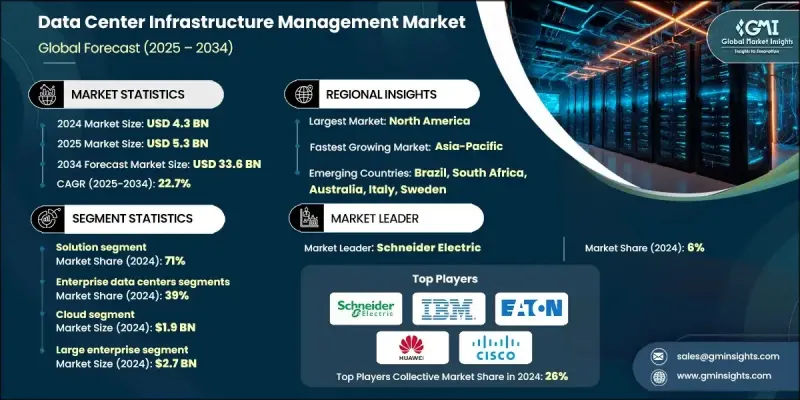
市場擴張的驅動力來自人工智慧工作負載的快速普及、混合雲端的複雜性以及日益嚴格的能源效率法規。傳統的容量規劃正被人工智慧驅動的預測性維運、數位孿生模擬以及完全融合的IT和營運技術(OT)環境所取代。隨著營運商尋求即時了解電力分配、熱狀況和冷卻系統,以維持性能並避免停機,資料中心基礎設施管理(DCIM)解決方案已變得不可或缺,尤其是在每個機架功率超過40千瓦的高密度人工智慧訓練集群中。此外,全球企業、超大規模和託管資料中心對基礎設施最佳化、永續性報告和成本效益型營運的需求不斷成長,也推動了該市場的加速成長。人工智慧、機器學習和預測分析的整合正在重新定義營運管理,並確保現代資料中心環境具有更高的效率、彈性和可擴展性。
| 市場範圍 | |
|---|---|
| 起始年份 | 2024 |
| 預測年份 | 2025-2034 |
| 起始值 | 43億美元 |
| 預測值 | 336億美元 |
| 複合年成長率 | 22.7% |
解決方案板塊在2024年佔據71%的市場佔有率,預計2025年至2034年將以23.5%的複合年成長率成長。該板塊涵蓋資料中心基礎設施管理(DCIM)軟體平台、監控工具、分析引擎以及軟硬體整合設備。現代DCIM解決方案的功能遠不止監控,還能提供全面的資產管理、容量規劃、預測性維護、數位孿生模擬、電力和冷卻最佳化以及永續性報告,使營運商能夠獲得可操作的基礎設施洞察。
2024年,企業資料中心市佔率達到39%,預計到2034年將以21.7%的複合年成長率成長。這些由企業內部擁有和營運的資料中心,由於其在全球範圍內廣泛分佈於醫療保健、製造業、政府和金融服務等行業,佔據了主導地位。不斷提高的效率需求、降低成本的目標以及永續發展合規要求,正在推動企業採用資料中心基礎設施管理(DCIM)解決方案。
2024年,美國資料中心基礎設施管理(DCIM)市場規模達14.8億美元。北美地區憑藉其高度集中的超大規模營運商、託管服務提供商和企業級資料中心,繼續佔據主導地位,其中美國貢獻了該地區90%的收入。全球約60%的資料中心容量和45%的資料中心能耗都位於美國。美國市場的成長主要受電力消耗不斷成長的驅動,這促使企業採用智慧管理解決方案來最佳化效率、監控能耗並降低營運成本。
全球資料中心基礎設施管理 (DCIM) 市場的主要參與者包括伊頓、富士通、思科、施耐德電氣、ABB、西門子、艾默生、惠普企業公司、IBM 公司和華為技術有限公司。這些企業正透過投資人工智慧驅動的預測分析、數位孿生建模和先進的監控工具來提升營運效率,從而鞏固其市場地位。與超大規模營運商、企業客戶和雲端服務供應商的策略合作,使得企業能夠針對複雜的 IT 和 OT 環境客製化解決方案。此外,各公司還在拓展新興市場,並提供基於雲端的 DCIM 平台,以提高可訪問性和可擴展性。增強永續性功能、整合基於物聯網的能源管理以及提供全方位維護服務契約,是企業在快速成長的行業中保持客戶忠誠度、與競爭對手區分開來並鞏固市場領導地位的關鍵策略。
目錄
第1章:方法論與範圍
第2章:執行概要
第3章:行業洞察
- 產業生態系分析
- 供應商格局
- 零件製造商
- 系統整合商和分銷商
- 設施營運商和服務提供者
- 最終用戶和企業
- 成本結構
- 利潤率
- 每個階段的價值增加
- 垂直整合趨勢
- 顛覆者
- 供應商格局
- 對力的影響
- 成長促進因素
- 高密度人工智慧和高效能運算工作負載的爆炸性成長
- 向混合雲和多雲端基礎設施轉型
- 能源成本上漲與強制性能源效率法規
- 邊緣資料中心激增
- 產業陷阱與挑戰
- 前期整合和部署複雜性高
- 供應商生態系統分散和互通性問題
- 市場機遇
- DCIM 2.0 採用
- OT+IT整合,實現全廠數位化孿生
- 成長促進因素
- 技術趨勢與創新生態系統
- 目前技術
- 人工智慧與機器學習
- 生成式人工智慧和大型語言模型
- 數位孿生技術
- 物聯網 (IoT) 和邊緣運算
- 新興技術
- 區塊鏈和分散式帳本技術
- 擴增實境(AR)和虛擬實境(VR)
- 量子計算
- 5G及下一代連結技術
- 目前技術
- 成長潛力分析
- 監管環境
- 數據主權和本地化要求
- 環境與永續發展法規
- 建築規範與安全標準
- 區域監管比較
- 北美洲
- 歐洲
- 亞太
- 拉丁美洲
- 中東和非洲
- 波特的分析
- PESTEL 分析
- 專利分析
- 成本細分分析
- 價格趨勢
- 競爭性定價策略
- 軟體許可價格範圍
- 專業服務費率
- 供應商收入模式及策略
- 產品線及研發路線圖
- 目前產品世代分析
- 功能集和效能基準測試
- 技術堆疊及架構
- 效能和可擴展性指標
- 優點與局限性
- 下一代產品研發管線
- 已公佈的產品發布計劃(2024-2026 年)
- Beta 和早期訪問計劃
- 技術預覽與概念驗證
- 預期功能增強
- 目前產品世代分析
- 專利分析
- 美國專利商標局專利分類分析
- 主要專利持有者和創新領導者
- 專利池和標準必要專利
- 新興技術專利熱點
- 永續性和環境方面
- 資料中心環境足跡
- 碳定價與排放交易機制
- DCIM在永續發展中的作用
- DCIM協助實現永續發展目標
- 市場採納與滲透分析
- 技術採納生命週期
- 採用障礙和促進因素
- 市場滲透率分析
- 客戶決策歷程
- 用例分析及應用場景
- 使用案例分類與分類
- 依資料中心類型
- 透過功能目標
- 按行業垂直領域
- 按部署規模
- 詳細用例分析
- 能源效率最佳化
- 產能規劃與預測
- 預測性維護和故障預防
- 多站點可見性與管理
- 使用案例分類與分類
- 客戶和最終用戶洞察
- 購買行為與決策過程
- 客戶旅程圖
- 客戶滿意度和淨推薦值
- 客戶痛點和未滿足的需求
第4章:競爭格局
- 介紹
- 公司市佔率分析
- 北美洲
- 歐洲
- 亞太
- 拉丁美洲
- 中東和非洲
- 競爭定位矩陣
- 戰略展望矩陣
- 關鍵進展
- 併購
- 合作夥伴關係與合作
- 新產品發布
- 擴張計劃和資金
- 高階定位策略
- 競爭分析與獨特賣點
第5章:市場估算與預測:依組件分類,2021-2034年
- 主要趨勢
- 解決方案
- 資產管理
- 網管
- 冷卻管理
- 電源和溫度管理
- 其他
- 服務
- 安裝與整合
- 管理
- 諮詢
第6章:市場估算與預測:依資料中心分類,2021-2034年
- 主要趨勢
- 企業資料中心
- 託管資料中心
- 超大規模資料中心
- 邊緣資料中心
第7章:市場估算與預測:依部署方式分類,2021-2034年
- 主要趨勢
- 雲
- 混合
- 現場
第8章:市場估算與預測:依組織規模分類,2021-2034年
- 主要趨勢
- 大型企業
- 中小企業
第9章:市場估計與預測:依應用領域分類,2021-2034年
- 主要趨勢
- 金融服務業
- 託管
- 能源
- 政府
- 衛生保健
- 製造業
- 資訊科技與電信
- 其他
第10章:市場估計與預測:依地區分類,2021-2034年
- 北美洲
- 美國
- 加拿大
- 歐洲
- 英國
- 德國
- 法國
- 義大利
- 西班牙
- 比利時
- 荷蘭
- 瑞典
- 俄羅斯
- 亞太地區
- 中國
- 印度
- 日本
- 澳洲
- 新加坡
- 韓國
- 越南
- 印尼
- 拉丁美洲
- 巴西
- 墨西哥
- 阿根廷
- MEA
- 南非
- 沙烏地阿拉伯
- 阿拉伯聯合大公國
第11章:公司簡介
- 全球參與者
- ABB
- Eaton
- FNT Software
- Hewlett-Packard Enterprise
- IBM
- Nlyte Software
- Schneider Electric
- Siemens
- Sunbird Software
- Regional champions
- CommScope
- Cormant
- Device42
- EkkoSense
- Emerson
- Fujitsu
- Huawei Technologies
- Hyperview
- Packet Power
- Rittal
- 新興參與者與創新者
- Arista
- Cisco
- Inspur
- Lenovo
- Modius
- NetApp
- Supermicro
The Global Data Center Infrastructure Management (DCIM) Market was valued at USD 4.3 billion in 2024 and is estimated to grow at a CAGR of 22.7% to reach USD 33.6 billion by 2034.
The market expansion is driven by the rapid adoption of AI workloads, hybrid cloud complexities, and increasingly stringent energy efficiency regulations. Traditional capacity planning is giving way to AI-powered predictive operations, digital twin simulations, and fully converged IT and operational technology (OT) environments. DCIM solutions have become indispensable as operators seek real-time visibility into power distribution, thermal conditions, and cooling systems to maintain performance and avoid downtime, particularly in high-density AI training clusters exceeding 40 kW per rack. Accelerating growth in this market is also linked to the rising need for infrastructure optimization, sustainability reporting, and cost-effective operations across enterprise, hyperscale, and colocation data centers globally. The integration of AI, machine learning, and predictive analytics is redefining operational management and ensuring higher efficiency, resilience, and scalability for modern data center environments.
| Market Scope | |
|---|---|
| Start Year | 2024 |
| Forecast Year | 2025-2034 |
| Start Value | $4.3 Billion |
| Forecast Value | $33.6 Billion |
| CAGR | 22.7% |
The solutions segment held a 71% share in 2024 and is anticipated to grow at a CAGR of 23.5% from 2025 to 2034. This segment includes DCIM software platforms, monitoring tools, analytics engines, and integrated hardware-software appliances. Modern DCIM solutions extend beyond monitoring to provide comprehensive asset management, capacity planning, predictive maintenance, digital twin simulations, power and cooling optimization, and sustainability reporting, enabling operators to gain actionable insights across the infrastructure.
The enterprise data centers segment held a 39% share in 2024 and is expected to grow at a CAGR of 21.7% through 2034. These centers, owned and operated internally by organizations, dominate due to their global prevalence across sectors such as healthcare, manufacturing, government, and financial services. Increasing efficiency demands, cost reduction targets, and sustainability compliance requirements are driving enterprise adoption of DCIM solutions.
U.S. Data Center Infrastructure Management (DCIM) Market generated USD 1.48 billion in 2024. North America continues to dominate due to its high concentration of hyperscale operators, colocation providers, and enterprise data centers, with the U.S. accounting for 90% of regional revenue. Approximately 60% of global data center capacity and 45% of worldwide data center energy consumption are in the United States. The market in the U.S. is driven by rising electricity usage, which fuels the adoption of intelligent management solutions to optimize efficiency, monitor power consumption, and reduce operational costs.
Prominent players in the Global Data Center Infrastructure Management (DCIM) Market include Eaton, Fujitsu, Cisco, Schneider Electric, ABB, Siemens, Emerson, Hewlett-Packard Enterprise Company, IBM Corporation, and Huawei Technologies. Companies in the Data Center Infrastructure Management (DCIM) Market are strengthening their foothold by investing in AI-powered predictive analytics, digital twin modeling, and advanced monitoring tools to improve operational efficiency. Strategic collaborations with hyperscale operators, enterprise clients, and cloud providers allow customization of solutions for complex IT and OT environments. Firms are also expanding into emerging markets and offering cloud-enabled DCIM platforms to increase accessibility and scalability. Enhancing sustainability features, integrating IoT-based energy management, and providing full-service maintenance contracts are key strategies that help maintain customer loyalty, differentiate from competitors, and reinforce market leadership in a rapidly growing industry.
Table of Contents
Chapter 1 Methodology & Scope
- 1.1 Research design
- 1.1.1 Research approach
- 1.1.2 Data collection methods
- 1.2 Base estimates and calculations
- 1.2.1 Base year calculation
- 1.2.2 Key trends for market estimates
- 1.3 Forecast
- 1.4 Primary research and validation
- 1.5 Some of the primary sources
- 1.6 Data mining sources
- 1.6.1 Secondary
- 1.6.1.1 Paid Sources
- 1.6.1.2 Public Sources
- 1.6.1.3 Sources, by region
- 1.6.1 Secondary
- 1.7 Inclusion & Exclusion
Chapter 2 Executive Summary
- 2.1 Industry 360° synopsis
- 2.2 Key market trends
- 2.2.1 Regional
- 2.2.2 Component
- 2.2.3 Data Center
- 2.2.4 Deployment
- 2.2.5 Organization Size
- 2.2.6 Application
- 2.3 TAM Analysis, 2025-2034
- 2.4 CXO perspectives: Strategic imperatives
- 2.4.1 Key decision points for industry executives
- 2.4.2 Critical success factors for market players
- 2.5 Future outlook and strategic recommendations
Chapter 3 Industry Insights
- 3.1 Industry ecosystem analysis
- 3.1.1 Supplier landscape
- 3.1.1.1 Component manufacturers
- 3.1.1.2 System integrators & distributors
- 3.1.1.3 Facility operators & service providers
- 3.1.1.4 End use & enterprises
- 3.1.2 Cost structure
- 3.1.3 Profit margin
- 3.1.4 Value addition at each stage
- 3.1.5 Vertical integration trends
- 3.1.6 Disruptors
- 3.1.1 Supplier landscape
- 3.2 Impact on forces
- 3.2.1 Growth drivers
- 3.2.1.1 Explosion of high-density AI & HPC workloads
- 3.2.1.2 Shift toward hybrid & multi-cloud infrastructure
- 3.2.1.3 Rising energy costs & mandatory efficiency regulations
- 3.2.1.4 Edge data center proliferation
- 3.2.2 Industry pitfalls & challenges
- 3.2.2.1 High upfront integration & deployment complexity
- 3.2.2.2 Fragmented vendor ecosystem & interoperability issues
- 3.2.3 Market opportunities
- 3.2.3.1 DCIM 2.0 adoption
- 3.2.3.2 Integration of OT + IT for full facility digital twins
- 3.2.1 Growth drivers
- 3.3 Technology trends & innovation ecosystem
- 3.3.1 Current technologies
- 3.3.1.1 Artificial intelligence & machine learning
- 3.3.1.2 Generative AI & large language models
- 3.3.1.3 Digital twin technology
- 3.3.1.4 Internet of things (IoT) & edge computing
- 3.3.2 Emerging technologies
- 3.3.2.1 Blockchain & distributed ledger technology
- 3.3.2.2 Augmented reality (AR) & virtual reality (VR)
- 3.3.2.3 Quantum computing
- 3.3.2.4 5G & next-generation connectivity
- 3.3.1 Current technologies
- 3.4 Growth potential analysis
- 3.5 Regulatory landscape
- 3.5.1 Data sovereignty & localization requirements
- 3.5.2 Environmental & sustainability regulations
- 3.5.3 Building codes & safety standards
- 3.5.4 Regional regulatory comparison
- 3.5.4.1 North America
- 3.5.4.2 Europe
- 3.5.4.3 Asia-Pacific
- 3.5.4.4 Latin America
- 3.5.4.5 Middle East & Africa
- 3.6 Porter's analysis
- 3.7 PESTEL analysis
- 3.8 Patent analysis
- 3.9 Cost breakdown analysis
- 3.10 Price trends
- 3.10.1 Competitive pricing strategies
- 3.10.2 Software licensing price ranges
- 3.10.3 Professional services rates
- 3.10.4 Vendor revenue models & strategies
- 3.11 Product pipeline & R&D roadmap
- 3.11.1 Current product generation analysis
- 3.11.1.1 Feature set & capabilities benchmarking
- 3.11.1.2 Technology stack & architecture
- 3.11.1.3 Performance & scalability metrics
- 3.11.1.4 Strengths & limitations
- 3.11.2 Next-generation product pipeline
- 3.11.2.1 Announced product releases (2024-2026)
- 3.11.2.2 Beta & early access programs
- 3.11.2.3 Technology previews & proof-of-concepts
- 3.11.2.4 Expected feature enhancements
- 3.11.1 Current product generation analysis
- 3.12 Patent analysis
- 3.12.1 USPTO patent classification analysis
- 3.12.2 Key patent holders & innovation leaders
- 3.12.3 Patent pools & standards-essential patents
- 3.12.4 Emerging technology patent hotspots
- 3.13 Sustainability and environmental aspects
- 3.13.1 Data center environmental footprint
- 3.13.2 Carbon pricing & emissions trading schemes
- 3.13.3 DCIM role in sustainability
- 3.13.4 DCIM-enabled sustainability achievements
- 3.14 Market adoption & penetration analysis
- 3.14.1 Technology adoption lifecycle
- 3.14.2 Adoption barriers & enablers
- 3.14.3 Market penetration analysis
- 3.14.4 Customer decision journey
- 3.15 Use case analysis & application scenarios
- 3.15.1 Use case taxonomy & classification
- 3.15.1.1 By data center type
- 3.15.1.2 By functional objective
- 3.15.1.3 By industry vertical
- 3.15.1.4 By deployment scale
- 3.15.2 Detailed use case analysis
- 3.15.2.1 Energy efficiency optimization
- 3.15.2.2 Capacity planning & forecasting
- 3.15.2.3 Predictive maintenance & failure prevention
- 3.15.2.4 Multi-site visibility & management
- 3.15.1 Use case taxonomy & classification
- 3.16 Customer & End use insights
- 3.16.1 Buying behavior & decision-making process
- 3.16.2 Customer journey mapping
- 3.16.3 Customer satisfaction & net promoter score
- 3.16.4 Customer pain points & unmet needs
Chapter 4 Competitive Landscape, 2024
- 4.1 Introduction
- 4.2 Company market share analysis
- 4.2.1 North America
- 4.2.2 Europe
- 4.2.3 Asia-Pacific
- 4.2.4 Latin America
- 4.2.5 Middle East & Africa
- 4.3 Competitive positioning matrix
- 4.4 Strategic outlook matrix
- 4.5 Key developments
- 4.5.1 Mergers & acquisitions
- 4.5.2 Partnerships & collaborations
- 4.5.3 New product launches
- 4.5.4 Expansion plans and funding
- 4.6 Premium positioning strategies
- 4.7 Competitive analysis and USPs
Chapter 5 Market Estimates & Forecast, By Component, 2021 - 2034 ($Bn)
- 5.1 Key trends
- 5.2 Solutions
- 5.2.1 Asset management
- 5.2.2 Network management
- 5.2.3 Cooling management
- 5.2.4 Power and temperature management
- 5.2.5 Others
- 5.3 Services
- 5.3.1 Installation & integration
- 5.3.2 Managed
- 5.3.3 Consulting
Chapter 6 Market Estimates & Forecast, By Data Center, 2021 - 2034 ($Bn)
- 6.1 Key trends
- 6.2 Enterprise data centers
- 6.3 colocation data centers
- 6.4 hyperscale data centers
- 6.5 edge data centers
Chapter 7 Market Estimates & Forecast, By Deployment, 2021 - 2034 ($Bn)
- 7.1 Key trends
- 7.2 Cloud
- 7.3 Hybrid
- 7.4 On-premises
Chapter 8 Market Estimates & Forecast, By Organization Size, 2021 - 2034 ($Bn)
- 8.1 Key trends
- 8.2 Large enterprise
- 8.3 SME
Chapter 9 Market Estimates & Forecast, By Application, 2021 - 2034 ($Bn)
- 9.1 Key trends
- 9.2 BFSI
- 9.3 Colocation
- 9.4 Energy
- 9.5 Government
- 9.6 Healthcare
- 9.7 Manufacturing
- 9.8 IT & telecom
- 9.9 Others
Chapter 10 Market Estimates & Forecast, By Region, 2021 - 2034 ($Bn)
- 10.1 North America
- 10.1.1 US
- 10.1.2 Canada
- 10.2 Europe
- 10.2.1 UK
- 10.2.2 Germany
- 10.2.3 France
- 10.2.4 Italy
- 10.2.5 Spain
- 10.2.6 Belgium
- 10.2.7 Netherlands
- 10.2.8 Sweden
- 10.2.9 Russia
- 10.3 Asia Pacific
- 10.3.1 China
- 10.3.2 India
- 10.3.3 Japan
- 10.3.4 Australia
- 10.3.5 Singapore
- 10.3.6 South Korea
- 10.3.7 Vietnam
- 10.3.8 Indonesia
- 10.4 Latin America
- 10.4.1 Brazil
- 10.4.2 Mexico
- 10.4.3 Argentina
- 10.5 MEA
- 10.5.1 South Africa
- 10.5.2 Saudi Arabia
- 10.5.3 UAE
Chapter 11 Company Profiles
- 11.1 Global players
- 11.1.1 ABB
- 11.1.2 Eaton
- 11.1.3 FNT Software
- 11.1.4 Hewlett-Packard Enterprise
- 11.1.5 IBM
- 11.1.6 Nlyte Software
- 11.1.7 Schneider Electric
- 11.1.8 Siemens
- 11.1.9 Sunbird Software
- 11.2 Regional champions
- 11.2.1 CommScope
- 11.2.2 Cormant
- 11.2.3 Device42
- 11.2.4 EkkoSense
- 11.2.5 Emerson
- 11.2.6 Fujitsu
- 11.2.7 Huawei Technologies
- 11.2.8 Hyperview
- 11.2.9 Packet Power
- 11.2.10 Rittal
- 11.3 Emerging players & innovators
- 11.3.1 Arista
- 11.3.2 Cisco
- 11.3.3 Inspur
- 11.3.4 Lenovo
- 11.3.5 Modius
- 11.3.6 NetApp
- 11.3.7 Supermicro

 2026年全球資料中心(DCIM)服務市場報告
 資料中心基礎設施管理(DCIM):市場佔有率分析、產業趨勢與統計資料、成長預測(2026-2031)
 全球資料中心基礎設施管理 (DCIM) 市場預測至 2034 年:按元件、功能、部署類型、資料中心類型、應用程式、最終用戶和地區分類全球資料中心電氣基礎設施服務市場預測(至2034年),依電氣系統類型、等級分類、電力容量、資料中心類別、最終使用者和地區分類全球資料中心電氣設備試運行市場:預測(至 2034 年)—按試運行類型、試運行級別、電氣系統、資料中心類型、服務供應商類型、最終用戶和地區進行分析全球超大規模資料中心擴建市場:預測(至 2034 年)-按元件、資料中心類型、部署方式、IT 架構、最終使用者和區域進行分析
 整合資料中心基礎設施市場 - 全球產業規模、佔有率、趨勢、機會及預測(按部署方式、組件、設施、地區和競爭格局分類),2021-2031年
 資料中心基礎設施市場規模、佔有率和成長分析(按產品、組件、資料中心、部署方式、企業規模、應用和地區分類)—產業預測,2026-2033年
 資料中心基礎設施市場機會、成長促進因素、產業趨勢分析及預測(2025-2034年)
 資料中心基礎設施市場按組件、資料中心類型、產業和地區分類