


 |
市場調查報告書
商品編碼
1885915
鋰離子電池回收市場機會、成長促進因素、產業趨勢分析及預測(2025-2034年)Lithium-Ion Battery Recycling Market Opportunity, Growth Drivers, Industry Trend Analysis, and Forecast 2025 - 2034 |
||||||

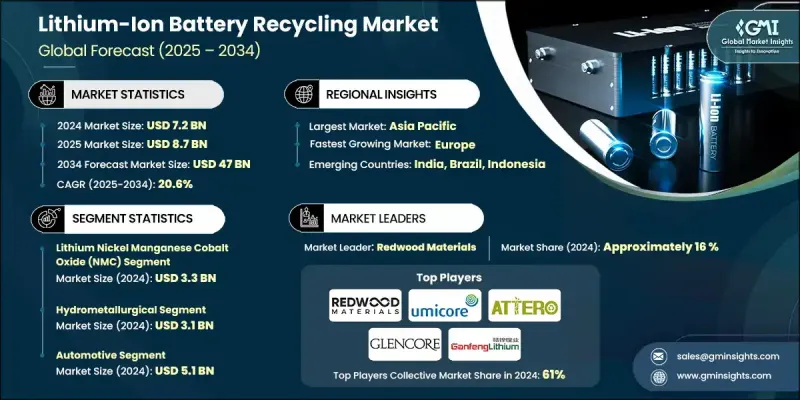
2024 年全球鋰離子電池回收市場價值為 72 億美元,預計到 2034 年將以 20.6% 的複合年成長率成長至 470 億美元。
該產業已迅速從專業的環保服務轉型為全球清潔能源供應鏈的核心環節。過去幾年,濕式冶金製程因其能夠比傳統冶煉更精確地回收鋰、鈷、鎳等高價值金屬而成為首選方案。更新的監管框架進一步推動了這一轉變,其中包括獎勵金屬回收效率高的回收商的全球新規,從而鼓勵更廣泛地採用水基精煉技術。此外,作為金屬提取中間體的黑料的生產和貿易也呈現強勁成長勢頭。小型回收商擴大參與這一領域,向大型濕式冶金精煉廠供應黑料。隨著電動車、儲能項目和製造業廢棄物產生的電池廢棄物數量不斷成長,預計該市場將在預測期內加速擴張。
| 市場範圍 | |
|---|---|
| 起始年份 | 2024 |
| 預測年份 | 2025-2034 |
| 起始值 | 72億美元 |
| 預測值 | 470億美元 |
| 複合年成長率 | 20.6% |
2024年,濕式冶金市場規模達31億美元,預計2034年將以20.9%的複合年成長率成長,達到全球市場佔有率的36.1%。濕式冶金的優點在於其更高的回收效率、更低的排放以及超過90%的關鍵金屬回收率。生產商正在擴大水基精煉設施的規模,以滿足日益成長的永續發展需求並增強其金屬回收能力。
2024年,汽車產業市場規模達51億美元,預計2025年至2034年將以20.5%的複合年成長率成長,佔全球市場佔有率的71.2%。大多數可回收的鋰離子電池來自電動車及相關製造活動。隨著全球電動車產量的不斷成長,廢棄電池和缺陷電池的數量持續增加,使得汽車產業成為回收供應鏈和產業長期成長的關鍵貢獻者。
2024年,美國鋰離子電池回收市場規模預計將達12.1億美元。該國市場成長得益於大規模回收項目,這些項目得到了政策激勵、資金支持以及國內電池製造業擴張的推動。聯邦和州政府的支持正在加速主要生產設施附近回收中心的建設,從而加強鋰、鎳和鈷等關鍵金屬的回收利用。
活躍於鋰離子電池回收市場的主要公司包括Redwood Materials、贛鋒鋰業、優美科、嘉能可和Attero Recycling。這些公司正在實施多種策略以鞏固市場地位並擴大競爭優勢。許多公司正大力投資濕式冶金產能,以提高回收率並減少對環境的影響,同時也透過自動化和先進的分離技術對現有設施進行現代化改造。各公司正與電動車製造商和電池生產商簽訂長期供應協議,以確保穩定的廢料來源。與政府機構的策略合作有助於為大規模回收項目爭取資金和監管支持。
目錄
第1章:方法論
- 市場範圍和定義
- 研究設計
- 研究方法
- 資料收集方法
- 資料探勘來源
- 全球的
- 地區/國家
- 基準估算和計算
- 基準年計算
- 市場估算的關鍵趨勢
- 初步研究和驗證
- 原始資料
- 預測模型
- 研究假設和局限性
第2章:執行概要
第3章:行業洞察
- 產業生態系分析
- 供應商格局
- 利潤率
- 每個階段的價值增加
- 影響價值鏈的因素
- 中斷
- 產業影響因素
- 成長促進因素
- 產業陷阱與挑戰
- 市場機遇
- 成長潛力分析
- 監管環境
- 北美洲
- 歐洲
- 亞太地區
- 拉丁美洲
- 中東和非洲
- 波特的分析
- PESTEL 分析
- 價格趨勢
- 按地區
- 未來市場趨勢
- 技術與創新格局
- 當前技術趨勢
- 新興技術
- 專利格局
- 貿易統計(註:僅提供重點國家的貿易統計)
- 主要進口國
- 主要出口國
- 永續性和環境方面
- 永續實踐
- 減少廢棄物策略
- 生產中的能源效率
- 環保舉措
- 碳足跡考量
第4章:競爭格局
- 介紹
- 公司市佔率分析
- 按地區
- 北美洲
- 歐洲
- 亞太地區
- 拉丁美洲
- MEA
- 按地區
- 公司矩陣分析
- 主要市場參與者的競爭分析
- 競爭定位矩陣
- 關鍵進展
- 併購
- 合作夥伴關係與合作
- 新產品發布
- 擴張計劃
第5章:市場估算與預測:依化學品類別分類,2025-2034年
- 主要趨勢
- 鋰鎳錳鈷氧化物(NMC)
- 磷酸鐵鋰(LFP)
- 鈷酸鋰(LCO)
- 其他
第6章:市場估算與預測:依製程分類,2025-2034年
- 主要趨勢
- 火法冶金
- 濕式冶金
- 物理/機械
第7章:市場估計與預測:依來源分類,2025-2034年
- 主要趨勢
- 汽車
- 商用車輛(電動巴士、貨車)
- 非公路用電動車(建築、礦業車隊)
- 電池製造廢棄物(大型工廠和次品)
- 乘用電動車(純電動車和插電式混合動力車)
- 非汽車
- 電動工具及工業電子產品(無線電鑽、UPS電源)
- 固定式儲能系統(電網和住宅)
- 微型交通工具(電動滑板車、自行車、無人機)
- 消費性電子產品(智慧型手機、筆記型電腦、平板電腦)
第8章:市場估算與預測:依地區分類,2025-2034年
- 主要趨勢
- 北美洲
- 美國
- 加拿大
- 歐洲
- 德國
- 英國
- 法國
- 義大利
- 西班牙
- 歐洲其他地區
- 亞太地區
- 中國
- 印度
- 日本
- 澳洲
- 韓國
- 亞太其他地區
- 拉丁美洲
- 巴西
- 墨西哥
- 阿根廷
- 拉丁美洲其他地區
- 中東和非洲
- 沙烏地阿拉伯
- 南非
- 阿拉伯聯合大公國
- 中東和非洲其他地區
第9章:公司簡介
- 3R Recycler
- ACE Green Recycling
- American Battery Technology Company
- Attero Recycling
- BatX Energies
- Cirba Solutions
- Ganfeng Lithium
- Glencore
- Li-Cycle Holdings Corporation
- Lohum Cleantech
- Neometals
- RecycLiCo Battery Material
- Redwood Materials
- SK TES
- Umicore
The Global Lithium-Ion Battery Recycling Market was valued at USD 7.2 billion in 2024 and is estimated to grow at a CAGR of 20.6% to reach USD 47 billion by 2034.
The industry has rapidly shifted from a specialized environmental service to a central part of the clean energy supply chain worldwide. Over the past few years, hydrometallurgical processes have become the preferred option due to their ability to recover high-value metals such as lithium, cobalt, and nickel with far greater precision than conventional smelting. This transition is further supported by updated regulatory frameworks, including new global rules that reward recyclers achieving high metal recovery efficiencies, encouraging wider adoption of water-based refining technologies. The industry is also experiencing strong momentum in the production and trade of black mass, which serves as an intermediate material for further metal extraction. Smaller recyclers are increasingly participating in this segment by supplying black mass to larger hydrometallurgical refiners. With the growing volume of battery waste generated from electric mobility, energy storage projects, and manufacturing scrap, the market is positioned for accelerated expansion throughout the forecast period.
| Market Scope | |
|---|---|
| Start Year | 2024 |
| Forecast Year | 2025-2034 |
| Start Value | $7.2 Billion |
| Forecast Value | $47 Billion |
| CAGR | 20.6% |
The hydrometallurgical segment was valued at USD 3.1 billion in 2024 and is forecast to grow at a 20.9% CAGR through 2034, reaching 36.1% of the global market. The shift toward hydrometallurgy is driven by its higher recovery efficiency, lower emissions profile, and ability to reclaim more than 90% of critical metals. Producers are scaling up water-based refining facilities to align with rising sustainability expectations and strengthen their metal recovery capabilities.
The automotive segment was valued at USD 5.1 billion in 2024 and is projected to grow at a 20.5% CAGR from 2025 to 2034, accounting for a 71.2% share. Most recyclable lithium-ion batteries originate from electric vehicles and related manufacturing activities. As EV production expands globally, the availability of end-of-life and defective batteries continues to increase, making the automotive sector a key contributor to recycling supply streams and long-term industry growth.
U.S. Lithium-Ion Battery Recycling Market generated USD 1.21 billion in 2024. Growth in the country is supported by large-scale recycling projects backed by policy incentives, funding programs, and expanding domestic battery manufacturing. Federal and state-level support is accelerating the development of recycling hubs near major production facilities, reinforcing the recovery of essential metals such as lithium, nickel, and cobalt.
Major companies active in the Lithium-Ion Battery Recycling Market include Redwood Materials, Ganfeng Lithium, Umicore, Glencore, and Attero Recycling. Companies in the Lithium-Ion Battery Recycling Market are implementing multiple strategies to strengthen their presence and expand their competitive advantage. Many are investing heavily in hydrometallurgical capacity to improve recovery rates and reduce environmental impact, while also modernizing facilities with automation and advanced separation technologies. Firms are forging long-term supply agreements with EV manufacturers and battery producers to secure consistent waste streams. Strategic collaborations with government agencies help unlock funding and regulatory support for large-scale recycling initiatives.
Table of Contents
Chapter 1 Methodology
- 1.1 Market scope and definition
- 1.2 Research design
- 1.2.1 Research approach
- 1.2.2 Data collection methods
- 1.3 Data mining sources
- 1.3.1 Global
- 1.3.2 Regional/Country
- 1.4 Base estimates and calculations
- 1.4.1 Base year calculation
- 1.4.2 Key trends for market estimation
- 1.5 Primary research and validation
- 1.5.1 Primary sources
- 1.6 Forecast model
- 1.7 Research assumptions and limitations
Chapter 2 Executive Summary
- 2.1 Industry 360° synopsis
- 2.2 Key market trends
- 2.2.1 Regional
- 2.2.2 Chemistry
- 2.2.3 Process
- 2.2.4 Source
- 2.3 TAM Analysis, 2025-2034
- 2.4 CXO perspectives: Strategic imperatives
- 2.4.1 Executive decision points
- 2.4.2 Critical success factors
- 2.5 Future Outlook and Strategic Recommendations
Chapter 3 Industry Insights
- 3.1 Industry ecosystem analysis
- 3.1.1 Supplier Landscape
- 3.1.2 Profit Margin
- 3.1.3 Value addition at each stage
- 3.1.4 Factor affecting the value chain
- 3.1.5 Disruptions
- 3.2 Industry impact forces
- 3.2.1 Growth drivers
- 3.2.2 Industry pitfalls and challenges
- 3.2.3 Market opportunities
- 3.3 Growth potential analysis
- 3.4 Regulatory landscape
- 3.4.1 North America
- 3.4.2 Europe
- 3.4.3 Asia Pacific
- 3.4.4 Latin America
- 3.4.5 Middle East & Africa
- 3.5 Porter's analysis
- 3.6 PESTEL analysis
- 3.7 Price trends
- 3.7.1 By region
- 3.8 Future market trends
- 3.9 Technology and Innovation landscape
- 3.9.1 Current technological trends
- 3.9.2 Emerging technologies
- 3.10 Patent Landscape
- 3.11 Trade statistics (Note: the trade statistics will be provided for key countries only)
- 3.11.1 Major importing countries
- 3.11.2 Major exporting countries
- 3.12 Sustainability and Environmental Aspects
- 3.12.1 Sustainable Practices
- 3.12.2 Waste Reduction Strategies
- 3.12.3 Energy Efficiency in Production
- 3.12.4 Eco-friendly Initiatives
- 3.13 Carbon Footprint Considerations
Chapter 4 Competitive Landscape, 2024
- 4.1 Introduction
- 4.2 Company market share analysis
- 4.2.1 By region
- 4.2.1.1 North America
- 4.2.1.2 Europe
- 4.2.1.3 Asia Pacific
- 4.2.1.4 LATAM
- 4.2.1.5 MEA
- 4.2.1 By region
- 4.3 Company matrix analysis
- 4.4 Competitive analysis of major market players
- 4.5 Competitive positioning matrix
- 4.6 Key developments
- 4.6.1 Mergers & acquisitions
- 4.6.2 Partnerships & collaborations
- 4.6.3 New Product Launches
- 4.6.4 Expansion Plans
Chapter 5 Market Estimates and Forecast, By Chemistry, 2025 - 2034 (USD Billion, Kilo Tons)
- 5.1 Key trends
- 5.2 Lithium Nickel Manganese Cobalt Oxide (NMC)
- 5.3 Lithium Iron Phosphate (LFP)
- 5.4 Lithium Cobalt Oxide (LCO)
- 5.5 Others
Chapter 6 Market Estimates and Forecast, By Process, 2025 - 2034 (USD Billion, Kilo Tons)
- 6.1 Key trends
- 6.2 Pyrometallurgical
- 6.3 Hydrometallurgical
- 6.4 Physical/Mechanical
Chapter 7 Market Estimates and Forecast, By Source, 2025 - 2034 (USD Billion, Kilo Tons)
- 7.1 Key trends
- 7.2 Automotive
- 7.2.1 Commercial vehicles (electric buses, vans)
- 7.2.2 Off-road electric vehicles (construction, mining fleets)
- 7.2.3 Battery manufacturing scrap (giga factories and rejects)
- 7.2.4 Passenger electric vehicles (BEVs and PHEVs)
- 7.3 Non-Automotive
- 7.3.1 Power tools and industrial electronics (cordless drills, UPS units)
- 7.3.2 Stationary energy storage systems (grid and residential)
- 7.3.3 Micromobility devices (e-scooters, bikes, drones)
- 7.3.4 Consumer electronics (smartphones, laptops, tablets)
Chapter 8 Market Estimates and Forecast, By Region, 2025 - 2034 (USD Billion, Kilo Tons)
- 8.1 Key trends
- 8.2 North America
- 8.2.1 U.S.
- 8.2.2 Canada
- 8.3 Europe
- 8.3.1 Germany
- 8.3.2 UK
- 8.3.3 France
- 8.3.4 Italy
- 8.3.5 Spain
- 8.3.6 Rest of Europe
- 8.4 Asia Pacific
- 8.4.1 China
- 8.4.2 India
- 8.4.3 Japan
- 8.4.4 Australia
- 8.4.5 South Korea
- 8.4.6 Rest of Asia Pacific
- 8.5 Latin America
- 8.5.1 Brazil
- 8.5.2 Mexico
- 8.5.3 Argentina
- 8.5.4 Rest of Latin America
- 8.6 Middle East & Africa
- 8.6.1 Saudi Arabia
- 8.6.2 South Africa
- 8.6.3 UAE
- 8.6.4 Rest of Middle East & Africa
Chapter 9 Company Profiles
- 9.1 3R Recycler
- 9.2 ACE Green Recycling
- 9.3 American Battery Technology Company
- 9.4 Attero Recycling
- 9.5 BatX Energies
- 9.6 Cirba Solutions
- 9.7 Ganfeng Lithium
- 9.8 Glencore
- 9.9 Li-Cycle Holdings Corporation
- 9.10 Lohum Cleantech
- 9.11 Neometals
- 9.12 RecycLiCo Battery Material
- 9.13 Redwood Materials
- 9.14 SK TES
- 9.15 Umicore

 鋰離子電池回收市場(按電池來源、電池化學、回收製程、可回收組件和最終用途分類)-全球預測,2025-2032
 鋰離子電池正極活性材料回收的專利趨勢分析(2025年)
 全球鋰離子電池回收解決方案市場,2025-2029年
 2032 年鋰離子電池回收市場預測:按化學、製程、來源、技術、最終用戶和地區進行的全球分析
 鋰離子電池回收的全球市場:供給來源·回收流程·電池化學物質·電池零組件·終端用戶產業·各地區 (~2032年)
 鋰離子電池回收市場規模、佔有率、趨勢分析報告:按應用、地區和細分市場預測,2025-2030 年
 鋰離子電池回收-市場佔有率分析、產業趨勢與統計、成長預測(2025-2030)
 鋰離子電池回收市場:預測(2025-2030年)
 全球鋰離子電池回收市場(2025-2029)
 鋰離子電池回收市場規模、佔有率、成長分析,按來源、按電池化學、按電池組件、按回收工藝、按地區 - 行業預測,2024-2031 年