


 |
市場調查報告書
商品編碼
1885785
精神益生菌成分市場機會、成長促進因素、產業趨勢分析及預測(2025-2034年)Psychobiotic Ingredients Market Opportunity, Growth Drivers, Industry Trend Analysis, and Forecast 2025 - 2034 |
||||||

2024 年全球精神益生菌成分市場價值為 3.051 億美元,預計到 2034 年將以 11.4% 的複合年成長率成長至 9.368 億美元。
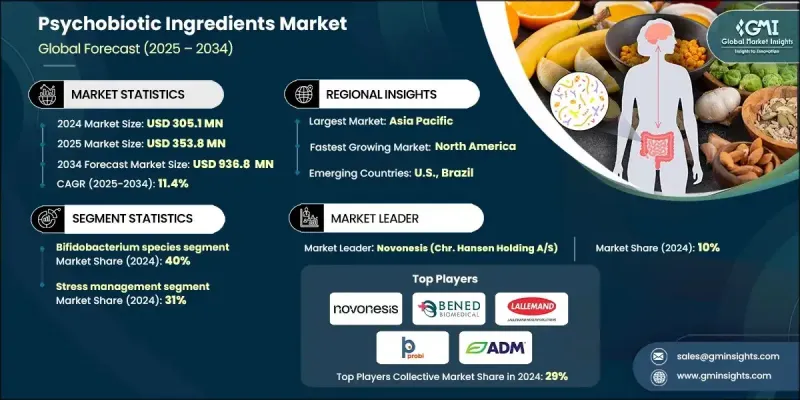
益生菌成分由特定的益生菌菌株組成,它們透過影響腸腦軸內的路徑來支持情緒健康。這些微生物來自一些以影響神經活動、神經傳導物質訊號傳導和整體心理平衡而聞名的細菌群。它們透過多種生物學作用發揮作用,包括形成神經活性分子、調節下丘腦-垂體-腎上腺軸(HPA軸)、緩解發炎反應、增強腸道屏障以及刺激腸腦之間的神經通訊。它們的成分與消化細胞和免疫細胞相互作用,發出可能影響情緒和認知過程的訊號。研究結果表明,當人們持續使用這些成分時,壓力指標、荷爾蒙平衡、焦慮指標和認知能力均有顯著改善。隨著人們對微生物組和心理健康的興趣持續成長,益生菌正從早期科學探索階段過渡到成熟的商業解決方案,並得到菌株特異性臨床證據的支持。大眾對心理健康的認知不斷提高,以及對天然和科學支持的健康產品的興趣日益濃厚,正在推動益生菌獲得更廣泛的市場認可。
| 市場範圍 | |
|---|---|
| 起始年份 | 2024 |
| 預測年份 | 2025-2034 |
| 起始值 | 3.051億美元 |
| 預測值 | 9.368億美元 |
| 複合年成長率 | 11.4% |
雙歧桿菌屬在 2024 年佔據了 40% 的市場佔有率,預計到 2034 年將以 15.1% 的複合年成長率成長。這些菌種之所以引領市場,是因為它們對腸腦通訊的影響已被充分證實,並且有大量研究支持它們能夠影響神經傳導物質路徑、壓力反應系統和發炎標記。
2024年,壓力管理細分市場佔31%的市場佔有率,預計到2034年將以10%的複合年成長率成長。此細分市場持續擴張,是因為消費者尋求可靠的解決方案,這些解決方案需有科學證據支持,能夠降低與壓力相關的生物標記並提高整體韌性。
2024年,北美益生菌成分市佔率達到10.8%,並持續穩定成長。該地區受益於成熟的微生物組研究科學體系、日益增強的腸腦軸認知以及強大的膳食補充劑產業。此外,公眾意識的提升、職場健康計劃以及對經臨床驗證的天然產品的需求,都進一步推動了該地區的成長。
活躍於益生菌原料市場的主要公司包括:菲仕蘭坎皮納原料公司 (FrieslandCampina Ingredients)、Seed Health、帝斯曼-菲美意公司 (DSM-Firmenich)、ADM、拉勒曼健康解決方案公司 (Lallemand Health Solutions)、Winclove Probiotics BV、Unique Biotech Limited、Novone 控股公司(Hlcia) AB、Bened Biomedical Co., Ltd.、AB-Biotics(KANEKA 子公司)以及樂斯福旗下的 Gnosis。這些公司採用多種策略方法來鞏固其競爭優勢。許多公司投資於先進的菌株開發和臨床研究,以建立強力的科學基礎來證明其對心理健康的益處。與膳食補充劑品牌、食品製造商和研究機構建立合作關係有助於擴大商業覆蓋範圍並加速創新。此外,各公司也專注於與監管法規的協調一致,以支持其關於壓力、情緒和認知健康的聲明。產品多元化,包括針對特定消費群體量身定做的配方,增強了產品組合的吸引力。
目錄
第1章:方法論與範圍
第2章:執行概要
第3章:行業洞察
- 產業生態系分析
- 供應商格局
- 利潤率
- 每個階段的價值增加
- 影響價值鏈的因素
- 中斷
- 產業影響因素
- 成長促進因素
- 產業陷阱與挑戰
- 市場機遇
- 成長潛力分析
- 監管環境
- 北美洲
- 歐洲
- 亞太地區
- 拉丁美洲
- 中東和非洲
- 波特的分析
- PESTEL 分析
- 價格趨勢
- 按地區
- 按細菌菌株類型
- 未來市場趨勢
- 技術與創新格局
- 當前技術趨勢
- 新興技術
- 專利格局
- 貿易統計(HS編碼)(註:僅提供重點國家的貿易統計資料)
- 主要進口國
- 主要出口國
- 永續性和環境方面
- 永續實踐
- 減少廢棄物策略
- 生產中的能源效率
- 環保舉措
- 碳足跡考量
第4章:競爭格局
- 介紹
- 公司市佔率分析
- 按地區
- 北美洲
- 歐洲
- 亞太地區
- 拉丁美洲
- MEA
- 按地區
- 公司矩陣分析
- 主要市場參與者的競爭分析
- 競爭定位矩陣
- 關鍵進展
- 併購
- 合作夥伴關係與合作
- 新產品發布
- 擴張計劃
第5章:市場估算與預測:依細菌菌株類型分類,2021-2034年
- 主要趨勢
- 乳桿菌屬
- 植物乳桿菌
- 鼠李糖乳桿菌
- 瑞士乳香
- 嗜酸乳桿菌
- 乾酪乳桿菌
- 羅伊氏乳桿菌
- 雙歧桿菌屬
- 短雙歧桿菌
- 長雙歧桿菌
- 嬰兒雙歧桿菌
- 乳酸雙歧桿菌
- 雙歧桿菌
- 動物雙歧桿菌
- 芽孢桿菌屬
- 凝結芽孢桿菌
- 枯草桿菌
- 其他有益物種
第6章:市場估算與預測:依應用領域分類,2021-2034年
- 主要趨勢
- 壓力管理
- 企業用戶
- 學生
- 醫護人員
- 緩解焦慮
- 廣泛性焦慮症的應用
- 社交焦慮症應用
- 憂鬱症治療
- 輕度至中度憂鬱症
- 抗憂鬱藥物的輔助治療
- 認知功能增強
- 記憶增強
- 學習能力提升
- 執行功能支持
- 預防老化和失智症
- 情緒與幸福感提升
- 整體健康狀況
- 臨床情緒應用
- 神經系統和行為障礙
- 自閉症譜系障礙(ASD)
- 注意力不足過動症(ADHD)
- 其他神經發育障礙
第7章:市場估計與預測:依地區分類,2021-2034年
- 主要趨勢
- 北美洲
- 美國
- 加拿大
- 歐洲
- 德國
- 英國
- 法國
- 西班牙
- 義大利
- 歐洲其他地區
- 亞太地區
- 中國
- 印度
- 日本
- 澳洲
- 韓國
- 亞太其他地區
- 拉丁美洲
- 巴西
- 墨西哥
- 阿根廷
- 拉丁美洲其他地區
- 中東和非洲
- 沙烏地阿拉伯
- 南非
- 阿拉伯聯合大公國
- 中東和非洲其他地區
第8章:公司簡介
- Novonesis (Chr. Hansen Holding A/S)
- Bened Biomedical Co., Ltd.
- Lallemand Health Solutions
- Probi AB
- ADM (Archer Daniels Midland)
- AB-Biotics (KANEKA subsidiary)
- Seed Health
- BioGaia AB
- Kerry Group plc
- FrieslandCampina Ingredients
- Gnosis by Lesaffre
- Winclove Probiotics BV
- DSM-Firmenich
- Unique Biotech Limited
The Global Psychobiotic Ingredients Market was valued at USD 305.1 million in 2024 and is estimated to grow at a CAGR of 11.4% to reach USD 936.8 million by 2034.
Psychobiotic ingredients consist of targeted probiotic strains that support emotional well-being by influencing pathways within the gut-brain connection. These microorganisms come from bacterial groups known for their ability to affect neurological activity, neurotransmitter signaling, and overall psychological balance. They operate through diverse biological actions, including the formation of neuroactive molecules, regulation of the HPA axis, moderation of inflammatory responses, strengthening of the intestinal barrier, and stimulation of neural communication between the gut and the brain. Their components interact with digestive and immune cells to send signals that may influence mood and cognitive processes. Research findings have shown measurable improvements in stress markers, hormonal balance, anxiety indicators, and cognitive performance when individuals use these ingredients consistently. As interest in the microbiome and mental wellness continues to rise, psychobiotics are transitioning from early scientific exploration to established commercial solutions supported by strain-specific clinical evidence. Greater public understanding of mental health, combined with growing interest in natural and science-backed wellness products, is driving broader market acceptance.
| Market Scope | |
|---|---|
| Start Year | 2024 |
| Forecast Year | 2025-2034 |
| Start Value | $305.1 Million |
| Forecast Value | $936.8 Million |
| CAGR | 11.4% |
The bifidobacterium species segment held 40% share in 2024 and is expected to grow at a CAGR of 15.1% through 2034. These species lead the market due to their well-documented effects on gut-brain communication, supported by strong research that highlights their ability to influence neurotransmitter pathways, stress response systems, and inflammatory markers.
The stress management segment accounted for 31% share in 2024 and is projected to grow at a CAGR of 10% through 2034. This segment continues to expand because consumers seek reliable solutions supported by scientific evidence showing reductions in stress-related biomarkers and improved overall resilience.
North America Psychobiotic Ingredients Market held a 10.8% share in 2024 and continues to show steady advancement. The region benefits from an established scientific community focused on microbiome research, growing awareness of the gut-brain connection, and a strong supplement industry. Awareness initiatives, workplace wellness programs, and demand for clinically supported natural products further reinforce regional growth.
Major companies active in the Psychobiotic Ingredients Market include FrieslandCampina Ingredients, Seed Health, DSM-Firmenich, ADM, Lallemand Health Solutions, Winclove Probiotics B.V., Unique Biotech Limited, Novonesis (Chr. Hansen Holding A/S), Probi AB, Kerry Group plc, BioGaia AB, Bened Biomedical Co., Ltd., AB-Biotics (KANEKA subsidiary), and Gnosis by Lesaffre. Companies in the Psychobiotic Ingredients Market use several strategic approaches to reinforce their competitive standing. Many invest in advanced strain development and clinical research to build strong scientific validation for mental wellness benefits. Partnerships with supplement brands, food manufacturers, and research institutions help expand commercial reach and accelerate innovation. Firms also emphasize regulatory alignment to support claims related to stress, mood, and cognitive health. Product diversification, including formulations tailored for specific consumer groups, strengthens portfolio appeal.
Table of Contents
Chapter 1 Methodology & Scope
- 1.1 Market scope and definition
- 1.2 Research design
- 1.2.1 Research approach
- 1.2.2 Data collection methods
- 1.3 Data mining sources
- 1.3.1 Global
- 1.3.2 Regional/Country
- 1.4 Base estimates and calculations
- 1.4.1 Base year calculation
- 1.4.2 Key trends for market estimation
- 1.5 Primary research and validation
- 1.5.1 Primary sources
- 1.6 Forecast model
- 1.7 Research assumptions and limitations
Chapter 2 Executive Summary
- 2.1 Industry 360° synopsis
- 2.2 Key market trends
- 2.2.1 Regional
- 2.2.2 Bacterial strain type
- 2.2.3 Application
- 2.2.4 Region
- 2.3 TAM Analysis, 2025-2034
- 2.4 CXO perspectives: Strategic imperatives
- 2.4.1 Executive decision points
- 2.4.2 Critical success factors
- 2.5 Future Outlook and Strategic Recommendations
Chapter 3 Industry Insights
- 3.1 Industry ecosystem analysis
- 3.1.1 Supplier landscape
- 3.1.2 Profit margin
- 3.1.3 Value addition at each stage
- 3.1.4 Factor affecting the value chain
- 3.1.5 Disruptions
- 3.2 Industry impact forces
- 3.2.1 Growth drivers
- 3.2.2 Industry pitfalls and challenges
- 3.2.3 Market opportunities
- 3.3 Growth potential analysis
- 3.4 Regulatory landscape
- 3.4.1 North America
- 3.4.2 Europe
- 3.4.3 Asia Pacific
- 3.4.4 Latin America
- 3.4.5 Middle East & Africa
- 3.5 Porter's analysis
- 3.6 PESTEL analysis
- 3.7 Price trends
- 3.7.1 By region
- 3.7.2 By bacterial strain type
- 3.8 Future market trends
- 3.9 Technology and Innovation landscape
- 3.9.1 Current technological trends
- 3.9.2 Emerging technologies
- 3.10 Patent Landscape
- 3.11 Trade statistics (HS code) ( Note: the trade statistics will be provided for key countries only)
- 3.11.1 Major importing countries
- 3.11.2 Major exporting countries
- 3.12 Sustainability and environmental aspects
- 3.12.1 Sustainable practices
- 3.12.2 Waste reduction strategies
- 3.12.3 Energy efficiency in production
- 3.12.4 Eco-friendly initiatives
- 3.13 Carbon footprint consideration
Chapter 4 Competitive Landscape, 2024
- 4.1 Introduction
- 4.2 Company market share analysis
- 4.2.1 By region
- 4.2.1.1 North America
- 4.2.1.2 Europe
- 4.2.1.3 Asia Pacific
- 4.2.1.4 LATAM
- 4.2.1.5 MEA
- 4.2.1 By region
- 4.3 Company matrix analysis
- 4.4 Competitive analysis of major market players
- 4.5 Competitive positioning matrix
- 4.6 Key developments
- 4.6.1 Mergers & acquisitions
- 4.6.2 Partnerships & collaborations
- 4.6.3 New Product Launches
- 4.6.4 Expansion Plans
Chapter 5 Market Estimates and Forecast, By Bacterial Strain Type, 2021-2034 (USD Billion) (Kilo Tons)
- 5.1 Key trends
- 5.2 Lactobacillus species
- 5.2.1 L. plantarum
- 5.2.2 L. rhamnosus
- 5.2.3 L. helveticus
- 5.2.4 L. acidophilus
- 5.2.5 L. casei
- 5.2.6 L. reuteri
- 5.3 Bifidobacterium species
- 5.3.1 B. breve
- 5.3.2 B. longum
- 5.3.3 B. infantis
- 5.3.4 B. lactis
- 5.3.5 B. bifidum
- 5.3.6 B. animalis
- 5.4 Bacillus species
- 5.4.1 B. coagulans
- 5.4.2 B. subtilis
- 5.5 Other beneficial species
Chapter 6 Market Estimates and Forecast, By Application, 2021-2034 (USD Billion) (Kilo Tons)
- 6.1 Key trends
- 6.2 Stress management
- 6.2.1 Corporate users
- 6.2.2 Students
- 6.2.3 Healthcare workers
- 6.3 Anxiety reduction
- 6.3.1 Generalized anxiety applications
- 6.3.2 Social anxiety applications
- 6.4 Depression treatment
- 6.4.1 Mild-to-moderate depression
- 6.4.2 Adjunct therapy to antidepressants
- 6.5 Cognitive function enhancement
- 6.5.1 Memory enhancement
- 6.5.2 Learning improvement
- 6.5.3 Executive function support
- 6.5.4 Aging & dementia prevention
- 6.6 Mood & well-being enhancement
- 6.6.1 General wellness
- 6.6.2 Clinical mood applications
- 6.7 Neurological & behavioral disorders
- 6.7.1 Autism spectrum disorder (ASD)
- 6.7.2 Attention deficit hyperactivity disorder (ADHD)
- 6.7.3 Other neurodevelopmental conditions
Chapter 7 Market Estimates and Forecast, By Region, 2021-2034 (USD Billion) (Kilo Tons)
- 7.1 Key trends
- 7.2 North America
- 7.2.1 U.S.
- 7.2.2 Canada
- 7.3 Europe
- 7.3.1 Germany
- 7.3.2 UK
- 7.3.3 France
- 7.3.4 Spain
- 7.3.5 Italy
- 7.3.6 Rest of Europe
- 7.4 Asia Pacific
- 7.4.1 China
- 7.4.2 India
- 7.4.3 Japan
- 7.4.4 Australia
- 7.4.5 South Korea
- 7.4.6 Rest of Asia Pacific
- 7.5 Latin America
- 7.5.1 Brazil
- 7.5.2 Mexico
- 7.5.3 Argentina
- 7.5.4 Rest of Latin America
- 7.6 Middle East and Africa
- 7.6.1 Saudi Arabia
- 7.6.2 South Africa
- 7.6.3 UAE
- 7.6.4 Rest of Middle East and Africa
Chapter 8 Company Profiles
- 8.1 Novonesis (Chr. Hansen Holding A/S)
- 8.2 Bened Biomedical Co., Ltd.
- 8.3 Lallemand Health Solutions
- 8.4 Probi AB
- 8.5 ADM (Archer Daniels Midland)
- 8.6 AB-Biotics (KANEKA subsidiary)
- 8.7 Seed Health
- 8.8 BioGaia AB
- 8.9 Kerry Group plc
- 8.10 FrieslandCampina Ingredients
- 8.11 Gnosis by Lesaffre
- 8.12 Winclove Probiotics B.V.
- 8.13 DSM-Firmenich
- 8.14 Unique Biotech Limited


