


 |
市場調查報告書
商品編碼
1871180
汽車資料記錄與分析硬體市場機會、成長促進因素、產業趨勢分析及預測(2025-2034年)Automotive Data Logging and Analytics Hardware Market Opportunity, Growth Drivers, Industry Trend Analysis, and Forecast 2025 - 2034 |
||||||

2024 年全球汽車數據記錄與分析硬體市場價值為 44 億美元,預計到 2034 年將以 7.3% 的複合年成長率成長至 87 億美元。
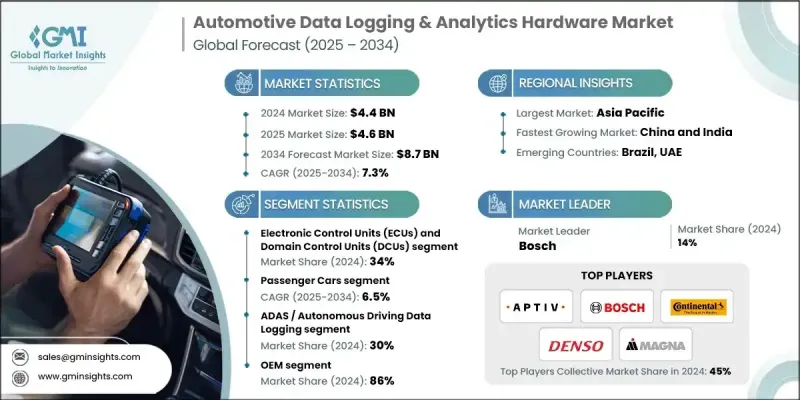
汽車產業正經歷一場由車輛電氣化、自動化和互聯出行驅動的根本變革。這項變革的核心在於對資料記錄和分析硬體日益成長的依賴,這對於提升性能、確保合規性和提高車輛安全至關重要。世界各國政府正在實施更嚴格的法規,要求車輛配備資料記錄系統,以確保透明度和可追溯性。向軟體定義車輛 (SDV) 的轉型正在重塑對能夠處理空中升級、生命週期管理和即時遙測的硬體的需求。遵守全球安全和網路安全標準,例如聯合國歐洲經濟委員會 (UNECE) 的 R155 和 R156 法規,正迫使汽車製造商採用安全、高效能的資料記錄平台。人工智慧和邊緣運算在現代車輛中的快速應用,使得感測器產生的資料能夠更快地進行本地處理。如今,先進的資料記錄系統預計每天能夠捕獲 TB 級的資訊,同時保持超過 1.2 GB/s 的網路吞吐量,並在 30 多個通道之間實現精確同步,這進一步鞏固了它們在汽車生態系統中的關鍵作用。
| 市場範圍 | |
|---|---|
| 起始年份 | 2024 |
| 預測年份 | 2025-2034 |
| 起始值 | 44億美元 |
| 預測值 | 87億美元 |
| 複合年成長率 | 7.3% |
到2024年,電子控制單元(ECU)和域控制單元(DCU)市佔率將達到34%。汽車設計正日益從分散式ECU轉向集中式域架構,以實現資料記錄功能的高階整合。這些系統需要管理多種通訊協定、確保資料安全並快速處理資訊。全球標準下網路安全框架的採用,正在推動配備安全硬體模組、防篡改日誌記錄和認證系統啟動的ECU的部署,以確保資料完整性。
到2024年,ADAS(進階駕駛輔助系統)和自動駕駛數據記錄領域將佔據30%的市場。下一代車輛中先進感測器和即時計算技術的日益整合,正在加速對複雜資料記錄解決方案的需求。自動駕駛和半自動駕駛技術的不斷發展,需要同時對雷達、LiDAR和攝影機系統進行高速、多通道資料收集。這有助於對自動駕駛演算法進行精確分析和驗證,從而支持車輛安全和自動駕駛領域的持續創新。
2024年,中國汽車數據記錄與分析硬體市場佔據了顯著佔有率,這得益於其龐大的汽車生產基地和對智慧互聯的高度重視。政府主導的智慧網聯汽車技術推廣措施強化了即時車輛資料擷取和集中管理的標準。國家智慧汽車發展策略下的各項政策加速了先進數據記錄硬體的部署,確保了車隊的安全合規性、自動化和資料可追溯性。
引領全球汽車數據記錄與分析硬體市場的關鍵企業包括大陸集團、電裝、採埃孚、安波福、現代摩比斯、李爾、博世、麥格納、法雷奧和Vector Informatik。這些領導企業正致力於創新、合作和產品多元化,以鞏固其市場地位。許多企業正在投資開發高速、人工智慧賦能的硬體解決方案,以管理自動駕駛和連網車輛產生的複雜資料流。與汽車製造商和技術提供商的策略合作正在推動即時分析、網路安全和邊緣處理領域的進步。此外,各企業也正在增強研發能力,以設計模組化、可擴展的硬體,從而與不斷發展的軟體定義車輛架構相容。
目錄
第1章:方法論
- 市場範圍和定義
- 研究設計
- 研究方法
- 資料收集方法
- 資料探勘來源
- 全球的
- 地區/國家
- 基準估算和計算
- 基準年計算
- 市場估算的關鍵趨勢
- 初步研究和驗證
- 原始資料
- 預報
- 研究假設和局限性
第2章:執行概要
第3章:行業洞察
- 產業生態系分析
- 供應商格局
- 利潤率分析
- 成本結構
- 每個階段的價值增加
- 影響價值鏈的因素
- 中斷
- 產業影響因素
- 成長促進因素
- ADAS和自動駕駛系統的應用日益普及
- 電動車(EV)和電池管理系統的擴展
- 車隊數位化和預測性維護的日益普及
- 軟體定義車輛 (SDV) 的採用
- 產業陷阱與挑戰
- 先進日誌記錄硬體成本高昂
- 硬體-軟體整合的複雜性
- 市場機遇
- 連網汽車基礎設施的擴展
- 售後改裝解決方案的成長
- 成長促進因素
- 成長潛力分析
- 監管環境
- 北美洲
- 歐洲
- 亞太地區
- 拉丁美洲
- 中東和非洲
- 波特的分析
- PESTEL分析
- 技術與創新格局
- 當前技術趨勢
- 新興技術
- 專利分析
- 永續性和環境方面
- 碳足跡評估
- 循環經濟一體化
- 電子垃圾管理要求
- 綠色製造舉措
- 用例和應用
- 最佳情況
- 價格分析及趨勢
- 歷史價格演變(2019-2024)
- 零件價格通膨的影響
- 半導體短缺對成本的影響
- 批量定價策略
- 區域價格差異
- 未來價格預測(2025-2034 年)
- 全球貿易分析
- 進出口量及價值分析
- 主要出口國
- 主要進口市場
- 貿易流模式及依存關係
- 關稅影響分析
- 供應鏈中斷的影響
- 原料及成分分析
- 半導體材料要求
- 稀土元素依賴性
- 塑膠和金屬外殼材料
- 電池和電源管理組件
- 材料價格波動的影響
第4章:競爭格局
- 介紹
- 公司市佔率分析
- 北美洲
- 歐洲
- 亞太地區
- 拉丁美洲
- MEA
- 主要市場參與者的競爭分析
- 競爭定位矩陣
- 戰略展望矩陣
- 關鍵進展
- 併購
- 合作夥伴關係與合作
- 新產品發布
- 擴張計劃和資金
第5章:市場估算與預測:依組件分類,2021-2034年
- 主要趨勢
- 電子控制單元(ECU)和域控制單元(DCU)
- 車載資訊控制單元 (TCU) 和連接硬體
- 感測器介面和數據採集硬體
- 閘道器和網路硬體
- 其他
第6章:市場估價與預測:依車輛類型分類,2021-2034年
- 主要趨勢
- 搭乘用車
- 掀背車
- 轎車
- SUV
- 商用車輛
- 輕型商用車(LCV)
- 中型商用車(MCV)
- 重型商用車輛(HCV)
第7章:市場估計與預測:依應用領域分類,2021-2034年
- 主要趨勢
- ADAS/自動駕駛資料記錄
- 車隊管理和遠端資訊處理
- 電動車電池管理
- 軟體定義車輛 (SDV) 支持
- 其他
第8章:市場估算與預測:依最終用途分類,2021-2034年
- 主要趨勢
- OEM
- 售後市場
第9章:市場估計與預測:依地區分類,2021-2034年
- 主要趨勢
- 北美洲
- 美國
- 加拿大
- 歐洲
- 德國
- 英國
- 法國
- 義大利
- 西班牙
- 北歐
- 俄羅斯
- 亞太地區
- 中國
- 印度
- 日本
- 澳洲
- 韓國
- 東南亞
- 拉丁美洲
- 巴西
- 墨西哥
- 阿根廷
- MEA
- 南非
- 沙烏地阿拉伯
- 阿拉伯聯合大公國
第10章:公司簡介
- 全球參與者
- Aptiv
- Bosch
- Continental
- Denso
- Harman International (Samsung)
- Lear
- Magna
- Panasonic Automotive Systems
- Valeo
- ZF Friedrichshafen
- 區域玩家
- Geotab
- Vector Informatik
- Verizon Connect
- Webfleet Solutions
- 技術專家和新興企業
- Intrepid Control Systems
- IPETRONIK
- National Instruments
- Samsara
- Spireon
- Trimble
- Asian Market Leaders
- BYD Electronic
- Huawei Technologies
- Hyundai Mobis
- LG Electronics
- Pioneer
- Fleet Management Specialists
- Azuga
- Fleet Complete
- Omnitracs
The Global Automotive Data Logging & Analytics Hardware Market was valued at USD 4.4 Billion in 2024 and is estimated to grow at a CAGR of 7.3% to reach USD 8.7 Billion by 2034.
The automotive industry is undergoing a fundamental transformation driven by vehicle electrification, automation, and connected mobility. At the core of this evolution lies the increasing reliance on data logging and analytics hardware, which is essential for enhancing performance, ensuring compliance, and improving vehicle safety. Governments worldwide are enforcing stricter regulations that require data logging systems in vehicles to ensure transparency and traceability. The transition toward software-defined vehicles (SDVs) is reshaping the demand for hardware capable of handling over-the-air updates, lifecycle management, and real-time telemetry. Compliance with global safety and cybersecurity standards, such as UNECE Regulations R155 and R156, is compelling automakers to adopt secure, high-performance data recording platforms. The rapid adoption of AI and edge computing in modern vehicles allows for faster local processing of sensor-generated data. Advanced data logging systems are now expected to capture terabytes of information daily while maintaining network throughput exceeding 1.2 GB/s and precise synchronization across more than 30 channels, reinforcing their critical role in the automotive ecosystem.
| Market Scope | |
|---|---|
| Start Year | 2024 |
| Forecast Year | 2025-2034 |
| Start Value | $4.4 Billion |
| Forecast Value | $8.7 Billion |
| CAGR | 7.3% |
The Electronic Control Units (ECUs) and Domain Control Units (DCUs) segment held a share of 34% in 2024. Automotive design is increasingly shifting from distributed ECUs to centralized domain architectures that enable advanced integration of data logging features. These systems are required to manage multiple communication protocols, ensure data protection, and process information rapidly. The adoption of cybersecurity frameworks under global standards is encouraging the implementation of ECUs equipped with secure hardware modules, tamper-resistant logging, and authenticated system booting to ensure data integrity.
The ADAS and Autonomous Driving Data Logging segment accounted for a 30% share in 2024. The growing integration of advanced sensors and real-time computing in next-generation vehicles is accelerating demand for sophisticated data logging solutions. The continuous evolution of autonomous and semi-autonomous technologies necessitates high-speed, multi-channel data capture across radar, LiDAR, and camera systems simultaneously. This enables accurate analysis and validation of automated driving algorithms, supporting ongoing innovation in vehicle safety and autonomy.
China Automotive Data Logging & Analytics Hardware Market generated a significant share in 2024, owing to its extensive automotive production base and strong emphasis on intelligent connectivity. Government-led initiatives promoting intelligent and connected vehicle technologies have reinforced standards for real-time vehicle data collection and centralized management. Policies under the national intelligent vehicle development strategy accelerate the deployment of advanced logging hardware, ensuring safety compliance, automation, and data traceability across fleets.
Key companies shaping the Global Automotive Data Logging & Analytics Hardware Market include Continental, Denso, ZF Friedrichshafen, Aptiv, Hyundai Mobis, Lear, Bosch, Magna, Valeo, and Vector Informatik. Leading companies in the Automotive Data Logging & Analytics Hardware Market are focusing on innovation, partnerships, and product diversification to strengthen their market position. Many are investing in developing high-speed, AI-enabled hardware solutions capable of managing complex data streams generated by autonomous and connected vehicles. Strategic collaborations with automakers and technology providers are fostering advancements in real-time analytics, cybersecurity, and edge processing. Companies are also enhancing their R&D capabilities to design modular, scalable hardware compatible with evolving software-defined vehicle architectures.
Table of Contents
Chapter 1 Methodology
- 1.1 Market scope and definition
- 1.2 Research design
- 1.2.1 Research approach
- 1.2.2 Data collection methods
- 1.3 Data mining sources
- 1.3.1 Global
- 1.3.2 Regional/Country
- 1.4 Base estimates and calculations
- 1.4.1 Base year calculation
- 1.4.2 Key trends for market estimation
- 1.5 Primary research and validation
- 1.5.1 Primary sources
- 1.6 Forecast
- 1.7 Research assumptions and limitations
Chapter 2 Executive Summary
- 2.1 Industry 360° synopsis, 2021 - 2034
- 2.2 Key market trends
- 2.2.1 Regional
- 2.2.2 Component
- 2.2.3 Vehicle
- 2.2.4 Application
- 2.2.5 End Use
- 2.3 TAM Analysis, 2025-2034
- 2.4 CXO perspectives: Strategic imperatives
- 2.4.1 Executive decision points
- 2.4.2 Critical success factors
- 2.5 Future outlook and strategic recommendations
Chapter 3 Industry Insights
- 3.1 Industry ecosystem analysis
- 3.1.1 Supplier landscape
- 3.1.2 Profit margin analysis
- 3.1.3 Cost structure
- 3.1.4 Value addition at each stage
- 3.1.5 Factor affecting the value chain
- 3.1.6 Disruptions
- 3.2 Industry impact forces
- 3.2.1 Growth drivers
- 3.2.1.1 Increasing adoption of ADAS and autonomous driving systems
- 3.2.1.2 Expansion of electric vehicles (EVs) and battery management systems
- 3.2.1.3 Growing fleet digitization and predictive maintenance
- 3.2.1.4 Software-defined vehicle (SDV) adoption
- 3.2.2 Industry pitfalls and challenges
- 3.2.2.1 High cost of advanced logging hardware
- 3.2.2.2 Complexity in hardware-software integration
- 3.2.3 Market opportunities
- 3.2.3.1 Expansion of connected vehicle infrastructure
- 3.2.3.2 Growth of aftermarket retrofit solutions
- 3.2.1 Growth drivers
- 3.3 Growth potential analysis
- 3.4 Regulatory landscape
- 3.4.1 North America
- 3.4.2 Europe
- 3.4.3 Asia Pacific
- 3.4.4 Latin America
- 3.4.5 Middle East & Africa
- 3.5 Porter's analysis
- 3.6 Pestel analysis
- 3.7 Technology and innovation landscape
- 3.7.1 Current technological trends
- 3.7.2 Emerging technologies
- 3.8 Patent analysis
- 3.9 Sustainability & environmental aspects
- 3.9.1 Carbon footprint assessment
- 3.9.2 Circular economy integration
- 3.9.3 E-Waste management requirements
- 3.9.4 Green manufacturing initiatives
- 3.10 Use cases and applications
- 3.11 Best-case scenario
- 3.12 Pricing analysis & trends
- 3.12.1 Historical price evolution (2019-2024)
- 3.12.2 Component price inflation impact
- 3.12.3 Semiconductor shortage cost impact
- 3.12.4 Volume pricing strategies
- 3.12.5 Regional price variations
- 3.12.6 Future price projections (2025-2034)
- 3.13 Global trade analysis
- 3.13.1 Import/Export volume & value analysis
- 3.13.2 Major exporting countries
- 3.13.3 Major importing markets
- 3.13.4 Trade flow patterns & dependencies
- 3.13.5 Tariff impact analysis
- 3.13.6 Supply chain disruption effects
- 3.14 Raw Material & component analysis
- 3.14.1 Semiconductor material requirements
- 3.14.2 Rare earth elements dependency
- 3.14.3 Plastic & metal housing materials
- 3.14.4 Battery & power management components
- 3.14.5 Material price volatility impact
Chapter 4 Competitive Landscape, 2024
- 4.1 Introduction
- 4.2 Company market share analysis
- 4.2.1 North America
- 4.2.2 Europe
- 4.2.3 Asia Pacific
- 4.2.4 LATAM
- 4.2.5 MEA
- 4.3 Competitive analysis of major market players
- 4.4 Competitive positioning matrix
- 4.5 Strategic outlook matrix
- 4.6 Key developments
- 4.6.1 Mergers & acquisitions
- 4.6.2 Partnerships & collaborations
- 4.6.3 New product launches
- 4.6.4 Expansion plans and funding
Chapter 5 Market Estimates & Forecast, By Component, 2021 - 2034 ($Mn, Units)
- 5.1 Key trends
- 5.2 Electronic Control Units (ECUs) and Domain Control Units (DCUs)
- 5.3 Telematics Control Units (TCUs) and Connectivity Hardware
- 5.4 Sensor Interface and Data Acquisition Hardware
- 5.5 Gateway and network hardware
- 5.6 Others
Chapter 6 Market Estimates & Forecast, By Vehicle, 2021 - 2034 ($Mn, Units)
- 6.1 Key trends
- 6.2 Passenger Cars
- 6.2.1 Hatchback
- 6.2.2 Sedan
- 6.2.3 SUV
- 6.3 Commercial Vehicles
- 6.3.1 Light Commercial Vehicles (LCV)
- 6.3.2 Medium Commercial Vehicles (MCV)
- 6.3.3 Heavy Commercial Vehicles (HCV)
Chapter 7 Market Estimates & Forecast, By Application, 2021 - 2034 ($Mn, Units)
- 7.1 Key trends
- 7.2 ADAS / Autonomous Driving Data Logging
- 7.3 Fleet management and telematics
- 7.4 EV battery management
- 7.5 Software-Defined Vehicle (SDV) Support
- 7.6 Others
Chapter 8 Market Estimates & Forecast, By End Use, 2021 - 2034 ($Mn, Units)
- 8.1 Key trends
- 8.2 OEM
- 8.3 Aftermarket
Chapter 9 Market Estimates & Forecast, By Region, 2021 - 2034 ($Mn, Units)
- 9.1 Key trends
- 9.2 North America
- 9.2.1 US
- 9.2.2 Canada
- 9.3 Europe
- 9.3.1 Germany
- 9.3.2 UK
- 9.3.3 France
- 9.3.4 Italy
- 9.3.5 Spain
- 9.3.6 Nordics
- 9.3.7 Russia
- 9.4 Asia Pacific
- 9.4.1 China
- 9.4.2 India
- 9.4.3 Japan
- 9.4.4 Australia
- 9.4.5 South Korea
- 9.4.6 Southeast Asia
- 9.5 Latin America
- 9.5.1 Brazil
- 9.5.2 Mexico
- 9.5.3 Argentina
- 9.6 MEA
- 9.6.1 South Africa
- 9.6.2 Saudi Arabia
- 9.6.3 UAE
Chapter 10 Company Profiles
- 10.1 Global Players
- 10.1.1 Aptiv
- 10.1.2 Bosch
- 10.1.3 Continental
- 10.1.4 Denso
- 10.1.5 Harman International (Samsung)
- 10.1.6 Lear
- 10.1.7 Magna
- 10.1.8 Panasonic Automotive Systems
- 10.1.9 Valeo
- 10.1.10 ZF Friedrichshafen
- 10.2 Regional Players
- 10.2.1 Geotab
- 10.2.2 Vector Informatik
- 10.2.3 Verizon Connect
- 10.2.4 Webfleet Solutions
- 10.3 Technology Specialists & Emerging Players
- 10.3.1 Intrepid Control Systems
- 10.3.2 IPETRONIK
- 10.3.3 National Instruments
- 10.3.4 Samsara
- 10.3.5 Spireon
- 10.3.6 Trimble
- 10.4 Asian Market Leaders
- 10.4.1 BYD Electronic
- 10.4.2 Huawei Technologies
- 10.4.3 Hyundai Mobis
- 10.4.4 LG Electronics
- 10.4.5 Pioneer
- 10.5 Fleet Management Specialists
- 10.5.1 Azuga
- 10.5.2 Fleet Complete
- 10.5.3 Omnitracs

 2026年全球汽車資料管理市場報告2026年全球汽車資料處理歷程市場報告
 汽車資料貨幣化市場:按類型、組件、資料來源類型、貨幣化模式、最終用戶、應用、車輛類型和部署模式分類-2026-2032年全球市場預測
 汽車資料處理歷程市場:按車輛類型、應用、最終用戶、部署模式、組件、國家和地區分類 - 全球產業分析、市場規模、市場佔有率和預測(2025-2032 年)
 全球汽車數據管理市場
 汽車數據貨幣化市場機會、成長動力、產業趨勢分析及 2025 - 2034 年預測
 汽車資料收益:市場佔有率分析、產業趨勢與統計、成長預測(2025-2030 年)汽車數據管理市場機會、成長動力、產業趨勢分析與預測 2025 - 2034
 汽車資料收益的成長機會,2024-2030車輛資料收益的生態系活動(2024-2030)