


 |
市場調查報告書
商品編碼
1844361
電子停車煞車 (EPB) 系統市場機會、成長動力、產業趨勢分析及 2025 - 2034 年預測Electronic Parking Brake (EPB) System Market Opportunity, Growth Drivers, Industry Trend Analysis, and Forecast 2025 - 2034 |
||||||

2024 年全球電子停車煞車 (EPB) 系統市場價值為 59 億美元,預計到 2034 年將以 9.1% 的複合年成長率成長至 137 億美元。
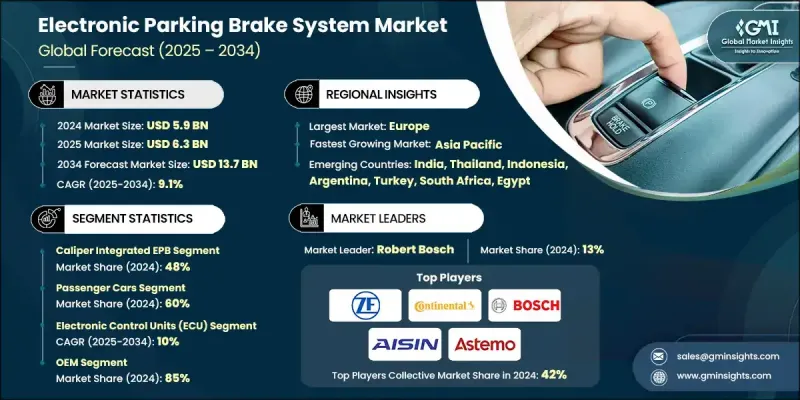
汽車產業對自動化、電氣化和先進安全功能的追求推動了市場成長。電子停車煞車 (EPB) 系統憑藉其增強的性能、最佳化的空間以及與現代駕駛輔助技術的無縫整合,正日益取代傳統的手煞車。汽車製造商正在嵌入 EPB 來支援自動停車、上坡起步輔助和智慧緊急煞車等功能,尤其是在純電動車、混合動力車和插電式混合動力車中。 EPB 與再生煞車和車輛能源系統的兼容性進一步推動了其被納入下一代電動平台。新興車型還配備了緊湊型致動器和無線控制,從而實現了更高的模組化和設計靈活性。隨著全球監管部門對道路安全和智慧煞車的日益重視,EPB 正成為各類車輛的必備部件。此外,軟體控制的煞車功能正在將 EPB 轉變為智慧安全系統,提供即時響應和診斷功能。永續發展趨勢也在影響 EPB 的設計,製造商專注於可回收材料、低能耗組件和減少環境影響,這與全球更廣泛的綠色出行運動保持一致。
| 市場範圍 | |
|---|---|
| 起始年份 | 2024 |
| 預測年份 | 2025-2034 |
| 起始值 | 59億美元 |
| 預測值 | 137億美元 |
| 複合年成長率 | 9.1% |
卡鉗整合式電子停車煞車系統 (EPB) 在 2024 年佔據 48% 的市場佔有率,預計到 2034 年將以 10% 的複合年成長率成長。這種類型的電子停車煞車系統 (EPB) 因其能夠最大程度地減輕系統重量、簡化安裝並比傳統的液壓或拉線機構提供更卓越的性能而廣受青睞。其日益普及反映了業界對高效能緊湊煞車系統架構的偏好。
2024年,乘用車市場佔了60%的市場佔有率,預計到2034年將以9.4%的複合年成長率成長。緊湊型、中型車、轎車和SUV中EPB的普及率不斷提高,正在推動其成長,尤其是在汽車製造商尋求與ADAS平台相契合的先進煞車技術的情況下。由於安全要求的提高以及消費者對日常駕駛舒適性和自動化的需求,北美、亞太和歐洲的監管標準持續加速EPB在該領域的滲透。
2024年,歐洲電子停車煞車 (EPB) 系統市場佔35%的市場佔有率,這得益於配備智慧煞車系統的高階豪華汽車的快速普及。強而有力的政策架構、嚴格的汽車安全基準以及汽車電子領域持續的研發投入,鞏固了歐洲在 EPB 技術方面的領先地位。而向連網汽車、電動平台和自動駕駛解決方案的持續轉變,則進一步鞏固了該地區的主導地位。
塑造全球電子停車煞車 (EPB) 系統市場競爭格局的關鍵參與者包括採埃孚 (ZF Friedrichshafen)、大陸集團 (Continental)、現代摩比斯 (Hyundai Mobis)、萬都 (Mando)、羅伯特·博世 (Robert Bosch)、曙光煞車工業 (Akebono Brake Bustry)、日立阿斯泰莫氏系統 (Hboste)、布雷克諾爾 (Brbo)、Bustry) (Knorr-Bremse) 與愛信精機 (Aisin Seiki)。在電子停車煞車系統市場營運的公司正專注於創新、模組化設計以及與數位車輛平台的整合,以增強其市場影響力。關鍵參與者正在投資軟體驅動的 EPB 解決方案,以支援 ADAS 相容性、自動駕駛功能和電子緊急控制。與原始設備製造商 (OEM) 進行基於平台的開發的策略合作,實現了不同車型之間的無縫整合。
目錄
第1章:方法論
- 市場範圍和定義
- 研究設計
- 研究方法
- 資料收集方法
- 資料探勘來源
- 全球的
- 地區/國家
- 基礎估算與計算
- 基準年計算
- 市場評估的主要趨勢
- 初步研究和驗證
- 主要來源
- 預測模型
- 研究假設和局限性
第2章:執行摘要
第3章:行業洞察
- 產業生態系統分析
- 供應商格局
- 利潤率分析
- 成本結構
- 每個階段的增值
- 影響價值鏈的因素
- 中斷
- 產業衝擊力
- 成長動力
- 向車輛自動化和ADAS轉變
- 汽車平台電氣化(電動車、油電混合車)
- OEM推動輕量化和模組化煞車系統
- 消費者對便利性和安全性的需求
- 線控制動系統的監理要求
- 產業陷阱與挑戰
- 極端條件下的電子可靠性
- 與 ADAS 和 ECU 的整合複雜性
- 市場機會
- 市場和動力系統整合機會
- 與電動和混合動力系統的整合
- 執行器和ECU技術的進步
- 擴展 ADAS 和線控制動平台
- 新興市場和中檔汽車需求不斷成長
- 未來的創新機會
- 先進的整合概念
- 智慧EPB系統開發
- 自動駕駛汽車準備
- 連網汽車整合
- 市場和動力系統整合機會
- 成長潛力分析
- 監管格局
- 波特的分析
- PESTEL分析
- 技術和創新格局
- ESC 和 ABS 整合
- 上坡起步輔助與自動停車功能
- 緊急煞車輔助整合
- ADAS 和自主系統整合
- EPB系統成本結構與價值鏈分析
- 組件成本細分與分析
- 按系統類型分類的製造成本結構
- 整合成本對車輛定價的影響
- 總擁有成本與傳統系統相比
- 價格趨勢
- 按地區
- 按產品
- 生產統計
- 生產中心
- 消費中心
- 匯出和匯入
- 專利分析
- 按技術類別和系統類型分類的有效專利
- EPB技術的專利申請趨勢
- 智慧財產權授權和技術轉移模式
- 專利訴訟風險評估
- 永續性和環境方面
- 永續實踐
- 減少廢棄物的策略
- 生產中的能源效率
- 環保舉措
- 碳足跡考慮
- 投資與融資分析
- 按 EPB 技術類別分類的研發投資
- OEM對EPB系統整合的投資
- 供應商投資和產能擴張
- 政府資助和安全研究項目
- 供應鏈動態和組件整合
- 執行器馬達和驅動組件採購
- 電子控制單元開發生態系統
- 感測器和反饋系統整合
- 軟體開發和驗證流程
- 標準化格局和互通性
- ISO 標準的製定與實施
- SAE國際EPB標準
- 區域標準協調工作
- OEM特定要求和變化
- 案例研究和實施範例
- Tesla EPB整合分析
- 傳統OEM EV EPB策略
- 中國電動車製造商的做法
- 經驗教訓和最佳實踐
- 連網汽車與網路安全整合
- 聯網EPB系統架構
- 網路安全要求和威脅
- 數據分析和服務增強
- EPB系統可靠度與故障模式分析
- 常見故障模式和根本原因
- 可靠性測試和驗證
- 預測性維護和診斷
- 品質保證與控制
- 未來展望與技術顛覆時間表
- 近期中斷(2025-2027)
- 大眾市場 EPB 採用加速
- 電動車整合成熟度
- 基本自主功能整合
- 車連網服務開發
- 中期中斷(2028-2030)
- 先進的自動駕駛汽車整合
- 線控制動技術商業化
- 人工智慧預測性維護
- 整車系統整合
- 長期中斷(2031-2034)
- 全自動車輛 EPB 系統
- 先進材料與製造
- 量子計算整合
- 下一代行動解決方案
- 近期中斷(2025-2027)
- 市場演變情景
- 樂觀的成長前景
- 保守的成長情景
- 中斷場景
第4章:競爭格局
- 介紹
- 公司市佔率分析
- 北美洲
- 歐洲
- 亞太地區
- 拉丁美洲
- 多邊環境協定
- 主要市場參與者的競爭分析
- 競爭定位矩陣
- 戰略展望矩陣
- 關鍵進展
- 併購
- 夥伴關係與合作
- 新產品發布
- 擴張計劃和資金
第5章:市場估計與預測:按系統,2021 - 2034
- 主要趨勢
- 纜索牽引系統
- 電動液壓卡鉗系統
- 卡鉗整合 EPB
- 其他
第6章:市場估計與預測:依車輛分類,2021 - 2034 年
- 主要趨勢
- 搭乘用車
- 掀背車
- 轎車
- SUV
- 商用車
- 輕型商用車
- 中型商用車
- 重型商用車
第7章:市場估計與預測:依組件,2021 - 2034
- 主要趨勢
- 電子控制單元(ECU)
- 執行器
- 感應器
- 開關和線束
- 其他
第 8 章:市場估計與預測:按銷售管道,2021 年至 2034 年
- 主要趨勢
- OEM
- 售後市場
第9章:市場估計與預測:按推進方式,2021 - 2034 年
- 主要趨勢
- 內燃機(ICE)
- 混合動力電動車(HEV/PHEV)
- 純電動車(BEV)
第 10 章:市場估計與預測:按地區,2021 年至 2034 年
- 主要趨勢
- 北美洲
- 美國
- 加拿大
- 歐洲
- 德國
- 英國
- 法國
- 義大利
- 西班牙
- 北歐人
- 俄羅斯
- 葡萄牙
- 克羅埃西亞
- 亞太地區
- 中國
- 印度
- 日本
- 澳洲
- 韓國
- 新加坡
- 泰國
- 印尼
- 拉丁美洲
- 巴西
- 墨西哥
- 阿根廷
- 多邊環境協定
- 南非
- 沙烏地阿拉伯
- 阿拉伯聯合大公國
- 土耳其
- 埃及
第 11 章:公司簡介
- 全球參與者
- Aisin Seiki
- Akebono Brake Industry
- Brembo
- Continental
- Hitachi Astemo
- Mando
- Robert Bosch
- ZF Friedrichshafen
- 區域參與者
- Advics
- BWI
- Chassis Brakes International
- Haldex
- Hyundai Mobis
- Knorr-Bremse
- Nissin Kogyo
- WABCO
- 新興玩家
- Aptiv
- Autoliv
- Denso
- Magna International
- Nexteer Automotive
- Schaeffler
- Tenneco
- Valeo
The Global Electronic Parking Brake (EPB) System Market was valued at USD 5.9 billion in 2024 and is estimated to grow at a CAGR of 9.1% to reach USD 13.7 billion by 2034.
Market growth is propelled by the automotive industry's push toward automation, electrification, and advanced safety features. EPB systems are increasingly replacing traditional handbrakes due to their enhanced performance, space optimization, and seamless integration with modern driver assistance technologies. Automakers are embedding EPBs to support features like auto-hold, hill-start assist, and smart emergency braking, particularly in EVs, hybrids, and plug-in hybrids. Their compatibility with regenerative braking and vehicle energy systems further drives their inclusion in next-gen electric platforms. Emerging models also feature compact actuators and wireless control, allowing for greater modularity and design flexibility. With rising global regulatory emphasis on road safety and intelligent braking, EPBs are becoming essential components across various vehicle categories. In addition, software-controlled braking capabilities are transforming EPBs into smart safety systems, offering real-time responsiveness and diagnostics. Sustainability trends are also influencing EPB design, with manufacturers focusing on recyclable materials, low-energy components, and reduced environmental impact, aligning with the broader green mobility movement worldwide.
| Market Scope | |
|---|---|
| Start Year | 2024 |
| Forecast Year | 2025-2034 |
| Start Value | $5.9 Billion |
| Forecast Value | $13.7 Billion |
| CAGR | 9.1% |
The caliper-integrated EPB segment held a 48% share in 2024 and is expected to grow at a CAGR of 10% through 2034. This type of EPB is widely favored for its ability to minimize overall system weight, simplify installation, and deliver superior performance over traditional hydraulic or cable-pull mechanisms. Its rising adoption reflects industry preference for efficient and compact brake system architectures.
The passenger cars segment held a 60% share in 2024 and is projected to grow at a CAGR of 9.4% through 2034. Increasing implementation of EPBs in compact and mid-size vehicles, sedans, and SUVs is driving growth, particularly as automakers seek advanced braking technologies that align with ADAS platforms. Regulatory standards across North America, Asia-Pacific, and Europe continue to accelerate EPB penetration across this segment due to enhanced safety mandates and consumer demand for comfort and automation in everyday driving.
Europe Electronic Parking Brake (EPB) System Market held a 35% share in 2024, supported by the rapid adoption of premium and luxury vehicles equipped with intelligent braking systems. Strong policy frameworks, stringent automotive safety benchmarks, and ongoing R&D across the vehicle electronics sector have cemented Europe's position at the forefront of EPB technology. The continued shift toward connected vehicles, electrified platforms, and autonomous driving solutions further strengthens the region's dominance.
Key players shaping the competitive landscape in the Global Electronic Parking Brake (EPB) System Market include ZF Friedrichshafen, Continental, Hyundai Mobis, Mando, Robert Bosch, Akebono Brake Industry, Hitachi Astemo, Brembo, Knorr-Bremse, and Aisin Seiki. Companies operating in the electronic parking brake system market are focusing on innovation, modular design, and integration with digital vehicle platforms to strengthen their market presence. Key players are investing in software-driven EPB solutions that support ADAS compatibility, autonomous functionality, and electronic emergency control. Strategic collaborations with OEMs for platform-based development allow for seamless integration across various vehicle models.
Table of Contents
Chapter 1 Methodology
- 1.1 Market scope and definition
- 1.2 Research design
- 1.2.1 Research approach
- 1.2.2 Data collection methods
- 1.3 Data mining sources
- 1.3.1 Global
- 1.3.2 Regional/Country
- 1.4 Base estimates and calculations
- 1.4.1 Base year calculation
- 1.4.2 Key trends for market estimation
- 1.5 Primary research and validation
- 1.5.1 Primary sources
- 1.6 Forecast model
- 1.7 Research assumptions and limitations
Chapter 2 Executive Summary
- 2.1 Industry 360° synopsis, 2021 - 2034
- 2.2 Key market trends
- 2.2.1 Regional
- 2.2.2 System
- 2.2.3 Vehicles
- 2.2.4 Component
- 2.2.5 Sales Channel
- 2.2.6 Propulsion
- 2.3 TAM Analysis, 2025-2034
- 2.4 CXO perspectives: Strategic imperatives
- 2.4.1 Executive decision points
- 2.4.2 Critical success factors
- 2.5 Future outlook and strategic recommendations
Chapter 3 Industry Insights
- 3.1 Industry ecosystem analysis
- 3.1.1 Supplier landscape
- 3.1.2 Profit margin analysis
- 3.1.3 Cost structure
- 3.1.4 Value addition at each stage
- 3.1.5 Factor affecting the value chain
- 3.1.6 Disruptions
- 3.2 Industry impact forces
- 3.2.1.1 Growth drivers
- 3.2.1.2 Shift toward vehicle automation and ADAS
- 3.2.1.3 Electrification of vehicle platforms (EVs, HEVs)
- 3.2.1.4 OEM push for lightweight and modular brake systems
- 3.2.1.5 Consumer demand for convenience and safety
- 3.2.1.6 Regulatory mandates for brake-by-wire systems
- 3.2.2 Industry pitfalls and challenges
- 3.2.2.1 Electronic reliability under extreme conditions
- 3.2.2.2 Integration complexity with ADAS and ECUs
- 3.2.3 Market opportunities
- 3.2.3.1 Market & powertrain integration opportunities
- 3.2.3.1.1 Integration with electric and hybrid powertrains
- 3.2.3.1.2 Advancements in actuator and ECU technologies
- 3.2.3.1.3 Expansion of ADAS and brake-by-wire platforms
- 3.2.3.1.4 Rising demand in emerging markets and mid-range vehicles
- 3.2.3.2 Future innovation opportunities
- 3.2.3.2.1 Advanced integration concepts
- 3.2.3.2.2 Smart EPB system development
- 3.2.3.2.3 Autonomous vehicle preparation
- 3.2.3.2.4 Connected vehicle integration
- 3.2.3.1 Market & powertrain integration opportunities
- 3.3 Growth potential analysis
- 3.4 Regulatory landscape
- 3.5 Porter’s analysis
- 3.6 PESTEL analysis
- 3.7 Technology and innovation landscape
- 3.7.1 ESC & ABS integration
- 3.7.2 Hill start assist & auto hold functions
- 3.7.3 Emergency brake assist integration
- 3.7.4 ADAS & autonomous system integration
- 3.8 EPB system cost structure & value chain analysis
- 3.8.1 Component cost breakdown & analysis
- 3.8.2 Manufacturing cost structure by system type
- 3.8.3 Integration cost impact on vehicle pricing
- 3.8.4 Total cost of ownership vs traditional systems
- 3.9 Price trends
- 3.9.1 By region
- 3.9.2 By product
- 3.10 Production statistics
- 3.10.1 Production hubs
- 3.10.2 Consumption hubs
- 3.10.3 Export and import
- 3.11 Patent analysis
- 3.11.1 Active patents by technology category & system type
- 3.11.2 Patent filing trends in EPB technology
- 3.11.3 IP licensing & technology transfer models
- 3.11.4 Patent litigation risk assessment
- 3.12 Sustainability and environmental aspects
- 3.12.1 Sustainable practices
- 3.12.2 Waste reduction strategies
- 3.12.3 Energy efficiency in production
- 3.12.4 Eco-friendly Initiatives
- 3.12.5 Carbon footprint considerations
- 3.13 Investment & funding analysis
- 3.13.1 R&D investment by EPB technology category
- 3.13.2 OEM investment in EPB system integration
- 3.13.3 Supplier investment & capacity expansion
- 3.13.4 Government funding & safety research programs
- 3.14 Supply chain dynamics & component integration
- 3.14.1 Actuator motor & drive component sourcing
- 3.14.2 Electronic control unit development ecosystem
- 3.14.3 Sensor & feedback system integration
- 3.14.4 Software development & validation processes
- 3.15 Standardization landscape & interoperability
- 3.15.1 ISO standards development & implementation
- 3.15.2 SAE international EPB standards
- 3.15.3 Regional standards harmonization efforts
- 3.15.4 OEM-specific requirements & variations
- 3.16 Case studies & implementation examples
- 3.16.1 Tesla EPB integration analysis
- 3.16.2 Traditional OEM EV EPB strategies
- 3.16.3 Chinese EV manufacturer approaches
- 3.16.4 Lessons learned & best practices
- 3.17 Connected vehicle & cybersecurity integration
- 3.17.1 Connected EPB system architecture
- 3.17.2 Cybersecurity requirements & threats
- 3.17.3 Data analytics & service enhancement
- 3.18 EPB system reliability & failure mode analysis
- 3.18.1 Common failure modes & root causes
- 3.18.2 Reliability testing & validation
- 3.18.3 Predictive maintenance & diagnostics
- 3.18.4 Quality assurance & control
- 3.19 Future outlook & technology disruption timeline
- 3.19.1 Near-term disruptions (2025-2027)
- 3.19.1.1 Mass market EPB adoption acceleration
- 3.19.1.2 Electric vehicle integration Maturity
- 3.19.1.3 Basic autonomous function integration
- 3.19.1.4 Connected vehicle service development
- 3.19.2 Medium-term disruptions (2028-2030)
- 3.19.2.1 Advanced autonomous vehicle integration
- 3.19.2.2 Brake-by-wire technology commercialization
- 3.19.2.3 AI-powered predictive maintenance
- 3.19.2.4 Full vehicle system integration
- 3.19.3 Long-term disruptions (2031-2034)
- 3.19.3.1 Fully autonomous vehicle EPB systems
- 3.19.3.2 Advanced materials & manufacturing
- 3.19.3.3 Quantum computing integration
- 3.19.3.4 Next-generation mobility solutions
- 3.19.1 Near-term disruptions (2025-2027)
- 3.20 Market evolution scenarios
- 3.20.1 Optimistic growth scenario
- 3.20.2 Conservative growth scenario
- 3.20.3 Disruption scenario
Chapter 4 Competitive Landscape, 2024
- 4.1 Introduction
- 4.2 Company market share analysis
- 4.2.1 North America
- 4.2.2 Europe
- 4.2.3 Asia Pacific
- 4.2.4 LATAM
- 4.2.5 MEA
- 4.3 Competitive analysis of major market players
- 4.4 Competitive positioning matrix
- 4.5 Strategic outlook matrix
- 4.6 Key developments
- 4.6.1 Mergers & acquisitions
- 4.6.2 Partnerships & collaborations
- 4.6.3 New Product Launches
- 4.6.4 Expansion Plans and funding
Chapter 5 Market Estimates & Forecast, By System, 2021 - 2034 (USD Mn, Units)
- 5.1 Key trends
- 5.2 Cable-pull systems
- 5.3 Electric-hydraulic caliper systems
- 5.4 Caliper integrated EPB
- 5.5 Others
Chapter 6 Market Estimates & Forecast, By Vehicles, 2021 - 2034 (USD Mn, Units)
- 6.1 Key trends
- 6.2 Passenger cars
- 6.2.1 Hatchbacks
- 6.2.2 Sedans
- 6.2.3 SUVS
- 6.3 Commercial vehicles
- 6.3.1 Light commercial vehicles
- 6.3.2 Medium commercial vehicles
- 6.3.3 Heavy commercial vehicles
Chapter 7 Market Estimates & Forecast, By Component, 2021 - 2034 (USD Mn, Units)
- 7.1 Key trends
- 7.2 Electronic control unit (ECU)
- 7.3 Actuators
- 7.4 Sensors
- 7.5 Switches & wiring harnesses
- 7.6 Others
Chapter 8 Market Estimates & Forecast, By Sales Channel, 2021 - 2034 (USD Mn, Units)
- 8.1 Key trends
- 8.2 OEM
- 8.3 Aftermarket
Chapter 9 Market Estimates & Forecast, By Propulsion, 2021 - 2034 (USD Mn, Units)
- 9.1 Key trends
- 9.2 Internal combustion engine (ICE)
- 9.3 Hybrid electric vehicle (HEV / PHEV)
- 9.4 Battery electric vehicle (BEV)
Chapter 10 Market Estimates & Forecast, By Region, 2021 - 2034 (USD Mn, Units)
- 10.1 Key trends
- 10.2 North America
- 10.2.1 US
- 10.2.2 Canada
- 10.3 Europe
- 10.3.1 Germany
- 10.3.2 UK
- 10.3.3 France
- 10.3.4 Italy
- 10.3.5 Spain
- 10.3.6 Nordics
- 10.3.7 Russia
- 10.3.8 Portugal
- 10.3.9 Croatia
- 10.4 Asia Pacific
- 10.4.1 China
- 10.4.2 India
- 10.4.3 Japan
- 10.4.4 Australia
- 10.4.5 South Korea
- 10.4.6 Singapore
- 10.4.7 Thailand
- 10.4.8 Indonesia
- 10.5 Latin America
- 10.5.1 Brazil
- 10.5.2 Mexico
- 10.5.3 Argentina
- 10.6 MEA
- 10.6.1 South Africa
- 10.6.2 Saudi Arabia
- 10.6.3 UAE
- 10.6.4 Turkey
- 10.6.5 Egypt
Chapter 11 Company Profiles
- 11.1 Global Players
- 11.1.1 Aisin Seiki
- 11.1.2 Akebono Brake Industry
- 11.1.3 Brembo
- 11.1.4 Continental
- 11.1.5 Hitachi Astemo
- 11.1.6 Mando
- 11.1.7 Robert Bosch
- 11.1.8 ZF Friedrichshafen
- 11.2 Regional Players
- 11.2.1 Advics
- 11.2.2 BWI
- 11.2.3 Chassis Brakes International
- 11.2.4 Haldex
- 11.2.5 Hyundai Mobis
- 11.2.6 Knorr-Bremse
- 11.2.7 Nissin Kogyo
- 11.2.8 WABCO
- 11.3 Emerging Players
- 11.3.1 Aptiv
- 11.3.2 Autoliv
- 11.3.3 Denso
- 11.3.4 Magna International
- 11.3.5 Nexteer Automotive
- 11.3.6 Schaeffler
- 11.3.7 Tenneco
- 11.3.8 Valeo

 乘用車電子停車煞車系統市場按分銷管道、推進類型、驅動方式和車輛類型分類 - 全球預測(2026-2032 年)
 汽車電子停車煞車市場規模、佔有率和成長分析(按系統類型、車輛類型、組件、銷售管道和地區分類)-2026-2033年產業預測
 電動駐煞車系統市場報告:趨勢、預測與競爭分析(至2031年)汽車電子式駐煞車系統市場(按車輛類型、傳動系統、技術、組件類型、整合類型、銷售管道和最終用戶)—2025-2032 年全球預測
 2032 年汽車停車煞車桿市場預測:按產品類型、材料、推進系統、車輛、銷售管道和地區進行的全球分析
 全球電子式駐煞車系統(EPB) 系統市場(按類型、車輛等級、零件、車輛類型、電動車類型、銷售管道和地區分類)- 預測至 2032 年
 全球汽車電子式駐煞車系統市場規模:按車輛類型、技術類型、銷售管道和地區 - 預測和範圍
 全球電動駐煞車系統(EPB) 市場