


 |
市場調查報告書
商品編碼
2034855
熱超材料的市場與技術(2026-2046)Thermal Metamaterials: Markets, Technology 2026-2046 |
||||||

本報告說明了熱超材料的發展如何與許多新興趨勢相契合,包括人工智慧資料中心的興起、1kW級微晶片的普及、印度等高溫地區新興經濟體的崛起,以及全球暖化導致製冷需求的顯著成長。熱超材料支持諸如無需移動部件、液體或氣體的固體冷卻,以及不會造成城市升溫的冷卻方式等趨勢。它們也與結構電子學和其他智慧材料的發展趨勢一致,成為「盒裝組件」的替代方案。這正在加速轉向使用價格低廉、日常可用、無毒、不易燃且處置問題極小的材料。具體而言,這些材料包括二氧化矽、矽酮、銅。
極強的多功能性
此外,這些堪稱「熱體操運動員」的材料,能夠實現以往無法實現的應用,例如軍事領域的熱欺騙和熱偽裝。熱超材料在控制熱擴散、熱輻射和熱對流方面展現出前所未有的潛力,幾乎所有產業,包括軍事、航太、時尚、醫療、建築和環境等,都對其需求日益成長。目前,熱超材料已開始銷售,並且得益於穩固的研究基礎,一旦克服一些挑戰,市場需求預計將會激增。例如,低成本的捲對卷印刷和3D列印技術指日可待。此外,由於需要高孔隙率結構,材料的使用量將受到限制。在紅外線控制應用中,對基板性能的要求相對較低,通常只需非常薄的基板即可。
本報告包含 33 個新的資訊圖表、22 條 2026 年至 2046 年的預測線、13 個主要結論、7 個章節、4 個 SWOT 分析以及 2026 年至 2046 年的藍圖。
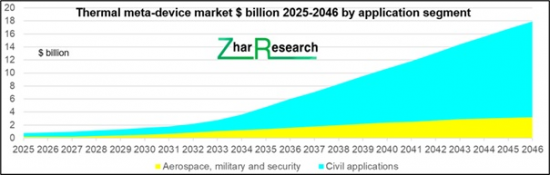
圖註:熱超材料市場(2025-2046 年)-按應用領域分類(不包括操控紅外線的熱超材料):資料來源:Zhar Research 報告《熱超材料:市場、技術 2026-2046》
第1章:執行摘要與結論
- 本報告的目的
- 本報告的調查方法
- 熱功能及其應用
- 市場促進因素與整體情勢
- 分析了從感測器到手術機器人和太空船等廣泛的應用領域。
- 主要結論:市場定位
- 主要結論:關鍵配方、功能與製造技術
- 132項近期熱超材料研究中公式的流行度
- 利用超材料將靜態傳熱轉換為動態傳熱
- 靜態輻射冷卻材料:超材料是眾多選擇之一。
- SWOT分析
- 熱超材料和冷卻技術藍圖(按市場和技術分類)
- 市場預測
- 超材料元件市場:電磁型與熱型(紅外線屬於電磁型範疇)
- 熱超構裝置市場(按應用和細分市場分類)
- 背景市場預測
- 全球冷卻模組市場規模(以7種技術分類)
- 商業產品中地面輻射冷卻性能
- 空調市場規模
- 全球暖通空調、冷藏庫、冷凍庫及其他冷凍設備的市場規模
- 冷藏庫和冷凍庫市場規模
- 用於 6G 通訊基礎設施和客戶端設備的溫度控管材料和結構
- 6G介電和導熱材料的市場規模(按地區分類)
第2章:引言
- 概述
- 超材料溫度控管材料的類型
- 三種超材料的重疊
- 導致冷氣需求增加的因素
- 空調需求增加以及未來需求的變化
- 傳統蒸氣壓縮冷卻技術的不足以及固體冷卻技術的進步
- 希望在電動車中取消液冷系統,並採用固體太陽能板。
- 對微晶片冷卻提出了新的嚴格要求
- 6G通訊領域對散熱材料的需求不斷成長
- 電子和資訊通訊技術領域新的冷卻挑戰和機遇
- 冷卻技術轉變為智慧材料的趨勢(2026-2046 年)
- 熱超材料的最大潛力在於冷卻
- 超導性熱超材料的潛力
- 溫度響應型和溫度可控型超材料
- 廣泛使用和提案的不良材料:新進入者的機會
第3章:熱超材料的原理與功能
- 概述
- 物理學基礎
- 2026 年新理論方法與新應用的實例
- 目前商業上最先進的超材料溫度控管材料領域和類型
- 三種超材料的重疊
- 2026 年及以前熱超材料結構的範例
- 熱超材料和超表面的SWOT分析
- 商業性重要的功能
- 熱輻射超材料、先進光學冷卻、過熱預防。
- 超高導熱係數的熱超材料
- 熱對流超材料
- 多模態熱超材料
- 熱隱身斗篷、熱偽裝、熱集中器、熱二極體、熱膨脹器、熱旋轉器、超材料
- 熱隱身斗篷和熱偽裝
- 熱集中器
- 熱二極體
- 熱膨脹器
- 熱旋轉器
- 多功能熱超材料,包括 2024 年至 2025 年的案例研究。
- 熱超材料的潛力在未來將繼續擴大。
第4章:下一階段:主動式、動態式和可調式熱超材料
- 概述
- 4D列印與熱超材料的多重耦合
- 電化學的應用
- 進展和目標用途範例
- 可調式液固混合熱超材料
- 靜態和動態熱超材料整合
- 環境溫度感測與回應
- 先進的熱輻射裝置:兼具隱蔽性能及溫度控管能力
- 主動遙感和熱偽裝
- 電動車電池中熱通量和熱流方向動態控制的可能性
- 自適應輻射冷卻和被動溫度控制
- 熱機械超材料
- 概述
- 可程式設計機械熱超材料
第5章 熱超材料的製造技術與材料
- 概述(包括需求、方法、材料以及積層製造和加工選項)
- 積層製造。
- 熱超構裝置的3D列印
- 熱超構裝置的金屬3D列印
- 利用金屬聚合物和金屬石墨烯進行熱超構裝置的3D列印
- 熱超結構中的功能梯度材料
- 其他材料選擇
- 用於製造可操控紅外線輻射的層狀熱超材料的印刷技術
- 利用熱超材料進行PDRC的材料與製造技術
第6章:熱超材料的眾多應用實例與研究進展(2025-2026)
- 概述:應用範圍廣泛,從感測器到手術機器人和太空船。
- 小型偏振發光器
- 從電腦到航太工程:熱傳遞
- 溫室和窗戶
- 利用熱超材料進行能源採集的進展
- 熱金屬透鏡
- 微晶片冷卻
- 太陽能發電冷凍
- 衛星熱控
- 電子設備的熱封裝
- 冷卻纖維
- 由於採用了熱超材料,熱電發電和冷卻裝置的性能得到了改善。
- 恆溫器、無能耗恆溫器、負能耗恆溫器、多溫區維護容器
- 車輛冷卻塗料
第7章 利用超材料的被動式日間輻射冷卻(PDRC)
- SWOT分析/概述
- 基於熱超材料的輻射冷卻及其替代方案的比較
- 一種利用半透明熱超材料的方法,將於2024年實現:圖案化PDMS
- 利用熱超材料製造的透明PDRC,適用於外牆、太陽能板和窗戶
- 對具有纖維素基發電和其他輻射冷卻功能的穿戴式超織物進行SWOT分析
- 採用超材料PDRC冷卻表面增強熱電發電機性能
- 其他關於超材料輻射冷卻的研究(2024年起)
- 超材料冷卻技術的商業化
- Radi-Cool(日本/馬來西亞)
- SRI USA
- PDRC:最新報告,包括超材料的替代方案
Summary
The new Zhar Research report, “Thermal Metamaterials : Markets, Technology 2026-2046” explains how thermal metamaterials follow many major trends emerging. They include the need for much more cooling, due to arriving AI datacenters, 1kW microchips, emerging countries in hotter locations such as India, and global warming. Thermal metamaterials support the trend to solid-state cooling without moving parts, liquids or gases and to cooling that does not heat cities. They follow the trend to structural electronics and other smart materials replacing components-in-a-box. They take us towards the use of affordable everyday materials, non-toxic, non-flammable and with minimal disposal issues. Think silicas, silicones, silicon, copper.
Astonishing versatility
In addition, these thermal gymnasts can perform the previously-impossible such as military thermal spoofing and camouflage. They exhibit unprecedented potential for governing heat diffusion, radiation and convection – yes, all three. Thermal metamaterials are therefore sought in most industry sectors - military, aerospace, fashion, medical, construction, environmental and more. Sales have commenced and they will surge as certain issues are overcome, thanks to the robust research pipeline. For example, low-cost reel-to-reel printing and 3D printing are in the frame. Necessarily highly-voided structures limit amounts used. Substrate characteristics for infrared handling are often relatively non-critical and can be very thin.
Your guide to commercial success
Commercially-oriented, the 305-page report, “Thermal Metamaterials : Markets, Technology 2026-2046” has 33 new infograms, 22 forecast lines 2026-2046, 13 primary conclusions, seven chapters, four SWOT appraisals and there are roadmaps for 2026-2046.
The Executive Summary and Conclusions (35 pages) is sufficient in itself for those with limited time. Here are the definitions, basics, conclusions and forecasts. The Chapter 2. Introduction (40 pages) explains metamaterials, temperature responsive and controlling versions, the burgeoning need for cooling, and how undesirable materials widely used and proposed are an opportunity for you to replace them. Understand the thermal metamaterial gymnastics including cloak, concentrator, rotator, camouflage, thermal illusion and enhanced and redirected conduction, convection and radiation.
Chapter 3. Thermal Metamaterial Principles and Functions (52 pages) dives into these basics in detail with new advances in theory and practice, mainly in 2025 and 2026, and evidence that there is much more ahead. Examples are thermal expanders, thermally radiative metamaterials, advanced photonic cooling and prevention of heating, ultra-conductive thermal metamaterials, thermal convective metamaterials and multimodal versions with multifunctional ones – for example doubling as windows – coming along. This naturally leads to Chapter 4. The Next Stage: Active, Dynamic and Tunable Thermal Metamaterials (20 pages). This includes unified static and dynamic versions and programmable mechanical-thermal metamaterials arriving.
Chapter 5. Manufacturing Technologies and Materials for Thermal Metamaterials (25 pages) introduces needs, approaches, materials, merits of additive vs subtractive manufacture and evidence of the many manufacturing technologies currently employed including 4D printing and photolithography. Learn how conventional heat management necessitates 3D thermal metamaterial structures but infrared manipulation trends to 2D printing reel-to-reel. Also covered are materials and manufacturing technologies for Passive Daylight Radiation Cooling PDRC using thermal metamaterials.
Chapter 6. Many Targetted Applications of Thermal Metamaterials with Research Advances 2025-6 (55 pages) is impressively broad. It includes sensors, surgical robots, spacecraft, information-rich thermal radiation meta-emitters, computers, aerospace engineering, greenhouses, windows, energy harvesting, thermal metalenses, microchip thermoelectrics and solar panel cooling, satellite thermal control, thermal packaging of electronics and textiles that cool. Much is new in 2026 and the report is constantly updated so, vitally, you get the latest.
The report closes with Chapter 7. Passive Daytime Radiative Cooling (PDRC) Using Metamaterials (60 pages) because this is a particularly strong focus for this technology. See PDRC basics, hype curve, SWOT, appraisal of latest research and company advances and products offered.
CAPTION: Thermal meta-device market $ billion 2025-2046 by application segment. Thermal metamaterials manipulating infrared are excluded. Source: Zhar Research report, “Thermal Metamaterials : Markets, Technology 2026-2046”.
1. Executive summary and conclusions
- 1.1 Purpose of this report
- 1.2 Methodology of this analysis
- 1.3 Thermal functions and applications
- 1.3.1 Market drivers and general situation
- 1.3.2 Applications analysed from sensors to surgical robots and spacecraft
- 1.4 Primary conclusions; market positioning
- 1.5 Primary conclusions: leading formulations, functionality and manufacturing technologies
- 1.6 Popularity by formulation in 132 examples of latest thermal metamaterial research
- 1.7 Static to dynamic heat transfer using metamaterials
- 1.8 Static radiative cooling materials showing metamaterials as one of many options
- 1.9 SWOT appraisals
- 1.9.1 SWOT of thermal metamaterials, metasurfaces and meta-devices
- 1.9.2 SWOT appraisal of Passive Daytime Radiative Cooling PDRC
- 1.9.3 SWOT appraisal of self-cooling radiative metafabric
- 1.10 Thermal metamaterial and cooling roadmap by market and by technology 2026-2046
- 1.11 Market forecasts as tables and graphs 2026-2046 in 22 lines including 1.12, tables, graphs, explanation
- 1.11.1 Meta-device market electromagnetic vs thermal with infrared in electromagnetic category $ billion 2025-2046
- 1.11.2 Thermal meta-device market $ billion 2025-2046 by application segment
- 1.12 Background market forecasts as tables and graphs 2026-2046
- 1.12.1 Cooling module global market by seven technologies $ billion 2025-2046
- 1.12.2 Terrestrial radiative cooling performance in commercial products W/sq. m 2025-2046
- 1.12.3 Air conditioner value market $ billion 2024-2046
- 1.12.4 Global market for HVAC, refrigerators, freezers, other cooling $ billion 2025-2046
- 1.12.5 Refrigerator and freezer value market $ billion 2024-2046
- 1.12.6 Thermal management material and structure for 6G Communications infrastructure and client devices $ billion if 6G is successful 2026-2046
- 1.12.7 Dielectric and thermal materials for 6G value market % by location 2029-2046
2. Introduction
- 2.1 Overview
- 2.2 Types of metamaterial thermal management materials
- 2.3 Three families of metamaterials overlap
- 2.4 Cooling needs increase for many reasons 2026-2046
- 2.4.1 Escalation of demand for air conditioning and forthcoming changes in requirement
- 2.4.2 Problems of traditional vapor compression cooling and progress to solid state cooling
- 2.4.3 Desire to eliminate liquid cooling for electric vehicles and solid-state cool solar panels
- 2.4.4 Severe new microchip cooling requirements arriving
- 2.4.5 Much greater need for thermal materials in 6G Communications
- 2.4.6 Other cooling problems and opportunities emerging in electronics and ICT
- 2.5 How cooling technology will trend to smart materials 2026-2046
- 2.6 Cooling is the largest potential for thermal metamaterials
- 2.7 The potential for ultra-conductive thermal metamaterials
- 2.8 Temperature responsive and controlling metamaterials
- 2.9 Undesirable materials widely used and proposed: this is an opportunity for you
3. Thermal metamaterial principles and functions
- 3.1 Overview
- 3.2 Basis in physics
- 3.3 Examples of new theoretical approaches in 2026 leading to new applications
- 3.4 Types of metamaterial thermal management materials with the currently most commercialised sectors
- 3.5 How three families of metamaterials overlap
- 3.6 Examples of thermal metamaterial structures in 2026 and earlier advances
- 3.7 SWOT assessment for thermal metamaterials and metasurfaces
- 3.8 Commercially important functions
- 3.8.1 Thermally radiative metamaterials, advanced photonic cooling and prevention of heating
- 3.8.2 Ultra-conductive thermal metamaterials
- 3.8.3 Thermal convective metamaterials
- 3.8.4 Multimodal thermal metamaterials
- 3.9 Thermal cloak, camouflage, concentrator, diode, expander, rotator metamaterials
- 3.9.1 Introduction
- 3.9.2 Thermal cloaks and camouflage
- 3.9.3 Thermal concentrators
- 3.9.4 Thermal diodes
- 3.9.5 Thermal expanders
- 3.9.6 Thermal rotators
- 3.10 Multifunctional thermal metamaterials with examples from 2024-5
- 3.11 Far more options for thermal metamaterials ahead
4. The next stage: Active, dynamic and tunable thermal metamaterials
- 4.1 Overview
- 4.2 4D printing and multi-coupling of thermal metamaterials
- 4.3 Use of electrochemistry
- 4.4 Examples of progress and target applications
- 4.4.1 Tunable liquid-solid hybrid thermal metamaterials
- 4.4.2 Unified static and dynamic thermal metamaterials
- 4.4.3 Sensing and responding to ambient temperatures
- 4.4.4 Advanced thermal radiation devices: stealth with thermal management
- 4.4.5 Active remote sensing and thermal camouflage
- 4.4.6 Dynamic control of heat flux and heat flow direction possibly for electric vehicle batteries
- 4.4.7 Adaptive radiative cooling and passive thermoregulation
- 4.5 Thermal-mechanical metamaterials
- 4.5.1 Overview
- 4.5.2 Programmable mechanical-thermal metamaterials
5. Manufacturing technologies and materials for thermal metamaterials
- 5.1 Overview including needs, approaches, materials and additive vs subtractive options
- 5.2 Additive manufacturing design, fabrication, property and application
- 5.3 3D printing of thermal meta-devices
- 5.3.1 Metal 3D printing of thermal meta-devices
- 5.3.2 Metal polymer and metal graphene 3D printing of thermal meta-devices
- 5.3.3 Functionally graded materials in thermal meta-structures
- 5.3.4 Other materials options
- 5.4 Printing technologies for laminar thermal metamaterials manipulating infrared radiation
- 5.5 Materials and manufacturing technologies for Passive Daylight Radiation Cooling PDRC using thermal metamaterials
6. Many targeted applications of thermal metamaterials with research advances 2025-6
- 6.1 Overview: applications from sensors to surgical robots and spacecraft
- 6.2 Compact polarised light emitters
- 6.3 Computers to aerospace engineering: heat transfer
- 6.4 Greenhouses and windows
- 6.5 Energy harvesting advances using thermal metamaterials in
- 6.6 Metalens – thermal
- 6.7 Microchip cooling
- 6.8 Photovoltaics cooling
- 6.9 Satellite thermal control
- 6.10 Thermal packaging of electronics
- 6.11 Textiles that cool
- 6.12 Thermoelectric harvesters and coolers enhanced by thermal metamaterials
- 6.13 Thermostats energy-free thermostat and negative-energy and multi-temperature maintenance container
- 6.14 Vehicle cooling paint
7. Passive daytime radiative cooling (PDRC) using metamaterials
- 7.1 Overview with SWOT appraisal
- 7.2 Radiative cooling based on thermal metamaterials compared to alternatives
- 7.3 Approach using translucent thermal metamaterials in 2024: patterned PDMS
- 7.4 Transparent PDRC for facades, solar panels and windows using thermal metamaterials
- 7.5 Cellulosic power generating and other radiative cooling wearable meta-fabrics with SWOT appraisal
- 7.6 Metamaterial PDRC cold side boosting power of thermoelectric generators in
- 7.7 Other metamaterial radiative cooling research 2024 and
- 7.8 Commercialisation of metamaterial cooling
- 7.8.1 Radi-Cool Japan, Malaysia
- 7.8.2 SRI USA
- 7.9 PDRC including beyond the metamaterial options – new report

 空間低溫冷卻設備市場報告:趨勢、預測與競爭分析(至2035年)
 全球蒸汽室市場預測(至2034年)-按類型、材料、應用、最終用戶和地區分類的分析散熱器市場預測至2034年-按產品類型、材質、製造流程、冷卻技術、應用和地區分類的全球分析
 熱導板:全球市場熱電冷卻器市場:按類型、設計、溫度範圍、最終用戶、國家和地區分類-全球產業分析、市場規模、市場佔有率及2026年至2033年預測先進導熱界面材料市場預測至2034年-全球材料類型、基體材料、填充材、導熱係數、形狀、應用、終端用戶產業和地區分析
 溫度控管市場:全球市場預測,2026-2032年
 溫度控管技術:市場佔有率分析、產業趨勢與統計、成長預測(2026-2031)熱電冷卻器市場-2026-2032年全球市場預測HBM中的溫度控管和TIM:市場佔有率分析、行業趨勢和統計數據以及成長預測(2026-2031年)